
 100% FREE ACCESS
10th Standard CBSE Syllabus & Materials
10th Standard CBSE
CBSE 10th Social Science ECO - Globalisation and the Indian Economy - New Model Questions Papers Study Material - QB365 Set A
NEW10th Standard CBSE
CBSE 10th Social Science ECO - Money and Credit - New Model Questions Papers Study Material - QB365 Set A
NEW10th Standard CBSE
CBSE 10th Social Science ECO - Sectors of the Indian Economy - New Model Questions Papers Study Material - QB365 Set A
NEW10th Standard CBSE
CBSE 10th Social Science ECO - Development - New Model Questions Papers Study Material - QB365 Set A
NEW10th Standard CBSE
CBSE 10th Social Science PS - Outcomes of Democracy - New Model Questions Papers Study Material - QB365 Set A
NEW10th Standard CBSE
CBSE 10th Social Science PS - Gender, Religion and Caste - New Model Questions Papers Study Material - QB365 Set A

Published on: 20/10/2025
Download CBSE Class 10th Standard CBSE Maths question papers, sample papers, important questions, and previous year solved papers in PDF format. Get free study materials, NCERT solutions, and exam preparation resources for Class 10th Standard CBSE Maths
Questions + Answers key
Take MCQ Maths Test
1.
Find the value of
4 tan 45°+\(\sqrt{3}\) cot 60°+3 sin2 60°+ tan 30°cot 45°
2.
Given, sin A \(=\frac{3}{5}\) find the other trigonometric ratios of the angle A.
3.
Prove that \(\frac{\cot A-\cos A}{\cot A+\cos A}=\frac{\operatorname{cosec} A-1}{\operatorname{cosec} A+1}\)
4.
Find a quadratic polynomial each with the given numbers as the sum and product of its zeroes respectively.
\(-\frac{1}{4}, \frac{1}{4}\)
5.
Evaluate
\(\frac { 3\tan ^{ 2 }{ { 30 }^{ ° } } +\tan ^{ 2 }{ { 60 }^{ ° }+cosec{ 30 }^{ ° }-\tan { { 45 }^{ ° } } } }{ \cot ^{ 2 }{ { 45 }^{ ° } } } \)
6.
Find p, the mean of the given data is 15.45.
| Class interval | 0-6 | 6-12 | 12-18 | 18-24 | 24-30 |
|---|---|---|---|---|---|
| Frequency | 6 | 8 | p | 9 | 7 |
7.
If \(\cot { \theta } =\frac { 15 }{ 8 } ,\) find the value of \(\frac { (2+2\sin { \theta } )(1-\sin { \theta } ) }{ (1+\cos { \theta } )(2-2\cos { \theta } ) } .\)
8.
If the equation px2+4x-3=0 has real roots, then find the value of p.
9.
If the elevation of the sun is 30o . Find the length of the shadow cast by a tower of height 150 feet.
10.
Find the roots of the following quadratic equation by fractorisation: 2x2+x-6=0
11.
The following table gives the literacy rate (in percentage) of 35 cities. Find the mean literacy rate.
| Literacy rate (in %) | 45-55 | 55-65 | 65-75 | 75-85 | 85-95 |
|---|---|---|---|---|---|
| Number of cities | 3 | 10 | 11 | 8 | 3 |
12.
Prove the following identities, where the angles involved are acute angles for which the expressions are defined.
\(\frac { \cos { A } -\sin { A } +1 }{ \cos { A } +\sin { A } -1 } =cosecA+\cot { A } \) using the identity \({ cosec }^{ 2 }A=1+\cot ^{ 2 }{ A } \)
13.
Five years hence, father's age will be three times the age of his son. Five years ago, father was seven times as old as his son. Find their present ages,
14.
From a point on the ground, the angles of elevation of the bottom and the top of a transmission tower fixed at the top of a 20 m high building are 45° and 60°. Find the height of the tower.
15.
Find the solution of the following system of equation by substitution method
2x-7y=11,6x-21y=3
16.
The mean of the following distribution is 53. Find the missing frequency p :
| Class | 0-20 | 20-40 | 40-60 | 60-80 | 80-100 |
| Frequency | 12 | 15 | 32 | p | 13 |
17.
Prove that : \(\frac { \cos { A } }{ 1+\tan { A } } -\frac { \sin { A } }{ 1+\cot { A } } =\cos { A } -\sin { A } \)
18.
Prove that \(\frac { \sin { \theta } -\cos { \theta } +1 }{ \sin { \theta } +\cos { \theta } -1 } =\frac { 1 }{ \sec { \theta } -\tan { \theta } } \) using the identity \(\sec ^{ 2 }{ \theta } =1+\tan ^{ 2 }{ \theta } .\)
19.
A ladder of length 6 m makes an angle of 45o with the floor while leaning against one wall of a room. If the foot of the ladder is kept fixed on the floor and it is made to lean against the opposite wall of the room, it makes an angle of 60o with the floor. Find the distance between these two walls of the room.
20.
If cot A = \(\sqrt{3}\) then sec2 A - cos2 A is equal to ________
21.
The value of \(\frac{\cos 45^{\circ}}{\sec 30^{\circ}+\operatorname{cosec} 30^{\circ}}\) is ___________
22.
A quadratic equation can have maximum ____ zeroes.
23.
The value of k is___________for which the system of linear equation kx + 4y = k - 4; 16x + ky = k has infinitely many solutions.
24.
The height of a tower is 10m.The height of its shadow when sun's altitude is 450 , is ...........
25.
The quadratic equation \(2x^{2} + 5\sqrt {3} x + 6 = 0\) has .................. roots.
26.
The quadratic equation \(x^{2} - 10 x + 2 = 0\) has ........... roots.
27.
If tan A = cot B, then A + B = 60°.
28.
Trigonometric ratios are same for the same angles.
29.
(x - 2) (x + 1) = (x - 1) (x + 3) represent a quadratic equation.
30.
In the given figure, graph of a polynomial f(x) is shown. The number of zeroes of polynomial f(x) is
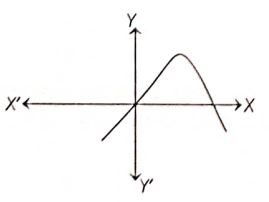
3
1
0
2
31.
\(\frac{1+\tan ^{2} A}{1+\cot ^{2} A}=\)
sec2 A
–1
cot2 A
tan2 A
32.
9 sec2 A – 9 tan2 A =
1
9
8
0
33.
\(\frac{2 \tan 30^{\circ}}{1+\tan ^{2} 30^{\circ}}\)=
sin 60°
cos 60°
tan 60°
sin 30°
34.
The roots of quadratic equation are 2x2+3x-9 = 0 are
-1.5 and -3
1.5 and -3
1.5 and 3
-1.5 and 3
35.
If the equation px2 – 6x – 2 = 0 has real roots then, ________
p ≥ -9/2
p > -9/2
p < -9/2
p ≤ -9/2
36.
The value/s of x when (x – 4) (3x + 2) = 0 ________
4, -2/3
-4, – 2/ 3
4, 2/3
-4, 2/3
37.
If 3cot A=4, then find cos2 A – sin2 A
25/7
1/25
22/7
7/25
38.
Which of the following is defined?
cot 0°
cosec 90°
tan 90°
sec 90°
39.
The value of cosec2 30° sin2 45° – sec2 60° is
2
1
-2
0
40.
Simplify \(\frac { 1+cot\quad A }{ sin\quad A } +\frac { sin\quad A }{ 1+cos\quad A } \)
2 sec A
2 cosec A
2 sin A
2 cos A
41.
If the pair of equation has no solution, then the pair of equation is
inconsistent
none of these
coincident
consistent
42.
Find the zero of a linear polynomial ax + b
-b/a
a/b
b/a
-a/b
43.
If one root of the equation (p + q)2 x2 – 2 (p + q) x + k =0 is 5/p+q , then k is
15
50
-15
-50
44.
The number of polynomials having zeroes -2 and 5 is:
1
3
2
more than 3
45.
If sun’s elevation is 60° then a pole of height 6 m will cast a shadow of length
3√2 m
2√3 m
6√3 m
√3 m
46.
A kite is flying at a height of 75 metres from the ground level, attached to a string inclined at 60° to the horizontal. The length of the string to the nearest metre is
55 m
87 m
100 m
60 m
47.
If the height and length of the shadow of a man are the same, then the angle of elevation of the sun is
60°
45°
30°
15°
48.
Which of the following is rational?
√3 + √5
√4 + √9
√2 + √4
√6 + √9
49.
Which of the following is not the graph of a quadratic polynomial?
-q.png)
-q.png)
-q.png)
-q.png)
1.
\(\frac{29 \sqrt{3}+1}{4 \sqrt{3}}\)
2.
\(\cos A=\frac{4}{5}, \tan A=\frac{3}{4}, \operatorname{cosec} A=\frac{5}{3}, \sec A=\frac{5}{4}, \cot A=\frac{4}{3}\)
3.
\(L H S=\frac{\cot A-\cos A}{\cot A+\cos A}=\frac{\frac{\cos A}{\sin A}-\cos A}{\frac{\cos A}{\sin A}+\cos A}\)
\(=\frac{\cos A\left(\frac{1}{\sin A}-1\right)}{\cos A\left(\frac{1}{\sin A}+1\right)}=\frac{\left(\frac{1}{\sin A}-1\right)}{\left(\frac{1}{\sin A}+1\right)}=\frac{\operatorname{cosec} A-1}{\operatorname{cosec} A+1}=\operatorname{RHS}\)
4.
\(-\frac{1}{4}, \frac{1}{4}\)
Let the quadratic polynomial be ax2 + bx + c, and its zeroes be α + ß
Given \(\alpha+\beta=-\frac{1}{4}=-\frac{b}{a}\)
\(\alpha \beta=\frac{1}{4}=\frac{c}{a}\)
If a = 4, b = 1, c = 1
Therefore, the quadratic polynomial is 4x2 + x +1.
5.
\(\frac { 3\tan ^{ 2 }{ { 30 }^{ ° } } +\tan ^{ 2 }{ { 60 }^{ ° }+cosec{ 30 }^{ ° }-\tan { { 45 }^{ ° } } } }{ \cot ^{ 2 }{ { 45 }^{ ° } } } \)
\(=\frac { 3\times { \left( \frac { 1 }{ \sqrt { 3 } } \right) }^{ 2 }+{ \left( \sqrt { 3 } \right) }^{ 2 }+2-1 }{ { \left( 1 \right) }^{ 2 } } \)
\(=\frac { 3\times \frac { 1 }{ 3 } +3+2-1 }{ 1 } \)
= 1 + 3 + 2 - 1
= 5
6.
10
7.
\(\cot { \theta } =\frac { 15 }{ 8 } \)
8.
\(p\ge -\frac { 4 }{ 3 } \)
9.
\(150 \sqrt {3} \ feet\)
10.
Given equation is 2x2 + x - 6 = 0
\(\Rightarrow\) 2x2 + 4x - 3x - 6 = 0
[\(\because\) 4 \(\times\)(-3) = -12 and 4 - 3 = 1]
\(\Rightarrow\) 2x (x + 2) -3 (x + 2) = 0
\(\Rightarrow\) (x + 2)(2x - 3) = 0
\(\Rightarrow\) x + 2 = 0 or 2x - 3 = 0
\(\Rightarrow\) x = -2 or \(x=\frac{3}{2}\)
Hence, the roots of the equation
2x2 + x - 6 = 0 are -2 and \(\frac{3}{2}\)
11.
To find the class marks, the following relation is used.
\(x_{i}=\frac{\text { Upper class limit + Lower class limit }}{2}\)
Class size (h) for this data = 10
Taking 70 as assumed mean (a), di, ui, and fiui are calculated as follows.
| Literacy rate (in %) |
Number of cities fi |
xi | di = xi − 70 | ui = di/10 | fiui |
| 45-55 | 3 | 50 | -20 | -2 | -6 |
| 55-65 | 10 | 60 | -10 | -1 | -10 |
| 65-75 | 11 | 70 | 0 | 0 | 0 |
| 75-85 | 8 | 80 | 10 | 1 | 8 |
| 85-95 | 3 | 90 | 20 | 2 | 6 |
| Total | 35 | -2 |
From the table, we obtain
\(\sum f_{i}=35 \)
\(\sum f_{i} u_{i}=-2 \)
\(\text { Mean } \bar{x}=a+\left(\frac{\sum f_{i} u_{i}}{\sum f_{i}}\right) \times h\)
\(=70+\left(-\frac{2}{35}\right) \times(10) \)
\(=70-\frac{20}{35} \)
\(=70-\frac{4}{7}\)
= 70 - 0.57
= 69.43
Therefore, mean literacy rate is 69.43%.
12.
LHS = \(\frac { \cos { A } -\sin { A } +1 }{ \cos { A } +\sin { A } -1 } \)
On dividing numerator and denominator by sin A, we get
\(=\frac { \frac { \cos { A } }{ \sin { A } } -\frac { \sin { A } }{ \sin { A } } +\frac { 1 }{ \sin { A } } }{ \frac { \cos { A } }{ \sin { A } } +\frac { \sin { A } }{ \sin { A } } -\frac { 1 }{ \sin { A } } } =\frac { \cot { A } -1+cosecA }{ \cot { A } +1-1cosecA } \) \(\left[ \because \cot { A } =\frac { \cos { \theta } }{ \sin { \theta } } and\frac { 1 }{ \sin { \theta } } =cosec \theta \right] \)
\(=\frac { \cot { A } +cosecA-1 }{ \cot { A } +1-1cosecA } \)
\(=\frac { (\cot { A } +cosecA)-({ cosec }^{ 2 }A-\cot ^{ 2 }{ A } ) }{ \cot { A } +1-1cosecA } \left[ \because 1={ cosec }^{ 2 }A-\cot ^{ 2 }{ A } \right] \)
\(=\frac { (\cot { A } +cosecA)-\left[ (\cot { A } +cosecA)(\cot { A } -cosecA) \right] }{ \cot { A } +1-1cosecA } \) \(\left[ \because \quad { a }^{ 2 }-{ b }^{ 2 }=(a+b)(a-b) \right] \)
\(=\frac { (\cot { A } +cosecA)-\left[ 1-(cosecA-\cot { A } ) \right] }{ \cot { A } +1-1cosecA } \)
\(\quad =\frac { (\cot { A } +cosecA)-\left[ 1-cosecA+\cot { A } \right] }{ \cot { A } +1-1cosecA } \)
\(=cosecA+\cot { A } =RHS\)
Hence proved.
13.
40 years, 10 years
14.
Let BC be the building, AB be the transmission tower and D be the point on the ground from where the angles of elevations are to be measured.
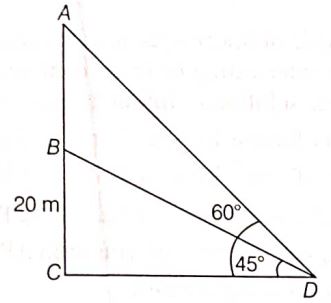
\(\begin{array}{rlrl}
\text { In } \triangle B C D, & \tan 45^{\circ} =\frac{B C}{C D} \\
\end{array}\)
\(\begin{array}{rlrl}
\Rightarrow 1 =\frac{20}{C D} \Rightarrow C D=20 \mathrm{~m}
\end{array}\)
\(\begin{array}{llrl}
\text { In } \triangle A C D, & \tan 60^{\circ} =\frac{A C}{C D}
\end{array}\)
\(\begin{array}{llrl}
\Rightarrow \sqrt{3} =\frac{A B+B C}{C D} \\
\end{array}\)
\(\begin{array}{llrl}
\Rightarrow \sqrt{3} =\frac{A B+20}{20} \\
\end{array}\)
\(\Rightarrow A B =20 \sqrt{3}-20=20(\sqrt{3}-1) \mathrm{m}\)
Thus, the height of the tower is \(20(\sqrt{3}-1) \mathrm{m}\).
15.
Given, equations are 2x - 7y = 11 ...(i)
and 6x - 21y = 33 ...(ii)
From Eq. (i), \(y=\frac{2 x-11}{7}\)
Then, from Eq. (ii), \(6 x-21\left(\frac{2 x-11}{7}\right)=33\)
\(\Rightarrow \quad 6 x-6 x+33=33 \Rightarrow 33=33\)
This equality is true for all values of x, therefore given pair of equations have infinitely many solutions.
16.
| xi(Class marks) | fi | fixi |
| 10 | 12 | 120 |
| 30 | 15 | 450 |
| 50 | 32 | 1600 |
| 70 | p | 70 p |
| 90 | 13 | 1179 |
| Total | \(\Sigma f_{ i }=72+p\) | \(\Sigma f_{ i }u_{ i }=3340+70p\) |
Mean \(\overset { - }{ x } =\frac { \Sigma f_{ i }u_{ i } }{ \Sigma f_{ i } } \)
\(\Rightarrow 53=\frac { 3340+70p }{ 72+p } \)
\(\Rightarrow 3340+70p=53(72+p)\)
\(\Rightarrow 3340+70p=3816-3340\)
\(\Rightarrow 70p-53p=3816-3340\)
\(\Rightarrow 17p=476\)
\(p=\frac { 476 }{ 17 } =28\)
17.
\(LHS=\frac { \cos { A } }{ 1+\tan { A } } -\frac { \sin { A } }{ 1+\cot { A } } \)
\(=\frac { \cos { A } }{ 1+\frac { \sin { A } }{ \cos { A } } } -\frac { \sin { A } }{ 1+\frac { \cos { A } }{ \sin { A } } } \)
\(=\frac { \cos ^{ 2 }{ A } }{ \cos { A } +\sin { A } } -\frac { \sin ^{ 2 }{ A } }{ \sin { A+\cos { A } } } \)
\(=\frac { \cos ^{ 2 }{ A-\sin ^{ 2 }{ A } } }{ \left( \sin { A+\cos { A } } \right) } \)
\(=\frac { \left( \cos { A } +\sin { A } \right) \left( \cos { A } -\sin { A } \right) }{ \sin { A+\cos { A } } } \)
\(=\cos { A } -\sin { A } \)
= RHS
18.
Since we will apply the identity involving sec \(\theta\) and tan \(\theta\), let us first convert the LHS (of the identity we need to prove) in terms of sec \(\theta\) and tan \(\theta\) by dividing numerator and denominator by cos \(\theta\).
\(\begin{aligned} \text { LHS } & =\frac{\sin \theta-\cos \theta+1}{\sin \theta+\cos \theta-1}=\frac{\tan \theta-1+\sec \theta}{\tan \theta+1-\sec \theta} \\ \end{aligned}\)
\(\begin{aligned} & =\frac{(\tan \theta+\sec \theta)-1}{(\tan \theta-\sec \theta)+1}=\frac{\{(\tan \theta+\sec \theta)-1\}(\tan \theta-\sec \theta)}{\{(\tan \theta-\sec \theta)+1\}(\tan \theta-\sec \theta)} \\ \end{aligned}\)
\(\begin{aligned} & =\frac{\left(\tan ^2 \theta-\sec ^2 \theta\right)-(\tan \theta-\sec \theta)}{\{\tan \theta-\sec \theta+1\}(\tan \theta-\sec \theta)} \\ \end{aligned}\)
\(\begin{aligned} & =\frac{-1-\tan \theta+\sec \theta}{(\tan \theta-\sec \theta+1)(\tan \theta-\sec \theta)} \end{aligned}\)
\(=\frac{-1}{\tan \theta-\sec \theta}=\frac{1}{\sec \theta-\tan \theta}\)
which is the RHS of the identity, we are required to prove.
19.
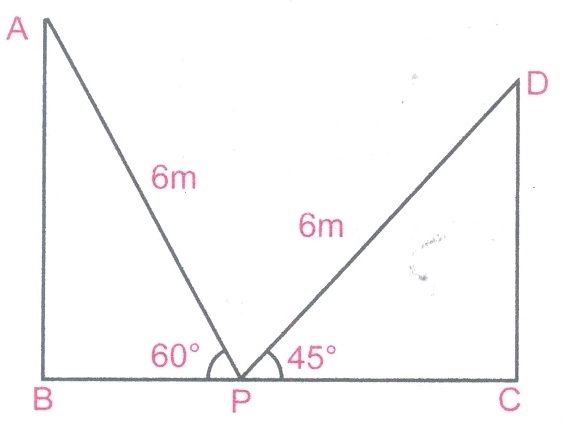
Let AP and DP be the position of the ladder whose length is 6 m.
In rt.ΔABP, \(\frac { BP }{ AP } =cos60^{ 0 }\Rightarrow \frac { BP }{ 6 } =\frac { 1 }{ 2 } \)
⇒ BP=1/2 x 6=3m
In rt, ΔDCP, \(\frac { PC }{ DP } =cos45^{ 0 }=\frac { PC }{ 6 } =\frac { 1 }{ \sqrt { 2 } } \)
⇒ PC=\(\frac { 6 }{ \sqrt { 2 } } \times \frac { \sqrt { 2 } }{ \sqrt { 2 } } =\frac { 6\sqrt { 2 } }{ 2 } =3\sqrt { 2 } m\)
Distance between two walls
=BP+PC=3+3\(\sqrt { 2 } \)
=3+3 x 1.41
=3(1+1.41)=7.23 m
20.
()
\(\frac{7}{12} ; \text { We have, } \cot A=\sqrt{3} \Rightarrow A=30^{\circ}\)
sec2 A - cos2 A = sec2 30 - cos2 30
\(=\left(\frac{2}{\sqrt{3}}\right)^{2}-\left(\frac{\sqrt{3}}{2}\right)^{2}=\frac{4}{3}-\frac{3}{4}\)
\(=\frac{16-9}{12}=\frac{7}{12}\)
21.
()
\(\frac{3-\sqrt{3}}{4 \sqrt{2}} ; \frac{\cos 45^{\circ}}{\sec 30^{\circ}+\operatorname{cosec} 30^{\circ}}=\frac{1 / \sqrt{2}}{2 / \sqrt{3}+2}\)
\(=\frac{\sqrt{3}}{\sqrt{2}(2+2 \sqrt{3})}=\frac{\sqrt{3}}{2 \sqrt{2}(1+\sqrt{3})}\)
\(=\frac{\sqrt{3}(\sqrt{3}-1)}{2 \sqrt{2}(3-1)}=\frac{3-\sqrt{3}}{4 \sqrt{2}}\)
22.
()
2
23.
()
k =28
24.
()
10m
25.
()
Real and distinct
26.
()
Real and distinct
[ \(\because\) discriminant = \(b^{2} - 4ac\)
= \((-10)^{2} - 4 \times 1 \times 2\)
= 100 - 8
= 92 > 0 ]
27.
(b)
28.
(a)
29.
(b)
30.
(d)
2
31.
(d)
tan2 A
32.
(b)
9
33.
(a)
sin 60°
34.
(b)
1.5 and -3
35.
(a)
p ≥ -9/2
36.
(a)
4, -2/3
37.
(d)
7/25
38.
(b)
cosec 90°
39.
(c)
-2
40.
(b)
2 cosec A
41.
(a)
inconsistent
42.
(a)
-b/a
43.
(b)
50
44.
(d)
more than 3
45.
(b)
2√3 m
46.
(b)
87 m
47.
(b)
45°
48.
(b)
√4 + √9
49.
(d)

10th Standard CBSE Syllabus & Materials
10th Standard CBSE
CBSE 10th Social Science PS - Federalism - New Model Questions Papers Study Material - QB365 Set A
NEW10th Standard CBSE
CBSE 10th Social Science PS - Power Sharing - New Model Questions Papers Study Material - QB365 Set A
NEW10th Standard CBSE
CBSE 10th Social Science GEO - Manufacturing Industries - New Model Questions Papers Study Material - QB365 Set A
NEW10th Standard CBSE
CBSE 10th Social Science GEO - Minerals and Energy Resources - New Model Questions Papers Study Material - QB365 Set A



NCERT Books

Syllabus

Exam Pattern

Sample Question Papers

Previous year Question Papers

Important Notes

MCQ Practice test

NCERT Exemplers

Case study Questions

Image Based Questions

Passage based Questions

HOT Questions

Value Based Questions

Model Questions Papers
NCERT ( Book Back ) Questions

Assertion and Reason
Important Questions And Answers

CBSE 10th Standard CBSE Subjects
CBSE Standards



