
 100% FREE ACCESS
10th Standard CBSE Syllabus & Materials
10th Standard CBSE
CBSE 10th Social Science ECO - Globalisation and the Indian Economy - New Model Questions Papers Study Material - QB365 Set A
NEW10th Standard CBSE
CBSE 10th Social Science ECO - Money and Credit - New Model Questions Papers Study Material - QB365 Set A
NEW10th Standard CBSE
CBSE 10th Social Science ECO - Sectors of the Indian Economy - New Model Questions Papers Study Material - QB365 Set A
NEW10th Standard CBSE
CBSE 10th Social Science ECO - Development - New Model Questions Papers Study Material - QB365 Set A
NEW10th Standard CBSE
CBSE 10th Social Science PS - Outcomes of Democracy - New Model Questions Papers Study Material - QB365 Set A
NEW10th Standard CBSE
CBSE 10th Social Science PS - Gender, Religion and Caste - New Model Questions Papers Study Material - QB365 Set A

Published on: 20/10/2025
Download CBSE Class 10th Standard CBSE Maths question papers, sample papers, important questions, and previous year solved papers in PDF format. Get free study materials, NCERT solutions, and exam preparation resources for Class 10th Standard CBSE Maths
Questions + Answers key
Take MCQ Maths Test
1.
Find the zeroes of the following quadratic polynomials and verify the relationship between the zeroes and the coefficients.
4u2 + 8u
2.
Solve the following pair of linear equations by the substitution method
s - t = 3
\(\\ \frac { s }{ 3 } +\frac { t }{ 2 } =6\)
3.
Prove that \(3+2\sqrt { 5 } \) is irrational.
4.
Find two consecutive positive integers, sum of whose squares in 365.
5.
Solve the following pair of linear equations by the elimination method and the substitution method :
3x - 5y - 4 = 0 and 9x = 2y + 7
6.
Find the zeroes of quadratic polynomial y2+92y+1920.
7.
The HCF of two numbers is 113 and their LCM is 56952. If one number is 904, find the other number.
8.
An express train takes 1 hour less than a passenger train to travel 132 km between Mysore and Bengaluru (without taking into consideration the time they stop at intermediate stations). If the average speed of the express train is 11 km/h more than that of the passenger train, find the average speed of the two trains.
9.
On comparing the ratios \(\frac{a_{1}}{a_{2}}, \frac{b_{1}}{b_{2}} and \frac{c_{1}}{c_{2}}\) find out whether the following pair of linear equations are consistent, or inconsistent.
\(\frac{4}{3} x+2 y=8 ; 2 x+3 y=12\)
10.
Find the LCM and HCF of the following pairs of integers and verify that LCM x HCF = Product of the two numbers.
510 and 92
11.
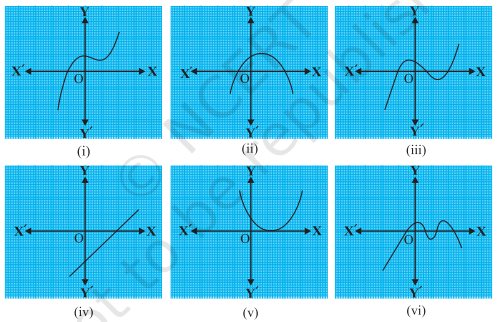
Look at the graphs in Fig. given below. Each is the graph of y = p(x), where p(x) is a polynomial. For each of the graphs, find the number of zeroes of p(x)
12.
Is it possible to design a rectangular mango grove whose length is twice its breadth, and the area is 800m2? If, so, find its length and breadth
13.
The quadratic polynomial, the sum of whose zeroes is -5 and their product is 6, is
x2 + 5x + 6
x2 - 5x + 6
x2 - 5x - 6
-x2 + 5x + 6
14.
If α and β are the zeroes of the polynomial x2 - 1, then the value of α + ß is
2
1
-1
0
15.
If x = -2 is a root of equation x2 – 4x + K = 0 then value of K is
-8
8
-12
12
16.
The pair of linear equations 8x – 5y = 7 and 5x – 8y = -7 have
One solution
Two solutions
Many solutions
No solution
17.
What is the HCF of 161 and 303?
1
11
13
3
18.
If x and y are odd positive integers then x2 + y2 is-
even
odd or even
multiple of 2 and 4
odd
19.
Mr Manoj Jindal arranged a lunch party for some of his friends. The expense of the lunch are partly constant and partly proportional to the number of guests. The expenses amount to Rs 650 for 7 guests and Rs 970 for 11 guests .
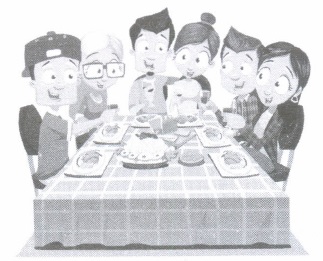
Denote the constant expense by Rs x and proportional expense per person by Rs y and answer the following questions.
(i) Represent both the situations algebraically.
| (a) x + 7y = 650, x + 11y = 970 | (b) x - 7y = 650, x - 11y = 970 |
| (c) x+ 11y=650,x+7y=970 | (d) 11x + 7y = 650, 11x - 7y = 970 |
(ii) Proportional expense for each person is
| (a) Rs 50 | (b) Rs 80 | (c) Rs 90 | (d) Rs 100 |
(iii) The fixed (or constant) expense for the party is
| (a) Rs 50 | (b) Rs 80 | (c) Rs 90 | (d) Rs 100 |
(iv) If there would be 15 guests at the lunch party, then what amount Mr Jindal has to pay?
| (a) Rs 1500 | (b) Rs 1300 | (c) Rs 1200 | (d) Rs 1290 |
(v) The system of linear equations representing both the situations will have
| (a) unique solution | (b) no solution |
| (c) infinitely many solutions | (d) none of these |
1.
Let p(u) = 4u2 + 8u = 4u(u+2)
To find zeroes, put p(u) = 0
\(\Rightarrow\) 4u(u+2) = 0 \(\Rightarrow\) u = 0 or u + 2 = 0 [\(\because\) 4 \(\neq\)0]
\(\Rightarrow\) u = 0 or u = -2
Hence, zeroes of the given polynonial are 0 and -2.
Verification
Here, sum of zeroes = 0 - 2 = -2 = -(8/4)
=-\(\frac{Coefficient \quad of \quad u}{Coefficient \quad of \quad u^{2}}\)
and product of zeroes
=0 \(\times\)-2 = 0 = (0/4) = \(\frac{Constant \quad term}{Coefficient \quad of \quad u^{2}}\)
so, the relationship between the zeroes and its coefficients is verified.
2.
Given, a pair of linear equations is :
s - t = 3
\(\Rightarrow\) s = t + 3 ....(i)
and \(\frac { s }{ 3 } +\frac { t }{ 2 } =6\) ...(ii)
On substituting s = t + 3, from egn. (i) in eqn. (ii),
we get
\(\\ \frac { t+3 }{ 3 } +\frac { t }{ 2 } =6\)
\(\Rightarrow\) 2(t + 3) + 3t = 36
\(\Rightarrow\) 5t + 6 = 36
\(\Rightarrow\) 5t = 30
\(\Rightarrow\) t = 6
From eqn., (i), s = 6 + 3 = 9
Hence, s = 9, t = 6
3.
Let us assume to the contrary that \(3+2\sqrt { 5 } \) is a rational number. Then, it can be expressed in the form \(\frac{a}{b}\), where a, b are coprime integers and \(b\neq 0\)
Now, \(3+2\sqrt { 5 } \) = a/b, where a,b are integers and \(b\neq 0\)
On rearranging, we get
\(2\sqrt { 5 } =\frac { a }{ b } -3\quad or\quad \sqrt { 5 } =\frac { a }{ 2b } -\frac { 3 }{ 2 } \)
Since, a, b are integers and \(b\neq 0\) , therefore \(\frac{a}{2b}\) is rational number and so \(\frac{a}{2b}\) - \(\frac{3}{2}\) is a rational number.
[since, difference of two rational numbers is also a rational number]
\(\Rightarrow \sqrt { 5 } \) is a rational number. But \(\sqrt { 5 } \) is an irrational number.
This shows that our assumption is incorrect.
So, \(3+2\sqrt { 5 } \) is irrational.
4.
Let the two consecutive integers be x and x+1
ATQ x2+(x+1)2=365
\(\Rightarrow\) x2+x2+2x+1=365 \(\Rightarrow\) 2x2+2x-364=0
\(\Rightarrow\) x2+x-182=0 \(\Rightarrow\) x2+14x-13x-182=0
\(\Rightarrow\) x(x+14)-13(x+14)=0 \(\Rightarrow\) (x-13)(x+14)=0
\(\Rightarrow\) x=13, -14 (-14 is rejected because it is a negative integer)
Hence, the two consecutive positive integers are 13 and 13+1=14
5.
By elimination method:
Given, 3x - 5y = 4 .....(i)
and 9x = 2y + 7 ......(ii)
On multiplying eqn. (i) by 3 and eqn. (ii) by 1,
9x -15y = 12 ......(iii)
9x - 2y = 7 .......(iv)
On subtracting eqn. (iv) from eqn. (iii),
(9x - 15y) - (9x - 2y) = 12 - 7
\(\Rightarrow\) -15y + 2y = 5
\(\Rightarrow\) -13y = 5
\(\therefore \quad y=-\frac { 5 }{ 13 } \)
On substituting y = \(\\ \\ \frac { -5 }{ 13 } \) in eqn. (i),
\(3x-5\left( \frac { -5 }{ 13 } \right) =4\)
\(\Rightarrow\) 39x + 25 = 52
\(\Rightarrow\) 39x = 27
\(\therefore \quad x=\frac { 9 }{ 13 } \)
Hence \(x=\frac { 9 }{ 13 }\) and \( \ y=-\frac { 5 }{ 13 } \)
By substitution method:
Given, 3x - 5y = 4 ....(i)
and 9x = 2y + 7 ....(ii)
From eqn. (ii), 2y = 9x - 7
\(\Rightarrow \quad y=\frac { 9x-2 }{ 2 } \) ....(iii)
On substituting y from eqn. (iii) in eqn. (i),
\(3x-5\times \left( \frac { 9x-7 }{ 2 } \right) =4\)
\(\Rightarrow\) 6x - 45x + 35 = 8
\(\Rightarrow\) -39x = -27
\(\therefore \quad x=\frac { 9 }{ 13 } \)
On substituting x = \(\frac { 9 }{ 13 } \) in eqn. (iii),
\(y=\frac { 9\times \frac { 9 }{ 13 } -7 }{ 2 } \)
\(=\frac { 81-91 }{ 2\times 13 } \)
\(=-\frac { 10 }{ 26 } \)
\(\therefore \quad y=-\frac { 5 }{ 13 } \)
Hence, \(\\ x=\frac { 9 }{ 13 } \) and \( \ y=-\frac { 5 }{ 13 } \)
6.
Let p(y)=y2+92y+1920=(y+32)(y+60)
Now, for zeroes of p(y), put p(y)=0
Zeroes y=-32, -60
7.
Given, HCF = 113, LCM = 56952 and one number = 904
Let another number = x
\(\therefore \quad HCF=\frac { x\times 904 }{ LCM } \)
\(\Rightarrow \quad 113=\frac { x\times 904 }{ 56952 } \)
\(\Rightarrow \quad x=\frac { 113\times 56952 }{ 904 } =7119\)
8.
Let the speed of the passenger train be x km/hr. Then,
Speed of the express train = (x + 11)km/hr
Time taken by the passenger train to cover 132 km between Mysore to Bangalore \(\frac{132}{x} \mathrm{hr}\)
Time taken by the express train to cover 132 km between Mysore to Bangalore = \(=\frac{132}{x+11} \mathrm{hr}\)
Therefore,
\( \frac{132}{x}-\frac{132}{x+11}=1 \)
\( \frac{132(x+11)-132 x}{x(x+11)}=1 \)
\(\frac{132 x+1452-132 x}{x^{2}+11}=1 \)
\(\frac{1452}{x^{2}+11}=1 \)
1452 = x2 + 11
x2 + 11 - 1452 = 0
x2 - 33x + 44x - 1452 = 0
x(x - 33) + 44(x - 33) = 0
(x - 33)(x + 44) = 0
So, either
x - 33 = 0
x = 33
Or
x + 44 = 0
x = -44
But, the speed of the train can never be negative.
Thus, when x = 33 then speed of express train
= x + 11
= 33 + 11
= 44
e speed of the passenger train is x = 33 km/hr
and the speed of the express train is x = 44 km/hr respectively.
9.
\(\frac{4}{3} x+2 y=8 ; 2 x+3 y=12\)
Here,\(\frac{a_{1}}{a_{2}}=\frac{4}{3 \times 2}=\frac{2}{3}, \frac{b_{1}}{b_{2}}=\frac{2}{3}, \frac{c_{1}}{c_{2}}=\frac{-8}{-12}=\frac{2}{3}\)
\(\because \quad \frac{a_{1}}{a_{2}}=\frac{b_{1}}{b_{2}}=\frac{c_{1}}{c_{2}}\)
\(\therefore\) Pair of equations is consistent with infinitely many solutions.
10.
510 and 92
510 = 2 x 255
= 2 x 3 x 85
= 2 x 3 x 5 x 17
= 2 x 3 x 5 x 17 x 1
Therefore 510 = 2 x 3 x 5 x 17 x 1 .....(A)
92 = 2 x 46
= 2 x 2 x 23
Hence 92 = 2 x 2 x 23 .....(B)
From (A) and (B) HCF of 510 and 92 is = 2 and their
LCM is 2 x 2 x 3 x 5 x 17 x 23 = 23460
Product of the LCM and HCF = 2 x 23460 = 46920
Product of the two numbers = 510 x 92 = 46920
Therefore it is proved that LCM x HCF = Product of the two numbers.
11.
(i) The number of zeroes is 1 as the graph intersects the x-axis at one point only.
(ii) The number of zeroes is 2 as the graph intersects the x-axis at two points.
(iii) The number of zeroes is 3. (Why?)
(iv) The number of zeroes is 1. (Why?)
(v) The number of zeroes is 1. (Why?)
(vi) The number of zeroes is 4. (Why?)
12.
Let breadth of a rectangular mango grove be x m
Then, length of a rectangular mango grove = 2x m
According to the question,
Area of rectangular mango grove = 800 m2
\(\Rightarrow\) 2x(x) = 800 [\(\because\) Area = length \(\times\) breadth]
\(\Rightarrow\) 2x2 = 800 \(\Rightarrow\) x2 = 400
\(\Rightarrow\) x = \(\pm\)20
But, x = -20 is not possible because breadth can never be negative. so, x = 20.
Thus, length = 2x = 40 m and breadth = 20 m.
13.
(a)
x2 + 5x + 6
14.
(d)
0
15.
(c)
-12
16.
(a)
One solution
17.
(a)
1
18.
(a)
even
19.
(i) (a): 1st situation can be represented as x + 7y = 650 ...(i) and
2nd situation can be represented as x + 11y = 970 ...(ii)
(ii) (b): Subtracting equations (i) from (ii), we get
\(4 y=320 \Rightarrow y=80\)
\(\therefore\) Proportional expense for each person is Rs 80.
(iii) (c): Puttingy = 80 in equation (i), we get
x + 7 x 80 = 650 \(\Rightarrow\) x = 650 - 560 = 90
\(\therefore\) Fixed expense for the party is Rs 90
(iv) (d): If there will be 15 guests, then amount that Mr Jindal has to pay = Rs (90 + 15 x 80) = Rs 1290
(v) (a): We have a1 = 1, b1 = 7, c1 = -650 and
\(a_{2}=1, b_{2}=11, c_{2}=-970 \)
\(\therefore \frac{a_{1}}{a_{2}}=1, \frac{b_{1}}{b_{2}}=\frac{7}{11}, \frac{c_{1}}{c_{2}}=\frac{-650}{-970}=\frac{65}{97}\)
\(\text { Here, } \frac{a_{1}}{a_{2}} \neq \frac{b_{1}}{b_{2}} \neq \frac{c_{1}}{c_{2}}\)
Thus, system of linear equations has unique solution.

10th Standard CBSE Syllabus & Materials
10th Standard CBSE
CBSE 10th Social Science PS - Federalism - New Model Questions Papers Study Material - QB365 Set A
NEW10th Standard CBSE
CBSE 10th Social Science PS - Power Sharing - New Model Questions Papers Study Material - QB365 Set A
NEW10th Standard CBSE
CBSE 10th Social Science GEO - Manufacturing Industries - New Model Questions Papers Study Material - QB365 Set A
NEW10th Standard CBSE
CBSE 10th Social Science GEO - Minerals and Energy Resources - New Model Questions Papers Study Material - QB365 Set A



NCERT Books

Syllabus

Exam Pattern

Sample Question Papers

Previous year Question Papers

Important Notes

MCQ Practice test

NCERT Exemplers

Case study Questions

Image Based Questions

Passage based Questions

HOT Questions

Value Based Questions

Model Questions Papers
NCERT ( Book Back ) Questions

Assertion and Reason
Important Questions And Answers

CBSE 10th Standard CBSE Subjects
CBSE Standards



