
 100% FREE ACCESS
10th Standard CBSE Syllabus & Materials
10th Standard CBSE
CBSE 10th Social Science ECO - Globalisation and the Indian Economy - New Model Questions Papers Study Material - QB365 Set A
NEW10th Standard CBSE
CBSE 10th Social Science ECO - Money and Credit - New Model Questions Papers Study Material - QB365 Set A
NEW10th Standard CBSE
CBSE 10th Social Science ECO - Sectors of the Indian Economy - New Model Questions Papers Study Material - QB365 Set A
NEW10th Standard CBSE
CBSE 10th Social Science ECO - Development - New Model Questions Papers Study Material - QB365 Set A
NEW10th Standard CBSE
CBSE 10th Social Science PS - Outcomes of Democracy - New Model Questions Papers Study Material - QB365 Set A
NEW10th Standard CBSE
CBSE 10th Social Science PS - Gender, Religion and Caste - New Model Questions Papers Study Material - QB365 Set A

Published on: 20/10/2025
Download CBSE Class 10th Standard CBSE Maths question papers, sample papers, important questions, and previous year solved papers in PDF format. Get free study materials, NCERT solutions, and exam preparation resources for Class 10th Standard CBSE Maths
Questions + Answers key
Take MCQ Maths Test
1.
A pole has to be erected at a point on the boundary of a circular park of diameter 13 metres in such a way that the differences of its distances from two diametrically opposite fixed gates A and B on the boundary is 7 metres. Is it possible to do so? If yes, at what distances from the two gates should the pole be erected?
2.
Find the dimensions of the prayer hall whose carpet area is 300 square metres and whose length is 1 metre more than twice its breadth. R
3.
Find the roots of the equation 2x2 - 5x + 3 = 0, by factorisation.
4.
Represent the following situations in the form of quadratic equations :
The area of a rectangular plot is 528 m2. The length of the plot (in meters) is one more than twice its breadth. We need to find the length and breadth of the plot.
5.
Find the values of k for each of the following quadratic equation, so that they have two equal roots \(kx(x-2)+6=0\)
6.
Find the values of k for each of the following quadratic equation, so that they have two equal roots \(2x^{ 2 }+kx+3=0\)
7.
Find the roots of the following quadratic equations by the factorisation.
\(x^{ 2 }-3x-10=0\)
8.
Represent the following situations mathematically:
John and Jivanti together have 45 marbles. Both of them lost 5 marbles each, and the product of the number of marbles they now have is 124. We would like to find out how many marbles they had to start with.
9.
Check whether the following are quadratic equations:
(i) (x – 2)2 + 1 = 2x – 3
(ii) x(x + 1) + 8 = (x + 2) (x – 2)
(iii) x (2x + 3) = x2 + 1
(iv) (x + 2)3 = x3 – 4
10.
A quadratic equation can have maximum ____ zeroes.
11.
The nature of the roots of the quadratic equation x2 + 2x + 3 = 0 is _______
12.
The positive value of k is _______ for which the quadratic equation 4x2 - 2kx + k = 0 has equal roots
13.
The quadratic equation ax2 + bx + c = 0, a \(\neq\) 0 has two distinct real roots, if _______
14.
______ is called discriminant of the quadratic equation ax2 + bx + c = 0, a \(\neq\) 0.
15.
An equation of the form ax2 + bx + c = 0 is called ______ equation in variable x, where a, band c are real numbers and a \(\neq\) 0
16.
If \(b^{2} - 4ac \ge 0,\) then quadratic equation \(ax^{2}+bx+c = 0\) has ................ roots.
17.
Any quadratic equation can be expressed as product of two ........... factors.
18.
If p(x) is quadratic polynomial, then p(x) = 0 is called a .............. equation.
19.
\(x = \alpha\) is a root of quadratic equation \(ax^{2} + bx + c = 0\) if and only if .................. .
20.
The value of k for which the quadratic equation \(9x^{2} - 24x + k = 0\) is ................. .
21.
The discriminant of quadratic equation \(x^{2}+ax+ b = 0\) is .................... .
22.
The quadratic equation \(2x^{2} + 5\sqrt {3} x + 6 = 0\) has .................. roots.
23.
The linear factors of the quadratic equation \(100^{2}-20x+1 = 0\) are ............. and .................. .
24.
The quadratic equation \(x^{2} - 10 x + 2 = 0\) has ........... roots.
25.
For the quadratic equation \(x^{2} + 4x + b = 0\) , the discriminant D = ................... .
26.
If the given quadratic equation \(2x^{2}+2x + p = 0\) has equal roots, then p = ..................
1.
Let P be the required location of the pole. Let the distance of the pole from the gate B be x m, i.e., BP = x m. Now the difference of the distances of the pole from the two gates = AP - BP (or, BP - AP) = 7 m.
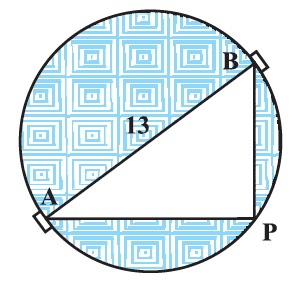
Therefore, AP = (x + 7) m.
Now, AB = 13m, and since AB is a diameter,
∠APB = 90°
Therefore, AP2 + PB2 = AB2 (By Pythagoras theorem)
i.e., (x + 7)2 + x2 = 132
i.e., x2 + 14x + 49 + x2 = 169
i.e., 2x2 + 14x - 120 = 0
So, the distance ‘x’ of the pole from gate B satisfies the equation
x2 + 7x - 60 = 0
So, it would be possible to place the pole if this equation has real roots. To see if this is so or not, let us consider its discriminant. The discriminant is
b2 - 4ac = 72 - 4 x 1 x (-60) = 289 > 0.
So, the given quadratic equation has two real roots, and it is possible to erect the pole on the boundary of the park.
Solving the quadratic equation x2 + 7x - 60 = 0, by the quadratic formula, we get
\(x=\frac{-7 \pm \sqrt{289}}{2}=\frac{-7 \pm 17}{2}\)
Therefore, x = 5 or -12.
Since x is the distance between the pole and the gate B, it must be positive.
Therefore, x = -12 will have to be ignored. So, x = 5.
Thus, the pole has to be erected on the boundary of the park at a distance of 5m from the gate B and 12m from the gate A.
2.
we found that if the breadth of the hall is x m, then x satisfies the equation 2x2 + x - 300 = 0. Applying the factorisation method, we write this equation as
2x2 - 24x + 25x - 300 = 0
2x (x - 12) + 25 (x - 12) = 0
i.e., (x - 12)(2x + 25) = 0
So, the roots of the given equation are x = 12 or x = - 12.5. Since x is the breadth of the hall, it cannot be negative.
Thus, the breadth of the hall is 12 m. Its length = 2x + 1 = 25 m.
3.
Let us first split the middle term - 5x as -2x -3x [because (-2x) x (-3x) = 6x2 = (2x2 ) x 3].
So, 2x2 - 5x + 3 = 2x2 - 2x - 3x + 3 = 2x (x - 1) -3(x - 1) = (2x - 3)(x - 1)
Now, 2x2 - 5x + 3 = 0 can be rewritten as (2x - 3)(x - 1) = 0.
So, the values of x for which 2x2 - 5x + 3 = 0 are the same for which (2x - 3)(x - 1) = 0,
i.e., either 2x - 3 = 0 or x - 1 = 0.
Now, 2x - 3 = 0 gives x = \(\frac{3}{2}\) and x - 1 = 0 gives x = 1.
So, x = \(\frac{3}{2}\) and x = 1 are the solutions of the equation.
In other words, 1 and \(\frac{3}{2}\) are the roots of the equation 2x2 - 5x + 3 = 0.
Verify that these are the roots of the given equation.
Note that we have found the roots of 2x2 - 5x + 3 = 0 by factorising 2x2 - 5x + 3 into two linear factors and equating each factor to zero.
4.
Let the breadth of the plot be x m.
Then, the length of the plot be (2x+1)m.
[by given condition]
\(\therefore\) Area of the rectangular plot=Length x breadth
\(\therefore\) 528 = (2x + 1)x [given]
\(\Rightarrow\) 528=2x2+x
\(\Rightarrow\) 2x2 + x - 528 = 0,
which is the required quadratic equation.
5.
kx(x - 2) + 6 = 0
or kx2 - 2kx + 6 = 0
Comparing this equation with ax2 + bx + c = 0, we get
a = k, b = - 2k and c = 6
= ( - 2k)2 - 4 (k) (6)
= 4k2 - 24k
For equal roots,
b2 - 4ac = 0
4k2 - 24k = 0
4k (k - 6) = 0
Either 4k = 0 or
k = 6 = 0
k = 0 or k = 6
However, if k = 0, then the equation will not have the terms 'x2' and 'x'.
Therefore, if this equation has two equal roots, k should be 6 only.
6.
2x2 + kx + 3 = 0
Comparing equation with ax2 + bx + c = 0, we get
a = 2, b = k and c = 3
Discriminant = b2 - 4ac = (k)2 - 4(2) (3)
= k2 - 24
For equal roots,
Discriminant = 0
k2 - 24 = 0
k2 = 24
\(k=\pm \sqrt{24}=\pm 2 \sqrt{6}\)
7.
Given equations is \(x^{ 2 }-3x-10=0\)
\(\Rightarrow x^{ 2 }-5x+2x-10=0\)
\(\left[ \because -5x(2)=-10\\ and-5+2=-3 \right] \)
\(\Rightarrow x(x-5)+2(x-5)=0\)
\(\Rightarrow x-5=0\quad \Rightarrow x=5\)
\(\Rightarrow x+2=0\Rightarrow x=-2\)
Hence, the roots of the equation
\(x^{ 2 }-3x-10=0\quad are-2\quad and\quad 5\)
8.
Let the number of marbles John had be x
Then the number of marbles Jivanti had be = 45 – x (Why?).
The number of marbles left with john, when he lost 5 marbles = x – 5
The number of marbles left with Jivanti, when she lost 5 marble = 45 – x – 5 = 40 – x
Therefore, their product = (x – 5) (40 – x)
= 40x – x2 – 200 + 5x
= – x2 + 45x – 200
So, – x2 + 45x – 200 = 124 (Given that product = 124)
i.e., – x2 + 45x – 324 = 0
i.e., x2 – 45x + 324 = 0
Therefore, the number of marbles John had, satisfies the quadratic equation
x2 – 45x + 324 = 0
which is the required representation of the problem mathematically
9.
(i) LHS = (x – 2)2 + 1 = x2 – 4x + 4 + 1 = x2 – 4x + 5
Therefore, (x – 2)2 + 1 = 2x – 3 can be rewritten as
x2 – 4x + 5 = 2x – 3
i.e., x2 – 6x + 8 = 0
It is of the form ax2 + bx + c = 0.
Therefore, the given equation is a quadratic equation
(ii) Since x(x + 1) + 8 = x2 + x + 8 and (x + 2)(x – 2) = x2 – 4
Therefore, x2 + x + 8 = x2 – 4
i.e., x + 12 = 0
It is not of the form ax2 + bx + c = 0.
Therefore, the given equation is not a quadratic equation
(iii) Here, LHS = x (2x + 3) = 2x2 + 3x
So, x (2x + 3) = x2 + 1 can be rewritten as
2x2 + 3x = x2 + 1
Therefore, we get x2 + 3x – 1 = 0
It is of the form ax2 + bx + c = 0.
So, the given equation is a quadratic equation
(iv) Here, LHS = (x + 2)3 = x3 + 6x2 + 12x + 8
Therefore, (x + 2)3 = x3 – 4 can be rewritten as
x3 + 6x2 + 12x + 8 = x3 – 4
i.e., 6x2 + 12x + 12 = 0 or, x2 + 2x + 2 = 0
It is of the form ax2 + bx + c = 0.
So, the given equation is a quadratic equation
10.
()
2
11.
b2 - 4ac = (2)2 - 4 x 1 x 3 = - 8 < 0
\(\Rightarrow\) Given equation has no real roots.
12.
For equal roots
b2 - 4ac = 0 ⇒ (-2k)2 - 4 x 4 x k =0
\(\Rightarrow\) 4k2 - 16k = 0 \(\Rightarrow\) k = 0, 4
13.
()
b2 - 4ac > 0
14.
()
b2 - 4ac
15.
()
Quadratic
16.
()
Real
17.
()
Linear
18.
()
Quadratic
19.
()
\(a\alpha ^{2} + b \alpha+ c = 0\)
20.
()
16
21.
()
\(a^{2}-4b\)
22.
()
Real and distinct
23.
()
10x - 1 , 10x - 1
[\(\because\) \(100 x^{2} - 20x + 1\) = \((10x)^{2} - 2 \times 10x \times 1 + 1^{2}\)
= \((10x - 1)^{2}\)
= \((10x - 1) (10 x - 1)\) ]
24.
()
Real and distinct
[ \(\because\) discriminant = \(b^{2} - 4ac\)
= \((-10)^{2} - 4 \times 1 \times 2\)
= 100 - 8
= 92 > 0 ]
25.
()
16 - 4b
[ \(\because\)discriminant = \(b^{2} - 4ac\)
= \(4^{2} - 4 \times 1 \times b\)
= 16 - 4b ]
26.
()
\(1\over 2\) [\(\because \) discriminant = \(b^{2} - 4ac\)
= \(2^{2}-4\times 2\times p\)
= 4 - 8 p
For equal roots, discrimiant = 0
\(\Rightarrow\) 4 - 8p = 0 \(\Rightarrow\) \(p = {1\over 2}\)]

10th Standard CBSE Syllabus & Materials
10th Standard CBSE
CBSE 10th Social Science PS - Federalism - New Model Questions Papers Study Material - QB365 Set A
NEW10th Standard CBSE
CBSE 10th Social Science PS - Power Sharing - New Model Questions Papers Study Material - QB365 Set A
NEW10th Standard CBSE
CBSE 10th Social Science GEO - Manufacturing Industries - New Model Questions Papers Study Material - QB365 Set A
NEW10th Standard CBSE
CBSE 10th Social Science GEO - Minerals and Energy Resources - New Model Questions Papers Study Material - QB365 Set A



NCERT Books

Syllabus

Exam Pattern

Sample Question Papers

Previous year Question Papers

Important Notes

MCQ Practice test

NCERT Exemplers

Case study Questions

Image Based Questions

Passage based Questions

HOT Questions

Value Based Questions

Model Questions Papers
NCERT ( Book Back ) Questions

Assertion and Reason
Important Questions And Answers

CBSE 10th Standard CBSE Subjects
CBSE Standards



