
 100% FREE ACCESS
10th Standard CBSE Syllabus & Materials
10th Standard CBSE
CBSE 10th Social Science ECO - Globalisation and the Indian Economy - New Model Questions Papers Study Material - QB365 Set A
NEW10th Standard CBSE
CBSE 10th Social Science ECO - Money and Credit - New Model Questions Papers Study Material - QB365 Set A
NEW10th Standard CBSE
CBSE 10th Social Science ECO - Sectors of the Indian Economy - New Model Questions Papers Study Material - QB365 Set A
NEW10th Standard CBSE
CBSE 10th Social Science ECO - Development - New Model Questions Papers Study Material - QB365 Set A
NEW10th Standard CBSE
CBSE 10th Social Science PS - Outcomes of Democracy - New Model Questions Papers Study Material - QB365 Set A
NEW10th Standard CBSE
CBSE 10th Social Science PS - Gender, Religion and Caste - New Model Questions Papers Study Material - QB365 Set A

Published on: 21/10/2025
Download CBSE Class 10th Standard CBSE Maths question papers, sample papers, important questions, and previous year solved papers in PDF format. Get free study materials, NCERT solutions, and exam preparation resources for Class 10th Standard CBSE Maths
Questions + Answers key
Take MCQ Maths Test
1.
Solve the following pair of equation by using elimination method
8x + 5y = 11, x + y = 4
2.
Solve for x and y: 2(3x - y) = 5xy, 2(x + 3y) = 5xy.
3.
A natural number, when increased by 12, equals 160 times its reciprocal. Find the number.
4.
Solve for x : \({2\over x+1}+{3\over 2(x-2)}={23\over 5x}, x\ne0,-1,2\)
5.
\(\sqrt{2}\)x + \(\sqrt{3}\)y = 0, \(\sqrt{3}\)x - .\(\sqrt{8}\)y = 0 has no solution
6.
x = -1, is a solution of the quadratic equation \(x^{2} + 4x + 5 = 0\) .
7.
For what values of k the equation \(9 x^2+6 i x+4=0\) has equal roots?
8.
Solve the following equation for x
\(4x^{ 2 }+4bx-(a^{ 2 }-b^{ 2 })\)
9.
Find whether the lines represented by 2x + y = 3 and 4x + 2y = 6 are parallel, coincident or intersecting.
10.
For what value of k, the pair of linear equations x+2y=3, 5x+ky+7=0 represents
(i) Intersecting lines
(ii) Parallel lines
Is there any value of k for which the given equations represents coincident lines?
11.
Find the value of p, so that x = 2 is a root of the quadratic equation \(3x^{2} - px - 3 = 0\) .
12.
The difference of two numbers is 4. If the difference of their reciprocals is \(\frac{4}{21}\), then find the two numbers.
13.
Find the value of k for which the following system of equations has a unique solution
2x-3y=k,3x-2y=6
14.
Solve using cross multiplication method:
5x + 4y - 4 = 0
x - 12y - 20 = 0
15.
Solve for x:
\(\frac { x+1 }{ x-1 } +\frac { x-2 }{ x+2 } =4-\frac { 2x+3 }{ x-2 } ;x\neq 1,-2,2\)
16.
Which of the following pairs of linear equations are consistent/inconsistent? If consistent, obtain the solution graphically.x + y = 5, 2x + 2y = 10
17.
Using the quadratic formula, solve the quadratic equation.
\(\sqrt { 3 } { x }^{ 2 }+11x+6\sqrt { 3 } =0\)
18.
The value(s) of k for which the quadratic equation \(5 x^2-9 k x+5=0\) has real and equal roots is/are
\(-\frac{10}{9}\)
\(\pm \frac{9}{10}\)
\(\frac{10}{9}\)
\(\pm \frac{10}{9}\)
19.
The pair of equations ax + 2y = 9 and 3x - by = 18 represent parallel lines, where a, b are integers, if
a=b
3a = 2b
2a = 3b
ab = 6
20.
A graph of quadratic polynomial is given below
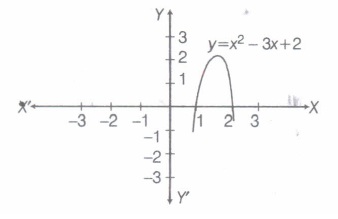
If we rotate the axes at an angle of 90° in anti-clockwise direction, the figure remains at the same position. Find the equation of the graph.
y2 + 3y + 2
y2 -3y + 2
y2 + 2y + 3
y2 - 2y + 3
21.
If the coefficient of x in the quadratic equation x2 + px + q = owas taken as 17 in the place of 13 and its roots were found to be -2 and -15 then the roots of the original equation.
3,10
-3, -10
-3, 10
3, -10
22.
A fraction becomes 4/5 when 1 is added to each of the numerator and denominator. However, if..we subtract 5 from each of them, it becomes 1/2. Then, numerator of the fraction is
6
7
8
9
23.
The pair of equations x + 2y + 5 = 0 and - 3x - 6y + 1= 0 has
a unique solution
exactlytwo solutions
infinitely many solutions
no solution
24.
When a man travels equal distance at speed x km/h and y km/h. his average speed is 4 km/h. But when he travels at these speed for equal time, his average speed is 4.5 km/h.The difference of the two speed is
2 km/h
4 km/h
3 km/h
5 km/h
25.
If x = 1 is a common root of the equation x2 + ax – 3 = 0 and bx2 – 7x + 2 = 0 then ab =
-3
7
10
6
26.
If one root of a Quadratic equation is m + √n , then the other root is
√m + n
Can not be determined
m + √n
m – √n
27.
The roots of quadratic equation ax² + bx + c = 0 is given by
\(\frac { b\pm \sqrt { { b }^{ 2 }-4ac } }{ 2c } \)
\(\frac { -b\pm \sqrt { { b }^{ 2 }-4ac } }{ 2c } \)
\(\frac { b\pm \sqrt { { b }^{ 2 }-4ac } }{ 2c } \)
\(\frac { -b\pm \sqrt { { b }^{ 2 }-4ac } }{ 2c } \)
28.
The same value of x satisfies the equations 4x + 5 = 0 and 4x2 + (5 + 3p)x + 3p2=0, then p is
0 or 5/4
¼ or ½
0 or ¼
0 or ½
29.
Which of the following is not a quadratic equation?
3x + 4 – 7x2 = 0
z2 – 2z = 0
5x +3y2 = 0
5x2 – 125 = 0
30.
If 1/2 is a root of the equation x2 + kx-5/4 = 0 then the other root of the quadratic equation is
1/4
-5/2
-2
1/2
31.
The value of x, y in the following
2x+2 – 3y+1 = 5 ………(1)
2x + 3y = 17 ………(2)
3,2
2,-3
-2,3
2,3
32.
A system of simultaneous linear equations has infinitely many solutions if two lines:
intersect at one point
are parallel
intersect at two points
are coincident
33.
Find x and y given
\(\frac { 2a }{ x } +\frac { 3b }{ y } =-1\)
\(\frac { 3a }{ x } -\frac { b }{ y } =4\)
a and b
a and -b
-a and -b
-a and b
34.
The value of x, y in the following pair of Linear equations is
\(\frac { a }{ x } -\frac { b }{ x } =0\) ... (1)
\(\frac { { ab }^{ 2 } }{ x } +\frac { { a }^{ 2 }b }{ y } ={ a }^{ 2 }+b^{ 2 }\)..... (2)
b, a
a, b
a,-b
-a,b
35.
In an examination, one mark is awarded for every correct answer, while 1/4 mark is deducted for every wrong answer. A student answered 120 questions and got 20 marks. Which of the following pair of equations would give the result for how many questions did he answered correctly?
x + y = 120; – x + 4y = 80
x + y = 60; x + 4y = 80
x + y = 120; 4x + 3y = 80
x + y = 120; 3x + 4y = 80
36.
Amit is planning to buy a house and the layout is given below. The design and the measurement has been made such that areas of two bedrooms and kitchen together is 95 m2.
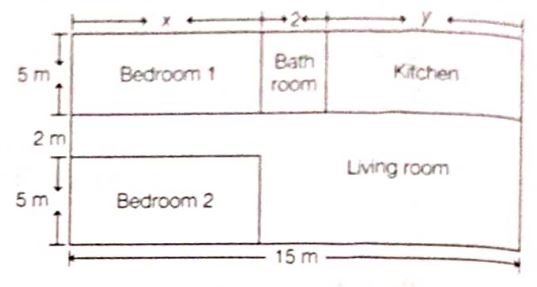
Based on the above information, answer the following questions:
(i) Form the pair of linear equations in two variables from this situation.
(ii) Find the length of the outer boundary of the layout.
(iii) Find the area of each bedroom and kitchen in the layout.
(iv) Find the area of living room in the layout.
(v) Find the cost of laying tiles in kitchen at the rate of Rs 50 per m2.
37.
Amit is preparing for his upcoming semester exam. For this, he has to practice the chapter of Quadratic Equations. So he started with factorization method. Let two linear factors of \(a x^{2}+b x+c \text { be }(p x+q) \text { and }(r x+s)\)
\(\therefore a x^{2}+b x+c=(p x+q)(r x+s)=p r x^{2}+(p s+q r) x+q s .\)
Now, factorize each of the following quadratic equations and find the roots.
(i) 6x2 + x - 2 = 0
| \((a) 1,6\) | \((b) \frac{1}{2}, \frac{-2}{3}\) | \((c) \frac{1}{3}, \frac{-1}{2}\) | \((d) \frac{3}{2},-2\) |
(ii) 2x2-+ x - 300 = 0
| \((a) 30, \frac{2}{15}\) | \((b) 60, \frac{-2}{5}\) | \((c) 12, \frac{-25}{2}\) | (d) None of these |
(iii) x2- 8x + 16 = 0
| (a) 3,3 | (b) 3,-3 | (c) 4,-4 | (d) 4,4 |
(iv) 6x2- 13x + 5 = 0
| \((a) 2, \frac{3}{5}\) | \((b) -2, \frac{-5}{3}\) | \((c) \frac{1}{2}, \frac{-3}{5}\) | \((d) \frac{1}{2}, \frac{5}{3}\) |
(v) 100x2- 20x + 1 = 0
| \((a) \frac{1}{10}, \frac{1}{10}\) | \((b) -10,-10\) | \((c) -10, \frac{1}{10}\) | \((d) \frac{-1}{10}, \frac{-1}{10}\) |
38.
Points A and B representing Chandigarh and Kurukshetra respectively are almost 90 km apart from each other on the highway. A car starts from Chandigarh and another from Kurukshetra at the same time. If these cars go in the same direction, they meet in 9 hours and if these cars go in opposite direction they meet in 9/7 hours. Let X and Ybe two cars starting from points A and B respectively and their speed be x km/hr and y km/hr respectively.
Then, answer the following questions.
(i) When both cars move in the same direction, then the situation can be represented algebraically as
| (a) x - y = 10 | (b) x + y = 10 | (c) x + y = 9 | (d) x - y = 9 |
(ii) When both cars move in opposite direction, then the situation can be represented algebraically as
| (a) x - y=70 | (b) x + y=90 | (c) x + y=70 | (d) x + y=10 |
(iii) Speed of car X is
| (a) 30 km/hr | (b) 40 km/hr | (c) 50 km/hr | (d) 60 km/hr |
(iv) Speed of car Y is
| (a) 50km//hr | (b) 40 km/hr | (c) 30 km/hr | (d) 60 km/hr |
(v) If speed of car X and car Y, each is increased by 10 km/hr, and cars are moving in opposite direction, then after how much time they will meet?
| (a) 5 hrs | (b) 4 hrs | (c) 2 hrs | (d) 1 hr |
1.
Given pair of linear equations is 8x + 5y = 11 ...(i)
and x + y = 4 ...(ii)
On multiplying Eq. (ii) by 8 and then subtracting from Eq. (i), we get
\(-3 y=-21 \Rightarrow y=7\)
Putting y = 7in Eq. (ii), we get
x=4-7=-3
Hence, x = - 3, y = 7.
2.
2(3x - y) = 5xy .....(i)
2(x + 3y) = 5xy .....(ii)
Divide eqns. (i) and (ii) by xy,
\(\frac { 6 }{ y } -\frac { 2 }{ x } =5\) .....(iii)
and \(\frac { 2 }{ y } +\frac { 6 }{ x } =5\) ......(iv)
Let \(\frac { 1 }{ y } \) = a and \(\frac { 1 }{ x } \) = b,
then equations (iii) and (iv) become
6a - 2b = 5 ...(v)
2a + 6b = 5 ....(vi)
Multiplying eqn. (v) by 3 and then adding with eqn. (vi),
20a = 20
\(\therefore\) a = 1
Substituting this value of a in eqn. (v),
b = \(\frac { 1 }{ 2 } \)
Now \(\frac { 1 }{ y } =a=1\)
\(\Rightarrow\) y = 1
and \(\frac { 1 }{ x } =b=\frac { 1 }{ 2 } \)
\(\Rightarrow\) x = 2
3.
8
4.
\(\frac { 2 }{ x+1 } +\frac { 3 }{ 2(x-2) } =\frac { 23 }{ 5x } \)
\(\Rightarrow \frac { 4(x-2)+3(x+1) }{ 2(x+1)(x-2) } =\frac { 23 }{ 5x } \)
\(\Rightarrow \frac { 4x-8+3x+3 }{ 2(x^{ 2 }-2x+x-2) } =\frac { 23 }{ 5x } \)
\(\Rightarrow \frac { 7x-5 }{ 2(x^{ 2 }-x-2) } =\frac { 23 }{ 5x } \)
\(\Rightarrow 5x(7x-5)=46(x^{ 2 }-x-2)\)
\(\Rightarrow 35x^{ 2 }-25x=46x^{ 2 }-46x-92=0\)
\(\Rightarrow 35x^{ 2 }-25x-46x^{ 2 }+46x+92=0\)
\(\Rightarrow -11x^{ 2 }+21x+92=0\)
\(\Rightarrow 11x^{ 2 }-44x+23x-92=0\)
11x(x-4)+23(x-4)=0
\(\Rightarrow (x-4)=0\quad (11x+23)=0\)
\(\Rightarrow x=4\quad \) or 11x=-23 or x=\(\frac { -23 }{ 11 }
\)
5.
(b)
6.
(b)
7.

8.
\(4x^{ 2 }+4bx+b^{ 2 }-a^{ 2 }\)
\(\Rightarrow (2x+b)^{ 2 }-a^{ 2 }=0\)
\(\Rightarrow (2x+b+a)(2x+b-a)=0\)
\(\Rightarrow x=\frac { \left( a+b \right) }{ 2 } ,x=\frac { a-b }{ 2 } \)
9.
Here a1 = 2, b1 = 1, c1 = 3
and a2 = 4, b2 = 2, c2 = 6
Clearly \(\frac { { a }_{ 1 } }{ { a }_{ 2 } } =\frac { { b }_{ 1 } }{ { b }_{ 2 } } =\frac { { c }_{ 1 } }{ { c }_{ 2 } } \)
i.e.\(\frac { 2 }{ 4 } =\frac { 1 }{ 2 } =\frac { 3 }{ 6 } \)
Hence lines are coincident.
10.
(i) k\(\neq\)10
(ii) k=10.
There is no value of k for which given system has infinitely many solutions. i.e, represent coincident lines.
11.
Since x=2 is a root of given quadratic equation
\(\therefore\) 3(2)2-P(2)-2=0
\(\Rightarrow\) 12-2p-2=0
\(\Rightarrow\) p=5
Hence, the value of p is 5.
12.
Let first number be x.
Then, second number =x + 4
[∴ difference of two numbers = 4]
According to the question,
\(\frac{1}{x}-\frac{1}{x+4}=\frac{4}{21}\)
- 7, - 3 or 3, 7
13.
For all real values k.
14.
\(\frac { x }{ -80-48 } =\frac { y }{ -4+100 } =\frac { 1 }{ -60-4 } \)
\(\Rightarrow\) x = 2
and \(y=\frac { -3 }{ 2 } \)
Alternative method:
Given: 5x + 4y - 4 = 0 .....(i)
x - 12y - 20 = 0 ......(ii)
By cross-multiplication method,
\(\frac { x }{ \left| \begin{matrix} 4 & -4 \\ -12 & -20 \end{matrix} \right| } =\frac { y }{ \left| \begin{matrix} -4 & 5 \\ -20 & 1 \end{matrix} \right| } =\frac { 1 }{ \left| \begin{matrix} 5 & 4 \\ 1 & -12 \end{matrix} \right| } \)
\(\Rightarrow \quad \frac { x }{ -80-48 } =\frac { y }{ -4+100 } =\frac { 1 }{ -60-4 } \)
\(\frac { x }{ -128 } =\frac { 1 }{ -64 } \) and \(\frac { y }{ 96 } =\frac { 1 }{ -64 } \)
\(\Rightarrow \quad x=2\) and \(y=\frac { -3 }{ 2 } \)
15.
\(\frac { x^{ 2 }+3x+2+x^{ 2 }-3x+2 }{ x^{ 2 }+x-2 } =\frac { 4x-8-2x-3 }{ x-2 } \)
\((2x^{ 2 }+4)(x-2)=(2x-11)(x^{ 2 }+x-2)\)
\(\Rightarrow 5x^{ 2 }+19x-30=0\)
\(\Rightarrow (5x-6)(x+5)=0\)
\(\Rightarrow x=-5,\frac { 6 }{ 5 } \)
16.
The pair of linear equations is :
x + y = 5
\(\Rightarrow\) x + y - 5 = 0 ....(i)
and 2x + 2y = 10
\(\Rightarrow\) 2x + 2y -10 = 0 ...(ii)
On comparing with ax + by + C = 0 , we have
a1 = 1, b1 = 1,.c1 = - 5
a2 = 2, b2 = 2, c2 = -10
\(\therefore \quad \frac { { a }_{ 1 } }{ { a }_{ 2 } } =\frac { 1 }{ 2 } ,\frac { { b }_{ 1 } }{ { b }_{ 2 } } =\frac { 1 }{ 2 } \)
and \(\frac { { c }_{ 1 } }{ { c }_{ 2 } } =\frac { -5 }{ -10 } =\frac { 1 }{ 2 } \)
Since \(\frac { { a }_{ 1 } }{ { a }_{ 2 } } =\frac { { b }_{ 1 } }{ { b }_{ 2 } } =\frac { { c }_{ 1 } }{ { c }_{ 2 } } \)
So, the pair of linear equations is coincident having many solutions. Thus, the equation is consistent. Now, we need to solve it graphically.
We have x + y = 5
\(\Rightarrow\) y = 5 - x
| x | 0 | 5 |
| y | 5 | 0 |
| Points | A | B |
and 2x + 2y = 10
\(\Rightarrow \quad y=\frac { 10-2x }{ 2 } \)
| x | 0 | 2 | 5 |
| y | 5 | 3 | 0 |
| Points | C | D | E |
On plotting these points, we observe that the lines are coincident having infinite solutions.
17.
The given equation is \(\sqrt { 3 } { x }^{ 2 }+11x+6\sqrt { 3 } =0\)
On comparing with \({ ax }^{ 2 }+bx+c=0\)
\(a=\sqrt { 3 } ,b=11\quad c=6\sqrt { 3 } \)
On substituting the values of a,b and c in the quadratic formula.
\(x=\frac { -b\pm \sqrt { { b }^{ 2 }-4ac } }{ 2a } \\ x=\frac { -11\pm \sqrt { { \left( 11 \right) }^{ 2 }-4\left( \sqrt { 3 } \right) \left( 6\sqrt { 3 } \right) } }{ 2(\sqrt { 3 } ) } \\ x=\frac { -11\pm \sqrt { 121-72 } }{ 2\sqrt { 3 } } \\ =\frac { -11\pm \sqrt { 49 } }{ 2\sqrt { 3 } } =\frac { -11\pm 7 }{ 2\sqrt { 3 } } \\ x=\frac { -11+7 }{ 2\sqrt { 3 } } =\frac { -4 }{ 2\sqrt { 3 } } =\frac { -2 }{ \sqrt { 3 } } \\ x=\frac { -11-7 }{ 2\sqrt { 3 } } =\frac { -18 }{ 2\sqrt { 3 } } =\frac { -9 }{ \sqrt { 3 } } \)
Hence, \(\frac { -2 }{ \sqrt { 3 } } \) and \(\frac { -9 }{ \sqrt { 3 } } \) are the required solutions of the given equation.
18.
(d)
\(\pm \frac{10}{9}\)
19.
(d)
ab = 6
20.
(a)
y2 + 3y + 2
21.
(b)
-3, -10
22.
(b)
7
23.
(d)
no solution
24.
(c)
3 km/h
25.
(c)
10
26.
(d)
m – √n
27.
(d)
\(\frac { -b\pm \sqrt { { b }^{ 2 }-4ac } }{ 2c } \)
28.
(a)
0 or 5/4
29.
(c)
5x +3y2 = 0
30.
(b)
-5/2
31.
(a)
3,2
32.
(d)
are coincident
33.
(b)
a and -b
34.
(b)
a, b
35.
(a)
x + y = 120; – x + 4y = 80
36.
(i) From the given figure, we see that area of two bedrooms
= 2(5x) = 10x m2
\(\therefore\) Area of kitchen= 5 \(\times\) y = 5y m2
According to the question,
Area of the two bedrooms and area of kitchen =95m2
\(\therefore\) 10x + 5y =95
\(\Rightarrow\)2x + y =19 (dividing both sidesby 5] ...(i)
Also, length of the home =15 m
\(\therefore\) x+2 + y =15
\(\Rightarrow\) x + y = 13 ....(ii)
Hence, pair of linear equations is
2x + y = 19 and x + y=13
(ii) The length of the outer boundary of the layout
= 2(l + b) =2(15 + 12) = 2(27) = 54 m
(iii) On solving Eqs. (i) and (ii), we get
x = 6 and y = 7
\(\therefore\) Area of each bedroom =5 \(\times\) x =5 \(\times\)6=30 m2
and area of kitchen=5 \(\times\) y = 5 \(\times\) 7 = 35 m2
(iv) \(\therefore\) Area of living room = 15 \(\times\) (5 + 2) - Area of bedroom 2
= 15 \(\times\)7 - 5 \(\times\)6
= 105 - 30 = 75 m2
(v) Since, area of kitchen = 5 \(\times\) y = 5 \(\times\) 7 = 35 m2
But, it is also given, the cost of laying tiles in kitchen at the rate of Rs 50 per m2.
\(\therefore\) Total cost of laying tiles in the kitchen = 35 \(\times\) 50 = Rs 1750
37.
(i) (b):We have \(6 x^{2}+x-2=0\)
\(\Rightarrow \quad 6 x^{2}-3 x+4 x-2=0 \)
\(\Rightarrow \quad(3 x+2)(2 x-1)=0 \)
\(\Rightarrow \quad x=\frac{1}{2}, \frac{-2}{3}\)
(ii) (c): \(2 x^{2}+x-300=0\)
\(\Rightarrow \quad 2 x^{2}-24 x+25 x-300=0 \)
\(\Rightarrow \quad(x-12)(2 x+25)=0 \)
\(\Rightarrow \quad x=12, \frac{-25}{2}\)
(iii) (d): \(x^{2}-8 x+16=0\)
\(\Rightarrow(x-4)^{2}=0 \Rightarrow(x-4)(x-4)=0 \Rightarrow x=4,4\)
(iv) (d): \(6 x^{2}-13 x+5=0\)
\(\Rightarrow \quad 6 x^{2}-3 x-10 x+5=0 \)
\(\Rightarrow \quad(2 x-1)(3 x-5)=0 \)
\(\Rightarrow \quad x=\frac{1}{2}, \frac{5}{3}\)
(v) (a): \(100 x^{2}-20 x+1=0\)
\(\Rightarrow(10 x-1)^{2}=0 \Rightarrow x=\frac{1}{10}, \frac{1}{10}\)
38.
(i) (a) : Suppose two cars meet at point Q. Then,
Distance travelled by car X = A Q,
Distance travelled by car Y = BQ.
It is given that two cars meet in 9 hours.
\(\therefore\) Distance travelled by car X in 9 hours = 9x km
\(\Rightarrow\) AQ=9x
Distance travelled by car Y in 9 hours = 9y km
\(\Rightarrow\) BQ=9y
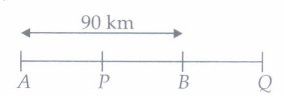
Clearly, AQ - BQ = AB
\(\Rightarrow\) 9x - 9y = 90
\(\Rightarrow\) x-y =10
(ii) (c): Suppose two cars meet at point P. Then
Distance travelled by car X = AP and
Distance travelled by car Y = BP.
In this case, two cars meet in 917 hours.
\(\therefore\) Distance travelled by car X in 9/7 hours = \(\frac {9}{7}\) x km
\(\Rightarrow A P=\frac{9}{7} x\)
Distance travelled by car Y in 9/7 hours \(\frac {9}{7}\) y km
\(\Rightarrow B P=\frac{9}{7} y\)
Clearly, AP + BP = AB
\(\Rightarrow \quad \frac{9}{7} x+\frac{9}{7} y=90 \Rightarrow \frac{9}{7}(x+y)=90 \Rightarrow x+y=70\)
(iii) (b): We have x - y = 10
\(\Rightarrow x+y=70\)
Adding equations (i) and (ii), we get
2x = 80 \(\Rightarrow\) x = 40
Hence, speed of car X is 40 km/hr.
(iv) (c): We have x - y = 10
\(\Rightarrow\) 40 - Y = 10 \(\Rightarrow\) Y = 30
Hence, speed of car y is 30 km/hr.
(v) (d)

10th Standard CBSE Syllabus & Materials
10th Standard CBSE
CBSE 10th Social Science PS - Federalism - New Model Questions Papers Study Material - QB365 Set A
NEW10th Standard CBSE
CBSE 10th Social Science PS - Power Sharing - New Model Questions Papers Study Material - QB365 Set A
NEW10th Standard CBSE
CBSE 10th Social Science GEO - Manufacturing Industries - New Model Questions Papers Study Material - QB365 Set A
NEW10th Standard CBSE
CBSE 10th Social Science GEO - Minerals and Energy Resources - New Model Questions Papers Study Material - QB365 Set A



NCERT Books

Syllabus

Exam Pattern

Sample Question Papers

Previous year Question Papers

Important Notes

MCQ Practice test

NCERT Exemplers

Case study Questions

Image Based Questions

Passage based Questions

HOT Questions

Value Based Questions

Model Questions Papers
NCERT ( Book Back ) Questions

Assertion and Reason
Important Questions And Answers

CBSE 10th Standard CBSE Subjects
CBSE Standards



