
 100% FREE ACCESS
10th Standard CBSE Syllabus & Materials
10th Standard CBSE
CBSE 10th Social Science ECO - Globalisation and the Indian Economy - New Model Questions Papers Study Material - QB365 Set A
NEW10th Standard CBSE
CBSE 10th Social Science ECO - Money and Credit - New Model Questions Papers Study Material - QB365 Set A
NEW10th Standard CBSE
CBSE 10th Social Science ECO - Sectors of the Indian Economy - New Model Questions Papers Study Material - QB365 Set A
NEW10th Standard CBSE
CBSE 10th Social Science ECO - Development - New Model Questions Papers Study Material - QB365 Set A
NEW10th Standard CBSE
CBSE 10th Social Science PS - Outcomes of Democracy - New Model Questions Papers Study Material - QB365 Set A
NEW10th Standard CBSE
CBSE 10th Social Science PS - Gender, Religion and Caste - New Model Questions Papers Study Material - QB365 Set A

Published on: 26/10/2025
Download CBSE Class 10th Standard CBSE Maths question papers, sample papers, important questions, and previous year solved papers in PDF format. Get free study materials, NCERT solutions, and exam preparation resources for Class 10th Standard CBSE Maths
Questions + Answers key
Take MCQ Maths Test
1.
Find a quadratic polynomial each with the given numbers as the sum and product of its zeroes respectively.
4, 1
2.
Given that HCF (306, 657) = 9, find LCM (306, 657).
3.
If α, β are zeroes of the x2 +7x + 7, find the value of \({1\over \alpha}+{1\over \beta}-2\alpha\beta\)
4.
Graphically, find whether the following pair of equations has no solution, unique solution or infinitely many solutions:
5x - 8y + 1 = 0; (1)
3x - \(24\over5\)y+\(3\over5\)=0 (2)
5.
In the given figure, \(\triangle\)ABC ~ \(\triangle\)PQR. Find the value of y + z.
6.
Find whether the pair of linear equations y = 0 and y = -5 has no solution, unique solution or infinitely many solutions.
7.
Find the least number that is divisible by all numbers between 1 and 10 (both inclusive).
8.
Give two different examples of pair of
(i) similar figures
(ii) non-similar figures
9.
Find the 7th term from the end of the AP 7, 12, 13, ..., 184.
10.
The 17th term of an AP exceeds its 10th term by 7. Find the common difference.
11.
Find all zeroes of the polynomial 2x4 -9x3 +5x2 +3x-1),if two of its zeroes are \((2+\sqrt{3}) \text { and }(2-\sqrt{3})\) .
12.
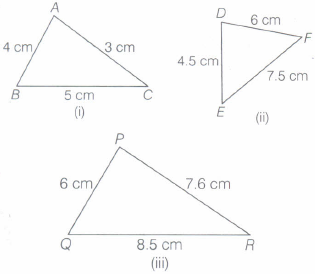
State which pairs of triangles in the given figure are similar? Also, state the similarity criterion used.
13.
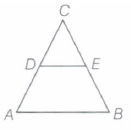
In the following figure, if \(\frac { AD }{ DC } =\frac { BE }{ EC } \) and \(\angle CDE=\angle CED\) then prove that \(\triangle CAB\) is an isosceles triangle?
14.
Check whether the rational number \(\frac{1}{13}\), is terminating recurring or non-terminating recurring decimal expansion.
15.
How many numbers of two digits are divisible by 7?
16.
For what value of k does (k-12)x2+2(k-12)x+2=0 have equal roots?
17.
Aftab tells his daughter, “Seven years ago, I was seven times as old as you were then. Also, three years from now, I shall be three times as old as you will be.” (Isn’t this interesting?) Represent this situation algebraically and graphically.
18.
Two trees of height a and bare p metre apart.
(i) Prove that the height of the point of intersection of the lines joining the top of each tree to the foot of the opposite trees is given by \(\frac { ab }{ a+b } m.\)
(ii) Which mathematical concept is used in this problem?
(iii) What is the value of trees in our life?
19.
Find the middle term of the sequence formed by all three-digit numbers which leave a remainder 5 when divided by 7. Also find the sum of all numbers on both sides of the middle term separately.
20.
Find the roots of x2-4ax+4a2-b2 =0, if they exist by the method of completing the square.
21.
What cannot be the difference between four consecutive terms of an arithmetic progression?
0,0,0
-2,-2,-2
2,3,4
\(\frac{2}{7}, \frac{2}{7}, \frac{2}{7}\)
22.
If one zero of the polynomial kx2 +3x+ k is 2, then the value of k is
\(-\frac{6}{5}\)
\(\frac{6}{5}\)
\(\frac{5}{6}\)
\(-\frac{5}{6}\)
23.
Three alarm clocks ring their alarms at regular Competency Based Question intervals of 20 min, 25 min and 30 min, respectively. If they first beep together at 12 noon, at what time will they beep again for the first time?
4:00 pm
4:30 pm
5:00 pm
5:30 pm
24.
If a and b are two coprime numbers, then a3 and b3 are
coprime
not coprime
even
odd
25.
Diagonal AC of a rectangle ABCD is produced to the point E such that AC : CE = 2 : 1, AB = 8 cm and BC = 6 m. The length of DE is
\(2 \sqrt{19}\)cm
15 cm
\(3 \sqrt{17}\)cm
13 cm
26.
A graph of quadratic polynomial is given below
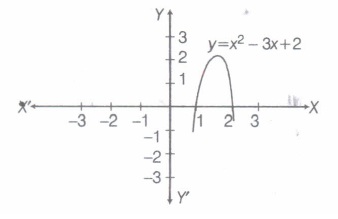
If we rotate the axes at an angle of 90° in anti-clockwise direction, the figure remains at the same position. Find the equation of the graph.
y2 + 3y + 2
y2 -3y + 2
y2 + 2y + 3
y2 - 2y + 3
27.
The sum of n terms of sequence \(\frac{1}{1 \times 2}, \frac{1}{2 \times 3}, \frac{1}{3 \times 4}, .\) is
\(\frac{1}{n+1}\)
\(\frac{1}{n}\)
\(\frac{n+1}{n}\)
\(\frac{n}{n+1}\)
28.
The pair of equations 3x+y =81. 81x-y = 3 has
no solution
unique solution
infinitelymany solutions
\(x=2 \frac{1}{8}, y=1 \frac{7}{8}\)
29.
Find the sum of first 40 integers divisible by 6
4000
4920
2460
4290
30.
Reduction of a rupee in the price of onion makes the possibility of buying one more kg of onion for Rs.56. Find the original price of the onion per kg
7,-8
8
7
1
31.
Which of the following equations has the sum of its roots as 3
2x2-3x+6=0
x2+5x+6=0
-x2+3x-3=0
3x2-3x+3=0
32.
In figure, DE || BC, then x equals to :
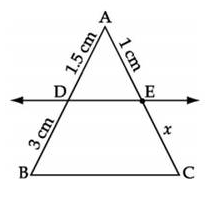
1.4 cm
2 cm
4 cm
2.5 cm
33.
What is the diagonal length of a TV screen whose dimensions are 80 x 60 cm?
10
100
20
100
34.
Find the value of ‘a” for which the system of equations 3x + 2y – 4 = 0 and ax – y – 3 = 0, will represent intersecting lines
a = 3/2
a ≠ 2/3
a = 2/3
a ≠ 3/2
35.
Find the quadratic polynomial whose zeros are 2 and -6.
x2 + 4x – 12
x2 + 4x + 12
x2 – 4x – 12
x2 – 4x + 12
36.
If one zero of the polynomial x2+ kx+18 is double the other zero then k =?
±3
9
3
±9
37.
value of ‘a’ so that (x + 6) is a factor of the polynomial x3 + 5x2 – 4x + a
10
12
13
0
38.
Given that the H.C.F. of 35 and 49 is 7, what is their LCM?
265
245
195
225
39.
Assertion: In a rhombus of side 15 cm, one of the diagonals is 20 cm long. The length of the second diagonal is 10\(\sqrt6\) cm.
Reason: The sum of the squares of the sides of a rhombus is equal to the sum of the squares of its diagonals.
Codes:
(a) If both Assertion and Reason are correct and Reason is the correct explanation of Assertion.
(b) If both Assertion and Reason are correct, but Reason is not the correct explanation of Assertion.
(c) If Assertion is correct but Reason is incorrect.
(d) If Assertion is incorrect but Reason is correct.
40.
Assertion The rational number \(\frac{129}{2^{2} \times 5^{7} \times 7^{2}}\) is non-terminating repeating decimals.
Reason Let x be a rational number whose decimal expansion terminates. Then, x can expressed in the form of \(\frac{p}{q}\) where p and q are coprime and the prime factorisation of q is of the form 2m x 5 n, where m and n are non-negative integers.
codes:
(a) If both Assertion and Reason are correct and Reason is the correct explanation of Assertion.
(b) If both Assertion and Reason are correct, but Reason is not the correct explanation of Assertion.
(c) If Assertion is correct but Reason is incorrect.
(d) If Assertion is incorrect but reason is correct.
41.
While playing a treasure hunt game, some clues (numbers) are hidden in various spots collectively forms an A.P. If the number on the nth spot is 20 + 4n, then answer the following questions to help the player in spotting the clues.
(i) Which number is on the first spot?
| (a) 20 | (b) 24 | (c) 16 | (d) 28 |
(ii) Which number is on the (n - 2)th spot?
| (a) 16+4n | (b) 24+4n | (c) 12+4n | (d) 28+4n |
(iii) Which number is on the 34th spot?
| (a) 156 | (b) 116 | (c) 120 | (d) 160 |
(iv) What is the sum of all the numbers on the first 10 spots?
| (a) 410 | (b) 420 | (c) 480 | (d) 410 |
(v) Which spot is numbered as 116?
| (a) 5th | (b) 8th | (c) 9th | (d) 24th |
42.
Piyush sells? saree at 8% profit and a sweater at 10% discount, thereby, getting a sum of Rs 1008. If he had sold the saree at 10% profit and the sweater at 8% discount, he would have got Rs 1028.
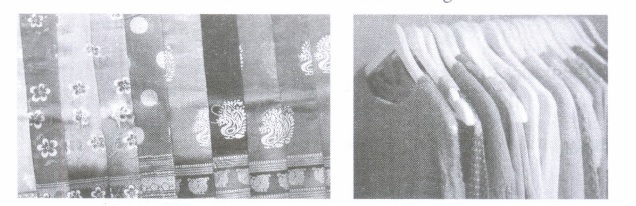
Denote the cost price of the saree and the list price (price before discount) of the sweater by Rs x and Rs y respectively
and answer the following questions.
(i) The 1st situation can be represented algebraically as
| (a) 2.08x + 1.9y = 2008 | (b) 1.08x + 0.9y = 1008 | (c) lOx + 8y = 1008 | (d) 8x + 10y = 1008 |
(ii) The 2nd situation can be represented algebraically as
| (a) 10x + 8y = 1028 | (b) 2.1x + 1.92y = 1028 | (c) 1.1x + 0.92y = 1028 | (d) 8x + 10y = 1028 |
(iii) Linear equation represented by 1st situation intersect the x-axis at
| \((a) (2800,0)\) | \((b) (2500,0)\) | \((c) \left(\frac{2500}{3}, 0\right)\) | \((d) \left(\frac{2800}{3}, 0\right)\) |
(iv) Linear equation represented by 2nd situation intersect the y-axis at
| \((a) \left(0, \frac{25700}{23}\right)\) | \((b) (0,25700)\) | \((c) \left(0, \frac{25800}{23}\right)\) | \((d) (0,26800)\) |
(v) Both linear equations represented by situation 1st and 2nd intersect each other at
| (a) (400,600) | (b) (600,400) | (c) (200,200) | (d) (800,600) |
43.
HCF and LCM are widely used in number system especially in real numbers in finding relationship between different numbers and their general forms. Also, product of two positive integers is equal to the product of their HCF and LCM. Based on the above information answer the following questions.
(i) If two positive integers x and yare expressible in terms of primes as x = p2q3 and y = p3 q, then which of the following is true?
| (a) HCF = pq2 x LCM | (b) LCM = pq2 x HCF |
| (c) LCM = p2q x HCF | (d) HCF = p2q x LCM |
(ii) A boy with collection of marbles realizes that if he makes a group of 5 or 6 marbles, there are always two marbles left, then which of the following is correct if the number of marbles is p?
| (a) p is odd | (b) p is even | (c) p is not prime | (d) both (b) and (c) |
(iii) Find the largest possible positive integer that will divide 398, 436 and 542 leaving remainder 7, 11, 15 respectively.
| (a) 3 | (b) 1 | (c) 34 | (d) 17 |
(iv) Find the least positive integer which on adding 1 is exactly divisible by 126 and 600.
| (a) 12600 | (b) 12599 | (c) 12601 | (d) 12500 |
(v) If A, Band C are three rational numbers such that 85C - 340A :::109, 425A + 85B = 146, then the sum of A, B and C is divisible by
| (a) 3 | (b) 6 | (c) 7 | (d) 9 |
1.
Let the quadratic polynomial be ax2 + bx + c, and its zeroes be α and ß
Given \(\alpha+B=4=-\frac{b}{a}\)
\(\alpha \beta=1=\frac{c}{a}\)
If a = 1, then b = -4, c = 1
Therefore, the quadratic polynomial is x2 – 4x +1.
2.
Given, HCF of 306 and 657 = 9
We know that
LCM \(\times\) HCF = Product of two numbers
\(\Rightarrow\) LCM \(\times\) 9 = 306 \(\times\) 657
\(\Rightarrow\) LCM = \( \frac{306 \times 657}{9}\)
= 34 \(\times\) 657 = 22338
\(\therefore\) LCM of 306 and 657 = 22338
3.
P(x)=x2+ 7x+ 7
Here, a =1, b =7, c=7
∴ α, β are both zeroes of p(x)
\(∴\ \alpha+\beta={-b\over a}=-7\)
\(\alpha\beta={c\over a}=7\)
Now \({1\over \alpha}+{1\over \beta}-2\alpha\beta={\beta+\alpha\over \alpha\beta}-2\alpha\beta\)
\(={-7\over 7}-2\times7=-1-14=-15\)
4.
Multiplying Equation (2) by \(\frac{5}{3},\) we get
5x – 8y + 1 = 0
But, this is the same as Equation (1). Hence the lines represented by Equations (1) and (2) are coincident. Therefore, Equations (1) and (2) have infinitely many solutions Plot few points on the graph and verify it yourself.
5.
\(\triangle\)ABC~\(\triangle\)PQR (Given)
\(\frac { AB }{ PQ } =\frac { BC }{ QR } =\frac { AC }{ PR } \)
\(\Rightarrow \frac { z }{ 3 } =\frac { 8 }{ 6 } =\frac { 4\sqrt { 3 } }{ y } \)
\(\Rightarrow \frac { z }{ 3 } =\frac { 8 }{ 6 } and\frac { 8 }{ 6 } =\frac { 4\sqrt { 3 } }{ y } \)
\(\Rightarrow z=\frac { 8\times 3 }{ 6 } and\quad y=\frac { 4\sqrt { 3 } \times 6 }{ 8 } \)
\(\therefore z=4 and\ y=3\sqrt { 3 } \)
\(\therefore y+z=4+3\sqrt { 3 } \)
6.
The pair of equations y = 0 and y = -5 has no solution.
7.
The required number is the LCM of 1, 2, 3, 4, 5, 6, 7, 8,9,10
∴ LCM = 2 x 2 x 3 x 2 x 3 x 5 x 7
=2520
8.
(i) (a) Pair of the equilateral triangles are similar figures.
(b) Pair of the squares are similar figures.
(ii) (a) A triangle and a quadrilateral form a pair of non-similar figures.
(b) A square and a circle form a pair of non-similar figures.
9.
We have, last term, l = 184 and common difference, d = 10 - 7 = 3
\(\therefore\) 7th term from the end = l -(7-1)d
= \(184 - 6 \times 3\)
= 184 - 18 = 166
10.
Let a be the first term and d be the common difference of given AP.
Now, according to the question, a17 = a10 + 7
\(\Rightarrow\) a17 - a10 = 7
\(\Rightarrow\) [a + (17 - 1)d] - [a + (10 - 1)d] = 7
[\(\because\) an = a + (n - 1)d]
\(\Rightarrow\) (a + 16d) - (a + 9d) = 7
\(\Rightarrow\) 7d = 7 \(\Rightarrow\) d= 1
Hence, the common difference of this AP is 1.
11.
Let P(x) = 2x4 - 9x3 + 5x2 + 3x -1
Since, \((2+\sqrt{3})\) and \((2-\sqrt{3})\) are the zeroes of P(x).
Therefore, product of the zeroes is the factors of P(x).
Now, \((x-(2+\sqrt{3}))(x-(2-\sqrt{3}))\)
\(=x^{2}-x(2-\sqrt{3})-x(2+\sqrt{3})+\left(2^{2}-(\sqrt{3})^{2}\right.\)
\(=x^{2}-2 x+x \sqrt{3}-2 x-x \sqrt{3}+(4-3)\)
= x2 - 4x + 1
Since,(x2 - 4x + 1) is a factor of P(x). So, P(x) is divisible by (x2 - 4x + 1).
By using long division,
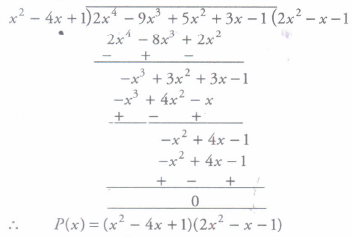
\(\therefore \quad P(x)=\left(x^{2}-4 x+1\right)\left(2 x^{2}-x-1\right)\)
Now, consider 2x2- x-1
= 2x2 - (2 - 1)x - 1
[by splitting the middle term]
= 2x2 - 2x + x-1= 2x(x -1) +1(x - 1)
= (x -1)(2x + 1
For zeroes (x -1)(2x +1)= 0 and \(2 x+1=0 \Rightarrow\) \(x=-\frac{1}{2}\)
when \(x-1=0 \Rightarrow x=1\)
So all zeroes are,\(1,-\frac{1}{2}, 2+\sqrt{3}, 2-\sqrt{3}\)
12.
Here, \(\frac { AB }{ DF } =\frac { 4 }{ 6 } =\frac { 2 }{ 3 } ,\frac { BC }{ EF } =\frac { 5 }{ 7.5 } =\frac { 2 }{ 3 } ,\frac { AC }{ DE } =\frac { 3 }{ 4.5 } =\frac { 2 }{ 3 } \)
As, \(\frac { AB }{ DF } =\frac { BC }{ EF } =\frac { AC }{ DE } \)
So, \(\triangle ABC\sim \triangle DFE\) [by SSS similarity criterion]
Hence, figures (i) and (ii) are similar triangles, but no other pairs of triangles in the given figure are similar.
13.
In \(\triangle ABC,\frac { AD }{ DC } =\frac { BE }{ EC } \)
\(\Rightarrow DE\parallel AB\) [by converse of BPT]
\(\therefore \angle CDE=\angle A\quad \angle CED=\angle B\) [corresponding angles]
Since, \(\angle CDE=\angle CED\)
\(\angle A=\angle B\)
CB = CA
[since, sides opposite to equal angles are also equal]
\(\therefore \triangle CAB\) is an isosceles triangle.
14.
Given, rational number is \(\frac{1}{13}\).
Here, prime factors of 13 are not of the form 2n 5m.
So, it will not have a terminating decimal expansion.
[ by using theorems 3 and 4]
Now, \(\frac { 1 }{ 13 } =0.076923076923...=\overline { 0.076923 } \)
Thus, \(\frac{1}{13}\) has non-terminating repeating decimal expansion.
15.
Two digits numbers are 10,11,12,13,14,15,...,97,98,99 in which only 14,21,28,..., 98 are divisible by 7.
Here, 21 - 14 = 28 - 21 = 7.
So, this list of numbers is an AP, whose first term (a) = 14, common difference (d) = 7 and nth term = 98.
\(\therefore\) a +( n- d ) d = 98
\(\Rightarrow\) 14 + (n - 1) 7 = 98
\(\Rightarrow\) 14 + 7n - 7 = 98 \(\Rightarrow\) 7n=91
\(\Rightarrow\) \(n=\frac{91}{7}=13\)
Hence, 13 numbers of two digits are divisible by 7.
16.
D \(=[2(k-12)]^{ 2 }-4(k-12)\times 2\)
\( =4(k-12)^{ 2 }-8(k-12)\quad \)
For equal and real roots, D = 0
\(\Rightarrow \ 4(k-12)^{ 2 }-8(k-12)=0\)
\(\Rightarrow 4(k-12)(k-12-2)=0\)
\(\Rightarrow 4(k-12)(k-14)=0\)
\(\Rightarrow k=12\) or k=14 \(\because a\neq 0\)
\(\Rightarrow d k\neq 12;\ \therefore k=14.\)
17.
Let present age of Aftab = x years and present age of Aftab's daughter = y years.
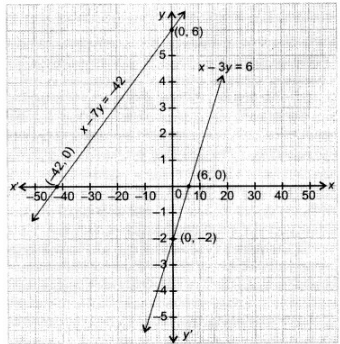
1st Condition
x-7=7(y-7)
\(\Rightarrow x-7=7 y-49\)
\(\Rightarrow x-7 y=-42\)
table
| x | 0 | -42 | -35 |
| y | 6 | 0 | 1 |
2nd condition :
Three years later
x+3=3(y+3)
x+3=3y+9
x-3y=6
Table
| x | 6 | 0 | 9 |
| y | 0 | -2 | 1 |
Thus,the algebraic eqation are
x-7y+42=0 and x-3y-6=0
18.
(i) Let AB and CD be the two trees of height a and b metre such that the trees are p metre apart i.e., AC = p. Let the lines AD and BC meet at O such that OL = hm.
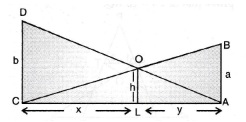
Let CL = x and LA = y,
then x + y = p
In \(\Delta\)ABC and \(\Delta\)LOC,
\(\angle\)CAB = \(\angle\)CLO (each 90°)
\(\angle\)C= \(\angle\)C (Common)
\(\therefore \Delta CAB\sim \Delta CLO\) (AA Similarity)
\(\Rightarrow \frac { CA }{ CL } =\frac { AB }{ LO } \quad \)
\(\Rightarrow \frac { p }{ x } =\frac { a }{ h } \quad \)
\(\Rightarrow x=\frac { ph }{ a } ....(i)\)
In \(\Delta\)ALO and \(\Delta\)ACD,
\(\angle\)ALO = \(\angle\)ACD (each 90°)
\(\angle\)A = \(\angle\)A (Common)
\(\therefore \angle ALO\sim \angle ACD\ (AA \quad similarity)\)
\(\Rightarrow \frac { AL }{ AC } =\frac { OL }{ DC } \)
\(\Rightarrow \frac { y }{ p } =\frac { h }{ b } \)
\(\\ \\ \Rightarrow \quad y=\frac { ph }{ d } \) .....(ii)
Adding eqns. (i) and (ii),
\(x+y=\frac { ph }{ a } +\frac { ph }{ b }\)
\(\Rightarrow p=ph\left( \frac { 1 }{ a } +\frac { 1 }{ b } \right) \)
\(\Rightarrow \frac { 1 }{ h } =\frac { 1 }{ a } +\frac { 1 }{ b } \)
\(\therefore h=\frac { ab }{ a+b } m.\)
(ii) Triangle.
(iii) Trees are helpful to keep our life in this world. They should be saved at any cost.
19.
The sequence is 103, 110, , 999
\(\therefore\) 999 = 103 + (n - 1) \(\times\) 7
\(\Rightarrow\) n = 129
Therefore \(\frac { 129+1 }{ 2 } \) = 65th term is the middle term
Middle term = 103 + (64)\(\times\)7 = 551
Sum of first 64 terms = 32 [206 + 63\(\times\)7]
= 20704
Sum of last 64 terms = 32 [1116 + 63 \(\times\) 7]
= 49824
20.
2a-b, 2a+b
21.
(c)
2,3,4
22.
(a)
\(-\frac{6}{5}\)
23.
(c)
5:00 pm
24.
(a)
coprime
25.
(c)
\(3 \sqrt{17}\)cm
26.
(a)
y2 + 3y + 2
27.
(d)
\(\frac{n}{n+1}\)
28.
(d)
\(x=2 \frac{1}{8}, y=1 \frac{7}{8}\)
29.
(b)
4920
30.
(c)
7
31.
(c)
-x2+3x-3=0
32.
(b)
2 cm
33.
(b)
100
34.
(d)
a ≠ 3/2
35.
(a)
x2 + 4x – 12
36.
(d)
±9
37.
(b)
12
38.
(b)
245
39.
(a) If both Assertion and Reason are correct and Reason is the correct explanation of Assertion.
40.
(a) If both Assertion and Reason are correct and Reason is the correct explanation of Assertion
41.
Number on nth spot = 20 + 4n i.e., tn = 20 + 4n
(i) (b): Number on 1st spot = t1 = 20 + 4(1) = 24
(ii) (c): Number on (n - 2)th spot = tn - 2
= 20 + 4 (n - 2)
= 20 + 4n - 8 = 12 + 4n
(iii) (a): Number on 34th spot = t34 = 20 + 4(34) = 156
(iv) (b): Here a = t1 = 24
Now, t2 = 20 + 4 (2) = 20 + 8 = 28
\(\therefore\) d = t2 - t1 = 4
So, required sum \(=S_{10}=\frac{10}{2}[2(24)+9(4)]=420\)
(v) (d): Let nth spot is numbered as 116.
\(\therefore\) tn = 116
\(\Rightarrow 20+4 n=116 \Rightarrow 4 n=96 \Rightarrow n=24\)
42.
(i) (b):Piyush sells a saree at 8% profit + sells a sweater at 10% discount = Rs 1008
\(\Rightarrow\) (100 + 8)% of x + (100 - 10)% of y = 1008
\(\Rightarrow\) 108% of x + 90% of y = 1008
\(\Rightarrow\) 1.08x + 0.9 y = 1008 ...(i)
(ii) (c): Piyush sold the saree at 10% profit + sold the sweater at 8% discount = Rs 1028
\(\Rightarrow\) (100 + 10)% of x + (100 - 8)% of Y = 1028
\(\Rightarrow\) 110%ofx+92%ofy= 1028
\(\Rightarrow\) 1.1 x + 0.92y = 1028 ...(ii)
(iii) (d): At x-axis, y = 0
\(\Rightarrow 1.08 x=1008 \Rightarrow x=\frac{1008}{1.08}=\frac{2800}{3}\)
(iv) (a): At y-axis, x = 0
\(\Rightarrow 0.92 y=1028 \Rightarrow y=\frac{1028}{0.92}=\frac{25700}{23}\)
(v) (b): Solving equations (i) and (ii), we get x = 600 and y = 400
Hence both linear equations intersect at (600, 400).
43.
(i) (b): LCM of x and y = p3q3 and HCF of x and y = p2q Also, LCM = pq2 x HCF.
(ii) (d): Number of marbles = 5m + 2 or 6n + 2.
Thus, number of marbles, p = (multiple of 5 x 6) + 2
= 30k + 2 = 2(15k + 1)
= which is an even number but not prime
(iii) (d): Here, required numbers
= HCF (398 - 7, 436 - 11,542 -15)
= HCF (391,425,527) = 17
(iv) (b): LCMof126and600 = 2 x 3 x 21 x 100= 12600 The least positive integer which on adding 1 is exactly divisible by 126 and 600 = 12600 - 1 = 12599
(v) (a): Here 8SC - 340A = 109 and 425A + 85B = 146 On adding them, we get 85A + 85B + 85C = 255 ~ A + B + C = 3, which is divisible by 3.

10th Standard CBSE Syllabus & Materials
10th Standard CBSE
CBSE 10th Social Science PS - Federalism - New Model Questions Papers Study Material - QB365 Set A
NEW10th Standard CBSE
CBSE 10th Social Science PS - Power Sharing - New Model Questions Papers Study Material - QB365 Set A
NEW10th Standard CBSE
CBSE 10th Social Science GEO - Manufacturing Industries - New Model Questions Papers Study Material - QB365 Set A
NEW10th Standard CBSE
CBSE 10th Social Science GEO - Minerals and Energy Resources - New Model Questions Papers Study Material - QB365 Set A



NCERT Books

Syllabus

Exam Pattern

Sample Question Papers

Previous year Question Papers

Important Notes

MCQ Practice test

NCERT Exemplers

Case study Questions

Image Based Questions

Passage based Questions

HOT Questions

Value Based Questions

Model Questions Papers
NCERT ( Book Back ) Questions

Assertion and Reason
Important Questions And Answers

CBSE 10th Standard CBSE Subjects
CBSE Standards



