
 100% FREE ACCESS
10th Standard CBSE Syllabus & Materials
10th Standard CBSE
CBSE 10th Social Science ECO - Globalisation and the Indian Economy - New Model Questions Papers Study Material - QB365 Set A
NEW10th Standard CBSE
CBSE 10th Social Science ECO - Money and Credit - New Model Questions Papers Study Material - QB365 Set A
NEW10th Standard CBSE
CBSE 10th Social Science ECO - Sectors of the Indian Economy - New Model Questions Papers Study Material - QB365 Set A
NEW10th Standard CBSE
CBSE 10th Social Science ECO - Development - New Model Questions Papers Study Material - QB365 Set A
NEW10th Standard CBSE
CBSE 10th Social Science PS - Outcomes of Democracy - New Model Questions Papers Study Material - QB365 Set A
NEW10th Standard CBSE
CBSE 10th Social Science PS - Gender, Religion and Caste - New Model Questions Papers Study Material - QB365 Set A

Published on: 26/10/2025
Download CBSE Class 10th Standard CBSE Maths question papers, sample papers, important questions, and previous year solved papers in PDF format. Get free study materials, NCERT solutions, and exam preparation resources for Class 10th Standard CBSE Maths
Questions + Answers key
Take MCQ Maths Test
1.
Find the discriminant of the quadratic equation 2x2 - 4x + 3 = 0, and hence find the nature of its roots.
2.
Find the LCM and HCF of the following pairs of integers and verify that LCM x HCF = Product of the two numbers.
336 and 54
3.
Graphically, find whether the following pair of equations has no solution, unique solution or infinitely many solutions:
5x - 8y + 1 = 0; (1)
3x - \(24\over5\)y+\(3\over5\)=0 (2)
4.
An army contingent of 1000 members is to march behind an army band of 56 members in a parade.
5.
Check whether the following equations are quadratic: x3-3x2+5x=(x-2)3
6.
Solve the following pair of linear equations by the elimination method and the substitution method :
\(\frac{x}{2}+\frac{2 y}{3}=-1\) and \(x-\frac{y}{3}=3\)
7.
The expression 2x3+bx2-cx+d leaves the same remainder, when divided by x+1 or x-2 or 2x-1. Find b and c.
8.
What is the geometrical meaning of the zeroes of a polynomial?
9.
Show that the square of an odd positive integer is of the form 8m + 1, where m is some whole number.
10.
An express train takes 1 hour less than a passenger train to travel 132 km between Mysore and Bengaluru (without taking into consideration the time they stop at intermediate stations). If the average speed of the express train is 11 km/h more than that of the passenger train, find the average speed of the two trains.
11.
3 chairs and 1 table cost ₹ 900; whereas 5 chairs and 3 tables cost ₹ 2100. If the cost of 1 chair is ₹ x x and the cost of 1 table is ₹ y, then the situation can be represented algebraically as
3x+y=900,3x+5y=2100
x+3y=900,3x+5y=2100
3x+y=900,5x+3y=2100
x+3y=900,5x+3y=2100
12.
If a quadratic polynomial curve in the shape of semi-circle is shown below. Then, the equation of this curve.
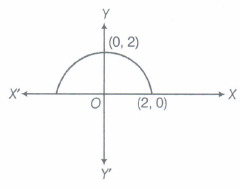
-x2 +2
x2 +2
\(\frac{1}{2}x ^{2}+2\)
\(-\frac{1}{2}x ^{2}+2\)
13.
The roots of quadratic equation ax² + bx + c = 0 is given by
\(\frac { b\pm \sqrt { { b }^{ 2 }-4ac } }{ 2c } \)
\(\frac { -b\pm \sqrt { { b }^{ 2 }-4ac } }{ 2c } \)
\(\frac { b\pm \sqrt { { b }^{ 2 }-4ac } }{ 2c } \)
\(\frac { -b\pm \sqrt { { b }^{ 2 }-4ac } }{ 2c } \)
14.
If x = 1 is a root of equation x2 – Kx + 5 = 0 then value of K is
5
6
4
-6
15.
Write the condition, when given quadratic equation has no real roots
b2 – 4ac = 0
b2 – 4ac > 0
Either A or C
b2 – 4ac < 0
16.
The difference between two numbers is 45 and one number is six times the other. Find them
7,42
8,48
6,36
9,54
17.
If the two zeroes of the quadratic polynomial 7x2 – 15x – k are reciprocals of each other, the value of k is:
1/7
7
-7
5
18.
The graph of y = p(x) is given below. The number of zeroes of p(x) are
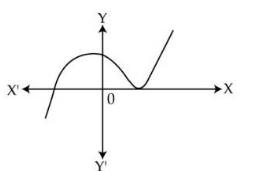
3
0
4
2
19.
There are 135 partcipants in English and 165 in Mathematics in a seminar. What is the minimum number of rooms required to seat them if each room must have the same number of participants from each of the two subjects.
25
30
15
20
20.
What is the HCF of 161 and 303?
1
11
13
3
21.
On a bright Sunday morning three friends A, B and C decided to go on river for fishing and boating. They decided to leave for the place together in the evening. The journey was smooth, it just went as scheduled then they reached to the river, and started to set the boat on sail. They were enjoying their ride with full speed. They started boating from a place to another place which is at a distance of 42 km and then again returns to the starting place. They took 20 hours in all. The time taken by them riding downstream in going 14 km is equal to the time taken by them riding upstream in going 6 km.
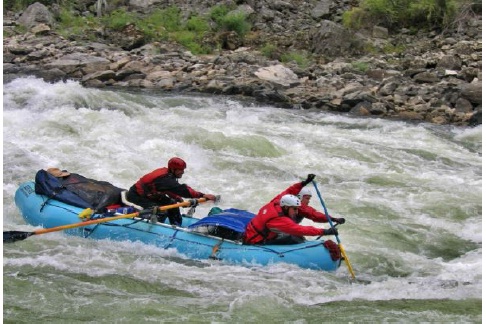
For calculating they took speed of the boat as x km/hr and the speed of the river as y km/hr. Based on the above situation, answer the following questions:
(i) The speed of the boat in downstream is
| (a) x + y km/hr | (b) x – y km/hr | (c) x y km/hr | (d) x/y km/hr |
(ii) The speed of the boat in upstream is
| (a) x + y km/hr | (b) x – y km/hr | (c) x y km/hr | (d) x/y km/hr |
(iii) The speed of the boat in still water is
| (a) 5 km/hr | (b) 2 km/hr | (c) 7 km/hr | (d) none of these |
(iv) The speed of the river is
| (a) 5 km/hr | (b) 2 km/hr | (c) 7 km/hr | (d) none of these |
(v) The speed of boat in upstream is
| (a) 5 km/hr | (b) 2 km/hr | (c) 3 km/hr | (d) 6 km/hr |
22.
A quadratic equation can be defined as an equation of degree 2. This means that the highest exponent of the polynomial in it is 2. The standard form of a quadratic equation is ax2+ bx + c = 0, where a, b, and c are real numbers and \(a \neq 0\) Every quadratic equation has two roots depending on the nature of its discriminant, D = b2 - 4ac.Based on the above information, answer the following questions.
(i) Which of the following quadratic equation have no real roots?
| \((a) -4 x^{2}+7 x-4=0\) | \((b) -4 x^{2}+7 x-2=0\) |
| \((c) -2 x^{2}+5 x-2=0\) | \((d) 3 x^{2}+6 x+2=0\) |
(ii) Which of the following quadratic equation have rational roots?
| \((a) x^{2}+x-1=0\) | \((b) x^{2}-5 x+6=0\) |
| \((c) 4 x^{2}-3 x-2=0\) | \((d) 6 x^{2}-x+11=0\) |
(iii) Which of the following quadratic equation have irrational roots?
| \((a) 3 x^{2}+2 x+2=0\) | \((b) 4 x^{2}-7 x+3=0\) |
| \((c) 6 x^{2}-3 x-5=0\) | \((d) 2 x^{2}+3 x-2=0\) |
(iv) Which of the following quadratic equations have equal roots?
| \((a) x^{2}-3 x+4=0\) | \((b) 2 x^{2}-2 x+1=0\) |
| \((c) 5 x^{2}-10 x+1=0\) | \((d) 9 x^{2}+6 x+1=0\) |
(v) Which of the following quadratic equations has two distinct real roots?
| \((a) x^{2}+3 x+1=0\) | \((b) -x^{2}+3 x-3=0\) |
| \((c) 4 x^{2}+8 x+4=0\) | \((d) 3 x^{2}+6 x+4=0\) |
23.
Points A and B representing Chandigarh and Kurukshetra respectively are almost 90 km apart from each other on the highway. A car starts from Chandigarh and another from Kurukshetra at the same time. If these cars go in the same direction, they meet in 9 hours and if these cars go in opposite direction they meet in 9/7 hours. Let X and Ybe two cars starting from points A and B respectively and their speed be x km/hr and y km/hr respectively.
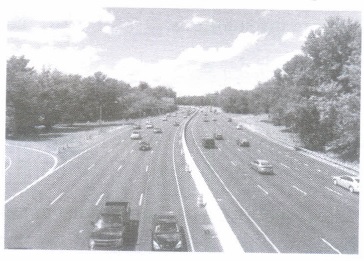
Then, answer the following questions.
(i) When both cars move in the same direction, then the situation can be represented algebraically as
| (a) x - y = 10 | (b) x + y = 10 | (c) x + y = 9 | (d) x - y = 9 |
(ii) When both cars move in opposite direction, then the situation can be represented algebraically as
| (a) x - y=70 | (b) x + y=90 | (c) x + y=70 | (d) x + y=10 |
(iii) Speed of car X is
| (a) 30 km/hr | (b) 40 km/hr | (c) 50 km/hr | (d) 60 km/hr |
(iv) Speed of car Y is
| (a) 50km//hr | (b) 40 km/hr | (c) 30 km/hr | (d) 60 km/hr |
(v) If speed of car X and car Y, each is increased by 10 km/hr, and cars are moving in opposite direction, then after how much time they will meet?
| (a) 5 hrs | (b) 4 hrs | (c) 2 hrs | (d) 1 hr |
24.
ABC construction company got the contract of making speed humps on roads. Speed humps are parabolic in shape and prevents overspeeding, mini mise accidents and gives a chance for pedestrians to cross the road. The mathematical representation of a speed hump is shown in the given graph.
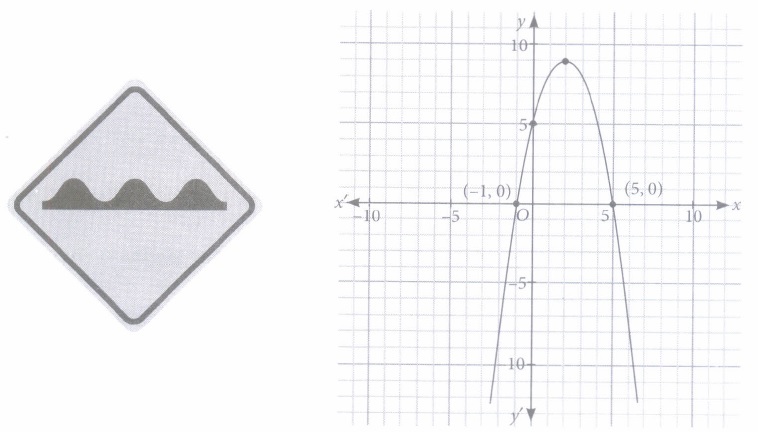
Based on the above information, answer the following questions.
(i) The polynomial represented by the graph can be _______polynomial.
| (a) Linear | (b) Quadratic |
| (c) Cubic | (d) Zero |
(ii) The zeroes of the polynomial represented by the graph are
| (a) 1,5 | (b) 1,-5 |
| (c) -1,5 | (d) -1,-5 |
(iii) The sum of zeroes of the polynomial represented by the graph are
| (a) 4 | (b) 5 | (c) 6 | (d) 7 |
(iv) If a and β are the zeroes of the polynomial represented by the graph such that \(\beta>\alpha, \text { then }|8 \alpha+\beta|=\)
| (a) 1 | (b) 2 | (c) 3 | (d) 4 |
(v) The expression of the polynomial represented by the graph is
| \(\text { (a) }-x^{2}-4 x-5\) | \((b) x^{2}+4 x+5\) | \((c) x^{2}+4 x-5\) | \((d) -x^{2}+4 x+5\) |
25.
Srikanth has made a project on real numbers, where he finely explained the applicability of exponential laws and divisibility conditions on real numbers. He also included some assessment questions at the end of his project as listed below. Answer them.
(i) For what value of n, 4n ends in 0?
| (a) 10 | (b) when n is even |
| (c) when n is odd | (d) no value of n |
(ii) If a is a positive rational number and n is a positive integer greater than 1, then for what value of n, an is a rational number?
| (a) when n is any even integer | (b) when n is any odd integer |
| (c) for all n > 1 | (d) only when n = 0 |
(iii) If x and yare two odd positive integers, then which of the following is true?
| (a) x2 + y2 is even | (b) x2 + y2 is not divisible by 4 |
| (c) x2 + y2 is odd | (d) both (a) and (b) |
(iv) The statement 'One of every three consecutive positive integers is divisible by 3' is
| (a) always true | (b) always false |
| (c) sometimes true | (d) None of these |
(v) If n is any odd integer, then n2 - 1 is divisible by
| (a) 22 | (b) 55 | (c) 88 | (d) 8 |
1.
The given equation is of the form ax2 + bx + c = 0, where a = 2, b = - 4 and c = 3. Therefore, the discriminant
b2 - 4ac = (-4)2 - (4 x 2 x 3) = 16 - 24 = -8 < 0
So, the given equation has no real roots.
2.
336 and 54
336 = 2 x 168
= 2 x 168
= 2 x 2 x 84
= 2 x 2 x 2 x 42
= 2 x 2 x 2 x 2 x 21
= 2 x 2 x 2 x 2 x 7 x 3 x 1
Therefore 336 = 2 x 2 x 2 x 2 x 7 x 3 .......(A)
54 = 2 x 27
= 2 x 3 x 9
= 2 x 3 x 3 x 3
Therefore 54 = 2 x 3 x 3 x 3 ......(B)
From (A) and (B) HCF of 336 and 54 = 2 x 3 = 6
LCM of 336 and 54 = 2 x 3 x 2 x 2 x 2 x 7 x 3 x 3 = 24 x 33 x 7 = 3024
Product of 336 and 54 = 18144
Product of LCM and HCF = 6 x 3024 = 18144
Therefore it is proved that LCM X HCF = Product of the two numbers.
3.
Multiplying Equation (2) by \(\frac{5}{3},\) we get
5x – 8y + 1 = 0
But, this is the same as Equation (1). Hence the lines represented by Equations (1) and (2) are coincident. Therefore, Equations (1) and (2) have infinitely many solutions Plot few points on the graph and verify it yourself.
4.
1000 = 2 x 2 x 2 x 5 x 5 x 5
56 = 2 x 2 x 2 x 7
HCF of 1000 and 56 = 8
\(\therefore\) Maximum number of columns = 8
5.
Given equation is, x3-3x2+5x=(x-2)3
x3-3x2+5x=x3-6x2+12x-8
3x2-7x+8=0
Which is of the form ax2+bx+c=0
Hence, given equation is a quadratic equation.
6.
x/2 + 2y/3 = - 1 and x – y/3 = 3
By elimination method
x/2 + 2y/3 = -1 ... (i)
x – y/3 = 3 ... (ii)
Multiplying equation (i) by 2, we get
x + 4y/3 = - 2 ... (iii)
x – y/3 = 3 ... (ii)
Subtracting equation (ii) from equation (iii), we get
5y/3 = -5
Dividing by 5 and multiplying by 3, we get
y = -15/5
y = - 3
Putting this value in equation (ii), we get
x – y/3 = 3 ... (ii)
x – (-3)/3 = 3
x + 1 = 3
x = 2
Hence our answer is x = 2 and y = −3.
By substitution method
x – y/3 = 3 ... (ii)
Add y/3 both side, we get
x = 3 + y/3 ... (iv)
Putting this value in equation (i) we get
x/2 + 2y/3 = - 1 ... (i)
(3+ y/3)/2 + 2y/3 = -1
3/2 + y/6 + 2y/3 = - 1
Multiplying by 6, we get
9 + y + 4y = - 6
5y = -15
y = - 3
Hence our answer is x = 2 and y = −3.
7.
b=-3, c=3
8.
Geometrically, the zeroes of a polynomial f(x) are the x-coordinates of the points, where the graph of y=f(x) intersects the X-axis.
9.
Let a be any positive integer.
We know that, any odd positive integer is of the form 2q + 1, where q is a whole number.
\(\therefore \) a = 2q + 1
\(\Rightarrow \) a2 = (2q + 1)2 [squaring both sides]
\(\Rightarrow \) a2 = 4q(q + 1) + 1 ...(i)
Note that q(q + 1) is either '0' or even, for any whole number q.
So, let q(q + 1) = 2m where m is a whole number.
From Eq.(i), we get a2 = 4(2m) + 1 = 8m + 1
10.
Let the speed of the passenger train be x km/hr. Then,
Speed of the express train = (x + 11)km/hr
Time taken by the passenger train to cover 132 km between Mysore to Bangalore \(\frac{132}{x} \mathrm{hr}\)
Time taken by the express train to cover 132 km between Mysore to Bangalore = \(=\frac{132}{x+11} \mathrm{hr}\)
Therefore,
\( \frac{132}{x}-\frac{132}{x+11}=1 \)
\( \frac{132(x+11)-132 x}{x(x+11)}=1 \)
\(\frac{132 x+1452-132 x}{x^{2}+11}=1 \)
\(\frac{1452}{x^{2}+11}=1 \)
1452 = x2 + 11
x2 + 11 - 1452 = 0
x2 - 33x + 44x - 1452 = 0
x(x - 33) + 44(x - 33) = 0
(x - 33)(x + 44) = 0
So, either
x - 33 = 0
x = 33
Or
x + 44 = 0
x = -44
But, the speed of the train can never be negative.
Thus, when x = 33 then speed of express train
= x + 11
= 33 + 11
= 44
e speed of the passenger train is x = 33 km/hr
and the speed of the express train is x = 44 km/hr respectively.
11.
(c)
3x+y=900,5x+3y=2100
12.
(a)
-x2 +2
13.
(d)
\(\frac { -b\pm \sqrt { { b }^{ 2 }-4ac } }{ 2c } \)
14.
(b)
6
15.
(d)
b2 – 4ac < 0
16.
(d)
9,54
17.
(b)
7
18.
(c)
4
19.
(d)
20
20.
(a)
1
21.
(i) (a):
Speed of the boat in downtream = x + y km/hr
(ii) (b):
Speed of the boat in upstream = x - y km/hr
According to this statement \(\frac{42}{x+y}+\frac{42}{x-y}=20 \Rightarrow \frac{21}{x+y}+\frac{21}{x-y}=10\) and \(\frac{14}{x+y}=\frac{6}{x-y} \Rightarrow \frac{7}{x+y}-\frac{3}{x-y}=0\)
Let \(\frac{1}{x+y}=\mathrm{p}\) and \(\frac{1}{x-y}=\mathrm{q}\) then we have 21p + 21q = 0 and 7p - 3q = 0
Solving 21p + 21q = 0 and 7p - 3q = 0
we get \(\mathrm{p}=\frac{1}{7}=\frac{1}{x+y} \Rightarrow \mathrm{x}+\mathrm{y}=7\) and \(\mathrm{q}=\frac{1}{3}=\frac{1}{x-y} \Rightarrow \mathrm{x}-\mathrm{y}=3\)
Again solving x + y = 7 and x - y = 3, we get x = 5 and y = 2
(iii) (a):
Speed of the boat = 5 km/hr
(iv) (b):
Speed of the river = 2 km/hr
(v) (c):
Speed of the boat in upstream = 5 – 2 = 3 km/hr
22.
(i) (a): To have no real roots, discriminant (D = b2 - 4ac) should be < 0.
(a) D = 72 - 4(-4)(-4) = 49 - 64 = -15 < 0
(b) D=72-4(-4)(-2)=49-32=17>0
(c) D = 52 - 4(-2)(-2) = 25 - 16 = 9 > 0
(d) D = 62 - 4(3)(2) = 36 - 24 = 12> 0
(ii) (b): To have rational roots, discriminant (D = b2 - 4ac) should be> 0 and also a perfect square
(a) D = 12- 4(1)( -1) = 1 + 4 = 5, which is not a perfect square.
(b) D = (-5)2 - 4(1)(6) = 25 - 24 = I, which is a perfect square.
(c) D = (-3)2 - 4(4)(-2) = 9 + 32 = 41, which is not a perfect square.
(d) D = (-1)2 - 4(6)(11) = 1 - 264 = -263, which is not a perfect square.
(iii) (c) : To have irrational roots, discriminant (D = b2 - 4ac) should be > 0 but not a perfect square.
(a) D = 22 - 4(3)(2) = 4 - 24 = -20 < 0
(b) D = (-7)2 - 4(4)(3) = 49 - 48 = 1 > 0 and also a perfect square.
(c) D = (-3)2 - 4(6)(-5) = 9 + 120 = 129> 0 and not a perfect square.
(d) D = 32 - 4(2)(-2) = 9 + 16 = 25 > 0 and also a perfect square.
(iv) (d): To have equal roots, discriminant (D = b2 - 4ac) should be = 0.
(a) D=(-3)2-4(1)(4)=9-16=-7<0
(b) D = (-2)2 - 4(2)(1) = 4 - 8 = -4 < 0
(c) D = (-10)2 - 4(5)(1) = 100 - 20 = 80 > 0
(d) D = 62 - 4(9)(1) = 36 - 36 = 0
(v) (a): To have two distinct real roots, discriminant (D = b2 - 4ac) should be > 0.
(a) D = 32 - 4(1)(1) = 9 - 4 = 5 > 0
(b) D = 32 - 4(-1)( -3) = 9 - 12 = -3 < 0
(c) D=82- 4(4)(4) = 64-64 = 0
(d) D = 62 - 4(3)(4) = 36 - 48 = -12 < 0
23.
(i) (a) : Suppose two cars meet at point Q. Then,
Distance travelled by car X = A Q,
Distance travelled by car Y = BQ.
It is given that two cars meet in 9 hours.
\(\therefore\) Distance travelled by car X in 9 hours = 9x km
\(\Rightarrow\) AQ=9x
Distance travelled by car Y in 9 hours = 9y km
\(\Rightarrow\) BQ=9y
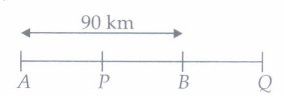
Clearly, AQ - BQ = AB
\(\Rightarrow\) 9x - 9y = 90
\(\Rightarrow\) x-y =10
(ii) (c): Suppose two cars meet at point P. Then
Distance travelled by car X = AP and
Distance travelled by car Y = BP.
In this case, two cars meet in 917 hours.
\(\therefore\) Distance travelled by car X in 9/7 hours = \(\frac {9}{7}\) x km
\(\Rightarrow A P=\frac{9}{7} x\)
Distance travelled by car Y in 9/7 hours \(\frac {9}{7}\) y km
\(\Rightarrow B P=\frac{9}{7} y\)
Clearly, AP + BP = AB
\(\Rightarrow \quad \frac{9}{7} x+\frac{9}{7} y=90 \Rightarrow \frac{9}{7}(x+y)=90 \Rightarrow x+y=70\)
(iii) (b): We have x - y = 10
\(\Rightarrow x+y=70\)
Adding equations (i) and (ii), we get
2x = 80 \(\Rightarrow\) x = 40
Hence, speed of car X is 40 km/hr.
(iv) (c): We have x - y = 10
\(\Rightarrow\) 40 - Y = 10 \(\Rightarrow\) Y = 30
Hence, speed of car y is 30 km/hr.
(v) (d)
24.
(i) (b): Since, the given graph is parabolic is shape, therefore it will represent a quadratic polynomial.
[\(\therefore\) Graph of quadratic polynomial is parabolic in shape 1
(ii) (c): Since, the graph cuts the x-axis at -1, 5. So the polynomial has 2 zeroes i.e., -1 and 5.
(iii) (a) : Sum of zeroes = -1 + 5 = 4
(iv) (c): Since a and β are zeroes of the given polynomial and β > a
\(\therefore\)a = - 1 and β = 5.
\(\therefore|8 \alpha+\beta|=|8(-1)+5|=|-8+5|=|-3|=3 .\)
(v) (d): Since the zeroes of the given polynomial are - 1 and 5.
\(\therefore\) Required polynomial p(x)
= k{ x2 -(-1 + 5)x + (-1)(5)} = k(.x2 - 4x - 5)
For k = -1, we get
p(x) = -.x2 + 4x + 5, which is the required polynomial.
25.
(i) (d) : For a number to end in zero it must be divisible by 5, but 4n = 22n is never divisible by 5. So, 4n never ends in zero for any value of n.
(ii) (c) : We know that product of two rational numbers is also a rational number.
So, a2 = a x a = rational number
a3 = a2 x a = rational number
a4 = a3 x a = rational number
................................................
...............................................
an = an-1 x a = rational number.
(iii) (d): Let x = 2m + 1 and y = 2k + 1
Then x2 + y2 = (2m + 1)2 + (2k + 1)2
= 4m2 + 4m + 1 + 4k2 + 4k + 1 = 4(m2 + k2 + m + k) + 2 So, it is even but not divisible by 4.
(iv) (a): Let three consecutive positive integers be n, n + 1 and n + 2.
We know that when a number is divided by 3, the remainder obtained is either 0 or 1 or 2.
So, n = 3p or 3p + lor 3p + 2, where p is some integer. If n = 3p, then n is divisible by 3.
If n = 3p + 1, then n + 2 = 3p + 1 + 2 = 3p + 3 = 3(p + 1) is divisible by 3.
If n = 3p + 2, then n + 1 = 3p + 2 + 1 = 3p + 3 = 3(p + 1) is divisible by 3.
So, we can say that one of the numbers among n, n + 1 and n + 2 Wi always divisible by 3.
(v) (d): Any odd number is of the form of (2k +1), where k is any integer.
So, n2 - 1 = (2k + 1)2 -1 = 4k2 + 4k
For k = 1, 4k2 + 4k = 8, which is divisible by 8.
Similarly, for k = 2, 4k2 + 4k = 24, which is divisible by 8.
And for k = 3, 4k2 + 4k = 48, which is also divisible by 8.
So, 4k2 + 4k is divisible by 8 for all integers k, i.e., n2 - 1 is divisible by 8 for all odd values of n.

10th Standard CBSE Syllabus & Materials
10th Standard CBSE
CBSE 10th Social Science PS - Federalism - New Model Questions Papers Study Material - QB365 Set A
NEW10th Standard CBSE
CBSE 10th Social Science PS - Power Sharing - New Model Questions Papers Study Material - QB365 Set A
NEW10th Standard CBSE
CBSE 10th Social Science GEO - Manufacturing Industries - New Model Questions Papers Study Material - QB365 Set A
NEW10th Standard CBSE
CBSE 10th Social Science GEO - Minerals and Energy Resources - New Model Questions Papers Study Material - QB365 Set A



NCERT Books

Syllabus

Exam Pattern

Sample Question Papers

Previous year Question Papers

Important Notes

MCQ Practice test

NCERT Exemplers

Case study Questions

Image Based Questions

Passage based Questions

HOT Questions

Value Based Questions

Model Questions Papers
NCERT ( Book Back ) Questions

Assertion and Reason
Important Questions And Answers

CBSE 10th Standard CBSE Subjects
CBSE Standards



