
 100% FREE ACCESS
10th Standard CBSE Syllabus & Materials
10th Standard CBSE
CBSE 10th Social Science ECO - Globalisation and the Indian Economy - New Model Questions Papers Study Material - QB365 Set A
NEW10th Standard CBSE
CBSE 10th Social Science ECO - Money and Credit - New Model Questions Papers Study Material - QB365 Set A
NEW10th Standard CBSE
CBSE 10th Social Science ECO - Sectors of the Indian Economy - New Model Questions Papers Study Material - QB365 Set A
NEW10th Standard CBSE
CBSE 10th Social Science ECO - Development - New Model Questions Papers Study Material - QB365 Set A
NEW10th Standard CBSE
CBSE 10th Social Science PS - Outcomes of Democracy - New Model Questions Papers Study Material - QB365 Set A
NEW10th Standard CBSE
CBSE 10th Social Science PS - Gender, Religion and Caste - New Model Questions Papers Study Material - QB365 Set A

Published on: 20/10/2025
Download CBSE Class 10th Standard CBSE Maths question papers, sample papers, important questions, and previous year solved papers in PDF format. Get free study materials, NCERT solutions, and exam preparation resources for Class 10th Standard CBSE Maths
Questions + Answers key
Take MCQ Maths Test
1.
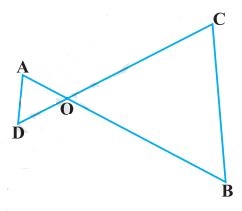
In the given figure, OA . OB = OC . OD. Show that \(\angle\)A = \(\angle\)C and \(\angle\)B = \(\angle\)D.
2.
Show that the following points are collinear: (2,-2),(-3,8) and (-1,4).
3.
Find the value of k for which the given equation has real and equal roots: x2+k(4x+k-1)+2=0
4.
Find the number of terms in the AP 17, 14\(\frac{1}{2}\), 12, ....., -32.
5.
Solve the following quadratic equation by factorization : \(\sqrt3x^2+10x+7\sqrt3=0\)
6.
Prove that \(\frac{2\sqrt 3}{5} \) is an rational number, given that\(\sqrt{3}\)is an irrational number.
7.
Find the zeroes of the given polynomial by factorisation method and verify the relations between the zeroes and the coefficients of the polynomials \(7y^{ 2 }-\frac { 11 }{ 3 } Y-\frac { 2 }{ 3 } \)
8.
There are 156, 208 and 260 students in groups A, B and C respectively. Buses are to be hired to take them for a field trip. Find the minimum number of buses to be hired, if the same number of students should be accommodated in each bus.
9.
In what ratio, does the point (\(\frac { 1 }{ 2 } \), 6) divides the line segment joining the points (3, 5) and (-7, 9)?
10.
The sum of n terms of an AP is 5n2 - 3n. Find the AP and also its 10th term.
11.
State and prove Basic Proportionality theorem.
12.
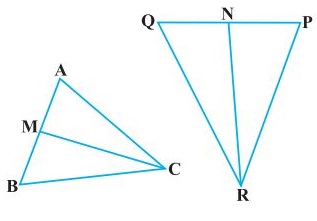
In figure CM and RN are respectively the medians of Δ ABC and Δ PQR. If Δ ABC ~ Δ PQR, prove that :
Δ AMC ~ Δ PNR
13.
Find the value of k for which the following system of equations has infinitely many solutions
x + (k + l)y = 5, (k + 1)x + 9y = (8k -1)
14.
The denominator of a fraction is one more than twice its numerator. If the sum of the fraction and its reciprocal is \(2\frac { 16 }{ 21 } \) find the fraction.
15.
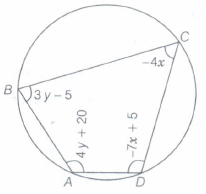
ABCD is a cyclic quadrilateral. Find the angles of the cyclic quadrilateral.
16.
The sum of the digits of a two-digit number is 8 and the difference between the number and that formed by reversing the digits is 18. Find the number.
17.
Find a relation between x and y if the points (x,y), (1,2) and (7,0) are collinear.
18.
Your elder brother wants to buy a car and plans to take loan from a bank for his car. He repays his total loan of Rs 118000 by paying every month starting with the first instalment of Rs 1000. If he increases the instalment by Rs 100 every month, answer the following:


(i) The amount paid by him in 30th instalmnent is
(a) 3900 (b) 3500 (c) 3700 (d) 3600
(ii) The amount paid by him in the 30 instalments is
(a) 37000 (b) 73500 (c) 75300 (d) 75000
(iii) What amount does he still have to pay after 30th instalment?
(a) 45500 (b) 49000 (c) 44500 (d) 54000
(iv) If total instalments are 40, then amount paid in the last instalment?
(a) 4900 (b) 3900 (c) 5900 (d) 9400
(v) The ratio of the 1st instalment to the last instalment is
(a) 1 : 49 (b) 10 : 49 (c) 10 : 39 (d) 39 : 10
19.
In a school, students thought of planting trees in and around the school to reduce air pollution. It was decided that each section of each class would plant twice as many plants as the class standard. There were 3 sections of each standard from 1 to 12. So, if there are three sections in class 1 say 1A, 1B and 1C, then each section would plant 2 trees. Similarly, each section of class 2 would plant 4 trees and so on. Thus, the number of trees planted by classes 1 to 12 formed an AP given by 6, 12, 18,...

(a) What is the common difference of the AP formed
| (i) 6 | (ii) 5 | (iii) 3 | (iv) 2 |
(b) What will be the nth term of the AP formed?
| (i) 5n | (ii) 6n | (iii) 5n+6 | (iv) 6n+6 |
(c) How many trees will be planted by the students of all the sections of class 8?
| (i) 42 | (ii) 48 | (iii) 54 | (iv) 60 |
(d) Find the total number of trees planted by class 12 students.
| (i) 54 | (ii) 72 | (iii) 66 | (iv) None of these |
(e) What will be the third term from the end of the AP formed?
| (i) 72 | (ii) 66 | (iii) 60 | (iv) 54 |
20.
A group of Class X students goes to picnic during vacation. There were three different slides and three friends Ajay, Ram and Shyam are sliding in the three slides. The position of the three friends shown by P, Q and R in three different slides are given below:
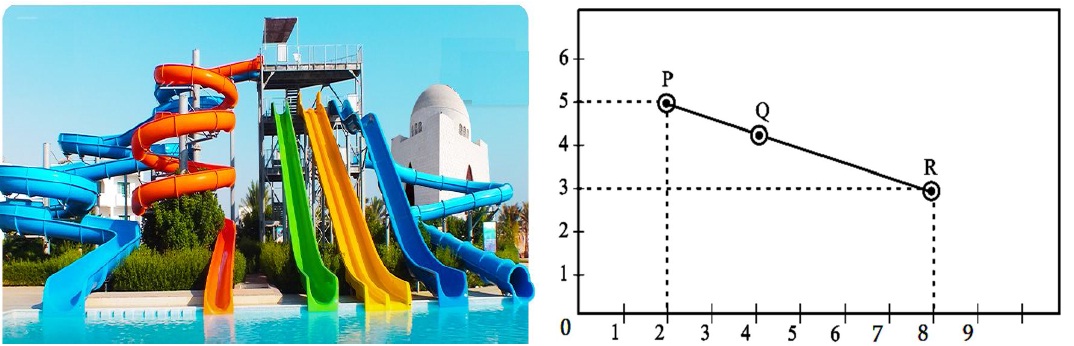
Consider O as origin, answer the below questions
(i) Find the co-ordinates of the point 'Q' which divides the line segment PR in the ratio1:2 internally
| (a) \(\left(4, \frac{13}{3}\right)\) | (b) \(\left(\frac{13}{3}, \frac{11}{3}\right)\) | (c) \(\left(\frac{10}{3}, \frac{13}{3}\right)\) | (d) \(\left(\frac{13}{3}, 4\right)\) |
(ii) Find the distance PR.
| (a) \(2 \sqrt{10} \) | (b) \(\sqrt{36}\) | (c) \(\sqrt{38}\) | (d) \(\sqrt{20}\) |
(iii) Find the co-ordinates of the point on x- axis which is at equal distance PQ.
| (a) \(\left(\frac{11}{9}, 0\right)\) | (b) (3,0) | (c) \(\left(\frac{13}{9}, 0\right)\) | (d) (1,3) |
(iv) Find the co-ordinates of the mid-points of PR.
| (a) (-4,5) | (b) (4,5) | (c) (5,4) | (d) (4,4) |
(v) If we shift origin 'O' by 2 units right and 1 units towards North. Then find the co-ordinates of point R.
| (a) (2,6) | (b) (6,2) | (c) (-6,2) | (d) (-2,6) |
21.
In an examination hall, students are seated at a distance of 2 m from each other, to maintain the social distance due to CORONA virus pandemic. Let three students sit at points A, Band C whose coordinates are (4, -3), (7,3) and (8, 5) respectively.
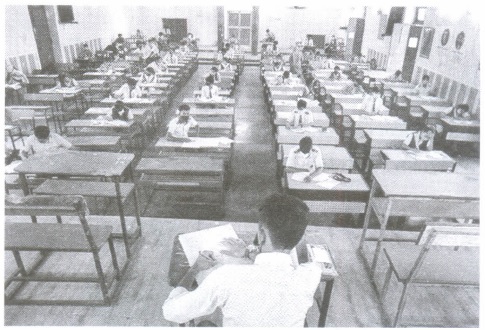
Based on the above information, answer the following questions.
(i) The distance between A and C is
| (a) \(\sqrt{5}\) units | (b) \(4\sqrt{5}\) units | (c) \(3\sqrt{5}\) units | (d) none of these |
(ii) If an invigilator at the point I, lying on the straight line joining Band C such that it divides the distance between them in the ratio of 1 : 2. Then coordinates of I are
| \((a) \left(\frac{22}{3}, \frac{11}{3}\right)\) | \((b) \left(\frac{23}{3}, \frac{13}{3}\right)\) | (c) (6,1) | (d) (9,1) |
(iii) The mid-point of the line segment joining A and C is
| (a) (1.6) | (b) (6.1) | \(\text { (c) }\left(\frac{11}{2}, 0\right)\) | (d) none of these |
(iv) The ratio in which B divides the line segment joining A and C is
| (a) 2:1 | (b) 3:1 | (c) 1:2 | (d) none of these |
(v) The points A, Band C lie on
| (a) a straight line | (b) an equilateral triangle |
| (c) a scalene triangle | (d) an isosceles triangle |
22.
In a soccer match, the path of the soccer ball in a kick is recorded as shown in the following graph.
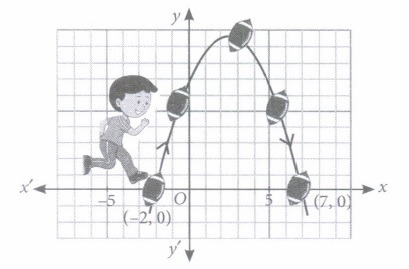
Based on the above i!;formation, answer the following questions.
(i) The shape of path of the soccer ball is a
| (a) Circle | (b) Parabola | (c) Line | (d) None of these |
(ii) The axis of symmetry of the given parabola is
| (a) y-axis | (b) x-axis |
| (c) line parallel to y-axis | (d) line parallel to x-axis |
(iii) The zeroes of the polynomial, represented in the given graph, are
| (a) -1,7 | (b) 5,-2 | (c) -2,7 | (d) -3,8 |
(iv) Which of the following polynomial has -2 and -3 as its zeroes?
| \((a) x^{2}-5 x-5\) | \((b) x^{2}+5 x-6\) | \((c) x^{2}+6 x-5\) | \((d) x^{2}+5 x+6\) |
(v) For what value of 'x', the value of the polynomial \(f(x)=(x-3)^{2}+9 \text { is } 9 ?\)
| (a) 1 | (b) 2 | (c) 3 | (d) 4 |
1.
OA. OB = OC . OD (Given)
So, \(\frac{\mathrm{OA}}{\mathrm{OC}}=\frac{\mathrm{OD}}{\mathrm{OB}}\) (1)
Also, we have \(\angle\)AOD = \(\angle\)COB (Vertically opposite angles) (2)
Therefore, from (1) and (2), \(\Delta\)AOD \(\sim\) \(\Delta\)COB (SAS similarity criterion)
So, \(\angle\)A = \(\angle\)C and \(\angle\)D = \(\angle\)B
(Corresponding angles of similar triangles)
2.
Using distance formula
\(AB=\sqrt { ({ -3-2) }^{ 2 }+[8-({ -2)] }^{ 2 } } \)
\(=\sqrt { { 5 }^{ 2 }+10^{ 2 } } =\sqrt { 25+100 } \)
\(=\sqrt { 125 } =5\sqrt { 5 } units\)
\(BC=\sqrt { [{ -1-(-3)] }^{ 2 }+(4-8)^{ 2 } } \)
\(=\sqrt { { 2 }^{ 2 }+4^{ 2 } } =\sqrt { 4+16 } =\sqrt { 20 } \)
\(=2\sqrt { 5 } units\)
\(AC=\sqrt { ({ -1-2) }^{ 2 }+[4-(-2)]^{ 2 } } \)
\(=\sqrt { { 3 }^{ 2 }+6^{ 2 } } =\sqrt { 9+36 } =\sqrt { 45 } \)
\(=3\sqrt { 5 } units\)
\(\because \ 2\sqrt { 5 } +3\sqrt { 5 } =5\sqrt { 5 } \)
∴ Points are collinear.
3.
Let length be x m and breadth be y m
Perimeter =2(l+b) \(\Rightarrow \) 2(x+y)=80
\(\Rightarrow \) x+y=40 \(\Rightarrow \) y=40-x
Area = lxb \(\Rightarrow \) x(40-x) =300
\(\Rightarrow \) 40-x2=300 \(\Rightarrow \) x2-40x+300=0
D=b2-4ac=(-40)2-4x1x300=1600-1200=400 > 0
\(\therefore \) Real solution is possible
Hence it is possible to design sides of a park.
4.
Here a = 17, d = 14\(\frac{1}{2}\) - 17 =\(\frac{29}{2}\) - 17 = \(-\frac{5}{2}\)
Let number of terms in AP = n
an = -38
\(\Rightarrow\) a + (n - 1)d = -38
\(\Rightarrow\) 17 + (n - 1) x \((-\frac{5}{2})\) = -38
\(\Rightarrow\) (n - 1)\((-\frac{5}{2})\) = -55
\(\Rightarrow\) (n - 1) = -55 x \((-\frac{2}{5})\) = 22
n = 23
5.
\(\sqrt3x^2+10x+7\sqrt3=0\)
\(\sqrt3 x^2+10x+7\sqrt3=0\)
\(\sqrt3x^2+7x+3x+7\sqrt3=0\)
\(x(\sqrt3x+7)+\sqrt3(\sqrt3x+7)=0\)
\((\sqrt3x+7)(x+\sqrt3)=0\)
\(x={-7\over \sqrt3} \ or \ x=-\sqrt3\)
6.
Let us assume that \(\frac{2\sqrt 3}{5} \)is rational number. Then, it will be
of the form \( \frac{a}{b} \) where a, b are coprime integers and b \(\neq\)0
Now \(\frac{2\sqrt 3}{5}\) \(\frac{a}{b}\)
On rearranging, we get \(\frac{5a -2b}{b}\) = \( \sqrt{3} \)
Since, 5 and are rational. So, \(\frac{5a -2b}{b}\) Will be rational
\(\therefore\) \( \sqrt{3} \) is rational.
But given that, \( \sqrt{3} \) is irrational So, this contradicts the fact that \( \sqrt{3} \) is irrational. Therefore, our assumption is wrong.
Hence, \(\frac{ 2+ \sqrt 3}{5}\)is Irrational
7.
Let \(f(y)=7y^{ 2 }-\frac { 11 }{ 3 } y-\frac { 2 }{ 3 }\)
\(=\frac { 21y^{ 2 }-11y-2 }{ 3 } \)
\(=\frac { 21y^{ 2 }-14y+3y-2 }{ 3 } \) [by splitting the middle term]
\(=\frac { 7y(3y-2)+1(3y-2) }{ 3 } \)
\(=\frac { 1 }{ 3 } (3y-2)(7y+1)\)
So, the value of \(7y^{ 2 }-\frac { 11 }{ 3 } y-\frac { 2 }{ 3 } \) is zero whe 3y-2=0 or 7y+1=0, i.e. when \(y=\frac { 2 }{ 3 } \) or \(y=\frac { 1 }{ 7 } \).
Thus, the zeroes\(=\frac { 2 }{ 3 } -\frac { 1 }{ 7 } =\frac { 14-3 }{ 21 } =\frac { 11 }{ 21 } =-\left( \frac { -11 }{ 3\times 7 } \right) \)
\(=-(1).\left( \frac { Coefficient \ of \ y }{ Coefficient \ of \ y^{ 2 } } \right) \) and product of zeroes\(=\left( \frac { 2 }{ 3 } \right) \left( -\frac { 1 }{ 7 } \right) =\frac { -2 }{ 21 } =\frac { -2 }{ 3\times 7 } \)
\(=\left( \frac { Constant \ term }{ Coefficient \ of \ y^{ 2 } } \right) \)
Hence, the relations between the zeroes and the coefficients of the polynomials is verified.
8.
Given numbers are 156, 208 and 260.
Here, 260 > 208 > 156
Let us first find the HCF of 260 and 208
By using Euclid's division lemma for 260 and 208,
we get
260 = (208 x 1) + 52
Here, remainder = 52 \(\neq \) 0
On taking 208 as new dividend and 52 as new divisor and then apply Euclid's division lemma, we get
208 = (52 x 4) + 0
Here, the remainder is zero and the divisor is 52.
So, 52 is the HCF of 208 and 260.
Now, 156 > 52
Let us find the HCF of 52 and 156. By using Euclid's division lemma, we get
156 = (52 x 3) + 0
Here, the remainder is zero and the divisor is 52.
So, 52 is the HCF of 52 and 156.
Thus, HCF of 156, 208 and 260 is 52.
Hence, the minimum number of buses
\(=\frac { 156 }{ 52 } +\frac { 208 }{ 52 } +\frac { 260 }{ 52 } \)
= 3 + 4 + 5 = 12
9.
1: 3
10.
Sum of n terms of given A.P. Sn =5n2 - 3n
\(\therefore\) Sum of ( n - 1 ) terms of given AP,
Sn - 1 = 5 ( n - 1 )2 - 3( n - 1 )
Sn - 1 =5 ( n2 - 2n + 1 ) - 3n + 3
= 5n2 - 10n + 5 - 3n + 3 = 5n2 - 13n + 8
\(\therefore\) nth term of AP = an = Sn - Sn - 1 = ( 5n2 - 3n ) - ( 5n2 - 13n + 8 )
an = 10n - 8
\(\therefore\) Ist term of AP = 10 x 1 - 8 = 2
2nd term of AP = 10 x 2 - 8 = 12 and 3rd term of AP = 10 X 3 - 8 = 22
\(\therefore\) Required AP is 2, 12, 22, ...
\(\therefore\) a10 = 10 X 10 - 8 = 92
11.
Basic Proportionality theorem It states that if a line is parallel to a side of a triangle which intersects the other sides into two distinct points, then the line divides those sides of the triangle in proportion.
Given Let ABC be a triangle.
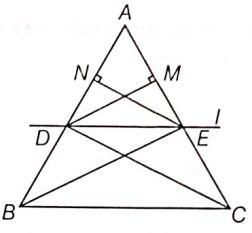
In the given triangle, line I is parallel to BC which intersect AB at D and AC at E.
To prove \(\frac{A D}{D B}=\frac{A E}{E B}\)
Construction Join BE and CD. Draw perpendicular lines DM and EN to the sides AC and AB of \(\Delta\)ABC respectively, as shown in the figure.
Proof Consider the given \(\Delta\)ABC.
\(\Delta\)ADE and \(\Delta\)DEB have equal heights i.e. EN.
So, area of \(\Delta\)ADE = \(\frac{1}{2} \times A D \times E N\)
Area of \(\Delta\)DEB = \(\frac{1}{2} \times D B \times E N\)
Thus, \(\frac{\text { Area }(\triangle A D E)}{\text { Area }(\triangle D E B)}=\frac{A D}{D B}\) ...(i)
Similarly, consider the \(\Delta\)ADE with base AE and height DM.
\(\begin{aligned}
& \text { Area of } \triangle A D E=\frac{1}{2} \times A E \times D M \\
\end{aligned}\)
\(\begin{aligned}
& \text { Area of } \triangle C D E=\frac{1}{2} \times E C \times D M \\
\end{aligned}\)
\(\begin{aligned}
& \frac{\text { Area }(\triangle A D E)}{\text { Area }(\triangle C D E)}=\frac{A E}{E C}
\end{aligned}\) ...(ii)
It is known that triangles with the same base and between same parallel lines have an equal area
Here, \(\Delta\)BDE and \(\Delta\)CDE have the same base DE and lie between the parallel lines DE and BC
\(\Rightarrow\) \(A(\triangle D E B)=A(\triangle D E C)\) ...(iii)
From Eqs. (i), (ii) and (iii), we get
\(\begin{array}{rlrl}
\frac{A(\triangle A D E)}{A(\triangle D E B)} =\frac{A(\triangle A D E)}{A(\triangle D E C)} \\
\end{array}\)
\(\Rightarrow \quad \frac{A D}{D B}=\frac{A E}{E C}\) Hence proved
12.
Δ ABC ~ Δ PQR (Given)
So, \(\frac{\mathrm{AB}}{\mathrm{PQ}}=\frac{\mathrm{BC}}{\mathrm{QR}}=\frac{\mathrm{CA}}{\mathrm{RP}}\) (1)
and \(\angle\) A = \(\angle\) P, \(\angle\) B = \(\angle\) Q and \(\angle\) C = \(\angle\) R (2)
But AB = 2 AM and PQ = 2 PN
(As CM and RN are medians)
So, from (1), \(\frac{2 \mathrm{AM}}{2 \mathrm{PN}}=\frac{\mathrm{CA}}{\mathrm{RP}}\)
i.e., \(\frac{\mathrm{AM}}{\mathrm{PN}}=\frac{\mathrm{CA}}{\mathrm{RP}}\) (3)
Also, \(\angle\) MAC = \(\angle\) NPR [From (2)] (4)
So, from (3) and (4),
Δ AMC ~ Δ PNR (SAS similarity) (5)
13.
k = 2
14.
Let the fraction be \(\frac { x }{ 2x+1 } \)
\(\frac { x }{ 2x+1 } +\frac { 2x+1 }{ x } =\frac { 58 }{ 21 } Z\)
\(21[x^{ 2 }+(2x+)=58(2x^{ 2 }+x)\)
\(\Rightarrow 11x^{ 2 }-26x-21=0\)
\(x=3,\frac { 7 }{ 11 } \) (rejected)
Fraction = \(\frac { 3 }{ 7 } \)
15.
We know that, in a cyclic quadrilateral, the sum of two opposite angles is 180°.
\(\therefore \quad \angle B+\angle D={ 180 }^{ 0 } and \quad \angle A+\angle C={ 180 }^{ 0 }\)
\(\Rightarrow \) 3y-5-7x+5=180 and 4y+20-4x=180
\(\Rightarrow \) 3y-7x=180 ...(i)
and 4y-4x=160
\(\Rightarrow \) y-x=4. [dividing both sides by 4] ...(ii)
On multiplying Eq. (ii) by 7 and then subtracting from Eq. (i), we get
-4y=180-280
\(\Rightarrow \) -4y=-100 y=25
On putting y=25 in Eq. (ii), we get
25-x=40 x=-15
On putting the values of x and y, we calculate the angles as
\(\angle A=4y+20=100+20={ 120 }^{ 0 }.\)
\(\\ \angle B=3y-5=75-5={ 70 }^{ 0 }.\)
\(\\ \angle C=-4x=-4(-15)={ 60 }^{ 0 }.\)
and \( \angle D=-7x+5=105+5={ 110 }^{ 0 }.\)
Hence, the angles are \(\angle A={ 120 }^{ 0 },\angle B={ 70 }^{ 0 },\angle C={ 60 }^{ 0 }\) and \( \angle D={ 110 }^{ 0 }.\)
16.
Let unit's digit be y and ten's digit be x. Then, x+y=8 and (10x+y)-(10y+x)=18
\(\Rightarrow\) 9x-9y=18
x=5, y=3, Required number=53
17.
\(\because\) Points (x,y), (1,2) and (7,0) are colinear
\(\because\) Area of the triangle formed by these pointer is 0.
⇒ \(\frac{1}{2}\)[x(2-0)+1(0-y)+7(y-2)=0
⇒ [2x+1(-y)+7y-14]=0 ⇒ 2x-y+7y-14=0
⇒ 2x+6y-14=0 ⇒ x+3y-7=0
18.
(a) Since, he pays first instalment of? 1000 and next consecutive months he pay the instalment are 1100, 1200, ..... .
Thus, we get the AP sequence,
1000, 1100, 1200, ...
Here, a = 1000, d = 1100 - 1000 = 100
Now, T30 = a + (30 - 1) d
= 1000 + 29 \(\times\) 100
= 1000 + 2900 = 3900
Hence, the amount paid by him in 30th instalment is Rs 3900.
(ii) (b) Now, \(S_{30}=\frac{30}{2}[2 a+(30-1) d]\)
= 15 (2 \(\times\) 1000 + 29 \(\times\)100)
= 15 (2000 + 2900)
= 15 \(\times\) 4900 = Rs 73500
(iii) (c) After 30th instalment, he still have to pay = 118000 - 73500= 44500
(iv) (a) The amount in last 40th instalment is
T40 = a + (40 - 1)d
= 1000 + 39 \(\times\) 100
= 1000 + 3900 = Rs 4900
(v) (b) The ratio of Ist instalment to the last instalment is \(\frac{1000}{4900} \text { i.e. } \frac{10}{49}\)
19.
(a) (i)
The given AP is 6,12,18...,
The common difference = 12-6 =6.
(b) (ii)
In the given AP, we have:a=d=6
\(\therefore a_{n}=a+(n-1) d=6+(n-1) 6=6+6 n-6=6 n\)
(c) (ii)
The number of trees planted by the students of all the sections of class
= 8th term of the given AP
= 6n = 6X8=48
(d) (ii) T
otal number of trees planted by class 12 students
= 6 X 12 = 72
(e) (iii)
3rd term from the end = \((n-3+1) \text { th term }\)
= (12-3+1) th term = 10th term
= 6X10=60
20.
(i) (a): \(x=\frac{m_{1} x_{1}+m_{2} x_{1}}{m_{1}+m_{2}}=\frac{1(8)+2(2)}{3}\)
\(=\frac{12}{3}=4\)
\(y=\frac{m_{1} y_{2}+m_{2} y_{1}}{m_{1}+m_{2}}=\frac{1(3)+2(5)}{3}=\frac{13}{3}\)
co-ordinates of the point 'Q' are \(\left(4, \frac{13}{3}\right)\)
(ii) (a): \(\mathrm{PR}=\sqrt{\left(x_{2}-x_{1}\right)^{2}+\left(y_{2}-y_{1}\right)^{2}}\)
\(=\sqrt{(8-2)^{2}+(3-5)^{2}}\)
\(=\sqrt{6^{2}+2^{2}}=\sqrt{40}\)
= \(2 \sqrt{10} \)
(iii) (c): Let A(x,0) be the point on x- axis which is equidistant from P and Q, then we have PA = QA
\(\Rightarrow \mathrm{PA}^{2}=\mathrm{QA}^{2}\)
\((2-x)^{2}+(5-0)^{2}=(4-x)^{2}+\left(\frac{13}{3}-0\right)^{2}\)
\(\Rightarrow 4+x^{2}-4 x+25=16+x^{2}-8 x+\frac{169}{9}\)
\(\Rightarrow \quad 4 x=16+\frac{169}{9}-4-25 \Rightarrow x=\frac{13}{9}\)
Hence the point, \(\left(\frac{13}{9}, 10\right) .\)
(iv) (c): Mid-points of PR. \(=\frac{x_{1}+x_{2}}{2}, \frac{y_{1}+y_{2}}{2}\)
\(=\left(\frac{2+8}{2}, \frac{5+3}{2}\right)\)
\(=\left(\frac{10}{2}, \frac{8}{2}\right)\)
= (5,4)
(v) (b):
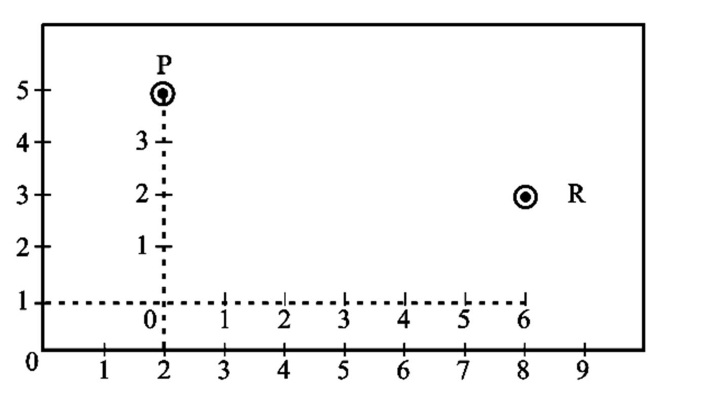
The co-ordinates of point R is (6,2)
21.
(i) (b): The distance between A and C
\(=\sqrt{(8-4)^{2}+(5+3)^{2}}=\sqrt{4^{2}+8^{2}} \)
\(=\sqrt{16+64}=\sqrt{80}=4 \sqrt{5} \text { units }\)
(ii) (a): Let the coordinates of I be (x, y).
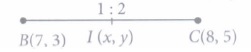
Then, by section formula
\(x =\frac{1 \times 8+2 \times 7}{1+2}=\frac{8+14}{3}=\frac{22}{3}\)
\(\text { and } y =\frac{1 \times 5+2 \times 3}{1+2}=\frac{5+6}{3}=\frac{11}{3}\)
Thus, the coordinates of I is \(\left(\frac{22}{3}, \frac{11}{3}\right)\)
(iii) (b): The mid -point of A and C
\(=\left(\frac{8+4}{2}, \frac{5-3}{2}\right)=(6,1)\)
(iv) (b): Let B divides the line segment joining A and C in the ratio k : 1. Then, the coordinates of B will be
\(\left(\frac{8 k+4}{k+1}, \frac{5 k-3}{k+1}\right)\)
\(\text { Thus, we have }\left(\frac{8 k+4}{k+1}, \frac{5 k-3}{k+1}\right)=(7,3)\)
\(\Rightarrow \frac{8 k+4}{k+1}=7 \text { and } \frac{5 k-3}{k+1}=3
\)
\(\text { Consider, } \frac{8 k+4}{k+1}=7 \Rightarrow 8 k+4=7 k+7 \Rightarrow k=3\)
Hence, the required ratio is 3 : 1
(v) (a):\(\because\) B divides AC in the ratio 3 : 4.
\(\therefore\) A, B, C lie on a straight line.
22.
(i) (b): The shape of the path of the soccer ball is a parabola.
(ii) (c): The axis of symmetry of the given curve is a line parallel to y-axis.
(iii) (a): The zeroes of the polynomial, represented in the given graph, are -2 and 7, since the curve cuts the x-axis at these points.
(iv) (d):A polynomial having zeroes -2 and -3 is \(p(x)=x^{2}-(-2-3) x+(-2)(-3)=x^{2}+5 x+6\)
(v) (c): We have \(f(x)=(x-3)^{2}+9\)
\(\text { Now, } 9=(x-3)^{2}+9 \)
\(\Rightarrow(x-3)^{2}=0 \Rightarrow x-3=0 \Rightarrow x=3\)

10th Standard CBSE Syllabus & Materials
10th Standard CBSE
CBSE 10th Social Science PS - Federalism - New Model Questions Papers Study Material - QB365 Set A
NEW10th Standard CBSE
CBSE 10th Social Science PS - Power Sharing - New Model Questions Papers Study Material - QB365 Set A
NEW10th Standard CBSE
CBSE 10th Social Science GEO - Manufacturing Industries - New Model Questions Papers Study Material - QB365 Set A
NEW10th Standard CBSE
CBSE 10th Social Science GEO - Minerals and Energy Resources - New Model Questions Papers Study Material - QB365 Set A



NCERT Books

Syllabus

Exam Pattern

Sample Question Papers

Previous year Question Papers

Important Notes

MCQ Practice test

NCERT Exemplers

Case study Questions

Image Based Questions

Passage based Questions

HOT Questions

Value Based Questions

Model Questions Papers
NCERT ( Book Back ) Questions

Assertion and Reason
Important Questions And Answers

CBSE 10th Standard CBSE Subjects
CBSE Standards



