
 100% FREE ACCESS
10th Standard CBSE Syllabus & Materials
10th Standard CBSE
CBSE 10th Social Science ECO - Globalisation and the Indian Economy - New Model Questions Papers Study Material - QB365 Set A
NEW10th Standard CBSE
CBSE 10th Social Science ECO - Money and Credit - New Model Questions Papers Study Material - QB365 Set A
NEW10th Standard CBSE
CBSE 10th Social Science ECO - Sectors of the Indian Economy - New Model Questions Papers Study Material - QB365 Set A
NEW10th Standard CBSE
CBSE 10th Social Science ECO - Development - New Model Questions Papers Study Material - QB365 Set A
NEW10th Standard CBSE
CBSE 10th Social Science PS - Outcomes of Democracy - New Model Questions Papers Study Material - QB365 Set A
NEW10th Standard CBSE
CBSE 10th Social Science PS - Gender, Religion and Caste - New Model Questions Papers Study Material - QB365 Set A

Published on: 20/10/2025
Download CBSE Class 10th Standard CBSE Maths question papers, sample papers, important questions, and previous year solved papers in PDF format. Get free study materials, NCERT solutions, and exam preparation resources for Class 10th Standard CBSE Maths
Questions + Answers key
Take MCQ Maths Test
1.
Find the roots of the equation 2x2 - 5x + 3 = 0, by factorisation.
2.
Which of the following pairs of linear equations are consistent/inconsistent? If consistent, obtain the solution graphically:
2x + y – 6 = 0, 4x – 2y – 4 = 0
3.
Find the zeroes of the following quadratic polynomials and verify the relationship between the zeroes and the coefficients.
x2 – 2x – 8
4.
Solve the following pair of linear equations by the substitution method
0.2x+ 0.3y = 1.3
0.4x + 0.5y = 2.3
5.
Show that \(5-\sqrt { 3 } \) is irrational.
6.
Represent the following situations mathematically:
John and Jivanti together have 45 marbles. Both of them lost 5 marbles each, and the product of the number of marbles they now have is 124. We would like to find out how many marbles they had to start with.
7.
Solve the following question - Aftab tells his daughter, “Seven years ago, I was seven times as old as you were then. Also, three years from now, I shall be three times as old as you will be.” (Isn’t this interesting?) Represent this situation algebraically and graphically by the method of substitution.
8.
Find the zeroes of the following quadratic polynomials and verify the relationship between the zeroes and the coefficients
3x2 – x – 4
9.
Find the zeroes of the following quadratic polynomials and verify the relationship between the zeroes and the coefficients.
4u2 + 8u
10.
Prove that the following are irrational :
\(\frac{1}{\sqrt{2}}\)
11.
Find the HCF and LCM of 6, 72 and 120 using the prime factorisation method.
12.
Solve the following pair of linear equations by the substitution method
s - t = 3
\(\\ \frac { s }{ 3 } +\frac { t }{ 2 } =6\)
13.
Find the roots of the quadratic equation: \(3x^{2}-2\sqrt {6} \ x +2 = 0\)
14.
Find two consecutive positive integers, sum of whose squares in 365.
15.
Check whether the following are quadratic equations: (x+1)2=2(x-3)
16.
On comparing the ratios \(\frac{a_{1}}{a_{2}}, \frac{b_{1}}{b_{2}} and \frac{c_{1}}{c_{2}}\) find out whether the following pair of linear equations are consistent, or inconsistent.
\(\frac{3}{2} x+\frac{5}{3} y=7 ; 9 x-10 y=14\)
17.
Find the LCM and HCF of the following pairs of integers and verify that LCM x HCF = Product of the two numbers.
336 and 54
18.
Find the LCM and HCF of the following integers by applying the prime factorisation method.
17, 23 and 29
19.
Find a quadratic polynomial each with the given numbers as the sum and product of its zeroes respectively.
\(0, \sqrt{5}\)
20.
Find a quadratic polynomial each with the given numbers as the sum and product of its zeroes respectively.
\(\sqrt{2}, \frac{1}{3}\)
21.
Consider the numbers 4n , where n is a natural number. Check whether there is any value of n for which 4n ends with the digit zero.
22.
On comparing the ratios \(\frac { { a }_{ 1 } }{ { a }_{ 2 } } ,\frac { { b }_{ 1 } }{ { b }_{ 2 } } and\frac { { c }_{ 1 } }{ { c }_{ 2 } } \), find out whether the following pairs of linear equations are consistent or inconsistent:
3x + 2y = 5; 2x - 3y = 7
23.
Find the nature of the roots of the following quadratic equation. If the real roots exist, find them: 2x2-6x+3=0
24.
The pair of equations ax + 2y = 9 and 3x - by = 18 represent parallel lines, where a, b are integers, if
a=b
3a = 2b
2a = 3b
ab = 6
25.
If the square of difference of the zeroes of the quadratic polynomial x2 + px + 45 is equal to 144, then the value of p is
土9
土12
土15
土18
26.
HCF of two numbers is 27 and their LCM is 162 of the number is 54, then the other number is
36
35
9
81
27.
If a cubic polynomial with the sum of its zeroes, sum of the products and its zeroes taken two at a time and product of its zeroes as 2, -5 and -11 respectively, then the cubic polynomial is
x3 + 7 x - 6
x3 + 7 x + 6
x3 - 7 x - 6
x3 - 7 x + 6
28.
The same value of x satisfies the equations 4x + 5 = 0 and 4x2 + (5 + 3p)x + 3p2=0, then p is
0 or 5/4
¼ or ½
0 or ¼
0 or ½
29.
Which of the following equations has two distinct real roots?
5x2 – 3x + 1 = 0
x2 + 3x + 2√2 = 0
2x2 – 3√2 x + 9/4 = 0
x2 + x – 5 = 0
30.
The nature of the roots of following quadratic equation 3x2-4√3x+4=0 is
Unequal
Equal
No real roots
None of above
31.
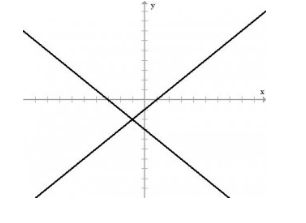
The graph below represents equations that have
unique solution
solution as 0
infinite solution
no solution
32.
What is the solution of the equations \(\sqrt { 2 } x-\sqrt { 3 } y\ =\ 0\ and\ \sqrt { 5 } x+\sqrt { 2 } y=0\)
0, 2
2, 0
0, 0
None
33.
Given that HCF (26 , 91) = 13, then LCM of (26 , 91) is :
182
91
364
2366
34.
Quadratic equations started around 3000 B.C. with the Babylonians. They were one of the world's first civilisation, and came up with some great ideas like agriculture, irrigation and writing. There were many reasons why Babylonians needed to solve quadratic equations. For example to know what amount of crop you can grow on the square field;
Based on the above information, represent the following questions in the form of quadratic equation.
(i) The sum of squares of two consecutive integers is 650.
| (a) x2 + 2x - 650=0 | (b) 2x2 + 2x - 649=0 | (c) x2 - 2x - 650=0 | (d) 2x2 + 6x - 550=0 |
(ii) The sum of two numbers is 15 and the sum of their reciprocals is 3/10.
| (a) x2+ 10x-150=0 | (b) 15x2-x + 150=0 | (c) x2-15x + 50=0 | (d) 3x2 - 10x + 15 = 0 |
(iii) Two numbers differ by 3 and their product is 504.
| (a) 3x2- 504=0 | (b) x2- 504x+3=0 | (c) 504x2+3=x | (d) x2 + 3x - 504 = 0 |
(iv) A natural number whose square diminished by 84 is thrice of 8 more of given number.
| (a) x2 + 8x-84=0 | (b) 3x2 - 84x+3=0 | (c) x2 -3x-108=0 | (d) x2 -11x+60=0 |
(v) A natural number when increased by 12, equals 160 times its reciprocal.
| (a) x2 - 12x + 160 = 0 | (b) x2 - 160x + 12 = 0 | (c) 12x2 - x - 160 = 0 | (d) x2 + 12x - 160 = 0 |
35.
Mr Manoj Jindal arranged a lunch party for some of his friends. The expense of the lunch are partly constant and partly proportional to the number of guests. The expenses amount to Rs 650 for 7 guests and Rs 970 for 11 guests .
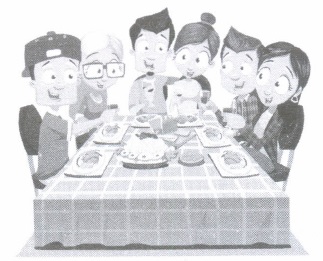
Denote the constant expense by Rs x and proportional expense per person by Rs y and answer the following questions.
(i) Represent both the situations algebraically.
| (a) x + 7y = 650, x + 11y = 970 | (b) x - 7y = 650, x - 11y = 970 |
| (c) x+ 11y=650,x+7y=970 | (d) 11x + 7y = 650, 11x - 7y = 970 |
(ii) Proportional expense for each person is
| (a) Rs 50 | (b) Rs 80 | (c) Rs 90 | (d) Rs 100 |
(iii) The fixed (or constant) expense for the party is
| (a) Rs 50 | (b) Rs 80 | (c) Rs 90 | (d) Rs 100 |
(iv) If there would be 15 guests at the lunch party, then what amount Mr Jindal has to pay?
| (a) Rs 1500 | (b) Rs 1300 | (c) Rs 1200 | (d) Rs 1290 |
(v) The system of linear equations representing both the situations will have
| (a) unique solution | (b) no solution |
| (c) infinitely many solutions | (d) none of these |
1.
Let us first split the middle term - 5x as -2x -3x [because (-2x) x (-3x) = 6x2 = (2x2 ) x 3].
So, 2x2 - 5x + 3 = 2x2 - 2x - 3x + 3 = 2x (x - 1) -3(x - 1) = (2x - 3)(x - 1)
Now, 2x2 - 5x + 3 = 0 can be rewritten as (2x - 3)(x - 1) = 0.
So, the values of x for which 2x2 - 5x + 3 = 0 are the same for which (2x - 3)(x - 1) = 0,
i.e., either 2x - 3 = 0 or x - 1 = 0.
Now, 2x - 3 = 0 gives x = \(\frac{3}{2}\) and x - 1 = 0 gives x = 1.
So, x = \(\frac{3}{2}\) and x = 1 are the solutions of the equation.
In other words, 1 and \(\frac{3}{2}\) are the roots of the equation 2x2 - 5x + 3 = 0.
Verify that these are the roots of the given equation.
Note that we have found the roots of 2x2 - 5x + 3 = 0 by factorising 2x2 - 5x + 3 into two linear factors and equating each factor to zero.
2.
Given, pair of linear equations is
2x + y - 6 = 0 ....(i)
and 4x - 2y - 4 = 0 ....(ii)
On Comparing with standard form of pair of linear equations, we get a1 = 2, b1 = 1, c1 = -6
and a2=4,b2=-2, c2= -4
Here,
\(\frac{a_{1}}{a_{2}}=\frac{2}{4}=\frac{1}{2}, \frac{b_{1}}{b_{2}}=-\frac{1}{2}\) and \(\frac{c_{1}}{c_{2}}=\frac{-6}{-4}=\frac{3}{2}\)
Thus, \(\frac{1}{2}\neq -\frac{1}{2}, i.e.\frac{a_{1}}{a_{2}}\neq \frac{b_{1}}{b_{2}}\)
Hence, the given pair of linear equations is consistent. Now, on plotting the graph similar to Q. 1, we get the following graph.
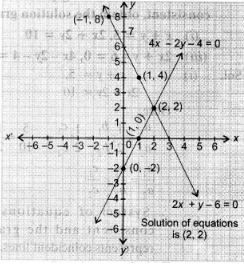
The lines AB and DE intersect at point C(2, 2).
Hence, the unique solution is x = 2, y =2.
3.
Let p(x) = x2 - 2x - 8
= x2 - 4x + 2x - 8 [by splitting the middle term]
= x(x - 4) + 2(x - 4) = (x + 2) (x - 4)
To find zeroes, put p(x) = 0
\(\Rightarrow\) x - 4 = 0 or x + 2 = 0 \(\Rightarrow\) x = 4 or x = -2
Hence, zeroes of the given polynomial are -2 and 4.
Verification
Here, sum of the zeroes = -2 + 4 = 2 = -(-2/1)
\(=-\frac{Coefficient \quad of \quad x}{Coefficient \quad of \quad x^{2}}\)
and product of the zeroes = -2 \(\times\) 4 = -8 = -8/1
\(=\frac{Constant \quad term}{Coefficient \quad of \quad x^{2}}\)
So, the relationship between the zeroes and its coefficients is verified.
4.
Given, a pair of linear equations is :
0.2x + 0.3y = 1.3 .....(i)
and 0.4 x + 0.5y= 2.3 ....(ii)
Multiply both sides of Eq. (i) and Eq. (ii) by 10, we get
2x + 3y = 13 ....(iii)
and 4x + 5y = 23 ....(iv)
On substituting y from eqn. (iii) in eqn. (ii),
\(\frac { 4 }{ 10 } x+\frac { 5 }{ 10 } \times \frac { (13-2x) }{ 3 } =\frac { 23 }{ 10 } \)
\(\Rightarrow \quad 4x+\frac { 5 }{ 3 } (13-2x)=23\)
\(\Rightarrow\) 12x + 5 (13 - 2x) = 3 \(\times\) 23
\(\Rightarrow\) 12x + 65 - 10x = 69
\(\Rightarrow\) 2x = 69 - 65 = 4
\(\therefore\) x = 2
On substituting x = 2 in eqn. (iii), we get
\(\\ y=\frac { 13-2\times 2 }{ 3 } =\frac { 9 }{ 3 } \)
i.e., y = 3
Hence, x = 2,y = 3
5.
Let us assume, to the contrary, that 5 - \( \sqrt{3}\) is rational.
That is, we can find coprime a and b (b \(\neq\)0) such that 5 - \( \sqrt{3}\) = \(\frac{a}{b}\)
Therefore, 5 - \(\frac{a}{b}=\sqrt{3}\)
Rearranging this equation, we get \(\sqrt{3}\) = 5 - \(\frac{a}{b}\)=\(\frac{5b-a}{b}\)
Since a and b are integers, we get 5 - \(\frac{a}{b}\) is rational, and so \( \sqrt{3}\) is rational.
But this contradicts the fact that \(\sqrt{3}\) is irrational.
This contradiction has arisen because of our incorrect assumption that 5 - \( \sqrt{3}\) is rational.
So, we conclude that 5 - \( \sqrt{3}\) is irrational.
6.
Let the number of marbles John had be x
Then the number of marbles Jivanti had be = 45 – x (Why?).
The number of marbles left with john, when he lost 5 marbles = x – 5
The number of marbles left with Jivanti, when she lost 5 marble = 45 – x – 5 = 40 – x
Therefore, their product = (x – 5) (40 – x)
= 40x – x2 – 200 + 5x
= – x2 + 45x – 200
So, – x2 + 45x – 200 = 124 (Given that product = 124)
i.e., – x2 + 45x – 324 = 0
i.e., x2 – 45x + 324 = 0
Therefore, the number of marbles John had, satisfies the quadratic equation
x2 – 45x + 324 = 0
which is the required representation of the problem mathematically
7.
Let s and t be the ages (in years) of Aftab and his daughter, respectively.
Then, the pair of linear equations that represent the situation is
s – 7 = 7 (t – 7), i.e., s – 7t + 42 = 0 ...(1)
and s + 3 = 3 (t + 3), i.e., s – 3t = 6 ...(2)
Using Equation (2), we get s = 3t + 6.
Putting this value of s in Equation (1), we get
(3t + 6) – 7t + 42 = 0,
i.e., 4t = 48, which gives t = 12.
Putting this value of t in Equation (2), we get
s = 3 (12) + 6 = 42
So, Aftab and his daughter are 42 and 12 years old, respectively.
Verify this answer by checking if it satisfies the conditions of the given problems.
8.
3x2 – x – 4 = 3x2 – 4x + 3x – 4
= x(3x - 4) +1(3x - 4)
=(3x - 4)(x +1)
The zeroes of the polynomial are {4/3, -1}
Relationship between the zeroes and the coefficient of the polynomial:
Also sum of the zeroes = \(\frac{4}{3}-1=\frac{4-3}{3}=\frac{1}{3}\)
Also product of the zeroes = \(\frac{4}{3} x-1=-\frac{4}{3}\)
Hence verified.
9.
Let p(u) = 4u2 + 8u = 4u(u+2)
To find zeroes, put p(u) = 0
\(\Rightarrow\) 4u(u+2) = 0 \(\Rightarrow\) u = 0 or u + 2 = 0 [\(\because\) 4 \(\neq\)0]
\(\Rightarrow\) u = 0 or u = -2
Hence, zeroes of the given polynonial are 0 and -2.
Verification
Here, sum of zeroes = 0 - 2 = -2 = -(8/4)
=-\(\frac{Coefficient \quad of \quad u}{Coefficient \quad of \quad u^{2}}\)
and product of zeroes
=0 \(\times\)-2 = 0 = (0/4) = \(\frac{Constant \quad term}{Coefficient \quad of \quad u^{2}}\)
so, the relationship between the zeroes and its coefficients is verified.
10.
Let us assume to the contrary that \(\frac{1}{\sqrt{2}}\) is rational, i.e. we can find coprime integers p and q (q \(\neq\)0), such that
\(\frac{1}{\sqrt{2}}=\frac{p}{q}\Rightarrow \frac{1\times \sqrt{2}}{\sqrt{2}\times \sqrt{2}}=\frac{p}{q}\)
\(\Rightarrow \frac{\sqrt{2}}{2}=\frac{p}{q}\Rightarrow \sqrt{2}=\frac{2p}{q}\)
Since, p, q are integers and q \(\neq\) 0, therefore \(\frac{2p}{q}\) is rational.
This implies that \( \sqrt{2}\) is rational.
But this contradicts the fact that \( \sqrt{2}\) is irrational.
This shows that our assumption is wrong.
So, we conclude that \(\frac{1}{\sqrt{2}}\) is an irrational. Hence proved.
11.
We have: 6 = 2 \(\times\) 3, 72 = 23 \(\times\) 32, 120 = 23 \(\times\) 3 \(\times\) 5
Here, 21 and 31 are the smallest powers of the common factors 2 and 3, respectively.
So, HCF (6, 72, 120) = 21 \(\times\) 31 = 2 \(\times\) 3 = 6
23, 32 and 51 are the greatest powers of the prime factors 2, 3 and 5 respectively involved in the three numbers.
So, LCM (6, 72, 120) = 23 \(\times\) 32 \(\times\) 51 = 360
Remark : Notice, 6 × 72 × 120 ≠ HCF (6, 72, 120) × LCM (6, 72, 120). So, the product of three numbers is not equal to the product of their HCF and LCM.
12.
Given, a pair of linear equations is :
s - t = 3
\(\Rightarrow\) s = t + 3 ....(i)
and \(\frac { s }{ 3 } +\frac { t }{ 2 } =6\) ...(ii)
On substituting s = t + 3, from egn. (i) in eqn. (ii),
we get
\(\\ \frac { t+3 }{ 3 } +\frac { t }{ 2 } =6\)
\(\Rightarrow\) 2(t + 3) + 3t = 36
\(\Rightarrow\) 5t + 6 = 36
\(\Rightarrow\) 5t = 30
\(\Rightarrow\) t = 6
From eqn., (i), s = 6 + 3 = 9
Hence, s = 9, t = 6
13.
\(3 x^{2}-2 \sqrt{6} x+2=3 x^{2}-\sqrt{6} x-\sqrt{6} x+2\)
\(=\sqrt{3} x(\sqrt{3} x-\sqrt{2})-\sqrt{2}(\sqrt{3} x-\sqrt{2})\)
\(=(\sqrt{3} x-\sqrt{2})(\sqrt{3} x-\sqrt{2})\)
So, the roots of the equation are the values of x for which
\((\sqrt{3} x-\sqrt{2})(\sqrt{3} x-\sqrt{2})=0\)
Now, \(\sqrt{3} x-\sqrt{2}=0 \text { for } x=\sqrt{\frac{2}{3}}\)
So, this root is repeated twice, one for each repeated factor \(\sqrt{3} x-\sqrt{2}\)
Therefore, the roots of 3x2 - 2\(\sqrt6\)x + 2 = 0 are \(\sqrt{\frac{2}{3}}, \sqrt{\frac{2}{3}}\)
14.
Let the two consecutive integers be x and x+1
ATQ x2+(x+1)2=365
\(\Rightarrow\) x2+x2+2x+1=365 \(\Rightarrow\) 2x2+2x-364=0
\(\Rightarrow\) x2+x-182=0 \(\Rightarrow\) x2+14x-13x-182=0
\(\Rightarrow\) x(x+14)-13(x+14)=0 \(\Rightarrow\) (x-13)(x+14)=0
\(\Rightarrow\) x=13, -14 (-14 is rejected because it is a negative integer)
Hence, the two consecutive positive integers are 13 and 13+1=14
15.
(x+1)2=2(x-3)
x2+2x+1=2x-6
x2+2x-2x+1+6=0
x2+7=0
Which is of the form ax2+bx+c=0. Hence the given equation is a quadratic equation.
16.
\(\frac{3}{2} x+\frac{5}{3} y=7,9 x-10 y=14\)
Here,\(\frac{a_{1}}{a_{2}}=\frac{3}{2 \times 9}=\frac{1}{6}, \frac{b_{1}}{b_{2}}=-\frac{5}{3 \times 10}=\frac{-1}{6}, \frac{c_{1}}{c_{2}}=\frac{-7}{-14}=\frac{1}{2}\)
\(\because \quad \frac{a_{1}}{a_{2}} \neq \frac{b_{1}}{b_{2}}\)
\(\therefore\) Pair of equations is consistent with unique solution
17.
336 and 54
336 = 2 x 168
= 2 x 168
= 2 x 2 x 84
= 2 x 2 x 2 x 42
= 2 x 2 x 2 x 2 x 21
= 2 x 2 x 2 x 2 x 7 x 3 x 1
Therefore 336 = 2 x 2 x 2 x 2 x 7 x 3 .......(A)
54 = 2 x 27
= 2 x 3 x 9
= 2 x 3 x 3 x 3
Therefore 54 = 2 x 3 x 3 x 3 ......(B)
From (A) and (B) HCF of 336 and 54 = 2 x 3 = 6
LCM of 336 and 54 = 2 x 3 x 2 x 2 x 2 x 7 x 3 x 3 = 24 x 33 x 7 = 3024
Product of 336 and 54 = 18144
Product of LCM and HCF = 6 x 3024 = 18144
Therefore it is proved that LCM X HCF = Product of the two numbers.
18.
17, 23 and 29
17 = 1 x 17
23 = 1 x 23
29 = 1 x 29
From the above, HCF (17, 23, 29) = 1 and LCM (17, 23, 29) = 11339
19.
\(0, \sqrt{5}\)
Let the polynomial be ax2 + bx + c, and its zeroes be α and ß
Given \(\alpha+B=0=-\frac{b}{a}\)
\(\alpha \beta=\sqrt{5}=\frac{c}{a}\)
If \(a=1, b=0, c=\sqrt{5}\)
Therefore, the quadratic polynomial is \(x^{2}+\sqrt{5}\)
20.
Let the polynomial be ax2 + bx + c, and its zeroes be α and ß
Given \(\alpha+\beta=\sqrt{2}=\frac{-b}{a}\)
\(\alpha \beta=\frac{1}{3}=\frac{c}{a}\)
If a = 3, then \(b=\sqrt{2}\) and c = 1/3
Therefore, the quadratic polynomial is \(3 x^{2}-3 \sqrt{2} x+1\).
21.
If the number 4n , for any n, were to end with the digit zero, then it would be divisible by 5. That is, the prime factorisation of 4n would contain the prime 5. This is not possible because 4n = (2)2n ; so the only prime in the factorisation of 4n is 2. So, the uniqueness of the Fundamental Theorem of Arithmetic guarantees that there are no other primes in the factorisation of 4n . So, there is no natural number n for which 4n ends with the digit zero.
You have already learnt how to find the HCF and LCM of two positive integers using the Fundamental Theorem of Arithmetic in earlier classes, without realising it. This method is also called the prime factorisation method. Let us recall this method through an example.
22.
The given equations can be rewritten as
3x + 2y - 5 = 0 and 2x - 3y - 7 = 0
On comparing with standard form of pair of linear equations, we get a1 = 3, b1 = 2, c1 = -5
and a2 = 2, b2 = -3, c2 = -7
Now, \(\frac{a_{1}}{a_{2}}=\frac{3}{2}, \frac{b_{1}}{b_{2}}=-\frac{2}{3}\) and \(\frac{c_{1}}{c_{2}}=\frac{5}{7}\)
Thus, \(\frac{3}{2}\neq -\frac{2}{3},i.e.\frac{a_{1}}{a_{2}}\neq \frac{b_{1}}{b_{2}}\)
Hence, the pair of linear equations is consistent.
23.
2x2 - 6x + 3 = 0
Comparing this equation with ax2 + bx + c = 0, we get
a = 2, b = -6, c = 3
Discriminant = b2 - 4ac
= (-6)2 - 4 (2) (3)
= 36 - 24 = 12
As b2 - 4ac > 0,
Therefore, distinct real roots exist for this equation
\( x=\frac{-b \pm b^{2}-4 a c}{2 a} \)
\(=\frac{-(-6) \pm \sqrt{(-6)^{2}-4(2)(3)}}{2(2)} \)
\(=\frac{6 \pm \sqrt{12}}{4}=\frac{6 \pm 2 \sqrt{3}}{4} \)
\(=\frac{3 \pm \sqrt{3}}{2} \)
Therefore the root are \(=\frac{3 \pm \sqrt{3}}{2} \)
24.
(d)
ab = 6
25.
(d)
土18
26.
(a)
36
27.
(d)
x3 - 7 x + 6
28.
(a)
0 or 5/4
29.
(d)
x2 + x – 5 = 0
30.
(b)
Equal
31.
(a)
unique solution
32.
(c)
0, 0
33.
(a)
182
34.
(i) (b): Let two consecutive integers be x, x + 1.
Given, x2 + (x + 1)2 = 650
\(\begin{array}{l}
\Rightarrow 2 x^{2}+2 x+1-650=0 \\
\Rightarrow 2 x^{2}+2 x-649=0
\end{array}\)
(ii) (c): Let the two numbers be x and 15 - x.
Given, \(\frac{1}{x}+\frac{1}{15-x}=\frac{3}{10}\)
\(\begin{array}{l}
\Rightarrow 10(15-x+x)=3 x(15-x) \\
\Rightarrow 50=15 x-x^{2} \Rightarrow x^{2}-15 x+50=0
\end{array}\)
(iii) (d): Let the numbers be x and x + 3.
Given, x(x + 3) = 504
\(\Rightarrow\) x2 + 3x - 504 = 0
(iv) (c): Let the number be x.
According to question, x2 - 84 = 3(x + 8)
\(\Rightarrow x^{2}-84=3 x+24 \Rightarrow x^{2}-3 x-108=0\)
(v) (d): Let the number be x.
According to question, x + 12 = \(\frac {160}{x}\)
\(\Rightarrow x^{2}+12 x-160=0\)
35.
(i) (a): 1st situation can be represented as x + 7y = 650 ...(i) and
2nd situation can be represented as x + 11y = 970 ...(ii)
(ii) (b): Subtracting equations (i) from (ii), we get
\(4 y=320 \Rightarrow y=80\)
\(\therefore\) Proportional expense for each person is Rs 80.
(iii) (c): Puttingy = 80 in equation (i), we get
x + 7 x 80 = 650 \(\Rightarrow\) x = 650 - 560 = 90
\(\therefore\) Fixed expense for the party is Rs 90
(iv) (d): If there will be 15 guests, then amount that Mr Jindal has to pay = Rs (90 + 15 x 80) = Rs 1290
(v) (a): We have a1 = 1, b1 = 7, c1 = -650 and
\(a_{2}=1, b_{2}=11, c_{2}=-970 \)
\(\therefore \frac{a_{1}}{a_{2}}=1, \frac{b_{1}}{b_{2}}=\frac{7}{11}, \frac{c_{1}}{c_{2}}=\frac{-650}{-970}=\frac{65}{97}\)
\(\text { Here, } \frac{a_{1}}{a_{2}} \neq \frac{b_{1}}{b_{2}} \neq \frac{c_{1}}{c_{2}}\)
Thus, system of linear equations has unique solution.

10th Standard CBSE Syllabus & Materials
10th Standard CBSE
CBSE 10th Social Science PS - Federalism - New Model Questions Papers Study Material - QB365 Set A
NEW10th Standard CBSE
CBSE 10th Social Science PS - Power Sharing - New Model Questions Papers Study Material - QB365 Set A
NEW10th Standard CBSE
CBSE 10th Social Science GEO - Manufacturing Industries - New Model Questions Papers Study Material - QB365 Set A
NEW10th Standard CBSE
CBSE 10th Social Science GEO - Minerals and Energy Resources - New Model Questions Papers Study Material - QB365 Set A



NCERT Books

Syllabus

Exam Pattern

Sample Question Papers

Previous year Question Papers

Important Notes

MCQ Practice test

NCERT Exemplers

Case study Questions

Image Based Questions

Passage based Questions

HOT Questions

Value Based Questions

Model Questions Papers
NCERT ( Book Back ) Questions

Assertion and Reason
Important Questions And Answers

CBSE 10th Standard CBSE Subjects
CBSE Standards



