
 100% FREE ACCESS
10th Standard CBSE Syllabus & Materials
10th Standard CBSE
CBSE 10th Social Science ECO - Globalisation and the Indian Economy - New Model Questions Papers Study Material - QB365 Set A
NEW10th Standard CBSE
CBSE 10th Social Science ECO - Money and Credit - New Model Questions Papers Study Material - QB365 Set A
NEW10th Standard CBSE
CBSE 10th Social Science ECO - Sectors of the Indian Economy - New Model Questions Papers Study Material - QB365 Set A
NEW10th Standard CBSE
CBSE 10th Social Science ECO - Development - New Model Questions Papers Study Material - QB365 Set A
NEW10th Standard CBSE
CBSE 10th Social Science PS - Outcomes of Democracy - New Model Questions Papers Study Material - QB365 Set A
NEW10th Standard CBSE
CBSE 10th Social Science PS - Gender, Religion and Caste - New Model Questions Papers Study Material - QB365 Set A

Published on: 21/10/2025
Download CBSE Class 10th Standard CBSE Maths question papers, sample papers, important questions, and previous year solved papers in PDF format. Get free study materials, NCERT solutions, and exam preparation resources for Class 10th Standard CBSE Maths
Questions + Answers key
Take MCQ Maths Test
1.
Let p be a prime number. If p divides a2 , then p divides a, where a is a positive integer.
2.
Find the HCF and LCM of 6, 72 and 120 using the prime factorisation method.
3.
Two tankers contain 850 L and 680 L of petrol respectively. Find the maximum capacity of a container which can measure the petrol of either tanker, in exact number of times.
4.
Explain why 7 × 11 × 13 + 13 and 7 × 6 × 5 × 4 × 3 × 2 × 1 + 5 are composite numbers.
5.
If two positive integers a and b are written as a = x3y2 and b = xy3; where x, y are prime numbers, find the HCF of a and b.
6.
Use Euclid's division algorithm to the HCF of the following three numbers.
(i) 441, 567 and 693
(ii) 1620, 1725 and 255
7.
The product of two consecutive positive integers is divisible by 2. Is this statement true or false? Give reason.
8.
Find the LCM and HCF of the following pairs of integers and verify that LCM x HCF = Product of the two numbers.
336 and 54
9.
Find the least number that is divisible by all numbers between 1 and 10 (both inclusive).
10.
Explain whether \(3\times 12\times 101+4\) is a prime number or a composite number
11.
Express number as a product of its prime factor 140
12.
Find the LCM of x and y, if xy = 180 and HCF of (x, y) = 5
13.
If n is an odd integer, then show that n2 - 1 is divisible by 8.
14.
A rational number in its decimal expansion is 327.7081. What can you say about the prime factors of q. when this number is expressed in the form \(\frac{p}{q}\)? Give reason.
15.
Write down the decimal expansions of those rational numbers in which have terminating decimal expansions.
\(\frac{13}{3125}\)
16.
The H.C.F.of 145 and 220 is
11
15
10
5
17.
Which of the following is a non-terminating repeating decimal?
14/35
1/7
7/8
35/14
18.
From among a minimum of how many integers can you say that one is divisible by 3?
1
4
3
5
19.
H.C.F. of two consecutive even numbers is:
2
1
0
4
20.
For some integer ‘m’ every odd integer is of form
2m + 1
m + 1
2 m
m
1.
Proof : Let the prime factorisation of a be as follows :
a = p1 p2 . . . pn , where p1 ,p2 , . . ., pn are primes, not necessarily distinct. Therefore, a2 = ( p1 p2 . . . pn )( p1 p2 . . . pn ) = p21 p22 . . . p 2n .
Now, we are given that p divides a 2 . Therefore, from the Fundamental Theorem of Arithmetic, it follows that p is one of the prime factors of a 2 . However, using the uniqueness part of the Fundamental Theorem of Arithmetic, we realise that the only prime factors of a2 are p1 ,p2 , . . ., pn . So p is one of p1 , p2 , . . ., pn .
Now, since a = p1 p2 . . . pn ,p divides a.
We are now ready to give a proof that \(\sqrt 2\) is irrational.
The proof is based on a technique called ‘proof by contradiction’.
2.
We have: 6 = 2 \(\times\) 3, 72 = 23 \(\times\) 32, 120 = 23 \(\times\) 3 \(\times\) 5
Here, 21 and 31 are the smallest powers of the common factors 2 and 3, respectively.
So, HCF (6, 72, 120) = 21 \(\times\) 31 = 2 \(\times\) 3 = 6
23, 32 and 51 are the greatest powers of the prime factors 2, 3 and 5 respectively involved in the three numbers.
So, LCM (6, 72, 120) = 23 \(\times\) 32 \(\times\) 51 = 360
Remark : Notice, 6 × 72 × 120 ≠ HCF (6, 72, 120) × LCM (6, 72, 120). So, the product of three numbers is not equal to the product of their HCF and LCM.
3.
Given capacities of two tankers are 850 L and 680 L.
Here, 850 > 680
Now, 850 = (680 x 1) + 170
[by Euclid's division lemma]
Here, remainder = 170 \(\neq \) 0. So, new dividend is 680 and divisor is 170.
Now, 680 = (170 x 4) + 0
[by Euclid's division lemma]
Here, remainder is zero and divisor is 170.
So, the HCF of 850 and 680 is 170.
Hence, the maximum capacity of the required container is 170 L.
4.
We have, (7 x 11 x 13) + 13 = 1001 + 13 = 1014
\(\Rightarrow \) 1014 = 2 x 3 x 13 x 13
We know that, a number is called composite number, if it has atleast one factor other than 1 and the number itself. Here, 1014 is the product of more than two prime numbers, i.e. 2, 3 and 13.
So, it is a composite number.
Now, (7 x 6 x 5 x 4 x 3 x 2 x 1) + 5 = 5045
\(\Rightarrow \) 5045 = 5 x 1009
Thus, it is the product of prime factors 5 and 1009.
Hence, it is also a composite number.
5.
\(a={ x }^{ 3 }{ y }^{ 2 }=x\times x\times x\times y\times y\) and \(b={ x }{ y }^{ 3 }=x\times y\times y\times y\)
HCF (a,b) = xy2
6.
First, use Euclid's division algorithm for two larger numbers any of three and get the HCF of these two. After that take the third number and resulting HCF of two numbers and apply again Euclid's division algorithm and get the required HCF.
(i) 63 (ii) 15
7.
True, because the product of any two consecutive numbers, say n(n + 1) will always be even as one out of n or (n+1) must be even.
8.
336 and 54
336 = 2 x 168
= 2 x 168
= 2 x 2 x 84
= 2 x 2 x 2 x 42
= 2 x 2 x 2 x 2 x 21
= 2 x 2 x 2 x 2 x 7 x 3 x 1
Therefore 336 = 2 x 2 x 2 x 2 x 7 x 3 .......(A)
54 = 2 x 27
= 2 x 3 x 9
= 2 x 3 x 3 x 3
Therefore 54 = 2 x 3 x 3 x 3 ......(B)
From (A) and (B) HCF of 336 and 54 = 2 x 3 = 6
LCM of 336 and 54 = 2 x 3 x 2 x 2 x 2 x 7 x 3 x 3 = 24 x 33 x 7 = 3024
Product of 336 and 54 = 18144
Product of LCM and HCF = 6 x 3024 = 18144
Therefore it is proved that LCM X HCF = Product of the two numbers.
9.
The required number is the LCM of 1, 2, 3, 4, 5, 6, 7, 8,9,10
∴ LCM = 2 x 2 x 3 x 2 x 3 x 5 x 7
=2520
10.
\(3\times 12\times 101+4=4(3\times 3\times 101+1)\)
= 4(909+1)
= 4(910)
= a composite number
[∵ Product of more than two factors]
11.
We, have
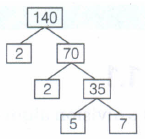
Product of prime factors of 140
= 2 x 2 x 5 x 7= 22 x 5 x 7
12.
36
13.
Let a = n2 - 1, where n = 1, 3, 5, ...
At n = 1, then a = (1)2 - 1 = 1 - 1 = 0
At n = 3, then a = (3)2 - 1 = 9 - 1 = 8
At n = 5, then a = (5)2 - 1 = 25 - 1 = 24
which is divisible by 8.
Hence, n is an odd integer.
14.
Here, 327.7081 is terminating. So, it represents a rational number.
Thus, \(327.7081=\frac { 3277081 }{ 10000 } =\frac { p }{ q } \)
Here, q = 104 = 2 x 2 x 2 x 2 x 5 x 5 x 5 x 5
= 24 x 54 = (2 x 5)4
So, the prime factors of q are 2 and 5.
15.
\(\frac { 13 }{ 3125 } =\frac { 13 }{ 5\times 5\times 5\times 5\times 5 } \)
On multiplying by 25 in numerator and denominator, we get
\(\frac { 13 }{ 3125 } =\frac { 13\times 2\times 2\times 2\times 2\times 2 }{ 5\times 2\times 5\times 2\times 5\times 2\times 5\times 2\times 5\times 2 } \)
\(=\frac { 13\times 32 }{ 10\times 10\times 10\times 10\times 10 } \)
\(=\frac { 416 }{ 100000 } \) = 0.00416
16.
(d)
5
17.
(b)
1/7
18.
(c)
3
19.
(a)
2
20.
(a)
2m + 1

10th Standard CBSE Syllabus & Materials
10th Standard CBSE
CBSE 10th Social Science PS - Federalism - New Model Questions Papers Study Material - QB365 Set A
NEW10th Standard CBSE
CBSE 10th Social Science PS - Power Sharing - New Model Questions Papers Study Material - QB365 Set A
NEW10th Standard CBSE
CBSE 10th Social Science GEO - Manufacturing Industries - New Model Questions Papers Study Material - QB365 Set A
NEW10th Standard CBSE
CBSE 10th Social Science GEO - Minerals and Energy Resources - New Model Questions Papers Study Material - QB365 Set A



NCERT Books

Syllabus

Exam Pattern

Sample Question Papers

Previous year Question Papers

Important Notes

MCQ Practice test

NCERT Exemplers

Case study Questions

Image Based Questions

Passage based Questions

HOT Questions

Value Based Questions

Model Questions Papers
NCERT ( Book Back ) Questions

Assertion and Reason
Important Questions And Answers

CBSE 10th Standard CBSE Subjects
CBSE Standards



