
 100% FREE ACCESS
10th Standard CBSE Syllabus & Materials
10th Standard CBSE
CBSE 10th Social Science ECO - Globalisation and the Indian Economy - New Model Questions Papers Study Material - QB365 Set A
NEW10th Standard CBSE
CBSE 10th Social Science ECO - Money and Credit - New Model Questions Papers Study Material - QB365 Set A
NEW10th Standard CBSE
CBSE 10th Social Science ECO - Sectors of the Indian Economy - New Model Questions Papers Study Material - QB365 Set A
NEW10th Standard CBSE
CBSE 10th Social Science ECO - Development - New Model Questions Papers Study Material - QB365 Set A
NEW10th Standard CBSE
CBSE 10th Social Science PS - Outcomes of Democracy - New Model Questions Papers Study Material - QB365 Set A
NEW10th Standard CBSE
CBSE 10th Social Science PS - Gender, Religion and Caste - New Model Questions Papers Study Material - QB365 Set A

Published on: 22/10/2025
Download CBSE Class 10th Standard CBSE Maths question papers, sample papers, important questions, and previous year solved papers in PDF format. Get free study materials, NCERT solutions, and exam preparation resources for Class 10th Standard CBSE Maths
Questions + Answers key
Take MCQ Maths Test
1.
Show that the points (1, 7), (4, 2), (–1, –1) and (– 4, 4) are the vertices of a square.
2.
Show that \(5-\sqrt { 3 } \) is irrational.
3.
One card is drawn from a well-shuffled deck of 52 cards. Find the probability of getting
(i) a king of red colour.
(ii) a face card.
(iii) a red face card.
(iv) the jack of hearts.
(v) a spade.
(vi) the queen of diamonds.
4.
A tree breaks due to storm and the broken part bends so that the top of the tree touches the ground making an angle 30o with it. The distance between the foot of the tree to the point where the top touches the ground is 8 m. Find the height of the tree.
5.
Prove that \(\frac{\cot A-\cos A}{\cot A+\cos A}=\frac{\operatorname{cosec} A-1}{\operatorname{cosec} A+1}\)
6.
Find a relation between x and y such that the point (x , y) is equidistant from the points A (7, 1) and B (3, 5).
7.
Find the LCM and HCF of the following pairs of integers and verify that LCM x HCF = Product of the two numbers.
510 and 92
8.
Find the LCM and HCF of the following integers by applying the prime factorisation method.
8, 9 and 25.
9.
Find a quadratic polynomial each with the given numbers as the sum and product of its zeroes respectively.
4, 1
10.
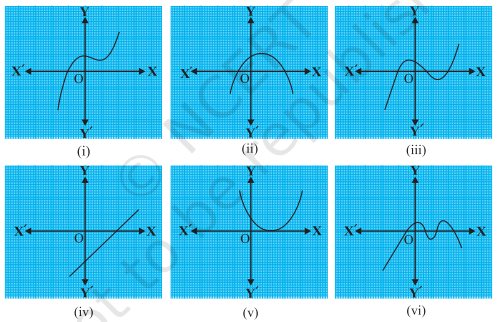
Look at the graphs in Fig. given below. Each is the graph of y = p(x), where p(x) is a polynomial. For each of the graphs, find the number of zeroes of p(x)
11.
If (1,2),(4,y),(x,6) and (3,5) are the vertices of the parallelogram taken in order, find x and y.
12.
Evaluate the following \(\frac{\cos 45^{\circ}}{\sec 30^{\circ}+\operatorname{cosec} 30^{\circ}}\)
13.
Find the zeroes of the following quadratic polynomials and verify the relationship between the zeroes and the coefficients.
4u2 + 8u
14.
Let p be a prime number. If p divides a2 , then p divides a, where a is a positive integer.
15.
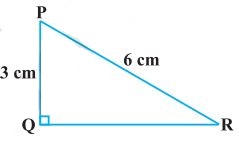
In \(\triangle PQR\), right-angles at Q, PQ = 3 cm and PR = 6 cm. Determine \(\angle QPR\) and \(\angle PRQ\).
16.
A box contains cards numbered 6 to 50. A card is drawn at random from the box. The probability that the drawn card has a number which is a perfect square like 4, 9... is
\(\frac{1}{45}\)
\(\frac{2}{15}\)
\(\frac{4}{45}\)
\(\frac{1}{9}\)
17.
If x - 1 is a factor of the polynomial p(x) = x3 + ax2 +2b and a + b = 4,then
a = 5 and b = -1
a = 9 and b = -5
a = 7 and b = -3
a = 5 and b = -1
18.
If a and b are two coprime numbers, then a3 and b3 are
coprime
not coprime
even
odd
19.
If the points (a, 0), (0, b) and (1, 1) are collinear, then \(\frac{1}{a}+\frac{1}{b}\) equals.
1
2
0
-1
20.
First, plot the points A(2, 4), B (6, 4), C (6,2) and 0 (2,2) and join all adjacent points. A pole BE of height his standing on point B. If Angle of elevation of the top of a pole from point A is 30°, The total area formed by the
figure is
\(8(\sqrt{3}+1) m^{2}\)
\(8(\sqrt{3}-1) m^{2}\)
\(\frac{8(\sqrt{3}+1)}{\sqrt{3}} \mathrm{~m}^{2}\)
\(\frac{8(\sqrt{3}-1)}{\sqrt{3}} m^{2}\)
21.
A tower stands at the centre of a circular park. If A and B are two points on the boundary of the park, such that AB = a m subtends an angle of 60° at the foot of the tower and the angle of elevation of the top of the tower from A or B is 30°. Find, then the height of the tower is
\(\sqrt{3}\) a m
\(a / \sqrt{3} m\)
\(\frac{\sqrt{3}}{a} m\)
None of these
22.
(1 + tan \(\theta\) + sec \(\theta\)) (1 + cot \(\theta\) – cosec \(\theta\)) =
0
1
2
-1
23.
If one of the zeroes of the cubic polynomial ax3 + bx2 + cx + d is zero, the product of then other two zeroes is
\(\frac{-c}{a}\)
\(\frac{c}{a}\)
0
\(\frac{-b}{a}\)
24.
From among a minimum of how many integers can you say that one is divisible by 3?
1
4
3
5
25.
The sum of the first three terms of an AP is 33. If the product of the first and the third term exceeds the second term by 29, the AP is ?
2 ,21,11
1,10,19
-1 ,8,17
2 ,11,20
26.
The point (-1,-5) lies in the Quadrant
3rd
1st
2nd
4th
27.
A card is drawn from a well-shuffled deck of 52 playing cards. The probability that the card will not be an ace card is
12/13
1/13
3/4
1/4
28.
The sum of the probability of an event and non event is :
2
1
0
none of these
29.
A tower stands vertically on the ground. From a point on the ground 30 m away from the foot of the tower, the angle of elevation of the top of the tower is 45°. The height of the tower will be
30√3 m
30 m
40 m
40√3 m
1.
Let A(1, 7), B(4, 2), C(–1, –1) and D(– 4, 4) be the given points. One way of showing that ABCD is a square is to use the property that all its sides should be equal and both its digonals should also be equal. Now
\(A B=\sqrt{(1-4)^{2}+(7-2)^{2}}=\sqrt{9+25}=\sqrt{34}\)
\(\mathrm{BC}=\sqrt{(4+1)^{2}+(2+1)^{2}}=\sqrt{25+9}=\sqrt{34}\)
\(C D=\sqrt{(-1+4)^{2}+(-1-4)^{2}}=\sqrt{9+25}=\sqrt{34}\)
\(\mathrm{DA}=\sqrt{(1+4)^{2}+(7-4)^{2}}=\sqrt{25+9}=\sqrt{34}\)
\(A C=\sqrt{(1+1)^{2}+(7+1)^{2}}=\sqrt{4+64}=\sqrt{68}\)
\(\mathrm{BD}=\sqrt{(4+4)^{2}+(2-4)^{2}}=\sqrt{64+4}=\sqrt{68}\)
Since, AB = BC = CD = DA and AC = BD, all the four sides of the quadrilateral ABCD are equal and its diagonals AC and BD are also equal. Thereore, ABCD is a square.
Alternative Solution : We find the four sides and one diagonal, say, AC as above. Here AD2 + DC2 = 34 + 34 = 68 = AC2. Therefore, by the converse of Pythagoras theorem, \(\angle \mathrm{D}=90^{\circ}\). A quadrilateral with all four sides equal and one angle 90° is a square. So, ABCD is a square.
2.
Let us assume, to the contrary, that 5 - \( \sqrt{3}\) is rational.
That is, we can find coprime a and b (b \(\neq\)0) such that 5 - \( \sqrt{3}\) = \(\frac{a}{b}\)
Therefore, 5 - \(\frac{a}{b}=\sqrt{3}\)
Rearranging this equation, we get \(\sqrt{3}\) = 5 - \(\frac{a}{b}\)=\(\frac{5b-a}{b}\)
Since a and b are integers, we get 5 - \(\frac{a}{b}\) is rational, and so \( \sqrt{3}\) is rational.
But this contradicts the fact that \(\sqrt{3}\) is irrational.
This contradiction has arisen because of our incorrect assumption that 5 - \( \sqrt{3}\) is rational.
So, we conclude that 5 - \( \sqrt{3}\) is irrational.
3.
Total number of cards in one deck of cards is 52.
\(\therefore\) Total number of outcomes =52
(i) Let E1 = Event of getting a king of red colour
\(\therefore\) Number of outcomes favourable to E1 =2
[\(\because\) there are four kings in a deck of playing cards out of which two are red and two are black]
Hence, probability of getting a king of red colour,
\(P\left(E_1\right)=\frac{2}{52}=\frac{1}{26}\)
(ii) Let E2 = Event of getting a face card
\(\therefore\) Number of outcomes favourable to E2 =12
(\(\because\) in a deck of cards, there are 12 face cards, namely 4 kings, 4 jacks, 4 queens]
Hence, probability of getting a face card,
\(P\left(E_2\right)=\frac{12}{52}=\frac{3}{13}\)
(iii) P(a red face card) \(\frac{6}{52}\) = \(\frac{3}{26}\)
(iv) Let E4= Event of getting a jack of heart
\(\therefore\)Number of outcomes favourable to E4 = 1
[\(\because\) there are four jack cards in a deck, namely 1 of heart, 1 of club, 1 of spade and 1 of diamond]
Hence, probability of getting a jack of heart,
\(P\left(E_4\right)=\frac{1}{52}\)
(v) Let E5 = Event of getting a spade
\(\therefore\) Number of outcomes favourable to E5 = 13
[\(\because\) in a deck of cards, there are 13 spades, 13 clubs, 13 hearts and 13 diamonds]
Hence, probability of getting a spade,
\(P\left(E_5\right)=\frac{13}{52}=\frac{1}{4}\)
(vi) P(the queen of diamonds) =\(\frac{1}{52}\)
4.
Let DB is a tree and AD is the broken part of it which touches the ground at C.
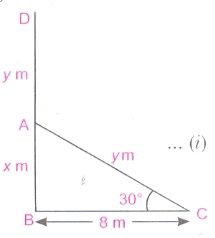
Given: ㄥACB = 30\(\unicode{xb0} \) and BC = 8m
Let AB = x m and AD = y m
∴ Now, length of the tree = (x + y)m
In ΔABC,
\(\frac { AB }{ BC } \) = tan 30\(\unicode{xb0} \) ⇒ \(\frac { x }{ 8 } =\frac { 1 }{ \sqrt { 3 } } \Rightarrow \frac { 8 }{ \sqrt { 3 } } \)
and \(\frac { AB }{ AC } \)-sin 30\(\unicode{xb0} \) ⇒ \(\frac { x }{ y } =\frac { 1 }{ 2 } \)
⇒ y = 2x ⇒ y = 2 x \(\frac { 8 }{ \sqrt { 3 } } =\frac { 16 }{ \sqrt { 3 } } \)
Hence, total height of the tree
x + y = \(\frac { 8 }{ \sqrt { 3 } } +\frac { 16 }{ \sqrt { 3 } } =\frac { 24 }{ \sqrt { 3 } } =\frac { 24 }{ \sqrt { 3 } } \times \frac { \sqrt { 3 } }{ \sqrt { 3 } } =\frac { 24\sqrt { 3 } }{ 3 } \)= 8 x 1.732 = 13.856 m
5.
\(L H S=\frac{\cot A-\cos A}{\cot A+\cos A}=\frac{\frac{\cos A}{\sin A}-\cos A}{\frac{\cos A}{\sin A}+\cos A}\)
\(=\frac{\cos A\left(\frac{1}{\sin A}-1\right)}{\cos A\left(\frac{1}{\sin A}+1\right)}=\frac{\left(\frac{1}{\sin A}-1\right)}{\left(\frac{1}{\sin A}+1\right)}=\frac{\operatorname{cosec} A-1}{\operatorname{cosec} A+1}=\operatorname{RHS}\)
6.
Given point P(x, y) is equidistant from the points A(7, 1) and B(3, 5).
So, AP = BP
\(\Rightarrow\) AP2 = BP2
\(\Rightarrow\) (x - 7)2 + (y - 1)2 = (x - 3)2 + (y - 5)2
\(\left[\because \text { distance }=\sqrt{\left(x_2-x_1\right)^2+\left(y_2-y_1\right)^2}\right]\)
\(\Rightarrow\) x2 + 49 - 14x + y2 + 1 - 2y
= x2 + 9 - 6x + y2 + 25 - 10y
\(\Rightarrow\) -14x - 2y + 50 = -6x - 10y + 34
\(\Rightarrow\) -6x - 10y + 14x + 2y = 50 - 34
\(\Rightarrow\) 8x - 8y = 16
\(\Rightarrow\) x - y = 2
[dividing by 8 on both sides]
Hence, the relation between x and y is x - y = 2.
7.
510 and 92
510 = 2 x 255
= 2 x 3 x 85
= 2 x 3 x 5 x 17
= 2 x 3 x 5 x 17 x 1
Therefore 510 = 2 x 3 x 5 x 17 x 1 .....(A)
92 = 2 x 46
= 2 x 2 x 23
Hence 92 = 2 x 2 x 23 .....(B)
From (A) and (B) HCF of 510 and 92 is = 2 and their
LCM is 2 x 2 x 3 x 5 x 17 x 23 = 23460
Product of the LCM and HCF = 2 x 23460 = 46920
Product of the two numbers = 510 x 92 = 46920
Therefore it is proved that LCM x HCF = Product of the two numbers.
8.
8, 9 and 25
8 = 23 x 1
9 = 32 x 1
25 = 52 x 1
From the above HCF (8, 9, 25) = 1 and LCM (8, 9, 25) = 1800
9.
Let the quadratic polynomial be ax2 + bx + c, and its zeroes be α and ß
Given \(\alpha+B=4=-\frac{b}{a}\)
\(\alpha \beta=1=\frac{c}{a}\)
If a = 1, then b = -4, c = 1
Therefore, the quadratic polynomial is x2 – 4x +1.
10.
(i) The number of zeroes is 1 as the graph intersects the x-axis at one point only.
(ii) The number of zeroes is 2 as the graph intersects the x-axis at two points.
(iii) The number of zeroes is 3. (Why?)
(iv) The number of zeroes is 1. (Why?)
(v) The number of zeroes is 1. (Why?)
(vi) The number of zeroes is 4. (Why?)
11.
Let A(1, 2), B(4, y), C(x, 6) and D(3, 5) are the vertices of a parallelogram.
Since, ABCD is a parallelogram.
\(\therefore\) Diagonals AC and BD will bisect each other. So, the mid-point of AC and mid-point of BD will be same
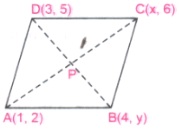
Thus mid-point of AC = Mid-point of BD
\(\begin{aligned} \Rightarrow \quad & \left(\frac{1+x}{2}, \frac{2+6}{2}\right)=\left(\frac{4+3}{2}, \frac{y+5}{2}\right) \\ \end{aligned}\)
\(\begin{aligned} & {\left[\because \text { coordinates of mid-point }=\left(\frac{x_1+x_2}{2}, \frac{y_1+y_2}{2}\right)\right] } \end{aligned}\)
On comparing the coordinate from both sides,we get
\(\frac{1+x}{2}=\frac{4+3}{2} \text { and } \frac{2+6}{2}=\frac{5+y}{2}\)
\(\Rightarrow\) 1 + x = 7 and 8 = 5 + y
\(\therefore\) x = 6 and y = 3
12.
(cos 45°)/(sec 30° + cosec 30°)
\(=\frac{\frac{1}{\sqrt{2}}}{\frac{2}{\sqrt{3}}+2}=\frac{\frac{1}{\sqrt{2}}}{\frac{2+2 \sqrt{3}}{\sqrt{3}}}\)
\(=\frac{\sqrt{3}}{\sqrt{2}(2+2 \sqrt{3})}=\frac{\sqrt{3}}{2 \sqrt{2}+2 \sqrt{6}}\)
\(=\frac{\sqrt{3}(2 \sqrt{6}-2 \sqrt{2})}{((2 \sqrt{6})+2 \sqrt{2})(2 \sqrt{6}-2 \sqrt{2})}\)
\(=\frac{2 \sqrt{3}(\sqrt{6}-\sqrt{2})}{(2 \sqrt{6})^{2}-(2 \sqrt{2})^{2}}=\frac{2 \sqrt{3}(\sqrt{6}-\sqrt{2})}{24-8}=\frac{2 \sqrt{3}(\sqrt{6}-\sqrt{2})}{16}\)
\(=\frac{\sqrt{18}-\sqrt{6}}{8}=\frac{3 \sqrt{2}-\sqrt{6}}{8}\)
13.
Let p(u) = 4u2 + 8u = 4u(u+2)
To find zeroes, put p(u) = 0
\(\Rightarrow\) 4u(u+2) = 0 \(\Rightarrow\) u = 0 or u + 2 = 0 [\(\because\) 4 \(\neq\)0]
\(\Rightarrow\) u = 0 or u = -2
Hence, zeroes of the given polynonial are 0 and -2.
Verification
Here, sum of zeroes = 0 - 2 = -2 = -(8/4)
=-\(\frac{Coefficient \quad of \quad u}{Coefficient \quad of \quad u^{2}}\)
and product of zeroes
=0 \(\times\)-2 = 0 = (0/4) = \(\frac{Constant \quad term}{Coefficient \quad of \quad u^{2}}\)
so, the relationship between the zeroes and its coefficients is verified.
14.
Proof : Let the prime factorisation of a be as follows :
a = p1 p2 . . . pn , where p1 ,p2 , . . ., pn are primes, not necessarily distinct. Therefore, a2 = ( p1 p2 . . . pn )( p1 p2 . . . pn ) = p21 p22 . . . p 2n .
Now, we are given that p divides a 2 . Therefore, from the Fundamental Theorem of Arithmetic, it follows that p is one of the prime factors of a 2 . However, using the uniqueness part of the Fundamental Theorem of Arithmetic, we realise that the only prime factors of a2 are p1 ,p2 , . . ., pn . So p is one of p1 , p2 , . . ., pn .
Now, since a = p1 p2 . . . pn ,p divides a.
We are now ready to give a proof that \(\sqrt 2\) is irrational.
The proof is based on a technique called ‘proof by contradiction’.
15.
Given PQ = 3 cm and PR = 6 cm.
Therefore, \(\begin{aligned} \frac{\mathrm{PQ}}{\mathrm{PR}} & =\sin \mathrm{R} \\ \end{aligned}\)
or \(\begin{aligned} \sin \mathrm{R} & =\frac{3}{6}=\frac{1}{2} \\ \end{aligned}\)
So, \(\begin{aligned} \angle \mathrm{PRQ} & =30^{\circ} \\ \end{aligned}\)
and therefore, \(\begin{aligned} \angle \mathrm{QPR} & =60^{\circ} \end{aligned}\)
You may note that if one of the sides and any other part (either an acute angle or any side) of a right triangle is known, the remaining sides and angles of the triangle can be determined.
16.
(d)
\(\frac{1}{9}\)
17.
(c)
a = 7 and b = -3
18.
(a)
coprime
19.
(a)
1
20.
(c)
\(\frac{8(\sqrt{3}+1)}{\sqrt{3}} \mathrm{~m}^{2}\)
21.
(b)
\(a / \sqrt{3} m\)
22.
(c)
2
23.
Let p(x) = ax3 + bx2 + cx + d
Given that, one of the zeroes of the cubic polynomial p(x) is zero.
Let \(\alpha,\beta\) and \( \gamma\) arethe zeroes of cubic polynomial p (x),
where a = 0.
We know that,
Sum of product of two zeroes at a time =\(\frac{c}{a}\)
\(\alpha\beta +\beta\gamma+\beta\alpha=\frac{c}{a}\)
\(\alpha\beta +\beta\gamma+\gamma*0=\frac{c}{a}[\because \alpha=0,given]\)
\(0+\beta\gamma+0=\frac{c}{a}\Rightarrow\beta\gamma=\frac{c}{a}\)
Hence, product of other two zeroes =\(\frac{c}{a}\)
24.
(c)
3
25.
(d)
2 ,11,20
26.
(a)
3rd
27.
(a)
12/13
28.
(b)
1
29.
(b)
30 m

10th Standard CBSE Syllabus & Materials
10th Standard CBSE
CBSE 10th Social Science PS - Federalism - New Model Questions Papers Study Material - QB365 Set A
NEW10th Standard CBSE
CBSE 10th Social Science PS - Power Sharing - New Model Questions Papers Study Material - QB365 Set A
NEW10th Standard CBSE
CBSE 10th Social Science GEO - Manufacturing Industries - New Model Questions Papers Study Material - QB365 Set A
NEW10th Standard CBSE
CBSE 10th Social Science GEO - Minerals and Energy Resources - New Model Questions Papers Study Material - QB365 Set A



NCERT Books

Syllabus

Exam Pattern

Sample Question Papers

Previous year Question Papers

Important Notes

MCQ Practice test

NCERT Exemplers

Case study Questions

Image Based Questions

Passage based Questions

HOT Questions

Value Based Questions

Model Questions Papers
NCERT ( Book Back ) Questions

Assertion and Reason
Important Questions And Answers

CBSE 10th Standard CBSE Subjects
CBSE Standards



