
 100% FREE ACCESS
10th Standard CBSE Syllabus & Materials
10th Standard CBSE
CBSE 10th Social Science ECO - Globalisation and the Indian Economy - New Model Questions Papers Study Material - QB365 Set A
NEW10th Standard CBSE
CBSE 10th Social Science ECO - Money and Credit - New Model Questions Papers Study Material - QB365 Set A
NEW10th Standard CBSE
CBSE 10th Social Science ECO - Sectors of the Indian Economy - New Model Questions Papers Study Material - QB365 Set A
NEW10th Standard CBSE
CBSE 10th Social Science ECO - Development - New Model Questions Papers Study Material - QB365 Set A
NEW10th Standard CBSE
CBSE 10th Social Science PS - Outcomes of Democracy - New Model Questions Papers Study Material - QB365 Set A
NEW10th Standard CBSE
CBSE 10th Social Science PS - Gender, Religion and Caste - New Model Questions Papers Study Material - QB365 Set A

Published on: 22/10/2025
Download CBSE Class 10th Standard CBSE Maths question papers, sample papers, important questions, and previous year solved papers in PDF format. Get free study materials, NCERT solutions, and exam preparation resources for Class 10th Standard CBSE Maths
Questions + Answers key
Take MCQ Maths Test
1.
Prove that \(\frac{\sin A+\cos A}{\sin A-\cos A}+\frac{\sin A-\cos A}{\sin A+\cos A}=\frac{2}{2 \sin ^2 A-1}\)
2.
The altitude of a right angled triangle is 7 cm less than its base. If its hypotenuse is 17 cm long, then
(a) represent the above information in the form of a quadratic equation.
(b) find the length of the sides of the triangle
3.
In \(\Delta A B C, P Q \| A C \text { and } P Q\) divides triangular region ABG into two parts such that ar (BPQ) \(=\frac{1}{4} \mathrm{ar}\) (PQCA). Find BP : PA.
4.
State whether the following are true or false. Justify your answer.
(i) The value of tan A is always greater than 1
(ii) sec A = \(=\frac{4}{3}\) for some value of \(\angle\) A.
(iii) sin A is the product of sin and A.
(iv) sin \(\theta=\frac{12}{5}\) for some \(\angle \) \(\theta\)
5.
On comparing the ratios \(\frac{a_{1}}{a_{2}}, \frac{b_{1}}{b_{2}}\) and \(\frac{c_{1}}{c_{2}}\) find out whether the lines represent the following pairs of linear equations intersect at a point or are parallel or coincide?
2x + 3y = 3 and x - 2y = 2
6.
Which of the following is not the graph quadratic polynomal?

7.
Find the four angles of a cyclic quadrilateral ABCD in which \(\angle\)A = (2x-1)°, \(\angle\)B=(y+5)°, \(\angle\)C=(2y+15)° and \(\angle\)D = (4x+7)°
8.
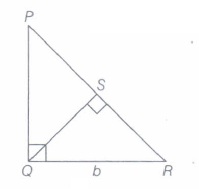
If A be the area of a right triangle and b be one of the sides containing the right angle, prove that the length of the altitude on the hypotenuse is \(\frac { 2Ab }{ \sqrt { { b }^{ 4 }+4{ A }^{ 2 } } } \)
9.
A pole has to be erected at a point on the boundary of a circular park of diameter 17 m in such a way that the differences of its distances from two diametrically opposite fixed gates A and B on the boundary is 7 metres. Find the distances from the
two gates where the pole is to be erected.
10.
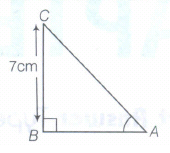
In the given figure, \(\Delta\)ABC is a right angled triangle right angled at B. If BC = 7 cm and AC - AB = 1 cm, find the value of sin A + cos A.
11.
Prove that \({ \left( 1+tan\ A \ \ tan\ B \right) }^{ 2 }+{ \left( tanA- tanB \right) }^{ 2 }={ sec }^{ 2 }A{ sec }^{ 2 }B\)
12.
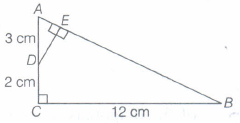
In the given figure, ABC is a right angled triangle, right angled at C and \(DE \bot AB\) .
(i) Prove that \(\triangle ABC\sim \triangle ADE\)
(ii) Find the lengths of AE and DE.
(iii) Find the area of ΔABC.
13.
A fraction becomes \(\frac {4}{5}\) if 2 is added to both numerator and denominator, if however 4 is subtracted from both numerator and denominator, then the fraction becomes \(\frac {1}{2}.\)Represent this situation2 algebraically and graphically.
14.
If α and β are zeroes of a quadratic polynomial x2 -5, then form a quadratic polynomial whose zeroes are 1+α and 1+β.
15.
The length, breadth and height of a room are 8m 25 cm, 6 m 75 cm, 4 m 50 cm, respectively. Find the length of the longest rod that can measure the three dimensions of the room exactly.
16.
Write the HCF of the smallest composite number and the smallest prime number.
17.
Explain, why (3 x 5 x 7) + 7 is a composite number?
18.
Examine that the list of numbers obtained from following situation, will be in the form of an AP. "Amount left with Sandeep (in RS) out of the total amount of RS.12000 which he had in the beginning, when he spends RS.500 in the beginning of every month."
19.
Kanika was given her pocket money on Jan 1st, 2008. She puts Rs 1 on day, 1, Rs 2 on day 2, Rs 3 on day 3 and continued doing so till the end of the month, from this money into her piggy back she also spent Rs 204 of her pocket money and found that at the end of the month she still had Rs 100 with her. How much was her pocket money for the month?
20.
Draw the quadrilateral formed by the points whose vertices are given below and name the type of the quadrilateral in each case:
(i) (7, -2), (5, 1) (-1, 1) and (-2, -2)
(ii) (1, -1), (-1, 3), (1, 7) and (3, 3)
21.
Find the vertices of a triangle, the mid-points of whose sides are (3,1), (5,6) and (-3,2).
22.
A ladder of length 6 m makes an angle of 45o with the floor while leaning against one wall of a room. If the foot of the ladder is kept fixed on the floor and it is made to lean against the opposite wall of the room, it makes an angle of 60o with the floor. Find the distance between these two walls of the room.
23.
The sum of n terms of a sequence is 3n2 + 4n. Find the nth term and show that the sequence is an AP.
24.
On a horizontal plane there is a vertical tower with a flag pole on the top of the tower. At a point 9 metres away from the foot of the tower the angles of elevation of the top and bottom of the flag pole are 60o and 30o respectively. Find the heights of the tower and flag pole mounted on it.
25.
At t minutes past 2 p.m. the time needed by the minutes hand of a clock to show 3 p.m. was found to be 3 minutes less than \(t^2\over 4\)minutes. Find t.
1.
\(\begin{aligned}
\mathrm{LHS} & =\frac{\sin A+\cos A}{\sin A-\cos A}+\frac{\sin A-\cos A}{\sin A+\cos A} \\
\end{aligned}\)
\(\begin{aligned}
=\frac{(\sin A+\cos A)^2+(\sin A-\cos A)^2}{(\sin A-\cos A)(\sin A+\cos A)}
\end{aligned}\)
\(=\frac{\left[\begin{array}{c}
\sin ^2 A+2 \sin A \cos A+\cos ^2 A+\sin ^2 A \\
-2 \sin A \cos A+\cos ^2 A
\end{array}\right]}{\sin ^2 A-\cos ^2 A}\)
\(\left[\because(a \pm b)^2=a^2+b^2 \pm 2 a b\right]\)
\(\begin{aligned}
& =\frac{2 \sin ^2 A+2 \cos ^2 A}{\sin ^2 A-\cos ^2 A}=\frac{2\left(\sin ^2 A+\cos ^2 A\right)}{\sin ^2 A-\cos ^2 A}
\end{aligned}\)
\(\begin{aligned}
=\frac{2}{\sin ^2 A-\cos ^2 A}
\end{aligned}\)
\(\begin{aligned}
=\frac{2}{\sin ^2 A-\left(1-\sin ^2 A\right)}
\end{aligned}\)
\(\begin{aligned}
=\frac{2}{\sin ^2 A-1+\sin ^2 A}
\end{aligned}\)
\(\begin{aligned}
=\frac{2}{2 \sin ^2 A-1}
\end{aligned}\)
= RHS Hence proved.
2.
Let base of triangle = x cm
Then, its altitude = (x - 7) cm
Hypotenuse of triangle = 17 cm [given]
(i) By Pythagoras theorem, we have
P2 + B2 = H2
\(\Rightarrow\) (x - 7)2 + x2 = (17)2
\(\Rightarrow\) x2 - 14x + 49 + x2 = 289
[\(\because\) (a - b)2 = a2 - 2ab + b2]
\(\Rightarrow\) 2x2 - 14x + 49 - 289 = 0
\(\Rightarrow\) x2 - 7x - 120 = 0,
which is the required quadratic equation.
(ii) We have, x2 - 7x - 120 = 0
By spliting the middle term, we get
x2 - 15x + 8x - 120 = 0
\(\Rightarrow\) x(x - 15) + 8(x - 15) = 0
\(\Rightarrow\) (x - 15) (x + 8) = 0
\(\Rightarrow\) x - 15 = 0 or x + 8 = 0
\(\Rightarrow\) x = 15 or x = -8
But the sides of triangle cannot be negative.
\(\therefore\) x = 15 cm
Thus, base of triangle= x = 15 cm
and altitude of triangle = (x - 7)
=(15 - 7) cm
= 8 cm
3.
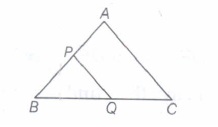
\(\text { and } \frac{\operatorname{ar}(\Delta B A C)}{\operatorname{ar}(\Delta B P Q)}=\frac{\operatorname{ar}(\Delta B P Q)+\operatorname{ar}(P Q C A)}{\operatorname{ar}(\Delta B P Q)}\)
\(=\frac{\operatorname{ar}(\Delta B P Q)+4 \operatorname{ar}(\Delta B P Q)}{\operatorname{ar}(\Delta B P Q)}=\frac{5}{1}\)
\(1: \sqrt{5}-1\)
4.
(i) False
(ii) True
(iii) False
(iv) False
5.
Intersecting lines
6.
(d) We know that, for any quadratic polynomial ax2 +bx +c, \(a \neq 0\), the graph of the corresponding equation y = {[x2 +bx + c has one of the two shapes ei ther open upwards like  or open downwards like
 depending on whether a> 0 or a < 0. So, option (d) cannot be possible. Also, the curve of a quadratic polynomial crosses the X-axis atrnost two points, but in option (d) the curve crosses the X-axis at three points, so it does not represent the quadratic polynomial.
7.
Given: \(\angle\)A = (2x-1)°
\(\angle\)B = (y+5)°
\(\angle\)C = (2y+15)°.
\(\angle\)D = (4x-7)°
In a cyclic quandrilateral ABCD,
\(\angle\)A + \(\angle\)C = 180° .....(i)
and \(\angle\)B + \(\angle\)D = 180° ....(ii)
Putting the value of \(\angle\)A and \(\angle\)C in (i), we get
(2a-1)+(2y+15) = 180°
⇒ 2x + 4x - 2 = 180°
⇒ 2x + 2y = 166° .....(iii)
Dividing the equation by 2, we get
x + y = 83°
Putting the value of \(\angle\)B and \(\angle\)D in (ii), we get
(y+5)+(4x-7) = 180° .......(iv)
⇒ y+4x-2 = 182
Subracting equation (iv) from (iii), we get
-3x = -99
x = 33
Putting x = 33 in equation (i), we get
33 + y = 83
y = 50
\(\angle\)A = 65°, \(\angle\)B=55°, \(\angle\)C=115°, \(\angle\)D=125°
8.
Let QR = b
A = ar (\(\Delta\)PQR)
\(\Rightarrow A=\frac { 1 }{ 2 } \times b\times PQ\)
\(\Rightarrow PQ=\frac { 2A }{ b } ....(i)\)
\(\\ \Delta PNQ\sim PQR (AA similarity)\)
\(\Rightarrow \frac { PQ }{ PR } =\frac { NQ }{ QR } ....(ii)\)
From \(\Delta PQR\)
PQ2 + QR2 = PR2
\(\Rightarrow \frac { 4{ A }^{ 2 } }{ { b }^{ 2 } } +{ b }^{ 2 }={ PR }^{ 2 }\)
\(\Rightarrow PR=\sqrt { \frac { 4A^{ 2 }+{ b }^{ 4 } }{ { b }^{ 2 } } } =\sqrt { \frac { 4{ A }^{ 2 }+{ b }^{ 4 } }{ b } } \)
Equation (ii) becomes
\(\frac { 2A }{ b\times PR } =\frac { NQ }{ b } \)
\(\Rightarrow NQ=\frac { 2A }{ PR } \)
Altitude \(NQ=\frac { 2Ab }{ \sqrt { 4{ A }^{ 2 }+{ b }^{ 4 } } } \)
9.
AB is diameter \(\Rightarrow \angle APB=90^{ 0 }\quad ab=17\quad m\)
\(x^{ 2 }+(x+7)^{ 2 }=(17)^{ 2 }\)
\(x^{ 2 }+x^{ 2 }+14x-240=0\)
or \(x^{ 2 }+7x-120=0\)
\(x=\frac { -7\pm \sqrt { 49\pm 480 } }{ 2 } =8,15\)
x=8m,x+7=15m
10.
11.
LHS = \({ \left( 1+tanAtanB \right) }^{ 2 }+{ \left( tanA-tanB \right) }^{ 2 }\)
\(=1+{ tan }^{ 2 }A{ tan }^{ 2 }B+2tanAtanB+{ tan }^{ 2 }A+{ tan }^{ 2 }B-2tanAtanB\)
\(=1+{ tan }^{ 2 }A+{ tan }^{ 2 }A{ tan }^{ 2 }B+{ tan }^{ 2 }B\)
\(={ sec }^{ 2 }A+{ tan }^{ 2 }B{ sec }^{ 2 }A\)
\(={ sec }^{ 2 }A(1+{ tan }^{ 2 }B)={ sec }^{ 2 }A{ sec }^{ 2 }B=RHS\)
Hence proved.
12.
(i) Use AA criterion to prove \(\Delta A B C \sim \Delta A D E\)
(ii) AE = \(\frac{15}{13}\) cm, DE = \(\frac{36}{13}\) cm
(iii) 30 cm2
13.
Let the numerator of the fraction be x and denominator be y. Then, the fraction is \(\frac {x}{y}.\)Now, according to condition I, we have
\(\frac { x+2 }{ y+2 } =\frac { 4 }{ 5 } \)
\(\Rightarrow\) 5x + 10 = 4y + 8 [cross-multiply both sides]
\(\Rightarrow\)5x - 4y + 2=0 ......(i)
and according to condition II, we have
\(\frac { x-2 }{ y-2 } =\frac { 1 }{ 2 } \) [cross-multiply both sides]
\(\Rightarrow\) 2x-8=y-4 \(\Rightarrow\) 2x-y-4=0 ...(ii)
Thus, the algebraic representation of given problem is
5x-4y=2=0 and 2x-y-4=0
To obtain graphical representation, we find atleast solutions for each equation
From Eq. (i), \(y=\frac { 5x+2 }{ 4 } ,\) Table for 5x-4y+2=0 is
| x | 2 | -2 | 6 |
| \(y=\frac { 5x+2 }{ 4 } \) | 3 | -2 | 8 |
So, points are A (2, 3), B( - 2, - 2) and C (6, 8) we plot these points on graph paper and join them to get a straight line representing5x - 4y + 2 = O. From Eq. (ii), y = 2x -4.
Table for 2x - y - 4 = 0 is
| x | 0 | 2 | 6 |
| y=2x-4 | -4 | 0 | 8 |
So, points are P(O, - 4), Q(2,0) and C(6, 8) we plot these points on graph paper and join them to get a straight line representing 2x - y - 4 =0
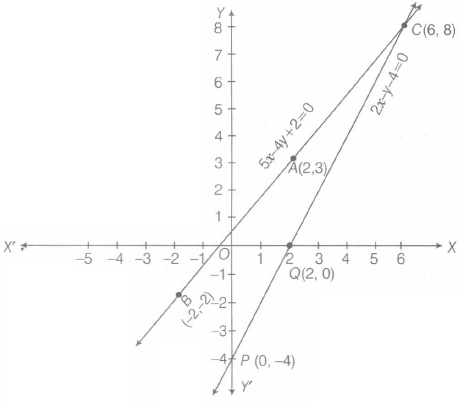
We find that the lines representing Eq. (i) and Eq. (ii) are inter~cting at point (6, 8).
14.
Let P(x)=x2-5
For finding a zeroes of p(x), p(x)=0
x2-5=0
⇒ x=±5
Let α=5 and β=-5
Now, 1+a=1+5=6
and 1-a=1-5=4
Thus, 6 and -4 are the zeroes of new quadratic polynomial.
Therefore the new quadratic polynomial will be (x-6)(x+4) or x2-2x-24
15.
Given, length of the room = 8 m 25 cm
= 825 cm [ \(\because \) 1 m - 100 cm]
Breadth of the room = 6 m 75 cm
= 675 cm
and height of the room = 4 m 50 cm
= 450 cm
Clearly, the length of the longest rod (in cm) is the HCF of 825, 675 and 450.
| 3 | 825 |
| 5 | 275 |
| 5 | 55 |
| 11 | 11 |
| 1 |
| 3 | 675 |
| 3 | 225 |
| 3 | 75 |
| 5 | 25 |
| 5 | 5 |
| 1 |
| 2 | 450 |
| 3 | 225 |
| 3 | 75 |
| 5 | 25 |
| 5 | 5 |
| 1 |
Thus, 825 = 3 x 52 x 11
675 = 33 x 52 and 450 = 2 x 32 x 52
Now, HCF(825, 675, 450) = Product of the smallest power of each common prime factor
= 3 x 52 = 75
Hence, the required length of the longest rod is 75 cm.
16.
Smallest composite number = 4 = 2 x 2 = 22
and smallest prime number = 2 = 21
\(\therefore \) HCF (4, 2) = 21 = 2
[since, HCF is the product of the smallest power of each common prime factor involved in the numbers].
17.
We have, (3 x 5 x 7) + 7 = 105 + 7 = 112
\(\therefore \) Prime factors of 112 = 2 x 2 x 2 x 2 x 7 = 24 x 7
So, it is the product of prime factors 2 and 7.
Hence, it is a composite number.
18.
Given, total amount Sandeep had=RS.12000
In the beginning of every month, he spend=RS.500
So, in the beginning of 1st month, he had amount, t1=RS.12000
In the beginning of 2nd month, he had amount, t2=12000-500=RS.11500
In the beginning of 3rd month, he had amount, t3=1500-500=RS.11000
In the beginning of 4th month, he had amount, t4=11000-500=RS.10500 and so on.
Now, the list of amount is 12000, 11500, 11000, 10500, ...Here, t2 - t1 = t3 - t2 = t4 - t3 =-500
i.e. tk+1-tk is the same everytime.
So, the above list of numbers forms an AP.
19.
Let her pocket money be Rs x. Now, she takes Rs 1 on day 1, Rs 2 on day 2, Rs 3 on day 3 and so on till the end of the month, from this money.
i.e. 1 + 2 + 3 + 4 + ..... + 31
which form an AP, in which number of terms is 31 and first term
\(\therefore\) Sum of first terms = S 31
Sum of n terms, \({ S }_{ n }=\frac { n }{ 2 } \left[ 2a+\left( n-1 \right) d \right] \)
\(\therefore\) \({ S }_{ 31 }=\frac { 31 }{ 2 } \left[ 2\times 1+\left( 31-1 \right) \times 1 \right] \)
\(=\frac { 31 }{ 2 } \left( 2+30 \right) \)
\(=\frac { 31\times 32 }{ 2 } \)
\(=31\times 16=496\)
So, Kanika takes Rs 496 till the end of the month from this money.
Also, she spent Rs 204 of her pocket money and found that at the end of the month, she still has Rs 100 with her.
Now, according to the condition
\(\left( x-496 \right) -204=100\)
\(\Rightarrow\) x - 700 = 100
\(\Rightarrow\) x = Rs 800
Hence, Rs 800 was her pocket money for the month.
20.
(i) trapezium
(ii) rhombus
21.
Let the vertices of △ABC be A(x1,y1), B(x2,y2) and C(x3, y3). Let D(3, 1), F.(5, 6) and F(- 3, 2) be the mid-points of BC, CA and AB respectively.
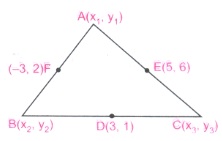
then \(\frac { { x }_{ 2 }+{ x }_{ 3 } }{ 2 } =3\ \Rightarrow \ { x }_{ 2 }+{ x }_{ 3 }=6\) ---- (i)
\(\frac { y_{ 2 }+{ y }_{ 3 } }{ 2 } =3\ \Rightarrow \ { y }_{ 2 }+{ y }_{ 3 }=2\) --- (ii)
\(\frac { { x }_{ 2 }+{ x }_{ 3 } }{ 2 } =5\ \Rightarrow \ { x }_{ 3 }+{ x }_{ 1 }=10\) --- (iii) and \(\frac { y_{ 3 }+{ y }_{ 1 } }{ 2 } =6\ \Rightarrow \ { y }_{ 1 }+{ y }_{ 3 }=12\) --- (iv)
\(\frac { { x }_{ 1 }+{ x }_{ 2 } }{ 2 } =-3\ \Rightarrow \ { x }_{ 1 }+{ x }_{ 2 }=-6\) --- (v) and \(\frac { y_{ 1 }+{ y }_{ 2 } }{ 2 } =2\ \Rightarrow \ { y }_{ 1 }+{ y }_{ 2 }=4\) --- (vi)
Adding (i), (iii) and (v), we get
2(x1+x2+x3) = 10 ⇒ x1+x2+x3=5 --- (vii)
Subtrcting (i), (iii), (v) separtely from (vii), we get x1=-1 , x2=-5, x3=11
Adding (ii), (iv) and (vi), we get
2(y1+y2+y3) = 18 ⇒ y1+y2+y3=9 --- (viii)
Subtracting (ii), (iv) and (vi) separetely from (viii), we get y1=7, y2=-3, y3=5.
Hence, the vertices of the triangle ABC are A(-1,7), B(-5,-3) and C(11,5).
22.
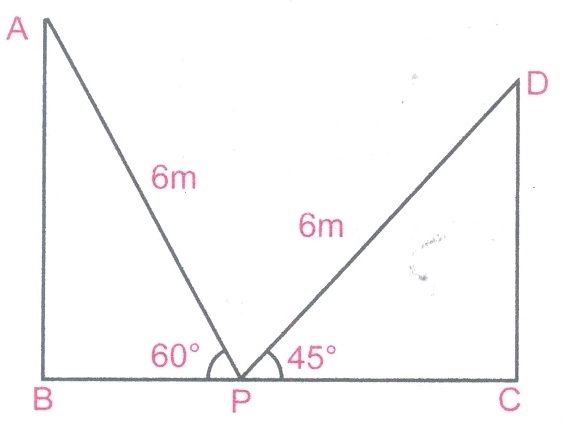
Let AP and DP be the position of the ladder whose length is 6 m.
In rt.ΔABP, \(\frac { BP }{ AP } =cos60^{ 0 }\Rightarrow \frac { BP }{ 6 } =\frac { 1 }{ 2 } \)
⇒ BP=1/2 x 6=3m
In rt, ΔDCP, \(\frac { PC }{ DP } =cos45^{ 0 }=\frac { PC }{ 6 } =\frac { 1 }{ \sqrt { 2 } } \)
⇒ PC=\(\frac { 6 }{ \sqrt { 2 } } \times \frac { \sqrt { 2 } }{ \sqrt { 2 } } =\frac { 6\sqrt { 2 } }{ 2 } =3\sqrt { 2 } m\)
Distance between two walls
=BP+PC=3+3\(\sqrt { 2 } \)
=3+3 x 1.41
=3(1+1.41)=7.23 m
23.
Here Sn = 3n2 + 4n
\(\Rightarrow\) Sn-1 = 3 ( n - 1 )2 + 4( n - 1 )
= 3 ( n2 - 2n + 1 ) + 4n - 4
= 3n2 - 6n + 3 + 4n - 4
= 3n2 - 2n - 1
\(\therefore\) an = Sn - Sn-1
= ( 3n2 + 4n ) - ( 3n2 - 2n - 1 )
an = 6n + 1
Change n to ( n - 1), we get
an -1 =6 ( n - 1) + 1
= 6n - 6 + 1 = 6n - 5
\(\therefore\) an - a1 = 6n + 1- 6n + 5 = 6
\(\because\) an - an-1 is constant i.e., d = 6
\(\therefore\) Sequence is an AP.
24.
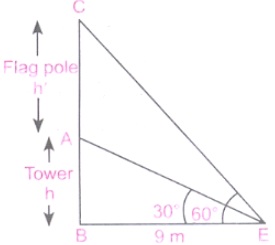
Given: AB be the tower and AC the flag pole on top of the tower.
ㄥCEB=60o, ㄥAEB=30o
To find Height of the tower and the height of the flag pole. Let height of the tower and flag pole be h m and h'm respectively.
Solution: In right ∆ABE
=\(\frac { AB }{ BE } =tan{ 30 }^{ 0 }\Rightarrow \frac { h }{ 9 } =\frac { 1 }{ \sqrt { 3 } } \)
h=\(\frac { 9 }{ \sqrt { 3 } } m=\frac { 9 }{ \sqrt { 3 } } =\frac { 9\sqrt { 3 } }{ 3 } m=3\sqrt { 3 } =5.196\)m .....(i)
In right ΔCBE,
\(\frac { CB }{ BE } =tan600\Rightarrow \frac { h+{ h }^{ ' } }{ BE } =tan60^{ 0 }\)
\(\frac { h+h' }{ BE } =\sqrt { 3 } \)
⇒ h+h'=\(9\sqrt { 3 } \) .......(ii)
\(h'=\frac { 27-9 }{ \sqrt { 3 } } =\frac { 18\times \sqrt { 3 } }{ \sqrt { 3 } \times \sqrt { 3 } } =\frac { 18\sqrt { 3 } }{ 3 } =6\sqrt { 3 } \)m
=6 x 1.732 m=10.392 m
Height of flag pole mounted on tower=10.392 m.
25.
ATQ (60-t) = \(\frac { t^{ 2 } }{ 4 } -3\)
\(\Rightarrow 240-4t=t^{ 2 }-12\)
\(\Rightarrow t^{ 2 }+4t-252=0\)
\(\Rightarrow t^{ 2 }+18t-14t-252=0\)
\(\Rightarrow (t+18)(t-14)=0\)
\(\Rightarrow \) t=14,-18 [rejected]
\(\Rightarrow \) t=14 minutes

10th Standard CBSE Syllabus & Materials
10th Standard CBSE
CBSE 10th Social Science PS - Federalism - New Model Questions Papers Study Material - QB365 Set A
NEW10th Standard CBSE
CBSE 10th Social Science PS - Power Sharing - New Model Questions Papers Study Material - QB365 Set A
NEW10th Standard CBSE
CBSE 10th Social Science GEO - Manufacturing Industries - New Model Questions Papers Study Material - QB365 Set A
NEW10th Standard CBSE
CBSE 10th Social Science GEO - Minerals and Energy Resources - New Model Questions Papers Study Material - QB365 Set A



NCERT Books

Syllabus

Exam Pattern

Sample Question Papers

Previous year Question Papers

Important Notes

MCQ Practice test

NCERT Exemplers

Case study Questions

Image Based Questions

Passage based Questions

HOT Questions

Value Based Questions

Model Questions Papers
NCERT ( Book Back ) Questions

Assertion and Reason
Important Questions And Answers

CBSE 10th Standard CBSE Subjects
CBSE Standards



