
 100% FREE ACCESS
10th Standard CBSE Syllabus & Materials
10th Standard CBSE
CBSE 10th Social Science ECO - Globalisation and the Indian Economy - New Model Questions Papers Study Material - QB365 Set A
NEW10th Standard CBSE
CBSE 10th Social Science ECO - Money and Credit - New Model Questions Papers Study Material - QB365 Set A
NEW10th Standard CBSE
CBSE 10th Social Science ECO - Sectors of the Indian Economy - New Model Questions Papers Study Material - QB365 Set A
NEW10th Standard CBSE
CBSE 10th Social Science ECO - Development - New Model Questions Papers Study Material - QB365 Set A
NEW10th Standard CBSE
CBSE 10th Social Science PS - Outcomes of Democracy - New Model Questions Papers Study Material - QB365 Set A
NEW10th Standard CBSE
CBSE 10th Social Science PS - Gender, Religion and Caste - New Model Questions Papers Study Material - QB365 Set A

Published on: 22/10/2025
Download CBSE Class 10th Standard CBSE Maths question papers, sample papers, important questions, and previous year solved papers in PDF format. Get free study materials, NCERT solutions, and exam preparation resources for Class 10th Standard CBSE Maths
Questions + Answers key
Take MCQ Maths Test
1.
PQ is tangent to a circle centered at O. If the radius of the circle is 5 cm, then the length of the tangent PQ is
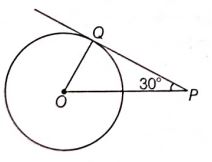
\(5 \sqrt{3} \mathrm{~cm}\)
\(\frac{10}{\sqrt{3}} \mathrm{~cm}\)
10 cm
\(\frac{5}{\sqrt{3}} \mathrm{~cm}\)
2.
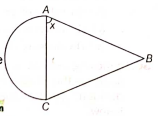
ΔABC is an isosceles triangle, with AB = BC.A semicircle of the area equal to that of the triangle is combined with it
What is the value of tan x?
1
1/4 π
1/2 π
π
3.
The vertices of a △OAB are O(0, 0), A(4, 0) and A(1, 4) B(-2, 3) and C(5, 8). The ordinate of the fourth vertex D is
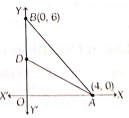
\(\sqrt{52} \text{units}\)
5 units
25 units
10 units
4.
If in ΔABC and ΔPQR, we have \(\frac{AB}{QR}= \frac{BC}{PR} = \frac{CA}{PQ}\) then
\(\triangle P Q R \sim \triangle C A B\)
\(\triangle P Q R \sim \triangle A B C\)
\(\triangle C B A \sim \triangle P Q R\)
\(\triangle B C A \sim \triangle P Q R\)
5.
If the quadratic equation \(a x^2+b x+c=0\) has two real and equal roots, then "c" is equal to
\(\frac{-b}{2 a}\)
\(\frac{b}{2 a}\)
\(\frac{-b^2}{4 a}\)
\(\frac{b^2}{4 a}\)
6.
The ratio of a two-digit number and the sum of its digits is 7:1. How many such two-digit numbers are possible?com
1
4
9
infinitely many
7.
If two positive integers a and b are written as a = x3y2 and b= xy3,where x, y are prime numbers, then the result obtained by dividing the product of the positive integers by the LCM (a, b) is
xy
xy2
x3y3
x2y2
8.
A is a point at a distance 13 cm from the centre O of a circle of radius 5 cm. AP and AQ are the tangents to the circle at P and Q. If a tangent BC is drawn at a point R lying on the minor arc PQ to intersect AP at Band AQ at C, then the perimeter of the MBC is
12 cm
24 cm
36 cm
48 cm
9.
If x - 2y + k = 0 is a median of the triangle whose vertices are at points A (- 1. 3),B (O,4) and C (- 5, 2),then the value of k is
2
4
6
8
10.
If the area of the triangle formed by the points (x, 2x), (- 2, 6) and (3, 1)is 5 sq units then x equals.
2/3
3/5
3
5
11.
Two concentric circles are of radii 10 cm and 8 cm, then the length of the chord of the larger circle which touches the smaller circle is
6 cm
12 cm
18 cm
9 cm
12.
It is given that, ΔABC - ΔEDF such that AB = 5 cm, AC = 7 cm, DF = 15 cm and DE = 12 cm, then the sum of the remaining sides of the triangles is
23.05 cm
16.8 cm
6.25 cm
24 cm
13.
If in two \(\Delta A B C \text { and } \Delta P Q R\) \(\frac{A B}{Q R}=\frac{B C}{P R}=\frac{C A}{P Q}\), then
Δ PQR - Δ CAB
Δ PQR - Δ ABC
Δ CBA - Δ PQR
Δ BCA - Δ PQR
14.
Tick the correct answer and justify : In D ABC, AB \(=6 \sqrt{3}\) cm, AC = 12 cm and BC = 6 cm. The angle B is :
120°
60°
90°
45°
15.
Suppose b1, b2, ... , b24 are in Ap, such that b1 + b5 + b10 + b15 + b20 + b24 = 300. Then, the sum of first 24 terms of the AP is
1200
900
600
1500
16.
The sum of the squares of three consecutive integers is 110, then the smallest positive integer is
6
5
7
4
17.
Is an sequence defined by an = 2n2 +1 forms an AP?
Yes
Not
Cannot be determined
None of these
18.
In an Ap, if a = 3.5, d = 0 and n = 101,then an will be
0
3.5
103.5
104.5
19.
The product of a non-zero rational and an irrational number is
always irrational
always rational
rational or irrational
one
20.
Find the fifth term of an A.P whose first term is -1 and common difference is -3.
-16
-13
10
4
21.
If p, q, r, s, t are the terms of an A.P. with common difference -1 the relation between p and t is
t = p – 6
t = p – 5
t = p + 4
t = p – 4
22.
The positive root of \(\sqrt { { 3x }^{ 2 }+6 } =9\)is
3
4
5
7
23.
The same value of x satisfies the equations 4x + 5 = 0 and 4x2 + (5 + 3p)x + 3p2=0, then p is
0 or 5/4
¼ or ½
0 or ¼
0 or ½
24.
If tan\(\theta =\frac { 12 }{ 5 } \) then\(\frac { 1+sin\theta }{ 1-sin\theta } \) is equal to
25
12/13
24
9
25.
If cosec2θ (1 + cosθ) (1 – cosθ) = ,λ then the value of λ is
1
-1
cos2θ
0
26.
The value of expression \(\frac { 1-tan\quad x\quad cot({ 90 }^{ o }-x) }{ 1-tan\quad x\quad cot({ 90 }^{ o }-x) } \)is
2cot2 x – 1
2cos2 x – 1
2sin2 x – 1
2tan2 x – 1
27.
The square root \(\frac { 1+sin\quad A }{ 1-sin\quad A } \)=
cot A – cosec A
sec A – tan A
sec A + tan A
cot A + cosec A
28.
In the adjoining figure, PQ||BC , the what could be the values of AQ & QC respectively
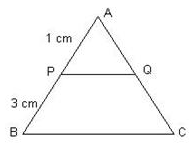
3 cm and 6 cm
2 cm and 6 cm
3 cm and 4 cm
1 cm and 6 cm
29.
Find x and y given
\(\frac { 2a }{ x } +\frac { 3b }{ y } =-1\)
\(\frac { 3a }{ x } -\frac { b }{ y } =4\)
a and b
a and -b
-a and -b
-a and b
30.
In an examination, one mark is awarded for every correct answer, while 1/4 mark is deducted for every wrong answer. A student answered 120 questions and got 20 marks. Which of the following pair of equations would give the result for how many questions did he answered correctly?
x + y = 120; – x + 4y = 80
x + y = 60; x + 4y = 80
x + y = 120; 4x + 3y = 80
x + y = 120; 3x + 4y = 80
31.
If two lines are parallel to each other the system of equation is
Consistent dependent
Inconsistent
Inconsistent dependent
consistent
32.
Which of the given is the set of zeroes of the polynomial p(x) = 2x3+x2-5x+2
-1/2, 1, -2
1/2, -1, -2
-1/2, -1, -2
1/2, 1, -2
33.
α,β,γ are the zeros of the polynomial 2x3 + x2 – 13x + 6, then the value of αβγ is
-3
-13/2
3
1/2
34.
If -√5 and √5 are the roots of the quadratic polynomial. Find the quadratic polynomial
(x-5)(x+5)
x2 – 25
x-5
x2 – 5
35.
The number of polynomials having zeroes -2 and 5 is:
1
3
2
more than 3
36.
Complete the statement : Any positive odd integer is of the form 6q + 1, or 6q + 3, or ___________ , where q is some integer
6q
6q+4
6q+2
6q+5
37.
The vertices of a ΔABC and given by A(2, 3) and B(–2, 1) and its centroid is G\(\left( 1,\frac { 2 }{ 3 } \right) \) Find the coordinates of the third vertex C of the ΔABC
(0, 2)
(1, –2)
(2, –3)
(–2, 3)
38.
A kite is flying at a height of 75 metres from the ground level, attached to a string inclined at 60° to the horizontal. The length of the string to the nearest metre is
55 m
87 m
100 m
60 m
39.
The length of shadow of a tower on the plane ground is √3 times the height of the tower. The angle of elevation of sun is :
90o
60o
30o
45o
40.
The tangents drawn at the ends of a diameter of a circle are:
intersecting at a point inside the circle
perpendicular
intersecting at the centre of the circle
parallel
41.
A dollhouse with a triangular roof is shown below
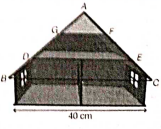
The front and back triangles are equilateral triangles with side lengths 45 cm each. Panels parallel to the floor of the dollhouse are used to make the attic. The sides DE and GFof the panels divide the sides AB and AC into three equal parts.
Based on the above information, answer the following questions.
(i) Which criteria of similar triangles do not apply to △AGF and △ADE?
(a) AAA
(b) SSS
(c) SAS
(d) RHS
(ii) The area of △ABC is 692 cm2, What is the area of the plank AGF?
(iii) What is the height (in cm) of the attic?
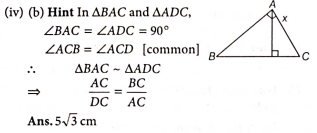
(iv) Two Overlapping right triangles are shown below. What is the value of x?
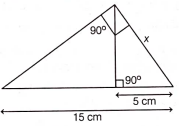
(a) 4 cm
(b) 5√3 cm
(c) 10 cm
(d) 37.5 cm
42.
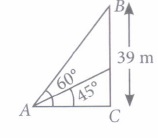
In an exhibition, a statue stands on the top of a pedestal. From the point on ground where a girl is clicking the photograph of the statue the angle of elevation of the top of the statue is 60° and from the same point, the angle of elevation of the top of pedestal is 45°.
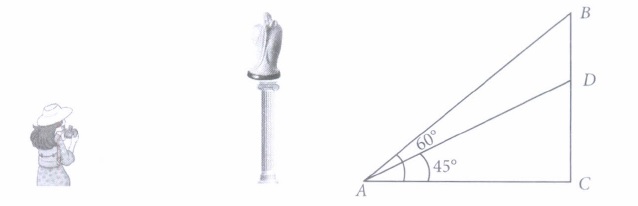
Based on the above information, answer the following questions.
(i) If the height of the pedestal is 20 m, then the distance between girl and the foot of the pedestal is
| (a) 20m | (b) 40m | (c) 60m | (d) 80m |
(ii) If the height of the pedestal is 20 m, then the height of the statue is
| \((a) 20 \sqrt{3} \mathrm{~m}\) | \((b) 20(\sqrt{3}-1) \mathrm{m}\) | \((c) 20(\sqrt{3}+1) \mathrm{m}\) | \((d) 10(\sqrt{3}-1) \mathrm{m}\) |
(iii) If the height of the statue is 1.6 m, then height of the pedestal is
| \((a) 0.8(\sqrt{3}-1) \mathrm{m}\) | \((b) 1.6(\sqrt{3}+1) \mathrm{m}\) | \((c) 0.8(\sqrt{3}) \mathrm{m}\) | \((d) 0.8(\sqrt{3}+1) \mathrm{m}\) |
(iv) If the total height of the statue and pedestal is 39 m, then find the length of AC.
| (a) 13 m | (b) \(12\sqrt{3} \mathrm{~m}\) | (c) \(13 \sqrt{3} \mathrm{~m}\) | (d) \(15 \sqrt{3} \mathrm{~m}\) |
(v) If the height of the pedestal is 35 m, then length of AD is
| (a) \(35\sqrt{2} \mathrm{~m}\) | (b) \(40\sqrt{2} \mathrm{~m}\) | (c) \(35 \sqrt{2+1} \mathrm{~m}\) | (d) \(35 \sqrt{2-1} \mathrm{~m}\) |
43.
In order to facilitate smooth passage of the parade, movement of traffic on certain roads leading to the route of the Parade and Tableaux always restricted. To avoid traffic on the road Delhi Police decided to construct a rectangular route plan, as shown in the figure. Based on the above information, answer the following questions.
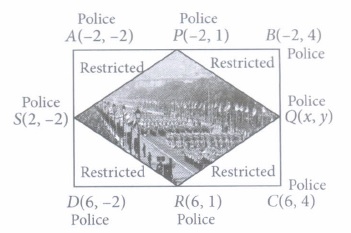
(i) If Q is the mid point of BC, then coordinates of Q are
| (a) (2,4) | (b) (2, -4) | (c) (1,-1) | (d) (-1,1) |
(ii) Quadrilateral PQRS is a
| (a) Trapezium | (b) Square | (c) Rectangle | (d) Rhombus |
(iii) What is the length of sides of quadrilateral PQRS?
| (a) 5 units each | (b) 3,4,5,6 units | (c) 4,5,6,7 units | (d) 8 units each |
(iv) What is the length of route PQRS?
| (a) 20 units | (b) 25 units | (c) 35 units | (d) 45 units |
(v) What is the length of route ABCD?
| (a) 26 units | (b) 27 units | (c) 28 units | (d) 29 units |
44.
From a shop, Sudhir bought 2 books of Mathematics and 3 books of Physics of class X for Rs 850 and Suman bought 3 books of Mathematics and 2 books of Physics of class X for Rs 900. Consider the price of one Mathematics book and that of one Physics book be Rs x and Rs y respectively.
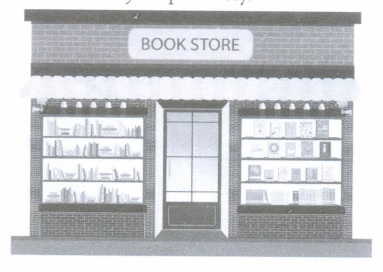
Based on the above information, answer the following questions.
(i) Represent the situation faced by Sudhir, algebraically,
| (a) 2x + 3y = 850 | (b) 3x+2y=850 | (c) 2x - 3y = 850 | (d) 3x - 2y = 850 |
(ii) Represent the situation faced by Suman, algebraically
| (a) 2x + 3y = 90 | (b) 3x + 2y = 900 | (c) 2x - 3y = 900 | (d) 3x - 2y = 900 |
(iii) The price of one Physics book is
| (a) Rs 80 | (b) Rs 100 | (c) Rs 150 | (d) Rs 200 |
(iv) The price of one Mathematics book is
| (a) Rs 80 | (b) Rs 100 | (c) Rs 150 | (d) Rs 200 |
(v) The system of linear equations represented by above situation, has
| (a) unique solution | (b) no solution |
| (c) infinitely many solutions | (d) none of these |
45.
Two friends Trisha and Rohan during their summer vacations went to Manali. They decided to go for trekking. While trekking they observes that the trekking path is in the shape of a parabola. The mathematical representation of the track is shown in the graph.
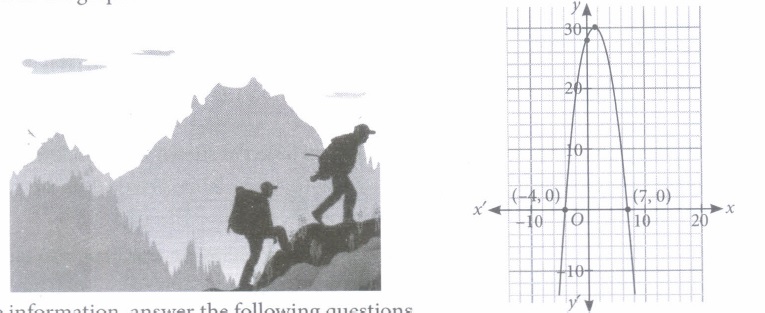
Based on the above information, answer the following questions.
(i) The zeroes of the polynomial whose graph is given, are
| (a) 4,7 | (b) -4,7 | (c) 4,3 | (d) 7,10 |
(ii) What will be the expression of the given polynomial p(x)?
| \((a) x^{2}-3 x+\mathbf{3} 8\) | \((b) -x^{2}+4 x+28\) | \((c) x^{2}-4 x+28\) | \((d) -x^{2}+3 x+28\) |
(iii) Product of zeroes of the given polynomial is
| (a) -28 | (b) 28 | (c) -30 | (d) 30 |
(iv) The zeroes of the polynomial 9x2 - 5 are
| \((a) \frac{3}{\sqrt{5}}, \frac{-3}{\sqrt{5}}\) | \((b) \frac{2}{\sqrt{5}}, \frac{-2}{\sqrt{5}}\) | \((c) \frac{\sqrt{5}}{3}, \frac{-\sqrt{5}}{3}\) | \((d) \frac{\sqrt{5}}{2}, \frac{-\sqrt{5}}{2}\) |
(v) If f(x) = x2 - 13x + 1, then f(4) =
| (a) 35 | (b) -35 | (c) 36 | (d) -36 |
1.
(a)
\(5 \sqrt{3} \mathrm{~cm}\)
2.
(c)
1/2 π
3.
(b)
5 units
4.
(a)
\(\triangle P Q R \sim \triangle C A B\)
5.
(d)
\(\frac{b^2}{4 a}\)
6.
(b)
4
7.
(b)
xy2
8.
(b)
24 cm
9.
(d)
8
10.
(a)
2/3
11.
(b)
12 cm
12.
(a)
23.05 cm
13.
(a)
Δ PQR - Δ CAB
14.
(c)
90°
15.
(a)
1200
16.
(b)
5
17.
(b)
Not
18.
(b)
3.5
19.
(a)
always irrational
20.
(b)
-13
21.
(d)
t = p – 4
22.
(c)
5
23.
(a)
0 or 5/4
24.
(a)
25
25.
(a)
1
26.
(b)
2cos2 x – 1
27.
(c)
sec A + tan A
28.
(b)
2 cm and 6 cm
29.
(b)
a and -b
30.
(a)
x + y = 120; – x + 4y = 80
31.
(b)
Inconsistent
32.
(d)
1/2, 1, -2
33.
(a)
-3
34.
(d)
x2 – 5
35.
(d)
more than 3
36.
(d)
6q+5
37.
(d)
(–2, 3)
38.
(b)
87 m
39.
(c)
30o
40.
(d)
parallel
41.
(i) (d) RHS
(ii) Hint In \(\triangle A G F\) and \(\triangle A B C\),
\(\angle G A F=\angle B A C\) [common]
\( \text { and } \quad \angle A G F=\angle A B C\)
\(\text { [corresponding angles, since } G F \| D E \text { ] }\)
\( \therefore \quad \triangle A G F \sim \triangle A B C \) [by AA similarity criterion]
\(\Rightarrow \quad \frac{\operatorname{ar}(\triangle A G F)}{\operatorname{ar}(\triangle A B C)}=\left(\frac{A G}{A B}\right)^2 \)
\( \Rightarrow \frac{\operatorname{ar}(\triangle A G F)}{692}=\left(\frac{A B}{3 \times A B}\right)^2 \quad\left[\because A G=\frac{1}{3} A B\right]\)
Ans. \(76.89 \mathrm{~cm}^2\)
iii) If area of \(\triangle A B C=692 \mathrm{~cm}^2\)
\(\Rightarrow \frac{\sqrt{3}}{4} a^2 =692 \)
\(\Rightarrow a^2 =\frac{692 \times 4}{\sqrt{3}}=1598.10 \)
\(\Rightarrow a =39.97 \approx 40 \mathrm{~cm}\)
Again, area of \(\triangle A B C=692 \mathrm{~cm}^2\)
\(\Rightarrow \quad \frac{1}{2} \times 40 \times h=692 \Rightarrow h=\frac{692 \times 2}{40}=34.6 \mathrm{~cm}\)
Total number of attics =3
therefore Height of the attic \(=\frac{34.6}{3}=11.53 \mathrm{~cm}\)
42.
(i) (a): \(\text { In } \triangle A C D\)
\(\tan 45^{\circ}=\frac{C D}{A C}=1 \)
\(\therefore \quad A C=C D=20 \mathrm{~m}\)
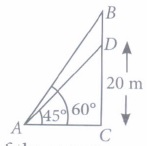
(ii) (b): Let, BD = h m be the height of the statue.
\(\text { In } \Delta A B C, \tan 60^{\circ}=\frac{B C}{A C} \Rightarrow \frac{B D+C D}{A C}=\sqrt{3} \)
\(\Rightarrow \frac{20+h}{20}=\sqrt{3}[\text { using }(\mathrm{i})] \Rightarrow h=20(\sqrt{3}-1) \mathrm{m}\)
(iii) (d): Since, in \(\triangle A C D, \angle D A C=45^{\circ}\)
\(\therefore \quad A C=C D(\operatorname{say} x) \)
\(\text { In } \Delta B A C, \tan 60^{\circ}=\frac{B C}{A C} \)
\(\Rightarrow \frac{1.6+x}{x}=\sqrt{3} \)
\(\Rightarrow 1.6=x(\sqrt{3}-1)\)
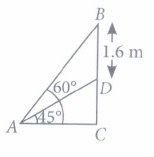
\(\Rightarrow \quad x=\frac{1.6}{\sqrt{3}-1} \times \frac{\sqrt{3}+1}{\sqrt{3}+1}=0.8(\sqrt{3}+1) \mathrm{m}\)
(iv) (c): \(\text { In } \triangle A B C\)
\(\tan 60^{\circ}=\frac{B C}{A C} \Rightarrow \frac{39}{A C}=\sqrt{3} \)
\(\Rightarrow A C=\frac{39}{\sqrt{3}} \times \frac{\sqrt{3}}{\sqrt{3}}=13 \sqrt{3} \mathrm{~m}\)
(v) (a): \(\text { In } \Delta A C D, \sin 45^{\circ}=\frac{C D}{A D}\)
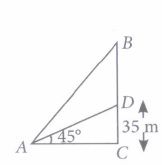
\(\Rightarrow \quad \frac{35}{A D}=\frac{1}{\sqrt{2}} \)
\(\Rightarrow A D=35 \sqrt{2} \mathrm{~m}\)
43.
(i) (a): Q(x, y) is mid-point of B( -2,4) and C(6,4).
\(\therefore \quad(x, y)=\left(\frac{-2+6}{2}, \frac{4+4}{2}\right)=\left(\frac{4}{2}, \frac{8}{2}\right)=(2,4)\)
(ii) (d): Since P, Q, Rand S are mid-points of sides
AB, Be, CD and AD respectively.
\(\therefore\) PQRS is a rhombus. [\(\because\) The quadrilateral formed by joining the midpoints of a rectangle is a rhombus]
(iii) (a) : Since PQRS is a rhombus, therefore, PQ = QR = RS = PS.
\(\therefore \quad P Q=\sqrt{(-2-2)^{2}+(1-4)^{2}}=\sqrt{16+9}=\sqrt{25}=5 \text { units }\)
Thus, length of each side of PQRS is 5 units.
(iv) (a): Length of route PQRS = 4 PQ = 4 x 5 = 20 units
(v) (c): Length of CD = 4 + 2 = 6 units and length of AD = 6 + 2 = 8 units
\(\therefore\) Length of route ABCD = 2(6 + 8) = 28 units
44.
(i) (a): Situation faced by Sudhir can be represented algebraically as 2x + 3y = 850
(ii) (b): Situation faced by Suman can be represented algebraically as 3x + 2y = 900
(iii) (c) : We have 2x + 3y = 850 .........(i)
and 3x + 2y = 900 .........(ii)
Multiplying (i) by 3 and (ii) by 2 and subtracting, we get
5y = 750 \(\Rightarrow\) Y = 150
Thus, price of one Physics book is Rs 150.
(iv) (d): From equation (i) we have, 2x + 3 x 150 = 850
\(\Rightarrow\) 2x = 850 - 450 = 400 \(\Rightarrow\) x = 200
Hence, cost of one Mathematics book = Rs 200
(v) (a): From above, we have
\(a_{1} =2, b_{1}=3, c_{1}=-850 \)
\(\text { and } a_{2} =3, b_{2}=2, c_{2}=-900\)
\(\therefore \quad \frac{a_{1}}{a_{2}}=\frac{2}{3}, \frac{b_{1}}{b_{2}}=\frac{3}{2}, \frac{c_{1}}{c_{2}}=\frac{-850}{-900}=\frac{17}{18} \Rightarrow \frac{a_{1}}{a_{2}} \neq \frac{b_{1}}{b_{2}} \neq \frac{c_{1}}{c_{2}}\)
Thus system of linear equations has unique solution.
45.
(i) (b): Since, the graph intersects the x-axis at two points, namely x = -4, 7
So, -4, 7 are the zeroes of the polynomial.
(ii) (d): p(x) = -x2 + 3x + 28
(iii) (a) : \(\text { Product of zeroes }=\frac{\text { Constant term }}{\text { Coefficient of } x^{2}}\)
\(\therefore \quad \text { Required product of zeroes }=\frac{28}{-1}=-28\)
(iv) (c): We have \(9 x^{2}-5 =(3 x)^{2}-(\sqrt{5})^{2} =(3 x-\sqrt{5})(3 x+\sqrt{5})
\)
\(\therefore x=\frac{\sqrt{5}}{3} \text { or } \frac{-\sqrt{5}}{3}\)
(v) (b): Here, \(f(x)=x^{2}-13 x+1\)
\(\therefore \quad f(4)=4^{2}-13(4)+1=16-52+1=-35\)

10th Standard CBSE Syllabus & Materials
10th Standard CBSE
CBSE 10th Social Science PS - Federalism - New Model Questions Papers Study Material - QB365 Set A
NEW10th Standard CBSE
CBSE 10th Social Science PS - Power Sharing - New Model Questions Papers Study Material - QB365 Set A
NEW10th Standard CBSE
CBSE 10th Social Science GEO - Manufacturing Industries - New Model Questions Papers Study Material - QB365 Set A
NEW10th Standard CBSE
CBSE 10th Social Science GEO - Minerals and Energy Resources - New Model Questions Papers Study Material - QB365 Set A



NCERT Books

Syllabus

Exam Pattern

Sample Question Papers

Previous year Question Papers

Important Notes

MCQ Practice test

NCERT Exemplers

Case study Questions

Image Based Questions

Passage based Questions

HOT Questions

Value Based Questions

Model Questions Papers
NCERT ( Book Back ) Questions

Assertion and Reason
Important Questions And Answers

CBSE 10th Standard CBSE Subjects
CBSE Standards



