
 100% FREE ACCESS
10th Standard CBSE Syllabus & Materials
10th Standard CBSE
CBSE 10th Social Science ECO - Globalisation and the Indian Economy - New Model Questions Papers Study Material - QB365 Set A
NEW10th Standard CBSE
CBSE 10th Social Science ECO - Money and Credit - New Model Questions Papers Study Material - QB365 Set A
NEW10th Standard CBSE
CBSE 10th Social Science ECO - Sectors of the Indian Economy - New Model Questions Papers Study Material - QB365 Set A
NEW10th Standard CBSE
CBSE 10th Social Science ECO - Development - New Model Questions Papers Study Material - QB365 Set A
NEW10th Standard CBSE
CBSE 10th Social Science PS - Outcomes of Democracy - New Model Questions Papers Study Material - QB365 Set A
NEW10th Standard CBSE
CBSE 10th Social Science PS - Gender, Religion and Caste - New Model Questions Papers Study Material - QB365 Set A

Published on: 26/10/2025
Download CBSE Class 10th Standard CBSE Maths question papers, sample papers, important questions, and previous year solved papers in PDF format. Get free study materials, NCERT solutions, and exam preparation resources for Class 10th Standard CBSE Maths
Questions + Answers key
Take MCQ Maths Test
1.
Prove the following identities, where the angles involved are acute angles for which the expressions are defined.
\({ (\sin { A } +cosecA) }^{ 2 }+{ (\cos { A } +\sec { A } ) }^{ 2 }=7+\tan ^{ 2 }{ A } +\cot ^{ 2 }{ A } \)
2.
Prove that q ( p2 - 1)=2 p, where \(\sin { \theta } +\cos { \theta } =p\) and \(\sec { \theta } +cosec\theta =q.\)
3.
There are 40 students in Class X of a school of whom 25 are girls and 15 are boys. The class teacher has to select one student as a class representative. She writes the name of each student on a separate card, the cards being identical. Then she puts cards in a bag and stirs them thoroughly. She then draws one card from the bag. What is the probability that the name written on the card is the name of (i) a girl? (ii) a boy?
4.
Two customers shyam and Ekta are visiting a particular shop in the same week (Tuesday to Saturday).Each is equally likely to visit the shop on any day.What is the probability that both will visit the shop on:
(i)The same
(ii)Consecutive day?
5.
The angle of elevation of the top of a tower at a distance of 120 m from a point A on the ground is 45o . If the angle of elevation of the top of a flagstaff fixed at the top of the tower, from A is 60o, then the height of the flagstaff. \([Use\sqrt { 3 } =1.73]\)
6.
A 1.2 m tall girl spots a balloon moving with the wind in a horizontal line at a height of 88.2 m from the ground. The angle of elevation of the balloon from the eyes of the girl at any instant is 60\(\unicode{xb0} \). After sometime, the angle of elevation reduces to 30\(\unicode{xb0} \) (see the figure). Find the distance travelled by the balloon during the interval.

7.
If the height of the tower is equal to the length of its shadow, then the angle of elevation of the Sun is
30°
45°
60°
90°
8.
In the figure given below, PQRS is a quadrilateral. PR is perpendicular to QR and PS
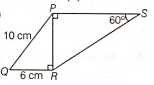
Based on the above information, answer the following questions.
What is the length of RS?
8 units
10 units
8 √2 units
16/3 √3 units
9.
If a digit is chosen at random from the digits 1, 2, 3, 4, 5, 6, 7, 8, 9, then the probability that this digit is an odd prime number is
\(\frac{1}{3}\)
\(\frac{2}{3}\)
\(\frac{4}{9}\)
\(\frac{5}{9}\)
10.
A number x is selected from the numbers 1,2,3 and then a second number y is randomly selected from the numbers 1,4,9, then the probability that the product xy of the two numbers will be less than 9 is
\(\frac{3}{7}\)
\(\frac{4}{9}\)
\(\frac{5}{9}\)
\(\frac{7}{9}\)
11.
If sin \(\theta=\frac{a}{b},\) then cos \(\theta\) is equal to
\(\frac{b}{\sqrt{b^{2}-a^{2}}}\)
\(\frac{b}{a}\)
\(\frac{\sqrt{b^{2}-a^{2}}}{b}\)
\(\frac{a}{\sqrt{b^{2}-a^{2}}}\)
12.
(1 + tan \(\theta\) + sec \(\theta\)) (1 + cot \(\theta\) – cosec \(\theta\)) =
0
1
2
-1
13.
\(\frac{2 \tan 30^{\circ}}{1-\tan ^{2} 30^{\circ}}\) =
cos 60°
sin 60°
tan 60°
sin 30°
14.
If cosec2θ (1 + cosθ) (1 – cosθ) = ,λ then the value of λ is
1
-1
cos2θ
0
15.
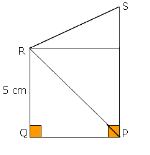
In given figure, if RP = 13 cm, QR = 5 cm and PS = 14 cm, then, tan S =In given figure, if RP = 13 cm, QR = 5 cm and PS = 14 cm, then, tan S =
4/3
9/4
8/4
5/4
16.
If sin(2α + 45°) = cos(30° – α ), where, 0° < α < 90°, then the value of α in degrees is.
35°
5°
15°
25°
17.
Three face cards of spade are removed from a well shuffled pack of 52 cards and a card is drawn from the remaining pack. The probability of getting a black face card is
12/50
9/50
3/49
7/49
18.
The probability of getting a number less than 5 in a single throw of dice is
5/6
2/3
1/2
1/3
19.
What is the probability that a number selected from the numbers (1, 2, 3,..........,15) is a multiple of 4?
1/5
4/5
2/15
1/3
20.
A man has to clean a window at a height of 5 m on a building. He needs to reach a point 1.3m below the window to clean it. What should be the length of the ladder that he should use which, when inclined at an angle of 60° to the horizontal, would enable him to reach the required position?
2.46
2√3
2.46/ √3
2.46√3
21.
The angle formed by the line of sight with the horizontal, when the point being viewed is above the horizontal level is called:
Obtuse angle
Angle of elevation
Angle of depression
Vertical angle
22.
Two pillars are a metres apart and the height of one is double that of the other. If from the middle point of the line joining their feet, an observer finds the angular elevation of their tops to be complementary, then the height of the taller pillar is
a√2m
2a m
a m
a/√2 m
23.
A tower stands vertically on the ground. From a point C on the ground, which is 20 m away from the foot of the tower, the angle of elevation of the top of the tower is found to be 45°. The height of the tower is
10 m
8 m
15 m
20 m
24.
Which of the following cannot be the probability of an event?
\(\frac{2}{3}\)
-1.5
15%
0.7
25.
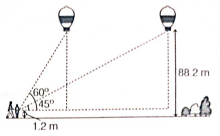
A 1.2 m tall girls pots a balloon moving with the wind in a horizontal linc at a height 88.2 m from the ground. The angle of elevation of the balloon from the eyes of the girlat any instant is 60°. After sometime, the angle of clevation reduces 45°. Find the distance travelled by the balloon during the interval.
26.
Videocon Electronics has launched two new mobile hands sets: Set I and Set II. Set I is cheaper as compared to Set II. But Set II has built-in device to recharge the battery with auto-cut power supply when it is fully charged. In a lot, there are 250 pieces of Set I and 100pieces of Set II. If mobile is picked at random, then
(i) find the probability of getting Set I.
(ii) find the probability of getting Set II.
27.
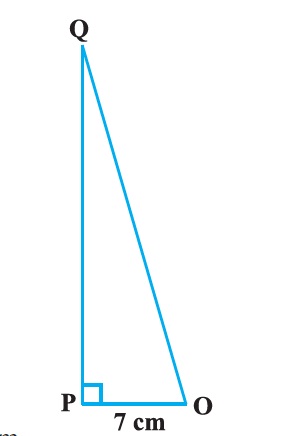
In \(\triangle\) OPQ, right-angled at P, OP = 7 cm and OQ – PQ = 1 cm . Determine the values of sin Q and cos Q.
28.
A person standing on the bank of a river, observes that the angle of elevation of the top of the tree standing on the opposite bank is 60°. When he retreats 20 m from the bank, he finds the angle of elevation to be 30°.Find the height of the tree and the breadth of the river.
29.
An aeroplane, when 3000m high, passes vertically above another plane at an instant when the angles of elevation of the two aeroplanes from the same point on the ground are 60° and 45° respectively. Find the vertical distance between the two aeroplanes.
30.
A box consists of 100 shirts of which 88 are good, 8 have minor defects and 4 have major defects. Ramesh, a shopkeeper will buy only those shirts which are good but 'Kewal' another shopkeeper will not buy shirts with major defects. A shirt is taken out of the box at random. What is the probability that
(i) Ramesh will buy the selected shirt?
(ii) 'Kewal' will buy the selected shirt?
31.
The angles of elevation and depression of the top and bottom of a light - house from the top of a 60 m high building are 30o and 60o respectively. Find
(i) the difference between the heights of the light - house and the building.
(ii) the distance between the light - house and the building.
32.
A piggy bank contains hundred 50 paise coins, fifty Rs. 1 coins, twenty Rs. 2 coins and ten Rs. 5 coins. If it is equally likely that one of the coins will fall out when the bank is turned upside down, then what is the probability that the coin
(i) will be a 50 paise coin?
(ii) will not be a Rs. 5 coin?
33.
A child has a die whose six faces show the letters as given below:

The die is thrown once. What is the probability of getting (i) A? (ii) D?
34.
Find the angle of elevation of the top of the tower from the point on the ground which is 30 m away from the foot of the tower of height 10 √3 rn.
35.
If \(\sin { \left( 36+\theta \right) } ^{ ° }=\cos { \left( 16+\theta \right) ^{ ° } } \), then find \(\theta \), where \(\left( 36+\theta \right) ^{ ° }\) and \(\left( 16+\theta \right) ^{ ° }\) are both acute angles.
36.
There is a group of 75 people who are patriotic, 35 people believe in violence.What is the probability of people who believe in non-violence?Which value you will develop in your character?
37.
All kings, queens and aces are removed from a pack of 52 cards. The remaining cards are well shuffled and then a card is drawn from it. Find the probability that the drawn card is
(i) a black face card (ii) a red card
38.
A bag contains 3 red balls, 5 black balls and 4 white balls. A ball is drawn at random from the bag. What is the probability that the ball is white?
39.
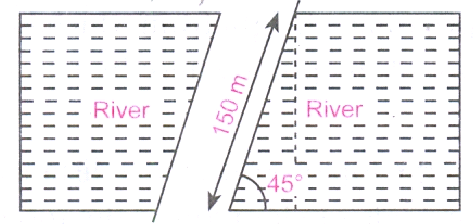
A bridge across a river makes an angle of 45o with the river bank (Fig. given). If the length of the bridge across the river is 150 m, what is the width of the river?
40.
While preparing for a competitive examination, Akbar came across a match-stick pattern based question. The pattern is given below.
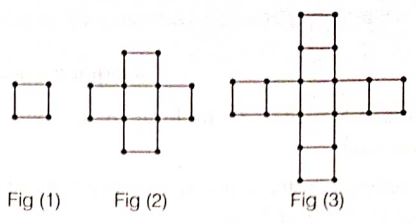
Based on the above information answer the following questions.
(i) Write first term and common difference of the AP formed by number of squares in each figure.
(ii) Write first term and common difference of the AP formed by number of sticks used in each figure.
(iii) (a) How many squares are there in fig (10)? Also, write the number of stick used in fig. (10).
Or (b) If 88 sticks are used to make mth (fig (m)), then find the value of m. How many squares are formed in this figure?
41.
Radio towers are used for transmitting a range of communication services including radio and television. The tower will either act as an antenna, itself or support one or more antennas on its structure.On a similar concept, a radio station tower was built in two Sections A and B. Tower is supported by wires from a point O.
Distance between the base of the tower and point O is 36 cm. From point O, the angle of elevation of the top of the Section B is 30° and the angle of elevation of the top of Section A is 45°.


Based on the above information, answer the following questions :
(i) Find the length of the wire from the point O be the top of Section B.
(ii) Find the distance AB.
(iii) Find the height of the Section A from the base of the tower.
Or
Find the area of \(\Delta\)OPB.
42.
Ritu's daughter is feeling so hungry and so thought to eat something. She looked into the fridge and found some bread pieces. She decided to make a sandwich. She cut the piece of bread diagonally and found that it forms a
righ.t angled triangle with sides 4 cm, 4\(\sqrt{3}\) cm and 8 cm.
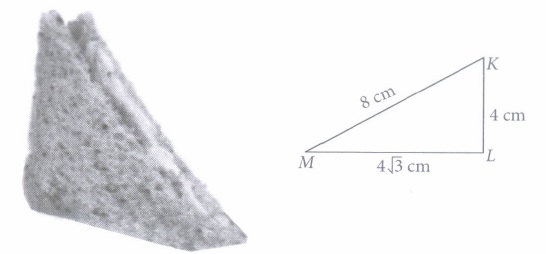
On the basis of above information, answer the following questions.
(i) The value of \(\angle\)M =
| (a) 30° | (b) 60° | (c) 45° | (d) None of these |
(ii) The value of \(\angle\)K =
| (a) 45° | (b) 30 ° | (c) 60° | (d) None of these |
(iii) Find the value of tanM.
| \((a) \sqrt{3}\) | \((b) \frac{1}{\sqrt{3}}\) | (c) 1 | (d) None of these |
(iv) sec2M - 1 =
| (a) tanM | (b) tan2M | (c) tan2M | (d) None of these |
(v) The value of \(\frac{\tan ^{2} 45^{\circ}-1}{\tan ^{2} 45^{\circ}+1}\) is
| (a) 0 | (b) 1 | (c) 2 | (d) -1 |
43.
Assertion : For 0o < θ ≤ 90o, cosec θ - cot θ and cosec θ + cot θ are reciprocal of each other
Reason : cosec θ - cot2 θ =1
(a) Both Assertion and Reason are correct and Reason is the correct explanation of Assertion.
(b) Both Assertion and Reason are correct but Reason is not the correct explanation of Assertion.
(c) Assertion is correct but Reason is incorrect.
(d) Assertion is incorrect but Reason is correct.
44.
Assertion (A) In a cricket match, a batsman hits a boundary 9 times out of 45 balls he plays. The probability that in a given ball, he does not hit the boundary is \(\frac{4}{5}\).
Reason (R) P(E) + P(not E) = 1
(a) Both Assertion (A) and Reason (R) are true and Reason (R) is the correct explanation of the Assertion (A).
(b) Both Assertion (A) and Reason (R) are true but Reason (R) is not correct explanation ot the Assertion (A).
(c) Assertion (A) is true but Reason (R) is false.
(d) Assertion (A) is false but Reason (R) is true.
1.
LHS = \({ (\sin { A } +cosecA) }^{ 2 }+{ (\cos { A } +\sec { A } ) }^{ 2 }\)
\(=\sin ^{ 2 }{ A } +{ cosec }^{ 2 }A+2\sin { A } cosecA+\cos ^{ 2 }{ A } +\sec ^{ 2 }{ A } +2\cos { A } \sec { A } \)
\(\left[ \because { (a+b) }^{ 2 }={ a }^{ 2 }+{ b }^{ 2 }+2ab \right] \)
\(=(\sin ^{ 2 }{ A } +\cos ^{ 2 }{ A } )+(1+\cot ^{ 2 }{ A } )+2\sin { A } \frac { 1 }{ \sin { A } } +(1+\tan ^{ 2 }{ A } )+2\cos { A } \frac { 1 }{ \cos { A } } \)\(\left[ \because { cosec }^{ 2 }A=1+\cot ^{ 2 }{ A } ,\sec ^{ 2 }{ A } =1+\tan ^{ 2 }{ A } ,cosecA=\frac { 1 }{ \sin { A } } and\sec { A } =\frac { 1 }{ \cos { A } } \right] \)\(=1+1+\cot ^{ 2 }{ A } +2+1+\tan ^{ 2 }{ A } +2\quad \left[ \because \sin ^{ 2 }{ A } +\cos ^{ 2 }{ A } =1 \right] \)
\(=7+\tan ^{ 2 }{ A } +\cot ^{ 2 }{ A } \)
= RHS
Hence proved.
2.
LHS = \((\sin { \theta } +cosec\theta )[{ (\sin { \theta } +\cos { \theta } ) }^{ 2 }-1]\)
\(=(\sin { \theta } +cosec\theta ){ (\sin ^{ 2 }{ \theta } +\cos ^{ 2 }{ \theta } +2\sin { \theta } .\cos { \theta } }-1)\)
\(=2\sin { \theta } +2\cos { \theta } =2p\)
3.
There are 40 students, and only one name card has to be chosen.
(i) The number of all possible outcomes is 40
The number of outcomes favourable for a card with the name of a girl = 25
Therefore, P (card with name of a girl) = P(Girl) = \(\frac{25}{40}=\frac{5}{8}\)
(ii) The number of outcomes favourable for a card with the name of a boy = 15
Therefore, P(card with name of a boy) = P(Boy) \(=\frac{15}{40}=\frac{3}{8}\)
Note : We can also determine P(Boy), by taking
P(Boy) = 1 – P(not Boy) = 1 – P(Girl) \(=1-\frac{5}{8}=\frac{3}{8}\)
4.
Here, two customers Shyam and Ekta are visiting a particular shop in the same week from Tuesday to Saturday.
\(\therefore\) The possible outcomes are:
| T T | T W | T Th | T F | T S |
| W T | W W | W Th | W F | W S |
| Th T | Th W | Th Th | Th F | Th S |
| F T | F W | F Th | F F | F S |
| S T | S W | S Th | S F | S S |
(i) P(Both visit the same day)
i.e, T T,W W,Th Th, F F, S S=\(\frac{5}{25}=\frac{1}{5}\)
(ii) P(Both visit on cnosecutive days) i.e., T W, W Th, Th F, F S, W T, Th W, F Th, S F
=\(\frac{8}{25}\)
5.
Let BC be the tower and BD is flagstaff of height h m.
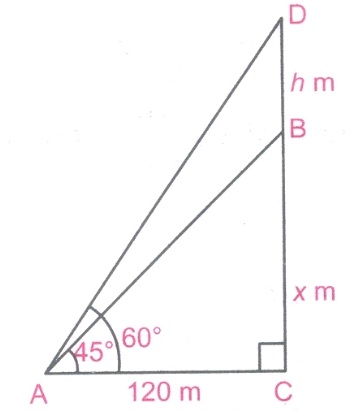
Let BC = x m
AC = 120 m, ㄥBAC = 45o and ㄥDAC = 60o
In right-angled triangle ACB,
\(\frac { AC }{ BC } =cot{ 45 }^{ 0 } \Rightarrow \frac { 120 }{ x } \)=1
x = 120 .....(i)
In right angled triangle ACD,
\(\frac { CD }{ AC } ={ tan60 }^{ 0 } \Rightarrow \frac { h+x }{ 120 } =\sqrt { 3 } \)
⇒ h + x = 120\(\sqrt { 3 } \)
⇒ h = 120\(\sqrt { 3 } \)-120 [using (i), x = 120]
⇒ h = 120 [\(\sqrt { 3 } \) - 1]
=120 [1.73 - 1]
m = 120 x 0.73 = 87.6 m
∴ Height of the flagstaff is 87.6 m.
6.
Let AD =1.2m be the height of girl standing on the horizontal line AB and let FH = EB = 88.2 m be the height of balloon from the line AB. At the eyes of the girl, the angles of clevation are \(\angle\)FDC = 60° and \(\angle\)EDC = 30°.

Now, FG = EC = 88.2 - 1.2 = 87 m
Let the distance travelled by the balloon, HB = y m and AH = x m.
\(\therefore\) DG = AH = x m and GC = HB = y m
In right angled \(\Delta\)FGD, tan 60°=\(\frac{P}{B}=\frac{F G}{D G}\)
\(\begin{array}{lll} \Rightarrow & \sqrt{3}=\frac{87}{x} \quad\left[\because \tan 60^{\circ}=\sqrt{3}\right] \\ \end{array}\)
\(\begin{array}{lll} \Rightarrow & x=\frac{87}{\sqrt{3}} & \ldots \text { (i) } \end{array}\)
In right angled \(\Delta\)ECD,
\(\begin{array}{rlrl} & \tan 30^{\circ} & =\frac{E C}{D C} \\ \end{array}\)
\(\begin{array}{rlrl} \Rightarrow \quad & \frac{1}{\sqrt{3}}=\frac{87}{D G+G C} \\ \end{array}\)
\(\begin{array}{rlrl} & {\left[\because \tan 30^{\circ}=\frac{1}{\sqrt{3}} \text { and } D C=D G+G C\right]} \\ \end{array}\)
\(\begin{array}{rlrl} \Rightarrow \quad & \frac{1}{\sqrt{3}}=\frac{87}{x+y} \Rightarrow x+y=87 \sqrt{3} \end{array}\) ...(ii)
On putting \(x=\frac{87}{\sqrt{3}}\) from Eq. (i), we get
\(\begin{array}{rlrl} \frac{87}{\sqrt{3}}+y=87 \sqrt{3} \\ \end{array}\)
\(\begin{array}{rlrl} \Rightarrow & \quad y=87\left(\sqrt{3}-\frac{1}{\sqrt{3}}\right) \\ \end{array}\)
\(\begin{array}{rlrl} \Rightarrow & y=\frac{87(3-1)}{\sqrt{3}}=\frac{87 \times 2}{\sqrt{3}} \times \frac{\sqrt{3}}{\sqrt{3}}=\frac{87 \times 2 \sqrt{3}}{3} \end{array}\)
[rationalising]
\(=29 \times 2 \sqrt{3}=58 \sqrt{3} \mathrm{~m}\)
Hence, the distance travelled by the balloon during the interval is \(58 \sqrt{3} \mathrm{~m}\).
7.
(b)
45°
8.
(d)
16/3 √3 units
9.
(a)
\(\frac{1}{3}\)
10.
11.
(c)
\(\frac{\sqrt{b^{2}-a^{2}}}{b}\)
12.
(c)
2
13.
(c)
tan 60°
14.
(a)
1
15.
(a)
4/3
16.
(c)
15°
17.
(c)
3/49
18.
(b)
2/3
19.
(a)
1/5
20.
21.
(b)
Angle of elevation
22.
(a)
a√2m
23.
(d)
20 m
24.
(b)
-1.5
25.
Trigonometric ratio involving AB, BC, OD, OA and angles is tanθ. [Refer AB, BC, OA and OD from the figure.]
Distance travelled by the balloon OB = AB - OA
From the figure, OD = BC, and it can be calculated as
88.2 m - 1.2 m = 87 m --- (1)
In ΔAOD,
tan 60° = OD/OA
√3 = 87/OA
OA = 87 / √3
= 87 × √3 / √3 × √3
= (87 × √3) / 3
= 29√3 m
26.
Given, total number of handsets = 350
(i)\(\begin{aligned} P(A)=\frac{250}{350}=\frac{5}{7} \end{aligned}\)
(ii) \(P(A)=\frac{100}{350}=\frac{2}{7}\)
27.
In \(\triangle\) OPQ, we have
OQ2 = OP2 + PQ2
i.e., (1 + PQ)2 = OP2 + PQ2
i.e., 1 + PQ2 + 2PQ = OP2 + PQ2
i.e., 1 + 2PQ = 72
i.e., PQ = 24 cm and OQ = 1 + PQ = 25 cm
So, \(\sin \mathrm{Q}=\frac{7}{25} \text { and } \cos \mathrm{Q}=\frac{24}{25}\)
28.
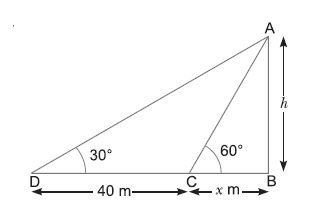
Let the height be 'h' m and breadth be 'b' m.
In \(\Delta ABC\),
\(\frac { h }{ b } =tan60°=\sqrt { 3 } \)
h=\(\sqrt { 3 } b\)
In \(\Delta ABD\), \(\frac { h }{ b+20 } =tan30°=\frac { 1 }{ \sqrt { 3 } } \)
h=\(\frac { b+20 }{ \sqrt { 3 } } \)
b\(\sqrt { 3 } \)=\(\frac { b+20 }{ \sqrt { 3 } } \)
3b = b + 20 => 2b = 20 => b = 10m
h=b\(\sqrt { 3 } \)=10 x 1.73=17.3 m
Height of tree is 17.3m and breadth of river is 10m.
29.
AC = 3000 m, \(\angle AOB=45°,\angle AOC=60°\)
In \(\Delta AOB\), \(\frac{AB}{OA}\)=tan 45°
\(\frac{3000-h}{x}\)=1
x=3000-h ...(i)
In \(\Delta AOC\), \(\frac{AC}{OA}\)=tan 60°
\(\frac{3000}{x}\)=\(\sqrt{3}\)
x=\(\frac { 3000 }{ \sqrt { 3 } } \)
=1000\(\sqrt{3}\)...(ii)
From (i) and (ii), we get x = 1732m
1000\(\sqrt{3}\)=3000-h
1732 = 3000-h
h = 1268
Hence, the vertical distance between the two aeroplanes is 1268 m
30.
Total number of shirts = 100
(i) let A = shirt is good.
Number of good shirts = 88
\(\therefore\) P(A)=\(\frac{88}{100}=\frac{22}{25}\)
\(\therefore\) Probability that Ramesh will buy
the selected shirt = \(\frac{22}{25}\)
(ii) let B = Shirt has no major defects.
Number of shirts with no major defect = 100-4 = 96
\(\therefore\) P(B)=\(\)\(\frac{96}{100}=\frac{24}{25}\)
\(\therefore\)Probability that Kewal will buy the selected shirt=\(\frac{24}{25}\)
31.
Let AB is the building
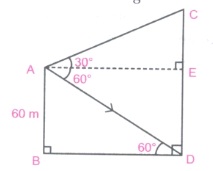
∴ AB=60 m and CD is the light house.
ㄥEAC=30o
and ㄥEAD=60o
∴ ㄥADB=60o
∴ AE||BD
In right ΔABD,
\(\frac { BD }{ AB } \)=cot 600⇒ \(\frac { BD }{ 60 } =\frac { 1 }{ \sqrt { 3 } } \)
⇒ BD=\(\frac { 60 }{ \sqrt { 3 } } \) m=20\(\sqrt { 3 } \) m.
∵ BD=AE
∴ AE=20\(\sqrt { 3 } \) m
Now in right ΔCEA, tan 300=\(\frac { CE }{ AE } \)
⇒ \(\frac { 1 }{ \sqrt { 3 } } =\frac { CE }{ 20\sqrt { 3 } } \)⇒ CE=20 m
(i) Difference between the heights of the light house and the building=CE=20 m
(ii) The distance between the light house and the building =BD=20\(\sqrt { 3 } \) m
32.
Given, number of 50 paise coins = 100,
number of Rs 1 coins = 50,
number of Rs 2 coins = 20
and number of Rs 5 coins = 10
\(\therefore\) total number of coins = 100 + 50 + 20 + 10 = 180
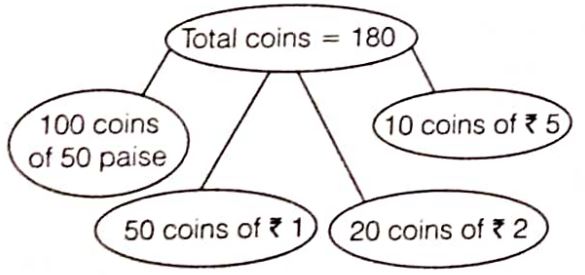
(i) P (50 paise coin)=\(\begin{aligned} & \frac{\text { Number of } 50 \text { paise coins }}{\text { Total number of coins }} \\ \end{aligned}\)
=\(\begin{aligned} \frac{100}{180}=\frac{5}{9} \end{aligned}\)
(ii) Number of coins which are not of Rs 5
= Total number of coins - Number of Rs 5 coins = 180 - 10 = 170
\(\therefore\) P (that the coin will not be a Rs 5 coin) \(\begin{aligned} & =\frac{170}{180} \\ \end{aligned}\)
\(\begin{aligned} & =\frac{17}{18} \end{aligned}\)
33.
Total number of outcomes in a single throw of a six faces die = 6
(i) Let E1 = Event of getting a letter A
then, number of outcomes favourable to E1 = 2
Hence, probability of getting a letter A,
\(P\left(E_1\right)=\frac{2}{6}=\frac{1}{3}\)
(ii) Let E2 = Event of getting a letter D
Then, number of outcomes favourable to E2 = 1
Hence, probability of getting a letter D,
\(P\left(E_2\right)=\frac{1}{6}\)
34.
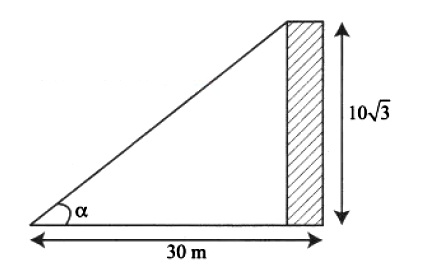
Let the angle of elevation of top of the tower be θ.
From ΔABC,
\({AB\over BC}=tan\theta\)
\(\Rightarrow\ {10\sqrt3\over 30}=tan\theta\)
\(\Rightarrow\ tan\theta={1\over\sqrt3}\)
θ=30°
Hence angle of elevation is θ.
35.
\(\sin { \left( 36+\theta \right) } ^{ ° }=\cos { \left( 16+\theta \right) ^{ ° } } \)
\(\Rightarrow \quad \cos { \left[ { 90 }^{ ° }-\left( 36+\theta \right) ^{ ° } \right] } =\cos { \left( 16+\theta \right) ^{ ° } } \)
\(\Rightarrow \quad { 90 }^{ ° }-{ 36 }^{ ° }-\theta =16+\theta \)
\(\Rightarrow \quad 2\theta =\quad { 90 }^{ ° }-{ 36 }^{ ° }-{ 16 }^{ ° }={ 38 }^{ ° }\)
\(\therefore \quad \theta =\frac { { 98 }^{ ° } }{ 2 } ={ 19 }^{ ° }\)
36.
(i) Total number of people = 75
Number of people believe in violence = 35
Number of people believe in non-violence
= 75-35=40
Probability Of people believe in non-violence
=\(\frac {40} {75} = \frac {8} {15}\)
(ii) In order to have a peaceful environment both values are required patriotism and non- violence. Only patriotism with violence is very dangerous.
37.
No. of queens = 4, No. of kings = 4, No. of aces = 4
= 52 -12 = 40, After No. of cards left removing all kings, queens and aces
(i) No. of black face cards in the remaining cards (2 jacks) = 2
\(\therefore \)Probability of black face card \(=\frac { 2 }{ 40 } =\frac { 1 }{ 20 } \)
(ii) Out of 12 cards removed, 6 are of red colour.
\(\therefore \)No. of red coloured cards left = 26-6 = 20
\(\therefore \)No. of ways to draw a red card = 20
\(\therefore \)Probability of getting a red card\(=\frac { 20 }{ 40 } =\frac { 1 }{ 2 } \)
38.
Total number of balls = 3 + 5 + 4 = 12
number of white balls = 4
\(\therefore\) Probability of drawing a white ball
\(=\frac{4}{12}=\frac{1}{3}\)
39.
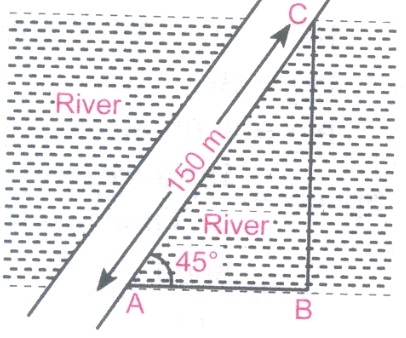
In given figure,
sin 45o = \(\frac { BC }{ AC } \Rightarrow \frac { 1 }{ \sqrt { 2 } } =\frac { BC }{ 150 } \)
BC = \(\frac { 150 }{ \sqrt { 2 } } =75\sqrt { 2 } \)m
40.
Given matchstick pattern
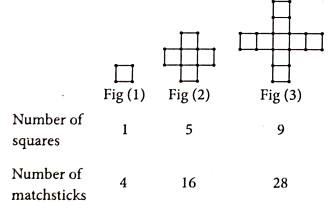
(i) The AP corresponding to number of squares in each figure is 1, 5, 9 .........
First term of AP = 1
Common difference of AP = 5 - 1 = 4
(ii) The AP corresponding to the number of sticks used in each figure is 4, 16, 28 ..........
First term of AP = 4
Common difference of AP = 16 – 4 = 12
(iii) (a) From part (i), the AP corresponding to number of squares is 1, 5, 9, ......
Here, a = 1 and 5 - 1 = 4
We have to find a10
We know that an = a + (n - 1)d
= 1 + (10 - 1)4
=1 + 9 \(\times\) 4 = 37
\(\therefore\) Fig. (10) will have 37 squares.
From part (ii), the AP we get corresponding to number of matchstick used is 4, 16, 28, ...
Here, a = 4 and d = 16 - 4 = 12
We have to find a10.
We know that
an = a + (n - 1)d
a10 = 4 + (10 - 1) 12
= 4 + 9 \(\times\) 12
= 4 + 108 = 112
\(\therefore\) Fig. (10) will have 112 matchsticks.
Or
(b) We have given, am = 88
a + (m - 1)d = 88
\(\Rightarrow\) 4+(m - 1)12 = 88 [\(\because\) a = 4, d = 12]
\(\Rightarrow\) (m - 1)12 = 84
\(\Rightarrow\) m - 1 = 7
m = 8
\(\therefore\) Fig. (8) will have 88 matchsticks.
To find number of squares in 8th figure we have to find a8 for the AP 1, 5, 9, .......
a8 = a + (8 - 1)d
a8 = 1 + 7 \(\times\) 4 = 29
Therefore, 8th figure will have 29 squares.
41.
(i) In right angled \(\Delta\)OPB,
\(\begin{aligned} & \cos 30^{\circ}=\frac{O P}{O B}=\frac{36}{O B} \\ \end{aligned}\)
\(\begin{aligned} \Rightarrow \quad O B & =\frac{36}{\cos 30^{\circ}}=\frac{36}{\frac{\sqrt{3}}{2}}=\frac{72}{\sqrt{3}} \times \frac{\sqrt{3}}{\sqrt{3}} \\ \end{aligned}\)
\(\begin{aligned} \Rightarrow \quad & O B=24 \sqrt{3} \mathrm{~cm} \end{aligned}\)
In right angled \(\Delta\)OPB,
\(\begin{aligned} \tan 30^{\circ} & =\frac{B P}{O P} \\ \end{aligned} \)
\(\begin{aligned} \Rightarrow \quad \frac{1}{\sqrt{3}} & =\frac{B P}{36} \\ \end{aligned}\)
\(\begin{aligned} \Rightarrow \quad B P & =\frac{36}{\sqrt{3}} \times \frac{\sqrt{3}}{\sqrt{3}} \\ \end{aligned}\)
\(\begin{aligned} =12 \sqrt{3} \mathrm{~cm} \end{aligned}\)
In right angled \(\Delta\)APO,
\(\begin{aligned} & \tan 45^{\circ}=\frac{A P}{O P} \\ \end{aligned}\)
\(\Rightarrow\) OP = AP [\(\because\) tan 45° = 1]
\(\Rightarrow\) AP = 36 cm ....(i)
\(\therefore\) Distance AB = AP - BP
= 36 - 12\(\sqrt3\)
=12(3-\(\sqrt3\)) cm
(iii) Height of the section A from the base of the tower
= AP = 36 cm [using Eq (i)]
Or
In right angled \(\Delta\)OPB,
\(\begin{aligned} \tan 30^{\circ} & =\frac{B P}{O P} \\ \end{aligned}\)
\(\Rightarrow\) BP = OP tan 30\(\circ\)
\(=36 \times \frac{1}{\sqrt{3}}=12 \sqrt{3} \mathrm{~cm}\)
\(\therefore\) Area of \(\Delta\)OPB = \(\begin{aligned} & =\frac{1}{2} \times O P \times B P \\ \end{aligned}\)
\(\begin{aligned} & =\frac{1}{2} \times 36 \times 12 \sqrt{3} \\ \end{aligned}\)
\(\begin{aligned} & =216 \sqrt{3} \mathrm{~cm}^2 \end{aligned}\)
42.
We have, KL = 4 cm, ML = 4\(\sqrt{3}\)m, KM = 8 cm
(i) (a): \(\tan M=\frac{K L}{L M}=\frac{4}{4 \sqrt{3}}=\frac{1}{\sqrt{3}}\)
\(\Rightarrow \tan M=\tan 30^{\circ} \Rightarrow \angle M=30^{\circ}\)
(ii) (c) : \(\tan K=\frac{M L}{K L}=\frac{4 \sqrt{3}}{4}=\sqrt{3}=\tan 60^{\circ}\)
\(\Rightarrow \angle K=60^{\circ}\)
(iii) (b)
(iv) (c)
(v) (a) : \(\frac{\tan ^{2} 45^{\circ}-1}{\tan ^{2} 45^{\circ}+1}=\frac{(1)^{2}-1}{1^{2}+1}=\frac{0}{2}=0\)
43.
(a) Both Assertion and Reason are correct and Reason is the correct explanation of Assertion.
Given, \(\operatorname{cosec} \theta-\cot \theta\)
Reciprocal of this expression \(=\frac{1}{\operatorname{cosec} \theta-\cot \theta}\)
On multiplying and dividing by \(\operatorname{cosec} \theta+\cot \theta\),
\(\frac{1}{\operatorname{cosec} \theta-\cot \theta} \times \frac{\operatorname{cosec} \theta+\cot \theta}{\operatorname{cosec} \theta+\cot \theta}= \frac{\operatorname{cosec} \theta+\cot \theta}{\operatorname{cosec}^2 \theta-\cot ^2 \theta}\)
\(=\operatorname{cosec} \theta+\cot \theta \quad\left[\because \operatorname{cosec}^2 \theta-\cot ^2 \theta=1\right]\)
44.
(a) A bastman hits a boundary 9 times out of 45 balls he plays.
P(A) = P (hits a target) = \(\frac{9}{45}=\frac{1}{5}\)
Since, \(P(A)+P(\bar{A})=1\)
\(\begin{aligned}
\Rightarrow \quad P(\bar{A}) & =1-P(A)
\end{aligned}\)
\(\begin{aligned}
=1-\frac{1}{5}=\frac{4}{5}
\end{aligned}\)
\(\therefore\) Probability of not hitting the boundary is \(\frac{4}{5}\)
\(\therefore\) Both Assertion (A) and reason (R) are correct.

10th Standard CBSE Syllabus & Materials
10th Standard CBSE
CBSE 10th Social Science PS - Federalism - New Model Questions Papers Study Material - QB365 Set A
NEW10th Standard CBSE
CBSE 10th Social Science PS - Power Sharing - New Model Questions Papers Study Material - QB365 Set A
NEW10th Standard CBSE
CBSE 10th Social Science GEO - Manufacturing Industries - New Model Questions Papers Study Material - QB365 Set A
NEW10th Standard CBSE
CBSE 10th Social Science GEO - Minerals and Energy Resources - New Model Questions Papers Study Material - QB365 Set A



NCERT Books

Syllabus

Exam Pattern

Sample Question Papers

Previous year Question Papers

Important Notes

MCQ Practice test

NCERT Exemplers

Case study Questions

Image Based Questions

Passage based Questions

HOT Questions

Value Based Questions

Model Questions Papers
NCERT ( Book Back ) Questions

Assertion and Reason
Important Questions And Answers

CBSE 10th Standard CBSE Subjects
CBSE Standards



