
 100% FREE ACCESS
10th Standard CBSE Syllabus & Materials
10th Standard CBSE
CBSE 10th Social Science ECO - Globalisation and the Indian Economy - New Model Questions Papers Study Material - QB365 Set A
NEW10th Standard CBSE
CBSE 10th Social Science ECO - Money and Credit - New Model Questions Papers Study Material - QB365 Set A
NEW10th Standard CBSE
CBSE 10th Social Science ECO - Sectors of the Indian Economy - New Model Questions Papers Study Material - QB365 Set A
NEW10th Standard CBSE
CBSE 10th Social Science ECO - Development - New Model Questions Papers Study Material - QB365 Set A
NEW10th Standard CBSE
CBSE 10th Social Science PS - Outcomes of Democracy - New Model Questions Papers Study Material - QB365 Set A
NEW10th Standard CBSE
CBSE 10th Social Science PS - Gender, Religion and Caste - New Model Questions Papers Study Material - QB365 Set A

Published on: 26/10/2025
Download CBSE Class 10th Standard CBSE Maths question papers, sample papers, important questions, and previous year solved papers in PDF format. Get free study materials, NCERT solutions, and exam preparation resources for Class 10th Standard CBSE Maths
Questions + Answers key
Take MCQ Maths Test
1.
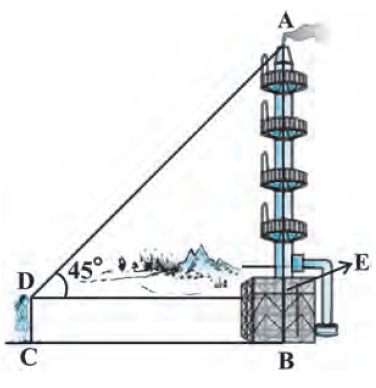
An observer 1.5 m tall is 28.5 m away from a chimney. The angle of elevation of the top of the chimney from her eyes is 45°. What is the height of the chimney?
2.
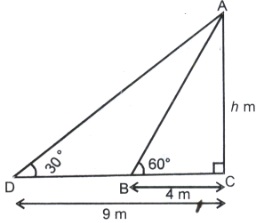
The angle of elevation of the top of a tower from two points at a distance of 4 m and 9 m from the base of the tower and in the same straight line with it are 60o and 30o respectively. Find the height of the tower.
3.
The angle of elevation of a jet fighter from a point A on the ground is 60o . After a flight of 15 seconds, the angle of elevation changes to 30o. If the jet is flying at a speed of 720 km/hr, find the constant height. \((\sqrt { 3 } =1.732)\) .
4.
A straight highway leads to the foot of a tower. A man standing at the top of the tower observes a car at an angle of depression of 30o , which is approaching the foot of the tower with a uniform speed. Six seconds later, the angle of depression of the car is found to be 60o . Find the time taken by the car to reach the foot of the tower from this point.
5.
From the top of a 7m high building, the angle of elevation of the top of a tower is 600 and the angle of depression of the foot of the tower is 300 find the height of the tower.
6.
A tree is broken by wind.The top struck the ground at an angle of 300 and at a distance of 30m from the root.Find the whole height of the tree
7.
A bridge across a river makes as angle of \({ 45 }^{ \circ }\)with the river bank. If the length of the bridge across the river is 150m, then find the width of the river.
8.
If a pole 6 m high throws shadow of \(2\sqrt { 3 } \) m, then find the angle of elevation of the sun.
9.
As observed from the top of a lighthouse, 100 m high above sea level, the angle of depression of a ship sailing directly towards it,changes from 30° to 60°. Determine the distance travelled by the ship during the period of observation. [take (√3 =1.732)]
10.
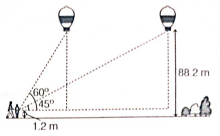
A 1.2 m tall girls pots a balloon moving with the wind in a horizontal linc at a height 88.2 m from the ground. The angle of elevation of the balloon from the eyes of the girlat any instant is 60°. After sometime, the angle of clevation reduces 45°. Find the distance travelled by the balloon during the interval.
11.
From the top of a building 60 m high, the angles of depression of the top and bottom of a tower are observed to be 45° and 60°, respectively. Then, find the height of the tower. [take, 13 = 1.732]
12.
Sunita is an electrician and she has to repair an electric fault on a pole of height 5 m. She needs to reach to a point on the pole 1.3 m below the top of the pole to undertake the repair work. What should be the length of the ladder that she should use which, when inclined at an angle of 60\(°\) from the horizontal, would enable her to reach the required position? Further, how far from the foot of the pole should she place the foot of the ladder? What value is indicated from this question?
13.
Radio towers are used for transmitting a range of communication services including radio and television. The tower will either act as an antenna, itself or support one or more antennas on its structure.On a similar concept, a radio station tower was built in two Sections A and B. Tower is supported by wires from a point O.
Distance between the base of the tower and point O is 36 cm. From point O, the angle of elevation of the top of the Section B is 30° and the angle of elevation of the top of Section A is 45°.


Based on the above information, answer the following questions :
(i) Find the length of the wire from the point O be the top of Section B.
(ii) Find the distance AB.
(iii) Find the height of the Section A from the base of the tower.
Or
Find the area of \(\Delta\)OPB.
14.
A boy is standing on the top of light house. He observed that boat P and boat Q are approaching to light house from opposite directions. He finds that angle of depression of boat P is 45° and angle of depression of boat Q is 30°. He also knows that height of the light house is 100 m.
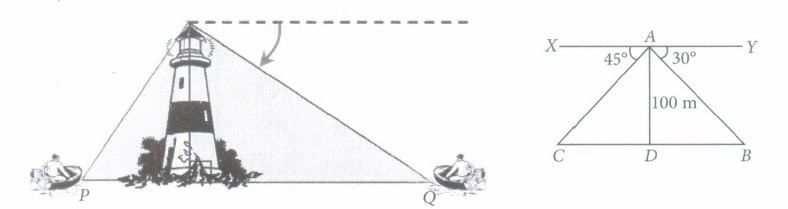
Based on the above information, answer the following questions.
(i) Measure of \(\angle\)ACD is equal to
| (a) 30° | (b) 45° | (c) 60° | (d) 90° |
(ii) If \(\angle\)YAB = 30°, then \(\angle\)ABD is also 30°, Why?
| (a) vertically opposite angles | (b) alternate interior angles |
| (c) alternate exterior angles | (d) corresponding angles |
(iii) Length of CD is equal to
| (a) 90 m | (b) 60 m | (c) 100 m | (d) 80 m |
(iv) Length of BD is equal to
| (a) 50 m | (b) 100 m | (c) 100\(\sqrt{2}\) m | (d) 100\(\sqrt{3}\) m |
(v) Length of AC is equal to
| (a)100\(\sqrt{2}\) m | (b) 100\(\sqrt{3}\) m | (c) 50 m | (d) 100 m |
1.
Here, AB is the chimney, CD the observer and ∠ ADE the angle of elevation (see Figure). In this case, ADE is a triangle, right-angled at E and we are required to find the height of the chimney.
We have AB = AE + BE = AE + 1.5 and DE = CB = 28.5 m
To determine AE, we choose a trigonometric ratio, which involves both AE and DE. Let us choose the tangent of the angle of elevation.
Now, \(\tan 45^{\circ}=\frac{\mathrm{AE}}{\mathrm{DE}}\)
i.e., \(1=\frac{\mathrm{AE}}{28.5}\)
Therefore, AE = 28.5
So the height of the chimney (AB) = (28.5 + 1.5) m = 30 m.
2.
Let us assume that the height of the tower AC be h m and ∠ABC=60o , ∠ADC=30o
As BC=4m
DC=9m (given)
Consider a rt△ACB, we have
tan 60o = \(\frac{AC}{BC}\)
⇒ \(\sqrt{3} = \frac{h}{4}\) --- (i)
Again, consider a rt. △ACD, we have
tan 300 = \(\frac{AC}{DC}\)
⇒ \(\frac { 1 }{ \sqrt { 3 } } =\frac { h }{ 9 } \) --- (ii)
Now, multiply (i) and (ii), we have
\(1=\frac{h}{4}\times\frac{h}{9}\)
⇒ 1= \(\frac {h^{2}} {36}\)
⇒ h2=36
⇒ h=\(\sqrt{36}\)=6 m
⇒ h=6m
Hence, height of the tower is 6m.
3.
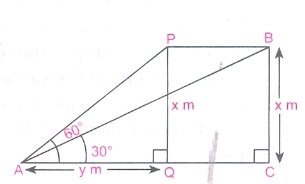
Speed of jet fighter=720 km/h=200 m/s
∴ Distance covered in 15 seconds
=200 x 15=3000 m
PB=3000 m
PB=QC=3000 m
In right ΔPQA,
\(\frac { PQ }{ AQ } \)=tan60o
⇒ \(\frac { x }{ y } =\sqrt { 3 } \Rightarrow x=\sqrt { 3 } y\) ....(i)
In right ∆BCA,
\(\frac { BC }{ AC } =tan30^{ 0 }\Rightarrow \frac { x }{ y+3000 } =\frac { 1 }{ \sqrt { 3 } } \)
⇒ x=\(\frac { y+3000 }{ \sqrt { 3 } } \) .......(ii)
From (i) and (ii), \(\sqrt { 3 } y=\frac { y+3000 }{ \sqrt { 3 } } \qquad \)
⇒ 3y=y+3000 ⇒ 2y=3000 ⇒ y=1500 m
x=1500 x \(\sqrt { 3 } \)m
x=1500\(\sqrt { 3 } \)=1500 x 1.732 m=2598 m
4.
Let CD = h m be the height of the tower. At point D of the tower, a man is standing and observes the car at an angle of depression of 30°. After six seconds, the angle of depression of the car is 60°.
i.e. \(\angle\)ODA = 30° and \(\angle\)ODB = 60°
\(\Rightarrow\) \(\angle\)DAC = \(\angle\)ODA = 30° [alternate angles]
and \(\angle\)DBC = \(\angle\)ODB = 60° [alternate angles]
Let AB = y m and BC = x m
In right angled \(\Delta\)BCD,

\(\begin{array}{rlrl} \tan 60^{\circ} & =\frac{P}{B}=\frac{C D}{B C} \\ \end{array}\)
\(\begin{array}{rlrl} \Rightarrow \quad \sqrt{3} & =\frac{h}{x} \\ \end{array}\)
\(\begin{array}{rlrl} \Rightarrow \quad h & =\sqrt{3} x & {\left[\because \tan 60^{\circ}=\sqrt{3}\right]} \end{array}\)
\(\Rightarrow \quad h = \sqrt3 x\)....(i)
In right angled \(\Delta\)ACD,
\(\begin{array}{rlrl} \tan 30^{\circ} & =\frac{C D}{A C}=\frac{C D}{A B+B C} & & {[\because A C=A B+B C]} \\ \end{array}\)
\(\begin{array}{rlrl} \Rightarrow \quad \frac{1}{\sqrt{3}} & =\frac{h}{x+y} & & {\left[\because \tan 30^{\circ}=\frac{1}{\sqrt{3}}\right]} \\ \end{array}\)
\(\begin{array}{rlrl} \Rightarrow \quad x+y & =h \sqrt{3} & \end{array}\)
\(\Rightarrow \quad x + y=\sqrt3 x(\sqrt3)\) [from Eq. (i)]
\(\Rightarrow\) x + y = 3x .....(ii)
It is given that a car moves from point A to B in six seconds. Let its speed be k km/s.
\(\therefore \quad \text { Time }=\frac{\text { Distance }}{\text { Speed }}\)
\(\Rightarrow \quad 6=\frac{y}{k} \Rightarrow y=6 k\)
On putting y = 6k in Eq. (ii), we get
x + 6k = 3x \(\Rightarrow\) 6k - 2x \(\Rightarrow\) x = 3k
\(\therefore \quad \text { Time }=\frac{\text { Distance }}{\text { Speed }}=\frac{x}{k}=\frac{3 k}{k}=3 \mathrm{~s}\)
Hence, the car moves from point B to point C in 3s.
5.
28
6.
51.96m
7.
\(75\sqrt { 2 } m\)
8.
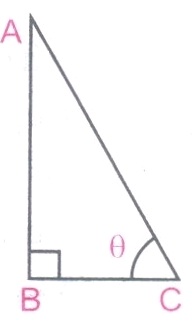
Let AB is pole and BC is its shadow
∴ AB = 6m, BC = 2\(\\ \\ \\ \\ \sqrt { 3 } \) m
In right ΔABC, \(\frac { AB }{ BC } \)=tanፀ
⇒ tanፀ = \(\frac { 6 }{ 2\sqrt { 3 } } \)
⇒ tanፀ = \(\sqrt { 3 } \)
⇒ ፀ = 60o
9.
To solve the problem, we need to determine the distance traveled by the ship as observed from the top of the lighthouse. The lighthouse is 100 meters above sea level, and the angles of depression change from 30∘ to 60∘.
1. Understanding the Problem:
The height of the lighthouse (h) = 100 m.
Angle of depression from the lighthouse to the ship initially = 30∘.
Angle of depression from the lighthouse to the ship finally = 60∘.
2. Setting Up the Diagram:
Let point A be the top of the lighthouse, point B be the position of the ship when the angle of depression is 30∘, and point C be the position of the ship when the angle of depression is 60∘.
The distances from the base of the lighthouse to the ship at points B and C can be denoted as x and y respectively.
3. Using Trigonometric Ratios:
For the angle of depression of 30∘:
\(\tan \left(30^{\circ}\right)=\frac{\text { height }}{\text { distance from lighthouse }}=\frac{100}{x} \)
\( \tan \left(30^{\circ}\right)=\frac{1}{\sqrt{3}} \Longrightarrow \frac{1}{\sqrt{3}}=\frac{100}{x} \Longrightarrow x=100 \sqrt{3}\)
For the angle of depression of 60∘ :
\( \tan \left(60^{\circ}\right)=\frac{\text { height }}{\text { distance from lighthouse }}=\frac{100}{y} \)
\(\tan \left(60^{\circ}\right)=\sqrt{3} \Longrightarrow \sqrt{3}=\frac{100}{y} \Longrightarrow y=\frac{100}{\sqrt{3}}\)
4. Calculating the Distance Traveled by the Ship:
The distance traveled by the ship is the difference between the two distances:
Distance traveled \(=x-y=100 \sqrt{3}-\frac{100}{\sqrt{3}}\)
To simplify this, we need a common denominator:
\(=\frac{100 \sqrt{3} \cdot \sqrt{3}}{\sqrt{3}}-\frac{100}{\sqrt{3}}=\frac{300-100}{\sqrt{3}}=\frac{200}{\sqrt{3}}\)
5. Substituting the Value of √3 :
Now, substituting \(\sqrt{3}=1.732\) :
Distance traveled \(=\frac{200}{1.732} \approx 115.47 \mathrm{~m}\)
Final Answer: √3
The distance traveled by the ship during the period of observation is approximately 115.47 meters.
10.
Trigonometric ratio involving AB, BC, OD, OA and angles is tanθ. [Refer AB, BC, OA and OD from the figure.]
Distance travelled by the balloon OB = AB - OA
From the figure, OD = BC, and it can be calculated as
88.2 m - 1.2 m = 87 m --- (1)
In ΔAOD,
tan 60° = OD/OA
√3 = 87/OA
OA = 87 / √3
= 87 × √3 / √3 × √3
= (87 × √3) / 3
= 29√3 m
11.
25.36 m
12.
Let AB be the pole and C be the point 1.3 m below the top A of the pole. Also, let D be the point on the ground, where ladder CD be placed.
So, \(\angle CDB=60°and BC=(5-1.3)m=3.7m\quad \)
Now, \(\frac { BC }{ CD } =sin\quad 60°\)
\(\Rightarrow \frac { 3.7 }{ CD } =\frac { \sqrt { 3 } }{ 2 } \)
\(\Rightarrow CD=\frac { 7.4 }{ \sqrt { 3 } } m\)
So, length of the ladder = \(\frac { 7.4 }{ \sqrt { 3 } } m\)
\(=\frac { 7.4\sqrt { 3 } }{ 3 } \) m
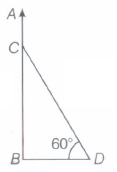
Also, \(\frac { BC }{ BD } =tan\quad 60°\)
\(\Rightarrow \frac { 3.7 }{ BD } =\sqrt { 3 } \Rightarrow BD=\frac { 3.7 }{ \sqrt { 3 } } m\)
Thus, foot of the ladder must be placed \(\frac { 3.7 }{ \sqrt { 3 } } m, i.e.\frac { 3.7\sqrt { 3 } }{ 3 } \)
m away from the foot of the pole.
Value Women can work in any field without gender bias.
Also, it indicates 'dignity for labour'.
13.
(i) In right angled \(\Delta\)OPB,
\(\begin{aligned} & \cos 30^{\circ}=\frac{O P}{O B}=\frac{36}{O B} \\ \end{aligned}\)
\(\begin{aligned} \Rightarrow \quad O B & =\frac{36}{\cos 30^{\circ}}=\frac{36}{\frac{\sqrt{3}}{2}}=\frac{72}{\sqrt{3}} \times \frac{\sqrt{3}}{\sqrt{3}} \\ \end{aligned}\)
\(\begin{aligned} \Rightarrow \quad & O B=24 \sqrt{3} \mathrm{~cm} \end{aligned}\)
In right angled \(\Delta\)OPB,
\(\begin{aligned} \tan 30^{\circ} & =\frac{B P}{O P} \\ \end{aligned} \)
\(\begin{aligned} \Rightarrow \quad \frac{1}{\sqrt{3}} & =\frac{B P}{36} \\ \end{aligned}\)
\(\begin{aligned} \Rightarrow \quad B P & =\frac{36}{\sqrt{3}} \times \frac{\sqrt{3}}{\sqrt{3}} \\ \end{aligned}\)
\(\begin{aligned} =12 \sqrt{3} \mathrm{~cm} \end{aligned}\)
In right angled \(\Delta\)APO,
\(\begin{aligned} & \tan 45^{\circ}=\frac{A P}{O P} \\ \end{aligned}\)
\(\Rightarrow\) OP = AP [\(\because\) tan 45° = 1]
\(\Rightarrow\) AP = 36 cm ....(i)
\(\therefore\) Distance AB = AP - BP
= 36 - 12\(\sqrt3\)
=12(3-\(\sqrt3\)) cm
(iii) Height of the section A from the base of the tower
= AP = 36 cm [using Eq (i)]
Or
In right angled \(\Delta\)OPB,
\(\begin{aligned} \tan 30^{\circ} & =\frac{B P}{O P} \\ \end{aligned}\)
\(\Rightarrow\) BP = OP tan 30\(\circ\)
\(=36 \times \frac{1}{\sqrt{3}}=12 \sqrt{3} \mathrm{~cm}\)
\(\therefore\) Area of \(\Delta\)OPB = \(\begin{aligned} & =\frac{1}{2} \times O P \times B P \\ \end{aligned}\)
\(\begin{aligned} & =\frac{1}{2} \times 36 \times 12 \sqrt{3} \\ \end{aligned}\)
\(\begin{aligned} & =216 \sqrt{3} \mathrm{~cm}^2 \end{aligned}\)
14.
(i) (b): \(\angle X A C=45^{\circ}\)
\(\therefore \quad \angle A C D=45^{\circ}\) [Alternate interior angles]
(ii) (b)
(iii) (c) : \(\text { In } \Delta A C D\)
\(\frac{A D}{D C}=\tan 45^{\circ} \)
\(\Rightarrow \frac{100}{D C}=1 \Rightarrow D C=100 \mathrm{~m}\)
(iv) (d): \(\text { In } \Delta A B D, \frac{A D}{B D}=\tan 30^{\circ}\)
\(\Rightarrow \quad \frac{100}{B D}=\frac{1}{\sqrt{3}} \)
\(\Rightarrow \quad B D=100 \sqrt{3} \mathrm{~m}\)
(v) (a): \(\text { In } \Delta A D C\)
\(\frac{A D}{A C}=\sin 45^{\circ} \Rightarrow \frac{100}{A C}=\frac{1}{\sqrt{2}} \Rightarrow A C=100 \sqrt{2} \mathrm{~m}\)

10th Standard CBSE Syllabus & Materials
10th Standard CBSE
CBSE 10th Social Science PS - Federalism - New Model Questions Papers Study Material - QB365 Set A
NEW10th Standard CBSE
CBSE 10th Social Science PS - Power Sharing - New Model Questions Papers Study Material - QB365 Set A
NEW10th Standard CBSE
CBSE 10th Social Science GEO - Manufacturing Industries - New Model Questions Papers Study Material - QB365 Set A
NEW10th Standard CBSE
CBSE 10th Social Science GEO - Minerals and Energy Resources - New Model Questions Papers Study Material - QB365 Set A



NCERT Books

Syllabus

Exam Pattern

Sample Question Papers

Previous year Question Papers

Important Notes

MCQ Practice test

NCERT Exemplers

Case study Questions

Image Based Questions

Passage based Questions

HOT Questions

Value Based Questions

Model Questions Papers
NCERT ( Book Back ) Questions

Assertion and Reason
Important Questions And Answers

CBSE 10th Standard CBSE Subjects
CBSE Standards



