
 100% FREE ACCESS
10th Standard CBSE Syllabus & Materials
10th Standard CBSE
CBSE 10th Social Science ECO - Globalisation and the Indian Economy - New Model Questions Papers Study Material - QB365 Set A
NEW10th Standard CBSE
CBSE 10th Social Science ECO - Money and Credit - New Model Questions Papers Study Material - QB365 Set A
NEW10th Standard CBSE
CBSE 10th Social Science ECO - Sectors of the Indian Economy - New Model Questions Papers Study Material - QB365 Set A
NEW10th Standard CBSE
CBSE 10th Social Science ECO - Development - New Model Questions Papers Study Material - QB365 Set A
NEW10th Standard CBSE
CBSE 10th Social Science PS - Outcomes of Democracy - New Model Questions Papers Study Material - QB365 Set A
NEW10th Standard CBSE
CBSE 10th Social Science PS - Gender, Religion and Caste - New Model Questions Papers Study Material - QB365 Set A

Published on: 20/10/2025
Download CBSE Class 10th Standard CBSE Maths question papers, sample papers, important questions, and previous year solved papers in PDF format. Get free study materials, NCERT solutions, and exam preparation resources for Class 10th Standard CBSE Maths
Questions + Answers key
Take MCQ Maths Test
1.
Find the coordinates of the point which divide the line segment joining A(2, -3) and B(-4, -6) into three equal parts.
2.
Prove that \(\\ \frac { 1-\cos { A } +\sin { A } }{ \sin { A } +\cos { A } -1 } =\frac { 1+\sin { A } }{ \cos { A } } .\)
3.
Show that \(\sqrt { \frac { 1+\cos { A } }{ 1-\cos { A } } } =cosec\quad A+\cot { A } \)
4.
Evaluate \({ \left( \frac { \sin { { 25 }^{ 0 } } }{ \cos { { 65 }^{ 0 } } } \right) }^{ 2 }+{ \left( \frac { \tan { { 65 }^{ 0 } } }{ \cot { { 25 }^{ 0 } } } \right) }^{ 2 }-2\cos ^{ 2 }{ { 45 }^{ 0 } } .\)
5.
Prove that the points A(2,3), B(-2,2), C(-1,-2) and D(3,-1) are the vertices of a square ABCD.
6.
Find the value of k for which the points (-5,1), (1,k) and (4,-2) are collinear.
7.
As observed from the top of a light - house, 100 m high above sea level, the angle of depression of a ship, sailing directly towards it, changes from 30o to 60o . Determine the distance travelled by the ship during the period of observation. \((Use\sqrt { 3 } =1.732)\)
8.
A boy standing on a horizontal plane finds a bird flying at a distance of 100 m from him at an elevation of 30o. A girl standing on the roof of 20 metre high building, finds the angle of elevation of the same bird to be 45o. Both the boy and the girl are on opposite sides of the bird. Find the distance of bird from the girl. [given \(\sqrt2\) = 1414]
9.
The angles of elevation of the top of a tower from two points at a distance of 4 m and 9 m from the base of the tower and in the same straight line with it are complementary. Prove that the height of the tower is 6 m.
10.
There are two windows in a house. First window is at the height of 2 m above the ground and other window is 4 m vertically above the lower window. Ankit and Radha are sitting inside the two windows at points G and F respectively. At an instant, the angles of elevation of a balloon from these windows are observed to be 60° and 30° as shown below
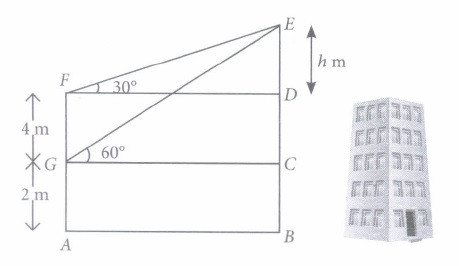
Based on the above information, answer the following questions.
(i) Who is more closer to the balloon?
| (a) Ankit | (b) Radha |
| (c) Both are at equal distance | (d) Can't be determined |
(ii) Value of DF is equal to
| \((a) \frac{h}{\sqrt{3}} \mathrm{~m}\) | \((b) h \sqrt{3} \mathrm{~m}\) | \((c) \frac{h}{2} \mathrm{~m}\) | \((d) 2 h \mathrm{~m}\) |
(iii) Value of h is
| (a) 2 | (b) 3 | (c) 4 | (d) 5 |
(iv) Height of the balloon from the ground is
| (a) 4 m | (b) 6 m | (c) 8 m | (d) 10 m |
(v) If the balloon is moving towards the building, then both angle of elevation will
| (a) remain same | (b) increases | (c) decreases | (d) can't be determined |
1.
Let P(x1 , y1) and Q(x2 , y2) are two points which divide AB in three equal parts.
By section formula
\(P\left( { x }_{ 1 }{ y }_{ 1 } \right) =\left( \frac { 1\times \left( -4 \right) +2\times \left( 2 \right) }{ 1+2 } ,\frac { 1\times \left( -6 \right) +2\times \left( -3 \right) }{ 1+2 } \right) \)
\(=\left( \frac { -4+4 }{ 3 } ,\frac { -6+(-6) }{ 3 } \right) \)
= (0, -4)
\(Q\left( { x }_{ 2 }{ y }_{ 2 } \right) =\left( \frac { 2\times \left( -4 \right) +1\times \left( 2 \right) }{ 2+1 } ,\frac { 2\times \left( -6 \right) +1\times \left( -3 \right) }{ 2+1 } \right) \)
\(=\left( \frac { -8+2 }{ 3 } ,\frac { -12+(-3) }{ 3 } \right) \)
= (- 2, - 5)
2.
LHS = \(\frac { 1-\cos { A } +\sin { A } }{ \sin { A } +\cos { A } -1 } =\frac { \sec { A } +\tan { A } +1 }{ 1-(\sec { A } -\tan { A } ) } \)
\(=\frac { (\sec { A } +\tan { A } )-1 }{ 1-(\sec { A } -\tan { A } ) } \times \frac { 1+(\sec { A } -\tan { A } ) }{ 1+(\sec { A } -\tan { A } ) } \)
\(=\frac { (\sec { A } +\tan { A } )+(\sec ^{ 2 }{ A } -\tan ^{ 2 }{ A } )-1-(\sec { A } -\tan { A } ) }{ 1-(\sec ^{ 2 }{ A } -\tan ^{ 2 }{ A } -2\tan { A } \sec { A } ) } \)
\(=\frac { \tan { A } +1-1+\tan { A } }{ 1-(\tan ^{ 2 }{ A } -\tan ^{ 2 }{ A } -2\tan { A } \sec { A } ) } [\because \sec ^{ 2 }{ A } -\tan ^{ 2 }{ A } =1]\)
\(=\frac { 2\tan { A } }{ 2\tan { A } (\sec { A } -\tan { A } ) } =\frac { 1 }{ \sec { A } -\tan { A } } \)
\(=\frac { \sec { A } +\tan { A } }{ (\sec ^{ 2 }{ A } -\tan ^{ 2 }{ A } ) } \)
\(=\frac { \sec { A } +\tan { A } }{ 1 } =\frac { 1+\sin { A } }{ \cos { A } } =RHS\)
Hence proved.
3.
LHS =\(\sqrt { \frac { 1+\cos { A } }{ 1-\cos { A } } \times \frac { 1+\cos { A } }{ 1+\cos { A } } } \)
\(=\frac { 1+\cos { A } }{ 1-\cos ^{ 2 }{ A } } =\frac { 1+\cos { A } }{ \sin { A } } \) \([\therefore 1-\cos ^{ 2 }{ A } =\sin ^{ 2 }{ A } ]\)
\(=cosecA+\cot { A } \)
4.
0
5.
Here, |AB|= \(\sqrt { (-2-2)^{ 2 }+(2-3)^{ 2 } } \)
= \(\sqrt { (-4)^{ 2 }+(-1)^{ 2 } } \)
=\(\sqrt { 16+1 } =\sqrt { 17 } \) Units
|BC|= \(\sqrt { (-1+2)^{ 2 }+(-2-2)^{ 2 } } \)
= \(\sqrt { (1)^{ 2 }+(-4)^{ 2 } } \)
=\(\sqrt { 1+16 } =\sqrt { 17 } \) units
|CD|= \(\sqrt { (3+1)^{ 2 }+(-1+2)^{ 2 } } \)
=\(\sqrt { 4^{ 2 }+1^{ 2 } } \)
= \(\sqrt { 17 } \)=units
|DA|=\(\sqrt { (2-3)^{ 2 }+(3+1)^{ 2 } } \)
= \(\sqrt { (-1)^{ 2 }+4^{ 2 } } \)=\(\sqrt { 1+16 } \)
= \(\sqrt { 17 } \) units
\(\Rightarrow \) AB=BC=CD=DA= units
Now,Diagonal |AC| =\(\sqrt { (-1-2)^{ 2 }+(-2-3)^{ 2 } } \)
= \(\sqrt { (-3)^{ 2 }+(-5)^{ 2 } } \)
=\(\sqrt { 9+25 } =\sqrt { 34 } \) units
Diagonal |BD|= \(\sqrt { (3+2)^{ 2 }+(-1-2)^{ 2 } } \)
= \(\sqrt { { 5 }^{ 2 }+(-3)^{ 2 } } \)
= \(\sqrt { 25+9 } =\sqrt { 34 } \) units
\(\Rightarrow \) Diagonal AC=Diagonal BD= units
Hence ABCD is a square
6.
k=-1
7.
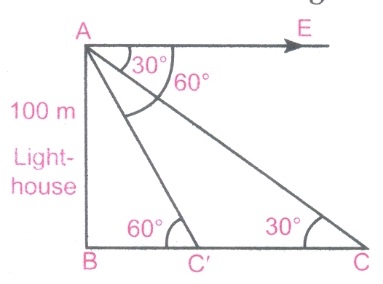
Given: AB the lighthouse 100 m above sea level and C is a ship sailing towards AB.
⇒ ㄥEAC = 30\(\unicode{xb0} \)
After travelling from C to C' angle of depression changes from ㄥEAC = 30\(\unicode{xb0} \) to ㄥEAC' = 60\(\unicode{xb0} \)
To Find: CC'
Solution: AE||BC
[Line of sight and line of horizontal]
⇒ ㄥACC' = ㄥEAC = 30\(\unicode{xb0} \) [Alternate angles]
ㄥAC'B = ㄥEAC' = 60\(\unicode{xb0} \) [Alternate angles]
In right ΔABC', \(\frac { AB }{ BC } \) = tan30o
\(\frac { 100 }{ BC } =\frac { 1 }{ \sqrt { 3 } } \Rightarrow BC=100\sqrt { 3 } \)
CC' = BC - BC'
=\(\left( 100\sqrt { 3 } -\frac { 100 }{ \sqrt { 3 } } \right) \)m
=\(\frac { 100\times 3-100 }{ \sqrt { 3 } } \)
=\(\frac { 200 }{ \sqrt { 3 } } m=\frac { 200\sqrt { 3 } }{ 3 } m\) = 115.466 m
8.
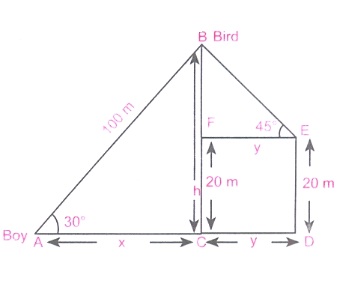
Given: A boy is standing at a distance of 100 m from the bird flying at an elevation of 30o. A girl is standing on the roof of 20 m high building finds the angle of elevation of the bird to be 45o Boy and girl are on opposite side of the bird.
To find: Distance between the bird and the girl i.e., BE.
Solution: In ΔACB,
⇒ \(\frac { h }{ 100 } \) = sin 300 ⇒ h = \(\frac { 1 }{ 2 } \) x 100 = 50 m
⇒ BF = h - 20 = (50 - 20) m = 30 m
In ΔBFE,\(\frac { 30 }{ BE } =sin{ 45 }^{ 0 }\Rightarrow \frac { 30 }{ BE } =\frac { 1 }{ \sqrt { 2 } } \Rightarrow 30\sqrt { 2 } \) = BE
BE = 30 x 1.414 = 42.420 = 42.42 m
9.
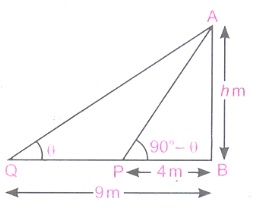
Let the height of the tower AB = h m,
We have PB = 4 m, QB = 9 m
Let ㄥAQB = θ [Both are complementary angles]
Then ㄥAPB = 90\(\unicode{xb0} \) - θ
In ΔABP, \(\frac { AB }{ PB } \) = tan (90\(\unicode{xb0} \)- θ)
⇒ h/4 = cotθ ....(i)
In ΔABQ, \(\frac { AB }{ QB } \) = tanፀ
h/9 = tanθ
h = 9tanθ ....(ii)
From equation (i) and (ii) we get
h x h = 4 cotθ x 9 tanθ
⇒ h2 = 36 cotθ x tanθ = 36 1/tanθ x tanθ
⇒ h2 = 36 ⇒ h = 6m
Hence, the height of the tower is 6 m.
10.
(i) (b): The person who makes small angle of elevation is more closer to the balloon.
\(\therefore\) Radlra is more closer to the balloon.
(ii) (b): \(\text { In } \Delta E F D, \tan 30^{\circ}=\frac{E D}{D F}\)
\(\Rightarrow \quad \frac{1}{\sqrt{3}}=\frac{h}{D F} \)
\(\Rightarrow \quad D F=h \sqrt{3} \mathrm{~m}\)
(iii) (a): In \(\Delta\)GCE,
\(\begin{array}{l}
\tan 60^{\circ}=\frac{E C}{G C}=\frac{h+4}{D F} \\
\Rightarrow \quad \sqrt{3}=\frac{h+4}{\sqrt{3} h} \Rightarrow 3 h=h+4 \Rightarrow h=2
\end{array}\)
(iv) (c): Height of the balloon from the ground = BE = BC + CD + DE = 2 + 4 + 2 = 8 m
(v) (b)

10th Standard CBSE Syllabus & Materials
10th Standard CBSE
CBSE 10th Social Science PS - Federalism - New Model Questions Papers Study Material - QB365 Set A
NEW10th Standard CBSE
CBSE 10th Social Science PS - Power Sharing - New Model Questions Papers Study Material - QB365 Set A
NEW10th Standard CBSE
CBSE 10th Social Science GEO - Manufacturing Industries - New Model Questions Papers Study Material - QB365 Set A
NEW10th Standard CBSE
CBSE 10th Social Science GEO - Minerals and Energy Resources - New Model Questions Papers Study Material - QB365 Set A



NCERT Books

Syllabus

Exam Pattern

Sample Question Papers

Previous year Question Papers

Important Notes

MCQ Practice test

NCERT Exemplers

Case study Questions

Image Based Questions

Passage based Questions

HOT Questions

Value Based Questions

Model Questions Papers
NCERT ( Book Back ) Questions

Assertion and Reason
Important Questions And Answers

CBSE 10th Standard CBSE Subjects
CBSE Standards



