
 100% FREE ACCESS
10th Standard CBSE Syllabus & Materials
10th Standard CBSE
CBSE 10th Social Science ECO - Globalisation and the Indian Economy - New Model Questions Papers Study Material - QB365 Set A
NEW10th Standard CBSE
CBSE 10th Social Science ECO - Money and Credit - New Model Questions Papers Study Material - QB365 Set A
NEW10th Standard CBSE
CBSE 10th Social Science ECO - Sectors of the Indian Economy - New Model Questions Papers Study Material - QB365 Set A
NEW10th Standard CBSE
CBSE 10th Social Science ECO - Development - New Model Questions Papers Study Material - QB365 Set A
NEW10th Standard CBSE
CBSE 10th Social Science PS - Outcomes of Democracy - New Model Questions Papers Study Material - QB365 Set A
NEW10th Standard CBSE
CBSE 10th Social Science PS - Gender, Religion and Caste - New Model Questions Papers Study Material - QB365 Set A

Published on: 20/10/2025
Download CBSE Class 10th Standard CBSE Maths question papers, sample papers, important questions, and previous year solved papers in PDF format. Get free study materials, NCERT solutions, and exam preparation resources for Class 10th Standard CBSE Maths
Questions + Answers key
Take MCQ Maths Test
1.
From the top of a lighthouse 40 m above the water, the angle of depression of a small boat is \({ 20 }^{ ° }\) Estimate how far the boat is form the base of the light house?
2.
A 6 ft tall man finds that the angle of elevation of a 24 ft high pillar and the angle of depression of its base are complementary angles. Find the distance of the man from the pillar.
3.
A kite is flying at a height of 45m above the ground. The string attached tot the kite is temporarily tied to a point on the ground is 60o. Find the length of the string assuming that there is no slack in the string.
4.
Write the relation between the angle of depression and the angle of elevation from an object on the ground to an object in the air
5.
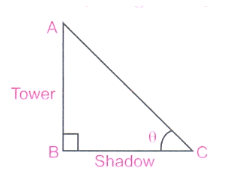
At some time of the day the length of the shadow of a tower is equal to its height. Find the sun's altitude at that time.
6.
A man standing on the deck of a ship, which is 10 m above the water level. He observes the angle of elevation of the top of a hill is 60° and the angle of depression ofthe base of the hill is 30°.Calculate the distance of the hill from the ship andheight of the hill.
7.
Determine the height of a mountain, if the elevation of its top at an unknown distance from the base is 30\(°\) and at a distance 10 km further off from the mountain, along the same line, the angle of elevation is 15\(°\) (Take tan 15\(°\) = 0.27)
8.
From a 60 m high building, the angle of depression of the top and bottom of a lamppost are \({ 30 }^{ ° }\)and \({ 60 }^{ ° }\) , respectively. Find the distance between lamppost and building. Also, find the difference of heights between building and lamppost.
9.
An Aeroplane at an altitude of 200 m observes the angle of depression of opposite points on the two banks of a river to be \({ 45 }^{ \circ }\) and \({ 60 }^{ \circ }\) .Find width of the river.
10.
From a balloon vertically above a straight road, the angles of depression of two cars at an instant are found to be 450 and 600.If the cars are 100m apart, find the height of the balloon.
11.
A man standing on the deck of a ship, which is 10 m above water level, observes the angle of elevation of the top of a hill as 60o and angle of depression of the base of the hill as 30o. Find the distance of the hill from the ship and height of the hill.
12.
An observer 1.5 m tall is 28.5 m away from a chimney. The angle of elevation of the top of the chimney from her eyes is 45°. What is the height of the chimney?
13.
If the height and length of the shadow of a man are the same, then find the angle of elevation of the sun.
14.
The angle of elevation of the top of a building from the foot of the tower is 30° and the angle of elevation of the top of the tower from the foot of the building is 60°. If the tower is 50 m high, then find the height of the building.
15.
A man on the top of a vertical observation tower observes a car moving at a uniform speed coming directly towards it.If it takes 12minutes for the angle of elevation to change from 300 to 450, how soon after this will the car reaches the observation tower?
16.
Seaweed is found under 80 m deep seafloor. To reach it, a diver makes a 45° dive from a boat. What is the distance travelled by the diver to reach the seafloor?
80 m
80.2 m
80√2 m
80√3 m
17.
The angles of elevation of the top of a tower from the points P and Q, at distance of a and b respectively from the base and in the same straight line with it, are complementary. The height of the tower is
ab
\(\sqrt{a b}\)
\(\sqrt{\frac{a}{b}}\)
\(\sqrt{\frac{b}{a}}\)
18.
If sun’s elevation is 60° then a pole of height 6 m will cast a shadow of length
3√2 m
2√3 m
6√3 m
√3 m
19.
The ——– is the line drawn from the eye of an observer to the point in the object viewed by the observer
Line of sight
Line of sight propagation
Line of symmetry
Line of incidence
20.
The angle of elevation from a point 30 feet from the base of a pole, of height h, as level ground to the top of the pole is 45° degree. Which equation can be used to find the height of the pole.
tan 45° = 30/h
tan 45° = h/30
sin 45° = h/30
cos 45° = h/30
21.
The angle of depression of a car, standing on the ground, from the top of a 75 m high tower, is 30°. The distance of the car from the base of the tower (in m.) is:
75√3
25√3
150
50√3
22.
The shadow of a tower standing on a level ground is found to be 40 m longer when the Sun’s altitude is 30° than when it is 60°. Find the height of the tower.
20
40√3
20√3
40
23.
In the following figure α is
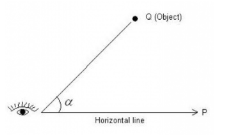
Angle of Depression
Angle of incidence
Angle of Elevation
Angle of sight
24.
A tree is broken by the wind. The top struck the ground at an angle of 30° and at a distance of 30 metres from the foot of the tree. The height of the tree in metres is
35√3
40√3
25√3
30√3
25.
The horizontal distance between two towers is 140 m. The angle of elevation of the top of the first tower when seen from the top of the second tower is 30°. If the height of the second tower is 60 m then, the height of the first tower is
139.5 m
142 m
135 m
140.83 m
26.
If altitude of the sun is 60°, the height of a tower which casts a shadow of length 30 m is:
30√3 cm
30/√3 m
15 m
15√2 m
27.
The angle formed by the line of sight with the horizontal, when the point being viewed is above the horizontal level is called:
Obtuse angle
Angle of elevation
Angle of depression
Vertical angle
28.
An observer 1.5 m tall is 28.5 m away from a tower. The angle of elevation of the top of the tower from his eyes is 45°. The height of the tower is
30 m
20 m
40 m
10 m
29.
The figure shows the observation of point C from point A. The angle of depression from A is:
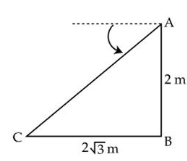
30°
60°
75°
45°
30.
A man has a height of 1.732 m. He observes the angle of depression to the head and toe of his son as 30° and 60° respectively. What is the height of his son? (Take √3 = 1.732)
3 m
1.155 m
3.464 m
1.732 m
31.
Two pillars are a metres apart and the height of one is double that of the other. If from the middle point of the line joining their feet, an observer finds the angular elevation of their tops to be complementary, then the height of the taller pillar is
a√2m
2a m
a m
a/√2 m
32.
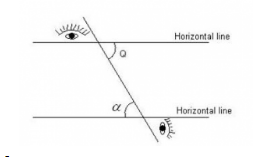
In the above fig Q and α respectively are
Angle of Depression and Angle of Depression
Angle of Elevation and Angle of depression
Angle of Elevation and Angle of Elevation
Angle of depression and Angle of Elevation
33.
A tower stands vertically on the ground. From a point C on the ground, which is 20 m away from the foot of the tower, the angle of elevation of the top of the tower is found to be 45°. The height of the tower is
10 m
8 m
15 m
20 m
34.
A man is standing on the deck of a ship, which is 8 m above water level. He observes the angle of elevation of the top of a hill as 600 and angle of depression of the base of the hill as 300. What is the height of the hill?
32 m
24√3 m
24m
8√3 m
35.
A tree casts a shadow 4 m long on the ground, when the angle of elevation of the sun is 450. The height of the tree is:
4.5 m
3 m
5.2 m
4 m
36.
One day while sitting on the bridge across a river Arun observes the angles of depression of the banks on opposite sides of the river are 30° and 60° respectively as shown in the figure. (Take \(\sqrt{3}\) = 1.73)
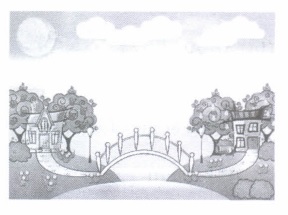
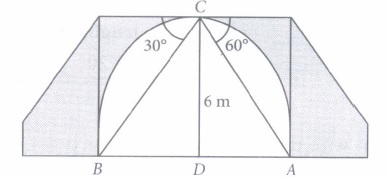
Based on the above information, answer the following questions.
(i) If the bridge is at a height of 6 m, then AD =
| (a) 6 m | \((b) \frac{\sqrt{3}}{6} \mathrm{~m}\) | \((c) 6 \sqrt{3} \mathrm{~m}\) | \((d) \frac{6}{\sqrt{3}} \mathrm{~m}\) |
(ii) BD =
| (a) 6 m | \((b) 6 \sqrt{3} \mathrm{~m}\) | \((c) \sqrt{3} \mathrm{~m}\) | \((d) 10 \sqrt{3} \mathrm{~m}\) |
(iii) Width of the river is
| (a) 10.85 m | (b) 13.87 m | (c) 15.85 m | (d) 19.85 m |
(iv) The angles of elevation and depression are always
| (a) acute angles | (b) obtuse angles | (c) right angles | (d) straight angles |
(v) If BD = 21 m, then height of the bridge is
| (a) 7 m | (b) 21 m | \((c) 7 \sqrt{3} \mathrm{~m}\) | \((d) \frac{7}{\sqrt{3}} \mathrm{~m}\) |
37.
Teewan, Arun and Pankaj were celebrating the festival of Diwali in open ground with firecrackers. There is a pedestal in the ground. All of sudden Teewan stands on pedestal and release sky lantern from the top of pedestal.
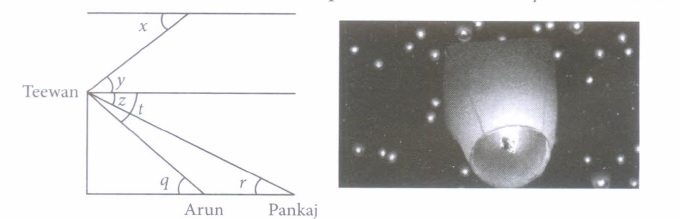
Based on the above information answer the following questions. (Take \(\sqrt{3}\) = J .73)
(i) Which one is a pair of angle of depression?
| \((a) (\angle x, \angle y)\) | \((b) (\angle y, \angle z)\) | \((c) (\angle z, \angle t)\) | \((d) (\angle r, \angle q)\) |
(ii) If the position of Pankaj is 25 m away from the base of pedestal and Zr = 30°, then find the height of pedestal.
| (a) 14.45m | (b) 15.5m | (c) 16.36m | (d) 17.36m |
(iii) If the height of pedestal is 30 m, \(\angle\)t = 45° and \(\angle\)z = 30°, then the horizontal distance between Arun and Pankaj is
| (a) 24.5 m | (b) 19.5 m | (c) 20 m | (d) 21.9 m |
(iv) If the vertical height of sky lantern from the top of pedestal is 12 m and \(\angle\)y = 30°, then distance between Teewan and sky lantern is
| (a) 20 m | (b) 16.97 m | (c) 24 m | (d) 19.86 m |
(v) If \(\angle\)q = 60° and position of Arun is 15 m away from the base of pedestal, then find the height of pedestal.
| (a) 16.25 m | (b) 25 m | (c) 25.95 m | (d) 26 m |
38.
There are two temples on each bank of a river. One temple is 50 m high. A man, who is standing on the top of 50 m high temple, observed from the top that angle of depression of the top and foot of other temple are 30° and 60° respectively. (Take \(\sqrt{3}\) = 1.73)
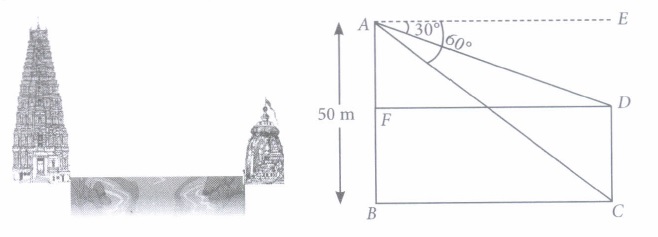
Based on the above information, answer the following questions.
(i) Measure of \(\angle\)ADF is equal to
| (a) 45° | (b) 60° | (c) 30° | (d) 90° |
(ii) Measure of \(\angle\)ACB is equal to
| (a) 45° | (b) 60° | (c) 30° | (d) 90° |
(iii) Width of the river is
| (a) 28.90 m | (b) 26.75 m | (c) 25 m | (d) 27 m |
(iv) Height of the other temple is
| (a) 32.5 m | (b) 35 m | (c) 33.33 m | (d) 40 m |
(v) Angle of depression is always
| (a) reflex angle | (b) straight |
| (c) an obtuse angle | (d) an acute angle |
1.
109.6 m
2.
\(6\sqrt { 3 } m\)
3.
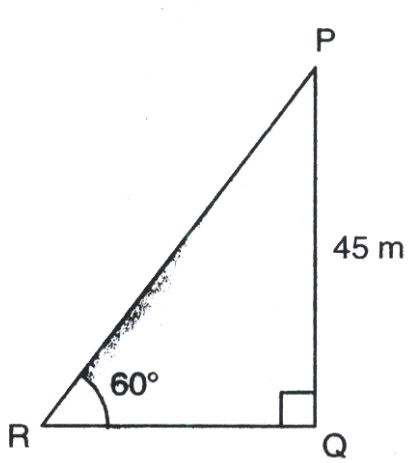
Let p is the position of the kite with height 45 m from the point Q on the ground. Let R is the other point on the ground to which kite is temporarily tied
AS ㄥPRQ=60o and PQ=45 m (given)
Consider art. ΔPQR, we have
sin 60o =\(\frac { PQ }{ PR } \)
\(\frac { \sqrt { 3 } }{ 2 } =\frac { 45 }{ PR } \)
PR=\(\frac { 90 }{ \sqrt { 3 } } \times \frac { \sqrt { 3 } }{ \sqrt { 3 } } \)
PR=\(\frac { 90\sqrt { 3 } }{ 3 } \)
=30\(\sqrt { 3 } \)
Hence, the length of the string is 30m.\(\sqrt { 3 } \) m.
4.
The angle of depression and the angle of elevation from an object on the ground to an object in the air equal.
5.
In right \(\Delta ABC\)
\(tan\theta =\frac { AB }{ BC } \)
\(\Rightarrow tan\theta =1 \left( \because AB=BC \right) \)
\(\Rightarrow \theta ={ 45 }^{ o }\)
6.
Hint Let a man is standing on the deck of a ship at point A such that \(A B=10 \mathrm{~m}\) and let CD be the hill.
Then, \(\angle E A D=60^{\circ}\)
and \(\angle C A E=\angle B C A=30^{\circ}\) [alternate angles]
Let \(B C=x \mathrm{~m}=A E\) and \(D E=h \mathrm{~m}\)
In right angled \(\triangle A E D\),
\(\tan 60^{\circ}=\frac{P}{B}=\frac{D E}{E A}=\frac{h}{x}\)
In right angled \(\triangle A B C\),
\(\tan 30^{\circ} =\frac{A B}{B C}\)
\(\Rightarrow \quad \frac{1}{\sqrt{3}} =\frac{10}{x} {\left[\because \tan 30^{\circ}=\frac{1}{\sqrt{3}}\right]}\)
Ans. Distance of the hill from the ship is \(10 \sqrt{3} \mathrm{~m}\) and height of the hill is 40 m .
7.
Let AB = h km be the height of the mountain. Let C be a point at a distance of x km from the base of the mountain such that \(\angle\)ACB = 30\(°\) and let D be a point at a distance of 10 km from C along the same line. Then \(\angle\)ADB = 15\(°\) and AD = AC + DC = (x + 10) km
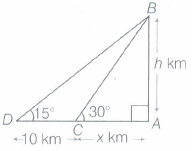
\(In\quad \Delta BAC,\quad tan\quad 30°=\frac { P }{ B } =\frac { AB }{ AC } \)
\(\Rightarrow \frac { 1 }{ \sqrt { 3 } } =\frac { h }{ x } \left[ \because tan 30°=\frac { 1 }{ \sqrt { 3 } } \right] \)
\(\Rightarrow x= h\sqrt { 3 } \) ......(i)
\(In \Delta BAD, tan 15°=\frac { AB }{ AD } \)
\(\Rightarrow 0.27=\frac { h }{ x+10 } \left[ given, tan 15°=0.27 \right] \)
\(\Rightarrow\) 0.27(x + 10) = h ......(ii)
On putting x = \(\sqrt { 3 } h\) from Eq. (i) in Eq. (ii), we get
\(0.27(\sqrt { 3 } h+10)=h\)
\(\Rightarrow 0.27\times \sqrt { 3 } h+0.27\times 10=h\)
\(\Rightarrow h(1-0.27\times \sqrt { 3 } )=0.27\times 10\)
\(\Rightarrow h(1-0.27\times 1.732)=2.7\) \(\left[ \because \sqrt { 3 } =1.732 \right] \)
\(\Rightarrow\) h(1-0.47) = 2.7
\(\Rightarrow 0.53h=2.7\Rightarrow h=\frac { 2.7 }{ 0.53 } =5.09\approx 5km\)
Hence, the height of mountain is 5 km.
8.
34.64 m; 20 m
9.
Let P be the position of the aeroplane. Then, PM=200m and let A and B be two points on the two banks of a river such that the angles of depression at A and B are \({ 60 }^{ \circ }\)and \({ 45 }^{ \circ }\) , respectively.
Let Am=x m and BM= y m.
Then, \(\angle XPB=\angle MBP={ 45 }^{ \circ }\) [altenatives angles]
and \(\angle XPB=\angle MBP={ 60 }^{ \circ }\) [altenatives angles]
In right angled \(\Delta AMP,\) \(\tan { { 60 }^{ \circ } } =\frac { PM }{ AM } \)
\(\Rightarrow \sqrt { 3 } =\frac { 200 }{ x } \Rightarrow 200=\sqrt { 3x } \)
\(\Rightarrow x=\frac { 200 }{ \sqrt { 3 } } m \)
In right angled \(\Delta BMP,\)
\(\tan { { 45 }^{ \circ } } =\frac { PM }{ BM } \Rightarrow 1=\frac { 200 }{ y }\)
\(\Rightarrow y=200m \)
Now, width of the river, AB=BM+MA
\(\Rightarrow AB=x+y=\frac { 200 }{ \sqrt { 3 } } +200\)
\( =200\left( \frac { 1 }{ \sqrt { 3 } } +1 \right)\)
\(=200(1.5773)=315.46m. [\because \sqrt { 3 } =1.732]\)
Hence, the width of the river is 315.46m.
10.
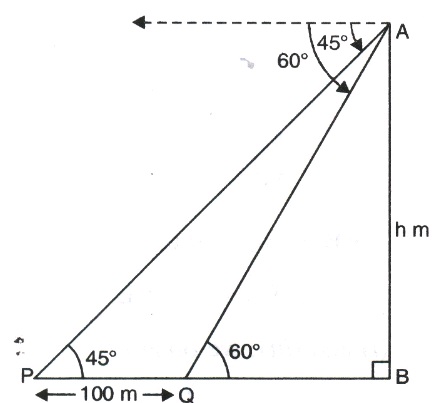
Let AB be the height of the balloon represented by h in above a straight road, P and Q be the positions of two cars 100 m apart, such that ㄥAPB=45o, ㄥAQB=60o, PQ=100 m.
Consider rt. ㄥAQB=60o, PQ=10o m.
\(\frac { AB }{ QB } \)=tan 60o
AB=\(\sqrt { 3 } \) QB
QB=\(\frac { AB }{ \sqrt { 3 } } =\frac { h }{ \sqrt { 3 } } \) .......(i)
Consider rt.ㄥed ΔPBA we have
\(\frac { AB }{ PB } \)=tan 45o
AB=PB
AB=PQ+QB
AB=100+QB
h=100+\(\frac { h }{ \sqrt { 3 } } \) [using (i)]
h\(\left( 1-\frac { 1 }{ \sqrt { 3 } } \right) \)=100
h=\(\frac { 100\sqrt { 3 } }{ \sqrt { 3 } -1 } =\frac { 100\sqrt { 3 } (\sqrt { 3 } +1) }{ (\sqrt { 3 } -1)(\sqrt { 3 } +1) } \)
=\(\frac { 100(3+\sqrt { 3 } ) }{ 2 } \)
=\(50(3+\sqrt { 3 } )\)m
11.
Let a man is standing on the deck of a ship at point A such that AB = 10 m and let CD be the hill.
Then, ∠EAD = 60° and ∠CAE = ∠BCA = 30° [alternate angles]
Let BC = x m = AE and DE = h m
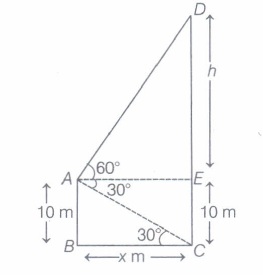
In right angled ΔAED,
\(\tan 60^{\circ}=\frac{P}{B}=\frac{D E}{E A}=\frac{h}{x}\)
In right angled ΔABC,
\(\tan 30^{\circ}=\frac{A B}{B C} \Rightarrow \frac{1}{\sqrt{3}}=\frac{10}{x}\left[\because \tan 30^{\circ}=\frac{1}{\sqrt{3}}\right]\)
distance of the hill from the ship is 10\(\sqrt3\) m and height of the hill is 40 m.
12.
Here, AB is the chimney, CD the observer and ∠ ADE the angle of elevation (see Figure). In this case, ADE is a triangle, right-angled at E and we are required to find the height of the chimney.
We have AB = AE + BE = AE + 1.5 and DE = CB = 28.5 m
To determine AE, we choose a trigonometric ratio, which involves both AE and DE. Let us choose the tangent of the angle of elevation.
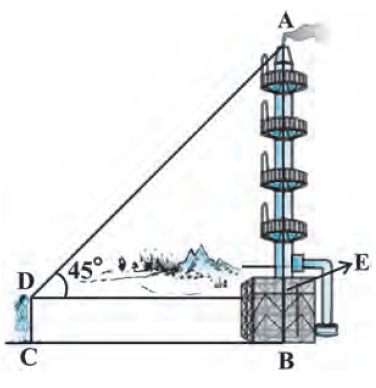
Now, \(\tan 45^{\circ}=\frac{\mathrm{AE}}{\mathrm{DE}}\)
i.e., \(1=\frac{\mathrm{AE}}{28.5}\)
Therefore, AE = 28.5
So the height of the chimney (AB) = (28.5 + 1.5) m = 30 m.
13.
Let SQ be the height and PQ be the shadow of a man.
According to the question, SQ = PQ
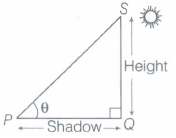
Again, let the angle of elevation of the sun be \(\theta \)
In right angled \(\\ \Delta PQS\)
\(tan\theta =\frac { perpendicular }{ Base } =\frac { QS }{ PQ }\)
\( \Rightarrow tan\theta =\frac { QS }{ QS } \left[ \because PQ = QS \right]\)
\( \\ \Rightarrow tan\theta =1=tan 45° \left[ \because tan 45°=1 \right] \)
\( \therefore \theta =45°\)
Hence, the angle of elevation of the sun is 45\(°\)
14.
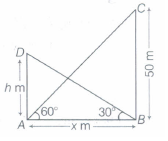
Let BC = 50 m be the height of the tower and AD=h m be the height of the building. Angle of elevation of the top of a building from the foot of tower is \(\angle DBA=30°\) and angle of elevation of the top of tower from the foot of building \(\angle CAB=60°\)
Also, let AB = x m be the distance between foot of the tower and building.
In right angled \(\Delta BAD\),
\(tan 30°=\frac { AD }{ AB } \)
\(\Rightarrow \frac { 1 }{ \sqrt { 3 } } =\frac { h }{ x }\)
\( \Rightarrow h=\frac { x }{ \sqrt { 3 } } \)
Again, in right angled \(\Delta CBA\),
\(tan 60°=\frac { BC }{ AB } \)
\(\Rightarrow \sqrt { 3 } =\frac { 50 }{ x } \Rightarrow x=\frac { 50 }{ \sqrt { 3 } } m\)
On putting \(x=\frac { 50 }{ \sqrt { 3 } } \) in Eq. (i), we get
\(h=\frac { 50 }{ \sqrt { 3 } } \times \frac { 1 }{ \sqrt { 3 } } =\frac { 50 }{ 3 } =16\frac { 2 }{ 3 } m\)
Hence, the height of the building is \(16\frac { 2 }{ 3 } m\)
15.
16 minutes 24 seconds
16.
(c)
80√2 m
17.
(b)
\(\sqrt{a b}\)
18.
(b)
2√3 m
19.
(a)
Line of sight
20.
21.
(a)
75√3
22.
(c)
20√3
23.
(c)
Angle of Elevation
24.
(d)
30√3
25.
(d)
140.83 m
26.
(a)
30√3 cm
27.
(b)
Angle of elevation
28.
(a)
30 m
29.
(a)
30°
30.
(b)
1.155 m
31.
(a)
a√2m
32.
(d)
Angle of depression and Angle of Elevation
33.
(d)
20 m
34.
(a)
32 m
35.
(d)
4 m
36.
(i) (d): Clearly, \(\angle\)DAC = 60°
So,in \(\Delta\)ADC, we have
\(\tan 60^{\circ}=\frac{C D}{A D} \Rightarrow \sqrt{3}=\frac{6}{A D} \)
\(\Rightarrow A D=\frac{6}{\sqrt{3}} \mathrm{~m}\)
(ii) (b): Clearly, \(\angle\)DBC = 30°
So, in \(\Delta\)BDC,we have
\(\tan 30^{\circ}=\frac{C D}{B D} \)
\(\Rightarrow \quad \frac{1}{\sqrt{3}}=\frac{6}{B D}
\)
\(\Rightarrow B D=6 \sqrt{3} \mathrm{~m}\)
(iii) (b): Width of the river = AB = AD + BD
\(\begin{array}{l}
=\frac{6}{\sqrt{3}}+6 \sqrt{3} \\
=6\left(\frac{1}{\sqrt{3}}+\sqrt{3}\right)=6\left(\frac{4}{\sqrt{3}}\right)=\frac{24}{\sqrt{3}} \mathrm{~m}=13.87 \mathrm{~m}
\end{array}\)
(iv) (a): The angle of elevation and angle of depression are always acute angles.
(v) (c): In \(\Delta\)BCD,if BD = 21m, then
\( \tan 30^{\circ}=\frac{C D}{B D} \)
\(\Rightarrow \quad \frac{1}{\sqrt{3}}=\frac{C D}{21} \Rightarrow C D=\frac{21 \sqrt{3}}{3}=7 \sqrt{3} \mathrm{~m}\)
37.
(i) (c)
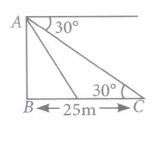
(ii) (a): Let AB be the height of pedestal.
\(\text { In } \Delta A B C, \)
\(\tan 30^{\circ}=\frac{A B}{B C} \)
\(\Rightarrow \quad A B=\frac{25}{\sqrt{3}}=\frac{25}{1.73}=14.45 \mathrm{~m}\)
(iii) (d): Let x be the distance between Arun and Pankaj.
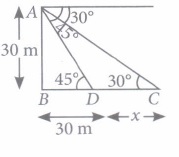
\(\text { In } \Delta A B \dot{D}, \tan 45^{\circ}=\frac{A B}{B D}\)
\(\Rightarrow B D=30 \mathrm{~m}\)
\(\text { Now, in } \Delta \overline{A B C} \text { , }\)
\(\tan 30^{\circ}=\frac{A B}{B C}\)
\(\Rightarrow \frac{30}{30+x}=\frac{1}{\sqrt{3}}\)
\(\Rightarrow x=30(\sqrt{3}-1)=30 \times 0.73=21.9 \mathrm{~m}\)
(iv) (c): \(\text { In } \triangle A R S\)
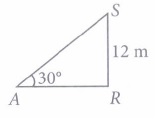
\(\sin 30^{\circ}=\frac{R S}{A S} \)
\(\Rightarrow \quad \frac{12}{A S} =\frac{1}{2} \Rightarrow A S=12 \times 2=24 \mathrm{~m}\)
(v) (c): \(\text { In } \Delta A B D, \frac{A B}{B D}=\tan 60^{\circ}\)
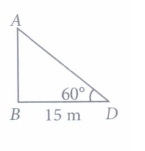
\(\begin{array}{l}
\Rightarrow \frac{A B}{15}=\sqrt{3} \\
\Rightarrow A B=15 \times 1.73=25.95 \mathrm{~m}
\end{array}\)
38.
(i) (c) : Since AE || FD
\(\therefore\) \(\angle\)EAD = \(\angle\)ADF = 30° [Alternate interior angles]
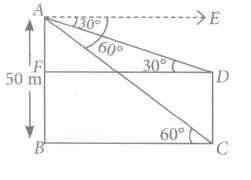
(ii) (b): Since, AE || BC
\(\therefore\) \(\angle\)EAC = \(\angle\)ACB = 60° [Alternate interior angles]
(iii) (a) : In \(\Delta\)ABC,
\(\begin{array}{l}
\tan 60^{\circ}=\frac{A B}{B C} \Rightarrow \sqrt{3}=\frac{50}{B C} \\
\Rightarrow \quad B C=\frac{50}{\sqrt{3}}=28.90 \mathrm{~m}
\end{array}\)
(iv) (c): In \(\Delta\)ADF, \(\tan 30^{\circ}=\frac{A F}{F D}\)
\(\Rightarrow \frac{1}{\sqrt{3}}=\frac{A B-B F}{F D} \Rightarrow \frac{1}{\sqrt{3}}=\frac{50-C D}{\frac{50}{\sqrt{3}}}\)
\(\left[\because F D=B C=\frac{50}{\sqrt{3}}\right] \)
\(\Rightarrow \frac{50}{3}=50-C D \Rightarrow C D=50-\frac{50}{3}=\frac{100}{3}=33.33 \mathrm{~m}\)
(v) (d)

10th Standard CBSE Syllabus & Materials
10th Standard CBSE
CBSE 10th Social Science PS - Federalism - New Model Questions Papers Study Material - QB365 Set A
NEW10th Standard CBSE
CBSE 10th Social Science PS - Power Sharing - New Model Questions Papers Study Material - QB365 Set A
NEW10th Standard CBSE
CBSE 10th Social Science GEO - Manufacturing Industries - New Model Questions Papers Study Material - QB365 Set A
NEW10th Standard CBSE
CBSE 10th Social Science GEO - Minerals and Energy Resources - New Model Questions Papers Study Material - QB365 Set A



NCERT Books

Syllabus

Exam Pattern

Sample Question Papers

Previous year Question Papers

Important Notes

MCQ Practice test

NCERT Exemplers

Case study Questions

Image Based Questions

Passage based Questions

HOT Questions

Value Based Questions

Model Questions Papers
NCERT ( Book Back ) Questions

Assertion and Reason
Important Questions And Answers

CBSE 10th Standard CBSE Subjects
CBSE Standards



