
 100% FREE ACCESS
10th Standard CBSE Syllabus & Materials
10th Standard CBSE
CBSE 10th Social Science ECO - Globalisation and the Indian Economy - New Model Questions Papers Study Material - QB365 Set A
NEW10th Standard CBSE
CBSE 10th Social Science ECO - Money and Credit - New Model Questions Papers Study Material - QB365 Set A
NEW10th Standard CBSE
CBSE 10th Social Science ECO - Sectors of the Indian Economy - New Model Questions Papers Study Material - QB365 Set A
NEW10th Standard CBSE
CBSE 10th Social Science ECO - Development - New Model Questions Papers Study Material - QB365 Set A
NEW10th Standard CBSE
CBSE 10th Social Science PS - Outcomes of Democracy - New Model Questions Papers Study Material - QB365 Set A
NEW10th Standard CBSE
CBSE 10th Social Science PS - Gender, Religion and Caste - New Model Questions Papers Study Material - QB365 Set A

Published on: 20/10/2025
Download CBSE Class 10th Standard CBSE Maths question papers, sample papers, important questions, and previous year solved papers in PDF format. Get free study materials, NCERT solutions, and exam preparation resources for Class 10th Standard CBSE Maths
Questions + Answers key
Take MCQ Maths Test
1.
A kite is flying at a height of 60 m above the ground. The string attached to the kite is temporarily tied to a point on the ground. The inclination of the string with the ground is 60o . Find the length of the string, assuming that there is no slack in the string.
2.
The angle of elevation of the top of a tower from a point on the ground, which is 30 m away from the foot of the tower is 30o . Find the height of the tower.
3.
A contractor plans to install two slides for the children to play in a park. For the children below the age of 5 years, she prefers to have a slide whose top is at a height of 1.5 m, and is inclined at an angle of 30o to the ground, whereas for elder children, she wants to have a steep slide at a height of 3 m, and inclined at an angle of 60o to the ground. What should be the length of the slide in each case?
4.
The angle of elevation of the top of a vertical tower from a point on the ground is 60o , From another point 10 m vertically above the first, its angle of elevation is 30o . Find the height of the tower.
5.
The angle of elevation of an aeroplane from a point on the ground is 60o. After a flight of 30 seconds the angle of elevation becomes 30o. If the aeroplane is flying at a constant height of \(3000\sqrt { 3 } \) m, find the speed of the aeroplane.
6.
A man on the deck of a ship, 12 m above water level, observes that the angle of elevation of the top of a cliff is 60o and the angle of depression of the base of the cliff is 30o. Find the distance of the cliff from the ship and the height of the cliff. \((Use\sqrt { 3 } =1.732)\)
7.
If a pole 6 m high throws shadow of \(2\sqrt { 3 } \) m, then find the angle of elevation of the sun.
8.
A ladder, leaning against a wall, makes an angle of 60o with the horizontal. If the foot of the ladder is 2.5 m away from the wall. find the length of the ladder.
9.
The angle of elevation of the top of a building from the foot of a tower is 30o and the angle of elevation of the top of the tower from the foot of the building is 60o. If the tower is 50 m high, find the height of the building.
10.
A man standing on the deck of a ship, which is 10 m above the water level. He observes the angle of elevation of the top of a hill is 60° and the angle of depression ofthe base of the hill is 30°.Calculate the distance of the hill from the ship andheight of the hill.
11.
From a window (60 metres high above the ground) of a house in street the angles of elevation and depression of the top and the foot of another house on opposite side of street are 60o and 45o respectively. Show that the height of the opposite house is \(60(1+\sqrt { 3 } )\) metres.
12.
A statue 1.46 m tall stand on the top of a pedestal. From a point on the ground, the angle of elevation of the top of the statue is 60o and from the same point, the angle of elevation of the top of the pedestal is 45o . Find the height of the pedestal. \((\sqrt { 3 } =1.73)\) .
13.
A pole 5 m high is fixed on the top of a tower. The angle of elevation of the top of the pole observed from a point 'A' on the ground is 60o and the angle of depression of the point 'A' from the top of the tower is 45o . Find the height of the tower. \((\sqrt { 3 } =1.73)\)
14.
The angle of elevation of the top of a tower from a point A on the ground is 30o. On moving a distance of 20 meters towards the foot of the tower to a point B, the angle of elevation increases to 60o . Find the height of the tower and distance of the tower from the point A. \((\sqrt { 3 } =1.732)\)
15.
A man standing on the deck of a ship, which is 10 m above water level, observes the angle of elevation of the top of a hill as 60o and angle of depression of the base of the hill as 30o. Find the distance of the hill from the ship and height of the hill.
16.
A tower stands vertically on the ground. From a point on the ground 30 m away from the foot of the tower, the angle of elevation of the top of the tower is 45°. The height of the tower will be
30√3 m
30 m
40 m
40√3 m
17.
Two pillars are a metres apart and the height of one is double that of the other. If from the middle point of the line joining their feet, an observer finds the angular elevation of their tops to be complementary, then the height of the taller pillar is
a√2m
2a m
a m
a/√2 m
18.
A tower stands vertically on the ground. From a point C on the ground, which is 20 m away from the foot of the tower, the angle of elevation of the top of the tower is found to be 45°. The height of the tower is
10 m
8 m
15 m
20 m
19.
A tree casts a shadow 4 m long on the ground, when the angle of elevation of the sun is 450. The height of the tree is:
4.5 m
3 m
5.2 m
4 m
20.
Which of the following is rational?
√3 + √5
√4 + √9
√2 + √4
√6 + √9
1.
Let C be the position of the kite and AC be the length of the string which makes an angle of 60° on the ground. The height of the kite from the ground is BC =60 m.
In right angled \(\Delta\)ABC,

\(\begin{aligned} \sin 60^{\circ} & =\frac{P}{H}=\frac{B C}{A C} \\ \end{aligned}\)
\(\begin{aligned} \Rightarrow \quad \frac{\sqrt{3}}{2} & =\frac{60}{A C} \end{aligned}\) \(\left[\because \sin 60^{\circ}=\frac{\sqrt{3}}{2}\right]\)
\(\begin{aligned} \therefore \quad A C & =\frac{60 \times 2}{\sqrt{3}} \times \frac{\sqrt{3}}{\sqrt{3}} \\ \end{aligned}\) [rationalising]
\(\begin{aligned} =\frac{120 \sqrt{3}}{3}=40 \sqrt{3} \mathrm{~m} \end{aligned}\)
Hence, the length of the string is 40\(\sqrt3\)m.
2.
Let BC be the height of the tower which is standing on the ground. Let A be a point on the ground which is 30 m away from the foot of tower.

Then, AB = 30 m and \(\angle\)BAC = 30°.
In right angled \(\Delta\)ABC,
\(\begin{array}{rlrl} \tan 30^{\circ} =\frac{B C}{A B}&&{\left[\because \tan \theta=\frac{P}{B}\right]} \\ \end{array}\)
\(\begin{array}{rlrl} \Rightarrow \quad \frac{1}{\sqrt{3}} & =\frac{B C}{30} & {\left[\because \tan 30^{\circ}=\frac{1}{\sqrt{3}}\right]} \\ \end{array}\)
\(\begin{array}{rlrl} \Rightarrow \quad B C & =\frac{30}{\sqrt{3}} \times \frac{\sqrt{3}}{\sqrt{3}}=10 \sqrt{3} \mathrm{~m} \end{array}\) [rationalising]
Hence, the height of the tower is 10\(\sqrt3\) m.
3.
Case I slide for the children below age of 5yr.
Let BC = 1.5 m be the height of the slide and let slide AC is inclined at an angle of 30° to the ground.

In right angled \(\Delta\)ABC,
\(\sin 30^{\circ}=\frac{B C}{A C} \quad\left[\because \sin \theta=\frac{P}{H}\right]\)
\(\Rightarrow \quad \frac{1}{2}=\frac{1.5}{A C} \quad\left[\because \sin 30^{\circ}=\frac{1}{2}\right]\)
\(\Rightarrow\) AC = 3 m
Case II Slide for the elder children.
Let RQ = 3 m be the height of the slide and let slide PR is inclined at an angle of 60° to the ground.

In right angled \(\Delta\)PQR,
\(\begin{aligned} \sin 60^{\circ} & =\frac{R Q}{P R} \\ \end{aligned}\)
\(\begin{aligned} \Rightarrow \quad \frac{\sqrt{3}}{2} & =\frac{3}{P R} \\ \end{aligned}\) \(\left[\because \sin 60^{\circ}=\frac{\sqrt{3}}{2}\right]\)
\(\begin{aligned} \Rightarrow \quad P R & =\frac{3 \times 2}{\sqrt{3}}=\frac{6}{\sqrt{3}} \times \frac{\sqrt{3}}{\sqrt{3}} \\ \end{aligned}\)
\(\begin{aligned} =2 \sqrt{3} \mathrm{~m} \end{aligned}\) [by rationalising]
Hence, length of slides in each case are 3m and 2\(\sqrt3\)m.
4.
Let AB is tower and BC=x
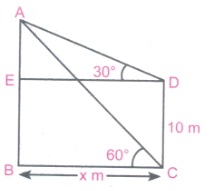
∵ BE=CD ⇒BE=10 m
Also BC=DE=x m. Take AE=y m
In right ΔAED, \(\frac { AE }{ DE } \)=tan 30o
⇒ \(\frac { y }{ x } =\frac { 1 }{ \sqrt { 3 } } \Rightarrow \sqrt { 3 } y\) ....(i)
In right ΔABC, \(\frac { AB }{ BC } \)=tan 60o
⇒ \(\frac { y+10 }{ 2 } =\sqrt { 3 } \)
y+10=\(\sqrt { 3 } \)x
y+10=\(\sqrt { 3 } \)(\(\sqrt { 3 } \)y)
⇒ y+10=3y
⇒ y=5m
Height of tower=AE+BE=5+10
=15 m
5.
From the point of observation (O),
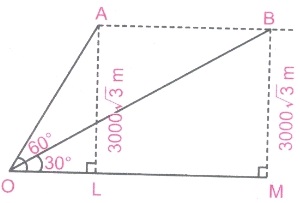
plane is at A, Al = 3000 \(\sqrt{3}\)m and ㄥAOL = 60o
After 30 seconds, plane is at B, therefore,
BM=3000\(\sqrt{3}\) m and ㄥBOM=30o
Distance AB is covered in 30 seconds. In right-angled triangle OLA.
\(\frac { OL }{ AL } \)=cot 60o
⇒ OL=\(3000\sqrt { 3 } \times \frac { 1 }{ \sqrt { 3 } } \)=3000 m ....(i)
In right-angled triangle OMB,
\(\frac { OM }{ BM } \)=cot 30o
OM=\(\\ 3000\sqrt { 3 } \times \sqrt { 3 } \)=9000 m ......(ii)
∴ AB=lM=OM-OL
=(9000-3000)m=6000 m [from (i) and (ii)]
Now in 30 s, distance covered=6000 m
∴ In 1 hour (3600 s), distance covered
=\(\frac { 6000 }{ 30 } \times \frac { 3600 }{ 1000 } \)km=720 km
∴ Speed of the aeroplane
=720 km/h
6.
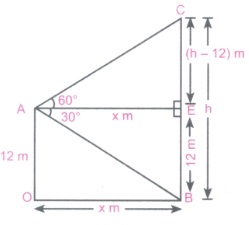
A is the position of the man, OA = 12m, BC is cliff.
Let height of the cliff
BC = h m and CE = (h - 12)m
Let AE = OB = x m
In right angled triangle AEB,
\(\frac { AE }{ BE } \) = cot30o ⇒ AE = 12 x \(\sqrt { 3 } \)
=12 x 1.732 m = 20.78 m
∴ Distance of ship from cliff = 20.78 m
In right angled triangle AEC,
\(\frac { CE }{ AE } =tan{ 60 }^{ 0 }\Rightarrow \frac { h-12 }{ 12\sqrt { 3 } } \) = \(\sqrt { 3 } \)
h - 12 = 36 ⇒ h = 48 m
∴. Height of the cliff = 48 m
7.
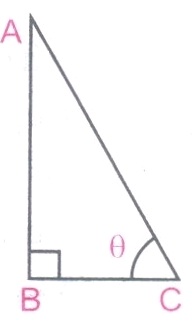
Let AB is pole and BC is its shadow
∴ AB = 6m, BC = 2\(\\ \\ \\ \\ \sqrt { 3 } \) m
In right ΔABC, \(\frac { AB }{ BC } \)=tanፀ
⇒ tanፀ = \(\frac { 6 }{ 2\sqrt { 3 } } \)
⇒ tanፀ = \(\sqrt { 3 } \)
⇒ ፀ = 60o
8.
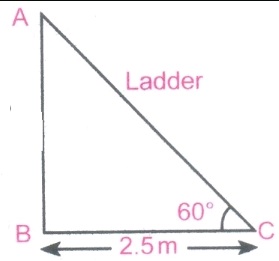
In right ΔABC
\(\frac { BC }{ AC } \) = cos 60\(\unicode{xb0} \)
⇒ \(\frac { 2.5 }{ AC } =\frac { 1 }{ 2 } \)
⇒ AC = 2.5 x 2 = 5 m
9.

Let BC = 50 m be the height of the tower and AD = h m be the height of the building. Angle of elevation of the top of the building from the foot of the tower is \(\angle\)DBA = 30° and angle of elevation of the top of the tower from the foot of the building \(\angle\)CAB = 60°. Also, let AB = x m be the distance between foots of the tower and the building.
In right angled \(\Delta\)BAD, tan 30°=\(\frac{P}{B}=\frac{A D}{A B}\)
\(\begin{array}{lll}
\Rightarrow & \frac{1}{\sqrt{3}}=\frac{h}{x} & {\left[\because \tan 30^{\circ}=\frac{1}{\sqrt{3}}\right]} \\
\end{array}\)
\(\begin{array}{lll}
\Rightarrow & b=\frac{x}{\sqrt{3}}
\end{array}\) ...(i)
and in right angled \(\Delta\)CBA, tan 60° = \(\frac{B C}{A B}\)
\(\begin{array}{lll}
\Rightarrow & \sqrt{3}=\frac{50}{x} & {\left[\because \tan 60^{\circ}=\sqrt{3}\right]} \\
\end{array}\)
\(\begin{array}{lll}
\Rightarrow & x=\frac{50}{\sqrt{3}} \mathrm{~m}
\end{array}\)
On putting \(x=\frac{50}{\sqrt{3}}\) in Eq. (i), we get
\(h=\frac{50}{\sqrt{3}} \times \frac{1}{\sqrt{3}}=\frac{50}{3}=16 \frac{2}{3} \mathrm{~m}\)
Hence, the height of the building is \(16 \frac{2}{3} \mathrm{~m}\).
10.
Hint Let a man is standing on the deck of a ship at point A such that \(A B=10 \mathrm{~m}\) and let CD be the hill.
Then, \(\angle E A D=60^{\circ}\)
and \(\angle C A E=\angle B C A=30^{\circ}\) [alternate angles]
Let \(B C=x \mathrm{~m}=A E\) and \(D E=h \mathrm{~m}\)
In right angled \(\triangle A E D\),
\(\tan 60^{\circ}=\frac{P}{B}=\frac{D E}{E A}=\frac{h}{x}\)
In right angled \(\triangle A B C\),
\(\tan 30^{\circ} =\frac{A B}{B C}\)
\(\Rightarrow \quad \frac{1}{\sqrt{3}} =\frac{10}{x} {\left[\because \tan 30^{\circ}=\frac{1}{\sqrt{3}}\right]}\)
Ans. Distance of the hill from the ship is \(10 \sqrt{3} \mathrm{~m}\) and height of the hill is 40 m .
11.
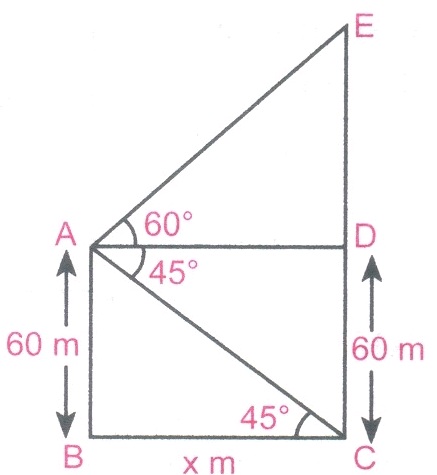
Let A be the window and CE be the opposite house
CD=AB=60 m [Opposite side of a rectangle] ........(i)
In rt. ΔABC, tan45o=\(\frac { 60 }{ BC } \)
⇒ 1=\(\frac { 60 }{ BC } \)
⇒ BC=60 m .........(ii)
AD=BC [Opposite sides of a rectangle]
∴ AD=60 m [From (ii)] ......(iii)
In rt. ΔADE, tan600=\(\frac { DE }{ AD } \)
⇒ \(\sqrt { 3 } =\frac { DE }{ 60 } \) [From (iii)]
⇒ DE=60\(\sqrt { 3 } \) m
∴ Height of the opposite house
CE=CD+DE=60+60\(\sqrt { 3 } \)
=60(1+\(\sqrt { 3 } \))m.
12.
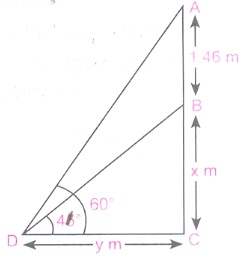
Let AB is statue, BC is pedestal and BC=x m, CD=y m.
In right ΔBCD, ΔBCD, \(\frac { BC }{ CD } \)=tan 45o
⇒, \(\frac { x }{ y } \)=1 ⇒ x=y .....(i)
In right ΔACD, \(\frac { AC }{ CD } \)=tan 600
⇒ \(\frac { x+1.46 }{ y } =\sqrt { 3 } \)
⇒ \(\frac { x+1.46 }{ x } \)=1.73 [Using (i)]
⇒ x+1.46=1.73x ⇒ 0.73x=1.46 ⇒ x=2
13.
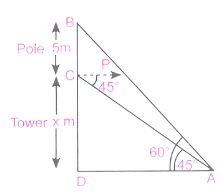
Let CD be a tower of height x m and BC is a pole and ㄥBAD=600 and ㄥPCA=450 ㄥPCA=ㄥCAD=450
In right ΔCDA, \(\frac { CD }{ DA } \)=tan 45o
⇒ \(\frac { x }{ DA } \)=1 ⇒ DA= x m
In right ΔBDA, \(\frac { BD }{ DA } \)=tan 60o
⇒ \(\frac { 5+x }{ x } =\sqrt { 3 } \)
⇒ 5+x=\(\sqrt { 3 } \)x ⇒ 5=(\(\sqrt { 3 } \)-1)x
⇒ x=\(\frac { 5 }{ \sqrt { 3 } -1 } m=\frac { 5(\sqrt { 3 } +1) }{ 2 } m=\frac { 5(1.73+1) }{ 2 } m=\frac { 13.65 }{ 2 } \)m=6.82 m
14.
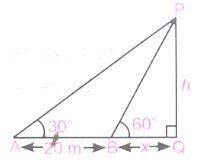
Let 'h' m be height of the tower PQ
AB=20 m. Let BQ=x m
In rt. ΔPQB
\(\frac { PQ }{ BQ } \)=tan 60o ⇒ \(\frac { h }{ x } =\sqrt { 3 } \Rightarrow \sqrt { 3 } x\) .........(i)
In rt. ΔPQA,
\(\frac { PQ }{ AQ } \)=tan 30o ⇒ \(\frac { h }{ 20+x } =\frac { 1 }{ \sqrt { 3 } } \Rightarrow \sqrt { 3 } \)h=20+x ....(ii)
From (i) and (ii)
\(\sqrt { 3 } .\sqrt { 3 } \)x=20+x ⇒ x=10
∴ Distance of tower fro A is 20 m+10 m=30 m
Put x=10 in (i), we get
h=\(\sqrt { 3 } \) x 10=1.732 x 10=1.732 m
15.
Let a man is standing on the deck of a ship at point A such that AB = 10 m and let CD be the hill.
Then, ∠EAD = 60° and ∠CAE = ∠BCA = 30° [alternate angles]
Let BC = x m = AE and DE = h m
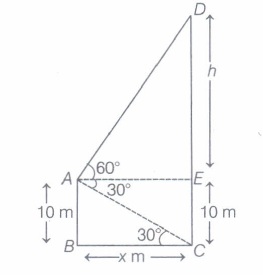
In right angled ΔAED,
\(\tan 60^{\circ}=\frac{P}{B}=\frac{D E}{E A}=\frac{h}{x}\)
In right angled ΔABC,
\(\tan 30^{\circ}=\frac{A B}{B C} \Rightarrow \frac{1}{\sqrt{3}}=\frac{10}{x}\left[\because \tan 30^{\circ}=\frac{1}{\sqrt{3}}\right]\)
distance of the hill from the ship is 10\(\sqrt3\) m and height of the hill is 40 m.
16.
(b)
30 m
17.
(a)
a√2m
18.
(d)
20 m
19.
(d)
4 m
20.
(b)
√4 + √9

10th Standard CBSE Syllabus & Materials
10th Standard CBSE
CBSE 10th Social Science PS - Federalism - New Model Questions Papers Study Material - QB365 Set A
NEW10th Standard CBSE
CBSE 10th Social Science PS - Power Sharing - New Model Questions Papers Study Material - QB365 Set A
NEW10th Standard CBSE
CBSE 10th Social Science GEO - Manufacturing Industries - New Model Questions Papers Study Material - QB365 Set A
NEW10th Standard CBSE
CBSE 10th Social Science GEO - Minerals and Energy Resources - New Model Questions Papers Study Material - QB365 Set A



NCERT Books

Syllabus

Exam Pattern

Sample Question Papers

Previous year Question Papers

Important Notes

MCQ Practice test

NCERT Exemplers

Case study Questions

Image Based Questions

Passage based Questions

HOT Questions

Value Based Questions

Model Questions Papers
NCERT ( Book Back ) Questions

Assertion and Reason
Important Questions And Answers

CBSE 10th Standard CBSE Subjects
CBSE Standards



