
 100% FREE ACCESS
10th Standard CBSE Syllabus & Materials
10th Standard CBSE
CBSE 10th Social Science ECO - Globalisation and the Indian Economy - New Model Questions Papers Study Material - QB365 Set A
NEW10th Standard CBSE
CBSE 10th Social Science ECO - Money and Credit - New Model Questions Papers Study Material - QB365 Set A
NEW10th Standard CBSE
CBSE 10th Social Science ECO - Sectors of the Indian Economy - New Model Questions Papers Study Material - QB365 Set A
NEW10th Standard CBSE
CBSE 10th Social Science ECO - Development - New Model Questions Papers Study Material - QB365 Set A
NEW10th Standard CBSE
CBSE 10th Social Science PS - Outcomes of Democracy - New Model Questions Papers Study Material - QB365 Set A
NEW10th Standard CBSE
CBSE 10th Social Science PS - Gender, Religion and Caste - New Model Questions Papers Study Material - QB365 Set A

Published on: 20/10/2025
Download CBSE Class 10th Standard CBSE Maths question papers, sample papers, important questions, and previous year solved papers in PDF format. Get free study materials, NCERT solutions, and exam preparation resources for Class 10th Standard CBSE Maths
Questions + Answers key
Take MCQ Maths Test
1.
Prove that \(\frac{\cot A-\cos A}{\cot A+\cos A}=\frac{\operatorname{cosec} A-1}{\operatorname{cosec} A+1}\)
2.
The angles of elevation of the top of a rock from the top and foot of a 60 m high tower are \({ 45 }^{ ° }\)and \({ 60 }^{ ° }\), respectively. Find the height of the rock.
3.
If (1,2),(4,y),(x,6) and (3,5) are the vertices of the parallelogram taken in order, find x and y.
4.
Which of the following are APs ? If they form an AP, find the common difference d and write three more terms.
\(-\frac{1}{2}\), \(-\frac{1}{2}\) , \(-\frac{1}{2}\), \(-\frac{1}{2}\).......
5.
Are x=0, x=1 the solution of the equation x2+x+1=0?
6.
Solve the following pairs of equations by reducing them to a pair of linear equation:
\(\frac{10}{x+y}+\frac{2}{x-y}=4\)
\(\frac{15}{x+y}-\frac{5}{x-y}=-2\)
7.
Evaluate : tan2 30° sin 30° + cos 60° sin2 90° tan2 60° - 2 tan 45° cos2 0° sin 90°
8.
Triangle ABC is right angled at Band 0 is the mid-point BC. Prove that AC2 = 4AD2- 3AB2.
9.
If A(-3,5), B(-2,-7), C(1,-8) and D(6,3) are the vertices of a quadrilateral ABCD, find its area.
10.
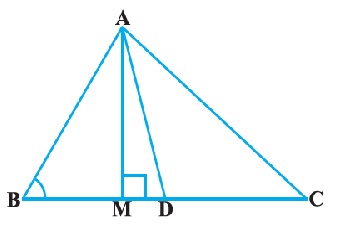
In the given figure, AD is a median of a triangle ABC and AM ⊥ BC. Prove that:
\(A B^{2}=A D^{2}-B C . D M+\left(\frac{B C}{2}\right)^{2}\)
11.
Draw an angle XAY on your notebook and on ray AX, mark points B1, B2, B3, B4 and B such that AB1 = B1B2 = B2B3 = B3B4 = B4B.
12.
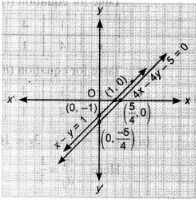
Which of the following pairs of linear equations are consistent/inconsistent? If consistent, obtain the solution graphically:
2x – 2y – 2 = 0, 4x – 4y – 5 = 0
13.
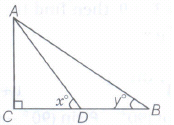
In the given figure, if D is the mid-point of BC, find the value of \(\frac { tan { x }^{ O } }{ tan { y }^{ O } } \)
14.
Two APs have two same common difference. The difference between their 100th terms is 111222333. What is the different between their millionth terms?
15.
A spherical balloon of radius 'r' subtends an angle \(\theta\) at the eye of an observer.If the angle of elevation of is \(\phi \), find the height of the centre of the balloon.
16.
If \(\sec \theta+\tan \theta=\alpha\) then \(\tan \theta\) is
\(\frac{p^2+1}{2 p}\)
\(\frac{p^2-1}{2 p}\)
\(\frac{p^2-1}{p^2+1}\)
\(\frac{p^2+1}{p^2-1}\)
17.
In a right angled \(\Delta\)ABC, \(\angle\)A = 90° and AB = AC. The value of sin C is
0
\(\frac{\sqrt{3}}{2}\)
\(\frac{1}{2}\)
\(\frac{1}{\sqrt{2}}\)
18.
First, plot the points A(2, 4), B (6, 4), C (6,2) and 0 (2,2) and join all adjacent points. A pole BE of height his standing on point B. If Angle of elevation of the top of a pole from point A is 30°, The total area formed by the
figure is
\(8(\sqrt{3}+1) m^{2}\)
\(8(\sqrt{3}-1) m^{2}\)
\(\frac{8(\sqrt{3}+1)}{\sqrt{3}} \mathrm{~m}^{2}\)
\(\frac{8(\sqrt{3}-1)}{\sqrt{3}} m^{2}\)
19.
In the following figure, from the top of a building AB, 60 m high, the angles of depression of the top and the bottom of a vertical lamp post CD are observed to be 30° and 60°, respectively.
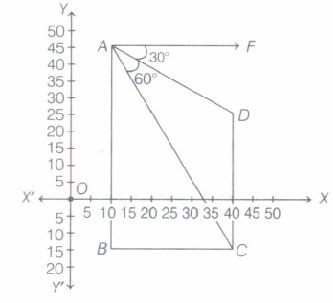
Find the radius of the circle, if Y-axis and AB are the tangents to the circle.
20 m
15 m
10 m
5 m
20.
Radhika wants to visit her friend who recently moved to a new house. The road map between Radhika's home and her friend's as well as the distance known to Radhika are as shown in the figure given below:
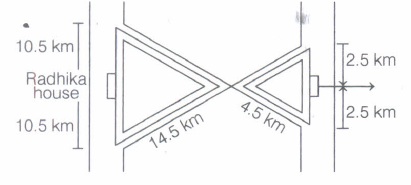
To reach the friend's house, the shortest distance which Radhika has to travel, is
30.95 km
32.5 km
28.5 km
35.35 km
21.
In Δ ABC and Δ DEF, ∠B = ∠E, ∠F = ∠C and AB = 3DE. Then, the two triangles are
congruent but not similar
similar but not congruent
neithercongruent nor similar
congruent as well as similar
22.
\(\frac{2 \tan 30^{\circ}}{1-\tan ^{2} 30^{\circ}}\) =
cos 60°
sin 60°
tan 60°
sin 30°
23.
sin 2A = 2 sin A is true, when A =
0°
30o
45°
60°
24.
\(\frac{1-\tan ^{2} 45^{\circ}}{1+\tan ^{2} 45^{\circ}}\) =
tan 90°
1
sin 45°
0
25.
A fraction becomes 4/5 when 1 is added to each of the numerator and denominator. However, if..we subtract 5 from each of them, it becomes 1/2. Then, numerator of the fraction is
6
7
8
9
26.
An AP has first term -3 and a common difference -1. Find the 3rd term of the A.
5
-7
-1
-5
27.
The first term of an A.P. is 12, the last term is -8, the common difference is -2. Find the sum of the A.P.
18
16
22
20
28.
Reduction of a rupee in the price of onion makes the possibility of buying one more kg of onion for Rs.56. Find the original price of the onion per kg
7,-8
8
7
1
29.
The discriminant of the quadratic equation 2x2 – 6x + 3 = 0, is
12
-12
-10
10
30.
If cos (40° + A) = sin 30°, the value of A is
40°
30°
60°
20°
31.
Adding 1 to the numerator and subtracting 1 from the denominator of a fraction makes it 1. However, if 1 is added only to the denominator of the fraction it becomes ½ . The fraction is______
2/3
3/5
5/3
3/2
32.
The pair of linear equations 8x – 5y = 7 and 5x – 8y = -7 have
One solution
Two solutions
Many solutions
No solution
33.
The ordinate of a point is twice its abscissa. If its distance from the point (4,3) is \(\sqrt { 10 } \) ,then the coordinates of the point are
(1,2) or (3,6)
(1,2) or (3,5)
(2,1) or (3,6)
(2,1) or (6,3)
34.
In what ratio of line x – y – 2 = 0 divides the line segment joining (3, –1) and (8, 9)?
1:2
2:1
2:3
1:3
35.
A man has a height of 1.732 m. He observes the angle of depression to the head and toe of his son as 30° and 60° respectively. What is the height of his son? (Take √3 = 1.732)
3 m
1.155 m
3.464 m
1.732 m
36.
Aanya and her father go to meet her friend Juhi for a party. When they reached to [uhi's place, Aanya saw the roof of the house, which is triangular in shape. If she imagined the dimensions of the roof as given in the figure, then answer the following questions.
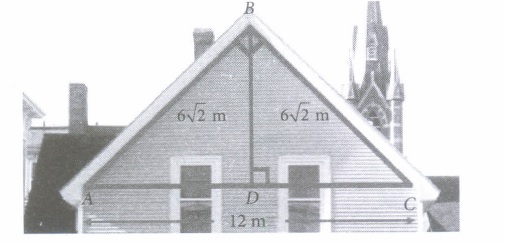
(i) If D is the mid point of AC, then BD =
| (a) 2m | (b) 3m | (c) 4m | (d) 6m |
(ii) Measure of \(\angle\)A =
| (a) 30° | (b) 60° | (c) 45° | (d) None of these |
(iii) Measure of \(\angle\)C =
| (a) 30° | (b) 60° | (c) 45° | (d) None of these |
(iv) Find the value of sinA + cosC.
| (a) 0 | (b) 1 | (c) \(\frac{1}{2}\) | (d) \(\sqrt{2}\) |
(v) Find the value of tan2C + tan2 A.
| (a) 0 | (b) 1 | (c) 2 | (d) \(\frac{1}{2}\) |
37.
Students of residential society undertake to work for the campaign "Say no to Plastics': Group A took the region under the coordinates (3, 3), (6, y), (x, 7) and (5, 6) and group B took the region under the coordinates (1, 3), (2,6), (5,7) and (4, 4).

Based on the above information, answer the following questions.
(i) If region covered by group A forms a parallelogram, where the coordinates are taken in the given order, then
| (a) x=8,y=4 | (b) x=4,y=8 | (c) x=2,y=4 | (d) x=4,y=2 |
(ii) Perimeter of the region covered by group A is
| (a) \(\sqrt{10}\) units | (b) \(\sqrt{13}\)units | (c) \(\sqrt{10}\) + \(\sqrt{13}\)units | (d) none of these |
(iii) If the coordinates of region covered by group B, taken in the same order forms a quadrilateral, then the length of each of its diagonals is
| (a) \(4\sqrt{2}\) units, \(2\sqrt{2}\) units | (b) \(6\sqrt{2}\) units, \(\sqrt{2}\) units |
| (c) \(3\sqrt{2}\) units, \(2\sqrt{2}\) units | (d) none of these |
(iv) If region covered by group B forms a rhombus, where the coordinates are taken in given order, then the perimeter of this region is
| (a) \(\sqrt{10}\) units | (b) \(2\sqrt{10}\)units | (c) \(3\sqrt{10}\) units | (d) \(4\sqrt{10}\) units |
(v) The coordinates of the point which divides the join of points P(x1, y1) and Q(x2, y2) internally in the ratio m: n is
| \(\text { (a) }\left(\frac{m x_{2}+n y_{2}}{m+n}, \frac{m x_{1}+n y_{1}}{m+n}\right)\) | \(\text { (b) }\left(\frac{m x_{1}+n y_{1}}{m+n}, \frac{m x_{2}+n y_{2}}{m+n}\right)\) |
| \(\text { (c) }\left(\frac{m x_{2}+n x_{1}}{m+n}, \frac{m y_{2}+n y_{1}}{m+n}\right)\) | (d) none of these |
38.
There are two routes to travel from source A to destination B by bus. First bus reaches at B via point C and second bus reaches from A to B directly. The position of A, Band C are represented in the following graph:
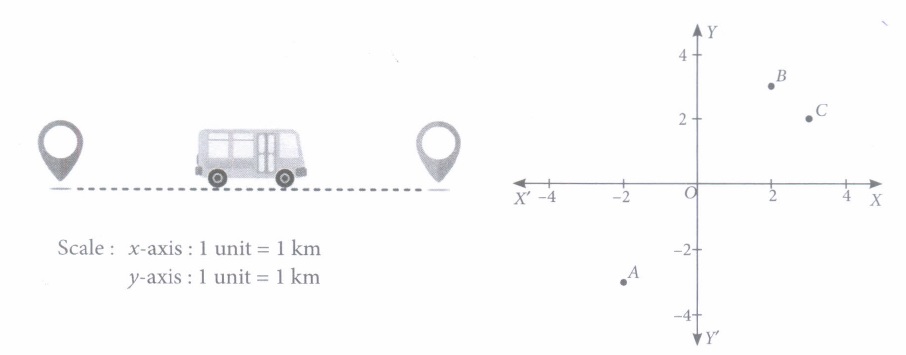
Based on the above information, answer the following questions.
(i) The distance between A and B is
| (a) 13 km | (b) 26 km | (c) \(\sqrt{13}\)km | (d) none of these |
(ii) The distance between A and Cis
| (a) 5 km | (b) 2 km | (c) \(\sqrt{5}\)km | (d) \(5\sqrt{2}\) km |
(iii) If it is assumed that both buses have same speed, then by which bus do you want to travel from A to B?
| (a) Firstbus | (b) Secondbus | (c) Any of them | (d) None of these |
(iv) If the fare for first bus is Rs10/km, then what will be the fare for total journey by that bus?
| (a) Rs 83 | (b) Rs 38 | (c) Rs 45 | (d) none of these |
(v) If the fare for second bus is Rs 15/km, then what will be the fare to reach to the destination by this bus?
| (a) Rs 105 | (b) Rs 108 | (c) Rs 110 | (d) Rs 115 |
1.
\(L H S=\frac{\cot A-\cos A}{\cot A+\cos A}=\frac{\frac{\cos A}{\sin A}-\cos A}{\frac{\cos A}{\sin A}+\cos A}\)
\(=\frac{\cos A\left(\frac{1}{\sin A}-1\right)}{\cos A\left(\frac{1}{\sin A}+1\right)}=\frac{\left(\frac{1}{\sin A}-1\right)}{\left(\frac{1}{\sin A}+1\right)}=\frac{\operatorname{cosec} A-1}{\operatorname{cosec} A+1}=\operatorname{RHS}\)
2.
141.96 m
3.
Let A(1, 2), B(4, y), C(x, 6) and D(3, 5) are the vertices of a parallelogram.
Since, ABCD is a parallelogram.
\(\therefore\) Diagonals AC and BD will bisect each other. So, the mid-point of AC and mid-point of BD will be same
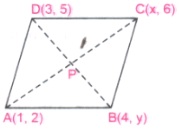
Thus mid-point of AC = Mid-point of BD
\(\begin{aligned} \Rightarrow \quad & \left(\frac{1+x}{2}, \frac{2+6}{2}\right)=\left(\frac{4+3}{2}, \frac{y+5}{2}\right) \\ \end{aligned}\)
\(\begin{aligned} & {\left[\because \text { coordinates of mid-point }=\left(\frac{x_1+x_2}{2}, \frac{y_1+y_2}{2}\right)\right] } \end{aligned}\)
On comparing the coordinate from both sides,we get
\(\frac{1+x}{2}=\frac{4+3}{2} \text { and } \frac{2+6}{2}=\frac{5+y}{2}\)
\(\Rightarrow\) 1 + x = 7 and 8 = 5 + y
\(\therefore\) x = 6 and y = 3
4.
Here, we have
\(a_{2}-a_{1}=-\frac{1}{2}-\left ( -\frac{1}{2} \right )=-\frac{1}{2}+\frac{1}{2}=0,\)
\(a_{3}-a_{2}=-\frac{1}{2}-\left (-\frac{1}{2} \right )=-\frac{1}{2}+\frac{1}{2}=0,\)
\(a_{4}-a_{3}=-\frac{1}{2}-\left ( -\frac{1}{2} \right )=-\frac{1}{2}+\frac{1}{2}=0\)
and so on.
Since, the difference of any two consecutive terms is same. Therefore, the given list of numbers forms an AP and its common difference (d) is 0.
Now, next three terms of this AP are
a5 = a4 + d = -\(\frac{1}{2}\) + 0 = - \(\frac{1}{2}\)
a6 = a5 + d = -\(\frac{1}{2}\) + 0 = - \(\frac{1}{2}\)
and a7 = a6 + d = -\(\frac{1}{2}\) + 0 = -\(\frac{1}{2}\)
5.
Given equation is, x2+x+1=0
When x=0, LHS=02+0+1=1\(\ne\)0
x=0 is not the solution
When x=1, LHS=12+1+1=3\(\ne\)0
x=1 is not the solution of given equation.
6.
\(\frac{10}{x+y}+\frac{2}{x-y}=4\)
\(\frac{15}{x+y}-\frac{5}{x-y}=-2\)
Putting \(\frac{1}{x}+y=p\) ,in the given equations, we get:
10p + 2q = 4
⇒ 10p + 2q - 4 = 0 ... (i)
15p - 5q = -2
⇒ 15p - 5q + 2 = 0 ... (ii)
Using cross multiplication, we get
\(\frac{p}{4-20}=\frac{q}{-60-(-20)}=\frac{1}{-50-30}\)
\(\frac{p}{-16}=\frac{q}{-80}=\frac{1}{-80}\)
\(\frac{p}{-16}=\frac{1}{-80}\)
p = 1/5 and q = 1
\(p=\frac{1}{x+y}=\frac{1}{5}\) and \(q=\frac{1}{x-y}=1\)
x + y = 5 ... (iii)
and x - y = 1 ... (iv)
Adding equation (iii) and (iv), we get
2x = 6
x = 3 .... (v)
Putting value of x in equation (iii), we get
y = 2
Hence, x = 3 and y = 2
7.
tan2 30° sin 30° + cos 60° sin2 90° tan2 60° - 2 tan 45° cos2 0° sin 90°
Expression = \(\frac{1}{3}\times\frac{1}{2}+\frac{1}{2}\times1\times3\times-2\times 1\times 1\times 1\)
\(=\frac{1}{6}+\frac{3}{2}-2=\frac{1+9-12}{6}\)
\(=-\frac{2}{6}=-\frac{1}{3}\)
8.
Given: ABC is right angled at Band D is the midpoint of BC.
\(\therefore BD=DC=\frac { 1 }{ 2 } BC\)
In \(\triangle\)ABD, AD2 = AB2 + BD2 (Pythagoras theorem) ...(i)
In \(\triangle\)ABC, AC2 = AB2 + BC2 (Pythagoras theorem) ...(ii)
From eqn. (i), AD2 = AB2 +\({ \left( \frac { BC }{ 2 } \right) }^{ 2 }\) (D is the mid-point of BC)
\(\Rightarrow\) 4AD2 = 4AB2 + BC2
\(\Rightarrow\) BC2 = 4A02 - 4AB2
Using this in equation (ii),
\(\Rightarrow\)AC2 = AB2 + 4AD2-4AB2
\(\Rightarrow\)AC2 = 4AD2 - 3AB2
Hence proved.
9.
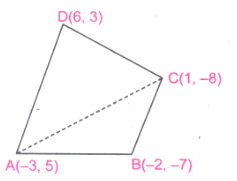
Area of quadrilateral ABCD
=Area of traingle ABC+Area of traingle ACD ...(i)
Now, ar (\(\triangle \)ABC)
=\(\frac { 1 }{ 2 } \) [-3(-7+8)-2(-8-5)+1(5+7)]
=\(\frac { 1 }{ 2 } \) [-3+26+12] = \(\frac { 35 }{ 2 } \)sq.units ...(ii)
Also, ar ( \(\triangle \)ACD)
=\(\frac { 1 }{ 2 } \) [-3(-8-3)-1(3-5)+6(5+8)]
= \(\frac { 1 }{ 2 } \)[33-2+78]=\(\frac { 109 }{ 2 } \) sq.units ...(iii)
From (i),(ii),(iii) we get
ar (ABCD)=\(\frac { 35 }{ 2 } +\frac { 109 }{ 2 } =\frac { 144 }{ 2 } \) =72 sq.units
10.
Applying Pythagoras theorem in ΔABM, we obtain
AB2 = AM2 + MB2
= (AD2 − DM2) + MB2
= (AD2 − DM2) + (BD − MD)2
= AD2 − DM2 + BD2 + MD2 − 2BD x MD
= AD2 + BD2 − 2BD x MD
\( =A D^{2}+\left(\frac{B C}{2}\right)^{2}-2\left(\frac{B C}{2}\right) \times M D \\ \)
11.
Similarly, on ray AY, mark points C1, C2, C3, C4 and C such that AC1 = C1C2 = C2C3 = C3C4 = C4C. Then join B1C1 and BC.
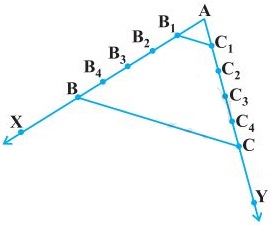
Note that \(\frac{\mathrm{AB}_{1}}{\mathrm{~B}_{1} \mathrm{~B}}=\frac{\mathrm{AC}_{1}}{\mathrm{C}_{1} \mathrm{C}}\) (Each equal to \(\frac{1}{4}\))
You can also see that lines B1C1 and BC are parallel to each other, i.e.,
B1C1 || BC (1)
Similarly, by joining B2C2, B3C3 and B4C4, you can see that:
\(\frac{\mathrm{AB}_{2}}{\mathrm{~B}_{2} \mathrm{~B}}=\frac{\mathrm{AC}_{2}}{\mathrm{C}_{2} \mathrm{C}}\left(=\frac{2}{3}\right) \text { and } \mathrm{B}_{2} \mathrm{C}_{2} \| \mathrm{BC}\) (2)
\(\frac{\mathrm{AB}_{3}}{\mathrm{~B}_{3} \mathrm{~B}}=\frac{\mathrm{AC}_{3}}{\mathrm{C}_{3} \mathrm{C}}\left(=\frac{3}{2}\right) \text { and } \mathrm{B}_{3} \mathrm{C}_{3} \| \mathrm{BC}\) (3)
\(\frac{\mathrm{AB}_{4}}{\mathrm{~B}_{4} \mathrm{~B}}=\frac{\mathrm{AC}_{4}}{\mathrm{C}_{4} \mathrm{C}}\left(=\frac{4}{1}\right) \text { and } \mathrm{B}_{4} \mathrm{C}_{4} \| \mathrm{BC}\) (4)
From (1), (2), (3) and (4), it can be observed that if a line divides two sides of a triangle in the same ratio, then the line is parallel to the third side.
You can repeat this activity by drawing any angle XAY of different measure and taking any number of equal parts on arms AX and AY . Each time, you will arrive at the same result.
12.
2x − 2y − 2 = 0
4x − 4y − 5 = 0
\(\frac{a_{1}}{a_{2}}=\frac{2}{4}=\frac{1}{2}, \frac{b_{1}}{b_{2}}=\frac{-2}{-4}=\frac{1}{2}, \frac{c_{1}}{c_{2}}=\frac{2}{5}\)
Since \(\frac{a_{1}}{a_{2}}=\frac{b_{1}}{b_{2}} \neq \frac{c_{1}}{c_{2}}\)
Therefore, these linear equations are parallel to each other and thus have no possible solution. Hence, the pair of linear equations is inconsistent
13.
\(\tan \theta=\frac{P}{B} \text { and } B C=2 C D\)
= 2
14.
111222333
15.
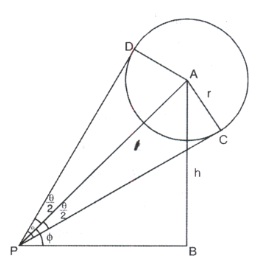
Let A be the centre of the balloon (spherical) whose radius is r.
Let AB be the height of the ballon i.e., h units, such that
ㄥDPC=ፀ, ㄥAPB-ф
Since ΔPDA and ΔPCA are congruent, therefore
ㄥAPC=ㄥAPD=ፀ/2
In rt. ㄥed ΔPCA,
\(\frac { AC }{ AP } =sin\frac { \theta }{ 2 } \)
⇒ AP=\(AC\frac { 1 }{ sin\frac { \theta }{ 2 } } =r.cosec\frac { \theta }{ 2 } \) or
Consider rt . ㄥed ΔPBA, we have
\(\frac { AB }{ AP } \)=sin ф
AB=AP.sinф
h=r.cosec\( \frac { \theta }{ 2 } \).sinф
h=r sinф.cosec\( \frac { \theta }{ 2 } \).
16.
(b)
\(\frac{p^2-1}{2 p}\)
17.
(d)
\(\frac{1}{\sqrt{2}}\)
18.
(c)
\(\frac{8(\sqrt{3}+1)}{\sqrt{3}} \mathrm{~m}^{2}\)
19.
(d)
5 m
20.
(a)
30.95 km
21.
(b)
similar but not congruent
22.
(c)
tan 60°
23.
(a)
0°
24.
(d)
0
25.
(b)
7
26.
(d)
-5
27.
(c)
22
28.
(c)
7
29.
(a)
12
30.
(d)
20°
31.
(b)
3/5
32.
(a)
One solution
33.
(a)
(1,2) or (3,6)
34.
(c)
2:3
35.
(b)
1.155 m
36.
We have, AB = BC = 6\(\sqrt{2}\) m and AC=12m .
(i) (d):\(\because\) Dis mid point of AC.
\(\therefore\) AD=DC=6m
Now, AB2 = BD2 + AD2 (\(\therefore\) \(\Delta\)ABD is a right triangle)
\(\Rightarrow B D^{2}=(6 \sqrt{2})^{2}-6^{2}=72-36=36 \)
\(\Rightarrow B D=6 \mathrm{~m}\)
(ii) (c) : \(\operatorname{In} \Delta A B D, \sin A=\frac{B D}{A B}=\frac{6}{6 \sqrt{2}}=\frac{1}{\sqrt{2}}\)
\(\Rightarrow \sin A=\sin 45^{\circ} \Rightarrow \angle A=45^{\circ}\)
(iii) (c) : \(\operatorname{In} \Delta B D C, \tan C=\frac{B D}{D C}=\frac{6}{6}\)
\(\Rightarrow \tan C=1=\tan 45^{\circ} \Rightarrow \angle C=45^{\circ}\)
(iv) (d) : \(\sin A=\frac{1}{\sqrt{2}}, \cos C=\cos 45^{\circ}=\frac{1}{\sqrt{2}}\)
\(\therefore \quad \sin A+\cos C=\frac{1}{\sqrt{2}}+\frac{1}{\sqrt{2}}=\frac{2}{\sqrt{2}}=\sqrt{2}\)
(v) (c): \((v) \quad(c): \tan C=1, \tan A=\tan 45^{\circ}=1\)
\(\Rightarrow \tan ^{2} C+\tan ^{2} A=1+1=2\)
37.
(i) (a): Since the diagonals of a parallelogram bisect each other.
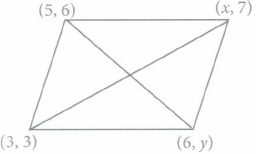
\(\therefore\) By mid-point formula, we have
\(\left(\frac{x+3}{2}, \frac{3+7}{2}\right)=\left(\frac{5+6}{2}, \frac{6+y}{2}\right) \)
\(\Rightarrow x+3=11 \text { and } y+6=10 \Rightarrow x=8 \text { and } y=4\)
(ii) (d): Distance between (3, 3) and (6, 4)
\(=\sqrt{(6-3)^{2}+(4-3)^{2}}=\sqrt{9+1}=\sqrt{10} \text { units }\)
And distance between (6, 4) and (8, 7)
\(=\sqrt{(8-6)^{2}+(7-4)^{2}}=\sqrt{4+9}=\sqrt{13} \text { units }\)
Now, required perimeter \(=2(\sqrt{10}+\sqrt{13}) \text { units }\)
(iii) (a): Let A(l, 3), B(2, 6), C(S, 7) and D(4, 4) be the given points. Then length of diagonal
\(A C =\sqrt{(5-1)^{2}+(7-3)^{2}=\sqrt{16+16}} \)
\(=\sqrt{32}=4 \sqrt{2} \text { units } \)
\(\text { and } B D =\sqrt{(4-2)^{2}+(4-6)^{2}}=\sqrt{4+4} \)
\(=\sqrt{8}=2 \sqrt{2} \text { units }\)
(iv) (d): Length of one of the sides
\(=\sqrt{(2-1)^{2}+(6-3)^{2}}=\sqrt{1+9}=\sqrt{10} \text { units }\)
\(\therefore \quad \text { Perimeter }=4 \sqrt{10} \text { units }\)
(v) (c)
38.
Coordinates of A, Band Care (-2, -3), (2, 3) and (3,2).
(i) (d): Required distance \(=\sqrt{(2+2)^{2}+(3+3)^{2}}\)
\(=\sqrt{4^{2}+6^{2}}=\sqrt{16+36}=2 \sqrt{13} \mathrm{~km} \approx 7.2 \mathrm{~km}\)
(ii) (d): Required distance \(=\sqrt{(3+2)^{2}+(2+3)^{2}}\)
\(=\sqrt{5^{2}+5^{2}}=5 \sqrt{2} \mathrm{~km}\)
(iii) (b): Distance between Band C
\(=\sqrt{(3-2)^{2}+(2-3)^{2}}=\sqrt{1+1}=\sqrt{2} \mathrm{~km}\)
Thus, distance travelled by first bus to reach to B
\(=A C+C B=5 \sqrt{2}+\sqrt{2}=6 \sqrt{2} \mathrm{~km} \approx 8.48 \mathrm{~km}\)
and distance travelled by second bus to reach to B
\(=A B=2 \sqrt{13} \mathrm{~km} \approx 7.2 \mathrm{~km}\)
\(\therefore\) Distance of first bus is greater than distance of the
second bus, therefore second bus should be chosen.
(iv) (d): Distance travelled by first bus = 8.48 km
\(\therefore\) Total fare = 8.48 x 10 = Rs 84.80
(v) (b): Distance travelled by second bus = 7. 2 km
\(\therefore\) Total fare = 7.2 x 15 = Rs 108

10th Standard CBSE Syllabus & Materials
10th Standard CBSE
CBSE 10th Social Science PS - Federalism - New Model Questions Papers Study Material - QB365 Set A
NEW10th Standard CBSE
CBSE 10th Social Science PS - Power Sharing - New Model Questions Papers Study Material - QB365 Set A
NEW10th Standard CBSE
CBSE 10th Social Science GEO - Manufacturing Industries - New Model Questions Papers Study Material - QB365 Set A
NEW10th Standard CBSE
CBSE 10th Social Science GEO - Minerals and Energy Resources - New Model Questions Papers Study Material - QB365 Set A



NCERT Books

Syllabus

Exam Pattern

Sample Question Papers

Previous year Question Papers

Important Notes

MCQ Practice test

NCERT Exemplers

Case study Questions

Image Based Questions

Passage based Questions

HOT Questions

Value Based Questions

Model Questions Papers
NCERT ( Book Back ) Questions

Assertion and Reason
Important Questions And Answers

CBSE 10th Standard CBSE Subjects
CBSE Standards



