
 100% FREE ACCESS
10th Standard CBSE Syllabus & Materials
10th Standard CBSE
CBSE 10th Social Science ECO - Globalisation and the Indian Economy - New Model Questions Papers Study Material - QB365 Set A
NEW10th Standard CBSE
CBSE 10th Social Science ECO - Money and Credit - New Model Questions Papers Study Material - QB365 Set A
NEW10th Standard CBSE
CBSE 10th Social Science ECO - Sectors of the Indian Economy - New Model Questions Papers Study Material - QB365 Set A
NEW10th Standard CBSE
CBSE 10th Social Science ECO - Development - New Model Questions Papers Study Material - QB365 Set A
NEW10th Standard CBSE
CBSE 10th Social Science PS - Outcomes of Democracy - New Model Questions Papers Study Material - QB365 Set A
NEW10th Standard CBSE
CBSE 10th Social Science PS - Gender, Religion and Caste - New Model Questions Papers Study Material - QB365 Set A

Published on: 21/10/2025
Download CBSE Class 10th Standard CBSE Maths question papers, sample papers, important questions, and previous year solved papers in PDF format. Get free study materials, NCERT solutions, and exam preparation resources for Class 10th Standard CBSE Maths
Questions + Answers key
Take MCQ Maths Test
1.
In the given figure, the height of the girl is 1.5 m and the height of the tree is 13.5 m.
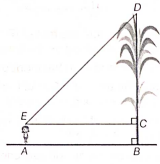
(Note The figure is not to scale.)
If AB= 12√3 m, what is the angle of elevation of the top of the tree from her eyes?
2.
An observer, 1.5 m tall, is 20.5 m away from a tower 22 m high. Determine the angle of elevation of the top of the tower from the eye of the observer.
3.
A kite is flying at a height of 90 m above the ground.The string attached to the kite is temporarily tied to a point on the ground.The inclination of the string with the ground is 60°.Find the length of the string assuming that there is no slack in the string.
4.
If \(\cos { \left( A-B \right) } =\frac { \sqrt { 3 } }{ 2 } \) and \(\sin { \left( A+B \right) } =\frac { \sqrt { 3 } }{ 2 } \), find A and B, where (A + B) and (A - B) are acute angles.
5.
If 4 cos \(\theta\) = 11 sin \(\theta\), find the value of \(\frac { 11\cos { \theta } -7\sin { \theta } }{ 11\cos { \theta } +7\sin { \theta } } \)
6.
If \(\sqrt { 2 } \sin { \theta } =1\), find the value of \(\sec ^{ 2 }{ \theta } -cosec^{ 2 }\theta \)
7.
A 4m tall tree casts a shadow of length m.If at the same time a flagpole casts a shadow 40m in length, then the find the length of the flagpole.
8.
A circus artist is climbing a 18m long rope which is tightly stretched and tied from the top of a vertical pole to the ground level is 300, then find the height of the pole.
9.
the shadow of a tower standing on a level ground is found to be 30m longer when the sun's altitude is 300 than when it is 600.Find the height of the tower.
10.
From a point 100m above lake, the angle of elevation of stationary helicopter is 300 and angle of depression of the helicopter in the lake is 600.Find the height of the helicopter.
11.
From a parachute vertically above a straight road, the angles of depression of two accidental vehicles, at an instant is found to be 450 and 600.If the vehicles are 100m apart, find the height of the parachute.
Which precautions one should take to avoid accidents on roads?
12.
The angles of elevation and depression of the top and bottom of a lighthouse from the top of a building, 60m high, are 300 and 600 respectively.
Find:
(i)the difference between the heights of the lighthouse and the building.
(ii)distance between the lighthouse and the building.
13.
A boy of height 1.3m spot a balloon moving with the wind in a horizontal level at some height from the ground. The angle of elevation of the balloon from the eyes of the boy at any instant is 60o. After 2seconds, the angle of elevation reduces to 30o. If the speed of the wind at that moment is \(29\sqrt{3}\) m/s, then find the height of the balloon from the ground.
14.
From a balloon vertically above a straight road, the angles of depression of two cars at an instant is found o be 450 and 600 .If the cars are 100m apart, find the height of the balloon.
15.
A ladder 15 metres long just reaches the top of a vertical wall.If the ladder makes an angle of 600 with the wall, find the height of the wall.
16.
A tower stands vertically on the ground. From a point on the ground which is 60m away from the foot of the tower, the angle of elevation of the top of the tower is found to be 60o. Find the height of the tower.
17.
A kite is flying at a height of 45m above the ground. The string attached tot the kite is temporarily tied to a point on the ground is 60o. Find the length of the string assuming that there is no slack in the string.
18.
A circus artist is climbing a rope 12m long which is tightly stretched and tied from the top of a vertical pole to the ground. Find the height of the pole, if the angle made by the rope with the ground is 30o
19.
An observer 1.5 m tall is 20.5 m away from a tower 22 m high. Determine the angle of elevation of the top of the tower from the eye of the observer.
20.
A ladder 15 m long just reaches the top of a vertical wall. If the ladder makes an angle of 60o with the wall, then find the height of the wall.
21.
An aeroplane when flying at a height of 3125 m from the ground passes vertically below another plane at an instant when the angles of elevation of the two planes from the same point on the ground are 30o and 60o respectively. Find the distance between the two planes at that instant.
22.
If a pole 6 m high throws shadow of \(2\sqrt { 3 } \) m, then find the angle of elevation of the sun.
23.
Find the angle of the elevation of the sun if the length of the shadow of the tower of height 20 m is \(20\sqrt { 3 } \).
24.
When the length of the shadow of a pole of height 7 m is equal to 7 m then find the elevation of these source of light.
25.
An observer, 1.7 m tall, is \(20\sqrt { 3 } \) m away from a tower. The angle of elevation from the eye of observer to the top of tower is 30o . Find the height of tower.
26.
A ladder, leaning against a wall, makes an angle of 60o with the horizontal. If the foot of the ladder is 2.5 m away from the wall. find the length of the ladder.
27.
Seaweed is found under 80 m deep seafloor. To reach it, a diver makes a 45° dive from a boat. What is the distance travelled by the diver to reach the seafloor?
80 m
80.2 m
80√2 m
80√3 m
28.
If sin A \(=\frac{1}{2}\) then the value of cot A is
\(\sqrt{3}\)
\(\frac{1}{\sqrt{3}}\)
\(\frac{\sqrt{3}}{2}\)
1
29.
If cos A \(=\frac{4}{5}\) then the value of tan A is
3 / 5
3 / 4
4 / 3
5 / 3
30.
\(\frac{1-\tan ^{2} 45^{\circ}}{1+\tan ^{2} 45^{\circ}}\) =
tan 90°
1
sin 45°
0
31.
\(\frac{2 \tan 30^{\circ}}{1+\tan ^{2} 30^{\circ}}\)=
sin 60°
cos 60°
tan 60°
sin 30°
32.
If sin θ = 1/2 , then the value of sin θ (sin θ – cosec θ) is
√3/2
-√3/2
3/4
-3/4
33.
The figure shows the observation of point C from point A. The angle of depression from A is:
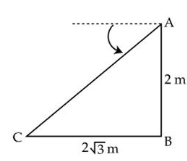
30°
60°
75°
45°
34.
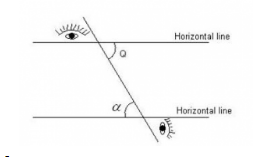
In the above fig Q and α respectively are
Angle of Depression and Angle of Depression
Angle of Elevation and Angle of depression
Angle of Elevation and Angle of Elevation
Angle of depression and Angle of Elevation
1.
According to the figure,
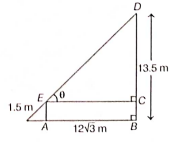
\(A B =E C=12 \sqrt{3} \mathrm{~m}\)
\(A E =B C=15 \mathrm{~m} \)
\(B D =135 \mathrm{~m}\)
\(\Rightarrow D C+B C =135 \mathrm{~m}\)
\(D C =135-1.5 \mathrm{~m} =12 \mathrm{~m}\)
In \(\triangle D E C\),
\(\tan \theta =\frac{D C}{E C} \)
\(=\frac{12}{12 \sqrt{3}} \text { [from Eqs. (i) and (ii)] } \)
\(\tan \theta =\frac{1}{\sqrt{3}}\)
\(\therefore \quad \theta =30^{\circ} {\left[\because \tan 30^{\circ}=\frac{1}{\sqrt{3}}\right] }\)
Hence, angle of elevation of top of the tree from her eyes is \(30^{\circ}\).
2.
Let BE = 22 m be the height of the tower and AD = 1.5m be the height of the observer. The point D be the observer's eye. Draw DC \\ AB.
Then, AB = 20.5 m = DC and, EC = BE - BC = BE - AD = 22 -1.5 = 20.5 m [∵ BC = AD]
Let S be the angle of elevation make by observer's eye to the top of the tower i.e. ∠EDC = θ.
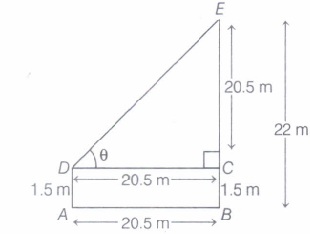
In right angled ΔDCE,
\(\tan \theta=\frac{P}{B}=\frac{C E}{D C}=\frac{20.5}{20.5}=1\)
45\(\unicode{xb0} \)
3.
In right ΔABC, \({AB \over AC}=sin\ 60^0\)
\(\Rightarrow\ x={180\sqrt3\over 3}\)
\(\Rightarrow\ \ x=60\sqrt3\)
= 60 x 1.732
Hence length of string = 103.92m.
4.
\(\cos { \left( A-B \right) } =\frac { \sqrt { 3 } }{ 2 } =\cos { { 30 }^{ ° } } \)
\(\Rightarrow\) A - B = 30° ...(i)
\(\sin { \left( A+B \right) } =\frac { \sqrt { 3 } }{ 2 } =\sin { { 60 }^{ ° } } \)
\(\Rightarrow\) A + B = 60° ... (ii)
Adding equations (i) and (ii),
2A = 90°
\(\therefore\) A = 45°
From eqn. (ii), B = 60° - A = 60° - 45° = 15°
5.
Given : 4 cos \(\theta\) = 11 sin \(\theta\)
\(\Rightarrow \quad \cos { \theta } =\frac { 11 }{ 4 } \sin { \theta } \)
Now \(\frac { 11\cos { \theta } -7\sin { \theta } }{ 11\cos { \theta } +7\sin { \theta } } =\frac { 11\times \frac { 11 }{ 4 } \sin { \theta } -7\sin { \theta } }{ 11\times \frac { 11 }{ 4 } \sin { \theta } +7\sin { \theta } } \)
\(=\frac { \sin { \theta } \left( \frac { 121 }{ 4 } -7 \right) }{ \sin { \theta } \left( \frac { 121 }{ 4 } +7 \right) } \)
\(=\frac { 121-28 }{ 121+28 } =\frac { 93 }{ 149 } \)
6.
Given, \(\sqrt { 2 } \sin { \theta } =1\)
\(\sin { \theta } =\frac { 1 }{ \sqrt { 2 } } =\sin { { 45 }^{ ° } } \)
\(\therefore \quad \theta ={ 45 }^{ ° }\)
Now \(\sec ^{ 2 }{ \theta } -cosec^{ 2 }\theta \) = \(\sec ^{ 2 }{ { 45 }^{ ° } } -cosec^{ 2 }{ 45 }^{ ° }\)
\(={ \left( \sqrt { 2 } \right) }^{ 2 }-{ \left( \sqrt { 2 } \right) }^{ 2 }\)
= 2 - 2
= 0
7.
80m
8.
9m
9.
25.95m
10.
200m
11.
\(50(3+\sqrt{3})m;\)To avoid accident everyone should follow road safety rules.
12.
(i)20m
(ii)34.64m
13.
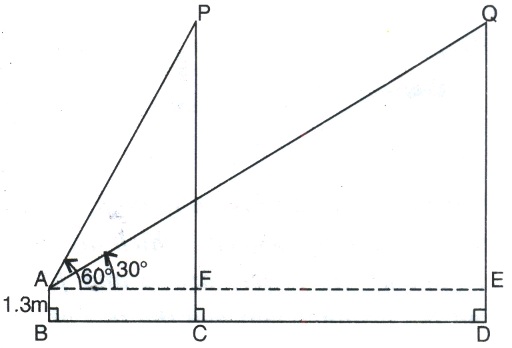
Let AB be the position of boy, P and Q be the two positions of the balloon, such that AB=1.3 m, ㄥPAE=60o, ㄥQAE=30o and speed of the balloon =29\(\sqrt { 3 } \) m/s.
∴ ED=FC=AB=1.3 m
Distance covered by the balloon in 2 seconds
=2 x 29\(\sqrt { 3 } \)=58\(\sqrt { 3 } \)m=FE
Consider rt. ㄥed ΔAEQ
QE/AE=tan 300
QE=AE x \(\frac { 1 }{ \sqrt { 3 } } \)
QE=(AF+FE) x \(\frac { 1 }{ \sqrt { 3 } } \)
PF=\(\left( \frac { PF }{ \sqrt { 3 } } +58\sqrt { 3 } \right) \times \frac { 1 }{ \sqrt { 3 } } \)
[∵ QE=PF]
PF=PF/3+58
PF\(\left( 1-\frac { 1 }{ 3 } \right) \)=58
PF=58 x 3/2
PF=87 m
Now PC=PF+FC
=87+1.3
=88.3 m
Hence, the height of the ballon is 88.3 m
14.
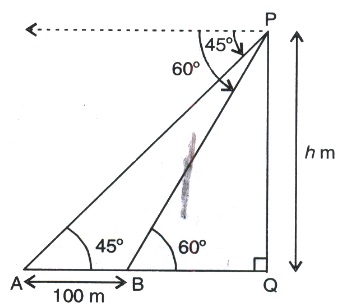
Let the height of the ballon at P be h meters. Let A and B be the two cars. Thus, AB=100 m
ㄥPAQ=45o and ㄥPBQ=60o
Consider right-angled ΔAQP
\(\frac { PQ }{ AQ } \)=tano
⇒ \(\frac { PQ }{ AQ } \)=1
⇒ PQ=AQ= h m
Now, consider right-angled ΔPBQ, we have
\(\frac { PQ }{ BQ } \)=tan 60o
\(\frac { PQ }{ BQ } \)=\(\\ \\ \\ \\ \\ \\ \\ \sqrt { 3 } \\ \)
\(\frac { h }{ h-100 } =\sqrt { 3 } \)
⇒ h=\(\frac { \sqrt { 3 } (100) }{ \sqrt { 3 } -1 } \)
⇒ h=\(\frac { \sqrt { 3 } (100) }{ \sqrt { 3 } -1 } \times \frac { \sqrt { 3 } +1 }{ \sqrt { 3 } +1 } \)
⇒ h=\(\frac { \sqrt { 3 } (100)(\sqrt { 3 } +1) }{ 2 } \)
=50(3+\(\sqrt { 3 } \))
Hence, the height of the ballon is 50(3+\(\sqrt { 3 } \)) m.
15.
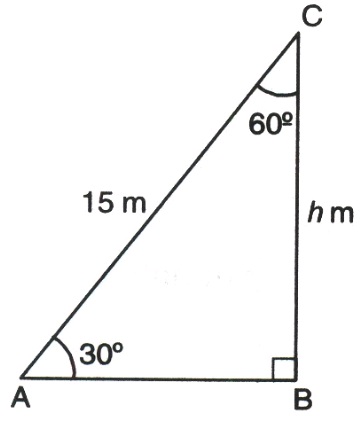
Here, length of the ladder is 15 m and angle of elevation is 90o - 60o i.e., 30o
Let h m be the height of the wall Consider right-angled ΔABC
\(\frac { BC }{ AC } \)=sin 30o
\(\frac { h }{ 12 } =\frac { 1 }{ 2 } \)
h=\(\frac { 15 }{ 2 } \)m
Hence, the height of the wall is 15/2 m or 7.5 m.
16.
Let AB be tower of height h m and C is a point on the ground such that BC=60 m
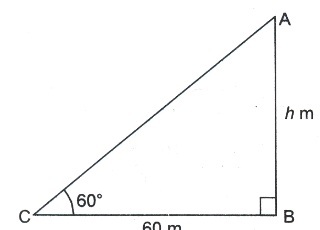
As ㄥACB=600 and AB=h m
Consider rt. angled ΔABC, we have
tan 600=\(\frac { AB }{ BC } \)
⇒ \(\sqrt { 3 } =\frac { h }{ 60 } \)
⇒ h=60\(\sqrt { 3 } \) m.
Hence, the height of the tower is 60 \(\sqrt { 3 } \) m.
17.
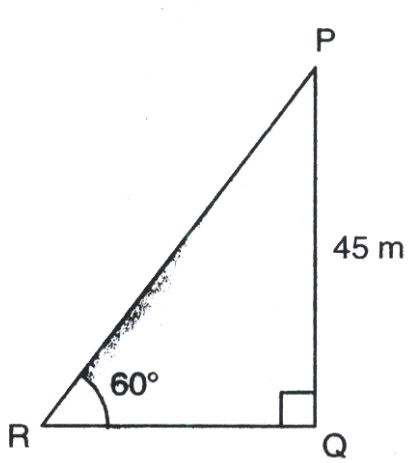
Let p is the position of the kite with height 45 m from the point Q on the ground. Let R is the other point on the ground to which kite is temporarily tied
AS ㄥPRQ=60o and PQ=45 m (given)
Consider art. ΔPQR, we have
sin 60o =\(\frac { PQ }{ PR } \)
\(\frac { \sqrt { 3 } }{ 2 } =\frac { 45 }{ PR } \)
PR=\(\frac { 90 }{ \sqrt { 3 } } \times \frac { \sqrt { 3 } }{ \sqrt { 3 } } \)
PR=\(\frac { 90\sqrt { 3 } }{ 3 } \)
=30\(\sqrt { 3 } \)
Hence, the length of the string is 30m.\(\sqrt { 3 } \) m.
18.
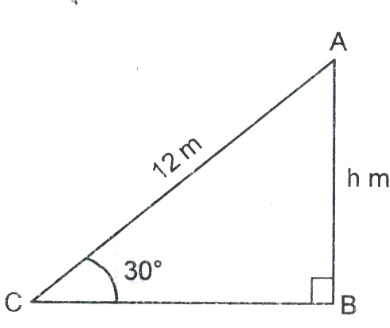
Let AB=h m be the height of the pole
AC=12 m is the length of rope
and ㄥACB=30o
Consider rt. angled ΔABC, we have
sin 300=\(\frac { AB }{ AC } \)
\(\frac { 1 }{ 2 } =\frac { h }{ 12 } \)
h=\(\frac { 12 }{ 2 } \)=6 m
19.
\(45^{\circ}\)
20.
\({15\over2}{\sqrt {3}} \ m \)
21.
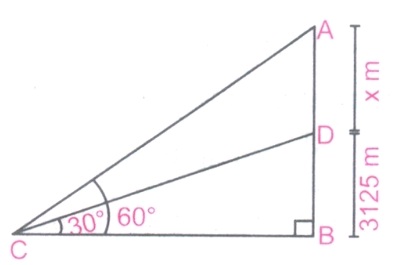
Let A and D are two aeroplanes such that BD = 3125 m
ㄥACB = 60o, ㄥDCB = 30o
ㄥACB = 60o.ㄥDCB = 30o
In rt. ΔABC, \(\frac { AB }{ BC } \) = tan 60o
⇒ \(\frac { x+3125 }{ BC } =\sqrt { 3 } \)
⇒ BC=\(\frac { x+3125 }{ \sqrt { 3 } } \)
⇒ BC=\(\frac { x+3125 }{ \sqrt { 3 } } \)m
In rt. ΔDBC, \(\frac { DB }{ BC } \) = tan 30o
⇒ \(\frac { BD }{ BC } =\frac { 1 }{ \sqrt { 3 } } \)
⇒ BD=\(\frac { BC }{ \sqrt { 3 } } \)
⇒ BD = \(\frac { 1 }{ \sqrt { 3 } } \times \frac { 3125+x }{ \sqrt { 3 } } \)
⇒ BD = 3125 = \(\frac { 3125+x }{ 3 } \)
Now, x = 6250 m
⇒ AD = 6250 m
22.
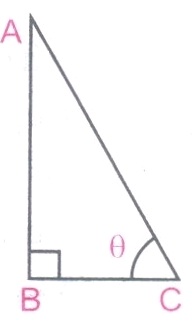
Let AB is pole and BC is its shadow
∴ AB = 6m, BC = 2\(\\ \\ \\ \\ \sqrt { 3 } \) m
In right ΔABC, \(\frac { AB }{ BC } \)=tanፀ
⇒ tanፀ = \(\frac { 6 }{ 2\sqrt { 3 } } \)
⇒ tanፀ = \(\sqrt { 3 } \)
⇒ ፀ = 60o
23.
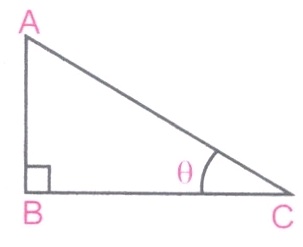
Let AB is tower and BC is its shadow
∴ AB = 20 m and BC = 20\(\sqrt { 3 } \)
In right ΔABC, \(\frac { AB }{ BC } \) = tanፀ
⇒ tanፀ = \(\frac { 20 }{ 20\sqrt { 3 } } \)
⇒ tanፀ = \(\frac { 1 }{ \sqrt { 3 } } \)
⇒ ፀ = 30o
24.
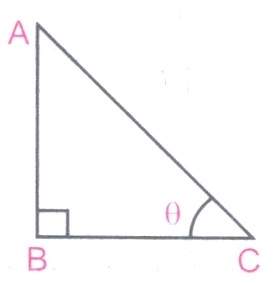
Let AB is pole and BC is its shadow
∴ AB = 7 m, BC = 7 cm
In right ∆ABC, \(\frac { AB }{ BC } \) = tanፀ
tanፀ = 7/7 = 1 ⇒ ፀ = 45o
25.
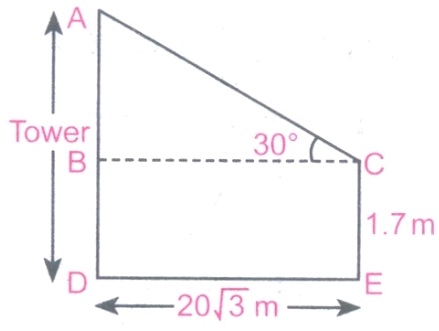
In right ΔABC, \(\frac { AB }{ BC } \) = tan30o
⇒ \(\frac { AB }{ 20\sqrt { 3 } } =\frac { 1 }{ \sqrt { 3 } } \) ⇒ AB = 20 m
Height of tower AD = AB + BD
= 20 + 1.7 = 21.7 m
26.
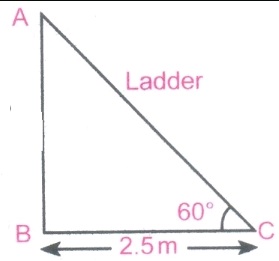
In right ΔABC
\(\frac { BC }{ AC } \) = cos 60\(\unicode{xb0} \)
⇒ \(\frac { 2.5 }{ AC } =\frac { 1 }{ 2 } \)
⇒ AC = 2.5 x 2 = 5 m
27.
(c)
80√2 m
28.
(a)
\(\sqrt{3}\)
29.
(b)
3 / 4
30.
(d)
0
31.
(a)
sin 60°
32.
(d)
-3/4
33.
(a)
30°
34.
(d)
Angle of depression and Angle of Elevation

10th Standard CBSE Syllabus & Materials
10th Standard CBSE
CBSE 10th Social Science PS - Federalism - New Model Questions Papers Study Material - QB365 Set A
NEW10th Standard CBSE
CBSE 10th Social Science PS - Power Sharing - New Model Questions Papers Study Material - QB365 Set A
NEW10th Standard CBSE
CBSE 10th Social Science GEO - Manufacturing Industries - New Model Questions Papers Study Material - QB365 Set A
NEW10th Standard CBSE
CBSE 10th Social Science GEO - Minerals and Energy Resources - New Model Questions Papers Study Material - QB365 Set A



NCERT Books

Syllabus

Exam Pattern

Sample Question Papers

Previous year Question Papers

Important Notes

MCQ Practice test

NCERT Exemplers

Case study Questions

Image Based Questions

Passage based Questions

HOT Questions

Value Based Questions

Model Questions Papers
NCERT ( Book Back ) Questions

Assertion and Reason
Important Questions And Answers

CBSE 10th Standard CBSE Subjects
CBSE Standards



