
 100% FREE ACCESS
10th Standard CBSE Syllabus & Materials
10th Standard CBSE
CBSE 10th Social Science ECO - Globalisation and the Indian Economy - New Model Questions Papers Study Material - QB365 Set A
NEW10th Standard CBSE
CBSE 10th Social Science ECO - Money and Credit - New Model Questions Papers Study Material - QB365 Set A
NEW10th Standard CBSE
CBSE 10th Social Science ECO - Sectors of the Indian Economy - New Model Questions Papers Study Material - QB365 Set A
NEW10th Standard CBSE
CBSE 10th Social Science ECO - Development - New Model Questions Papers Study Material - QB365 Set A
NEW10th Standard CBSE
CBSE 10th Social Science PS - Outcomes of Democracy - New Model Questions Papers Study Material - QB365 Set A
NEW10th Standard CBSE
CBSE 10th Social Science PS - Gender, Religion and Caste - New Model Questions Papers Study Material - QB365 Set A

Published on: 21/10/2025
Download CBSE Class 10th Standard CBSE Maths question papers, sample papers, important questions, and previous year solved papers in PDF format. Get free study materials, NCERT solutions, and exam preparation resources for Class 10th Standard CBSE Maths
Questions + Answers key
Take MCQ Maths Test
1.
Seaweed is found under 80 m deep seafloor. To reach it, a diver makes a 45° dive from a boat. What is the distance travelled by the diver to reach the seafloor?
80 m
80.2 m
80√2 m
80√3 m
2.
Three vertices of a parallelogram ABCD are A(1, 4) B(- 2, 3) and C (5, 8). The ordinate of the fourth vertex D is
8
9
7
6
3.
If (2, 4) is the mid-point of the line segment joining (6,3) and (a, 5), then the value of a is
2
4
-4
-2
4.
If three points \((0,0),(3, \sqrt{3})\) and \((3, \lambda)\) form an equilateral triangle, then \(\lambda\) equals.
2
-3
-4
None of these
5.
An observer, 1.5 m tall is 20.5 away from a tower 22 m high, then the angle of elevation of the top of the tower from the eye of the observer is
30°
45°
60°
90°
6.
If x = 3 sec2 – 1, y = tan2 – 2 then x – 3y is equal to
4
8
5
3
7.
If sin θ = 1/2 , then the value of sin θ (sin θ – cosec θ) is
√3/2
-√3/2
3/4
-3/4
8.
The value of cosec2 30° sin2 45° – sec2 60° is
2
1
-2
0
9.
if tan θ+cot θ =2 then the value of tan2 θ+cot2 θ is
0
2
3
1
10.
Simplify \(\frac { 1+cot\quad A }{ sin\quad A } +\frac { sin\quad A }{ 1+cos\quad A } \)
2 sec A
2 cosec A
2 sin A
2 cos A
11.
The distance between the points P (-6,7) and Q (-1,-5) is
15
12
13
10
12.
The perimeter of a triangle with vertices (0, 4) (0, 0) and (3, 0) is
15
12
8
10
13.
One end of a line of length 10 units is at the point (-3, 2). If the ordinate of the other end be 10, then the abscissa will be
9 or -3
-9 or -3
3 or -9
3 or 9
14.
Find the ratio in which the line joining the points (6, 4) and (1, –7) is divided by x-axis
1 : 3
2 : 7
4 : 7
6 : 7
15.
Find the value of P for which the point (–1, 3), (2, p) and (5, –1) are collinear.
4
3
2
1
16.
Find the coordinates of the point equidistant from the points A(1, 2), B (3, –4) and C(5, –6)
(2, 3)
(–1, –2)
(0, 3)
(1, 3)
17.
The ——– is the line drawn from the eye of an observer to the point in the object viewed by the observer
Line of sight
Line of sight propagation
Line of symmetry
Line of incidence
18.
A vertical tower is 20 m high. A man at some distance from the tower knows that the cosine of the angle of the elevation of the top of tower is 0.5. He is standing from the foot of the tower at a distance of:
30√3 m
20√3 m
20/√3 m
10/√3 m
19.
If the height and length of the shadow of a man are the same, then the angle of elevation of the sun is
60°
45°
30°
15°
20.
A kite is flying, attached to a thread which is 165m long. The thread makes an angle of 300 with the ground. The height of the kite from the ground, assuming that there is no slack in the thread is
84 m
82.5 m
81.5 m
80 m
21.
There is fire incident in the house. The house door is locked so, the fireman is trying to enter the house from the window. He places the ladder against the wall such that its top reaches the window as shown in the figure .
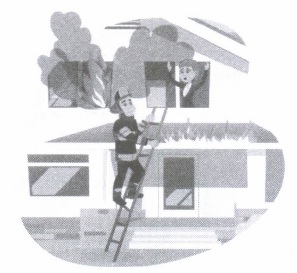
Based on. the above information, answer the following questions.
(i) If window is 6 m above the ground and angle made by the foot ofladder to the ground is 30°, then length of the ladder is
| (a) 8m | (b) 10m | (c) 12m | (d) 14m |
(ii) If fireman place the ladder 5 m away from the wall and angle of elevation is observed to be 30°, then length of the ladder is
| (a) 5 m | \((b) \frac{10}{\sqrt{3}} \mathrm{~m}\) | \((c) \frac{15}{\sqrt{2}} \mathrm{~m}\) | (d) 20 m |
(iii) If fireman places the ladder 2.5 m away from the wall and angle of elevation is observed to be 60°, then find the height of the window. (Take \(\sqrt{3}\) = 1.73)
| (a) 4.325 m | (b) 5.5 m | (c) 6.3 m | (d) 2.5 m |
(iv) If the height of the window is 8 m above the ground and angle of elevation is observed to be 45°, then horizontal distance between the foot of ladder and wall is
| (a) 2 m | (b) 4 m | (c) 6 m | (d) 8 m |
(v) If the fireman gets a 9 m long ladder and window is at 6 m height, then how far should the ladder be placed?
| (a) 5 m | (b) 3\(\sqrt{5}\)m | (c) 3 m | (d) 4 m |
22.
Aanya and her father go to meet her friend Juhi for a party. When they reached to [uhi's place, Aanya saw the roof of the house, which is triangular in shape. If she imagined the dimensions of the roof as given in the figure, then answer the following questions.
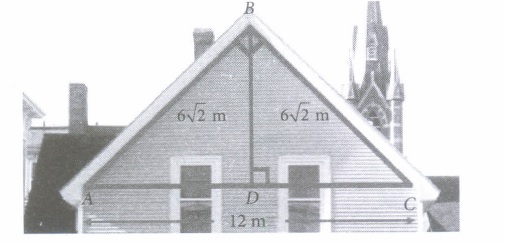
(i) If D is the mid point of AC, then BD =
| (a) 2m | (b) 3m | (c) 4m | (d) 6m |
(ii) Measure of \(\angle\)A =
| (a) 30° | (b) 60° | (c) 45° | (d) None of these |
(iii) Measure of \(\angle\)C =
| (a) 30° | (b) 60° | (c) 45° | (d) None of these |
(iv) Find the value of sinA + cosC.
| (a) 0 | (b) 1 | (c) \(\frac{1}{2}\) | (d) \(\sqrt{2}\) |
(v) Find the value of tan2C + tan2 A.
| (a) 0 | (b) 1 | (c) 2 | (d) \(\frac{1}{2}\) |
23.
The camping alpine tent is usually made using high quality canvas and it is water proof. These alpine tents are mostly used in hilly areas, as the snow will not settle on the tent and make it damp. It is easy to layout and one need not use a manual to set it up. One alpine tent is shown in the figure given below, which has two triangular faces and three rectangular faces. Also, the image of canvas on graph paper is shown in the adjacent figure.
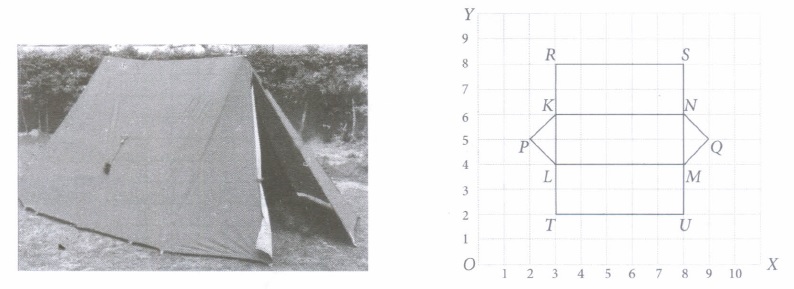
Based on the above information, answer the following questions.
(i) Distance of point Q from y-axis is
| (a) 9 units | (b) 8 units | (c) 4 units | (d) 5 units |
(ii) What are the coordinates of U?
| (a) (2,8) | (b) (8,2) | (c) (6,9) | (d) (9,6) |
(iii) The distance between the points P and Q is
| (a) 4 units | (b) 5 units | (c) 6 units | (d) 7 units |
(iv) If a point A(x, y) is equidistant from Rand T, then
| (a) y - 2 = 0 | (b) y - 3 = 0 | (c) y-5=0 | (d) y - 6 = 0 |
(v) Perimeter of image of a rectangular face is
| (a) 5 units | (b) 8 units | (c) 10 units | (d) 14 units |
24.
There are two routes to travel from source A to destination B by bus. First bus reaches at B via point C and second bus reaches from A to B directly. The position of A, Band C are represented in the following graph:
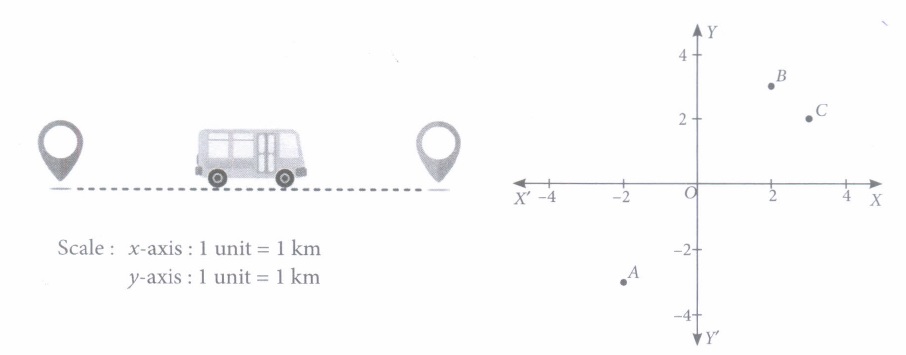
Based on the above information, answer the following questions.
(i) The distance between A and B is
| (a) 13 km | (b) 26 km | (c) \(\sqrt{13}\)km | (d) none of these |
(ii) The distance between A and Cis
| (a) 5 km | (b) 2 km | (c) \(\sqrt{5}\)km | (d) \(5\sqrt{2}\) km |
(iii) If it is assumed that both buses have same speed, then by which bus do you want to travel from A to B?
| (a) Firstbus | (b) Secondbus | (c) Any of them | (d) None of these |
(iv) If the fare for first bus is Rs10/km, then what will be the fare for total journey by that bus?
| (a) Rs 83 | (b) Rs 38 | (c) Rs 45 | (d) none of these |
(v) If the fare for second bus is Rs 15/km, then what will be the fare to reach to the destination by this bus?
| (a) Rs 105 | (b) Rs 108 | (c) Rs 110 | (d) Rs 115 |
1.
(c)
80√2 m
2.
(b)
9
3.
(d)
-2
4.
(d)
None of these
5.
(b)
45°
6.
(b)
8
7.
(d)
-3/4
8.
(c)
-2
9.
(b)
2
10.
(b)
2 cosec A
11.
(c)
13
12.
(b)
12
13.
(c)
3 or -9
14.
(c)
4 : 7
15.
(d)
1
16.
(b)
(–1, –2)
17.
(a)
Line of sight
18.
(c)
20/√3 m
19.
(b)
45°
20.
(b)
82.5 m
21.
(i) (c) : Let AC be the length of the ladder.
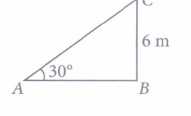
\(\text { In } \Delta A B C, \frac{B C}{A C}=\sin 30^{\circ} \)
\(\Rightarrow \frac{6}{A C}=\frac{1}{2} \Rightarrow A C=12 \mathrm{~m}\)
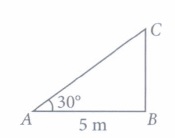
(ii) (b): \(\text { In } \Delta A B C, \frac{A B}{A C}=\cos 30^{\circ}\)
\(\Rightarrow \frac{5}{A C}=\frac{\sqrt{3}}{2} \Rightarrow A C=\frac{10}{\sqrt{3}} \mathrm{~m}\)
(iii) (a) : Let BC be the height of window from ground.
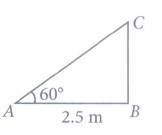
\(\text { In } \Delta A B C, \frac{B C}{A B}=\tan 60^{\circ} \)
\(\Rightarrow \frac{B C}{2.5}=\sqrt{3} \)
\(\Rightarrow B C=2.5 \times 1.73=4.325 \mathrm{~m}\)
(iv) (d): Let AB be the horizontal distance between the foot of ladder and wall.
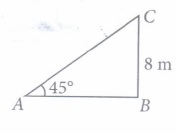
\(\text { In } \Delta A B C, \frac{B C}{A B}=\tan 45^{\circ} \)
\(\Rightarrow \quad \frac{8}{A B}=1 \Rightarrow A B=8 \mathrm{~m}\)
(v) (b): Let the required distance be x.
\(\text { In } \Delta A B C,(9)^{2}=x^{2}+(6)^{2}\)
[By Pythagoras theorem]
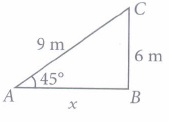
\(\Rightarrow 81-36=x^{2} \Rightarrow 45=x^{2} \)
\(\Rightarrow \quad x=3 \sqrt{5} \mathrm{~m}\)
22.
We have, AB = BC = 6\(\sqrt{2}\) m and AC=12m .
(i) (d):\(\because\) Dis mid point of AC.
\(\therefore\) AD=DC=6m
Now, AB2 = BD2 + AD2 (\(\therefore\) \(\Delta\)ABD is a right triangle)
\(\Rightarrow B D^{2}=(6 \sqrt{2})^{2}-6^{2}=72-36=36 \)
\(\Rightarrow B D=6 \mathrm{~m}\)
(ii) (c) : \(\operatorname{In} \Delta A B D, \sin A=\frac{B D}{A B}=\frac{6}{6 \sqrt{2}}=\frac{1}{\sqrt{2}}\)
\(\Rightarrow \sin A=\sin 45^{\circ} \Rightarrow \angle A=45^{\circ}\)
(iii) (c) : \(\operatorname{In} \Delta B D C, \tan C=\frac{B D}{D C}=\frac{6}{6}\)
\(\Rightarrow \tan C=1=\tan 45^{\circ} \Rightarrow \angle C=45^{\circ}\)
(iv) (d) : \(\sin A=\frac{1}{\sqrt{2}}, \cos C=\cos 45^{\circ}=\frac{1}{\sqrt{2}}\)
\(\therefore \quad \sin A+\cos C=\frac{1}{\sqrt{2}}+\frac{1}{\sqrt{2}}=\frac{2}{\sqrt{2}}=\sqrt{2}\)
(v) (c): \((v) \quad(c): \tan C=1, \tan A=\tan 45^{\circ}=1\)
\(\Rightarrow \tan ^{2} C+\tan ^{2} A=1+1=2\)
23.
(i) (a): Coordinates of Q are (9, 5).
\(\therefore\) Distance of point Q from y-axis = 9 units
(ii) (b): Coordinates of point U are (8, 2).
(iii) (d): We have, P(2, 5) and Q (9, 5)
\(\therefore \quad P Q=\sqrt{(2-9)^{2}+(5-5)^{2}}=\sqrt{49+0}=7 \text { units }\)
(iv) (c): Point A(x, y) is equidistant from R (3, 8) and T(3,2).
\(\therefore \quad A R=A T \Rightarrow A R^{2}=A T^{2} \)
\(\Rightarrow \quad(x-3)^{2}+(y-8)^{2}=(x-3)^{2}+(y-2)^{2} \)
\(\Rightarrow y^{2}+64-16 y=y^{2}+4-4 y \)
\(\Rightarrow 16 y-4 y=64-4 \)
\(\Rightarrow 12 y=60 \Rightarrow y=5\)
(v) (d): Length of TU = 5 units and of TL = 2 units
\(\therefore\) Perimeter of image of a rectangular face = 2(5 + 2) = 14 units
24.
Coordinates of A, Band Care (-2, -3), (2, 3) and (3,2).
(i) (d): Required distance \(=\sqrt{(2+2)^{2}+(3+3)^{2}}\)
\(=\sqrt{4^{2}+6^{2}}=\sqrt{16+36}=2 \sqrt{13} \mathrm{~km} \approx 7.2 \mathrm{~km}\)
(ii) (d): Required distance \(=\sqrt{(3+2)^{2}+(2+3)^{2}}\)
\(=\sqrt{5^{2}+5^{2}}=5 \sqrt{2} \mathrm{~km}\)
(iii) (b): Distance between Band C
\(=\sqrt{(3-2)^{2}+(2-3)^{2}}=\sqrt{1+1}=\sqrt{2} \mathrm{~km}\)
Thus, distance travelled by first bus to reach to B
\(=A C+C B=5 \sqrt{2}+\sqrt{2}=6 \sqrt{2} \mathrm{~km} \approx 8.48 \mathrm{~km}\)
and distance travelled by second bus to reach to B
\(=A B=2 \sqrt{13} \mathrm{~km} \approx 7.2 \mathrm{~km}\)
\(\therefore\) Distance of first bus is greater than distance of the
second bus, therefore second bus should be chosen.
(iv) (d): Distance travelled by first bus = 8.48 km
\(\therefore\) Total fare = 8.48 x 10 = Rs 84.80
(v) (b): Distance travelled by second bus = 7. 2 km
\(\therefore\) Total fare = 7.2 x 15 = Rs 108

10th Standard CBSE Syllabus & Materials
10th Standard CBSE
CBSE 10th Social Science PS - Federalism - New Model Questions Papers Study Material - QB365 Set A
NEW10th Standard CBSE
CBSE 10th Social Science PS - Power Sharing - New Model Questions Papers Study Material - QB365 Set A
NEW10th Standard CBSE
CBSE 10th Social Science GEO - Manufacturing Industries - New Model Questions Papers Study Material - QB365 Set A
NEW10th Standard CBSE
CBSE 10th Social Science GEO - Minerals and Energy Resources - New Model Questions Papers Study Material - QB365 Set A



NCERT Books

Syllabus

Exam Pattern

Sample Question Papers

Previous year Question Papers

Important Notes

MCQ Practice test

NCERT Exemplers

Case study Questions

Image Based Questions

Passage based Questions

HOT Questions

Value Based Questions

Model Questions Papers
NCERT ( Book Back ) Questions

Assertion and Reason
Important Questions And Answers

CBSE 10th Standard CBSE Subjects
CBSE Standards



