
 100% FREE ACCESS
10th Standard CBSE Syllabus & Materials
10th Standard CBSE
CBSE 10th Social Science ECO - Globalisation and the Indian Economy - New Model Questions Papers Study Material - QB365 Set A
NEW10th Standard CBSE
CBSE 10th Social Science ECO - Money and Credit - New Model Questions Papers Study Material - QB365 Set A
NEW10th Standard CBSE
CBSE 10th Social Science ECO - Sectors of the Indian Economy - New Model Questions Papers Study Material - QB365 Set A
NEW10th Standard CBSE
CBSE 10th Social Science ECO - Development - New Model Questions Papers Study Material - QB365 Set A
NEW10th Standard CBSE
CBSE 10th Social Science PS - Outcomes of Democracy - New Model Questions Papers Study Material - QB365 Set A
NEW10th Standard CBSE
CBSE 10th Social Science PS - Gender, Religion and Caste - New Model Questions Papers Study Material - QB365 Set A

Published on: 20/10/2025
Download CBSE Class 10th Standard CBSE Maths question papers, sample papers, important questions, and previous year solved papers in PDF format. Get free study materials, NCERT solutions, and exam preparation resources for Class 10th Standard CBSE Maths
Questions + Answers key
Take MCQ Maths Test
1.
Prove that : \(\left( \sin { \theta } +cosec\theta \right) ^{ 2 }+\left( \cos { \theta } +\sec { \theta } \right) ^{ 2 }=7+\tan ^{ 2 }{ \theta } +\cot ^{ 2 }{ \theta } \)
2.
The table below gives the distribution of villages under different heights from sea level in a certain region:
| Height (in metre) | 200 | 600 | 1000 | 1400 | 1800 | 2200 |
| No. of Villages | 142 | 265 | 560 | 271 | 89 | 16 |
(i) Compute the mean height of the region.
(ii) Which mathematical concept is used in this problem?
(iii) What is the value of village in modern times?
3.
The following data gives the distribution of total monthly household expenditure of 200 families of a village. Find the modal monthly expenditure of the families. Also, find mean monthly expenditure.
| Expenditure (in RS) | Number of families |
|---|---|
| 1000-1500 | 24 |
| 1500-2000 | 40 |
| 2000-2500 | 33 |
| 2500-3000 | 28 |
| 3000-3500 | 30 |
| 3500-4000 | 22 |
| 4000-4500 | 16 |
| 4500-5000 | 7 |
4.
A helicopter, at an altitude of 1500m, finds that two ships are sailing towards it, in the same direction.The angles of depression of the ships as observed from helicopter are 600 and 300 respectively.Find the distance between the two ships.
5.
A TV tower stands vertically on a bank of a canal. From a point on the other bank directly opposite the tower, the angle of elevation of the top of the tower is 60\(\unicode{xb0} \). From another point 20 m away from this point on the line joining this point to the foot of the tower, the angle of elevation of the top of the tower is 30\(\unicode{xb0} \) (see the given figure). Find the height of the tower and the width of the canal.

6.
Prove that the angle between two tangents drawn from an external point to a circle is supplementary to the angle subtended by the line segment joining the points of contact at the centre.
7.
There were 35 students in a hostel. Due to the admission of 7 new students, the expenses of the mess were increased by Rs 42 per day while the average expenditure per head diminished by Rs 1. What was the original expenditure of the mess?
8.
An observer 1.2 metere tall is 28.2 m away from the tower.The angle of elevation of the top of the tower from his eye is 60°.What is the height of the tower?
9.
A player sitting on the top of a tower of height 20m observes the angle of depression of a ball lying on the ground as 600.Find the distance between the foot of the tower and the ball.
10.
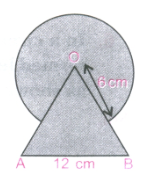
Find the area of the shaded region in the figure, where a circular arc of radius 6 cm has been drawn with vertex O of an equilateral triangle OAB of side 12 cm as centre.
11.
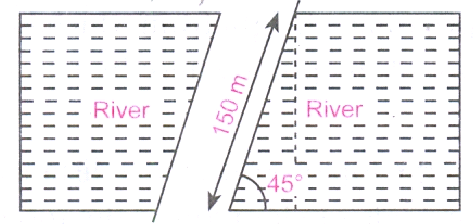
A bridge across a river makes an angle of 45o with the river bank (Fig. given). If the length of the bridge across the river is 150 m, what is the width of the river?
12.
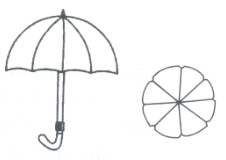
An umbrella has 8 ribs which are equally spaced (see the figure). Assuming umbrella to be a flat circle of radius 45 cm, find the area between the two consecutive ribs of the umbrella.
13.
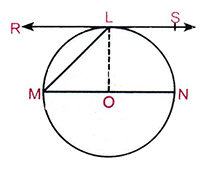
In the given figure, RS is the tangent to the circle at L and MN is a diameter. If, determine \(\angle RLM.\)
-S.jpg)
14.
A ship was moving towards the shore at a uniform speed of 36 km/h. Initially, the ship was 1.3 km away from the foot of a lighthouse which is 173.2 m in height.
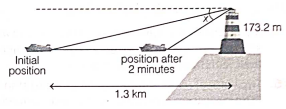
(Note The figure is not to scale.)
Find the angle of depression x of the top of the lighthouse from the ship after the ship had been moving for 2 min. Show your steps and give reasons.
[take (√3 =1.732)]
15.
The following is the distribution of weights (in kg) of 40 persons :
| Weight (in kg) | 40 - 45 | 45 - 50 | 50 - 55 | 55 - 60 | 60 - 65 | 65 - 70 | 70 - 75 | 75 - 80 |
| Number of persons | 4 | 4 | 13 | 5 | 6 | 5 | 2 | 1 |
Construct a cumulative frequency distribution (of the 'less than type') table for the data above.
16.
Evaluate the following : \(\frac { \sec ^{ 2 }{ \left( { 90 }^{ ° }-\theta \right) -\cot ^{ 2 }{ \theta } } }{ 2\left( \sin ^{ 2 }{ { 25 }^{ ° } } +\sin ^{ 2 }{ { 65 }^{ ° } } \right) } -\frac { 2\cos ^{ 2 }{ { 60 }^{ ° }\tan ^{ 2 }{ { 28 }^{ ° }\tan ^{ 2 }{ { 62 }^{ ° } } } } }{ 3\left( \sec ^{ 2 }{ { 43 }^{ ° } } -\cot ^{ 2 }{ { 47 }^{ ° } } \right) } \)
17.
A person standing on the bank of a river, observes that the angle of elevation of the top of the tree standing on the opposite bank is 60°. When he retreats 20 m from the bank, he finds the angle of elevation to be 30°.Find the height of the tree and the breadth of the river.
18.
The weekly expenditure of 500 families is tabulated below
| Weekly Expenditure (Rs) | Number of families |
| 0-1000 | 150 |
| 1000-2000 | 200 |
| 2000-3000 | 75 |
| 3000-4000 | 60 |
| 4000-5000 | 15 |
Find the median expenditure.
19.
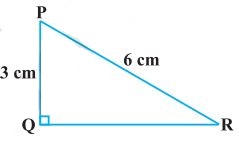
In \(\triangle PQR\), right-angles at Q, PQ = 3 cm and PR = 6 cm. Determine \(\angle QPR\) and \(\angle PRQ\).
20.
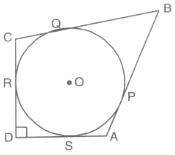
In the figure, \(\angle ADC={ 90 }^{ \circ }\), BC = 38 cm, CD = 28 cm and BP = 25 cm. Find the radius of the circle.
21.
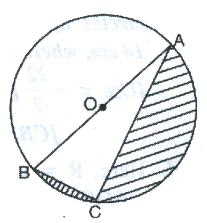
In figure, AC=24cm, BC=10cm and O is the centre of the circle.Find the area of the shaded region.[Use \(\pi\)=3.14]
22.
Seaweed is found under 80 m deep seafloor. To reach it, a diver makes a 45° dive from a boat. What is the distance travelled by the diver to reach the seafloor?
80 m
80.2 m
80√2 m
80√3 m
23.
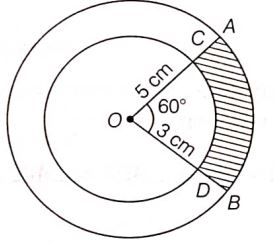
In the given figure, two concentric circles of radii 5 cm and 3 cm have their centre O. OAB is a sector of outer circle making an angle of 60° at the centre while OCD is the sector of smaller Circle. The area of the shaded region is
\(\frac{7 \pi}{2} \mathrm{~cm}^2\)
\(\frac{8 \pi}{3} \mathrm{~cm}^2\)
\(\frac{25 \pi}{6} \mathrm{~cm}^2\)
\(\frac{3 \pi}{2} \mathrm{~cm}^2\)
24.
If for a distribution \(\sum_1^n f_i x_i=132+5 p, \sum_1^n f_i=20\) and mean of the distribution is 8.1, then the value of p is
3
6
4
5
25.
Let A, B and C are three points on a circle. The tangent at C meets BA produced at T. Given that, ∠ATC = 36° and ∠ACT = 48°. Calculate the angle sub tended by AB at the centre of the circle.
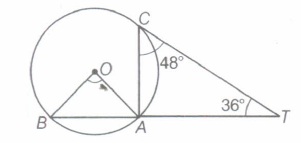
36\(\unicode{xb0} \)
48\(\unicode{xb0} \)
84\(\unicode{xb0} \)
96\(\unicode{xb0} \)
26.
If \(m=a \cos ^{3} \theta+3 a \cos \theta \sin ^{2} \theta \text { and } n=a \sin ^{3} \theta\) \(+3 a \cos ^{2} \theta \sin \theta\) , \((m+n)^{2 / 3}+(m-n)^{2 / 3}\) is equal to
\(2 a^{2 / 3}\)
\(a^{2 / 3}\)
\(2 a^{3 / 2}\)
\(a^{3 / 2}\)
27.
Tangents AP and AO are drawn to circle with centre 0 from an external point A, then \(\angle P A Q\) is equal to
\(2 \angle O P Q\)
\(\frac{\angle O P Q}{2}\)
\(\frac{\angle O P Q}{3}\)
\(\frac{\angle O P Q}{4}\)
28.
(sec A + tan A) (1 – sin A) =
sec A
sin A
cosec A
cos A
29.
What is the empirical relationship between the three measures of central tendency?
3 Mean = Mode + 2 Median
3 Median = Mode + 2 Mean
3 Median = 2Mode + Mean
3 Mean = 2Mode + Median
30.
| Expenditure | 0-10 | 10-20 | 20-30 | 30-40 | 40-50 |
| No of famileis | 14 | 23 | 27 | 21 | 15 |
What is the mode of the given data
24
22
25
21
31.
Median of the data represented below is

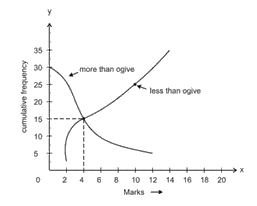
3
Less than 4
4
Between 2-4
32.
| Expendicture | 0-10 | 10-20 | 20-30 | 30-40 | 40-50 |
| No. of families | 14 | 23 | 27 | 21 | 15 |
What is the mode of the given data?
25
27
22
21
33.
If a cosθ + b sinθ = 4 and a sinθ – b cosθ = 3, then a2 + b2 is
12
None
25
7
34.
If cos (40° + A) = sin 30°, the value of A is
40°
30°
60°
20°
35.
If sin 3θ = cos(θ – 60) where θ and (θ – 6) are acute angles, the value of θ is
60°
24°
30°
90°
36.
ABCD is a square of side 10 cm. The area of the shaded region will be
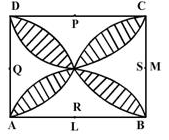
80 cm2
57 cm2
75 cm2
60 cm2
37.
A pendulum swings through an angle of 300 and describes an arc 8.8cm in length. The length of the pendulum is
17 cm
8.8 cm
15.8 cm
16.8 cm
38.
A man on a top of a tower observes a truck at an angle of depression α where tanα = 1/ √5 and sees that it is moving towards the base of the tower. Ten minutes later, the angle of depression of the truck is found to be β where tan β = √5 . If the truck is moving at a uniform speed, then how much more time it will take to reach the base of the tower.
150√5 sec
1500 sec
150 sec
150/ √5 sec
39.
An electrician has to repair an electric fault on a pole of height 4 m. He needs to reach a point 1.3 m below the top of the pole to undertake the repair work. The length of the ladder he should use which when inclined at an angle of 60° to the horizontal would enable him to reach the required position is:
\(\frac { 9\sqrt { 3 } }{ 5 } \)m
\(\frac { 5 }{ 9 } \)m
\(\frac { \sqrt { 3 } }{ 5 } \)m
\(\frac { 9 }{ 5 } \)m
40.
Assertion : In the given figure, AP and AO are tangents to a circle such that AP = 11cm and \(\angle P A Q=60^{\circ}\), then length of PQ is 8 cm.
Reason : The centre of the circle lies on the bisector of the angle between the two tangents.
Codes :
(a) If both Assertion and Reason are correct and Reason is the correct explanation of Assertion.
(b) If both Assertion and Reason are correct, but Reason is not the correct explanation of Assertion.
(c) If Assertion is correct but Reason is incorrect.
(d) If Assertion is incorrect but Reason is correct.
41.
Assertion In right triangle ABC and DEF\(\left(\angle C=\angle F=90^{\circ}\right), \angle B \text { and } \angle E\) are acute angles, such that sin B = sin E, then \(\angle B=\angle E\)
Reason \(\Delta A B C \sim \Delta D E F\)
Codes:
(a) If both Assertion and Reason are correct and Reason is the correct explanation of Assertion.
(b) If both Assertion and Reason are correct, but Reason is not the correct explanation of Assertion.
(c) If Assertion is correct but Reason is Incorrect.
(d) If Assertion is incorrect but Reason is correct
42.
The COVID-19 pandemic also known as coronavirus pandemic, is an ongoing pandemicof coronavirus disease caused by the transmission of severe acute respiratory syndrome corona virus 2 (SARS-CoV-2) among humans.
The following tables shows the age distribution of case admitted during a day in two different hospitals
Table 1
| Age (in years) | 5-15 | 15-25 | 25-35 | 35-45 | 45-55 | 55-65 |
| Number of cases | 6 | 11 | 21 | 23 | 14 | 5 |
Table 2
| Age (in years) | 5-15 | 15-25 | 25-35 | 35-45 | 45-55 | 55-65 |
| Number of cases | 8 | 16 | 10 | 42 | 24 | 12 |
Refer to Table 1
(i) The average age for which maximum cases occurred is
(a) 32.24 (b) 34.36 (c) 36.82 (d) 42.24
(ii) The upper limit of modal class is
(a) 15 (b) 25 (c) 35 (d) 45
(iii) The mean of the given data is
(a) 26.2 (b) 32.4 (c) 33.5 (d) 35.4
Refer to Table 2
(iv) The mode of the given data is
(a) 41.4 (b) 48.2 (c) 55.3 (d) 64.6
(v) the median of the given data is
(a) 32.7 (b) 40.2 (c) 42.3 (d) 48.6
43.
In an international school in Hyderabad organised an Interschool Throwball Tournament for girls just after the pre-board exam. The throw ball team was very excited. The team captain Anjali directed the team to assemble in the ground for practices. Only three girls Priyanshi, Swetha and Aditi showed up. The rest did not come on the pretext of preparing for pre-board exam. Anjali drew a circle of radius 5 m on the ground. The centre A was the position of Priyanshi. Anjali marked a point N, 13 m away from centre A as her own position. From the point N, she drew two tangential lines NS and NR and gave positions S and R to Swetha and Aditi. Anjali throws the ball to Priyanshi, Priyanshi throws it to Swetha, Swetha throws it to Anjali, Anjali throws it to Aditi, Aditi throws it to Priyanshi, Priyanshi throws it to Swetha and so on.
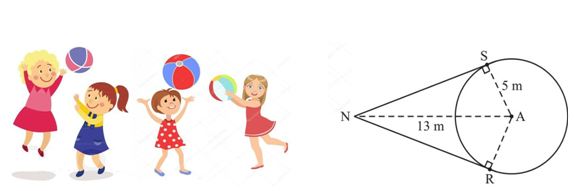
(a) What is the measure of \(\angle \mathrm{NSA} ?\)
| (i) 30o | (ii) 45o | (iii) 60o | (iv) 90o |
(b) Find the distance between Swetha and Anjali
| (i) 8m | (ii) ) 12 m | (iii) 15m | (iv) 18m |
(c) How far does Anjali have to throw the ball towards Aditi
| (i) 18m | (ii) 15m | (iii) 12m | (iv) 8m |
(d) If \(\angle \mathrm{SNR}\) is equal to θ, then which of the following is true?
| (i) \(\angle \mathrm{ANS}=90^{\circ}-\theta\) | (ii) \(\angle \mathrm{SAN}=90^{\circ}-\theta\) | (iii) \(\angle \operatorname{RAN}=\theta\) | (iv) \(\angle \operatorname{RAS}=180^{\circ}-\theta\) |
(e) If \(\angle \mathrm{SNR}\) SNR is equal to \(\theta\) ,then \(\angle \mathrm{NAS}\) is equal
| (i) \(90^{\circ}-(\theta / 2)\) | (ii) \(1180^{\circ}-2 \theta\) | (iii) \(90^{\circ}-\theta\) | (iv) \(90^{\circ}+\theta\) |
44.
Teewan, Arun and Pankaj were celebrating the festival of Diwali in open ground with firecrackers. There is a pedestal in the ground. All of sudden Teewan stands on pedestal and release sky lantern from the top of pedestal.
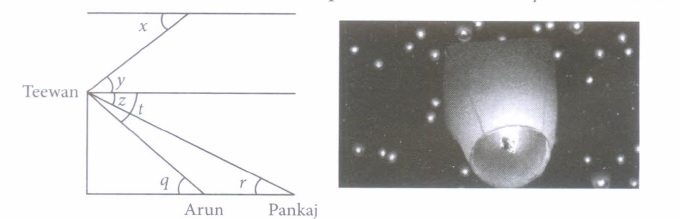
Based on the above information answer the following questions. (Take \(\sqrt{3}\) = J .73)
(i) Which one is a pair of angle of depression?
| \((a) (\angle x, \angle y)\) | \((b) (\angle y, \angle z)\) | \((c) (\angle z, \angle t)\) | \((d) (\angle r, \angle q)\) |
(ii) If the position of Pankaj is 25 m away from the base of pedestal and Zr = 30°, then find the height of pedestal.
| (a) 14.45m | (b) 15.5m | (c) 16.36m | (d) 17.36m |
(iii) If the height of pedestal is 30 m, \(\angle\)t = 45° and \(\angle\)z = 30°, then the horizontal distance between Arun and Pankaj is
| (a) 24.5 m | (b) 19.5 m | (c) 20 m | (d) 21.9 m |
(iv) If the vertical height of sky lantern from the top of pedestal is 12 m and \(\angle\)y = 30°, then distance between Teewan and sky lantern is
| (a) 20 m | (b) 16.97 m | (c) 24 m | (d) 19.86 m |
(v) If \(\angle\)q = 60° and position of Arun is 15 m away from the base of pedestal, then find the height of pedestal.
| (a) 16.25 m | (b) 25 m | (c) 25.95 m | (d) 26 m |
1.
\(L.H.S=\left( \sin { \theta } +cosec\theta \right) ^{ 2 }+\left( \cos { \theta } +\sec { \theta } \right) ^{ 2 }\)
\(=\sin ^{ 2 }{ \theta } +{ cosec }^{ 2 }\theta +2\sin { \theta } cosec\theta +\cos ^{ 2 }{ \theta } +\sec ^{ 2 }{ \theta } +2\cos { \theta } \sec { \theta } \)
\(=\left( \sin ^{ 2 }{ \theta } +\cos ^{ 2 }{ \theta } \right) +{ cosec }^{ 2 }\theta +2\sin { \theta } \times \frac { 1 }{ \sin { \theta } } +\sec ^{ 2 }{ \theta } +2\cos { \theta } \times \frac { 1 }{ \cos { \theta } } \)
\(=1+\left( 1+\cot ^{ 2 }{ \theta } \right) +2+\left( 1+\tan ^{ 2 }{ \theta } \right) +2\)
\(=7+\tan ^{ 2 }{ \theta } +\cot ^{ 2 }{ \theta } \)
= R.H.S
2.
(i) Let the assumed mean, A = 1400 and h = 400
Calculation of Mean
| Height (in m) x1 | No. of Villages fi | D = x1-1400 | \({ u }_{ i }=\frac { { x }_{ i }-1400 }{ 400 } \) | fiui |
| 200 | 142 | -1200 | -3 | -426 |
| 600 | 265 | -800 | -2 | -530 |
| 1000 | 560 | -400 | -1 | -560 |
| 1400 | 271 | 0 | 0 | 0 |
| 1500 | 89 | 400 | 1 | 89 |
| 2200 | 16 | 800 | 2 | 32 |
| Total | \(N=\sum { f_{ i } } =1343\) | \(\sum { f_{ i } }{ u_{ i } } =-1395\) |
We have A = 1400, h = 400, \(\sum { f_{ i } }{ u_{ i } }\) = -1395 and N = 1343
Mean = A + \(h\left\{ \frac { 1 }{ N } \sum { f_{ i } } { u }_{ i } \right\} \)
= 1400 + 400\(\times\) \(\left( \frac { -1395 }{ 1343 } \right) \)
= 1400 - 415.49 = 984.51
(ii) Mean by assumed mean method.
(iii) Villages are necessary to keep a balance in nature.
3.
It can be observed from the given data that the maximum class frequency is 40, belonging to 1500 − 2000 intervals.
Therefore, modal class = 1500 − 2000
Lower limit (l) of modal class = 1500
Frequency (f1) of modal class = 40
Frequency (f0) of class preceding modal class = 24
Frequency (f2) of class succeeding modal class = 33
Class size (h) = 500
\(\text { Mode }=l+\left(\frac{f_{1}-f_{0}}{2 f_{1}-f_{0}-f_{2}}\right) \times h \)
\(=1500+\left(\frac{40-24}{2(40)-24-33}\right) \times 500 \)
\(=1500+\left(\frac{16}{80-57}\right) \times 500\)
=1500+8000/23
Therefore, modal monthly expenditure was Rs 1847.83.
To find the class mark, the following relation is used.
\(Class mark =\frac{\text { Upper class limit + Lower class limit }}{2}\)
Class size (h) of the given data = 500
Taking 2750 as assumed mean (a), di, ui, and fiuiare calculated as follows
Taking 2750 as assumed mean (a), di, ui, and fiuiare calculated as follows.
| Expenditure (in Rs) |
Number of families fi |
xi | di = xi − 2750 | ui = di /500 | fiui |
| 1000- 1500 | 24 | 1250 | -1500 | -3 | -72 |
| 1500-2000 | 40 | 1750 | -1000 | -2 | -80 |
| 2000-2500 | 33 | 2250 | -500 | -1 | -33 |
| 2500-3000 | 28 | 2750 | 0 | 0 | 0 |
| 3000-3500 | 30 | 3250 | 500 | 1 | 30 |
| 3500-4000 | 22 | 3750 | 1000 | 2 | 44 |
| 4000-4500 | 16 | 4250 | 1500 | 3 | 48 |
| 4500-5000 | 7 | 4750 | 2000 | 4 | 28 |
| Total | 200 | -35 |
From the table, we obtain
\(\sum f_{i}=200 \)
\(\sum f_{i} u_{i}=-35 \)
\(\text { Mean } \bar{x}=a+\left(\frac{\sum f_{i} u_{i}}{\sum f_{i}}\right) x h \)
\(\bar{x}=2750+\left(\frac{-354}{200}\right) \times 500\)
= 2750 - 87.5
= 2662.5
Therefore, mean monthly expenditure was Rs 2662.50.
4.
1732m
5.
Let BC = x m be the width of the canal and AB = h m be the height of the tower.
Given, \(\angle\)ACB = 60\(\unicode{xb0} \) and \(\angle\)ADB = 30\(\unicode{xb0} \)
In right angled \(\Delta\)ABD,
\(\tan 30^{\circ}=\frac{P}{B}=\frac{A B}{D B}\)
\(\Rightarrow \quad \frac{1}{\sqrt{3}}=\frac{h}{D C+C B}\)

\(\left[\because \tan 30^{\circ}=\frac{1}{\sqrt{3}} \text { and } D B=D C+C B\right]\)
\(\Rightarrow \quad \frac{1}{\sqrt{3}}=\frac{h}{20+x} \Rightarrow 20+x=\sqrt{3} h\) ...(i)
and in right angled \(\Delta\)ABC,
\(\tan 60^{\circ}=\frac{A B}{B C} \Rightarrow \sqrt{3}=\frac{h}{x} \quad\left[\because \tan 60^{\circ}=\sqrt{3}\right]\)
\(\Rightarrow \quad h=\sqrt{3} x\) ..(ii)
On putting h = \(\sqrt{3}\)x in Eq. (i), we get
20 + x = \(\sqrt{3}\) (\(\sqrt{3}\)x)
\(\Rightarrow\) 20 + x = 3x
\(\Rightarrow\) 2x = 20 \(\Rightarrow\) x = 10 m
On putting x = 10 m in Eq. (ii), we get h = \(\sqrt{3}\)(10)
\(\Rightarrow\) h = 10\(\sqrt{3}\) m
Hence, the height of the tower is 10\(\sqrt{3}\) m and width of the canal is 10 m.
6.
Let PQ and PR be two tangents drawn from an external point P to a circle with centre O.
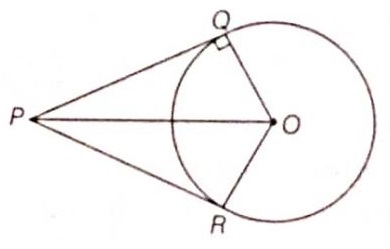
To prove \(\angle\)QOR = 180° – \(\angle\)QPR
or \(\angle\)QOR + \(\angle\)QPR = 180°
Proof In \(\Delta\)OQP and \(\Delta\)ORP,
PQ = PR [\(\because\) tangents drawn from an external point are equal in length]
OQ = OR [radii of circle]
OP = OP [common sides]
\(\therefore\) \(\Delta\)OQP \(\cong\) \(\Delta\)ORP [by SSS congruence rule]
Then, \(\angle\)QPO = \(\angle\)RPO [by CPCT]
and \(\angle\)POQ = \(\angle\)POR [by CPCT]
\(\left.\begin{array}{ll} \Rightarrow & \angle Q P R=2 \angle O P Q \\ \text { and } & \angle Q O R=2 \angle P O Q \end{array}\right\}\) ...(i)
Now, in right angled \(\Delta\)OQP, \(\angle\)QPO + \(\angle\)QOP = 90°
\(\Rightarrow\) \(\angle\)QOP = 90° - \(\angle\)QPO
\(\Rightarrow\) 2\(\angle\)QOP = 180°- 2 \(\angle\)QPO
[multiplying both sides by 2]
\(\Rightarrow\) \(\angle\)QOR = 180° - \(\angle\)QPR [from Eq. (i)]
\(\Rightarrow\) \(\angle\)QOR + \(\angle\)QPR = 180° Hence proved.
7.
Let original total expenditure of mess was Rs x
\(\Rightarrow\) Average expenditure per student = Rs \({ { x}\over{ 35} }\)
New expenditure of mess = Rs x + 42
Average expenditure per student = \({ { x+42 }\over{42 } }={ {x }\over{42 } }+1\)
\(\Rightarrow\) \({ { x}\over{ 42} }+1={ { x}\over{ 35} }-1\Rightarrow1+1={ { x}\over{35 } }-{ {x }\over{ 42} }\)
\(\Rightarrow\) 2 = \({ {6x-5x }\over{ 210} }\Rightarrow x=420\)
Original expenditure of mess was Rs 420
8.
From the triangle ABC
\({h\over 28.2}=tan60^0\)
h = 28.2 x tan 60°
= 28.2 x \(\sqrt3\)
= 28.2\(\sqrt3\) + 1.2m
Height ofthe tower = AC+CD
= 50 m
9.
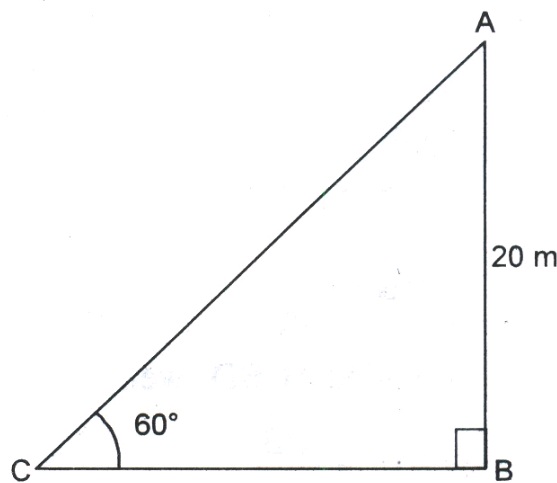
Let AB = 20 m be the height of tower. Let the ball lying on the ground at point C.
∴ ㄥACB = 60\(\unicode{xb0} \)
Consider rt. angled ΔABC, we have
\(\frac { AB }{ AC } \) = tan 60\(\unicode{xb0} \)
\(\frac { 20 }{ BC } =\sqrt { 3 } \)
⇒ BC = \(\frac { 20 }{ \sqrt { 3 } } =\frac { 20\sqrt { 3 } }{ 3 } \)
=\(\frac { 20\times 1.73 }{ 3 } \)
=11.53 m.
∴ The distance between the foot of the tower and the ball is 11.53 m.
10.
Area of sector OCDE \(=\frac{60^{\circ}}{360^{\circ}} \pi r^{2}\)
\(\begin{array}{l} =\frac{1}{6} \times \frac{22}{7} \times 6 \times 6 \\ =\frac{132}{7} \mathrm{~cm}^{2} \end{array}\)
Area of triangle OAB \(=\frac{\sqrt{3}}{4}(12)^{2}=\frac{\sqrt{3} \times 12 \times 12}{4}=36 \sqrt{3} \mathrm{~cm}^{2}\)
Area of circle \(=\pi r^{2}=\frac{22}{7} \times 6 \times 6=\frac{792}{7} \mathrm{~cm}^{2}\)
Area of shaded region = Area of ΔOAB + Area of circle − Area of sector OCDE
\(\begin{array}{l} =36 \sqrt{3}+\frac{792}{7}-\frac{132}{7} \\ =\left(36 \sqrt{3}+\frac{660}{7}\right) c m^{2} \end{array}\)
11.
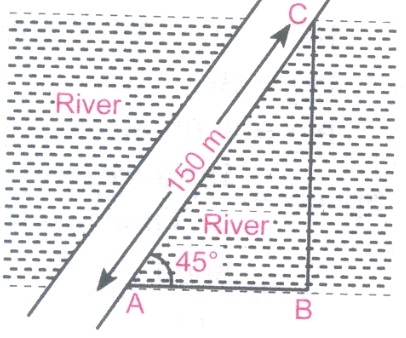
In given figure,
sin 45o = \(\frac { BC }{ AC } \Rightarrow \frac { 1 }{ \sqrt { 2 } } =\frac { BC }{ 150 } \)
BC = \(\frac { 150 }{ \sqrt { 2 } } =75\sqrt { 2 } \)m
12.
Given, umbrella to be a flat circle. So, the central angle of an umbrella is 360°.
Since, umbrella has 8 ribs.
\(\therefore\) Angle between two ribs.
\(=\frac{360^{\circ}}{8}=45^{\circ}\)
Area between two ribs = Area of one sector of the umbrella
\(=\frac{\theta}{360^{\circ}} \times \pi r^2=\frac{45^{\circ}}{360^{\circ}} \times \frac{22}{7} \times(45)^2[\because r=45, \text { given }]\)
\(\begin{aligned} & =\frac{22}{7 \times 8}(45)^2 \\ \end{aligned}\)
\(\begin{aligned} & =\frac{22275}{28} \mathrm{~cm}^2 \end{aligned}\)
13.
Join OL
OL RS
Also OL = OM [Radii of the same circle]
ஃ
⇒
14.
Speed of ship \(=36 \mathrm{~km} / \mathrm{h}\)
Time taken \(=2 \mathrm{~min}\)
Therefore Distance covered by ship in \(2 \mathrm{~min}=36 \times \frac{2}{60}=1.2 \mathrm{~km}\)
Distance of ship from foot of lighthouse =1.3-1.2
\(=0.1 \mathrm{~km} =100 \mathrm{~m}\)
Let angle of elevation of the ship to the top of the lighthouse \(=y^{\circ}\)
Then, \(\tan y=\frac{173.2}{100}=1.732\)
\(\Rightarrow \quad \tan y=\sqrt{3} {[\because 1.732=\sqrt{3}]} \)
\( \Rightarrow \quad y=60^{\circ} \)
\({\left[\because \tan \sqrt{3}=\tan 60^{\circ}\right]}\)
Now, \(y=x^{\circ} \quad[\because\) alternate interior angles are equal ]
Thus, \(x^{\circ}=60^{\circ}\)
15.
| Weight (in Kg) | Number of persons (cumulative frequency) |
| Less than 45 | 4 |
| Less than 50 | 4 + 4 = 8 |
| Less than 55 | 8 + 13 = 21 |
| Less than 60 | 21 = 5 = 26 |
| Less than 65 | 26 + 6 = 32 |
| Less than 70 | 32 + 5 = 37 |
| Less than 75 | 37 + 2 = 39 |
| Less than 80 | 39 + 1 = 40 |
16.
\(\frac { \sec ^{ 2 }{ \left( { 90 }^{ ° }-\theta \right) -\cot ^{ 2 }{ \theta } } }{ 2\left( \sin ^{ 2 }{ { 25 }^{ ° } } +\sin ^{ 2 }{ { 65 }^{ ° } } \right) } -\frac { 2\cos ^{ 2 }{ { 60 }^{ ° }\tan ^{ 2 }{ { 28 }^{ ° }\tan ^{ 2 }{ { 62 }^{ ° } } } } }{ 3\left( \sec ^{ 2 }{ { 43 }^{ ° } } -\cot ^{ 2 }{ { 47 }^{ ° } } \right) } \)
\(=\frac { \left( { cosec }^{ 2 }\theta -\cot ^{ 2 }{ \theta } \right) }{ 2\left( \sin ^{ 2 }{ { 25 }^{ ° } } +\cos ^{ 2 }{ { 25 }^{ ° } } \right) } -\frac { 2\times \frac { 1 }{ 2 } \times \frac { 1 }{ 2 } \tan ^{ 2 }{ { 28 }^{ ° } } \times \cot ^{ 2 }{ { 28 }^{ ° } } }{ 3\left[ \sec ^{ 2 }{ { 43 }^{ ° } } -\tan ^{ 2 }{ { 43 }^{ ° } } \right] } \)
\(=\frac { 1 }{ 2\times \left( 1 \right) } -\frac { \frac { 1 }{ 2 } \times \tan ^{ 2 }{ { 28 }^{ ° }\times \frac { 1 }{ \tan ^{ 2 }{ { 28 }^{ ° } } } } }{ 3 } \)
\(=\frac{1}{2}-\frac{1}{6}=\frac{1}{3}\)
17.
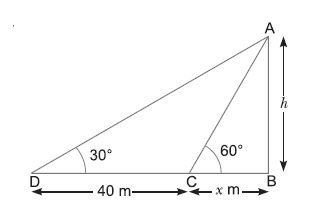
Let the height be 'h' m and breadth be 'b' m.
In \(\Delta ABC\),
\(\frac { h }{ b } =tan60°=\sqrt { 3 } \)
h=\(\sqrt { 3 } b\)
In \(\Delta ABD\), \(\frac { h }{ b+20 } =tan30°=\frac { 1 }{ \sqrt { 3 } } \)
h=\(\frac { b+20 }{ \sqrt { 3 } } \)
b\(\sqrt { 3 } \)=\(\frac { b+20 }{ \sqrt { 3 } } \)
3b = b + 20 => 2b = 20 => b = 10m
h=b\(\sqrt { 3 } \)=10 x 1.73=17.3 m
Height of tree is 17.3m and breadth of river is 10m.
18.
| Expenditure | f (families) | c.f |
| 0-1000 | 150 | 150 |
| 1000-2000 | 200 | 350 |
| 2000-3000 | 75 | 425 |
| 3000-4000 | 60 | 485 |
| 4000-5000 | 15 | 500 |
| \(\Sigma f=500\) |
N=500, \(\frac { N }{ 2 } =250\)
Median class = 1000-2000
Median = l + \(\frac { \frac { N }{ 2 } -c.f }{ f } \times h\)
\(=1000+\frac { 250-150 }{ 200 } \times 1000\)
=1000+500=1500
Median Expenditure = Rs 1500 /week
19.
Given PQ = 3 cm and PR = 6 cm.
Therefore, \(\begin{aligned} \frac{\mathrm{PQ}}{\mathrm{PR}} & =\sin \mathrm{R} \\ \end{aligned}\)
or \(\begin{aligned} \sin \mathrm{R} & =\frac{3}{6}=\frac{1}{2} \\ \end{aligned}\)
So, \(\begin{aligned} \angle \mathrm{PRQ} & =30^{\circ} \\ \end{aligned}\)
and therefore, \(\begin{aligned} \angle \mathrm{QPR} & =60^{\circ} \end{aligned}\)
You may note that if one of the sides and any other part (either an acute angle or any side) of a right triangle is known, the remaining sides and angles of the triangle can be determined.
20.
Join OR and OS and let r be the radius of circle
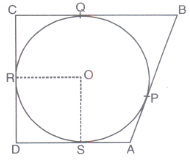
BC = 38 cm, CD = 28 cm
BP 25 cm = BQ [tangent from external point]
CQ = BC- BQ = 38 - 25= 13 cm
∴ CR = CQ 13 cm
RD = CD - CR = 28 -13 = 15 cm
Quad. DROS is a square (3 angles are 90°)
∴ r = DR = 15 cm
21.
Here, AC = 24 cm, BC = 10 cm and AOB is a diameter.
Since angle in semicircle is a right angle i.e., \(\angle \)ACB = 90°
ஃ AB = \(\sqrt{AC^2+BC^2}\)
= \(\sqrt{24^2+10^2}\) = \(\sqrt{576+100}\)
= \(\sqrt{676}\) = 26 cm
ஃ RAdius, area of circle = \(26\over2\) = 13 cm
Now, Area of semicircle
= Area of semicircle - Area of \(\triangle\)ABC
= \(1\over2\)\(\pi\)r2 - \(1\over2\) x BC x BC
= \(1\over2\) x 3.14 x 13 x 13 - \(1\over2\) x 24 x 10
= \(530.66\over2\) - 120
= 265.33 - 120 = 145.33 cm2
22.
(c)
80√2 m
23.
(b)
\(\frac{8 \pi}{3} \mathrm{~cm}^2\)
24.
(b)
6
25.
(d)
96\(\unicode{xb0} \)
26.
(a)
\(2 a^{2 / 3}\)
27.
(a)
\(2 \angle O P Q\)
28.
(d)
cos A
29.
(b)
3 Median = Mode + 2 Mean
30.
(a)
24
31.
(c)
4
32.
(b)
27
33.
(c)
25
34.
(d)
20°
35.
(b)
24°
36.
(b)
57 cm2
37.
(d)
16.8 cm
38.
(c)
150 sec
39.
(a)
\(\frac { 9\sqrt { 3 } }{ 5 } \)m
40.
If Assertion is incorrect but Reason is correct.
41.
(a) If both Assertion and Reason are correct and Reason is the correct explanation of Assertion.
42.
(i) (c) From table, we see that maximum frequency is 23.Therefore, modal class is 35-45.
Here, l=35, f1 = 23, f0 = 21, f2 = 14 and h = 10
\(\begin{aligned} \therefore \text { Mode } & =l+\frac{f_1-f_0}{2 f_1-f_0-f_2} \times h \\ \end{aligned}\)
\(\begin{aligned} & =35+\frac{23-21}{46-21-14} \times 10 \\ \end{aligned}\)
\(\begin{aligned} & =35+\frac{20}{11}=35+1.82=36.82 \end{aligned}\)
(ii) (d) Since, class interval 35-45 has highest frequency i.e. 23, So it is modal class.
\(\therefore\) Upper limit of modal class is 45.
(iii) (d) Calculation of mean
| Class interval | Frequency (f1) | Class marks (xi) | fixi |
| 5-15 | 6 | 10 | 60 |
| 15-25 | 11 | 20 | 220 |
| 25-35 | 21 | 30 | 630 |
| 35-45 | 23 | 40 | 920 |
| 45-55 | 14 | 50 | 700 |
| 55-65 | 5 | 60 | 300 |
| Total | \(\Sigma\)fi = 80 | \(\Sigma f_i x_i=2830\) |
\(\therefore\) \(\text { Mean, } \bar{x}=\frac{\Sigma f_i x_i}{\Sigma f_i}=\frac{2830}{80}=35.375=35.4\)
(iv) (a) Here, maximum frequency is 42 and the class corresponding to this frequency is 35 – 45. So, the modal class is 35-45.
\(\therefore\) l = 35, f1 = 42, f0 = 10, f2 = 24 and h = 10
Now, mode = \(\begin{aligned} & =l+\left(\frac{f_1-f_0}{2 f_1-f_0-f_2}\right) \times h \\ \end{aligned}\)
\(\begin{aligned} & =35+\frac{42-10}{2 \times 42-10-24} \times 10 \\ \end{aligned}\)
\(\begin{aligned} & =35+\frac{32}{50} \times 10=35+6.4=41.4 \end{aligned}\)
(v) (b) The cumulative frequency table for given data is
| Age | Number of cases (fi) | Cumulative frequency (cf) |
| 5-15 | 8 | 8 |
| 15-25 | 16 | 24 |
| 25-35 | 10 | 34 |
| 35-45 | 42 | 76 |
| 45-55 | 24 | 100 |
| 55-65 | 12 | 112 |
| Total | N = 112 |
Here, N = 112
\(\therefore \quad \frac{N}{2}=\frac{112}{2}=56\)
Since, the cumulative frequency just greater that 56 is 76 and the corresponding class interval is 35-45.
\(\therefore\) Median class = 35 - 45,
l = 35, cf = 34, h = 10 and f = 42
\(\begin{aligned} \therefore \text { Median } & =l+\frac{\left(\frac{N}{2}-f\right)}{f} \times h=35+\frac{56-34}{42} \times 10 \\ \end{aligned}\)
\(\begin{aligned} & =35+\frac{22}{42} \times 10=35+5.24=40.24 \end{aligned}\)
43.
(a) (iv) NS and NR are both tangent to the circle
So, \(N S \perp S A\) and \(N R \perp R A\)
[ \(\therefore\) Tangent to a circle is perpendicular to the radius through the point of contact ]
\(\therefore \angle N S A=90^{\circ}\)
(b) (ii)
\(\angle N S A=90^{\circ} \quad \Rightarrow N A^{2}=N S^{2}+S A^{2}\) [ By Pythagora's Theorem]
\(\Rightarrow N S=\sqrt{N A^{2}-S A^{2}}=\sqrt{13^{2}-5^{2}}=\sqrt{169-25}\)
\(=\sqrt{144}=12 \mathrm{~m}\)
(c) (iiii)
NR = NS = 12m
Tangents drawn from an external point are equal
\(\therefore N R=12 \mathrm{~m}\)
(d) (iv)
\(\angle S N R+\angle R A S=180^{\circ} \Rightarrow \angle R A S=180^{\circ}-\angle S N R\)
[\(\because\) The angle between the two tangents drawn from an external point to a circle is supplementary to the angle subtended by the line segments joining the points of contact to the centre]
\(\Rightarrow \angle R A S=180^{\circ}-\theta\)
(e) (i)
\(\angle R A S=180^{\circ}-\theta\) [ Calulated bove]
Now, \(\angle N A S=\angle N A R=\frac{1}{2} \angle R A S\)
[\(\because\) If two tangents are drawn from an external point, then they extend equal angles at the centre]
\(\Rightarrow \angle N A S=\frac{1}{2}\left(180^{\circ}-\theta\right)=90^{\circ}-\frac{\theta}{2}\)
44.
(i) (c)
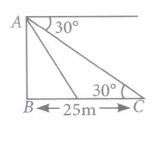
(ii) (a): Let AB be the height of pedestal.
\(\text { In } \Delta A B C, \)
\(\tan 30^{\circ}=\frac{A B}{B C} \)
\(\Rightarrow \quad A B=\frac{25}{\sqrt{3}}=\frac{25}{1.73}=14.45 \mathrm{~m}\)
(iii) (d): Let x be the distance between Arun and Pankaj.
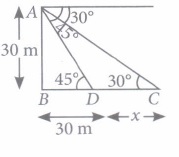
\(\text { In } \Delta A B \dot{D}, \tan 45^{\circ}=\frac{A B}{B D}\)
\(\Rightarrow B D=30 \mathrm{~m}\)
\(\text { Now, in } \Delta \overline{A B C} \text { , }\)
\(\tan 30^{\circ}=\frac{A B}{B C}\)
\(\Rightarrow \frac{30}{30+x}=\frac{1}{\sqrt{3}}\)
\(\Rightarrow x=30(\sqrt{3}-1)=30 \times 0.73=21.9 \mathrm{~m}\)
(iv) (c): \(\text { In } \triangle A R S\)
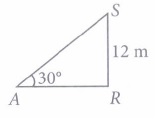
\(\sin 30^{\circ}=\frac{R S}{A S} \)
\(\Rightarrow \quad \frac{12}{A S} =\frac{1}{2} \Rightarrow A S=12 \times 2=24 \mathrm{~m}\)
(v) (c): \(\text { In } \Delta A B D, \frac{A B}{B D}=\tan 60^{\circ}\)
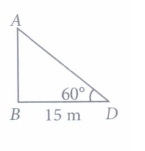
\(\begin{array}{l}
\Rightarrow \frac{A B}{15}=\sqrt{3} \\
\Rightarrow A B=15 \times 1.73=25.95 \mathrm{~m}
\end{array}\)

10th Standard CBSE Syllabus & Materials
10th Standard CBSE
CBSE 10th Social Science PS - Federalism - New Model Questions Papers Study Material - QB365 Set A
NEW10th Standard CBSE
CBSE 10th Social Science PS - Power Sharing - New Model Questions Papers Study Material - QB365 Set A
NEW10th Standard CBSE
CBSE 10th Social Science GEO - Manufacturing Industries - New Model Questions Papers Study Material - QB365 Set A
NEW10th Standard CBSE
CBSE 10th Social Science GEO - Minerals and Energy Resources - New Model Questions Papers Study Material - QB365 Set A



NCERT Books

Syllabus

Exam Pattern

Sample Question Papers

Previous year Question Papers

Important Notes

MCQ Practice test

NCERT Exemplers

Case study Questions

Image Based Questions

Passage based Questions

HOT Questions

Value Based Questions

Model Questions Papers
NCERT ( Book Back ) Questions

Assertion and Reason
Important Questions And Answers

CBSE 10th Standard CBSE Subjects
CBSE Standards



