
 100% FREE ACCESS
10th Standard CBSE Syllabus & Materials
10th Standard CBSE
CBSE 10th Social Science ECO - Globalisation and the Indian Economy - New Model Questions Papers Study Material - QB365 Set A
NEW10th Standard CBSE
CBSE 10th Social Science ECO - Money and Credit - New Model Questions Papers Study Material - QB365 Set A
NEW10th Standard CBSE
CBSE 10th Social Science ECO - Sectors of the Indian Economy - New Model Questions Papers Study Material - QB365 Set A
NEW10th Standard CBSE
CBSE 10th Social Science ECO - Development - New Model Questions Papers Study Material - QB365 Set A
NEW10th Standard CBSE
CBSE 10th Social Science PS - Outcomes of Democracy - New Model Questions Papers Study Material - QB365 Set A
NEW10th Standard CBSE
CBSE 10th Social Science PS - Gender, Religion and Caste - New Model Questions Papers Study Material - QB365 Set A

Published on: 22/10/2025
Download CBSE Class 10th Standard CBSE Maths question papers, sample papers, important questions, and previous year solved papers in PDF format. Get free study materials, NCERT solutions, and exam preparation resources for Class 10th Standard CBSE Maths
Questions + Answers key
Take MCQ Maths Test
1.
If \(\cos { \theta } +\sin { \theta } =p\) and \(\sec { \theta } +cosec\theta =q\), prove that q(p2 - 1) = 2p.
2.
A boat covers 32 km upstream and 36 km downs earn in 7 hours. Also, it covers 40 km upstream and 48 km downstream in 9 hours. Find the speed of the boat in still water and that of the stream.
3.
The length of the sides forming right angle of a right triangle are 5x cm and (3x - 1) cm. If the area of the triangle is 60 crrr2 , Find its hypotenuse.
4.
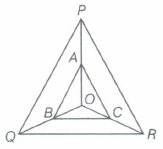
In the given figure, A, B and C are points on OP, OQ and OR respectively, such that \(AB\parallel PQ\) and \(AC\parallel PR\). Show that \(BC\parallel QR\).
5.
A vessel is in the form of a hemisphere bowl mounted by a hollow cylinder. The diameter of the hemisphere is 16 cm and the total of height of the vessel is 15 cm. Find the capacity of the vessel. \(\left[ take,\quad \pi =\frac { 22 }{ 7 } \right] \)
6.
Find the sum of the integers between 100 and 200 that is divisible by 9.
7.
Evaluate the following : sin 60° cos 30° + sin 30° cos 60°
8.
If in two triangles, sides of one triangle are proportional to (i.e., in the same ratio of ) the sides of the other triangle, then their corresponding angles are equal and hence the two triangles are similiar.
9.
Draw the graph of the pair of linear equation x-y+2=0 and 4x-y-4. Calculate the area of the triangle formed by the lines so drawn and the X-axis.
10.
If -4 is a root of the quadratic equation x2+px-4=0 and the equation 2x2+px+k=0 has equal roots, then find the value of k.
11.
A bucket is in the form of a frustum of cone. Its depth is 15 cm and the diameters of the top and the bottom are 56 cm and 42 cm respectively. Find how many litres of water can the bucket hold ?
12.
The sum of n terms of a sequence is 3n2 + 4n. Find the nth term and show that the sequence is an AP.
13.
If x = a , y = b is the solution of the equations x - y = 2 and x + y = 4, then find the values of Q and b.
14.
Prove that : \(\sqrt { \frac { 1-\cos { A } }{ 1+\cos { A } } } =cosecA-\cot { A } \)
15.
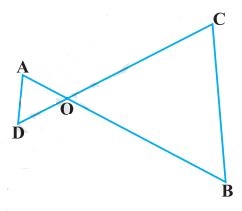
In the given figure, OA . OB = OC . OD. Show that \(\angle\)A = \(\angle\)C and \(\angle\)B = \(\angle\)D.
16.
Find, 100 is a term of the A.P. 25, 28, 31, or not.
17.
The perimeter of a right triangle is 60 cm. Its hypotenuse is 25 cm. Find the area of the triangle.
18.
How many metres of cloth 1m 10cm wide, will be required to make a conical circus tent whose height is 12m and the radius of whose base is 10m? Also determine the cost of the cloth at Rs.7 per m
19.
The common difference of the AP whose nth term is given by \(a_n=3 n+7\), is
7
3
3n
1
20.
Write the condition, when given quadratic equation has no real roots
b2 – 4ac = 0
b2 – 4ac > 0
Either A or C
b2 – 4ac < 0
21.
If cos (40° + A) = sin 30°, the value of A is
40°
30°
60°
20°
22.
Three numbers form a Pythagorean triplet. Two of them are 15 and 17 where 17 is the largest of them. The third number is
8
12
13
5
23.
If two lines are parallel to each other the system of equation is
Consistent dependent
Inconsistent
Inconsistent dependent
consistent
24.
If a solid, cone of base radius ‘r’ and height ‘h’ is placed over a solid cylinder having same base radius ‘r’ and height – ‘h’ as that of the cone, then the curved surface area of the shape is \(\pi \left( \sqrt { { h }^{ 2 }+r^{ 2 } } \right) +2\pi rh\) Is it true?
No
Yes
May be
Cannot be determined
25.
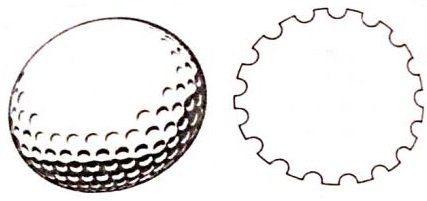
A golf ball is spherical with ab 300-500 dimples that help increase velocity while in play. Golf balls traditionally white but available in colo also. In the given figure, a golf ball diameter 4.2 cm and the surface has dimples (hemi-spherical) of radius 2 mm
Based on the above, answer the following questions
(i) Find the surface area of one such dimple.
(ii) Find the volume of the material dug out to make one dimple.
(iii) Find the total surface area exposed to the surroundings.
Or
Find the volume of the golf ball
26.
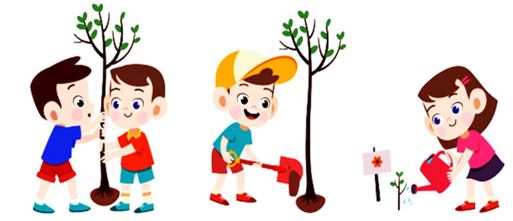
In a school, students thought of planting trees in and around the school to reduce air pollution. It was decided that each section of each class would plant twice as many plants as the class standard. There were 3 sections of each standard from 1 to 12. So, if there are three sections in class 1 say 1A, 1B and 1C, then each section would plant 2 trees. Similarly, each section of class 2 would plant 4 trees and so on. Thus, the number of trees planted by classes 1 to 12 formed an AP given by 6, 12, 18,...
(a) What is the common difference of the AP formed
| (i) 6 | (ii) 5 | (iii) 3 | (iv) 2 |
(b) What will be the nth term of the AP formed?
| (i) 5n | (ii) 6n | (iii) 5n+6 | (iv) 6n+6 |
(c) How many trees will be planted by the students of all the sections of class 8?
| (i) 42 | (ii) 48 | (iii) 54 | (iv) 60 |
(d) Find the total number of trees planted by class 12 students.
| (i) 54 | (ii) 72 | (iii) 66 | (iv) None of these |
(e) What will be the third term from the end of the AP formed?
| (i) 72 | (ii) 66 | (iii) 60 | (iv) 54 |
1.
Given : \(\cos { \theta } +\sin { \theta } =p\) and \(\sec { \theta } +cosec\theta =q\)
L.H.S = q(p2 - 1)
\(=\left( \sec { \theta } +cosec\theta \right) \left[ \left( \cos { \theta } +\sin { \theta } \right) ^{ 2 }-1 \right] \)
\(=\left( \sec { \theta } +cosec\theta \right) \left[ 1+2\sin { \theta } \cos { \theta } -1 \right] \)
\(=\left( \frac { 1 }{ \cos { \theta } } +\frac { 1 }{ \sin { \theta } } \right) \left( 2\sin { \theta } \cos { \theta } \right) \)
\(=\frac { \sin { \theta } +\cos { \theta } }{ \cos { \theta \sin { \theta } } } \times 2\sin { \theta } \cos { \theta } \)
\(=2\left( \sin { \theta } +\cos { \theta } \right) \)
= 2p
= R.H.S
2.
Let the speed of the boat be x km/hr and the speed of the stream be y km/hr.
According to the question,
\(\frac { 32 }{ x-y } +\frac { 36 }{ x+y } =7\)
and \(\frac { 40 }{ x-y } +\frac { 48 }{ x+y } =9\)
Let \(\frac { 1 }{ x-y } =A,\frac { 1 }{ x+y } =B,\)
32A + 36B = 7 ....(i)
and 40A + 48B = 9 .....(ii)
Multiply equation (i) by 40 and (ii) by 32 and substracting.
1280A + 1440B = 280
1280A + 1536B = 288
\(\underline { -\quad \quad - \quad \quad - } \)
-96 B = -8
\(B=\frac { 1 }{ 12 } \)
\(\therefore\) Substitute the value of B in (ii),
\(40A+48\left( \frac { 1 }{ 12 } \right) =9\)
\(\Rightarrow\) 40A + 4 = 9
\(\Rightarrow\) 40A = 5
\(\therefore\) \(A=\frac { 1 }{ 8 } \)
\(\therefore \quad A=\frac { 1 }{ 8 } \) and \(B=\frac { 1 }{ 12 } \)
Hence \(A=\frac { 1 }{ 8 } =\frac { 1 }{ x-y } \)
\(\Rightarrow\) x - y = 8 ....(iii)
and \(B=\frac { 1 }{ 12 } =\frac { 1 }{ x+y } \)
\(\Rightarrow\) x + y = 12 ....(iv)
Adding equations (i) and (ii),
2x = 20
\(\therefore\) x = 10
and Substituting this value of x in eqn.(i),
y = x - 8 = 10 - 8 = 2
Hence, the speed of the boat = 10 km/hr and speed of the stream = 2 km/hr.
3.
Area of triangle = \(\frac { 1 }{ 2 } \times 5x+(3x-1)\)
15x2-5x=120
\(\Rightarrow 3x^{ 2 }-x-24=0\)
\(\Rightarrow 3x^{ 2 }-9x8x-24=0\)
\(\Rightarrow 3x(x-3)+8(x-3)=0\)
\(\Rightarrow (x-3)(3x+8)=0\)
\(x=3,x=\frac { 8 }{ 3 } \)
Length can't be negative, so x = 3
AB = 15 cm, BC = 9 - 1
= 8cm
\(AC=\sqrt { 15^{ 2 }+8^{ 2 } } \)
\(=\sqrt { 225+64 } \)
\(=\sqrt { 289 } =17cm\)
4.
In \(\triangle OPQ\), \(AB\parallel PQ\) [given]
\(\therefore \quad \frac { OA }{ AP } =\frac { OB }{ BQ } \) ... (i)
[by basic proportionality theorem]
Also, in \(\triangle OPR\), \(AC\parallel PR\) [given]
\(\therefore \quad \frac { OA }{ AP } =\frac { OC }{ CR } \) ... (ii)
From Eqs. (i) and (ii),
\(\frac { OB }{ BQ } =\frac { OC }{ CR } \Rightarrow \quad BC\parallel QR\)
[by converse of basic proportionality theorem]
Hence proved.
5.
Capacity of the vessel = Volume of hemispherical bowl + Volume of the cylinder
= 2480.7619 cm3
6.
Numbers divisible by 9 between 100 and 200 are 108, 117, 126, ..., 198.
Here, a = 108, d = 9, an = 198
an = a + ( n - 1 )d \(\Rightarrow\) 198 = 108 + ( n - 1 )9
\(\Rightarrow\) 198 = 108 + 9n - 9 \(\Rightarrow\) 198 = 99 + 9n
\(\Rightarrow\) 198 - 99 = 9n \(\Rightarrow\) \({99\over9}\) = n \(\Rightarrow\) 11 = n
and Sn = \({n\over 2}[2a+(n-1)d]\)
S11 = \({11\over2}\) [ 2 X 10⁸ + ( 11 - 1 )9]
= \({11\over2}\) [ 216 + 90 ] = \({11\over2}\times306\) = 1683
7.
sin 60° cos 30° + sin 30° cos 60°
\(=\frac{\sqrt{3}}{2} \times \frac{\sqrt{3}}{2}+\frac{1}{2} \times \frac{1}{2}\)
\(\left[\because \sin 60^{\circ}=\cos 30^{\circ}=\frac{\sqrt{3}}{2} \text { and } \sin 30^{\circ}=\cos 60^{\circ}=\frac{1}{2}\right]\)
\(=\frac{3}{4}+\frac{1}{4}=\frac{3+1}{4}=\frac{4}{4}=1\)
8.
This criterion is referred to as the SSS (Side - Side - Side) similarity criterion for two triangles.
This theorem can be proved by taking two triangles ABC and DEF such that
\(\frac{\mathrm{AB}}{\mathrm{DE}}=\frac{\mathrm{BC}}{\mathrm{EF}}=\frac{\mathrm{CA}}{\mathrm{FD}}(<1)\)
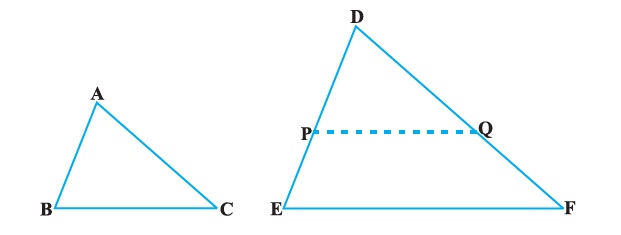
Cut DP = AB and DQ = AC and join PQ.
It can be seen that \(\frac{\mathrm{DP}}{\mathrm{PE}}=\frac{\mathrm{DQ}}{\mathrm{QF}} \text { and } \mathrm{PQ} \text { II EF }\)
So, ∠ P = ∠ E and ∠ Q = ∠ F.
Therefore, \(\frac{\mathrm{DP}}{\mathrm{DE}}=\frac{\mathrm{DQ}}{\mathrm{DF}}=\frac{\mathrm{PQ}}{\mathrm{EF}}\)
So, \(\frac{\mathrm{DP}}{\mathrm{DE}}=\frac{\mathrm{DQ}}{\mathrm{DF}}=\frac{\mathrm{BC}}{\mathrm{EF}}\)
So, BC = PQ
Thus, \(\Delta\) ABC ≅ \(\Delta\) DPQ
So, ∠ A = ∠ D, ∠ B = ∠ E and ∠ C = ∠ F
9.
6 sq units
10.
\(\frac { 9 }{ 8 } \)
11.
28.49 litres.
12.
Here Sn = 3n2 + 4n
\(\Rightarrow\) Sn-1 = 3 ( n - 1 )2 + 4( n - 1 )
= 3 ( n2 - 2n + 1 ) + 4n - 4
= 3n2 - 6n + 3 + 4n - 4
= 3n2 - 2n - 1
\(\therefore\) an = Sn - Sn-1
= ( 3n2 + 4n ) - ( 3n2 - 2n - 1 )
an = 6n + 1
Change n to ( n - 1), we get
an -1 =6 ( n - 1) + 1
= 6n - 6 + 1 = 6n - 5
\(\therefore\) an - a1 = 6n + 1- 6n + 5 = 6
\(\because\) an - an-1 is constant i.e., d = 6
\(\therefore\) Sequence is an AP.
13.
The values a and b will satisfy given equations.
Thus, we have
a -b =2 ... (i)
and a + b =4 ...(ii)
Now, solving Eqs. (i) and (ii) to find a and b.
Ans. a = 3, b = 1
14.
\(LHS=\sqrt { \frac { 1-\cos { A } }{ 1+\cos { A } } } =\sqrt { \frac { 1-\cos { A } }{ 1+\cos { A } } \times \frac { 1-\cos { A } }{ 1-\cos { A } } } \)
\(=\sqrt { \frac { { \left( 1-\cos { A } \right) }^{ 2 } }{ \left( 1-\cos ^{ 2 }{ A } \right) } } =\sqrt { \frac { { \left( 1-\cos { A } \right) }^{ 2 } }{ \sin ^{ 2 }{ A } } } \)
\(\left( \because \quad \sin ^{ 2 }{ \theta } +\cos ^{ 2 }{ \theta } =1 \right) \)
\(=\frac { 1-\cos { A } }{ \sin { A } } =\frac { 1 }{ \sin { A } } -\frac { \cos { A } }{ \sin { A } } \)
\(=cosecA-\cot { A } =RHS\)
15.
OA. OB = OC . OD (Given)
So, \(\frac{\mathrm{OA}}{\mathrm{OC}}=\frac{\mathrm{OD}}{\mathrm{OB}}\) (1)
Also, we have \(\angle\)AOD = \(\angle\)COB (Vertically opposite angles) (2)
Therefore, from (1) and (2), \(\Delta\)AOD \(\sim\) \(\Delta\)COB (SAS similarity criterion)
So, \(\angle\)A = \(\angle\)C and \(\angle\)D = \(\angle\)B
(Corresponding angles of similar triangles)
16.
25 + 28 + 31 + + 100
a = 25, d = 3
Let the number of terms be "n",
∴ 25 + (n - 1) x 3 = 100
⇒ (n-1) x 3 = 75
⇒ n =26
Hence, 100 is a term of the given AP.
17.
Here, the perimeter of a right triangle= 60 cm
Length of the hypotenuse = 25 cm
Let the base of the right triangle be x cm
\(\therefore \) Perpendicular of the right triangle = 60 - 25 -x
= (35 - x) cm
By using Pythagoras Theorem, we have
x2+(35-x)2= (25)2
\(\Rightarrow x^{ 2 }+(35-x)^{ 2 }=(25)^{ 2 }\)
\(\Rightarrow x^{ 2 }+1225+x^{ 2 }-70x=625\)
\(\Rightarrow 2x^{ 2 }-70x+600=0\)
or x2-35x+300=0
x2-15x-20x+300=0
\(\Rightarrow x(x-15)-20x(x-15)=0\)
\(\Rightarrow (x-15)(x-20)=0\)
\(\Rightarrow x=15\) or x=20
When x = 15, Base = 15 cm, Altitude = 35 - 15 = 20 cm
When x = 20, Base = 20 cm Altitude 15 cm
Now, area of the right triangle
\(=\frac { 1 }{ 2 } \)x Base x altitude
\(=\frac { 1 }{ 2 } \) x15x20 or \(\frac { 1 }{ 2 } \) x20x15
= 150 cm2
18.
Height of conical tent=12m
Radius of base=10 m
Slant height l=\(\sqrt{\left(12\right)^{2}+\left(10\right)}\)
=\(\sqrt{244}\)=15.62m
Area of canvas required=πrl
=\(\frac{22}{7}\)x10x15.62=490.91 m2
Area of canvas required=πrl
=\(\frac{22}{7}\)x10x15.62=490.91 m2
width of canvas=1.10m
length of canvas=\(\frac{490.91}{1.10}\)=446.28m
Rate=Rs.7 per m
Total cost=Rs.446.28x7=Rs.3123.96
19.
(b)
3
20.
(d)
b2 – 4ac < 0
21.
(d)
20°
22.
(a)
8
23.
(b)
Inconsistent
24.
(b)
Yes
25.
Given, diameter of golf ball= 4.2 cm
Radius (R) = 2.1 cm
Radius of dimple (r) = 2 mm = 0.2 cm
(i) Surface area of each dimple = 2\(\pi\)r2
\(=2 \times \frac{22}{7} \times 0.2 \times 0.2\)
= 0.08 \(\pi\)cm2
(ii) Volume of material dug out to make 1 dimple
= Volume of 1 dimple (hemisphere)
\(=\frac{2}{3} \pi r^3=\frac{0.016 \pi}{3} \mathrm{~cm}^3\)
(iii) Total surface area exposed to surroundings = Surface area of golf ball - Surface area of 315 dimples
\(\begin{aligned} & =4 \pi R^2-315 \times 0.08 \pi \mathrm{cm}^2 \\ \end{aligned}\)
\(\begin{aligned} & =(70.56 \pi-25.2 \pi) \mathrm{cm}^2 \\ \end{aligned}\)
\(\begin{aligned} & =45.36 \pi \mathrm{cm}^2 \end{aligned}\)
Or
Volume of golf ball = Volume of sphere - Volume of 315 dimple
\(\begin{aligned} & =\frac{4}{3} \pi R^3-315 \times \frac{2}{3} \pi r^3 \\ \end{aligned}\)
\(\begin{aligned} & =\frac{\pi}{3}(37.044-5.04) \mathrm{cm}^3=10.668 \pi \mathrm{cm}^3 \end{aligned}\)
26.
(a) (i)
The given AP is 6,12,18...,
The common difference = 12-6 =6.
(b) (ii)
In the given AP, we have:a=d=6
\(\therefore a_{n}=a+(n-1) d=6+(n-1) 6=6+6 n-6=6 n\)
(c) (ii)
The number of trees planted by the students of all the sections of class
= 8th term of the given AP
= 6n = 6X8=48
(d) (ii) T
otal number of trees planted by class 12 students
= 6 X 12 = 72
(e) (iii)
3rd term from the end = \((n-3+1) \text { th term }\)
= (12-3+1) th term = 10th term
= 6X10=60

10th Standard CBSE Syllabus & Materials
10th Standard CBSE
CBSE 10th Social Science PS - Federalism - New Model Questions Papers Study Material - QB365 Set A
NEW10th Standard CBSE
CBSE 10th Social Science PS - Power Sharing - New Model Questions Papers Study Material - QB365 Set A
NEW10th Standard CBSE
CBSE 10th Social Science GEO - Manufacturing Industries - New Model Questions Papers Study Material - QB365 Set A
NEW10th Standard CBSE
CBSE 10th Social Science GEO - Minerals and Energy Resources - New Model Questions Papers Study Material - QB365 Set A



NCERT Books

Syllabus

Exam Pattern

Sample Question Papers

Previous year Question Papers

Important Notes

MCQ Practice test

NCERT Exemplers

Case study Questions

Image Based Questions

Passage based Questions

HOT Questions

Value Based Questions

Model Questions Papers
NCERT ( Book Back ) Questions

Assertion and Reason
Important Questions And Answers

CBSE 10th Standard CBSE Subjects
CBSE Standards



