
 100% FREE ACCESS
10th Standard CBSE Syllabus & Materials
10th Standard CBSE
CBSE 10th Social Science ECO - Globalisation and the Indian Economy - New Model Questions Papers Study Material - QB365 Set A
NEW10th Standard CBSE
CBSE 10th Social Science ECO - Money and Credit - New Model Questions Papers Study Material - QB365 Set A
NEW10th Standard CBSE
CBSE 10th Social Science ECO - Sectors of the Indian Economy - New Model Questions Papers Study Material - QB365 Set A
NEW10th Standard CBSE
CBSE 10th Social Science ECO - Development - New Model Questions Papers Study Material - QB365 Set A
NEW10th Standard CBSE
CBSE 10th Social Science PS - Outcomes of Democracy - New Model Questions Papers Study Material - QB365 Set A
NEW10th Standard CBSE
CBSE 10th Social Science PS - Gender, Religion and Caste - New Model Questions Papers Study Material - QB365 Set A

Published on: 26/10/2025
Download CBSE Class 10th Standard CBSE Maths question papers, sample papers, important questions, and previous year solved papers in PDF format. Get free study materials, NCERT solutions, and exam preparation resources for Class 10th Standard CBSE Maths
Questions + Answers key
Take MCQ Maths Test
1.
A tent is of the shape of a right circular cylinder upto a height of 3 metres and then becomes a right circular cone with a maximum height of 13.5 metres above the ground. Calculate the cost of painting the inner side of the tent at the rate of Rs.2 per square metre, if the radius of the base is 14 metres.
2.
Two chords PQ and RS intersect at T outside the circle. If PQ = 5 cm, OT = 3cm. TS = 2 cm, then find the length of RS.
3.
A vessel is in the form of a hollow hemisphere mounted by a hollow cylinder. The diameter of the hemisphere is 14 cm and the total height of the vessel is 13 cm. Find the inner surface area of the vessel.
4.
If the sum of first m terms of an AP is 2m2 + 3m, then what is its second term?
5.
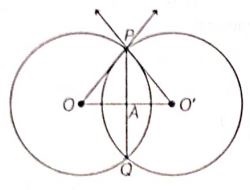
Two circles with centres O and O' of radil 6 cm and 8 cm, respectively Intersect at two points P and Q such that OP and O'P are tangents to the two circles. Find the length of the common chord PQ.
6.
The sum of the 3rd and 7th terms of an A.P. is 6 and their product is 8. Find the sum of first 20 terms of the A.P.
7.
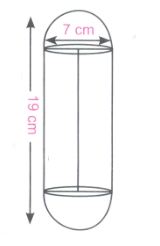
A solid is in the form of a cylinder with hemispherical ends.The total height of the solid is 19cm and the diameter of the cylinder is 7cm.Find the volume and surface area of the solid.
8.
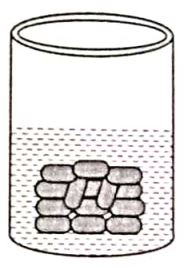
A gulab jamun, contains sugar syrup up to about 30% of its volume.Find approximately how much syrup would be found in 45 gulab jamuns, each shaped like a cylinder with two hemispherical ends with length 5cm and diameter 2.8cm . (see figure).
9.
If AB is a tangent drawn from a point B to a circle with centre C and radius 1.5 cm such that \(\angle C B A=30^{\circ}\),then find the length of a tangent AB.
10.
A solid is consisting of a right circular cone of height 120 cm and radius 60 cm standing on a hemisphere of radius 60 cm. It is placed upright in a right circular cylinder full of water such that it touches the bottom. Find the volume of water left in the cylinder, if the radius of the cylinder is 60 cm and its height is 180 cm.
11.
The sum of first n, 2n and 3n terms of an AP are S1, S2 and S3, respectively. Prove that S3 = 3(S2 - S1).
12.
Examine that the list of numbers obtained from following situation, will be in the form of an AP. "Amount left with Sandeep (in RS) out of the total amount of RS.12000 which he had in the beginning, when he spends RS.500 in the beginning of every month."
13.
The lengths of tangents drawn from an external point to a circle are equal.
14.
Water flows in a tank 150 m x 100 m at the base through a pipe whose cross-section is 2 dm by 1.5 dm at the speed of 15 km/h. In what time will the water be 3 m deep?
15.
Find the sum of first 40 integers divisible by 6
4000
4920
2460
4290
16.
Ramesh’s salary in February 2008 is Rs. 10,000. If he’s promised an increase of Rs. 1000 every year, what would be his salary in Feb 2011
Rs.14,000
Rs. 12,000
Rs. 13,000
Rs. 15,000
17.
An AP has first term 1 with a common difference also 1 and has 49 as its last term. Find its sum. 1,2,3,4 ……..49
1221
1242
1225
1232
18.
There are two cones. The curved surface area of one is twice that of the other. The slant height of the latter is twice that of the former. The ratio of their radii is
4:1
1:3
2:5
2:1
19.
A toy is in the form of a cone mounted on a hemisphere of common base radius 7 cm. The total height of the toy is 31 cm. Find the total surface area of the toy.
465
912
769
858
20.
If a solid, cone of base radius ‘r’ and height ‘h’ is placed over a solid cylinder having same base radius ‘r’ and height – ‘h’ as that of the cone, then the curved surface area of the shape is \(\pi \left( \sqrt { { h }^{ 2 }+r^{ 2 } } \right) +2\pi rh\) Is it true?
No
Yes
May be
Cannot be determined
21.
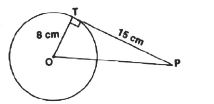
In the figure, Ab is a chord of length 16 cm, of a circle of radius 10 cm. The tangents at A and B intersect at a point P. Find the length of PA.
\(\frac { 20 }{ 5 } \)cm
\(\frac { 40 }{ 5 } \)cm
\(\frac { 20 }{ 3 } \)cm
\(\frac { 40 }{ 3 } \)cm
22.
Assertion (A) Total surface area of the toy is the sum of the curved surface area of the hemisphere and the curved surface area of the cone.
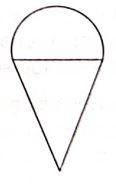
Reason (R) Toy is obtained by fixing the plane surfaces of the hemisphere and cone together.
(a) Both Assertion and Reason are correct and Reason is the correct explanation of Assertion.
(b) Both Assertion and Reason are correct but Reason is not the correct explanation of Assertion.
(c) Assertion is correct but Reason is incorrect.
(d) Assertion is incorrect but Reason is correct.
23.
Assertion (A) The surface areaof largest sphere that can be inscribed in a hollow cube of side a cm is \(\pi\) a2 cm2.
Reason (R) The surface area of a sphere of radius r is \(\frac{4}{3} \pi r^3\)
(a) Both Assertion and Reason are correct and Reason is the correct explanation of Assertion.
(b) Both Assertion and Reason are correct but Reason is not the correct explanation of Assertion.
(c) Assertion is correct but Reason is incorrect.
(d) Assertion is incorrect but Reason is correct.
24.
Assertion The first term of an AP is m and its common difference is p, then the 13th term is a + 10p.
Reason In an AP Sn - Sn-1 = an.
Codes:
(a) If both Assertion and Reason are correct and Reason is the correct explanation of Assertion.
(b) If both Assertion and Reason are correct, but Reason is not the correct explanation of Assertion.
(c) If Assertion is correct but Reason is incorrect.
(d) If Assertion is incorrect but Reason is correct.
25.
In a maths class, the teacher draws two circles that touch each other externally at point K with centres A and B and radii 5 em and 4 em respectively as shown in the figure.
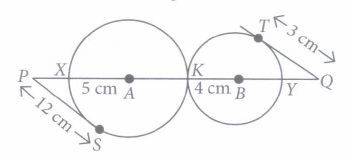
Based on the above information, answer the following questions.
(i) The value of PA =
| (a) 12 cm | (b) 5 cm | (c) 13 cm | (d) Can't be determined |
(ii) The value of BQ =
| (a) 4 cm | (b) 5 cm | (c) 6 cm | (d) None of these |
(iii) The value of PK =
| (a) 13 cm | (b) 15 cm | (c) 16 cm | (d) 18 cm |
(iv) The value of QY =
| (a) 2 cm | (b) 5 cm | (c) 1 cm | (d) 3 cm |
(v) Which of the following is true?
| (a) PS2=PA.PK | (b) TQ2=QB.QK | (c) PS2=PX.PK | (d) TQ2 = QA.QB |
1.
Rs. 2068
2.
10 cm
3.
Here, vessel is a combination of a hollow hemisphere and a hollow cylinder.
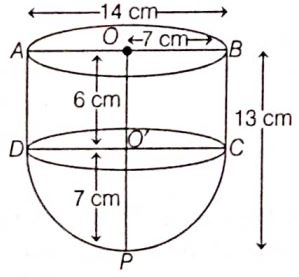
For cylindrical portion,
Diameter = AB = DC = 14 cm
\(\therefore\) Radius = OB = O'C = O' P
\(=\frac{A B}{2}=\frac{14}{2}=7 \mathrm{~cm}\)
Total length of vessel, PO = 13 cm
\(\therefore\) Length of cylinder, OO' = PO - O'P = 13 - 7 = 6 cm
For hemispherical portion,
Radius of hemisphere = Height of hemisphere = 7 cm
Now, the inner surface area of the vessel = Curved surface area of cylinder + Curved surface area of hemisphere
\(\begin{aligned} & =2 \pi r h+2 \pi r^2 \\ \end{aligned}\)
\(\begin{aligned} & =2 \times \frac{22}{7} \times 7 \times 6+2 \times \frac{22}{7} \times(7)^2 \\ \end{aligned}\)
\(\begin{aligned} & =2 \times 22 \times 6+2 \times 22 \times 7 \\ \end{aligned}\)
\(\begin{aligned} & =44(6+7)=44 \times 13=572 \mathrm{~cm}^2 \end{aligned}\)
4.
Sm = 2m2 + 3m
S1 = 2 x 12 + 3 x 1 = 5 = a1
S2 = 2 x 22 + 3 x 2 = 14
a1 + a2 = 14
5 + a2 = 14
a2 = 9
5.
Here, two circles are of radii OP = 6 cm and O'P = 8 cm
These two circles intersect at P and Q.
Here, OP and O'P are two tangents drawn at point P.
\(\therefore \quad \angle O P O^{\prime}=90^{\circ}\)
[tangents at any point of circle is perpendicular to radius through the point of contact]
In \(\Delta\)OPO'.
By Pythagoras theorem,
(OO')2 = (OP)2 + (PO')2
\(\Rightarrow\) 62 + 82 = (OO')2
\(\Rightarrow\) OO' = 10 cm
Also, \(P A \perp O O^{\prime} .\)
Let OA = x, then
AO' = 10 - x
In \(\Delta\)OAP,
(OP)2 = (OA)2 +(AP)2
[by Pythagoras theorem]
(AP)2 = 62 - x2 = 36 - x2 ...(i)
Now, in \(\Delta\)APO'
(PO')2 = (PA)2 + (AO')2
[by Pythagoras theorem]
\(\Rightarrow\) (PA)2 = 82 - (10 - x)2 ...(ii)
From Eqs. (i) and (ii), we get
36 - x2 = 64 - (10 - x)2
\(\Rightarrow\) 36 - x2 = 64 - 100 - x2 + 20x
\(\Rightarrow\) 20x = 72
\(\Rightarrow \quad x=\frac{18}{5}=3.6 \mathrm{~cm}\)
From Eq. (i),
AP2 = 36 - 12.96 = 23.04
\(\Rightarrow\) AP = 4.8 cm
Since, the perpendicular drawn from the centre of a circle to a chord bisect it.
\(\therefore\) Length of common chord = PQ
= 2AP
= 2 \(\times\) 4.8 = 9.6 cm
6.
a3 + a7 = 6; a3 \(\times\) a7 = 8
\(\Rightarrow\) 2a + 8d = 6; (a + 2d)(a + 6d) = 8.
\(\Rightarrow\) a + 4d = 3 \(\Rightarrow\) a = 3 - 4d.
(3 - 4d + 2d)(3 - 4d + 6d) = 8
\(\Rightarrow\) (3 + 2d)(3 - 2d) = 8 \(\Rightarrow\) 9 - 4d2 = 8
\(\Rightarrow \quad d=\pm \frac { 1 }{ 2 } \)
Case (i): \(d=\frac { 1 }{ 2 } \Rightarrow a=1;{ S }_{ 20 }=115\)
Case (ii): \(d=-\frac { 1 }{ 2 } \Rightarrow a=5;{ S }_{ 20 }=5\)
7.
Diameter of cylinder = diameter of the hemisphere = 7 cm
\(\therefore \) Radius of cylinder = \(\frac { 7 }{ 2 } \) cm
Total height of the solid = 19 cm
Height of the cylinder = 19 - \(\left( \frac { 7 }{ 2 } +\frac { 7 }{ 2 } \right) =12cm\)
Volume of the solid = volume of the cylinder + 2 X volume of one hemisphere
= \(\pi r^{ 2 }h+2\times \frac { 2 }{ 3 } \pi r^{ 3 }=\pi r^{ 2 }\left( h+\frac { 4 }{ 3 } r \right) \)
\(\frac { 22 }{ 7 } \times \frac { 7 }{ 2 } \times \frac { 7 }{ 2 } \left( 12\times \frac { 4 }{ 3 } \times \frac { 7 }{ 2 } \right) cm^{ 3 }\)
\(\frac { 22 }{ 7 } \times \frac { 7 }{ 2 } \times \frac { 7 }{ 2 } \left( 12+\frac { 14 }{ 3 } \right) =641.666cm^{ 2 }=641.67cm^{ 3 }\)
Surface area of the solid = curved surface area of the cylinder + 2 x curved surface area of a hemisphere
= \(2\pi rh+2\times 2\pi r^{ 2 }=2\pi r(h+2r)\)
\(=2\times \frac { 22 }{ 7 } \times \frac { 7 }{ 2 } \left( 12+2\times \frac { 7 }{ 2 } \right) =418cm^{ 2 }\)
8.
Given, one gulabjamun is a combination of a cylinder and two hemispheres. Here, total length of one gulabjamun = 5 cm and diameter = 2.8 cm
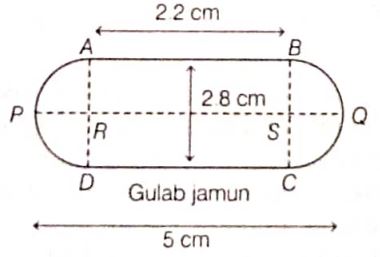
\(\therefore\) Radius of cylindrical part = Radius of hemispherical part
\(=r=\frac{2.8}{2}=1.4 \mathrm{~cm}\)
Height of cylindrical part,
h = PQ - (PR + SQ) = 5 - (1.4 + 1.4)
= 5 - 2.8 = 2.2 cm
\(\therefore\) Volume of one gulabjamun = 2 \(\times\) Volume of hemispherical part + Volume of cylindrical part
\(\begin{aligned} & =2 \times\left[\frac{2}{3} \pi r^{3}\right]+\pi r^2 h=\frac{4}{3} \pi r^{3}+\pi r^2 h \\ \end{aligned}\)
\(\begin{aligned} & =\pi r^2\left[\frac{4 r}{3}+h\right]=\frac{22}{7} \times 1.4 \times 1.4\left[\frac{4}{3} \times 1.4+2.2\right] \\ \end{aligned}\)
\(\begin{aligned} & =\frac{22}{7} \times \frac{14}{10} \times \frac{14}{10}\left[\frac{4}{3} \times \frac{14}{10}+\frac{22}{10}\right] \\ \end{aligned}\)
\(\begin{aligned} & =22 \times \frac{1}{5} \times \frac{7}{5}\left[\frac{28}{15}+\frac{11}{5}\right]=\frac{154}{25} \times \frac{61}{15}=\frac{9394}{375} \mathrm{~cm}^3 \end{aligned}\)
Now, volume of 45 gulabjamuns
\(=45 \times \frac{9394}{375}=\frac{3 \times 9394}{25}=\frac{28182}{25}=1127.28 \mathrm{~cm}^3\)
Since, one gulabjamun contains sugar syrup upto about 30% of its volume.
Hence, quantity of syrup found in 45 gulabjamuns
\(=1127.28 \times \frac{30}{100}=1127.28 \times \frac{3}{10}=338.184 \approx 338 \mathrm{~cm}^3\)
9.
\(3 \mathrm{~cm} \text { and } \frac{3 \sqrt{3}}{2} \mathrm{~cm}\)
10.
Given, height of cone, h = 120 cm, radius of cone r = 60cm.
Radius of hemisphere = 60 cm.
Volume of cone = \(\frac {1}{3}\)\(\pi\)r2h
=\(\frac {1}{3}\) x 3.14 x 60 x 60 x 120
= 3.14 x 60 x 60 x 40
= 452160 cm3
Volume of hemisphere=\(\frac {2}{3}\) \(\pi\)r3
= \(\frac {2}{3}\)x3.14x60 x 60 x 60
= 452160 cm3
Total volume = Volume of cone + Volume of hemisphere
= 452160 +452160
= 904320 cm3
Height of cylinder = 180 cm,
radius = 60 cm,
Volume of water in the cylinder
= Volume of cylinder
= \(\pi\)r2h
= 3.14 x 60 x 60 x 180
= 2034720 cm3
Water left in the cylinder = Volume of water - Volume of (cone + sphere)
= 2034720 - 904320
= 1130400 cm3.
11.
Let a be the first term and d be the common difference of given AP.
According to the question,
\(S_{ 1 }=S_{ n }=\frac { n }{ 2 } \left[ 2a+(n-1)d \right] \\ S_{ 2 }=S_{ 2n }=\frac { 2n }{ 2 } \left[ 2a+(2n-1)d \right] \)
and \(S_{ 3 }=S_{ 3n }=\frac { 3n }{ 2 } \left[ 2a+(3n-1)d \right] \)
Now, \(S_{ 2 }-S_{ 1 }=\frac { 2n }{ 2 } \left[ 2a+(n-1)d \right] -\frac { n }{ 2 } \left[ 2a+(n-1)d \right] \)
\(=\frac { n }{ 2 } \left[ 2\left\{ 2a+(2n-1d \right\} -\left\{ 2a+(n-1d \right\} \right] \\ =\frac { n }{ 2 } \left[ 2a+(3n-1)d \right] \\ \therefore \ 3\left( S_{ 2 }-S_{ 1 } \right) =\frac { 3n }{ 2 } \left[ 2a+(3n-1)d \right] \\ \Rightarrow \ 3\left( S_{ 2 }-S_{ 1 } \right) =S_{ 3 }\ or S_{ 3 }=3\left( S_{ 2 }-S_{ 1 } \right) \)
12.
Given, total amount Sandeep had=RS.12000
In the beginning of every month, he spend=RS.500
So, in the beginning of 1st month, he had amount, t1=RS.12000
In the beginning of 2nd month, he had amount, t2=12000-500=RS.11500
In the beginning of 3rd month, he had amount, t3=1500-500=RS.11000
In the beginning of 4th month, he had amount, t4=11000-500=RS.10500 and so on.
Now, the list of amount is 12000, 11500, 11000, 10500, ...Here, t2 - t1 = t3 - t2 = t4 - t3 =-500
i.e. tk+1-tk is the same everytime.
So, the above list of numbers forms an AP.
13.
We are given a circle with centre O, a point P lying outside the circle and two tangents PQ, PR on the circle from P see fig. We are required to prove that PQ = PR.
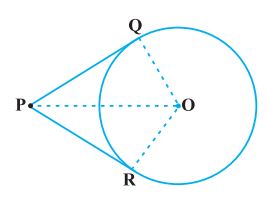
For this, we join OP, OQ and OR. Then \(\angle\)OQP and \(\angle\)ORP are right angles, because these are angles between the radii and tangents, and according to Theorem 10.1 they are right angles. Now in right triangles OQP and ORP,
OQ = OR (Radii of the same circle)
OP = OP (Common)
Therefore, \(\Delta\)OQP \(\cong\)\(\Delta\) ORP (RHS)
This gives PQ = PR (CPCT)
14.
Suppose in x hours water will be 3 metres deep in the tank.
Volume of water in the tank = (150 x 100 x 3) m3 = 45000 m3
Area of cross-section of the pipe = \((\frac{2}{10}\times\frac{1.5}{10})m^2=\frac{3}{100}m^2\)
Volume of water that flows in the tank in x hours
= (area of cross-section of the pipe) x (speed of water) x (time)
= \((\frac{3}{100}\times15000\times x)\) m3 = 450 x m3
[\(\therefore\) Speed = 15 km/h = 15000 m/h]
Since the volume of water in the tank is equal to the volume of water that flows in the tank in x hours.
\(\therefore\) 450 x = 45000 \(\Rightarrow\) x = 100 hours.
15.
(b)
4920
16.
(c)
Rs. 13,000
17.
(c)
1225
18.
(a)
4:1
19.
(d)
858
20.
(b)
Yes
21.
(d)
\(\frac { 40 }{ 3 } \)cm
22.
Total surface area (TSA) of toy = CSA of hemisphere + CSA of cone
This is because the toy is obtained by joining the plane surfaces of hemisphere and cone.
23.
(c) Given, side of cube = a cm
\(\Rightarrow\) Diameter of sphere = a cm
\(\Rightarrow\) Radius of sphere = \(\frac{a}{2}\)cm
We know that surface area of sphere = 4\(\pi\)r2
\(=4 \pi \times \frac{a}{2} \times \frac{a}{2}\)
= a2\(\pi\)cm2
24.
(d) If Assertion is incorrect but Reasonis correct.
25.
Here, AS = 5 cm, BT = 4 cm [\(\therefore\)Radii of circles]
(i) (c): Since, radius at point of contact is perpendicular to tangent.
\(\therefore\) By Pythagoras theorem, we have
\(P A=\sqrt{P S^{2}+A S^{2}}=\sqrt{12^{2}+5^{2}}=\sqrt{169}=13 \mathrm{~cm}\)
(ii) (b): Again by Pythagoras theorem, we have
\(B Q=\sqrt{T Q^{2}+B T^{2}}=\sqrt{3^{2}+4^{2}}=\sqrt{25}=5 \mathrm{~cm}\)
(iii) (d): PK = PA + AK = 13 + 5 = 18 cm
(iv) (c): QY = BQ - BY = 5 - 4 = 1 cm
(v) (c): PS2 = PA2 - AS2 = PA2 - AK2
= (PA + AK)(PA - AK) = PK.PX [\(\because\) AK = AX]

10th Standard CBSE Syllabus & Materials
10th Standard CBSE
CBSE 10th Social Science PS - Federalism - New Model Questions Papers Study Material - QB365 Set A
NEW10th Standard CBSE
CBSE 10th Social Science PS - Power Sharing - New Model Questions Papers Study Material - QB365 Set A
NEW10th Standard CBSE
CBSE 10th Social Science GEO - Manufacturing Industries - New Model Questions Papers Study Material - QB365 Set A
NEW10th Standard CBSE
CBSE 10th Social Science GEO - Minerals and Energy Resources - New Model Questions Papers Study Material - QB365 Set A



NCERT Books

Syllabus

Exam Pattern

Sample Question Papers

Previous year Question Papers

Important Notes

MCQ Practice test

NCERT Exemplers

Case study Questions

Image Based Questions

Passage based Questions

HOT Questions

Value Based Questions

Model Questions Papers
NCERT ( Book Back ) Questions

Assertion and Reason
Important Questions And Answers

CBSE 10th Standard CBSE Subjects
CBSE Standards



