
 100% FREE ACCESS
10th Standard CBSE Syllabus & Materials
10th Standard CBSE
CBSE 10th Social Science ECO - Globalisation and the Indian Economy - New Model Questions Papers Study Material - QB365 Set A
NEW10th Standard CBSE
CBSE 10th Social Science ECO - Money and Credit - New Model Questions Papers Study Material - QB365 Set A
NEW10th Standard CBSE
CBSE 10th Social Science ECO - Sectors of the Indian Economy - New Model Questions Papers Study Material - QB365 Set A
NEW10th Standard CBSE
CBSE 10th Social Science ECO - Development - New Model Questions Papers Study Material - QB365 Set A
NEW10th Standard CBSE
CBSE 10th Social Science PS - Outcomes of Democracy - New Model Questions Papers Study Material - QB365 Set A
NEW10th Standard CBSE
CBSE 10th Social Science PS - Gender, Religion and Caste - New Model Questions Papers Study Material - QB365 Set A

Published on: 26/10/2025
Download CBSE Class 10th Standard CBSE Maths question papers, sample papers, important questions, and previous year solved papers in PDF format. Get free study materials, NCERT solutions, and exam preparation resources for Class 10th Standard CBSE Maths
Questions + Answers key
Take MCQ Maths Test
1.
In \(\Delta A B C, D E \| B C . \text { If } D E=\frac{2}{3}\) BC and area of \(\Delta A B C\) = 81 cm2, then find the area of \(\Delta D A E .\)
2.
In an equilateral triangle ABC, D is a point on side BC such that BD \(=\frac{1}{3}\) BC. Prove that 9 AD2 = 7 AB2
3.
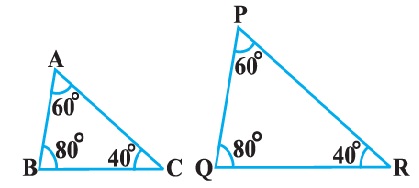
State which pair of triangles in the following figure are similar? Write the similarity criterion used by you for answering the question and also write the pairs of similar triangles in the symbolic form:
4.
A sphere of diameter 6 cm is dropped in a right circular cylindrical vessel partly filled with water. The diameter of the cylindrical vessel is 12 cm. If the sphere is completely submerged in water, by how much will the level of water rise in the
cylindrical vessel?
5.
A cylinder and a cone have equal radii of their bases and equal heights.If their curved surface areas are in the ratio 8: 5, show that the ratio of radius of each to the height of each is 3 : 4.
6.
In the given figure, if LM II CB and LN II CD. Prove that \(\frac { AM }{ AB } =\frac { AN }{ AD } .\)
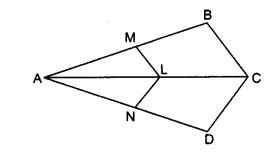
Use the basic proportionality theorem in both \(\Delta\)ABC and \(\Delta\)ACD
7.
In \(\triangle ABC\) , D and E are points on the sides AB and AC respectively, such that \(DE\parallel BC\) . If AD = 4x - 3, AE = 8x - 7, BD = 3x - 1 and CE = 5x - 3, find the value of x.
8.
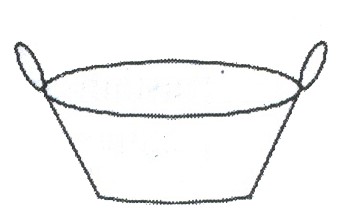
Hanumappa and his wife Gangamma are busy making jaggery out of sugarcane juice. They have processed the sugarcane juice to make the molasses, which is poured into moulds in the shape of a frustum of a cone having the diameters of its two circular faces as 30 cm and 35 cm and the vertical height of the mould is 14 cm (see fig.). If each cm3 of molasses has mass about 1.2 g, find the mass of the molasses that can be poured into each mould.
9.
A fancy paperweight of glass consists of a right circular cylinder mounted on another right circular cylinder. The total height of the paperweight is 6 cm. The diameter of the lower cylinder is 7 cm and diameter of upper cylinder is 3.5 cm. Find the volume of the paperweight.
10.
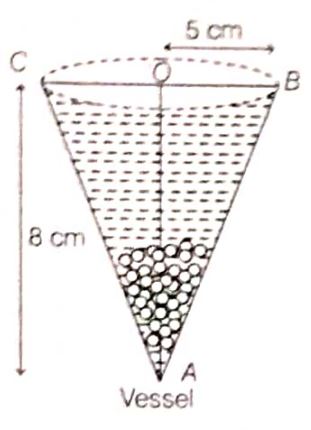
A vessel is in the form of an inverted cone. Its height is 8 cm and the radius of its top, which is open, is 5 cm. It is filled with water up to the brim. When lead shots, each of which is a sphere of radius 0.5 cm are dropped into the vessel, one- fourth of the water flows out. Find the number of lead shots dropped in the vessel.
11.
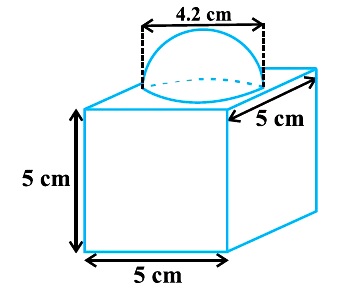
The decorative block shown in figure is made of two solids — a cube and a hemisphere. The base of the block is a cube with edge 5 cm, and the hemisphere fixed on the top has a diameter of 4.2 cm. Find the total surface area of the block. \(\text { (Take } \pi=\frac{22}{7} \text { ) }\)
12.
If a line is drawn parallel to one side of a triangle to intersect the other two sides in distinct points, the other two sides are divided in the same ratio.
13.
An aeroplane leaves an airport and files due North at a speed of 1000 km/h. At the same time, another aeroplane leaves the same airport and files due West at a speed of 1200 km/h. How far apart will be the two planes after \(1\frac{1}{2}\) h?
14.
Two congruent triangles are actually similar triangles with the ratio of corresponding sides as.
1:2
1:1
1:3
2:1
15.
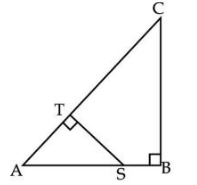
In the given figure, T and B are right angles. If the lengths of AT, BC and AS (in centimeters) are 15, 16 and 17 respectively, then the length of TC (in centimeters) is:
18
12
19
16
16.
The total surface area of an open pipe of length 50 cm, external diameter 20 cm and internal diameter 6 cm will be
4657.71 cm2
4757.71 cm2
4677.75 cm2
4557.81 cm2
17.
If two identical solid cubes each of volume 64 cm3 are joined end to end, then the total surface area of the resulting cuboid is:
210 cm2
200 cm2
160 cm2
180 cm2
18.
Assertion (A) Total surface area of the toy is the sum of the curved surface area of the hemisphere and the curved surface area of the cone.
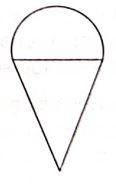
Reason (R) Toy is obtained by fixing the plane surfaces of the hemisphere and cone together.
(a) Both Assertion and Reason are correct and Reason is the correct explanation of Assertion.
(b) Both Assertion and Reason are correct but Reason is not the correct explanation of Assertion.
(c) Assertion is correct but Reason is incorrect.
(d) Assertion is incorrect but Reason is correct.
19.
Assertion: In a quadrilateral ABCD, ∠B = 90°. If AD2 = AB2 + BC2 + CD2, then ∠ACD = 90°.
Reason: In a triangle, if the square of one side is equal to the sum of the squares of the other two sides, then the angle opposite to the first side is a right angle.
Codes:
(a) If both Assertion and Reason are correct and Reason is the correct explanation of Assertion.
(b) If both Assertion and Reason are correct, but Reason is not the correct explanation of Assertion.
(c) If Assertion is correct but Reason is incorrect.
(d) If Assertion is incorrect but Reason is correct.
20.
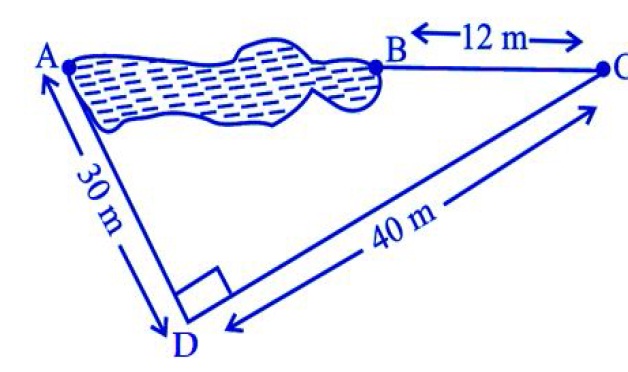
Points A and B are on the opposite edges of a pond as shown in below figure. To find the distance between the two points, Ram makes a right-angled triangle using rope connecting B with another point C at a distance of 12 m, connecting C to point D at a distance of 40 m from point C and then connecting D to the point A which is at a distance of 30 m from D such that ∠ADC = 900.
(i) Which property of geometry will be used to find the distance AC?
| (a) Similarity of Triangles | (b) Thales Theorem | (c) Pythagoras Theorem | (d) Quadratic Equation |
(ii) What is the distance AC?
| (a) 50m | (b) 12m | (c) 100m | (d) 70m |
(iii) Which is the following does not form a Pythagoras triplet?
| (a) (7, 24, 25) | (b) (15, 8, 17) | (c) (5, 12, 13) | (d) (21, 20, 28) |
(iv) Find the length AB.
| (a) 12m | (b) 38m | (c) 50m | (d) none of these |
(v) Find the length of the rope used.
| (a) 120m | (b) 70m | (c) 82m | (d) none of these |
1.
36 cm2
2.
Let the side of the equilateral triangle be a, and AE be the altitude of ΔABC.
\(\therefore B E=E C=\frac{B C}{2}=\frac{a}{2}\)
And, AE = \(\frac{a \sqrt{3}}{2}\)
Given that, BD = \(\frac{1}{3} B C\)
∴ BD = a/3
\(D E=B E-B D=\frac{a}{2}-\frac{a}{3}=\frac{a}{6}\)
Applying Pythagoras theorem in ΔADE, we get
AD2 = AE2 + DE2
\( A D^{2}=\left(\frac{a \sqrt{3}}{2}\right)^{2}+\left(\frac{a}{6}\right)^{2} \)
\(=\left(\frac{3 a^{2}}{4}\right)+\left(\frac{a^{2}}{36}\right) \)
\(=\frac{28 a^{2}}{36} \)
\(=\frac{7}{9} A B^{2} \)
\(\Rightarrow 9 A D^{2}=7 A B^{2} \)
3.
Yes, ΔABC ∼ ΔPQR [by AAA similarity criterion]
4.
Let the water level raised in cylindrical vessel be h cm
Volume of Sphere = Volume of water displaced in cylinder
\(\frac {4}{3}\pi\)(3)3 = \(\pi\)(6)2h
\(\frac {4}{3}\) x 27 = 36h
36=36h
h=1 cm
5.
Let radius be r and the height be h.
Curved surface area of cylinder = 2πrh
Curved surface area of cone =πr\(\sqrt{r^{2}+h^{2}}\)
\(\frac{2\pi{rh}}{\pi{r}\sqrt{r^{2}+h^{2}}}\)=\(\frac{8}{5}\Rightarrow \frac{h}{\sqrt{r^{2}+h^{2}}}=\frac{4}{5}\)
⇒ 25h2=16(r2+h2)
⇒ 25h2=16r2+16h2
⇒ 9h2=16r2
⇒ \(\frac{9}{16}=\frac{r^{2}}{h^{2}}\Rightarrow \frac{r}{h}=\frac{3}{4}\)
=r:h=3:4
6.
In \(\Delta\)ACB, LM || CB [given]
\(\Rightarrow \quad \frac{A M}{M B}=\frac{A L}{L C}\) ....(i)
[ by basic proportionality theorem]
In \(\Delta\)ACD, LN ||CD [given]
\(\Rightarrow \quad \frac{A N}{N D}=\frac{A L}{L C}\) ....(ii)
[by basic proportionality theorem]
From Eqs. (i) and (ii), we get
\(\frac{A M}{M B}=\frac{A N}{N D} \Rightarrow \frac{M B}{A M}=\frac{N D}{A N}\)
[on taking reciprocal of the terms]
\(\Rightarrow \quad \frac{M B}{A M}+1=\frac{N D}{A N}\) + 1 [adding 1 on both sides]
\(\begin{aligned} & \Rightarrow \quad \frac{M B+A M}{A M}=\frac{N D+A N}{A N} \\ \end{aligned}\)
\(\begin{aligned} \Rightarrow \quad \frac{A M}{A M+M B}=\frac{A N}{A N+N D} \end{aligned}\)
[on taking reciprocal of the terms]
\(\therefore \quad \frac{A M}{A B}=\frac{A N}{A D} \quad\left[\begin{array}{c} \because A D=A N+N D \\ \text { and } A B=A M+M B \end{array}\right]\)
Hence proved.
7.
Given, in \(\triangle ABC\), \(DE\parallel BC\)
By Thales theorem, we get
\(\frac { AD }{ DB } =\frac { AE }{ EC } \)
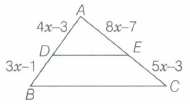
\(\Rightarrow \frac { 4x-3 }{ 3x-1 } =\frac { 8x-7 }{ 5x-3 } \)
[\(\because \) AD = 4x - 3, DB = 3x - 1, AE = 8x - 7, EC = 5x - 3]
\(\Rightarrow \) (4x - 3)(5x - 3) = (8x - 7)(3x - 1)
\(\Rightarrow \) 20x2 - 12x + 9 - 15x = 24x2 - 21x - 8x + 7
\(\Rightarrow \) 4x2 - 2x - 2 = 0
\(\Rightarrow \) 2x2 - x - 1 = 0 [dividing both sides by 2]
\(\Rightarrow \) 2x2 - 2x + x - 1 = 0 [by splitting the middle term]
\(\Rightarrow \) 2x(x - 1) + 1 (x - 1) = 0
\(\Rightarrow \) (2x + 1) (x - 1) = 0 \(\therefore x=-\frac { 1 }{ 2 } \) or x = 1
If \(x=-\frac { 1 }{ 2 } \), then AD = \(4\times -\frac { 1 }{ 2 } -3=-5<0\) [not possible]
Hence, x = 1 is the required value.
8.
Since the mould is in the shape of a frustum of a cone, the quantity (volume) of molasses that can be poured into it \(=\frac{\pi}{3} h\left(r_{1}^{2}+r_{2}^{2}+r_{1} r_{2}\right)\)
where r1 is the radius of the larger base and r2 is the radius of the smaller base.
\(=\frac{1}{3} \times \frac{22}{7} \times 14\left[\left(\frac{35}{2}\right)^{2}+\left(\frac{30}{2}\right)^{2}+\left(\frac{35}{2} \times \frac{30}{2}\right)\right] \mathrm{cm}^{3}=11641.7 \mathrm{~cm}^{3} .\)
It is given that 1 cm3 of molasses has mass 1.2g. So, the mass of the molasses that can be poured into each mould = (11641.7 × 1.2) g
= 13970.04 g = 13.97 kg
= 14 kg (approx.)
9.
173.25 cm3
10.
Here, a cone and spherical lead shots are given. Since, lead shots are dropped into the vessel, so the water which flows out from the vessel is equal to the volume of lead shots.
Given, height of the vessel, h = 8 cm and radius of the vessel, r = 5 cm.
\(\therefore\) Volume of water filled in a vessel = Volume of cone
\(\begin{aligned} & =\frac{1}{3} \times \pi \times r^2 \times h \\ \end{aligned}\)
\(\begin{aligned} & =\frac{1}{3} \times \frac{22}{7} \times 5 \times 5 \times 8 \\ \end{aligned}\)
\(\begin{aligned} & =\frac{4400}{21} \mathrm{~cm}^3 \end{aligned}\)
Also, radius of a spherical lead shot = 0.5 cm
\(\therefore\) Volume of one spherical lead shot \(=\frac{4}{3} \times \pi \times r^3\)
\(=\frac{4}{3} \times \frac{22}{7} \times \frac{1}{2} \times \frac{1}{2} \times \frac{1}{2}=\frac{11}{21} \mathrm{~cm}^3\)
Let n be the number of lead shots dropped in the vessel, then according to the question,
n \(\times\) Volume of one spherical lead shot
= \(\frac{1}{4}\)\(\times\)Volume of water filled in a vessel
\(\begin{aligned} \Rightarrow & & n \times \frac{11}{21} & =\frac{4400}{21} \times \frac{1}{4} \\ \end{aligned}\)
\(\begin{aligned} \Rightarrow & & n \times 11 & =1100 \\ \end{aligned}\)
\(\begin{aligned} \Rightarrow & & n & =100 \end{aligned}\)
Hence, required number of lead shots is 100.
11.
The total surface area of the cube = 6 × (edge)2 = 6 × 5 × 5 cm2 = 150 cm2.
Note that the part of the cube where the hemisphere is attached is not included in the surface area.
So, the surface area of the block = TSA of cube – base area of hemisphere + CSA of hemisphere
\(=150-\pi r^{2}+2 \pi r^{2}=\left(150+\pi r^{2}\right) \mathrm{cm}^{2} \)
\(=150 \mathrm{~cm}^{2}+\left(\frac{22}{7} \times \frac{4.2}{2} \times \frac{4.2}{2}\right) \mathrm{cm}^{2} \)
\(=(150+13.86) \mathrm{cm}^{2}=163.86 \mathrm{~cm}^{2}\)
12.
We are given a triangle ABC in which a line parallel to side BC intersects other two sides AB and AC at D and E respectively.
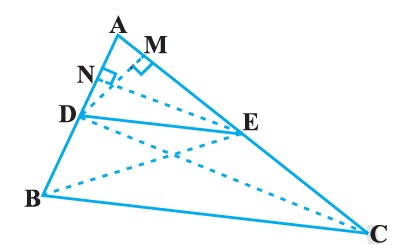
We need to prove that \(\frac{\mathrm{AD}}{\mathrm{DB}}=\frac{\mathrm{AE}}{\mathrm{EC}}\)
Let us join BE and CD and then draw \(\mathrm{DM} \perp \mathrm{AC}\) and \(E N \perp A B\)
Now, area of \(\Delta \mathrm{ADE}\left(=\frac{1}{2} \text { base } \times \text { height }\right)=\frac{1}{2} \mathrm{AD} \times \mathrm{EN}\)
Recall from Class IX, that area of \(\Delta\) ADE is denoted as ar(ADE).
So, \(\operatorname{ar}(\mathrm{ADE})=\frac{1}{2} \mathrm{AD} \times \mathrm{EN}\)
Similarly, \(\operatorname{ar}(\mathrm{BDE})=\frac{1}{2} \mathrm{DB} \times \mathrm{EN}\)
\(\operatorname{ar}(\mathrm{ADE})=\frac{1}{2} \mathrm{AE} \times \mathrm{DM} \text { and } \operatorname{ar}(\mathrm{DEC})=\frac{1}{2} \mathrm{EC} \times \mathrm{DM}\)
Therefore, \(\frac{\operatorname{ar}(\mathrm{ADE})}{\operatorname{ar}(\mathrm{B} \mathrm{DE})}=\frac{\frac{1}{2} \mathrm{AD} \times \mathrm{EN}}{\frac{1}{2} \mathrm{DB} \times \mathrm{EN}}=\frac{\mathrm{AD}}{\mathrm{DB}}\) (1)
and \(\frac{\operatorname{ar}(\mathrm{ADE})}{\operatorname{ar}(\mathrm{DEC})}=\frac{\frac{1}{2} \mathrm{AE} \times \mathrm{DM}}{\frac{1}{2} \mathrm{EC} \times \mathrm{DM}}=\frac{\mathrm{AE}}{\mathrm{EC}}\) (2)
Note that \(\Delta\) BDE and DEC are on the same base DE and between the same parallels BC and DE.
So, ar(BDE) = ar(DEC) (3)
Therefore, from (1), (2) and (3), we have:
\(\frac{\mathrm{AD}}{\mathrm{DB}}=\frac{\mathrm{AE}}{\mathrm{EC}}\)
13.
Let O be the position of airport.
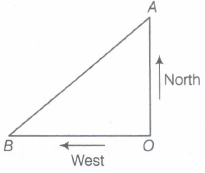
In \(1\frac{1}{2}\) h, the distance travelled by aeroplane when it files due North at a speed of 1000 km/h,
OA = 1000 x \(\frac{3}{2}\) = 1500 km.
[ \(\because\) distance = speed x time]
In \(1\frac{1}{2}\) h, the distance travelled by aeroplane when it files due West at a speed of 1200 km/h, OB = 1200 x \(\frac{3}{2}\) = 1800 km
[ \(\because\) distance = speed x time]
Since, North and West directions are perpendicular to each other.
So, using Pythagoras theorem, we get
AB2 = OB2 + OA2 \(\Rightarrow\) AB2 = (1800)2 + (1500)2
\(\Rightarrow\) AB2 = 3240000 + 2250000 = 5490000
\(\therefore\) AB = 300 \(\sqrt{61}\) km [taking positive square root]
Hence, the distance between two planes after \(1\frac{1}{2}\) h is 300 \(\sqrt{61}\) km.
14.
(b)
1:1
15.
(c)
19
16.
(a)
4657.71 cm2
17.
(c)
160 cm2
18.
Total surface area (TSA) of toy = CSA of hemisphere + CSA of cone
This is because the toy is obtained by joining the plane surfaces of hemisphere and cone.
19.
(a) If both Assertion and Reason are correct and Reason is the correct explanation of Assertion.
20.
(i) (c): Pythagoras Theorem
(ii) (a): ADC is a right-angled triangle. By Pythagoras theorem we get AC2 = (30)2 + (40)2
⇒ AC2 = 900 + 1600
⇒ AC2 = 2500
⇒ AC = 50m
(iii) (d): (21, 20, 28)
since,\((28)^{2} \neq(20)^{2}+(21)^{2}\)
(iv) (b): AC = 50m and BC = 12m
⇒ AB = AC - BC
⇒ AB = 50 - 12 = 38m
(v) (c): Length of the rope used = 30 + 40 + 12
= 82m

10th Standard CBSE Syllabus & Materials
10th Standard CBSE
CBSE 10th Social Science PS - Federalism - New Model Questions Papers Study Material - QB365 Set A
NEW10th Standard CBSE
CBSE 10th Social Science PS - Power Sharing - New Model Questions Papers Study Material - QB365 Set A
NEW10th Standard CBSE
CBSE 10th Social Science GEO - Manufacturing Industries - New Model Questions Papers Study Material - QB365 Set A
NEW10th Standard CBSE
CBSE 10th Social Science GEO - Minerals and Energy Resources - New Model Questions Papers Study Material - QB365 Set A



NCERT Books

Syllabus

Exam Pattern

Sample Question Papers

Previous year Question Papers

Important Notes

MCQ Practice test

NCERT Exemplers

Case study Questions

Image Based Questions

Passage based Questions

HOT Questions

Value Based Questions

Model Questions Papers
NCERT ( Book Back ) Questions

Assertion and Reason
Important Questions And Answers

CBSE 10th Standard CBSE Subjects
CBSE Standards



