
 100% FREE ACCESS
10th Standard CBSE Syllabus & Materials
10th Standard CBSE
CBSE 10th Social Science ECO - Globalisation and the Indian Economy - New Model Questions Papers Study Material - QB365 Set A
NEW10th Standard CBSE
CBSE 10th Social Science ECO - Money and Credit - New Model Questions Papers Study Material - QB365 Set A
NEW10th Standard CBSE
CBSE 10th Social Science ECO - Sectors of the Indian Economy - New Model Questions Papers Study Material - QB365 Set A
NEW10th Standard CBSE
CBSE 10th Social Science ECO - Development - New Model Questions Papers Study Material - QB365 Set A
NEW10th Standard CBSE
CBSE 10th Social Science PS - Outcomes of Democracy - New Model Questions Papers Study Material - QB365 Set A
NEW10th Standard CBSE
CBSE 10th Social Science PS - Gender, Religion and Caste - New Model Questions Papers Study Material - QB365 Set A

Published on: 26/10/2025
Download CBSE Class 10th Standard CBSE Maths question papers, sample papers, important questions, and previous year solved papers in PDF format. Get free study materials, NCERT solutions, and exam preparation resources for Class 10th Standard CBSE Maths
Questions + Answers key
Take MCQ Maths Test
1.
The volume of a hemisphere is \(2425\frac { 1 }{ 2 } { cm }^{ 3 }.\) Find its curved surface area. \(\left[ Use\quad \pi =\frac { 22 }{ 7 } \right] \)
2.
A storage oil tanker consists of a cylindrical portion 7 m in diameter with two hemispherical ends of the same diameter. The oil tanker lying horizontally. If the total length of the tanker is 20 m, then find the capacity of the container.
3.
A toy is in the form of a cone mounted on a hemisphere. The diameter of the base of the cone and that of hemisphere is 18 cm and the height of cone is 12 cm. Calculate the surface area of the toy. \(\left[ Take\quad \pi =3.14 \right] \)
4.
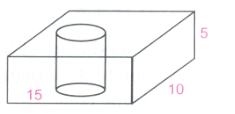
In figure, from a cuboidal solid metallic block of dimensions 15 cm x 10 cm x 5 cm, a cylindrical hole of diameter 7 cm is drilled out. Find the surface area of the remaining block. [Use \(\pi=\frac{22}{7}\)]
5.
A tent is in the shape of a cylinder surmounted by a conical top. If the height and diameter of the cylindrical part are 2.1 m and 4 m respectively, and the slant height of the top is 2.8 m, find the area of the canvas used for making the tent. Also, find the cost of the canvas of the tent at the rate of Rs. 500 per m2 . (Note that the base of the tent will not be covered with canvas.)
6.
If the total surface area of a solid hemisphere is 462 cm2, find its volume. [Take \(\pi=\frac{22}{7}\)]
7.
How many silver coins, 1.75cm in diameter and of thickness 2mm, must be melted to form a cuboid of dimensions 5.5cm x 10cm x 3.5cm?
8.
Find the volume of the largest right circular cone that can be cut out of a cube whose edge is 9cm?[Use \(\pi=22/7\)]
9.
A solid is in the shape of a cone standing on a hemisphere with both their radii being equal to 1cm and the height of the cone is equal to its radius.Find the volume of the solid in terms of \(\pi\)
10.
Two cubes each of volume 27cm3 are joined end to end to form a solid.Find the surface area of the resulting cuboid.
11.
A conical military tent having diameter of the base 24m and slant height of the tent is 13m, find the curved surface area cone.\([\pi={22\over7}]\)
12.
A container with a grey hemispherical lid has radius R cm. In figure 1, it contains water upto a height of R cm. It is, then inverted as shown in figure 2.
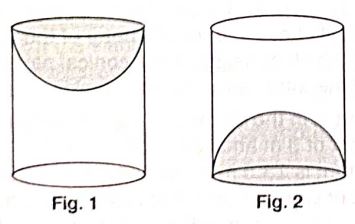
What is the height of water in figure 2?
R cm
\(\frac{5R}{3}\) cm
2 R cm
\(\frac{7R}{3}\)cm
13.
A golf ball has diameter equal to 4.2 cm. Its surface has 200 dimples each of radius 2 mm. Assuming that the dimples are hemispherical, total surface area which is exposed to the surroundings is
85.82 cm2
100 cm2
90 cm2
80.58 cm2
14.
What is the area of a semi–circle of radius 5 cm?
78.57 cm
71.42 cm
63.18 cm
79.86 cm
15.
A cylinder and a cone are of the same base radius and same height. Find the ratio of the volumes of the cylinder of that of the cone.
1 : 3
1 : 2
3 : 1
2 : 1
16.
Dinesh is building a greenhouse in his farm as shown below. The base of the greenhouse is circular having a diameter of 12 m and it has a hemispherical dome on top.
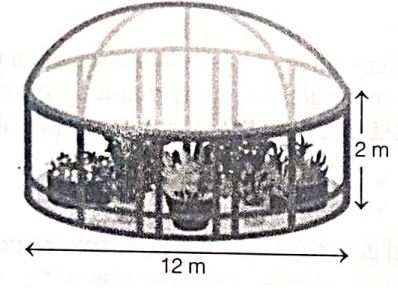
(Note The image is not to scale.)
How much will it cost him to cover the walls and top of the greenhouse with transparent plastic, if the plastic sheet costs Rs 77 per sq m? Show your steps.
\(\left[\text { take, } \pi=\frac{22}{7}\right]\)
17.
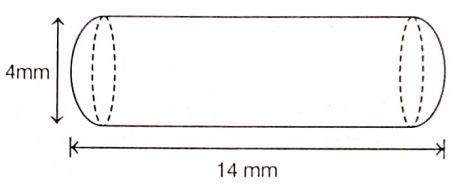
A medicine capsule is in the shape of a cylinder with two hemispheres stuck to each of its ends. The length of the entire capsule is 14 mm and the diameter of the capsule is 4 mm. Find its surface area. Also, find its volume.
18.
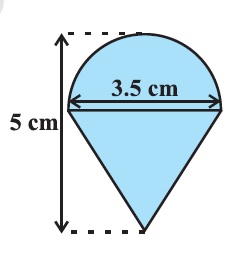
Rasheed got a playing top (lattu) as his birthday present, which surprisingly had no colour on it. He wanted to colour it with his crayons. The top is shaped like a cone surmounted by a hemisphere. The entire top is 5 cm in height and the diameter of the top is 3.5 cm. Find the area he has to colour \(\text { (Take } \pi=\frac{22}{7} \text { ) }\)
19.
Assertion (A) Total surface area of the toy is the sum of the curved surface area of the hemisphere and the curved surface area of the cone.
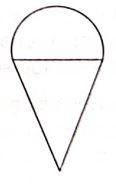
Reason (R) Toy is obtained by fixing the plane surfaces of the hemisphere and cone together.
(a) Both Assertion and Reason are correct and Reason is the correct explanation of Assertion.
(b) Both Assertion and Reason are correct but Reason is not the correct explanation of Assertion.
(c) Assertion is correct but Reason is incorrect.
(d) Assertion is incorrect but Reason is correct.
20.
Assertion (A) The surface areaof largest sphere that can be inscribed in a hollow cube of side a cm is \(\pi\) a2 cm2.
Reason (R) The surface area of a sphere of radius r is \(\frac{4}{3} \pi r^3\)
(a) Both Assertion and Reason are correct and Reason is the correct explanation of Assertion.
(b) Both Assertion and Reason are correct but Reason is not the correct explanation of Assertion.
(c) Assertion is correct but Reason is incorrect.
(d) Assertion is incorrect but Reason is correct.
21.
Metallic silos are used by farmers for storing grains. Farmer Girdhar has decided to build a new metallic silo to store his harvested grains. It is in the shape of a cylinder mounted by a cone.
Dimensions of the conical part of a silo is as follows.
Radius of base = 1.5 m
Height = 2m
Dimensions of the cylindrical part of a silo is as follow.
Radius of base 1.5
Height =7m
On the basis of the above information, answer the following questions.
(i) Calculate the slant height of the conical part of one silo.
(ii) Find the curved surface area of the conical part of one silo.
(iii) (a) Find the cost of metal sheet used to make the curved cylindrical part of 1 silo at the rate of ₹2000 per m2.
(b) Find the total capacity of one silo to store grains.
1.
Here, Volume of a hemisphere = 2425 \(\frac{1}{2}\) cm3
\(\Rightarrow\) \(\frac { 2 }{ 3 } \times \frac { 22 }{ 7 } \times { r }^{ 3 }=\frac { 4851 }{ 2 } \)
\(\Rightarrow\) \({ r }^{ 3 }=\frac { 4851 }{ 2 } \times \frac { 3\times 7 }{ 2\times 22 } \)
\(=\frac { 441\times 21 }{ 2\times 2\times 2 } \)
\(\Rightarrow\) r = \(\frac{21}{2} cm\)
Now, curved surface area = 2\(\pi\)r2
= 2 x \(\frac { 22 }{ 7 } \times \frac { 21 }{ 2 } \times \frac { 21 }{ 2 } \)
= 693 cm2
2.
Radius of hemisphere portion = Radius of cylindrical portion = \(\frac{7}{2}m\)
Total length of the tanker = 20 m
\(\therefore\) Length of cylindrical portion = 20 - 7 = 13 m
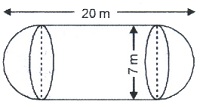
Now, Capacity (volume) of the oil tanker
= Volume of cylinder + 2 x Volume of hemisphere
= \(\pi r^2h+2\times\frac{2}{3}\pi r^3\)
= \(\frac{22}{7}\times\frac{7}{2}\times\frac{7}{2}\times13+2\times\frac{2}{3}\times\frac{22}{7}\times\frac{7}{2}\times\frac{7}{2}\times\frac{7}{2}\)
= 500.5 + 179.67 = 680.17 m3
3.
Radius of the base of the cone and hemisphere
= \(\frac{18}{2}\) = 9 cm
Height of cone = 12 cm
Slant height l = \(\sqrt{9^2+12^2}\) = \(\sqrt{81+144}\)
= \(\sqrt{225}\) = 15 cm
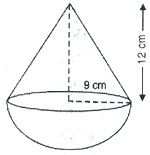
Total surface area of toy
= C.S.A. of hemisphere + C.S.A. of cone
= \(2\pi r^2+\pi rl=\pi r(2r+l)\)
= 3.14 x 9(2 x 9 + 15)
= 3.14 x 9 x 33 = 932.58 cm2
4.
Surface area of remaining block =
surface area of cuboid + curved surface area of cylinder - surface area of two circular end of cylinder hole
= 2[lb + bh + lh] + \(2\pi rh-2\pi r^2\)
= 2[15 x 10 + 10 x 5 + 15 x 5] + 2 x \(\frac{22}{7}\times\frac{7}{2}\) x 5 - 2 x \(\frac{22}{7}\times\frac{7}{2}\times\frac{7}{2}\)
= 2(150 + 50 + 75) + 110 - 77 cm2
= 583 cm2
5.
Given that, tent is a combination of a cylinder and a cone.
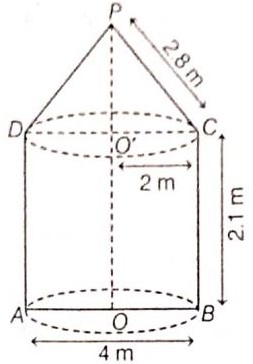
For conical portion,
Slant height, l = 2.8 m
Radius, r = Radius of cylinder \(=\frac{\text { Diameter }}{2}=\frac{4}{2}=2 \mathrm{~m}\)
For cylindrical portion,
Radius, r = \(\frac{4}{2}=2 \mathrm{~cm}\)
Height, h = 2.1 m
\(\therefore\) Required surface area of the tent = CSA of cone + CSA of cylinder
\(\begin{aligned} & =\pi r l+2 \pi r h=\pi r(l+2 h) \\ \end{aligned}\)
\(\begin{aligned} & =\frac{22}{7} \times 2 \times(2.8+2 \times 2.1) \\ \end{aligned}\)
\(\begin{aligned} & =\frac{44}{7}(2.8+4.2)=\frac{44}{7} \times 7=44 \mathrm{~m}^2 \end{aligned}\)
Now, cost of the canvas of the tent at the rate of Rs 500 per m2 = Surface area \(\times\) Cost per m2 = 44 \(\times\) 500 = Rs 22000
6.
Total surface area of a solid hemisphere
=2πr2+πr2=3πr2
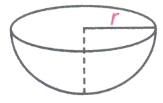
Now, 3πr2=462
⇒ r2=\(\frac{462\times{7}}{3\times{22}}\)=49⇒ r=7
Volume of hemisphere=\(\frac{2}{3}\pi{r}^{3}=\frac{2}{3}\times{\frac{22}{7}}\times\left(7\right)^{3}\)
=\(\frac{2}{3}\)x22x49 cm3=718.67 cm3
7.
Coins are cylindrical in shape.
Height (h1) of cylindrical coins = 2 mm = 0.2 cm
Radius (r) of circular end of coins = 1.75/2 =0.875 cm
Let n coins be melted to form the required cuboids.
Volume of n coins = Volume of cuboids
nxπxr2xh1 = lxbxh
n x π x (0.875)2 x 0.2 = 5.5 x 10 x 3.5
\(n=\frac{5.5 \times 10 \times 3.5 \times 7}{(0.875)^{2} \times 0.2 \times 22}=400\)
Therefore, the number of coins melted to form such a cuboid is 400.
8.
Radius of cone=\(\frac{1}{2}\)x edge of cube
=\(\frac{9}{2}\)cm
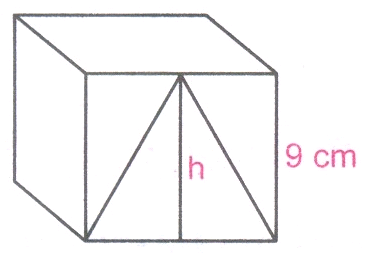
Height of cone, h=9 cm
Volume of cone=\(\frac{1}{3}\pi{r}^{2}h\)
=\(\frac{1}{3}\times{\frac{22}{7}}\times{\frac{9}{2}}\times{\frac{9}{2}}\times{9}\)
=190.928 cm3
9.
Given, solid is a combination of a cone and a hemisphere.
Also, radius of the cone, r = radius of the hemisphere
= 1 cm
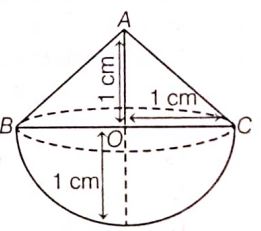
Height of the cone, h = 1 cm
\(\therefore\) Required volume of the solid = Volume of the cone + Volume of the hemisphere
\(\begin{aligned} & =\frac{1}{3} \pi r^2 h+\frac{2}{3} \pi r^3=\frac{1}{3} \pi(1)^2(1)+\frac{2}{3} \pi(1)^3 \\ \end{aligned}\)
\(\begin{aligned} & =\frac{\pi}{3}+\frac{2}{3} \pi=\frac{(\pi+2 \pi)}{3}=\frac{3 \pi}{3}=\pi \mathrm{cm}^3 \end{aligned}\)
10.
Let the length of each edge of the cube be x cm
Volume = x3 cm3⇒27=x3
Length of the cuboid formed = 3 cm + 3 cm = 6 cm
breadth, b = 3 cm, height, h = 3 cm
Surface area of the cuboid fomed = 2(lb + bh + hl)
=2(6x3+3x3+3x6)
=2(18+9+18)=2x45 = 90 cm2
11.
Diameter of tent = 24m radius = 12m
Slant height=13m
Curved surface area =\(\pi r l=\frac{22}{7} \times 12 \times=\frac{3432}{7} m^2\)
12.
(b)
\(\frac{5R}{3}\) cm
13.
(d)
80.58 cm2
14.
(a)
78.57 cm
15.
(c)
3 : 1
16.
Given, diameter of base of the greenhouse is circular = 12 m
radius = 6 m
Height of greenhouse cylindrical wall = 2 m
\(\therefore\) CSA of the hemispherical roof = 2 \(\times\) \(\pi\) \(\times\) 62m2
= 72 \(\pi\)m2
and CSA of the cylindrical wall = 2\(\times\)\(\pi\)\(\times\)6\(\times\)2 m2
= 24\(\pi\)m2
TSA of the greenhouse to be covered = 72\(\pi\) + 24 \(\pi\)
= 96\(\pi\)m2
The cost of the plastic sheet required to cover the entire greenhouse = 96\(\pi\) \(\times\) 77= Rs 23232
17.
Length of the capsule = 14 mm
Diameter of the capsule = 4 mm
Radius of the capsule \(=\frac{4}{2}=2 \mathrm{~mm}\)
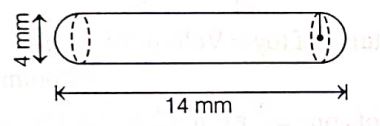
Length of the cylinder = Total length of capsule - Radius of left hemisphere - Radius of right hemisphere
= 14 - 2 - 2 = 10 mm
Surface area of capsule = Curved surface area of cylinder + Surface area of left hemisphere + Surface area of right hemisphere
\(\begin{aligned}
=2 \pi r h+2 \pi r^2+2 \pi r^2 \\
\end{aligned}\)
\(\begin{aligned}
=2 \pi r h+4 \pi r^2 \\
\end{aligned}\)
\(\begin{aligned}
=2 \times \frac{22}{7} \times 2 \times 10+4 \times \frac{22}{7} \times 2 \times 2
\end{aligned}\)
= 125.71 + 50.29
= 176
Thus, the required surface area of the capsule is 176 mm2.
Volume of capsule = Volume of cylinder + Volume of left hemisphere + Volume of right hemisphere
\(\begin{aligned}
& =\pi r^2 h+\frac{2}{3} \pi r^3+\frac{2}{3} \pi r^3 \\
\end{aligned}\)
\(\begin{aligned}
& =\pi r^2 h+\frac{4}{3} \pi r^3 \\
\end{aligned}\)
\(\begin{aligned}
& =\frac{22}{7} \times 2 \times 2 \times 10+\frac{4}{3} \times \frac{22}{7} \times 2 \times 2 \times 2
\end{aligned}\)
= 125.71 + 33.52
= 159.23 mm3
18.
This top is exactly like the object we have discussed. So, we can conveniently use the result we have arrived at there. That is :
TSA of the toy = CSA of hemisphere + CSA of cone
Now, the curved surface area of the hemisphere = \(\frac{1}{2}\left(4 \pi r^{2}\right)=2 \pi r^{2} \)
\(=\left(2 \times \frac{22}{7} \times \frac{3.5}{2} \times \frac{3.5}{2}\right) \mathrm{cm}^{2}\)
Also, the height of the cone = height of the top – height (radius) of the hemispherical part
\(=\left(5-\frac{3.5}{2}\right) \mathrm{cm}=3.25 \mathrm{~cm}\)
So, the slant height of the cone \((l)=\sqrt{r^{2}+h^{2}}=\sqrt{\left(\frac{3.5}{2}\right)^{2}+(3.25)^{2}} \mathrm{~cm}=3.7 \mathrm{~cm}(\text { approx. })\)
Therefore, CSA of cone \(=\pi r l=\left(\frac{22}{7} \times \frac{3.5}{2} \times 3.7\right) \mathrm{cm}^{2}\)
This gives the surface area of the top as
\(=\left(2 \times \frac{22}{7} \times \frac{3.5}{2} \times \frac{3.5}{2}\right) \mathrm{cm}^{2}+\left(\frac{22}{7} \times \frac{3.5}{2} \times 3.7\right) \mathrm{cm}^{2}\)
\(=\frac{22}{7} \times \frac{3.5}{2}(3.5+3.7) \mathrm{cm}^{2}=\frac{11}{2} \times(3.5+3.7) \mathrm{cm}^{2}=39.6 \mathrm{~cm}^{2}(\text { approx. })\)
You may note that ‘total surface area of the top’ is not the sum of the total surface areas of the cone and hemisphere
19.
Total surface area (TSA) of toy = CSA of hemisphere + CSA of cone
This is because the toy is obtained by joining the plane surfaces of hemisphere and cone.
20.
(c) Given, side of cube = a cm
\(\Rightarrow\) Diameter of sphere = a cm
\(\Rightarrow\) Radius of sphere = \(\frac{a}{2}\)cm
We know that surface area of sphere = 4\(\pi\)r2
\(=4 \pi \times \frac{a}{2} \times \frac{a}{2}\)
= a2\(\pi\)cm2
21.
Given dimension of conical part of a silo is radius,
of base = 1.5 m
Height =2 m
And dimension of the cylindrical part of a silo is radius of base = 1.5 m
Height =7m
(i) We know that slant height
\(l=\sqrt{r^2+h^2}=\sqrt{(1.5)^2+(2)^2}=2.5 \mathrm{~m}\)
(ii) Curved surface area of cone = πrl
\(=\frac{22}{7} \times 1.5 \times 2.5=11.78 \mathrm{~m}^2\)
(iii) (a) Curved surface area of cylinder = 2πrh
\(=2 \times \frac{22}{7} \times 1.5 \times 7=66 \mathrm{~m}^2\)
Cost of 1 m2 of metal sheet =₹2000
∴ Cost of metal sheet used = 66 × 2000=₹132000
Or
(b) Volume of cylinder = πr2h
\(=\frac{22}{7} \times(1.5)^2 \times 7=49.5 \mathrm{~m}^3\)
Volume of cone \(=\frac{1}{3} \pi r^2 h\)
\(=\frac{1}{3} \times \frac{22}{7} \times(1.5)^2 \times 2=4.71 \mathrm{~m}^3\)
Thus, total capacity of 1 silo= 49.5 + 4.71= 54.21 m3.

10th Standard CBSE Syllabus & Materials
10th Standard CBSE
CBSE 10th Social Science PS - Federalism - New Model Questions Papers Study Material - QB365 Set A
NEW10th Standard CBSE
CBSE 10th Social Science PS - Power Sharing - New Model Questions Papers Study Material - QB365 Set A
NEW10th Standard CBSE
CBSE 10th Social Science GEO - Manufacturing Industries - New Model Questions Papers Study Material - QB365 Set A
NEW10th Standard CBSE
CBSE 10th Social Science GEO - Minerals and Energy Resources - New Model Questions Papers Study Material - QB365 Set A



NCERT Books

Syllabus

Exam Pattern

Sample Question Papers

Previous year Question Papers

Important Notes

MCQ Practice test

NCERT Exemplers

Case study Questions

Image Based Questions

Passage based Questions

HOT Questions

Value Based Questions

Model Questions Papers
NCERT ( Book Back ) Questions

Assertion and Reason
Important Questions And Answers

CBSE 10th Standard CBSE Subjects
CBSE Standards



