
 100% FREE ACCESS
10th Standard CBSE Syllabus & Materials
10th Standard CBSE
CBSE 10th Social Science ECO - Globalisation and the Indian Economy - New Model Questions Papers Study Material - QB365 Set A
NEW10th Standard CBSE
CBSE 10th Social Science ECO - Money and Credit - New Model Questions Papers Study Material - QB365 Set A
NEW10th Standard CBSE
CBSE 10th Social Science ECO - Sectors of the Indian Economy - New Model Questions Papers Study Material - QB365 Set A
NEW10th Standard CBSE
CBSE 10th Social Science ECO - Development - New Model Questions Papers Study Material - QB365 Set A
NEW10th Standard CBSE
CBSE 10th Social Science PS - Outcomes of Democracy - New Model Questions Papers Study Material - QB365 Set A
NEW10th Standard CBSE
CBSE 10th Social Science PS - Gender, Religion and Caste - New Model Questions Papers Study Material - QB365 Set A

Published on: 20/10/2025
Download CBSE Class 10th Standard CBSE Maths question papers, sample papers, important questions, and previous year solved papers in PDF format. Get free study materials, NCERT solutions, and exam preparation resources for Class 10th Standard CBSE Maths
Questions + Answers key
Take MCQ Maths Test
1.
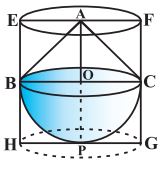
A solid toy is in the form of a hemisphere surmounted by a right circular cone. The height of the cone is 2 cm and the diameter of the base is 4 cm. Determine the volume of the toy. If a right circular cylinder circumscribes the toy, find the difference of the volumes of the cylinder and the toy. (Take \(\pi\)= 3.14)
2.
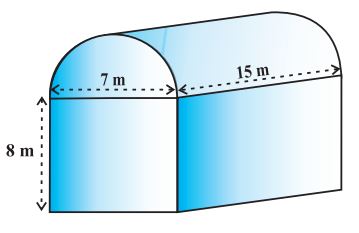
Shanta runs an industry in a shed which is in the shape of a cuboid surmounted by a half cylinder (see figure). If the base of the shed is of dimension 7 m × 15 m, and the height of the cuboidal portion is 8 m, find the volume of air that the shed can hold. Further,suppose the machinery in the shed occupies a total space of 300 m3, and there are 20 workers, each of whom occupy about 0.08 m3 space on an average. Then, how much air is in the shed? \(\text { (Take } \pi=\frac{22}{7} \text { ) }\)
3.
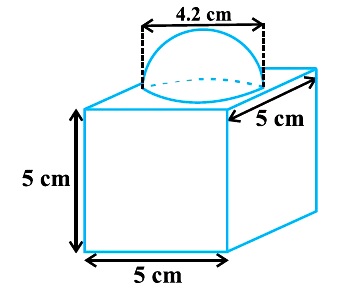
The decorative block shown in figure is made of two solids — a cube and a hemisphere. The base of the block is a cube with edge 5 cm, and the hemisphere fixed on the top has a diameter of 4.2 cm. Find the total surface area of the block. \(\text { (Take } \pi=\frac{22}{7} \text { ) }\)
4.
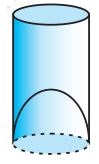
A juice seller was serving his customers using glasses as shown in Figure. The inner diameter of the cylindrical glass was 5 cm, but the bottom of the glass had a hemispherical raised portion which reduced the capacity of the glass. If the height of a glass was 10 cm, find the apparent capacity of the glass and its actual capacity. \(\left[ Use\quad \pi =3.14 \right] \)
5.
An iron pillar has some part in the form of a right circular cylinder and remaining in the form of a right circular cone. the radius of base of each of cone and cylinder is 8 cm. The cylindrical part is 240 cm high and the conical part is 36 cm high. Find the weight of the pillar, if one cubic cm of iron weights 10 g. [Use \(\pi =22/7\)]
6.
Water is flowing at the rate of 15 km/hour through a pipe of diameter 14 cm into a cuboidal pond which is 50 m long and 44 m wide. In what time will the level of water in the pond rise by 21 cm?
7.
A solid right circular cone of diameter 14 cm and height 8 cm is melted to form a hollow sphere. If the external diameter of the sphere is 10 cm, find the internal diameter of the sphere.
8.
The interior of a building is in the form of a cylinder of diameter 4.3m and height 3.8m, surmounted by a cone whose vertical angle is a right angle.Find the area of the surface and volume of the building.
9.
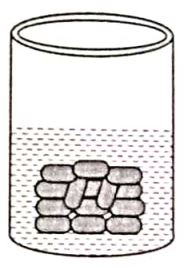
A gulab jamun, contains sugar syrup up to about 30% of its volume.Find approximately how much syrup would be found in 45 gulab jamuns, each shaped like a cylinder with two hemispherical ends with length 5cm and diameter 2.8cm . (see figure).
10.
The dimensions of a room are 8m x 6m xh.It has two doors each of size 2m x 1m and one almirah of size 3m x 2m.The cost of covering the walls by wallpaper which is 40cm wide at Rs.1.25 per m is Rs.362.50.Find height.
1.
Let BPC be the hemisphere and ABC be the cone standing on the base of the hemisphere (see Figure). The radius BO of the hemisphere (as well as of the cone) \(=\frac{1}{2} \times 4 \mathrm{~cm}=2 \mathrm{~cm} .\)
So, volume of the toy = \(\begin{aligned} & =\frac{2}{3} \pi r^3+\frac{1}{3} \pi r^2 h \end{aligned}\)
\(\begin{aligned} & =\left[\frac{2}{3} \times 3.14 \times(2)^3+\frac{1}{3} \times 3.14 \times(2)^2 \times 2\right] \mathrm{cm}^3=25.12 \mathrm{~cm}^3 \end{aligned}\)
Now, let the right circular cylinder EFGH circumscribe the given solid. The radius of the base of the right circular cylinder = HP = BO = 2 cm, and its height is EH = AO + OP = (2 + 2) cm = 4 cm
So, the colume required = volume of the right circular cylinder - volume of the toy
= 3.14 \(\times\)22 \(\times\)4 - 25.12) cm3
= 25.12 cm3
hence, the required difference of the two volumes = 25.12 cm3.
2.
The volume of air inside the shed (when there are no people or machinery) is given by the volume of air inside the cuboid and inside the half cylinder, taken together.
Now, the length, breadth and height of the cuboid are 15 m, 7 m and 8 m, respectively. Also, the diameter of the half cylinder is 7 m and its height is 15 m.
So, the required volume = volume of the cuboid \(+\frac{1}{2}\) volume of the cylinder
\(=\left[15 \times 7 \times 8+\frac{1}{2} \times \frac{22}{7} \times \frac{7}{2} \times \frac{7}{2} \times 15\right] \mathrm{m}^{3}=1128.75 \mathrm{~m}^{3}\)
Next, the total space occupied by the machinery = 300 m3
And the total space occupied by the workers = 20 × 0.08 m3 = 1.6 m3
Therefore, the volume of the air, when there are machinery and workers
= 1128.75 – (300.00 + 1.60) = 827.15 m3
3.
The total surface area of the cube = 6 × (edge)2 = 6 × 5 × 5 cm2 = 150 cm2.
Note that the part of the cube where the hemisphere is attached is not included in the surface area.
So, the surface area of the block = TSA of cube – base area of hemisphere + CSA of hemisphere
\(=150-\pi r^{2}+2 \pi r^{2}=\left(150+\pi r^{2}\right) \mathrm{cm}^{2} \)
\(=150 \mathrm{~cm}^{2}+\left(\frac{22}{7} \times \frac{4.2}{2} \times \frac{4.2}{2}\right) \mathrm{cm}^{2} \)
\(=(150+13.86) \mathrm{cm}^{2}=163.86 \mathrm{~cm}^{2}\)
4.
Since the inner diameter of the glass = 5 cm and height = 10 cm,
the apparent capacity of the glass \(=\pi r^{2} h\)
\(=3.14 \times 2.5 \times 2.5 \times 10 \mathrm{~cm}^{3}=196.25 \mathrm{~cm}^{3}\)
But the actual capacity of the glass is less by the volume of the hemisphere at the base of the glass.
i.e., it is less by \(\frac{2}{3} \pi r^{3}=\frac{2}{3} \times 3.14 \times 2.5 \times 2.5 \times 2.5 \mathrm{~cm}^{3}=32.71 \mathrm{~cm}^{3}\)
So, the actual capacity of the glass = apparent capacity of glass – volume of the hemisphere
= (196.25 – 32.71) cm3
=163.54 cm3
5.
Let r1 and r2 denote the radius of the base of the cyclinder and cone respectively.
Then r1 = r2 = 8 cm. Let h1 and h2 cm be the heights of the cylinder and the cone respectively.
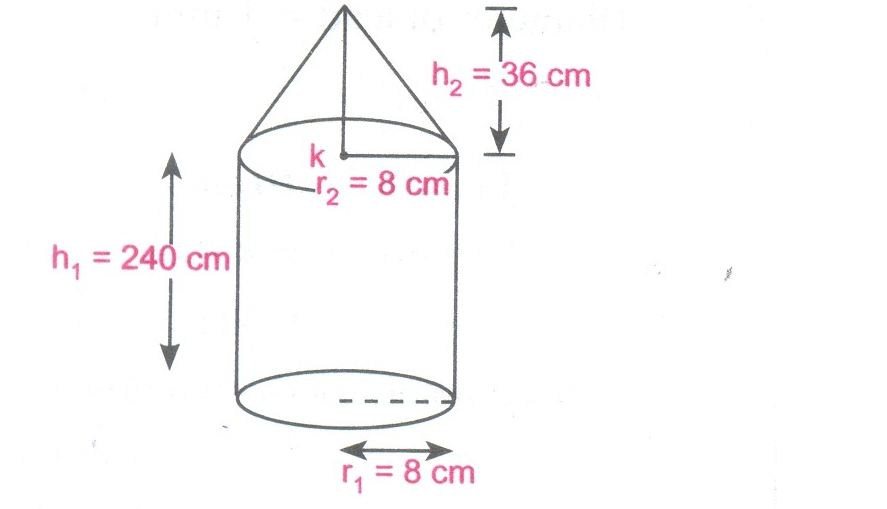
Then h1 =240 cm and h2 = 36 cm
Now volume of the cylinder = \(\pi r^{ 2 }_{ 1 }h_{ 1 }cm^{ 3 }\)
= \((\pi \times 8\times 8\times 240)cm^{ 3 }\)
\((\pi \times 64\times 240)cm^{ 3 }\)
Volume of the cone = \(\frac { 1 }{ 3 } \pi r^{ 2 }_{ 2 }h_{ 2 }cm^{ 3 }\)
=\(\left( \frac { 1 }{ 3 } \pi \times 8\times 8\times 36 \right) cm^{ 3 }\)
\(=\left( \frac { 1 }{ 3 } \pi \times 64\times 36 \right) cm^{ 3 }\)
\(\therefore \) Total volume of the iron
= volume of cylinder + volume of cone
= \(\left( \pi \times 64\times 240+\frac { 1 }{ 3 } \pi \times 64\times 36 \right) cm^{ 3 }\)
= \(\pi +64\times (240+12)cm^{ 3 }\)
= 22X64X36 cm3
Hence, total weight of the pillar
= volume X weight per cm3
= (22 x 64 x 36) 10 g = 506880 g.
= 506.88 kg.
6.
Let the level of water raise in the tank in x hours = 15000x metres
Length of the water flow in x hours = 15000x metres
Diameter of the pipe = 14 cm
radius = \(\frac { 14 }{ 2 } =7cm=\frac { 7 }{ 100 } cm\)
Volume of water = \(\pi r^{ 2 }h\)
Volume of water flow in x hours in the pond = \(\frac { 22 }{ 7 } \times \frac { 7 }{ 100 } \times \frac { 7 }{ 100 } \times 15000x\)
According to the question
\(50\times 44\times \frac { 21 }{ 100 } =\frac { 22 }{ 7 } \times \frac { 7 }{ 100 } \times \frac { 7 }{ 100 } \times 15000x\)
\(\Rightarrow 22\times 21=\frac { 154\times 15 }{ 10 } x\Rightarrow x=\frac { 22\times 21\times 10 }{ 154\times 15 } =2\)
Hence, the level of water in the pond will rise by 21 cm in 2 hours.
7.
Volume of hollow sphere = volume of cone
\(\frac{4}{3}\pi (R^3 - r^3)=\frac{1}{3}\pi r^2h\)
\(\Rightarrow \ \frac{4}{3}(5^3 - r^3)=\frac{1}{3}\times(7)^2 \times8\)
\(\Rightarrow \ \frac{4}{3}(125 - r^3)=\frac{1}{3}\times49 \times8\)
\(\Rightarrow \ 500 -4r^3 = 49\times 8\)
\(\Rightarrow \ -4r^3 = 392 - 500\)
\(\Rightarrow \ -4r^3 = -108\)
\(\Rightarrow \ r^3 =27\)
\(\Rightarrow \ r =3\) cm
Diameter, d = 6 cm
8.
Vertical angle of conical part 900
\(\Rightarrow \) Semi-vertical angle of conical part = 450
In \(\triangle \) AOB \(\angle 1=45^{ 0 }\Rightarrow OA=OB=\frac { 4.3 }{ 2 } m\)
Slant height of cone = \(\sqrt { r^{ 2 }+h^{ 2 } } =\sqrt { \left( \frac { 4.3 }{ 2 } \right) ^{ 2 } } =\frac { 4.3 }{ 2 } \sqrt { 2 } m\)
= \(\sqrt { 2\times \frac { (4.3)^{ 2 } }{ 2 } } =\frac { 4.3 }{ 2 } \sqrt { 2 } m\)
Surface area of solid = S.A. Of cone + S.A. of cylinder
= \(\pi rl+2\pi rH=\pi r(l+2H)\)
= \(\frac { 22 }{ 7 } \times \frac { 4.3 }{ 2 } \left( \frac { 4.3 }{ 2 } \sqrt { 2 } +2\times 3.8 \right) =71.896m^{ 2 }\)
Volume of the building = volume of the cylinder + volume of the cone
= \(\pi r^{ h }+\frac { 1 }{ 3 } \pi r^{ 2 }H=\pi \times r^{ 2 }\left( 3.8\times \frac { 1 }{ 3 } \times \frac { 4.3 }{ 2 } \right) \)
\(=\frac { 22 }{ 7 } \times \frac { 4.3 }{ 2 } \times \frac { 4.3 }{ 2 } \left( 3.8+\frac { 4.3 }{ 6 } \right) =65.61m^{ 2 }\)
9.
Given, one gulabjamun is a combination of a cylinder and two hemispheres. Here, total length of one gulabjamun = 5 cm and diameter = 2.8 cm
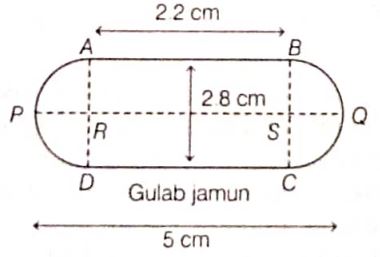
\(\therefore\) Radius of cylindrical part = Radius of hemispherical part
\(=r=\frac{2.8}{2}=1.4 \mathrm{~cm}\)
Height of cylindrical part,
h = PQ - (PR + SQ) = 5 - (1.4 + 1.4)
= 5 - 2.8 = 2.2 cm
\(\therefore\) Volume of one gulabjamun = 2 \(\times\) Volume of hemispherical part + Volume of cylindrical part
\(\begin{aligned} & =2 \times\left[\frac{2}{3} \pi r^{3}\right]+\pi r^2 h=\frac{4}{3} \pi r^{3}+\pi r^2 h \\ \end{aligned}\)
\(\begin{aligned} & =\pi r^2\left[\frac{4 r}{3}+h\right]=\frac{22}{7} \times 1.4 \times 1.4\left[\frac{4}{3} \times 1.4+2.2\right] \\ \end{aligned}\)
\(\begin{aligned} & =\frac{22}{7} \times \frac{14}{10} \times \frac{14}{10}\left[\frac{4}{3} \times \frac{14}{10}+\frac{22}{10}\right] \\ \end{aligned}\)
\(\begin{aligned} & =22 \times \frac{1}{5} \times \frac{7}{5}\left[\frac{28}{15}+\frac{11}{5}\right]=\frac{154}{25} \times \frac{61}{15}=\frac{9394}{375} \mathrm{~cm}^3 \end{aligned}\)
Now, volume of 45 gulabjamuns
\(=45 \times \frac{9394}{375}=\frac{3 \times 9394}{25}=\frac{28182}{25}=1127.28 \mathrm{~cm}^3\)
Since, one gulabjamun contains sugar syrup upto about 30% of its volume.
Hence, quantity of syrup found in 45 gulabjamuns
\(=1127.28 \times \frac{30}{100}=1127.28 \times \frac{3}{10}=338.184 \approx 338 \mathrm{~cm}^3\)
10.
Total cost of covering the walls with wallpaper = Rs 362.50
Cost of paper per m = Rs 1.25
\(\Rightarrow \) Length of paper = \(\frac { Rs\quad 362.50 }{ Rs\quad 1.25 } =290m\)
Area of paper required = area of 4 walls =area Of 2 doors =area of I almirah
\(\Rightarrow 290\times \frac { 40 }{ 100 } =\left[ 2h(8+6)-2\times 2\times 1-3\times 2 \right] m^{ 2 }\)
\(\Rightarrow 29\times 4=(28h-4-6)m^{ 2 }\)
\(\Rightarrow \) 116=28h-10\(\Rightarrow \) 126\(\Rightarrow \) h= \(\frac { 126 }{ 28 } =4.5m\)

10th Standard CBSE Syllabus & Materials
10th Standard CBSE
CBSE 10th Social Science PS - Federalism - New Model Questions Papers Study Material - QB365 Set A
NEW10th Standard CBSE
CBSE 10th Social Science PS - Power Sharing - New Model Questions Papers Study Material - QB365 Set A
NEW10th Standard CBSE
CBSE 10th Social Science GEO - Manufacturing Industries - New Model Questions Papers Study Material - QB365 Set A
NEW10th Standard CBSE
CBSE 10th Social Science GEO - Minerals and Energy Resources - New Model Questions Papers Study Material - QB365 Set A



NCERT Books

Syllabus

Exam Pattern

Sample Question Papers

Previous year Question Papers

Important Notes

MCQ Practice test

NCERT Exemplers

Case study Questions

Image Based Questions

Passage based Questions

HOT Questions

Value Based Questions

Model Questions Papers
NCERT ( Book Back ) Questions

Assertion and Reason
Important Questions And Answers

CBSE 10th Standard CBSE Subjects
CBSE Standards



