
 100% FREE ACCESS
10th Standard CBSE Syllabus & Materials
10th Standard CBSE
CBSE 10th Social Science ECO - Globalisation and the Indian Economy - New Model Questions Papers Study Material - QB365 Set A
NEW10th Standard CBSE
CBSE 10th Social Science ECO - Money and Credit - New Model Questions Papers Study Material - QB365 Set A
NEW10th Standard CBSE
CBSE 10th Social Science ECO - Sectors of the Indian Economy - New Model Questions Papers Study Material - QB365 Set A
NEW10th Standard CBSE
CBSE 10th Social Science ECO - Development - New Model Questions Papers Study Material - QB365 Set A
NEW10th Standard CBSE
CBSE 10th Social Science PS - Outcomes of Democracy - New Model Questions Papers Study Material - QB365 Set A
NEW10th Standard CBSE
CBSE 10th Social Science PS - Gender, Religion and Caste - New Model Questions Papers Study Material - QB365 Set A

Published on: 20/10/2025
Download CBSE Class 10th Standard CBSE Maths question papers, sample papers, important questions, and previous year solved papers in PDF format. Get free study materials, NCERT solutions, and exam preparation resources for Class 10th Standard CBSE Maths
Questions + Answers key
Take MCQ Maths Test
1.
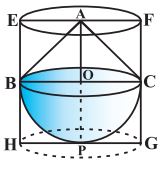
A solid toy is in the form of a hemisphere surmounted by a right circular cone. The height of the cone is 2 cm and the diameter of the base is 4 cm. Determine the volume of the toy. If a right circular cylinder circumscribes the toy, find the difference of the volumes of the cylinder and the toy. (Take \(\pi\)= 3.14)
2.
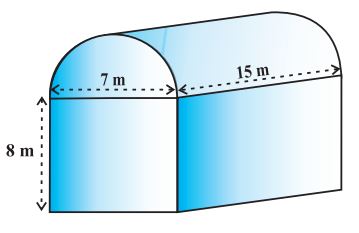
Shanta runs an industry in a shed which is in the shape of a cuboid surmounted by a half cylinder (see figure). If the base of the shed is of dimension 7 m × 15 m, and the height of the cuboidal portion is 8 m, find the volume of air that the shed can hold. Further,suppose the machinery in the shed occupies a total space of 300 m3, and there are 20 workers, each of whom occupy about 0.08 m3 space on an average. Then, how much air is in the shed? \(\text { (Take } \pi=\frac{22}{7} \text { ) }\)
3.
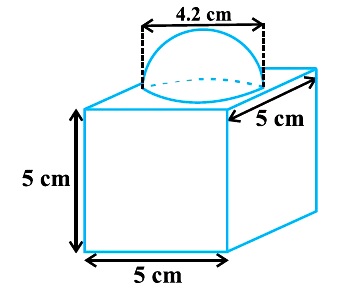
The decorative block shown in figure is made of two solids — a cube and a hemisphere. The base of the block is a cube with edge 5 cm, and the hemisphere fixed on the top has a diameter of 4.2 cm. Find the total surface area of the block. \(\text { (Take } \pi=\frac{22}{7} \text { ) }\)
4.
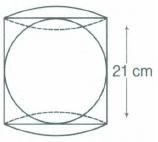
Ashwani, a factory owner wants to thank all his workers by gifting a decorated spherical ball. The diameter of the sphere is (2a+5) cm. Each ball is to be packed in a right circular cylindrical box which just encloses a sphere as shown in the figure.
If the height of the cylinder is 21 cm, then
(i) what is the value of a?
(ii) what is the curved surface area of a sphere?
(iii) which value are shown by Ashwani?
5.
A sphere, of diameter 12 cm, is dropped in a right circular cylindrical vessel, partly filled with water. If the sphere is completely submerged in water, the water level in the cylindrical vessel rises by 3\(\frac{5}{9}\) cm. Find the diameter of the cylindrical vessel.
6.
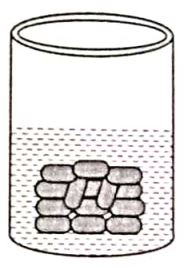
A gulab jamun, contains sugar syrup up to about 30% of its volume.Find approximately how much syrup would be found in 45 gulab jamuns, each shaped like a cylinder with two hemispherical ends with length 5cm and diameter 2.8cm . (see figure).
7.
The group of Class X students went on a trip. The incharge of the trip is planned to stay in tents. They took canvas for the arrangement of two tents which is in the shape of a cylinder surmounted by a conical top. The height and diameter of the cylindrical part are 2.1 m and 4 m respectively, and the slant height of the top is 2.8 m.
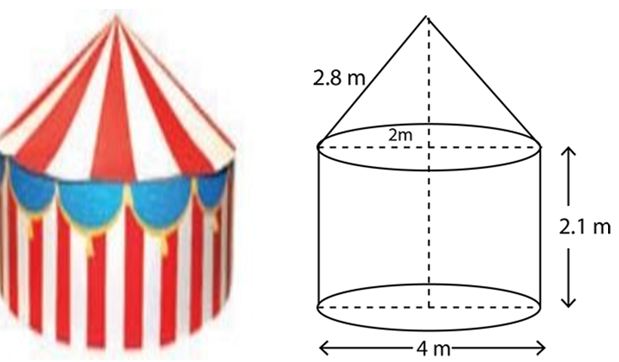
(i) Write the formula of Total Surface Area of cylinder
| (a) \(2 \pi r(r+h)\) | (b) \(2 \pi r h\) | (c) \(\frac{1}{3} \pi r^{2} h\) | (d) none of these |
(ii) Find the formula for finding the Area of canvas used in one tent.
| (a) \(2 \pi r h+\Pi r l\) | (b) \(2 \Pi r h+\Pi r l+2 \Pi r^{2}\) | (c) \(2 \Pi r h+\Pi r l+\Pi r^{2}\) | (d) \(\Pi r h+\Pi r l\) |
(iii) What will be the volume of tent if the conical part of tent has height H and radius R and the height of cylinder is h and base radius is same as of cone?
| (a) \(\frac{1}{3} \pi \mathrm{R}^{2} \mathrm{H}+\pi \mathrm{R}^{2} h\) | (b) \(\frac{1}{3} \pi \mathrm{R}^{2} \mathrm{H}\) | (c) \(\pi \mathrm{R}^{2} h\) | (d) none of these |
(iv) What is the ratio of volumes of two cylinders of radius cm, height 5 cm and radius 3 cm, height 5 cm respectively?
| (a) 1 : 9 | (b) 2 : 9 | (c) 3 : 9 | (d) 4:9 |
(v) Find the area of the canvas used for making one tent used in the trip.
| (a) 4.4m2 | (b) 44m2 | (c) 440 m² | (d) none of these |
8.
In a potato race, a bucket is placed at the starting point, which is 4 m from the first potato, and the other potatoes are placed 3 m apart in a straight line. There are ten potatoes in the line (see below figure).
A competitor starts from the bucket, picks up the nearest potato, runs back with it, drops it in the bucket, runs back to pick up the next potato, runs to the bucket to drop it in, and she continues in the same way until all the potatoes are in the bucket

(a) What is the distance covered by the competitor in first potato?
| (a) 10m | (b) 8m | (c) 12m | (d) 14m |
(ii) What is the distance covered by the competitor in second potato?
| (a) 14 m | (b) 12 m | (c) 10 m | (d) 8m |
(iii) What is the distance covered by the competitor in fourth potato?
| (a) 22 m | (b) 24 m | (c) 26 m | (d) 28 m |
(iv) What is the total distance covered by the competitor in first and second potato?
| (a) 22 m | (b) 24 m | (c) 26 m | (d) 30 m |
(v) If the A.P. 8, 14, 20, ..., then find the common difference
| (a) 4 | (b) 8 | (c) 12 | (d) 6 |
9.
A student made a wooden pen stand which is in the shape of a cuboid with four conical depressions to hold pens. The dimensions of the cuboid are 15 cm by 10 cm by 3.5 cm. The radius of each of the depressions is 0.5 cm and the depth is 1.4 cm. Find the volume of wood in the entire stand (see the below figure).
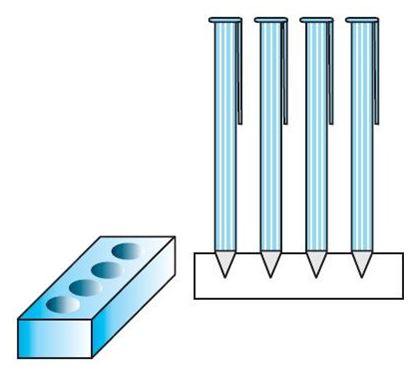
(a) What is the volume of cuboid?
| (i) 525 cm3 | (ii) 225 cm3 | (iii) 552 cm3 | (iv) 225 cm3 |
(b) What is the volume of cone?
| (i) \(\frac{11}{3} \mathrm{~cm}^{3}\) | (ii) \(\frac{11}{30} \mathrm{~cm}^{3}\) | (iii) \(\frac{3}{11} \mathrm{~cm}^{3}\) | (iv) \(\frac{30}{11} \mathrm{~cm}^{3}\) |
(c) What is the total volume of conical depressions?
| (i) 1.74 cm3 | (ii) 1.44cm3 | (iii) 1.47cm3 | (iv) 1.77cm3 |
(d) What is the volume of wood in the entire stand?
| (i) 522.35 cm3 | (ii) 532.53 cm3 | (iii) 523.35 cm3 | (iv) 523.53cm3 |
(e) The given problem is based on which mathematical concept?
| (i) Triangle | (ii) surface Areas & Volumes | (iii) Height & Distances | (iv) None of these |
10.
Rasheed is very happy for his birthday celebration. He got lot of birthday gifts in his party. Out of all birthday gifts, he liked a playing top (lattu) most, which surprisingly had no colour on it. He wanted to colour it with his crayons. The top is shaped like a cone surmounted by a hemisphere (see the below figure). The entire top is 5 cm in height and the diameter of the top is 3.5 cm.
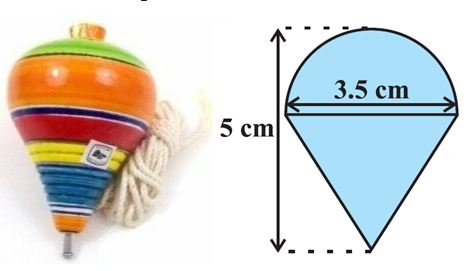
(a) What is height of the cone?
| (i) 5 cm | (ii) 3 cm | (iii) 3.25 cm | (iv) 4 cm |
(b) What is slant height of the cone?
| (i) 5 cm | (ii) 3.7 cm | (iii) 3.25 cm | (iv) 4cm |
(c) What is the Curved Surface Area of the cone?
| (i) 19.5 cm2 | (ii) 20.35 cm2 | (iii) 20.5 cm2 | (iv) 19.25 cm2 |
(d) What is the Curved Surface Area of the hemisphere?
| (i) 19.5 cm2 | (ii) 20.35 cm2 | (iii) 20.5 cm2 | (iv) 19.25 cm2 |
(e) What is the Total Surface Area of the toy?
| (i) 39.6 cm2 | (ii) 39.35 cm2 | (iii) 39.5 cm2 | (iv) 39.85 cm2 |
1.
Let BPC be the hemisphere and ABC be the cone standing on the base of the hemisphere (see Figure). The radius BO of the hemisphere (as well as of the cone) \(=\frac{1}{2} \times 4 \mathrm{~cm}=2 \mathrm{~cm} .\)
So, volume of the toy = \(\begin{aligned} & =\frac{2}{3} \pi r^3+\frac{1}{3} \pi r^2 h \end{aligned}\)
\(\begin{aligned} & =\left[\frac{2}{3} \times 3.14 \times(2)^3+\frac{1}{3} \times 3.14 \times(2)^2 \times 2\right] \mathrm{cm}^3=25.12 \mathrm{~cm}^3 \end{aligned}\)
Now, let the right circular cylinder EFGH circumscribe the given solid. The radius of the base of the right circular cylinder = HP = BO = 2 cm, and its height is EH = AO + OP = (2 + 2) cm = 4 cm
So, the colume required = volume of the right circular cylinder - volume of the toy
= 3.14 \(\times\)22 \(\times\)4 - 25.12) cm3
= 25.12 cm3
hence, the required difference of the two volumes = 25.12 cm3.
2.
The volume of air inside the shed (when there are no people or machinery) is given by the volume of air inside the cuboid and inside the half cylinder, taken together.
Now, the length, breadth and height of the cuboid are 15 m, 7 m and 8 m, respectively. Also, the diameter of the half cylinder is 7 m and its height is 15 m.
So, the required volume = volume of the cuboid \(+\frac{1}{2}\) volume of the cylinder
\(=\left[15 \times 7 \times 8+\frac{1}{2} \times \frac{22}{7} \times \frac{7}{2} \times \frac{7}{2} \times 15\right] \mathrm{m}^{3}=1128.75 \mathrm{~m}^{3}\)
Next, the total space occupied by the machinery = 300 m3
And the total space occupied by the workers = 20 × 0.08 m3 = 1.6 m3
Therefore, the volume of the air, when there are machinery and workers
= 1128.75 – (300.00 + 1.60) = 827.15 m3
3.
The total surface area of the cube = 6 × (edge)2 = 6 × 5 × 5 cm2 = 150 cm2.
Note that the part of the cube where the hemisphere is attached is not included in the surface area.
So, the surface area of the block = TSA of cube – base area of hemisphere + CSA of hemisphere
\(=150-\pi r^{2}+2 \pi r^{2}=\left(150+\pi r^{2}\right) \mathrm{cm}^{2} \)
\(=150 \mathrm{~cm}^{2}+\left(\frac{22}{7} \times \frac{4.2}{2} \times \frac{4.2}{2}\right) \mathrm{cm}^{2} \)
\(=(150+13.86) \mathrm{cm}^{2}=163.86 \mathrm{~cm}^{2}\)
4.
(i) 8 cm
(ii) 1386 cm2
(iii) Social justice, caring
5.
Increase in water level when sphere is dropped into cylindrical vessel = \(\frac{32}{9}\)cm
Volume of water level raised = \(\pi r^2h\) \(=\frac{22}{7}=r^2=\frac{32}{9}\)
Volume of water level raised = volume of sphere
\(\frac{22}{7}=r^2=\frac{32}{9}\)= \(\frac{4}{3}\times\frac{22}{7}\times(6)^3\)
\(\Rightarrow\) r2 = 81
\(\Rightarrow\) r = 9 cm
Diameter, d = 18 cm
6.
Given, one gulabjamun is a combination of a cylinder and two hemispheres. Here, total length of one gulabjamun = 5 cm and diameter = 2.8 cm
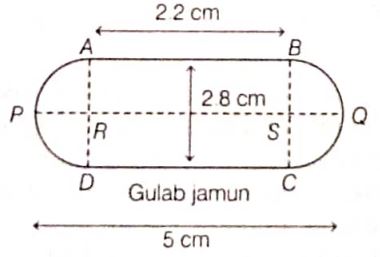
\(\therefore\) Radius of cylindrical part = Radius of hemispherical part
\(=r=\frac{2.8}{2}=1.4 \mathrm{~cm}\)
Height of cylindrical part,
h = PQ - (PR + SQ) = 5 - (1.4 + 1.4)
= 5 - 2.8 = 2.2 cm
\(\therefore\) Volume of one gulabjamun = 2 \(\times\) Volume of hemispherical part + Volume of cylindrical part
\(\begin{aligned} & =2 \times\left[\frac{2}{3} \pi r^{3}\right]+\pi r^2 h=\frac{4}{3} \pi r^{3}+\pi r^2 h \\ \end{aligned}\)
\(\begin{aligned} & =\pi r^2\left[\frac{4 r}{3}+h\right]=\frac{22}{7} \times 1.4 \times 1.4\left[\frac{4}{3} \times 1.4+2.2\right] \\ \end{aligned}\)
\(\begin{aligned} & =\frac{22}{7} \times \frac{14}{10} \times \frac{14}{10}\left[\frac{4}{3} \times \frac{14}{10}+\frac{22}{10}\right] \\ \end{aligned}\)
\(\begin{aligned} & =22 \times \frac{1}{5} \times \frac{7}{5}\left[\frac{28}{15}+\frac{11}{5}\right]=\frac{154}{25} \times \frac{61}{15}=\frac{9394}{375} \mathrm{~cm}^3 \end{aligned}\)
Now, volume of 45 gulabjamuns
\(=45 \times \frac{9394}{375}=\frac{3 \times 9394}{25}=\frac{28182}{25}=1127.28 \mathrm{~cm}^3\)
Since, one gulabjamun contains sugar syrup upto about 30% of its volume.
Hence, quantity of syrup found in 45 gulabjamuns
\(=1127.28 \times \frac{30}{100}=1127.28 \times \frac{3}{10}=338.184 \approx 338 \mathrm{~cm}^3\)
7.
(i) (a) \(2 \pi r(r+h)\)
(ii) (a) Area of canvas used = Cuurved Surface Area of conical part + Curved Surface Area of cylindrical part
\(=\pi r l+2 \pi r h\)
(iii) (d) Volume of tent = Volume of cylinder + Volume of cone
= \(\frac{1}{3} \pi R^{2} H+\pi R^{2} h\)
(iv) (d) \(\text { Ratio of volume of two cylinders }=\frac{\pi R_{1}^{2} H_{1}}{\pi R_{2}^{2} \mathrm{H}_{2}}\)
= \(\frac{2 \times 2 \times 5}{3 \times 3 \times 5}=\frac{4}{9}\)
(v)(b) \(\text { Area of canvas used }=\pi r l+2 \pi r h\)
= \(\pi r(2 h+l)\)
= \(\frac{22}{7} \times 2(2 \times(2.1)+2.8)\)
8.
(i) (b) 8m
(ii) (a) 14m
(iii) (c) 26m
(iv) (a) 22m
(v) (d) 6m
9.
(a) (i) Volume of cuboid = lbh
= 15 X 10 X 3.5
= 15 X 35 = 525cm3
(b) (ii) Volume of cone = \(\frac{1}{3} \pi \mathrm{R}^{2} \mathrm{H}=\frac{1}{3} \times \frac{22}{7} \times 0.5 \times 0.5 \times 1.4\)
\(=\frac{1}{3} \times \frac{22}{7} \times \frac{1}{2} \times \frac{1}{2} \times \frac{14}{10}=\frac{11}{30} \mathrm{~cm}^{3} .\)
(c) (iii) \(\text { Volume of } 4 \text { cones }=4 \times \frac{11}{30} \mathrm{~cm}^{3}=\frac{22}{15} \mathrm{~cm}^{3}=1.47 \mathrm{~cm}^{3}\)
(d) (iii) Volume of wood = 525 cm3 – 1.47 cm3
= 523.53 cm3
(e) (ii) )Surface Areas & Volumes
10.
(a) (iii) Height of the cone = height of the top – height (radius) of the hemispherical part
= 5 – (3.5/2) = 5 – 1.75
= 3.25 cm
(b) (ii) Slant height of the cone \((l)=\sqrt{r^{2}+h^{2}}\)
\(=\sqrt{\left(\frac{3.5}{2}\right)^{2}+(3.25)^{2}} \mathrm{~cm}\)
= 3.7 cm(approx)
(c) (iii) \(\text { CSA of cone }=\pi r l=\left(\frac{22}{7} \times \frac{3.5}{2} \times 3.7\right) \mathrm{cm}^{2}\)
= 20.35 cm2
(d) (iv) Curved surface area of the hemisphere =\(2 \pi r^{2}\)
=\(\left(2 \times \frac{22}{7} \times \frac{3.5}{2} \times \frac{3.5}{2}\right) \mathrm{cm}^{2} \\\)
=19.25 cm2
(e) (i) Total Surface Area of the toy = CSA of hemisphere + CSA of cone
= 19.25 + 20.35 cm2
= 39.6 cm2

10th Standard CBSE Syllabus & Materials
10th Standard CBSE
CBSE 10th Social Science PS - Federalism - New Model Questions Papers Study Material - QB365 Set A
NEW10th Standard CBSE
CBSE 10th Social Science PS - Power Sharing - New Model Questions Papers Study Material - QB365 Set A
NEW10th Standard CBSE
CBSE 10th Social Science GEO - Manufacturing Industries - New Model Questions Papers Study Material - QB365 Set A
NEW10th Standard CBSE
CBSE 10th Social Science GEO - Minerals and Energy Resources - New Model Questions Papers Study Material - QB365 Set A



NCERT Books

Syllabus

Exam Pattern

Sample Question Papers

Previous year Question Papers

Important Notes

MCQ Practice test

NCERT Exemplers

Case study Questions

Image Based Questions

Passage based Questions

HOT Questions

Value Based Questions

Model Questions Papers
NCERT ( Book Back ) Questions

Assertion and Reason
Important Questions And Answers

CBSE 10th Standard CBSE Subjects
CBSE Standards



