
 100% FREE ACCESS
10th Standard CBSE Syllabus & Materials
10th Standard CBSE
CBSE 10th Social Science ECO - Globalisation and the Indian Economy - New Model Questions Papers Study Material - QB365 Set A
NEW10th Standard CBSE
CBSE 10th Social Science ECO - Money and Credit - New Model Questions Papers Study Material - QB365 Set A
NEW10th Standard CBSE
CBSE 10th Social Science ECO - Sectors of the Indian Economy - New Model Questions Papers Study Material - QB365 Set A
NEW10th Standard CBSE
CBSE 10th Social Science ECO - Development - New Model Questions Papers Study Material - QB365 Set A
NEW10th Standard CBSE
CBSE 10th Social Science PS - Outcomes of Democracy - New Model Questions Papers Study Material - QB365 Set A
NEW10th Standard CBSE
CBSE 10th Social Science PS - Gender, Religion and Caste - New Model Questions Papers Study Material - QB365 Set A

Published on: 20/10/2025
Download CBSE Class 10th Standard CBSE Maths question papers, sample papers, important questions, and previous year solved papers in PDF format. Get free study materials, NCERT solutions, and exam preparation resources for Class 10th Standard CBSE Maths
Questions + Answers key
Take MCQ Maths Test
1.
A hemisphere bowl of internal radius 9cm is full of water.Its contents are emptied in a cylindrical vessel of internal radius 6cm.Find the height of water in the cylindrical vessel.
2.
The diameter of a roller 120cm long is 84cm.If it takes 500 complete revolutions to level a playground, determine the cost of levelling it at the rate of 30 paise per square metre.
3.
A cubical block of side 7 cm is surmounted by a hemisphere. What is the greatest diameter the hemisphere can have? Find the surface area of the solid.
4.
The sum of the radius of the base and the height of a solid cylinder is 37cm.If the total surface area of the of the solid cylinder is 1628cm2, find the volume of the cylinder.\([\pi=22/7]\)
5.
A vessel is in form of an inverted cone.Its height is 8cm and the radius of its top, which is open, is 5cm.It is filled with water up to the brim.When lead shots, each of which is a sphere of radius 0.5cm are dropped into the vessel, one-fourth of the water flows out.Find the number of lead shots dropped in the vessel.
6.
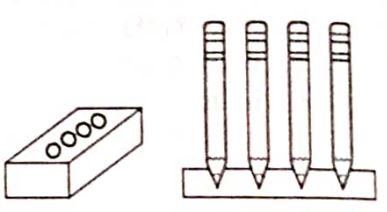
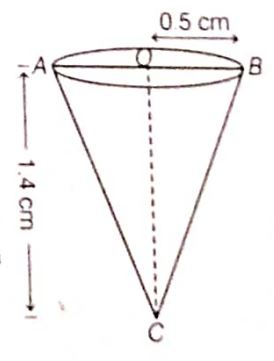
A pen stand made of wood is in the shape of a cuboid with four conical depressions to hold pens.The dimensions of the cuboid are 15 cm \(\times\) 10 cm \(\times\) 3.5 cm. The radius of each of the depressions is 0.5 cm and the depth is 1.4cm. Find the volume of wood in the entire stand (see figure).
7.
A solid is in the shape of a cone standing on a hemisphere with both their radii being equal to 1cm and the height of the cone is equal to its radius.Find the volume of the solid in terms of \(\pi\)
8.
A cylinder and a cone have equal radii of their bases and equal heights.If their curved surface areas are in the ratio 8: 5, show that the ratio of radius of each to the height of each is 3 : 4.
9.
A solid is in the shape of a cone mounted on a hemisphere of same base radius.If the curved surface areas of the hemispherical part and the conical part are equal, then find the ratio of the radius and the height of the conical part.
10.
If the lateral surface area of a cylinder is 94.2cm2 and its height is 5cm, then find radius of its base.\([\pi=3.14]\)
11.
A wooden article was made by scooping out a hemisphere from each end of a solid cylinder, as shown in figure.If the height of the cylinder is 10cm, and its base is of radius 3.5cm, find the total surface area of the article.
12.
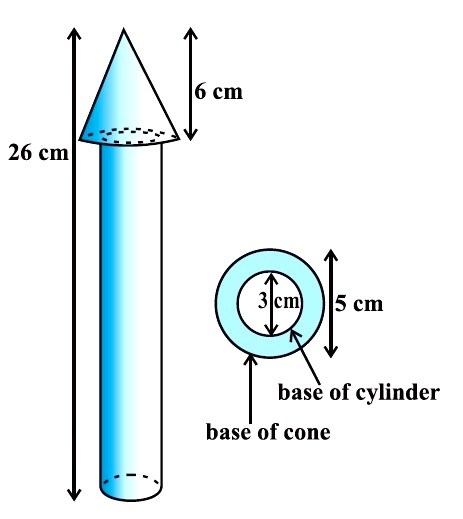
A wooden toy rocket is in the shape of a cone mounted on a cylinder, as shown in figure. The height of the entire rocket is 26 cm, while the height of the conical part is 6 cm. The base of the conical portion has a diameter of 5 cm, while the base diameter of the cylindrical portion is 3 cm. If the conical portion is to be painted orange and the cylindrical portion yellow, find the area of the rocket painted with each of these colours. \(\text { (Take } \pi=3.14)\)
13.
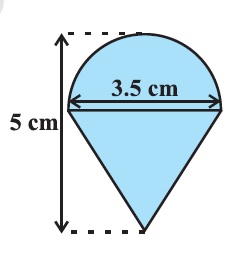
Rasheed got a playing top (lattu) as his birthday present, which surprisingly had no colour on it. He wanted to colour it with his crayons. The top is shaped like a cone surmounted by a hemisphere. The entire top is 5 cm in height and the diameter of the top is 3.5 cm. Find the area he has to colour \(\text { (Take } \pi=\frac{22}{7} \text { ) }\)
14.
An iron spherical ball has been melted and recast into smaller balls of equal size. If the radius of each of the smaller balls is 1/4 of the radius of the original ball, how many such balls are made? Compare the surface area of all the smaller balls combined together with that of the original ball.
15.
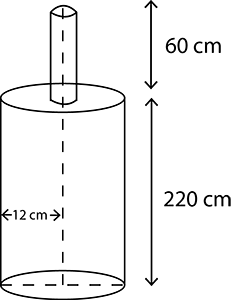
A solid iron pole consists of a cylinder of height 220 cm and base diameter 24 cm, which is surmounted by another cylinder of height 60 cm and radius 8 cm.Find the mass of the pole, given that 1cm3 of iron has approximately 8g mass.(use \(\pi\)=3.14)
16.
A toy is in the form of a cone mounted on a hemisphere of diameter 7 cm. The total height of the toy is 14.5 cm. The total surface area of the toy will be
304 .5 cm2
400 cm2
203.94 cm2
231 cm2
17.
A golf ball has diameter equal to 4.2 cm. Its surface has 200 dimples each of radius 2 mm. Assuming that the dimples are hemispherical, total surface area which is exposed to the surroundings is
85.82 cm2
100 cm2
90 cm2
80.58 cm2
18.
A toy is in the form of a cone mounted on a hemisphere of radius 3.5 cm. If the total height of the toy is 15.5 cm, then its total surface area is
212.6 cm2
216.2 cm2
214.5 cm2
220.6 cm2
19.
If a right angled triangle is revolved about one of the sides containing the right angle it forms a
Right circular cone
Right triangle
Prism
Pyramid
20.
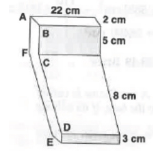
In the figure, the shape of a solid copper piece (made of two pieces) with dimensions as shown. The face ABCDEFA has uniform cross section. Assume that the angles at A, B, C, D, E and F are right angles. Calculate the volume of the piece.
840 cm
880 cm3
876 cm3
890 cm3
1.
Radius of hemispherical bowl r = 9cm
\(\therefore \) Volume of water in the bowl = volume of hemispherical bowl
= \(\frac { 2 }{ 3 } \pi r^{ 3 }=\frac { 2 }{ 3 } \pi \times (9)^{ 3 }=486\pi cm^{ 3 }\)
Radius of culindrical vessel = R= 6 cm
Let height of water in the vessel be h cm
\(\therefore \) Volume of water = \(\pi r^{ 2 }h=\pi (6)^{ 2 }h=36\pi hcm^{ 3 }\)
\(\Rightarrow 36\pi h=480\pi \Rightarrow h=13.5cm\)
2.
Diameter of roller = 84 cm \(\Rightarrow \) radius of roller = 42 cm
Area levelled in one revolutions = \(2\times \frac { 22 }{ 7 } \times 120\times 42cm^{ 2 }=\frac { 221760 }{ 7\times 10000 } m^{ 2 }\)
Area levelled in 500 revolutions = \(500\times \frac { 221760 }{ 7 } cm^{ 2 }=500\times \frac { 221760 }{ 7\times 10000 } m^{ 2 }\)
Cost of levelling 1 m2 = 30 paise
Total cost of levelling = Rs \(\frac { 30 }{ 100 } \times 500\times \frac { 221760 }{ 7\times 10000 } \) = Rs 475.20
3.
Given, a cubical block is surmounted by a hemisphere. Therefore, diameter of hemisphere must be equal to the side of cubical block and it is the greatest diameter of hemisphere.
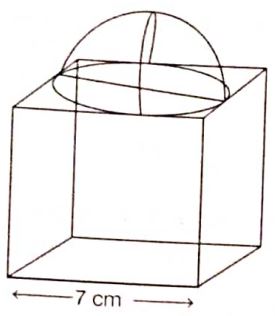
For cubical portion,
Edge = 7 cm
For hemispherical portion,
Diameter = 7 cm
\(\therefore\) Radius, r = \(\frac{7}{2}\)cm
Now, required surface area of solid = TSA of the cube + CSA of hemisphere - Area of circular base of hemisphere.
\(\begin{aligned} & =6 \times(\text { Edge })^2+2 \pi r^2-\pi r^2 \\ \end{aligned}\)
\(\begin{aligned} & =6 \times(7)^2+2 \times \frac{22}{7} \times \frac{7}{2} \times \frac{7}{2}-\frac{22}{7} \times \frac{7}{2} \times \frac{7}{2} \\ \end{aligned}\)
\(\begin{aligned} & =294+11 \times 7-\frac{11 \times 7}{2} \\ \end{aligned}\)
\(\begin{aligned} & =294+77-\frac{77}{2} \end{aligned}\)
= 371 - 38.5 = 332.5 cm2
4.
Let radius of the base be r
r+h=37 cm
h=(37-r)cm
Total surface area=2πr(r+h)⇒1628=2x\(\frac{22}{7}\)xrx37
r=1628x\(\frac{7}{22\times{2}\times{37}}\)=7cm
h=(37-7)cm=30 cm
Volume of cylinder=πr2h=\(\frac{22}{7}\)x(7)2x30 cm3=22x7x30 cm3
=4620 cm3
5.
Given, height of the cone=8 cm and radius of the cone = 5 cm
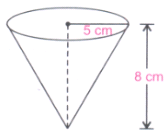
Volume of cone=\(\frac{1}{3}\)πr2h
=\(\frac{1}{3}\)π(5)28 cm3=\(\frac{200}{3}\)π cm3
Radius of one spherical lead shot=0.5 cm
Volume of one spherical lead shot=\(\frac{4}{3}\)πr 3=\(\frac{4}{3}\)π(0.5)3 cm3
=\(\frac{4\times{0.125}}{3}\)π cm3=\(\frac{0.5}{3}\)π cm3
When spherical lead are dropped in the vessel, one fourth of water flows out
Let number of lead shots be n
Volume of n spherical shots = \(\frac{1}{4}\) volume of conical vessel
n\(\left(\frac{0.5}{3}\pi\right)\)=\(\frac{1}{4}\left(\frac{200}{3}\pi\right)\)⇒n(0.5)=50⇒ n=\(\frac{50\times{10}}{5}\)=100
6.
Given, length of cuboid (l) = 15 cm, breadth of cuboid (b) = 10 cm and height of cuboid (h) = 3.5 cm
\(\therefore\) Volume of cuboid = l \(\times\) b \(\times\) h
= 15 \(\times\) 10 \(\times\)3.5 = 525 cm3
Also, radius of conical depression,r = 0.5 cm
and height of conical depression, h = 1.4 cm
\(\therefore\) Volume of one conical depression \(=\frac{1}{3} \pi \times r^2 \times h\)
\(\begin{aligned} & =\frac{1}{3} \times \frac{22}{7} \times 0.5 \times 0.5 \times 1.4 \\ \end{aligned}\)
\(\begin{aligned} & =\frac{22}{3} \times \frac{1}{2} \times \frac{1}{2} \times \frac{2}{10}=\frac{11}{30} \mathrm{~cm}^3 \end{aligned}\)
Now, volume of 4 conical depressions = 4 \(\times\)Volume of one conical depression
\(=4 \times \frac{11}{30}=\frac{22}{15} \mathrm{~cm}^3\)
Hence, the volume of wood in the entire stand = Volume of cuboid - Volume of 4 conical depressions
\(=525-\frac{22}{15}=525-1.47=523.53 \mathrm{~cm}^3\)
7.
Given, solid is a combination of a cone and a hemisphere.
Also, radius of the cone, r = radius of the hemisphere
= 1 cm
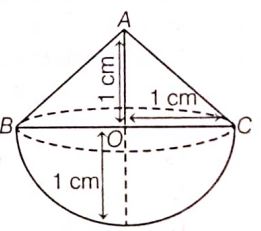
Height of the cone, h = 1 cm
\(\therefore\) Required volume of the solid = Volume of the cone + Volume of the hemisphere
\(\begin{aligned} & =\frac{1}{3} \pi r^2 h+\frac{2}{3} \pi r^3=\frac{1}{3} \pi(1)^2(1)+\frac{2}{3} \pi(1)^3 \\ \end{aligned}\)
\(\begin{aligned} & =\frac{\pi}{3}+\frac{2}{3} \pi=\frac{(\pi+2 \pi)}{3}=\frac{3 \pi}{3}=\pi \mathrm{cm}^3 \end{aligned}\)
8.
Let radius be r and the height be h.
Curved surface area of cylinder = 2πrh
Curved surface area of cone =πr\(\sqrt{r^{2}+h^{2}}\)
\(\frac{2\pi{rh}}{\pi{r}\sqrt{r^{2}+h^{2}}}\)=\(\frac{8}{5}\Rightarrow \frac{h}{\sqrt{r^{2}+h^{2}}}=\frac{4}{5}\)
⇒ 25h2=16(r2+h2)
⇒ 25h2=16r2+16h2
⇒ 9h2=16r2
⇒ \(\frac{9}{16}=\frac{r^{2}}{h^{2}}\Rightarrow \frac{r}{h}=\frac{3}{4}\)
=r:h=3:4
9.
Let radius of the base be r
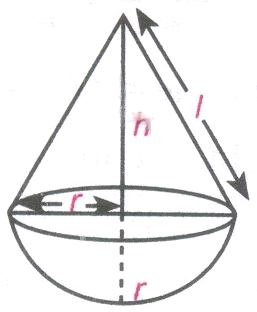
Height of conical part=h
Slant height of conical pat=l
l=\(\sqrt{h^{2}+r^{2}}\)...(i)
ATQ= 2πr2=πrl⇒ l=2r
Equation (i) becomes
2r=\(\sqrt{h^{2}+r^{2}}\)
4r2=h2+r2
h2=3r2⇒\(\frac{r^{2}}{h^{2}}\)=\(\frac{1}{3}\)
\(\frac{r}{h}\)=\(\frac{1}{\sqrt{3}}\)
r:h=1:\(\sqrt{3}\)
10.
Lateral surface area = \(94.2 \ cm^{2}\) , h = 5 cm
\(2\pi rh = 94.2\)
\(\Rightarrow \) 2 x 3.14 x r x 5 = 94.2
\(\Rightarrow \) \(r = {94.2 \over 2 \times 3.14 \times 5}\) = 3 cm
11.
Given: height of cylinder=10 cm
base radius=3.5 cm
Curved surface area of cylinder =2πrh=\(\frac{2\times22\times35\times10}{7\times10}\)cm2=220 cm2
Inner surface area of hemispherical cavity=2πr2=2x\(\frac{22}{7}\times\frac{35\times35}{10\times10}\)cm2=77 cm2
Inner surface area of both hemispherical cavity=77 cm2+77 cm2=154 cm2
Total surface area of solid = curved surface area of solid + inner surface area of both hemispherical ends
= 220 cm2 + 154 cm2 = 374 cm2
12.
Denote radius of cone by r, slant height of cone by l, height of cone by h, radius of cylinder by r' and height of cylinder by h'. Then r = 2.5 cm, h = 6 cm, r' = 1.5 cm, h' = 26 – 6 = 20 cm and
\(l=\sqrt{r^{2}+h^{2}}=\sqrt{2.5^{2}+6^{2}} \mathrm{~cm}=6.5 \mathrm{~cm}\)
Here, the conical portion has its circular base resting on the base of the cylinder, but the base of the cone is larger than the base of the cylinder. So, a part of the base of the cone (a ring) is to be painted.
So, the area to be painted orange = CSA of the cone + base area of the cone – base area of the cylinder
\(=\pi r l+\pi r^{2}-\pi\left(r^{\prime}\right)^{2} \)
\(=\pi\left[(2.5 \times 6.5)+(2.5)^{2}-(1.5)^{2}\right] \mathrm{cm}^{2} \)
\(=\pi[20.25] \mathrm{cm}^{2}=3.14 \times 20.25 \mathrm{~cm}^{2} \)
\(=63.585 \mathrm{~cm}^{2}\)
Now, the area to be painted yellow = CSA of the cylinder + area of one base of the cylinder
\(=2 \pi r^{\prime} h^{\prime}+\pi\left(r^{\prime}\right)^{2} \)
\(=\pi r^{\prime}\left(2 h^{\prime}+r^{\prime}\right) \)
\(=(3.14 \times 1.5)(2 \times 20+1.5) \mathrm{cm}^{2} \)
\(=4.71 \times 41.5 \mathrm{~cm}^{2} \)
\(=195.465 \mathrm{~cm}^{2}\)
13.
This top is exactly like the object we have discussed. So, we can conveniently use the result we have arrived at there. That is :
TSA of the toy = CSA of hemisphere + CSA of cone
Now, the curved surface area of the hemisphere = \(\frac{1}{2}\left(4 \pi r^{2}\right)=2 \pi r^{2} \)
\(=\left(2 \times \frac{22}{7} \times \frac{3.5}{2} \times \frac{3.5}{2}\right) \mathrm{cm}^{2}\)
Also, the height of the cone = height of the top – height (radius) of the hemispherical part
\(=\left(5-\frac{3.5}{2}\right) \mathrm{cm}=3.25 \mathrm{~cm}\)
So, the slant height of the cone \((l)=\sqrt{r^{2}+h^{2}}=\sqrt{\left(\frac{3.5}{2}\right)^{2}+(3.25)^{2}} \mathrm{~cm}=3.7 \mathrm{~cm}(\text { approx. })\)
Therefore, CSA of cone \(=\pi r l=\left(\frac{22}{7} \times \frac{3.5}{2} \times 3.7\right) \mathrm{cm}^{2}\)
This gives the surface area of the top as
\(=\left(2 \times \frac{22}{7} \times \frac{3.5}{2} \times \frac{3.5}{2}\right) \mathrm{cm}^{2}+\left(\frac{22}{7} \times \frac{3.5}{2} \times 3.7\right) \mathrm{cm}^{2}\)
\(=\frac{22}{7} \times \frac{3.5}{2}(3.5+3.7) \mathrm{cm}^{2}=\frac{11}{2} \times(3.5+3.7) \mathrm{cm}^{2}=39.6 \mathrm{~cm}^{2}(\text { approx. })\)
You may note that ‘total surface area of the top’ is not the sum of the total surface areas of the cone and hemisphere
14.
Let radius of original ball be 4x \(\Rightarrow \) radius of each small ball be x
Number of balls = \(\frac { Volume \ of \ original \ ball }{ Volume \ of \ 1 \ small \ ball } \)
\(=\frac { \frac { 4 }{ 3 } \pi \times (4x)^{ 3 } }{ \frac { 4 }{ 3 } \pi x^{ 3 } } =\frac { 4^{ 3 }x^{ 3 } }{ x^{ 3 } } =4^{ 3 }=64\)
S.A. of 1 small balls = 64X4 \(\pi x^{ 2 }\)
S.A of 64 small balls = 64X \(4\pi x^{ 2 }\)
S.A of original ball = \(4\pi (4x^{ 2 })=4\times \pi \times 16x^{ 2 }\)
\(=\frac { S.A \ of \ small \ balls \ combined \ together }{ S.A \ of \ original \ ball } \ =\frac { 64\times 4\pi x^{ 2 } }{ 4\pi \times 16x^{ 2 } } =4:1\)
15.
Height (h1) of larger cylinder = 220 cm
Radius (r1) of larger cylinder = \(\frac{24}{2}\)= 12 cm
Height (h2) of smaller cylinder = 60 cm
Radius (r2) of smaller cylinder = 8 cm
Total volume of pole = Volume of larger cylinder + Volume of smaller cylinder
\(\begin{aligned} & =\pi r_1^2 h_1+\pi r_2^2 h_2 \\ \end{aligned}\)
\(\begin{aligned} & =\left(\pi(12)^2 \times 220\right)+\left(\pi(8)^2 \times 60\right) \\ \end{aligned}\)
\(\begin{aligned} & =\pi[144 \times 220+64 \times 60] \\ \end{aligned}\)
\(\begin{aligned} & =3.14[31,680+3,840] \\ \end{aligned}\)
\(\begin{aligned} & =3.14 \times 35520=111,532.8 \mathrm{~cm}^3 \end{aligned}\)
Mass of 1 cm3 iron = 8 g
Mass of 111532.8 cm3 iron = 11532.8 \(\times\)8 = 892262.4 g
16.
(c)
203.94 cm2
17.
(d)
80.58 cm2
18.
(c)
214.5 cm2
19.
(a)
Right circular cone
20.
(b)
880 cm3

10th Standard CBSE Syllabus & Materials
10th Standard CBSE
CBSE 10th Social Science PS - Federalism - New Model Questions Papers Study Material - QB365 Set A
NEW10th Standard CBSE
CBSE 10th Social Science PS - Power Sharing - New Model Questions Papers Study Material - QB365 Set A
NEW10th Standard CBSE
CBSE 10th Social Science GEO - Manufacturing Industries - New Model Questions Papers Study Material - QB365 Set A
NEW10th Standard CBSE
CBSE 10th Social Science GEO - Minerals and Energy Resources - New Model Questions Papers Study Material - QB365 Set A



NCERT Books

Syllabus

Exam Pattern

Sample Question Papers

Previous year Question Papers

Important Notes

MCQ Practice test

NCERT Exemplers

Case study Questions

Image Based Questions

Passage based Questions

HOT Questions

Value Based Questions

Model Questions Papers
NCERT ( Book Back ) Questions

Assertion and Reason
Important Questions And Answers

CBSE 10th Standard CBSE Subjects
CBSE Standards



