
 100% FREE ACCESS
10th Standard CBSE Syllabus & Materials
10th Standard CBSE
CBSE 10th Social Science ECO - Globalisation and the Indian Economy - New Model Questions Papers Study Material - QB365 Set A
NEW10th Standard CBSE
CBSE 10th Social Science ECO - Money and Credit - New Model Questions Papers Study Material - QB365 Set A
NEW10th Standard CBSE
CBSE 10th Social Science ECO - Sectors of the Indian Economy - New Model Questions Papers Study Material - QB365 Set A
NEW10th Standard CBSE
CBSE 10th Social Science ECO - Development - New Model Questions Papers Study Material - QB365 Set A
NEW10th Standard CBSE
CBSE 10th Social Science PS - Outcomes of Democracy - New Model Questions Papers Study Material - QB365 Set A
NEW10th Standard CBSE
CBSE 10th Social Science PS - Gender, Religion and Caste - New Model Questions Papers Study Material - QB365 Set A

Published on: 20/10/2025
Download CBSE Class 10th Standard CBSE Maths question papers, sample papers, important questions, and previous year solved papers in PDF format. Get free study materials, NCERT solutions, and exam preparation resources for Class 10th Standard CBSE Maths
Questions + Answers key
Take MCQ Maths Test
1.
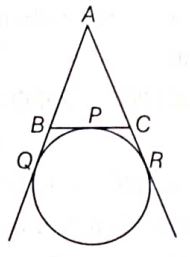
A circle touches the side BC of a \(\Delta\)ABC at a point P and touches AB and AC when produced at Q and R respectively. Show that \(A Q=\frac{1}{2}\)(Perimeter of \(\Delta\)ABC).
2.
A bag contains 6 red, 4 black and some white balls.
(i) Find the number of white balls in the bag, if the probability of drawing a white ball is 1/3.
(ii) How many red balls should be removed from the bag for the probability of drawing a white ball to be \(\frac{1}{2}\)?
3.
Prove that : \(\sqrt { \frac { \sec { \theta } -1 }{ \sec { \theta } +1 } } +\sqrt { \frac { \sec { \theta } +1 }{ \sec { \theta } -1 } } =2cosec\theta \)
4.
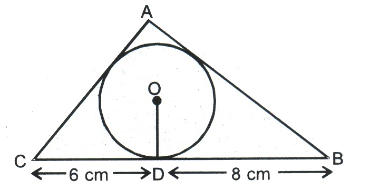
A triangle ABC is drawn to circumscribe a circle of radius 4 cm such that the segments BD and DC into which BC is divided by the point of contact D are of lengths 8 cm and 6 cm respectively (see Fig). Find the sides AB and AC.
5.
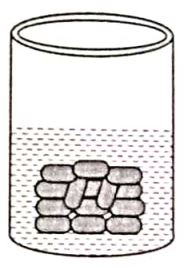
A gulab jamun, contains sugar syrup up to about 30% of its volume.Find approximately how much syrup would be found in 45 gulab jamuns, each shaped like a cylinder with two hemispherical ends with length 5cm and diameter 2.8cm . (see figure).
6.
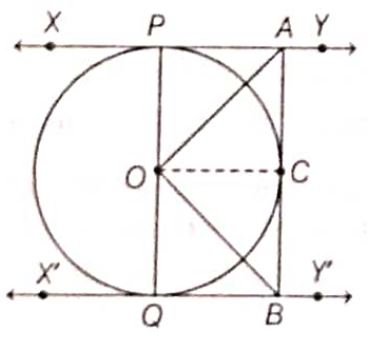
In the given figure, XY and X'Y' are two parallel tangents to a circle with centre O and another tangent AB with point of contact C intersecting XY at A and X'Y' at B.Prove that \(\angle AOB=90^0\)
7.
Prove that : \(\frac { \left( \sin ^{ 4 }{ \theta } +\cos ^{ 4 }{ \theta } \right) }{ 1-2\sin ^{ 2 }{ \theta } \cos ^{ 2 }{ \theta } } =1\)
8.
Prove \((\tan { \theta } +2)(2\tan { \theta } +1)=5\tan { \theta } +2\sec ^{ 2 }{ \theta } .\)
9.
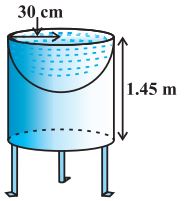
Mayank made a bird-bath for his garden in the shape of a cylinder with a hemispherical depression at one end (see fig.). The height of the cylinder is 1.45 m and its radius is 30 cm. Find the total surface area of the bird-bath.\(\left[ Take\quad \pi =\frac { 22 }{ 7 } \right] \)
10.
Cards marked with numbers 5 to 50, are placed in a box and mixed thoroughly. A card is drawn from the box at random. Find the probability that the number on the taken is
(i) a prime number less than 10.
(ii) a number which is a perfect square.
11.
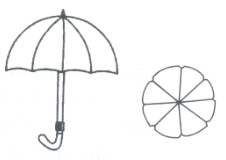
An umbrella has 8 ribs which are equally spaced (see the figure). Assuming umbrella to be a flat circle of radius 45 cm, find the area between the two consecutive ribs of the umbrella.
12.
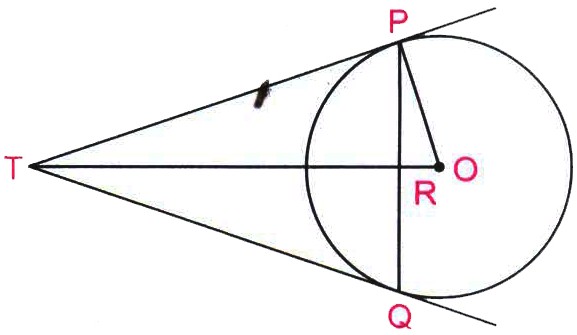
In figure PQ is a chord of length 16cm, of a circle of radius 10cm. The tangents at P and Q intersect at a point T.Find the length of TP.
13.
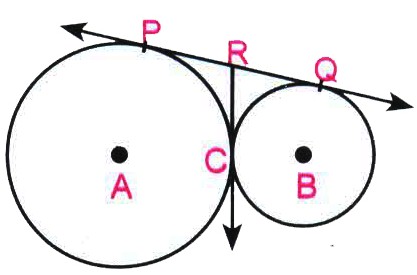
In figure, a circle touches the side BC of \(\Delta ABC\) at P and touches AB and AC produced at Q and R respectively. If AQ = 5cm, find the perimeter of \(\Delta ABC\)
 .
.
14.
(cos4 A - sin4 A) on simplified form, gives
2 sin2 A - 1
2 sin2 A + 1
2 cos2 A + 1
2 cos2 A - 1
15.
A surahi is the combination of
a sphere and a cylinder
a hemisphere and a cylinder
two hemispheres
a cylinder and a cone
16.
In the given figure, two concentric circles of radii 5 cm and 3 cm have their centre O. OAB is a sector of outer circle making an angle of 60° at the centre while OCD is the sector of smaller Circle. The area of the shaded region is
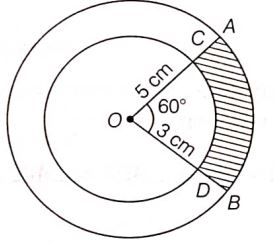
\(\frac{7 \pi}{2} \mathrm{~cm}^2\)
\(\frac{8 \pi}{3} \mathrm{~cm}^2\)
\(\frac{25 \pi}{6} \mathrm{~cm}^2\)
\(\frac{3 \pi}{2} \mathrm{~cm}^2\)
17.
If cos \(\theta=\frac{1}{\sqrt{2}},\) then tan \(\theta\) is equal to
\(\frac{1}{\sqrt{2}}\)
0
1
\(\sqrt{2}+1\)
18.
From a solid cube of side 14 cm, a sphere of maximum diameter is carved out. The radius of sphere is
7 cm
14 cm
\(\frac{7}{2}\) cm
\(\sqrt{14}\) cm
19.
In the given figure, a circle touches all the four sides of quadrilateral ABCD with AB = 6 cm, BC = 7 cm and CD = 4 cm, then length of AD is
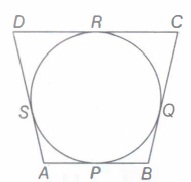
3 cm
4 cm
5 cm
6 cm
20.
In the given figure, if TP and TQ are the two tangents to a circle with centre O so that \(\angle POQ\)= 110°, then \(\angle PTQ\) is equal to
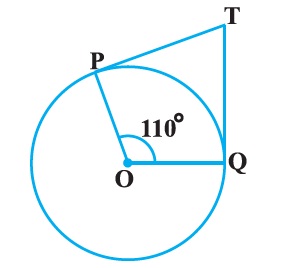
60°
70°
80°
90°
21.
If a cot θ + b cosec θ = p and b cot θ + a cosec θ = q then p2 – q2 is equal to:
b2 + a2
b2 – a2
a2 – b2
a2 + b2
22.
\(\frac { sin\theta }{ 1-cos\theta } \) is equal to
\(\frac { 1-cos\theta }{ sin\theta } \)
\(\frac { 1+cos\theta }{ sin\theta } \)
\(\frac { 1-cos\theta }{ cos\theta } \)
\(\frac { 1-sin\theta }{ cos\theta } \)
23.
A circus tent is cylindrical to a height of 4 m and conical above it. If its diameter is 105 m and its slant height is 40 m, the total area of the canvas required is
7920 m2
2640 m2
1760 m2
3960 m2
24.
If the curved surface area of a right circular cylinder is 1760 cm2 and its radius is 10 cm, then what is its height?
7 cm
24 cm
28 cm
14 cm
25.
A momento is made as shown in the figure. Its base shade is to be silver plated from the front at the rate of 20 per cm2. what is the total coast of silver plating?
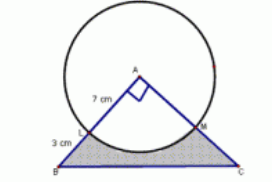
230
260
240
250
26.
A square ABCD is inscribed in a circle of 10 units. The area of the circle not included in the square is
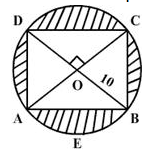
100 sq. units
250 sq. units
114 sq. units
112 sq. units
27.
Find the circumference of the circle, whose area is 144 cm2
46 πcm
24 πcm
72 πcm
12 πcm
28.
A fair die is cast in the game of ‘Ludo’. The probability of getting a score greater than 6 is
zero
2/3
1/6
1
29.
In the figure, the pair of tangents AP and AQ, drawn from an external point A to a circle with centre O, are perpendicular to each other and length of each tangent is 4 cm, then the radius of the circle is
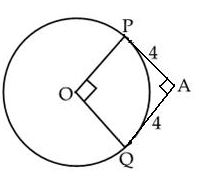
10 cm
4 cm
7.5 cm
2.5 cm
30.
In the figure, Ab is a chord of length 16 cm, of a circle of radius 10 cm. The tangents at A and B intersect at a point P. Find the length of PA.
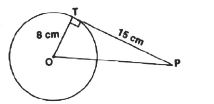
\(\frac { 20 }{ 5 } \)cm
\(\frac { 40 }{ 5 } \)cm
\(\frac { 20 }{ 3 } \)cm
\(\frac { 40 }{ 3 } \)cm
31.
Which of the following cannot be the probability of an event?
\(\frac{2}{3}\)
-1.5
15%
0.7
32.
Prove that \(\frac{1}{1+\sin \theta}+\frac{1}{1-\sin \theta}=2 \sec ^2 0\)
33.
Prove that : \(\frac { { cosec }^{ 2 }\theta }{ { cosec }\theta -1 } -\frac { { cosec }^{ 2 }\theta }{ { cosec }\theta +1 } =2\sec ^{ 2 }{ \theta } \)
34.
A petrol tank is a cylinder of diameter 21 cm and length 18 cm fitted with conical ends each of axis-length 9 cm. Determine the surface area of the petrol tank.
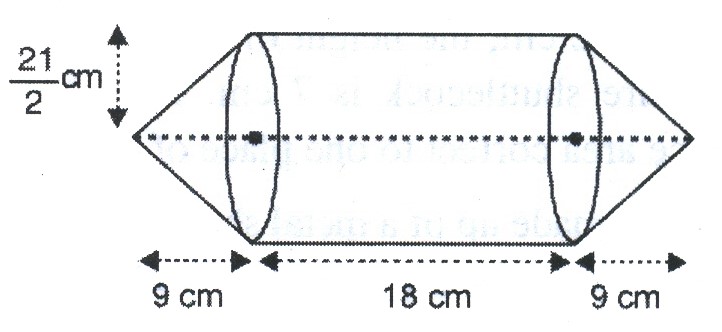
35.
The volume of a hemisphere is \(2425\frac { 1 }{ 2 } { cm }^{ 3 }.\) Find its curved surface area. \(\left[ Use\quad \pi =\frac { 22 }{ 7 } \right] \)
36.
Three different coins are tossed together. Find the probability of getting
(i) exactly two heads
(ii) at least two heads
(iii) at least two tails.
37.
Two dice are thrown simultaneously. What is the probability that
(a) 5 will not come up on either of them?
(b) 5 will come up on at least one?
(c) 5 will come up at both dice?
38.
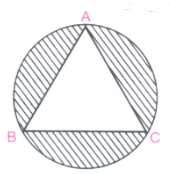
In given figure, an equilateral triangle has been inscribed in a circle of radius 6 cm. Find the area of the shaded region. \([Use\ \pi=3.14]\)
39.
Assertion (A) Total surface area of the toy is the sum of the curved surface area of the hemisphere and the curved surface area of the cone.
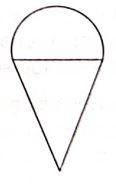
Reason (R) Toy is obtained by fixing the plane surfaces of the hemisphere and cone together.
(a) Both Assertion and Reason are correct and Reason is the correct explanation of Assertion.
(b) Both Assertion and Reason are correct but Reason is not the correct explanation of Assertion.
(c) Assertion is correct but Reason is incorrect.
(d) Assertion is incorrect but Reason is correct.
40.
Assertion : In the given figure, AP and AO are tangents to a circle such that AP = 11cm and \(\angle P A Q=60^{\circ}\), then length of PQ is 8 cm.
Reason : The centre of the circle lies on the bisector of the angle between the two tangents.
Codes :
(a) If both Assertion and Reason are correct and Reason is the correct explanation of Assertion.
(b) If both Assertion and Reason are correct, but Reason is not the correct explanation of Assertion.
(c) If Assertion is correct but Reason is incorrect.
(d) If Assertion is incorrect but Reason is correct.
41.
A stable owner has four horses. He usually tie these horses with 7 m long rope to pegs at each corner of a square shaped grass field of 20 m length, to graze in his farm. But tying with rope Sometimes results in injuries to his horses, so he decided to build fence around the area, so that each horse can graze.
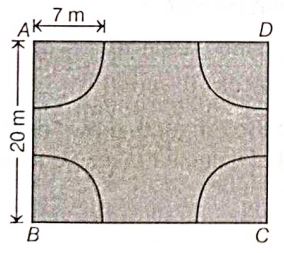
Based on the above, answer the following questions
(a) Find the area of the square shaped grass field.
(b) (i) Find the area of the total field in which these horses can graze.
Or
(ii) If the length of the rope of each horse is increased from 7m to 10m, find the area grazed by one horse. (use \(\pi\) = 3.14)
(c) What is area of the field that is left ungrazed, if the length of the rope of each horse is 7 cm?
42.
Some students were asked to list theirs favourite colour. The measure of each colour is shown by the central angle of a pie-chart given below :
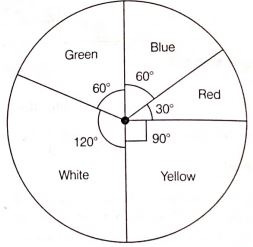
Study the pie-chart and answer the following questions :
(i) If a student is chosen at random, then find the probability of his/her favourite colour being white?
(ii) What is the probability of his/her favourite colour being blue or green?
(iii) If 15 students liked the colour yellow, how many students participated in the survey?
Or
What is the probability of the favourite colour being red or blue?
43.
Singing bowls (hemispherical in shape) are commonly used in sounds healing practices. Mallet (cylindrical in shape) is used to strike the bowl in a sequence to produce sound and vibration.
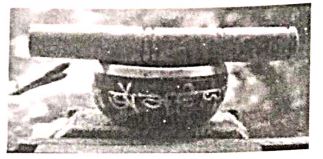
One such bowl is shown here whose dimensions are
Hemispherical bowl has outer radius 6 cm and inner radius 5 cm.
Mallet has height of 10 cm and radius 2 cm.
Based on the above, answer the following questions
(i) What is the volume of the material used in making the mallet?
(ii) The bowl is to be polished fron inside. Find the inner surface area of the bowl.
(iii) Find the volume of metal used to make the bowl.
Or
Find total surface area of the mallet (Use \(\pi\)= 3.14)
1.
BQ = BP (length of tangents drawn from an external point to a circle are equal) ...(i)
CP = CR ...(ii)
and AQ = AR
\(\therefore\) 2AQ = AQ + AR
= (AB + BQ) + (AC + CR)
= (AB + BP) + (AC + CP)
[using Eqs. (i) and (ii)]
\(\Rightarrow\) 2AQ = AB + AC + (BP + CP)
\(\Rightarrow\) 2AQ = AB + AC + BC
\(\begin{array}{ll} \Rightarrow & A Q=\frac{1}{2}(A B+B C+A C) \end{array}\)
\(\begin{array}{ll} \Rightarrow & A Q=\frac{1}{2} \text { Perimeter of } \triangle A B C \end{array}\)
2.
(i) Let number of white balls be n.
Total number of balls = 6 + 4 + n = 10 + n
Let E be the event of drawing a white ball.
Given, \(P(E)=\frac{1}{3}\)
\(\begin{aligned}
\Rightarrow \frac{\text { Number of outcomes favourable to } E}{\text { Total number of outcomes }}=\frac{1}{3}
\end{aligned}\)
\(\begin{aligned}
\Rightarrow \quad \frac{n}{10+n}=\frac{1}{3} \Rightarrow n=5
\end{aligned}\)
(ii) Now, total number of balls = 10 + n = 10 + 5 = 15
Let x red balls are removed from the bag.
\(\therefore\) Total number of balls in the bag = 15 - x
Now, \(\begin{gathered}
P(E)=\frac{1}{2}
\end{gathered}\)
\(\begin{gathered}
\Rightarrow
\frac{5}{15-x}=\frac{1}{2}
\end{gathered}\)
\(\Rightarrow\) x = 5
3.
\(LHS=\sqrt { \frac { \sec { \theta } -1 }{ \sec { \theta } +1 } } +\sqrt { \frac { \sec { \theta } +1 }{ \sec { \theta } -1 } } \)
\(=\frac { \left( \sec { \theta } -1 \right) +\left( \sec { \theta } +1 \right) }{ \sqrt { \left( \sec { \theta } +1 \right) \left( \sec { \theta } -1 \right) } } \)
\(=\frac { 2\sec { \theta } }{ \sqrt { \sec ^{ 2 }{ \theta } .1 } } =\frac { 2\sec { \theta } }{ \tan { \theta } } \)
\(\left( \because \quad \tan ^{ 2 }{ \theta } =\sec ^{ 2 }{ \theta } -1 \right) \)
\(=2\times \frac { 1 }{ \cos { \theta } } \times \frac { \cos { \theta } }{ \sin { \theta } } \)
\(=2\times \frac { 1 }{ \sin { \theta } } \)
\(=2cosec\theta \)
= RHS
4.
Given, CD = 6 cm, BD = 8 cm and radius = 4 cm
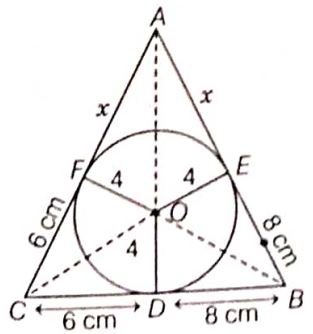
Join OC, OA and OB.
Let the circle touches the other sides AB and AC at points E and F, respectively.
We know that tangents drawn from an external point to the circle are equal in length.
\(\therefore\) CD = CF = 6 cm [\(\because\) C is an external point]
BD = BE = 8 cm [\(\because\) B is an external point]
and AF = AE = x cm (say [\(\because\) A is an external point]
Area of \(\Delta\)OCB, \(A_1=\frac{1}{2} \times \text { Base } \times \text { Height }\)
\(\begin{aligned} & =\frac{1}{2} \times C B \times O D \\ \end{aligned}\)
\(\begin{aligned} & =\frac{1}{2} \times 14 \times 4=28 \mathrm{~cm}^2 \\ \end{aligned}\)
\(\begin{aligned} & \quad[\because C B=C D+B D=6+8=14] \end{aligned}\)
Area of \(\Delta\)OCA,
\(\begin{aligned} A_2 & =\frac{1}{2} \times A C \times O F \end{aligned}\)
\(\begin{aligned} =\frac{1}{2}(6+x) \times 4=(12+2 x) \mathrm{cm}^2 \end{aligned}\)
and area of \(\Delta\)OBA,
\(A_3=\frac{1}{2} \times A B \times O E=\frac{1}{2}(8+x) \times 4=(16+2 x) \mathrm{cm}^2\)
Thus, area of \(\Delta\)ABC
= A1 + A2 + A3 = [28 + (12 + 2x) + (16+ 2x)]
= (56 + 4x) cm2 ...(i)
Now, semi-perimeter of \(\Delta\)ABC=\(\frac{1}{2}\)(AB + BC + CA)
\(\Rightarrow \quad s=\frac{1}{2}(x+8+14+6+x)\)
\(\Rightarrow\) s = (14 + x) cm
Using Heron's formula,
area of \(\Delta\)ABC = \(\begin{aligned} & =\sqrt{s(s-a)(s-b)(s-c)} \end{aligned}\)
\(\begin{aligned} =\sqrt{(14+x)(14+x-14)(14+x-x-6)(14+x-x-8)} \end{aligned}\)
\(\begin{aligned} & =\sqrt{(14+x) \times x \times 8 \times 6} \end{aligned}\)
\(\begin{aligned} =\sqrt{(14+x) 48 x} \end{aligned}\) ...(ii)
From Eqs. (i) and (ii), we get
\(\sqrt{(14+x) 48 x}=56+4 x=4(14+x)\)
On squaring both sides, we get
(14 + x) 48 x = 42 (14 + x)2
\(\Rightarrow\) 3x = 14 + x
\(\Rightarrow\) 2x = 14
\(\Rightarrow\) x = 7
\(\therefore\) Length of AC = 6 + x = 6 + 7 = 13 cm
and length of AB = 8 + x = 8 + 7 = 15 cm
5.
Given, one gulabjamun is a combination of a cylinder and two hemispheres. Here, total length of one gulabjamun = 5 cm and diameter = 2.8 cm
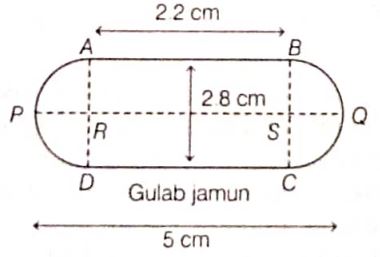
\(\therefore\) Radius of cylindrical part = Radius of hemispherical part
\(=r=\frac{2.8}{2}=1.4 \mathrm{~cm}\)
Height of cylindrical part,
h = PQ - (PR + SQ) = 5 - (1.4 + 1.4)
= 5 - 2.8 = 2.2 cm
\(\therefore\) Volume of one gulabjamun = 2 \(\times\) Volume of hemispherical part + Volume of cylindrical part
\(\begin{aligned} & =2 \times\left[\frac{2}{3} \pi r^{3}\right]+\pi r^2 h=\frac{4}{3} \pi r^{3}+\pi r^2 h \\ \end{aligned}\)
\(\begin{aligned} & =\pi r^2\left[\frac{4 r}{3}+h\right]=\frac{22}{7} \times 1.4 \times 1.4\left[\frac{4}{3} \times 1.4+2.2\right] \\ \end{aligned}\)
\(\begin{aligned} & =\frac{22}{7} \times \frac{14}{10} \times \frac{14}{10}\left[\frac{4}{3} \times \frac{14}{10}+\frac{22}{10}\right] \\ \end{aligned}\)
\(\begin{aligned} & =22 \times \frac{1}{5} \times \frac{7}{5}\left[\frac{28}{15}+\frac{11}{5}\right]=\frac{154}{25} \times \frac{61}{15}=\frac{9394}{375} \mathrm{~cm}^3 \end{aligned}\)
Now, volume of 45 gulabjamuns
\(=45 \times \frac{9394}{375}=\frac{3 \times 9394}{25}=\frac{28182}{25}=1127.28 \mathrm{~cm}^3\)
Since, one gulabjamun contains sugar syrup upto about 30% of its volume.
Hence, quantity of syrup found in 45 gulabjamuns
\(=1127.28 \times \frac{30}{100}=1127.28 \times \frac{3}{10}=338.184 \approx 338 \mathrm{~cm}^3\)
6.
Given XY and X'Y' are two parallel tangents. Another tangent AB touches the circle at C and intersect XY at A and X'Y'at B.
To prove \(\angle\)AOB = 90°
Proof We know that, tangents drawn from an external point to a circle are equal in length.
\(\therefore\) AP = AC [\(\because\) A is an external point] ...(i)
Thus, in \(\Delta\)APO and \(\Delta\)ACO, AP = AC [from Eq. (i)]
AO = AO [common sides]
OP = OC [radii of circle]
\(\Delta\)APO \(\cong\)\(\Delta\)ACO [by SSS congruence rule]
Then, \(\angle\)OAP = \(\angle\)OAC [by CPCT] ...(ii)
\(\Rightarrow\) \(\angle\)PAC = 2 \(\angle\)CAO ....(iii)
Similarly, we can prove that \(\angle\)CBO = \(\angle\)OBQ
\(\Rightarrow\) \(\angle\)CBQ = 2 \(\angle\)CBO ...(iv)
since, XY || X'Y' [given]
\(\therefore\) \(\angle\)PAC + \(\angle\)QBC = 180°
[\(\because\) sum of interior angles on the same side of transversal is 180°]
\(\Rightarrow\) 2 \(\angle\)CAO + 2 \(\angle\)CBO = 180° [from Eqs. (iii) and (iv)]
\(\Rightarrow\) \(\angle\)CAO + \(\angle\)CBO = 90° ...(v)
Now, in \(\Delta\)AOB, \(\angle\)CAO + \(\angle\) CBO + \(\angle\)AOB = 180°
[by angle sum property of triangle]
\(\Rightarrow\) \(\angle\)CAO + \(\angle\)CBO = 180° - \(\angle\)AOB ...(vi)
From Eqs. (v) and (vi), we get
180° - \(\angle\)AOB = 90° \(\Rightarrow\) \(\angle\)AOB = 90° Hence proved.
7.
\(LHS=\frac { \left( \sin ^{ 4 }{ \theta } +\cos ^{ 4 }{ \theta } \right) }{ 1-2\sin ^{ 2 }{ \theta } \cos ^{ 2 }{ \theta } } \)
\(=\frac { { \left( \sin ^{ 2 }{ \theta } \right) }^{ 2 }+{ \left( \cos ^{ 2 }{ \theta } \right) }^{ 2 } }{ 1-2\sin ^{ 2 }{ \theta } \cos ^{ 2 }{ \theta } } \)
\(=\frac { { \left( \sin ^{ 2 }{ \theta } +\cos ^{ 2 }{ \theta } \right) }^{ 2 }-2\sin ^{ 2 }{ \theta } \cos ^{ 2 }{ \theta } }{ 1-2\sin ^{ 2 }{ \theta } \cos ^{ 2 }{ \theta } } \)
\(=\frac { 1-2\sin ^{ 2 }{ \theta } \cos ^{ 2 }{ \theta } }{ 1-2\sin ^{ 2 }{ \theta } \cos ^{ 2 }{ \theta } } =1=RHS\)
8.
LHS=\((\tan { \theta } +2)(2\tan { \theta } +1)\)
\(=2\tan ^{ 2 }{ \theta } +4\tan { \theta } +\tan { \theta } +2\)
\(=2\tan ^{ 2 }{ \theta } +2+5\tan { \theta } \)
\(=2(\tan ^{ 2 }{ \theta } +1)+5\tan { \theta } \)
\(=2\sec ^{ 2 }{ \theta } +5\tan { \theta } \quad \left[ \because 1+\tan ^{ 2 }{ \theta } =\sec ^{ 2 }{ \theta } \right] \)
\(=5\tan { \theta } +2\sec ^{ 2 }{ \theta } \)=RHS
Hence proved.
9.
Let h be height of the cylinder, and r the common radius of the cylinder and hemisphere. Then, the total surface area of the bird-bath = CSA of cylinder + CSA of hemisphere
= 2\(\pi\)rh + 2\(\pi\)r2 = 2\(\pi\)r(h + r)
\(=2 \times \frac{22}{7} \times 30(145+30) \mathrm{cm}^2\)
= 33000 cm2 = 3.3 m2
10.
Total no.of cards = 46
Total no.of ways to select a card = 46
(i) Prime no.less than 10 in these cards are 5, 7
\(\therefore\) No.of ways to select a prime no.less than 10 = 2
\(\therefore\) Probability that the number on the card is prime = \(\frac{2}{46}=\frac{1}{23}\)
(ii) No. which is a perfect square, i.e. 9, 16, 25, 36, 49
No. of ways to select a card with perfect square = 5
\(\therefore\) Probability = \(\frac{5}{46}\)
11.
Given, umbrella to be a flat circle. So, the central angle of an umbrella is 360°.
Since, umbrella has 8 ribs.
\(\therefore\) Angle between two ribs.
\(=\frac{360^{\circ}}{8}=45^{\circ}\)
Area between two ribs = Area of one sector of the umbrella
\(=\frac{\theta}{360^{\circ}} \times \pi r^2=\frac{45^{\circ}}{360^{\circ}} \times \frac{22}{7} \times(45)^2[\because r=45, \text { given }]\)
\(\begin{aligned} & =\frac{22}{7 \times 8}(45)^2 \\ \end{aligned}\)
\(\begin{aligned} & =\frac{22275}{28} \mathrm{~cm}^2 \end{aligned}\)
12.
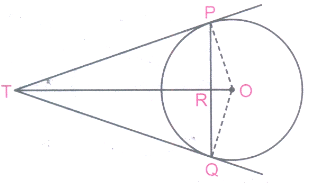
Given: PQ is chord of length 16 cm, TP and TQ are the tangents to a circle with centre O, radius 10 cm.
To find: TP.
Solution: Join OP and OQ.
In triangles OTP and OTQ, OT is common
OP = OQ (radii)
TP = TQ [length of the tangents drawn from a point outside the circle to the circle are equal]
ஃ \(\triangle\)OPT ≅ \(\triangle\)OQT (SSS cong. rule)
ஃ \(\angle \)POT = \(\angle \)QOT .....(i)
Consider, triangles OPR and OQR;
OP = OQ (radii); OR is common
\(\angle \)POR = \(\angle \)QOR [from (i)]
ஃ \(\triangle\)OPR ≅ \(\triangle\)OQR (SAS cong. rule)
\(\angle \)ஃ PR = RQ = \(1\over2\)x16 = 8 cm ...(ii)
\(\angle \)ORP = \(\angle \)ORQ = 90o ....(iii)
In right angled triangle TRP,
TR2 = TP2 - (8)2 = TP2 - 64 [from (iii) .... (iv)]
Also OT2 = TP2 - (10)2
(TR+6)2 = TP2 + 100
[∵ OR = \(\sqrt{100-64}\)=6]
TR2 + 12TR + 36 = TP2 + 100
TP2 - 64 + 12TR + 36 = TP2 + 100
12TR = 128 ⇒ TR=\(32\over3\)cm
Form (iv) \({ \left( \frac { 32 }{ 3 } \right) }^{ 2 }\)=TP2 - 64
⇒ TP2 = \({1024\over9}+64={1024+576\over9}={1600\over9}\)
⇒ TP = \(40\over3\) cm
13.
Given: A circle touches the side BC of \(\triangle\)ABC at P and touch AB and AC produce at Q and R respectively and AQ = 5 cm.
To find: Perimeter of \(\triangle\)ABC.Sol: AQ and AR are tangent from the same point AQ = AR = 5 cm ...(i)
[Tangent from the same external points are equal]
BQ and BP are tangent from the same point ....(ii)
⇒ BQ = BP
CP and CR are also tangent from the same point
⇒ CP = CR .....(iii)
In ABC
Perimeter of \(\triangle\)ABC = AB + BC + AC = AB + BP + CP + AC AB + BQ + CR + AC = AQ + AR [From (ii) and (iii)]
= 5 cm + 5 cm = 10 cm [From (i)]
Permeter \(\triangle\)ABC = 10 cm
14.
(d)
2 cos2 A - 1
15.
(a)
a sphere and a cylinder
16.
(b)
\(\frac{8 \pi}{3} \mathrm{~cm}^2\)
17.
(c)
1
18.
(a)
7 cm
19.
(a)
3 cm
20.
(b)
70°
21.
(b)
b2 – a2
22.
(b)
\(\frac { 1+cos\theta }{ sin\theta } \)
23.
(a)
7920 m2
24.
(c)
28 cm
25.
(a)
230
26.
(c)
114 sq. units
27.
(b)
24 πcm
28.
(a)
zero
29.
(b)
4 cm
30.
(d)
\(\frac { 40 }{ 3 } \)cm
31.
(b)
-1.5
32.
Hint \(L H S =\frac{1}{1+\sin \theta}+\frac{1}{1-\sin \theta}=\frac{1-\sin \theta+1+\sin \theta}{(1+\sin \theta)(1-\sin \theta)}\)
\(=\frac{2}{\left(1-\sin ^2 \theta\right)}=\frac{2}{\cos ^2 \theta} \quad\left[\because 1-\sin ^2 A=\cos ^2 A\right] \)
\( =2 \sec ^2 \theta=\text { RHS } \quad \text { Hence proved. }\)
33.
\(\frac { { cosec }^{ 2 }\theta }{ { cosec }\theta -1 } -\frac { { cosec }^{ 2 }\theta }{ { cosec }\theta +1 } \)
\(={ cosec }^{ 2 }\theta \left[ \frac { 1 }{ \frac { 1 }{ \sin { \theta } } -1 } -\frac { 1 }{ \frac { 1 }{ \sin { \theta } } +1 } \right] \)
\(={ cosec }^{ 2 }\theta \left[ \frac { \sin { \theta } }{ 1-\sin { \theta } } -\frac { \sin { \theta } }{ 1+\sin { \theta } } \right] \)
\(=\frac { 1\times \sin { \theta } }{ \sin ^{ 2 }{ \theta } } \left[ \frac { \left( 1+\sin { \theta } \right) -\left( 1-\sin { \theta } \right) }{ \left( 1-\sin { \theta } \right) \left( 1+\sin { \theta } \right) } \right] \)
\(=\frac { 1 }{ \sin { \theta } } \left[ \frac { 2\sin { \theta } }{ 1-\sin ^{ 2 }{ \theta } } \right] \)
\(=\frac { 2 }{ \cos ^{ 2 }{ \theta } } =2\sec ^{ 2 }{ \theta } \)
= RHS
34.
2100.78 cm2
35.
Here, Volume of a hemisphere = 2425 \(\frac{1}{2}\) cm3
\(\Rightarrow\) \(\frac { 2 }{ 3 } \times \frac { 22 }{ 7 } \times { r }^{ 3 }=\frac { 4851 }{ 2 } \)
\(\Rightarrow\) \({ r }^{ 3 }=\frac { 4851 }{ 2 } \times \frac { 3\times 7 }{ 2\times 22 } \)
\(=\frac { 441\times 21 }{ 2\times 2\times 2 } \)
\(\Rightarrow\) r = \(\frac{21}{2} cm\)
Now, curved surface area = 2\(\pi\)r2
= 2 x \(\frac { 22 }{ 7 } \times \frac { 21 }{ 2 } \times \frac { 21 }{ 2 } \)
= 693 cm2
36.
(i) Possible outcomes HHH, HHT, HTH,THH, TTH, THT, HTT, TTT
Total number of possible outcomes = 8
Let A = getting exactly two heads
Favourable outcomes to event A are HHT, HTH to THH.
\(\therefore \ P(A)\ =\ \frac { 3 }{ 8 } \)
(ii) Let B = getting atleast two heads
Favourable outcomes to B are HHT, HTH, THH or HHH.
\(\therefore P(B)\ =\ \frac { 4 }{ 8 } =\frac { 1 }{ 2 } \)
(iii) Let C = getting at least two tails
\(\therefore \) Favourable outcomes to event C are TTH, THT, HTT or TTT
\(\therefore \ P(C)\ =\ \frac { 4 }{ 8 } =\frac { 1 }{ 2 } \)
37.
Elernentarv events are
(1,1),(1,2),(1,3),(1,4),(1,5),(1,6)
(2,1),(2,2),(2,3),(2,4),(2,5),(2,6)
(3,1),(3,2),(3,3),(3,4),(3,5),(3,6)
(4,1),(4,2),(4,3),(4,4),(4,5),(4,6)
(5,1),(5,2),(5,3),(5,4),(5,5),(5,6)
(6,1),(6,2),(6,3),(6,4),(6,5),(6,6)
Total no. of elementary events = 36
(a)Let A = 5 will not collie up on either of thetn.
\(\therefore\) Total no. of eletnentary events favourable to A = 25. Hence, P(A) = \(\frac {25}{36}\)
(b)B=5 will come up at least one die
\(\therefore\) total no. of eletnentarv events lhsourable to B = 11. Hence, P(B) =\(\frac {11}{36}\)
(c)C= 5 will come up at both dice
\(\therefore\)No. of elementary event favourable to C = 1 Hence, P(C)= \(\frac {1}{36}\)
38.
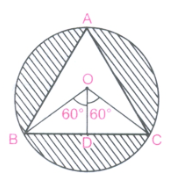
In OBD
cos 60°=\(OD \over OB\)and sin 60°=\(BD\over OB\)
⇒ \(1\over2\)= \(OD\over6\) and \(\frac { \sqrt { 3 } }{ 2 } \) = \(BD\over6\)
⇒ \(6\over2\)=OD and \(\frac { \sqrt { 3 } }{ 2 } \)x6 = BD
⇒ OD = 3 and BD = 3\(\sqrt3\)
BC = 2BD = 2 x 3\(\sqrt3\)=6\(\sqrt3\)
Area of the shaded region = area of circle - area of \(\triangle\)ABC
= \(2\pi { (6) }^{ 2 }-\frac { \sqrt { 3 } }{ 2 } { \left( 6\sqrt { 3 } \right) }^{ 2 }\)
= 3.14 x 6 x - \(\frac { \sqrt { 3 } }{ 4 } \) x 6\(\sqrt3\) x 6 \(\sqrt3\)
= 113.04 - 27 x 1.732 = 113.04 - 46.76 = 66.28 cm2
39.
Total surface area (TSA) of toy = CSA of hemisphere + CSA of cone
This is because the toy is obtained by joining the plane surfaces of hemisphere and cone.
40.
If Assertion is incorrect but Reason is correct.
41.
(a) Length of the square shaped grass field = 20 m
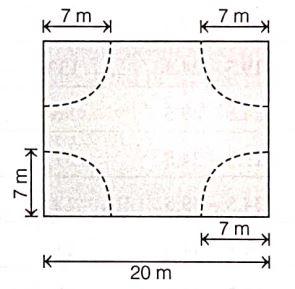
Area of the square shaped grass field = 20 \(\times\) 20 = 400 m2
(b) (i) Length of the rope = 7 m
Thus, each horse can graze upto 7 m of distance along the side.
The grazed area is making a complete circle by taking all the four grazed parts.
So, area of grazed part = \(\pi\)r2
\(=\frac{22}{7} \times 7^2=22 \times 7=154 \mathrm{~m}^2\)
Therefore, area of the total field in which these horses can graze is 154 m2.
(ii) New length of the rope of each horse = 10 m
Area grazed by one horse \(=\frac{1}{4} \pi r^2\)
\(\begin{aligned} & =\frac{1}{4} \times 3.14 \times 10^2 \\ \end{aligned}\)
\(\begin{aligned} & =\frac{314}{4}=78.5 \mathrm{~m}^2 \end{aligned}\)
Therefore, the required area grazed by one horse is 78.5 m2.
(c) Length of rope of each horse = 7 m
Area of square shaped grass field = 400 m2
[from part (a)]
Area of total field grazed by horses = 154 m2
[from Eq. (ii) (a)]
Area of field left ungrazed = Area of square field - Area of grazed field by horses
= 400 - 154 = 246
Therefore, area of field left ungrazed is 246m2.
42.
(i) Total angle = 360°
Angle of white = 120°
\(\therefore \text { Probability }=\frac{120^{\circ}}{360^{\circ}}=\frac{1}{3}\)
(ii) Total angle = 360°
Angle of blue = 60°
Angle of green = 60°
\(\therefore \text { Probability }=\frac{60^{\circ}+60^{\circ}}{360^{\circ}}=\frac{120^{\circ}}{360^{\circ}}=\frac{1}{3}\)
(iii) Let n students participated in the survey
\(\Rightarrow \frac{90^{\circ}}{360^{\circ}} \times n=15 \Rightarrow n=15 \times 4=60\)
\(\therefore\) 60 students participated in the survey.
Or
Total angle = 360°
Angle of red = 30°
Angle of blue = 60°
\(\therefore \text { Probability }=\frac{60^{\circ}+30^{\circ}}{360^{\circ}}=\frac{90^{\circ}}{360^{\circ}}=\frac{1}{4}\)
43.
Given,
Hemisphere Outer radius(R) = 6 cm
and Inner radius (r) = 5 cm
Cylinder (Mallet) Height (h) = 10 cm
and Radius (r') = 2 cm
(i) Volume of material used in making the mallet
= \(\pi\)r2h
= 3.14 \(\times\)2 \(\times\)2\(\times\)10 = 125.6 cm3
(ii) Inner surface area of bowel = LSA of hemisphere
= 2\(\pi\)r2 = 2 \(\times\)3.14 \(\times\) 5 \(\times\) 5 = 157 cm2
(iii) Volume of metal used to make the bowl
\(\begin{aligned}
& =\frac{2}{3} \pi\left(R^3-r^3\right) \\
\end{aligned}\)
\(\begin{aligned}
& =\frac{2}{3} \times 3.14\left(6^3-5^3\right) \\
\end{aligned}\)
\(\begin{aligned}
& =\frac{2}{3} \times 3.14 \times 91=190.493 \mathrm{~cm}^3
\end{aligned}\)
Or
Total surface area of mallet = 2\(\pi\)r' (h + r')
= 2 \(\times\) 3.14 \(\times\) 2(10 + 2)
=4 \(\times\)3.14 \(\times\)12 = 150.72 cm2

10th Standard CBSE Syllabus & Materials
10th Standard CBSE
CBSE 10th Social Science PS - Federalism - New Model Questions Papers Study Material - QB365 Set A
NEW10th Standard CBSE
CBSE 10th Social Science PS - Power Sharing - New Model Questions Papers Study Material - QB365 Set A
NEW10th Standard CBSE
CBSE 10th Social Science GEO - Manufacturing Industries - New Model Questions Papers Study Material - QB365 Set A
NEW10th Standard CBSE
CBSE 10th Social Science GEO - Minerals and Energy Resources - New Model Questions Papers Study Material - QB365 Set A



NCERT Books

Syllabus

Exam Pattern

Sample Question Papers

Previous year Question Papers

Important Notes

MCQ Practice test

NCERT Exemplers

Case study Questions

Image Based Questions

Passage based Questions

HOT Questions

Value Based Questions

Model Questions Papers
NCERT ( Book Back ) Questions

Assertion and Reason
Important Questions And Answers

CBSE 10th Standard CBSE Subjects
CBSE Standards



