
 100% FREE ACCESS
10th Standard CBSE Syllabus & Materials
10th Standard CBSE
CBSE 10th Social Science ECO - Globalisation and the Indian Economy - New Model Questions Papers Study Material - QB365 Set A
NEW10th Standard CBSE
CBSE 10th Social Science ECO - Money and Credit - New Model Questions Papers Study Material - QB365 Set A
NEW10th Standard CBSE
CBSE 10th Social Science ECO - Sectors of the Indian Economy - New Model Questions Papers Study Material - QB365 Set A
NEW10th Standard CBSE
CBSE 10th Social Science ECO - Development - New Model Questions Papers Study Material - QB365 Set A
NEW10th Standard CBSE
CBSE 10th Social Science PS - Outcomes of Democracy - New Model Questions Papers Study Material - QB365 Set A
NEW10th Standard CBSE
CBSE 10th Social Science PS - Gender, Religion and Caste - New Model Questions Papers Study Material - QB365 Set A

Published on: 22/10/2025
Download CBSE Class 10th Standard CBSE Maths question papers, sample papers, important questions, and previous year solved papers in PDF format. Get free study materials, NCERT solutions, and exam preparation resources for Class 10th Standard CBSE Maths
Questions + Answers key
Take MCQ Maths Test
1.
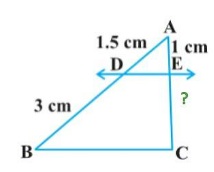
See the given Figure. DE || BC. Find EC
2.
A card is drawn at random from a pack of 52 playing cards. Find the probability that the card drawn is neither an ace nor a king.
3.
If P(E) = 0.05, what is the probability of 'not E'?
4.
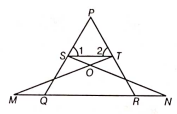
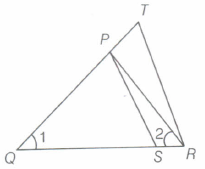
In the given figure, if ∠1 = ∠2 and ΔNSQ = ΔMTR, prove that ΔPTS ~ ΔPRQ.
5.
Five Cards, ten, Jack, Queen, King and Ace of diamonds are well shuffled. One card is picked up from them.
(i) Find the probability that the drawn card is Queen.
(ii) If Queen is put aside, then find the probability that the second card drawn is an ace.
6.
Two dice are thrown at the same time.Find the probability of getting:
(i) sum of two numbers appearing on both the dice is 8.
7.
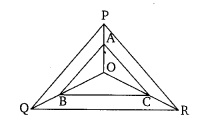
In the given figure A, B and Care points on OP, OQ and OR respectively such that AB II PQ and AC II PR. Prove that BC II QR.
8.
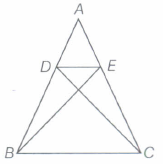
In the given figure, if \(\triangle ABE\cong \triangle ACD\), show that \(\triangle ADE\sim \triangle ABC\) .
9.
In the given figure, \(\frac { QR }{ QS } =\frac { QT }{ PR } \) and \(\angle 1=\angle 2\) . Show that \(\triangle PQS\sim \triangle TQR\) .
10.
A die has its six faces marked 0, 1, 1, 1, 6, 6. Two such dice are thrown together and the total score is recorded.
(i) How many different scores are possible?
(ii) What is the probability of getting a total of 7?
11.
Three squares are based on the sides of a right angled triangle. The area of the two smaller ones are 144 sq. cm and 256 sq. cm. What is the area of the third one?
625 sq. cm
361 sq. cm
400 sq. cm
900sq. cm
12.
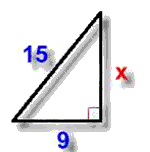
From the given figure, find the unknown x.
12
225
10
144
13.
In a triangle ABC, AC= √180 ,AB=6 ,BC=12 .What is ∠B = ?
90°
30°
45°
60°
14.
A bag contains 3 white and 5 red balls. If a ball is drawn at random, the probability that the drawn ball is red is
3/8
3/15
5/8
5/15
15.
The probability that it will rain tomorrow is 0.85. What is the probability that it will not rain tomorrow
0.25
0.145
3/20
none of these
1.
Let EC = x cm
It is given that DE || BC.
By using basic proportionality theorem, we obtain
\(\frac{A D}{D B}=\frac{A E}{E C}\)
\(\frac{1.5}{3}=\frac{1}{x}\)
\(x=\frac{3 \times 1}{1.5}\)
x = 2
∴ EC = 2 cm
2.
Total number of cards = 52
Number of aces and kings = 4 + 4 = 8
Number of cards which are neither ace nor king = 44
Probability that the card drawn is neither an ace nor a king = \(\frac{44}{52}=\frac{11}{13}\)
3.
Given, P(E) = 0.05
we know that P(E) + P(\(\bar{E}\)) = 1
\(\therefore\) P(\(\bar{E}\)) = 1 - P(E) \(\Rightarrow\) P(\(\bar{E}\)) = 1 - 0.05 = 0.95
4.
Hint Given \(\triangle N S Q \cong \triangle M T R\) and \(\angle 1=\angle 2\)
To prove \(\triangle P T S \sim \triangle P R Q\)
Proof Since, \(\triangle N S Q \cong \triangle M T R\)
\( \therefore S Q=T R \)
\( \text { Also, } \ \triangle=\angle 2 \)
\(\Rightarrow \quad P T=P S\)
[since sides opposite to equal angles are also equal] From Eqs. (i) and (ii),
\(\frac{P S}{S Q}=\frac{P T}{T R} \)
\(\Rightarrow S T \| Q R\)
[by converse of basic proportionality theorem]
\( \therefore \quad \angle 1=\angle P Q R\)
\(\text { and } \quad \angle 2=\angle P R Q \quad \text { [corresponding angles] }\)
In ΔPTS and ΔPRQ,
\(\angle T P S=\angle Q P R \quad \text { [common angle] }\)
\(\triangle=\angle P Q R \quad \text { [proved above] }\)
\(\text { and } \quad \angle 2=\angle P R Q\)
\(\therefore \quad \triangle P T S-\triangle P R Q \text { [by AAA similarity criterion] }\)
Hence proved.
5.
Total cards = 5
(i) P(Queen) = \(\frac{1}{5}\)
(ii) P(Ace) = \(\frac{1}{4}\) (Since, Queen was kept aside, 5 - 1 = 4).
6.
P(sum is 8) = \(\frac{5}{36}\)
7.
In \(\triangle\)POQ, AB || PQ, (Given)
\(\Rightarrow \frac { AO }{ AP } =\frac { OB }{ BQ } \quad ...(i)\quad (BPT)\)
In \(\triangle\)OPR, AC || PR, (Given)
\(\therefore\frac { OA }{ AP } =\frac { OC }{ CR } \quad ...(ii)\quad (BPT)\)
From equations (i) and (ii),
\(\frac { OB }{ BQ } =\frac { OC }{ CR } \)
\(\therefore\) BC || QR, (By converse of BPT)
8.
Given, \(\triangle ABE\cong \triangle ACD\)
\(\Rightarrow \) AB = AC and AE = AD [by CPCT]
\(\Rightarrow \) \(\frac{AB}{AC} =1\)
and \(\frac{AD}{AE}=1\)
\(\Rightarrow\frac { AB }{ AC } =\frac { AD }{ AE } \) .... (i)
In \(\triangle ADE\) and \(\triangle ABC\) , we have
\(\frac{AD}{AE}=\frac{AB}{AC}\) [from Eq.(i)]
\(\Rightarrow\frac{AD}{AB}=\frac{AE}{AC}\)
and \(\angle DAE=\angle BAC\) [common angle]
\(\therefore \) \(\triangle ADE\sim \triangle ABC\) [by SAS similarity criterion]
Hence proved.
9.
In \(\triangle PQR, \angle 1=\angle 2\) [given]
\(\Rightarrow \) PR = PQ [since, sides opposite to equal angles of a triangle are not equal]
Given that, \(\frac { QR }{ QS } =\frac { QT }{ PR } \Rightarrow \quad \frac { QR }{ QS } =\frac { QT }{ PQ } \)
[\(\because \) PQ = PR, proved above]
\(\Rightarrow \frac { QS }{ QR } =\frac { PQ }{ QT } \)
[on taking of the terms reciprocals] ... (i)
In \(\triangle PQS\) and \(\triangle TQR\), we have
\(\angle PQS=\angle TQR\) [common]
and \(\Rightarrow \frac { QS }{ QR } =\frac { QP }{ QT } \) [from Eq.(i)]
\(\therefore \triangle PQS\sim \triangle TQR\) [by SAS similarity criterion]
Hence proved.
10.
Possible outcomes
(0,0),(0,1),(0,1),(0,1),(0,6),(0,6)
(1,0),(1,1),(1,1),(1,1),(1,6),(1,6)
(1,0),(1,1),(1,1),(1,1),(1,6),(1,6)
(1,0),(1,1),(1,1),(1,1),(1,6),(1,6)
(6,0),(6,1),(6,1),(6,1),(6,6),(6,6)
(6,0),(6,1),(6,1),(6,1),(6,6),(6,6)
Different total scores are 0, 1, or 12
Let A = getting a total of 7
No. of favourable outcomes are = 12
\(\therefore\) P(A) = \(\frac{12}{36}=\frac{1}{3}\)
11.
(c)
400 sq. cm
12.
(a)
12
13.
(a)
90°
14.
(c)
5/8
15.
(c)
3/20

10th Standard CBSE Syllabus & Materials
10th Standard CBSE
CBSE 10th Social Science PS - Federalism - New Model Questions Papers Study Material - QB365 Set A
NEW10th Standard CBSE
CBSE 10th Social Science PS - Power Sharing - New Model Questions Papers Study Material - QB365 Set A
NEW10th Standard CBSE
CBSE 10th Social Science GEO - Manufacturing Industries - New Model Questions Papers Study Material - QB365 Set A
NEW10th Standard CBSE
CBSE 10th Social Science GEO - Minerals and Energy Resources - New Model Questions Papers Study Material - QB365 Set A



NCERT Books

Syllabus

Exam Pattern

Sample Question Papers

Previous year Question Papers

Important Notes

MCQ Practice test

NCERT Exemplers

Case study Questions

Image Based Questions

Passage based Questions

HOT Questions

Value Based Questions

Model Questions Papers
NCERT ( Book Back ) Questions

Assertion and Reason
Important Questions And Answers

CBSE 10th Standard CBSE Subjects
CBSE Standards



