
 100% FREE ACCESS
10th Standard CBSE Syllabus & Materials
10th Standard CBSE
CBSE 10th Social Science ECO - Globalisation and the Indian Economy - New Model Questions Papers Study Material - QB365 Set A
NEW10th Standard CBSE
CBSE 10th Social Science ECO - Money and Credit - New Model Questions Papers Study Material - QB365 Set A
NEW10th Standard CBSE
CBSE 10th Social Science ECO - Sectors of the Indian Economy - New Model Questions Papers Study Material - QB365 Set A
NEW10th Standard CBSE
CBSE 10th Social Science ECO - Development - New Model Questions Papers Study Material - QB365 Set A
NEW10th Standard CBSE
CBSE 10th Social Science PS - Outcomes of Democracy - New Model Questions Papers Study Material - QB365 Set A
NEW10th Standard CBSE
CBSE 10th Social Science PS - Gender, Religion and Caste - New Model Questions Papers Study Material - QB365 Set A

Published on: 22/10/2025
Download CBSE Class 10th Standard CBSE Maths question papers, sample papers, important questions, and previous year solved papers in PDF format. Get free study materials, NCERT solutions, and exam preparation resources for Class 10th Standard CBSE Maths
Questions + Answers key
Take MCQ Maths Test
1.
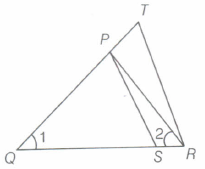
In the given figure, \(\frac { QR }{ QS } =\frac { QT }{ PR } \) and \(\angle 1=\angle 2\) . Show that \(\triangle PQS\sim \triangle TQR\) .
2.
Solve the following pair of linear equations.
41x+53y=135 and 53x+41y=147
3.
If a and β are the zeroes of the quadratic polynomial p(x)=ax2+bx+c, then evaluate a2β+aβ2 .
4.
A peacock is sitting on the top of a tree. It observes a serpent on the ground making an angle of depression of 30o . The peacock with the speed of 300 m/minute catches the serpent in 12 seconds. What is the height of the tree?
5.
How many two-digit numbers are divisible by 3?
6.
The coordinates of one end point of a diameter of a circle are (4,-1) and the coordinates of the centre are (1,-3).
(i) Find the coordinates of the other end of the diameter.
(ii) Find the diameter of the circle.
(iii) Calculate the area of circle,
7.
The altitude of a right triangle is 7 cm less than its base. If the hypotenuse is 13 cm, find the other two side.
8.
Prove that \(\frac{\cot A-\cos A}{\cot A+\cos A}=\frac{\operatorname{cosec} A-1}{\operatorname{cosec} A+1}\)
9.
Find the zeroes of the quadratic polynomial x2 + 7x + 10, and verify the relationship between the zeroes and the coefficients.
10.
Solve 2x-3y=13 and 7x-2y=20 and hence find the value of m for which y=mx+7.
11.
Write whether \(\left( \frac { 2\sqrt { 45 } +3\sqrt { 20 } }{ 2\sqrt { 5 } } \right) \) on simplification gives a rational or an irrational number.
12.
Find the point on y-axis which is equidistant from the points (5,-2) and (-3,2)
13.
Find the roots of the following quadratic equation, if they exist, by the method of completing the square: \(4x^2+4\sqrt3+3=0\)
14.
If in \(\Delta A B C \text { and } \Delta D E F, \frac{A B}{D E}=\frac{B C}{F D}\) then they will be similar, when
∠B = ∠E
∠A = ∠D
∠B = ∠D
∠A = ∠F
15.
sin 2A = 2 sin A is true, when A =
0°
30o
45°
60°
16.
The 9th term of an AP is 449 and 449th term is 9. The term which is equal to zero is:
502th
459th
501th
458th
17.
The 8th term of 117, 104, 91, 78, …….is.....
26
27
4
17
18.
The roots of x2 – 8x + 12 = 0, are
no real roots
x = 0
real and equal
real and unequal
19.
Write the condition, when given quadratic equation has no real roots
b2 – 4ac = 0
b2 – 4ac > 0
Either A or C
b2 – 4ac < 0
20.
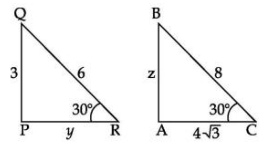
In figure, ΔABC ~ ΔPQR
2 + √3
4 + √3
3 + 4√3
4 + 3√3
21.
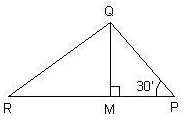
QM ⊥ RP and PR2 - PQ2 = OR2 . If ∠QPM = 30° , Then ∠MQR is
45o
60°
90°
30°
22.
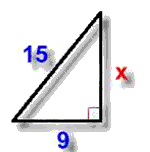
From the given figure, find the unknown x.
12
225
10
144
23.
In elimination method_______is an important condition
Equating only the x co-efficient
Equating only the y coefficient
Equating either of the coefficients
Equating both the coefficients
24.
Find the solution to the following system of linear equations:
2p+3q=9
p-q=2
(4,2)
(-4,1)
(2,-3)
(3,1)
25.
Find the zero of a linear polynomial ax + b
-b/a
a/b
b/a
-a/b
26.
From among a minimum of how many integers can you say that one is divisible by 3?
1
4
3
5
27.
What is the HCF of 1076 and 584
16
4
12
24
28.
The ordinate of a point is twice its abscissa. If its distance from the point (4,3) is \(\sqrt { 10 } \) ,then the coordinates of the point are
(1,2) or (3,6)
(1,2) or (3,5)
(2,1) or (3,6)
(2,1) or (6,3)
29.
Find the coordinates of the point equidistant from the points A(1, 2), B (3, –4) and C(5, –6)
(2, 3)
(–1, –2)
(0, 3)
(1, 3)
30.
Find AB in the given figure
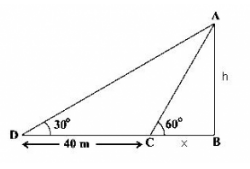
√3
30√3
20√3
10√3
31.
If the height and length of the shadow of a man are the same, then the angle of elevation of the sun is
60°
45°
30°
15°
32.
Assertion Sum of first 10 even natural number is 120.
Reason If a is the first term, l is the last term and d is the common difference of an Ap, then nth term from the end is given by 1- (n -1) d.
Codes:
(a) If both Assertion and Reason are correct and Reason is the correct explanation of Assertion.
(b) If both Assertion and Reason are correct, but Reason is not the correct explanation of Assertion.
(c) If Assertion is correct but Reason is incorrect.
(d) If Assertion is incorrect but Reason is correct.
33.
Assertion: If the equation
y2 + 4my + n = 0 has real roots, then \(m^{2}=\frac{n}{4}\)
Reason: If the quadratic equation
ax2 + bx + c = 0, a ≠ 0 has b2 - 4ac = 0, then x = \(\frac{-b}{2 a}, \frac{-b}{2 a}\)
Codes:
(a) If both Assertion and Reason are correct and Reason is the correct explanation of Assertion.
(b) If both Assertion and Reason are correct, but Reason is not the correct explanation of Assertion.
(c) If Assertion is correct but Reason is incorrect.
(d) If Assertion is incorrect but Reason is correct.
34.
One day Ram went to his home town during Dussehra vacation. During his excursion, he noted the four places Temple, TV tower, Mall and School, then he tried to locate all the places using graph sheet by taking his position at origin. He marked A, B, C and D for School, TV Tower, Temple and Mall respectively on the graph sheet by taking scale as 1 unit = 1 km as shown below.
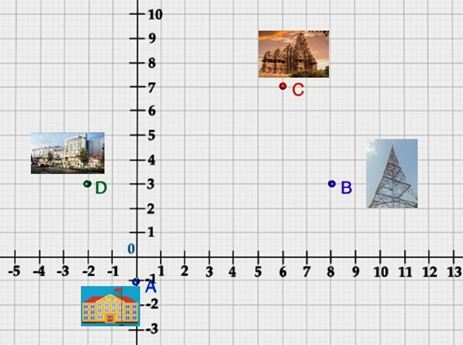
(i) Find the coordinates of C.
| (a) (0, -1) | (b) (8, 3) | (c) (6, 7) | (d) (-2, 3) |
(ii) Find the distance between School and TV Tower.
| (a) 4 km | (b) \(4 \sqrt{5} \mathrm{~km}\) | (c) \(2 \sqrt{5} \mathrm{~km}\) | (d) \(3 \sqrt{5} \mathrm{~km}\) |
(iii) Find the distance between TV tower and Mall
| (a) 8 km | (b) 10 km | (c) 6 km | (d) 9 km |
(iv) Find the distance between School and Temple
| (a) 8 km | (b) 10 km | (c) 6 km | (d) 9 km |
(v) Name the quadrilateral ABCD so formed
| (a) Square | (b) rectangle | (c) rhombus | (d) none of these |
35.
A boy is standing on the top of light house. He observed that boat P and boat Q are approaching to light house from opposite directions. He finds that angle of depression of boat P is 45° and angle of depression of boat Q is 30°. He also knows that height of the light house is 100 m.
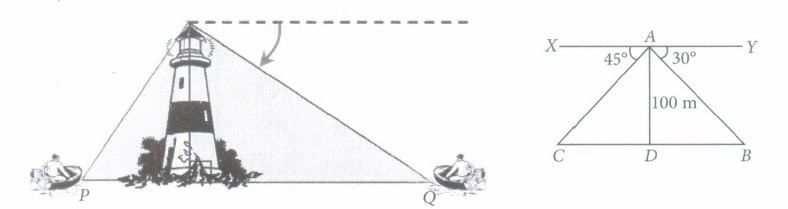
Based on the above information, answer the following questions.
(i) Measure of \(\angle\)ACD is equal to
| (a) 30° | (b) 45° | (c) 60° | (d) 90° |
(ii) If \(\angle\)YAB = 30°, then \(\angle\)ABD is also 30°, Why?
| (a) vertically opposite angles | (b) alternate interior angles |
| (c) alternate exterior angles | (d) corresponding angles |
(iii) Length of CD is equal to
| (a) 90 m | (b) 60 m | (c) 100 m | (d) 80 m |
(iv) Length of BD is equal to
| (a) 50 m | (b) 100 m | (c) 100\(\sqrt{2}\) m | (d) 100\(\sqrt{3}\) m |
(v) Length of AC is equal to
| (a)100\(\sqrt{2}\) m | (b) 100\(\sqrt{3}\) m | (c) 50 m | (d) 100 m |
36.
In a pathology lab, a culture test has been conducted. In the test, the number of bacteria taken into consideration in various samples is all3-digit numbers that are divisible by 7, taken in order.
On the basis of above information, answer the following questions.
(i) How many bacteria are considered in the fifth sample?
| (a) 126 | (b) 140 | (c) 133 | (d) 149 |
(ii) How many samples should be taken into consideration?
| (a) 129 | (b) 128 | (c) 130 | (d) 127 |
(iii) Find the total number of bacteria in the first 10 samples.
| (a) 1365 | (b) 1335 | (c) 1302 | (d) 1540 |
(iv) How many bacteria are there in the 7th sample from the last?
| (a) 952 | (b) 945 | (c) 959 | (d) 966 |
(v) The number of bacteria in 50th sample is
| (a) 546 | (b) 553 | (c) 448 | (d) 496 |
1.
In \(\triangle PQR, \angle 1=\angle 2\) [given]
\(\Rightarrow \) PR = PQ [since, sides opposite to equal angles of a triangle are not equal]
Given that, \(\frac { QR }{ QS } =\frac { QT }{ PR } \Rightarrow \quad \frac { QR }{ QS } =\frac { QT }{ PQ } \)
[\(\because \) PQ = PR, proved above]
\(\Rightarrow \frac { QS }{ QR } =\frac { PQ }{ QT } \)
[on taking of the terms reciprocals] ... (i)
In \(\triangle PQS\) and \(\triangle TQR\), we have
\(\angle PQS=\angle TQR\) [common]
and \(\Rightarrow \frac { QS }{ QR } =\frac { QP }{ QT } \) [from Eq.(i)]
\(\therefore \triangle PQS\sim \triangle TQR\) [by SAS similarity criterion]
Hence proved.
2.
Given pair of linear equations is
41x+53y=135 ..(i)
and 53x+41y=147 ...(ii)
On adding Eqs. (i) and (ii), we get
94x+94y=282
\(\Rightarrow\) x+y=3 [dividingboth sides by 94] ...(iii)
On subtracting Eq. (i) from Eq. (ii), we get
12x-12y=12
\(\Rightarrow\) x-y=1 [dividing both sides by 12] ...(iv)
Now, on adding Eqs.(iii) and (iv), we get
2x=4 \(\Rightarrow\) x=2
On substituting x=2 in Eq. (iii), we get
y=3-2=1
Hence, x=2 and y=1 is the required solution.
3.
Given, a and β are the zeroes of the polynomial
p(x)=ax2+bx+c.
Sum of zeroes, a+β=\(-b\over a\) and product of zeroes, aβ=\(c\over a\)
Now, a2β+aβ2=aβ(a+β)
\(=\frac { c }{ a } \times \frac { (b) }{ a } =\frac { -bc }{ a^{ 2 } } \)
4.
Let C be the position of peacock and A be the position of serpent.
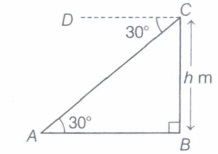
Given, ∠DCA = 30°
\(\Rightarrow \angle B A C=\angle D C A=30^{\circ}\) [alternate angles]
∵ Distance = Speed x Time
∴ \(A C=300 \ \frac{12}{60}\left[\because 12 \mathrm{~s}=\frac{12}{60} \mathrm{~min}\right]\)
\(\Rightarrow A C=60 \mathrm{~m}\)
In right angled ΔABC,
\(\sin 30^{\circ}=\frac{P}{H}=\frac{B C}{A C}=\frac{h}{60}\)
30 m.
5.
The list of two-digit numbers divisible by 3 is :
12, 15, 18, . . . , 99
Is this an AP? Yes it is. Here, a = 12, d = 3, an = 99.
As an = a + (n – 1) d,
we have 99 = 12 + (n – 1) x 3
i.e., 87 = (n – 1) x 3
i.e., \(n-1=\frac{87}{3}=29\)
i.e., n = 29 + 1 = 30
So, there are 30 two-digit numbers divisible by 3.
6.
Given that coordinates of one end point of the diameter is (4, -1) and centre of the circle is (1,- 3).
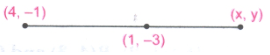
Let coordinates of the other end of the diameter be (x, y).
We know that the centre of the circle (1,-3) is the mid-point of diameter.
\(\Rightarrow \frac { 4+x }{ 2 } =1\) and \( \frac { (-1+y) }{ 2 } =-3\)
\(\Rightarrow 4+x=2\) and \( -1+y=-6\Rightarrow x=-2\) and \( y=-6+1=-5\)
Thus, coordinates of the other end of the diameter are (-2, -5).
7.
Let base be x cm, then height be (x-7) cm
By Pythagoras Theorem, (base)2 + (height)2=(hypotenuse)2
\(\Rightarrow\) x2+(x-7)2=(13)2 \(\Rightarrow\) x2+x2+49-14x=169
\(\Rightarrow\) 2x2-14x-120=0 \(\Rightarrow\) x2-7x-60=0
\(\Rightarrow\) x2-12x+5x-60=0 \(\Rightarrow\) x(x-12)+5(x-12)=0
\(\Rightarrow\) (x+5)(x-12)=0 \(\Rightarrow\) x-12=0 or x+5=0
\(\Rightarrow\) x=12 or x=-5 (-5 is rejected as sides can never be negative)
\(\Rightarrow\) Base=12 cm and altitude=12-7=5 cm
8.
\(L H S=\frac{\cot A-\cos A}{\cot A+\cos A}=\frac{\frac{\cos A}{\sin A}-\cos A}{\frac{\cos A}{\sin A}+\cos A}\)
\(=\frac{\cos A\left(\frac{1}{\sin A}-1\right)}{\cos A\left(\frac{1}{\sin A}+1\right)}=\frac{\left(\frac{1}{\sin A}-1\right)}{\left(\frac{1}{\sin A}+1\right)}=\frac{\operatorname{cosec} A-1}{\operatorname{cosec} A+1}=\operatorname{RHS}\)
9.
We have
x2 + 7x + 10 = (x + 2)(x + 5)
So, the value of x2 + 7x + 10 is zero when x + 2 = 0 or x + 5 = 0, i.e., when x = – 2 or x = –5. Therefore, the zeroes of x2 + 7x + 10 are – 2 and – 5. Now,
sum of zeroes = \(-2+(-5)=-(7)=\frac{-(7)}{1}=\frac{-(\text { Coefficient of } x)}{\text { Coefficient of } x^{2}}\)
product of zeroes = \((-2) \times(-5)=10=\frac{10}{1}=\frac{\text { Constant term }}{\text { Coefficient of } x^{2}}\)
10.
First, solve the given equations similar to question 1 to get the value of x and y and then put these value in y=mx+7 or y=mx+3 to get required value of m.
x=2, y=-3, m=-5
11.
Rational
12.
Let point on y-axis be (0,a)
Now distance of this point from (5,-2) equal to distance from point (-3,2)
i.e., \(\Rightarrow \sqrt { 5^{ 2 }+\left( -2-a \right) ^{ 2 } } =\sqrt { \left( 3 \right) ^{ 2 }+\left( a-2 \right) ^{ 2 } } \)
Squaring and simplifying, we get
25+4+a2+4a = 9+a2+4-4a ⇒ 8a=-16 ⇒ a=-2
13.
\(4x^2+4\sqrt3+3=0\)
\(\Rightarrow \quad { x }^{ 2 }+\frac { 4 }{ 4 } \sqrt { 3 } x+\frac { 3 }{ 4 } =0\quad \Rightarrow \quad { x }^{ 2 }+\sqrt { 3 } x=-\frac { 3 }{ 4 } \)
Now adding square of (a coefficient of x) on both sides, we get
\(\Rightarrow \quad { x }^{ 2 }+\sqrt { 3 } x+{ \left( \frac { \sqrt { 3 } }{ 2 } \right) }^{ 2 }=-\frac { 3 }{ 4 } +{ \left( \frac { \sqrt { 3 } }{ 2 } \right) }^{ 2 }\quad \Rightarrow \quad { \left( x+\frac { \sqrt { 3 } }{ 2 } \right) }^{ 2 }=-\frac { 3 }{ 4 } +\frac { 3 }{ 4 } \)
\(\Rightarrow \quad { \left( x+\frac { \sqrt { 3 } }{ 2 } \right) }^{ 2 }=0\quad \Rightarrow \quad x+\frac { \sqrt { 3 } }{ 2 } =0\)
\(\Rightarrow \quad x=\frac { \sqrt { 3 } }{ 2 } \)
Hence, the roots are\(\frac { -\sqrt { 3 } }{ 2 } \) and\(\frac { -\sqrt { 3 } }{ 2 } \).
14.
(c)
∠B = ∠D
15.
(a)
0°
16.
(d)
458th
17.
(a)
26
18.
(d)
real and unequal
19.
(d)
b2 – 4ac < 0
20.
(d)
4 + 3√3
21.
(d)
30°
22.
(a)
12
23.
(c)
Equating either of the coefficients
24.
(d)
(3,1)
25.
(a)
-b/a
26.
(c)
3
27.
(b)
4
28.
(a)
(1,2) or (3,6)
29.
(b)
(–1, –2)
30.
(c)
20√3
31.
(b)
45°
32.
(d) If Assertion is incorrect but Reason is correct.
33.
(a) If both Assertion and Reason are correct and Reason is the correct explanation of Assertion.
34.
(i) (c) (6, 7)
(ii) (b) \(\mathrm{AB}=\sqrt{(8-0)^{2}+(3+1)^{2}}\)
(iii) (b) BD = 10 km
(iv) (b) \(\mathrm{AC}=\sqrt{(6-0)^{2}+(7+1)^{2}}\)
\(=\sqrt{36+64}=\sqrt{100}=10\)
(v) (a) From (ii) \(\mathrm{AB}=4 \sqrt{5}\)
\(\mathrm{DC}=\sqrt{(6+2)^{2}+(7-3)^{2}}\)
= \(\sqrt{64+16}=\sqrt{80}=4 \sqrt{5}\)
\(\mathrm{AD}=\sqrt{(-2-0)^{2}+(3+1)^{2}}\)
\(=\sqrt{4+16}=\sqrt{20}=2 \sqrt{5}\)
and \(\mathrm{BC}=\sqrt{(6-8)^{2}+(7-3)^{2}}\)
= \(=\sqrt{4+16}=\sqrt{20}=2 \sqrt{5}\)
\(\therefore \quad \mathrm{AB}=\mathrm{DC} \text { and } \mathrm{AD}=\mathrm{BC}\)
Thus, opposite sides are equal.
From (iii) and (iv) we have
BD = 10 and AC = 10
Since opposite sides are equal and diagonals are equal therefore ABCD is a rectangle.
35.
(i) (b): \(\angle X A C=45^{\circ}\)
\(\therefore \quad \angle A C D=45^{\circ}\) [Alternate interior angles]
(ii) (b)
(iii) (c) : \(\text { In } \Delta A C D\)
\(\frac{A D}{D C}=\tan 45^{\circ} \)
\(\Rightarrow \frac{100}{D C}=1 \Rightarrow D C=100 \mathrm{~m}\)
(iv) (d): \(\text { In } \Delta A B D, \frac{A D}{B D}=\tan 30^{\circ}\)
\(\Rightarrow \quad \frac{100}{B D}=\frac{1}{\sqrt{3}} \)
\(\Rightarrow \quad B D=100 \sqrt{3} \mathrm{~m}\)
(v) (a): \(\text { In } \Delta A D C\)
\(\frac{A D}{A C}=\sin 45^{\circ} \Rightarrow \frac{100}{A C}=\frac{1}{\sqrt{2}} \Rightarrow A C=100 \sqrt{2} \mathrm{~m}\)
36.
Here the smallest 3-digit number divisible by 7 is 105. So, the number of bacteria taken into consideration is 105, 112, 119, .... ,994 So, first term (a) = 105, d = 7 and last term = 994
(i) (c): t5 = a + 4d = 105 + 28 = 133
(ii) (b): Let n samples be taken under consideration.
\(\because\) Last term = 994
\(\Rightarrow\) a + (n - 1)d = 994 \(\Rightarrow\) 105 + (n - 1)7 = 994 \(\Rightarrow\) n = 128
(iii) (a): Total number of bacteria in first 10 samples
\(=S_{10}=\frac{10}{2}[2(105)+9(7)]=1365\)
(iv) (a): t7 from end = (128 - 7 + 1)th term from beginning = 122th term = 105 + 121(7) = 952
(v) (c): t50 = 105 + 49 x 7 = 448

10th Standard CBSE Syllabus & Materials
10th Standard CBSE
CBSE 10th Social Science PS - Federalism - New Model Questions Papers Study Material - QB365 Set A
NEW10th Standard CBSE
CBSE 10th Social Science PS - Power Sharing - New Model Questions Papers Study Material - QB365 Set A
NEW10th Standard CBSE
CBSE 10th Social Science GEO - Manufacturing Industries - New Model Questions Papers Study Material - QB365 Set A
NEW10th Standard CBSE
CBSE 10th Social Science GEO - Minerals and Energy Resources - New Model Questions Papers Study Material - QB365 Set A



NCERT Books

Syllabus

Exam Pattern

Sample Question Papers

Previous year Question Papers

Important Notes

MCQ Practice test

NCERT Exemplers

Case study Questions

Image Based Questions

Passage based Questions

HOT Questions

Value Based Questions

Model Questions Papers
NCERT ( Book Back ) Questions

Assertion and Reason
Important Questions And Answers

CBSE 10th Standard CBSE Subjects
CBSE Standards




