
 100% FREE ACCESS
10th Standard CBSE Syllabus & Materials
10th Standard CBSE
CBSE 10th Social Science ECO - Globalisation and the Indian Economy - New Model Questions Papers Study Material - QB365 Set A
NEW10th Standard CBSE
CBSE 10th Social Science ECO - Money and Credit - New Model Questions Papers Study Material - QB365 Set A
NEW10th Standard CBSE
CBSE 10th Social Science ECO - Sectors of the Indian Economy - New Model Questions Papers Study Material - QB365 Set A
NEW10th Standard CBSE
CBSE 10th Social Science ECO - Development - New Model Questions Papers Study Material - QB365 Set A
NEW10th Standard CBSE
CBSE 10th Social Science PS - Outcomes of Democracy - New Model Questions Papers Study Material - QB365 Set A
NEW10th Standard CBSE
CBSE 10th Social Science PS - Gender, Religion and Caste - New Model Questions Papers Study Material - QB365 Set A

Published on: 22/10/2025
Download CBSE Class 10th Standard CBSE Maths question papers, sample papers, important questions, and previous year solved papers in PDF format. Get free study materials, NCERT solutions, and exam preparation resources for Class 10th Standard CBSE Maths
Questions + Answers key
Take MCQ Maths Test
1.
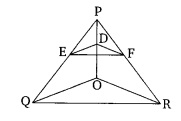
In the given figure, DE || OQ and DF || OR. Show that EF || QR.
2.
In a school, students thought of planting trees in and around the school to reduce air pollution. It was decided that the number of trees, that each section of each class will plant, will be the same as the class, in which they are studying, e.g., a section of Class I will plant 1 tree, a section of Class II will plant 2 trees and so on till Class XII. There are three sections of each class. How many trees will be planted by the students?
3.
Find the 10th term of the AP : 2, 7, 12, . . .
4.
Prove that the tangents drawn at the ends of a diameter of a circle are parallel.
5.
The sum of the 4th and 8th terms of an AP is 24 and sum of the 6th and 10th terms is 44. Find the first three terms of the AP.
6.
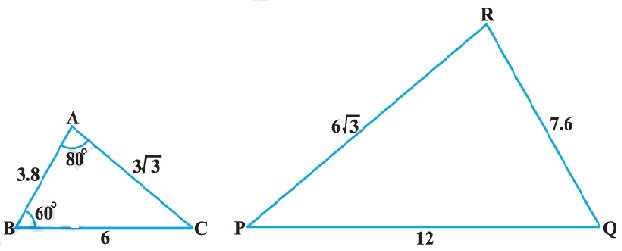
Observe Figure and then find ∠ P.
7.
Let p be a prime number. If p divides a2 , then p divides a, where a is a positive integer.
8.
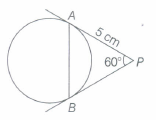
In the given figure, PA and PB are tangents to the given circle such that PA = 5 cm and \(\angle APB={ 60 }^{ \circ }\). Find the length of chord AB.
9.
The 6th and 17th terms of an A.P. are 19 and 41 respectively, find the 40th term.
10.
A man rowing a boat away from a lighthouse 150 m high takes 2 minutes to change the angle of elevation of the top of lighthouse from 45o to 30o. Find the speed of the boat. \((Use\sqrt { 3 } =1.732)\)
11.
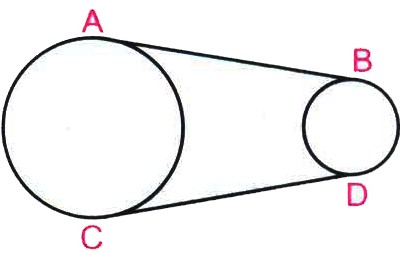
In figure, AB and CD are common tangents to two circles of unequal radii.Prove that AB=CD.
12.
State and Prove Fundamental Theorem of Arithmetic.
13.
If the mth term of an AP is \(\frac {1}{n}\) and nth term is \(\frac { 1 } { m },\) then show that the sum of mn terms is \(\frac { 1 } { 2 } ( mn + 1).\)
14.
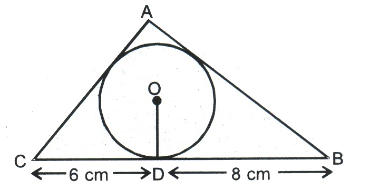
A triangle ABC is drawn to circumscribe a circle of radius 4 cm such that the segments BD and DC into which BC is divided by the point of contact D are of lengths 8 cm and 6 cm respectively (see Fig). Find the sides AB and AC.
15.
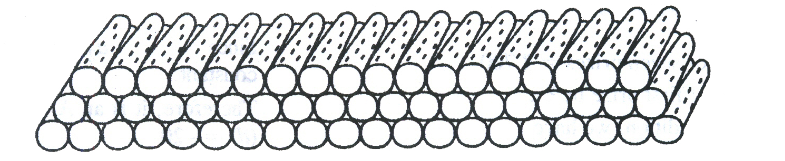
200 logs are stacked in the following manner: 20 logs in the bottom row, 19 in the next row, 18 in the row next to it and so on.
(i) In how many rows are the 200 logs placed and how many logs are in the top row?
(ii) Which value is depicted in the pattern of log?
16.
If tangents PA and PB from a point P to a circle with centre O are inclined to each other at angle of 80°, then \(\angle POA \) is equal to
50°
60°
70°
80°
17.
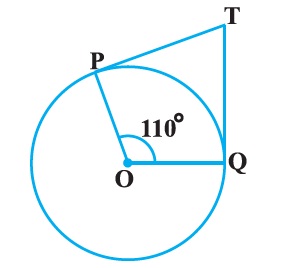
In the given figure, if TP and TQ are the two tangents to a circle with centre O so that \(\angle POQ\)= 110°, then \(\angle PTQ\) is equal to
60°
70°
80°
90°
18.
From a point Q, the length of the tangent to a circle is 24 cm and the distance of Q from the centre is 25 cm. The radius of the circle is
7 cm
12 cm
15 cm
24.5 cm
19.
Tangents AP and AO are drawn to circle with centre 0 from an external point A, then \(\angle P A Q\) is equal to
\(2 \angle O P Q\)
\(\frac{\angle O P Q}{2}\)
\(\frac{\angle O P Q}{3}\)
\(\frac{\angle O P Q}{4}\)
20.
If the lengths of the diagonals of rhombus are 16 cm and 12 cm. Then, the length of the sides of the rhombus is
9 cm
10 cm
8 cm
20 cm
21.
11th term of the AP: – 3 ,\(-\frac{1}{2}\) ,2 , ..., is
28
22
- 38
\(-48 \frac{1}{2}\)
22.
If x andy are odd positive integers, then X2 + y2 is
even and divisible by 4
even and not divisible by 4
odd and divisible by 4
odd and not divisible by 4
23.
If p, q, r, s, t are the terms of an A.P. with common difference -1 the relation between p and t is
t = p – 6
t = p – 5
t = p + 4
t = p – 4
24.
Which term of the A.P 10,8,6,… will be the first negative term?
6
7
5
4
25.
What is the sum of the first 50 multiples of 3?
4325
3255
3825
4455
26.
The nth term of the AP 9, 13, 17, 21, 25, ………….. is:
3n+2
4n+5
5n+3
4n-5
27.
Amit starts his exercise regime with 25 push ups on Monday. He plans to increase 5 push ups every following Monday. How many push ups will he be doing on the 3rd Monday since he started?
35
45
60
70
28.
What is the sum of the first 20 whole numbers
190
200
100
140
29.
Given two triangles ABC and PQR such that, AB = 2 cm , PQ = 3cm, ∠B = ∠Q BC = 5 cm, QR = 7.5 cm. AG and PS are medians .Find \(\frac { AG }{ PS } \) =?
2/5
1/5
4/5
2/3
30.
There are 135 partcipants in English and 165 in Mathematics in a seminar. What is the minimum number of rooms required to seat them if each room must have the same number of participants from each of the two subjects.
25
30
15
20
31.
6n is divisible by
2
3
5
2 and 3 both
32.
If altitude of the sun is 60°, the height of a tower which casts a shadow of length 30 m is:
30√3 cm
30/√3 m
15 m
15√2 m
33.
A circle may have…….
Infinite tangents
No tangent
1 tangent
2 tangent
34.
What is the distance between two parallel tangents of a circle of the radius 4 cm?
8 cm
4 cm
2 cm
6 cm
35.
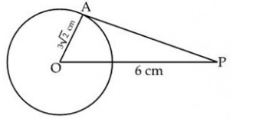
A tangent PA is drawn from an external point P to a circle of radius 3√2 cm such that the distance of the point P from O is 6 cm as shown figure. The value of ∠APO is
30o
60o
45o
75o
36.
A Ferris wheel (or a big wheel in the United Kingdom) is an amusement ride consisting of a rotating upright wheel with multiple passenger-carrying components (commonly referred to as passenger cars, cabins, tubs, capsules, gondolas, or pods) attached to the rim in such a way that as the wheel turns, they are kept upright, usually by gravity.
After taking a ride in Ferris wheel, Aarti came out from the crowd and was observing her friends who were enjoying the ride . She was curious about the different angles and measures that the wheel will form. She forms the figure as given below.
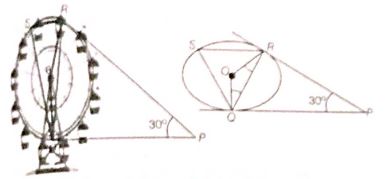
(i) In the given figure, find \(\angle\)ROQ
(a) 60° (b) 100° (c) 150° (d) 90°
(ii) Find \(\angle\)RQP.
(a) 75° (b) 60° (c) 30° (d) 90°
(iii) Find \(\angle\)RSQ
(a) 60° (b) 75° (c) 100° (d) 30°
(iv) Find \(\angle\)ORP.
(a) 90° (b) 70° (c) 100° (d) 60°
37.
A circus artist is climbing through a 15 m long rope which is highly stretched and tied from the top of a vertical pole to the ground as shown below. Based on the above information, answer the following questions.
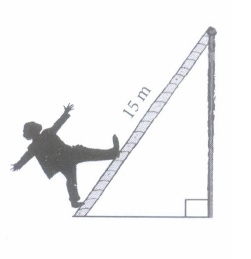
(i) Find the height of the pole, if angle made by rope to the ground level is 45°.
| \((a) 15 \mathrm{~m}\) | \((b) 15 \sqrt{2} \mathrm{~m}\) |
| \((c) \frac{15}{\sqrt{3}} \mathrm{~m}\) | \((d) \frac{15}{\sqrt{2}} \mathrm{~m}\) |
(ii) If the angle made by the rope to the ground level is 45°, then find the distance between artist and pole at ground level.
| \((a) \frac{15}{\sqrt{2}} \mathrm{~m}\) | \((b) 15 \sqrt{2} \mathrm{~m}\) | \((c) 15 \mathrm{~m}\) | \((d) {15}{\sqrt{3}} \mathrm{~m}\) |
(iii) Find the height of the pole if the angle made by the rope to the ground level is 30°.
| (a) 2.5 m | (b) 5 m | (c) 7.5 m | (d) 10 m |
(iv) If the angle made by the rope to the ground level is 30° and 3 m rope is broken, then find the height of the pole
| (a) 2m | (b) 4m | (c) 5m | (d) 6m |
(v) Which mathematical concept is used here?
| (a) Similar Triangles | (b) Pythagoras Theorem |
| (c) Application of Trigonometry | (d) None of these |
38.
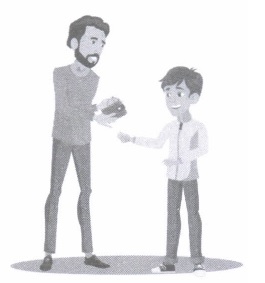
Anuj gets pocket money from his father everyday. Out of the pocket money, he saves Rs 2.75 on first day, Rs 3 on second day, Rs 3.25 on third day and so on.
On the basis of above information, answer the following questions .
(i) What is the amount saved by Anuj on 14th day?
| (a) Rs 6.25 | (b) Rs 6 | (c) Rs 6.50 | (d) Rs 6.75 |
(ii) What is the total amount saved by Anuj in 8 days?
| (a) Rs 18 | (b) Rs 33 | (c) Rs 24 | (d) Rs 29 |
(iii) What is the amount saved by Anuj on 30th day?
| (a) Rs 10 | (b) Rs 12.75 | (c) Rs 10.25 | (d) Rs 9.75 |
(iv) What is the total amount saved by him in the month of June, if he starts savings from 1st June?
| (a) Rs 191 | (b) Rs 191.25 | (c) Rs 192 | (d) Rs 192.5 |
(v) On which day, he save tens times as much as he saved on day-I?
| (a) 9th | (b) 99th | (c) 10th | (d) 100th |
1.
In Δ POQ, DE || OQ [given]
\(\therefore \frac{P E}{E Q}=\frac{P D}{D O}\) ...(i)
[by basic proportionality theorem]
In ΔPOR, DF || OR [given]
\(\therefore \frac{P F}{F R}=\frac{P D}{D O}\) ...(ii)
[by basic proportionality theorem]
From Eqs. (i) and (ii), we get
\(\frac{P E}{E Q}=\frac{P F}{F R}\)
In ΔPQR, we have \(\frac{P E}{E Q}=\frac{P F}{F R}\)
∴ EF || QR
[by Converse of basic proportionally theorem]
Hence proved.
2.
According to the question, there are three sections of each class, so the number of trees that are planted by students of class I, class lI, class III,... and class XII, are respectively, 1 \(\times\)3, 2 \(\times\)3,3 \(\times\)3, ... and 12 \(\times\)3
Thus, we get the following list of numbers, 3, 6, 9, .., 36
Clearly, it forms an AP.
Here, the first term, a = 3
common differencc, d = 6 - 3 = 3
and the last term, l = 36
Let the last term of this AP be its nth term.
Then, an = a + (n - 1) d = l
\(\Rightarrow\) 3 + (n - 1) (3) = 36 \(\Rightarrow\) (n - 1) 3 = 33
\(\Rightarrow\) n - 1 = 11 \(\Rightarrow\) n = 12
Hence, the number of the trees planted by the students
= Sum of 12 terms of above AP
\(\begin{array}{ll} =\frac{12}{2}(3+36) & {\left[\because S_n=\frac{n}{2}(a+l)\right]} \end{array}\)
= 6 \(\times\) 39 = 234
3.
Here, a = 2, d = 7 – 2 = 5 and n = 10.
We have an = a + (n – 1) d
So, a10 = 2 + (10 – 1) × 5 = 2 + 45 = 47
Therefore, the 10th term of the given AP is 47.
4.
Let AB be a diameter of a given circle and LM and PQ be the tangent lines drawn to the circle at points A and B, respectively.
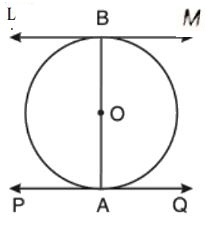
To prove LM || PQ
Proof We know that the tangent at any point of a circle is perpendicular to the radius through the point of contact.
\(\therefore\) OA \(\perp\) PQ and OB \(\perp\) LM
\(\Rightarrow\) AB \(\perp\) PQ
and AB \(\perp\) LM
\(\Rightarrow\) \(\angle\)PAB = 90°
and \(\angle\)ABM = 90°
\(\Rightarrow\) \(\angle\)PAB = \(\angle\)ABM
[each = 90°]
But these are alternate angles.
\(\therefore\) PQ || LM
Hence, the tangents drawn at the ends of a diameter of a circle are parallel.
Hence proved.
5.
Let a be the first term and d be the common difference of given AP.
Given, a4 + a8 = 24
\(\therefore\) (a + 3d) + (a + 7d) = 24 [\(\because\) an = a + (n - 1)d]
\(\Rightarrow\) a + 5d = 12 ....(i)
[dividing both sides by 2]
and a6 + a10 = 44
\(\Rightarrow\) (a + 5d) + (a + 9d) = 44
\(\Rightarrow\) 2a + 14d = 44 \(\Rightarrow\) a + 7d = 22 .... (ii)
[dividing both sides by 2]
On subtracting Eq. (i) from Eq. (ii), we get
2d = 10 \(\Rightarrow\) d = 5
On putting d = 5 in Eq. (i), we get
a + 25 = 12 \(\Rightarrow\) a = -13
Hence, the first three terms are
a,(a + d) and (a + 2d)
i.e. -13, (-13 + 5) and (-13 + 2 \(\times\)5)
i.e. -13, -8 and -3.
6.
In ∆ ABC and Δ PQR,
\(\frac{\mathrm{AB}}{\mathrm{RQ}}=\frac{3.8}{7.6}=\frac{1}{2}, \frac{\mathrm{BC}}{\mathrm{QP}}=\frac{6}{12}=\frac{1}{2} \text { and } \frac{\mathrm{CA}}{\mathrm{PR}}=\frac{3 \sqrt{3}}{6 \sqrt{3}}=\frac{1}{2}\)
That is, \(\frac{\mathrm{AB}}{\mathrm{RQ}}=\frac{\mathrm{BC}}{\mathrm{QP}}=\frac{\mathrm{CA}}{\mathrm{PR}}\)
So, Δ ABC ~ Δ RQP (SSS similarity)
Therefore, ∠ C = ∠ P (Corresponding angles of similar triangles)
But ∠ C = 180° - ∠ A - ∠ B (Angle sum property)
= 180° - 80° - 60° = 40°
So, ∠ P = 40°
7.
Proof : Let the prime factorisation of a be as follows :
a = p1 p2 . . . pn , where p1 ,p2 , . . ., pn are primes, not necessarily distinct. Therefore, a2 = ( p1 p2 . . . pn )( p1 p2 . . . pn ) = p21 p22 . . . p 2n .
Now, we are given that p divides a 2 . Therefore, from the Fundamental Theorem of Arithmetic, it follows that p is one of the prime factors of a 2 . However, using the uniqueness part of the Fundamental Theorem of Arithmetic, we realise that the only prime factors of a2 are p1 ,p2 , . . ., pn . So p is one of p1 , p2 , . . ., pn .
Now, since a = p1 p2 . . . pn ,p divides a.
We are now ready to give a proof that \(\sqrt 2\) is irrational.
The proof is based on a technique called ‘proof by contradiction’.
8.
5 cm
9.
87
10.
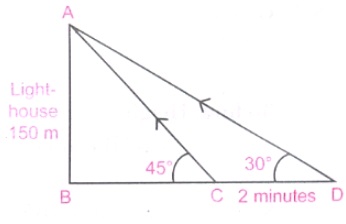
Let AB is lighthouse
AB=150 m
Initially boat is at C and after 2 minutes it reaches at D.
In right ∆ABC
\(\frac { AB }{ BC } \)=tan45o
⇒ \(\frac { 150 }{ BC } \)=1 ⇒ BC=150 m
In right ∆ABD, \(\frac { AB }{ BD } \)=tan 30o
⇒ \(\frac { 150 }{ BD } =\frac { 1 }{ \sqrt { 3 } } \Rightarrow BD=150\sqrt { 3 } \)
Distance covered in 2 minutes=BD-BC= \( 150\sqrt { 3 } -150=150(\sqrt { 3 } -1)\)m
Speed=Distance covered/time taken=\(\frac { 150(\sqrt { 3 } -1) }{ 2 } \)
=75 x (1.732-1)=54.9 m/minutes
11.
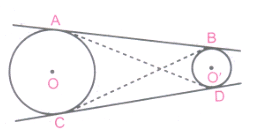
Construction: Join AD and BC
Proof: The tangent drawn from an internal point to a circle are equal in length.
If A is external point for circle hving centre O.
AB = AD .....(i)
If C is external point then
BC = CD .....(ii)
Now, B is external point for circle having centre O
AB = BC .....(iii)
So, from (i), (ii) and (iii), we get
AB = BC = CD
So, AB = CD Hence proved.
12.
Every composite number can be expressed (factorised) as a product of primes, and this factorisation is unique, apart from the order in which the prime factors occur.
The Fundamental Theorem of Arithmetic says that every composite number can be factorised as a product of primes. Actually it says more. It says that given any composite number it can be factorised as a product of prime numbers in a ‘unique’ way, except for the order in which the primes occur. That is, given any composite number there is one and only one way to write it as a product of primes, as long as we are not particular about the order in which the primes occur. So, for example, we regard 2 x 3 x 5 x 7 as the same as 3 x 5 x 7 x 2, or any other possible order in which these primes are written.
This fact is also stated in the following form: The prime factorisation of a natural number is unique, except for the order of its factors.
In general, given a composite number x, we factorise it as x = p1 p2 ... pn , where p1 , p2 ,..., pn are primes and written in ascending order, i.e., p1 ≤ p2 ≤ . . . ≤ pn . If we combine the same primes, we will get powers of primes. For example,
32760 = 2 x 2 x 2 x 3 x 3 x 5 x 7 x 13 = 23 x 32 x 5 x 7 x 13
Once we have decided that the order will be ascending, then the way the number is factorised, is unique.
The Fundamental Theorem of Arithmetic has many applications, both within mathematics and in other fields.
13.
Let a be the first term and d be the common difference of given AP.
Given, \({a}_{m}=\frac {1}{n} \Rightarrow a + (m - 1)d = \frac {1} {n}\) ....(i)
and \({a}_{n}=\frac {1} {m} \Rightarrow a + (n-1)d = \frac {1} {m}\) ....(ii)
On subtracting Eq. (ii) from Eq. (i), we get
\((m-n)d=\frac {1}{n}-\frac{1}{m}\)
\(\Rightarrow \ (m-n)d=\frac {m-n}{mn}\)
\(\Rightarrow d=\frac {1}{mn}\)
On putting \(d=\frac {1}{mn}\) in Eq. (i), we get
\(a + (m-1)\frac {1}{m}=\frac {1}{n}`\)
\(\Rightarrow \quad a+\frac {1}{n}-\frac {1}{mn}=\frac{1}{n}\)
\(\Rightarrow a=\frac {1}{mn}\)
Now, sum of mn terms,
\({S}_{mn}=\frac {mn}{2} \left[2a+(mn-1)d \right]\)
\(\left[\because {S}_{n}=\frac {n}{2}\{\ 2a + (n-1)d \}\ \right]\)
\(\Rightarrow \quad {S}{mn}=\frac {mn}{2}\left[\frac {2} {mn} + (mn - 1) \frac {1 } {mn }\right]=\frac {1} {2}(mn+1)\)
14.
Given, CD = 6 cm, BD = 8 cm and radius = 4 cm
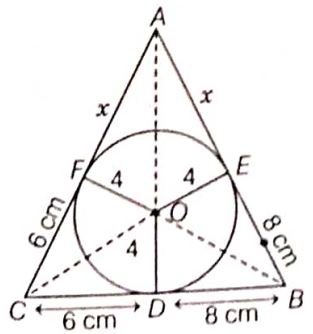
Join OC, OA and OB.
Let the circle touches the other sides AB and AC at points E and F, respectively.
We know that tangents drawn from an external point to the circle are equal in length.
\(\therefore\) CD = CF = 6 cm [\(\because\) C is an external point]
BD = BE = 8 cm [\(\because\) B is an external point]
and AF = AE = x cm (say [\(\because\) A is an external point]
Area of \(\Delta\)OCB, \(A_1=\frac{1}{2} \times \text { Base } \times \text { Height }\)
\(\begin{aligned} & =\frac{1}{2} \times C B \times O D \\ \end{aligned}\)
\(\begin{aligned} & =\frac{1}{2} \times 14 \times 4=28 \mathrm{~cm}^2 \\ \end{aligned}\)
\(\begin{aligned} & \quad[\because C B=C D+B D=6+8=14] \end{aligned}\)
Area of \(\Delta\)OCA,
\(\begin{aligned} A_2 & =\frac{1}{2} \times A C \times O F \end{aligned}\)
\(\begin{aligned} =\frac{1}{2}(6+x) \times 4=(12+2 x) \mathrm{cm}^2 \end{aligned}\)
and area of \(\Delta\)OBA,
\(A_3=\frac{1}{2} \times A B \times O E=\frac{1}{2}(8+x) \times 4=(16+2 x) \mathrm{cm}^2\)
Thus, area of \(\Delta\)ABC
= A1 + A2 + A3 = [28 + (12 + 2x) + (16+ 2x)]
= (56 + 4x) cm2 ...(i)
Now, semi-perimeter of \(\Delta\)ABC=\(\frac{1}{2}\)(AB + BC + CA)
\(\Rightarrow \quad s=\frac{1}{2}(x+8+14+6+x)\)
\(\Rightarrow\) s = (14 + x) cm
Using Heron's formula,
area of \(\Delta\)ABC = \(\begin{aligned} & =\sqrt{s(s-a)(s-b)(s-c)} \end{aligned}\)
\(\begin{aligned} =\sqrt{(14+x)(14+x-14)(14+x-x-6)(14+x-x-8)} \end{aligned}\)
\(\begin{aligned} & =\sqrt{(14+x) \times x \times 8 \times 6} \end{aligned}\)
\(\begin{aligned} =\sqrt{(14+x) 48 x} \end{aligned}\) ...(ii)
From Eqs. (i) and (ii), we get
\(\sqrt{(14+x) 48 x}=56+4 x=4(14+x)\)
On squaring both sides, we get
(14 + x) 48 x = 42 (14 + x)2
\(\Rightarrow\) 3x = 14 + x
\(\Rightarrow\) 2x = 14
\(\Rightarrow\) x = 7
\(\therefore\) Length of AC = 6 + x = 6 + 7 = 13 cm
and length of AB = 8 + x = 8 + 7 = 15 cm
15.
(i) Number of logs stacked in each row form a sequence 20, 19, 18, 17,...., which is an AP with first term, a= 20 and common difference, d = 19 - 20 = -1.
Suppose number of rows is n, then Sn= 200
\(\begin{aligned} \Rightarrow \frac{n}{2}[2 \times 20+(n-1)(-1)] & =200 \\ \end{aligned}\)
\(\begin{aligned} {\left[\because S_n\right.} & \left.=\frac{n}{2}\{2 a+(n-1) d\}\right] \end{aligned}\)
\(\begin{array}{lr} \Rightarrow & 400=40 n-n^2+n \\ \end{array}\)
\(\begin{array}{lr} \Rightarrow & n^2-41 n+400=0 \\ \end{array}\)
\(\begin{array}{lr} \Rightarrow & n^2-25 n-16 n+400=0 \\ \end{array}\)
\(\begin{array}{lr} \Rightarrow & n(n-25)-16(n-25)=0 \\ \end{array}\)
\(\begin{array}{lr} \Rightarrow & (n-25)(n-16)=0 \\ \end{array}\)
\(\begin{array}{lr} \Rightarrow & n=16 \text { or } n=25 \end{array}\)
Hence, the number of rows is either 25 or 16.
When, n = 16,
an= a + (n -1) d = 20 + (16 - 1) ( - 1)
= 20 - 15 = 5
When, n = 25,
an = a + (n - 1) d = 20 + (25-1) (-1)
= 20 - 24 = - 4
[\(\because\) number of logs cannot be negative]
Hence, the number of rows is 16 and number of logs in the top row is 5.
(ii) The pattern of logs show space saving creativity, reasoning and balancing.
16.
(a)
50°
17.
(b)
70°
18.
(a)
7 cm
19.
(a)
\(2 \angle O P Q\)
20.
(b)
10 cm
21.
(b)
22
22.
(b)
even and not divisible by 4
23.
(d)
t = p – 4
24.
(b)
7
25.
(c)
3825
26.
(b)
4n+5
27.
(a)
35
28.
(a)
190
29.
(d)
2/3
30.
(d)
20
31.
(d)
2 and 3 both
32.
(a)
30√3 cm
33.
(a)
Infinite tangents
34.
(a)
8 cm
35.
(c)
45o
36.
(i) (c) In quadrilateral PQOR, we have
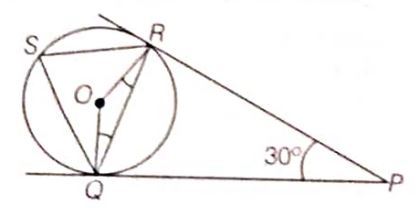
\(\begin{array}{r} \angle Q P R+\angle P R O+\angle P Q O+\angle R O Q=360^{\circ} \\ \end{array}\)
\(\Rightarrow \begin{array}{r} 30^{\circ}+90^{\circ}+90^{\circ}+\angle R O Q=360^{\circ} \end{array}\)
[\(\because\) radius is always perpendicular to the tangent at point of contact]
\(\Rightarrow \quad \angle R O Q=360^{\circ}-210^{\circ}=150^{\circ} \)
\((ii) (a) In \quad \triangle Q O R, O Q=O R\) [radii]
\(\begin{array}{ll} \therefore & \angle O R Q=\angle O Q R \\ \end{array}\)
\(\begin{array}{ll} \text { Now, } & \angle R O Q+\angle O R Q+\angle O Q R=180^{\circ} \\ \end{array}\)
\(\begin{array}{ll} \Rightarrow & 2 \angle O Q R=180^{\circ}-150^{\circ} \\ \end{array}\)
\(\begin{array}{ll} \Rightarrow & 2 \angle O Q R=30^{\circ} \\ \end{array}\)
\(\begin{array}{ll} \Rightarrow & \angle O Q R=15^{\circ} \end{array}\)
Again, \(\begin{array}{ll} \angle O Q R=90^{\circ} \end{array}\) \([\because O Q \perp Q P]\)
\(\begin{aligned} \Rightarrow \angle O Q R+\angle R Q P=90 \\ \end{aligned}\)\({\circ}\)
\(\Rightarrow \quad \angle R Q P=90^{\circ}-15^{\circ}=75^{\circ}\)
(iii) (b) We know that angle subtended by an are at centre is double the angle subtended by it at any other part of the circle.
\(\begin{aligned} 2 \angle R S Q & =\angle R O Q \\ \end{aligned}\)
\(\begin{aligned} \angle R S Q & =\frac{1}{2} \times 150^{\circ}=75^{\circ} \end{aligned}\)
(iv) (a) \(\angle\)ORP = 90\(\circ\) as radius is always perpendicular to the tangent at the point of contact.
37.
(i) (d): Let h be the height of the pole.
In \(\Delta\)ABC,
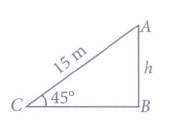
\( \frac{h}{15}=\sin 45^{\circ} \Rightarrow \frac{h}{15}=\frac{1}{\sqrt{2}}\)
\(\Rightarrow \quad h =\frac{15}{\sqrt{2}} \mathrm{~m}\)
(ii) (a): Let x be the required distance.
In \(\Delta\)ABC,
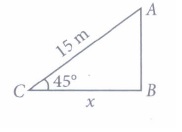
\(\frac{x}{15}=\cos 45^{\circ}=\frac{1}{\sqrt{2}}\)
\(\Rightarrow \quad x=\frac{15}{\sqrt{2}} \mathrm{~m}\)
(iii) (c) : Let h be the height of the pole.
In right triangle ABC,
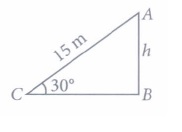
\(\frac{h}{15}=\sin 30^{\circ}=\frac{1}{2}\)
\(\Rightarrow \quad h=\frac{15}{2}=7.5 \mathrm{~m}\)
(iv) (d): If 3 m rope is broken, then the length of the rope is 12 m.
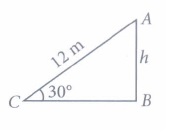
\(\text { In } \Delta A B C, \frac{h}{12}=\sin 30^{\circ}=\frac{1}{2} \)
\(\Rightarrow \quad h=\frac{12}{2}=6 \mathrm{~m}\)
(v) (c)
38.
Here the savings form an A.P. i.e., Rs 2.75, Rs 3, Rs 3.25, ...
So, a = 2.75, d = 3 - 2.75 = 0.25
(i) (b): Amount saved by Anuj on 14th day
= t14 = a + 13d = 2.75 + 13(0.25) = ₹ 6
(ii) (d): Total amount saved by Anuj in 8 days
\(=S_{8}=\frac{8}{2}[2(2.75)+7(0.25)]=₹ 29\)
(iii) (a): Amount saved by Anuj on 30th day
= t30 = a + 29d = 2.75 + 29(0.25) = ₹ 10
(iv) (b): Number of days in June = 30
\(\therefore S_{30}=\frac{30}{2}[2(2.75)+29(0.25)]=₹ 191.25\)
(v) (d): Let on nth day, he saves 10 times as he saves on 1st day.
tn = 10(2.75) \(\Rightarrow\) a + (n - 1)d = 27.5 \(\Rightarrow\) n = 100.

10th Standard CBSE Syllabus & Materials
10th Standard CBSE
CBSE 10th Social Science PS - Federalism - New Model Questions Papers Study Material - QB365 Set A
NEW10th Standard CBSE
CBSE 10th Social Science PS - Power Sharing - New Model Questions Papers Study Material - QB365 Set A
NEW10th Standard CBSE
CBSE 10th Social Science GEO - Manufacturing Industries - New Model Questions Papers Study Material - QB365 Set A
NEW10th Standard CBSE
CBSE 10th Social Science GEO - Minerals and Energy Resources - New Model Questions Papers Study Material - QB365 Set A



NCERT Books

Syllabus

Exam Pattern

Sample Question Papers

Previous year Question Papers

Important Notes

MCQ Practice test

NCERT Exemplers

Case study Questions

Image Based Questions

Passage based Questions

HOT Questions

Value Based Questions

Model Questions Papers
NCERT ( Book Back ) Questions

Assertion and Reason
Important Questions And Answers

CBSE 10th Standard CBSE Subjects
CBSE Standards



