
 100% FREE ACCESS
10th Standard CBSE Syllabus & Materials
10th Standard CBSE
CBSE 10th Social Science ECO - Globalisation and the Indian Economy - New Model Questions Papers Study Material - QB365 Set A
NEW10th Standard CBSE
CBSE 10th Social Science ECO - Money and Credit - New Model Questions Papers Study Material - QB365 Set A
NEW10th Standard CBSE
CBSE 10th Social Science ECO - Sectors of the Indian Economy - New Model Questions Papers Study Material - QB365 Set A
NEW10th Standard CBSE
CBSE 10th Social Science ECO - Development - New Model Questions Papers Study Material - QB365 Set A
NEW10th Standard CBSE
CBSE 10th Social Science PS - Outcomes of Democracy - New Model Questions Papers Study Material - QB365 Set A
NEW10th Standard CBSE
CBSE 10th Social Science PS - Gender, Religion and Caste - New Model Questions Papers Study Material - QB365 Set A

Published on: 20/10/2025
Download CBSE Class 10th Standard CBSE Maths question papers, sample papers, important questions, and previous year solved papers in PDF format. Get free study materials, NCERT solutions, and exam preparation resources for Class 10th Standard CBSE Maths
Questions + Answers key
Take MCQ Maths Test
1.
Find the zeroes of the following polynomial by factorisation method and verify the relations between the zeroes and their coefficients.\(7 y^{2}-\frac{11}{3} y-\frac{2}{3}\)
2.
Find the value of k for which the following pair of equations has no solution:
x + 2y = 3, (k-1)x + (k +1)y = (k + 2).
3.
Prove that \(\frac { \sin { \theta } -\cos { \theta } +1 }{ \sin { \theta } +\cos { \theta } -1 } =\frac { 1 }{ \sec { \theta } -\tan { \theta } } \) using the identity \(\sec ^{ 2 }{ \theta } =1+\tan ^{ 2 }{ \theta } .\)
4.
A card is drawn from a well shuffled deck of 52 cards.Find the probability of getting:
(i)A king of red colour
(ii)A face card
(iii)The queen of diamonds.
5.
Show that the points A(1,0), B(5,3), C(2,7) and D(-2,4) are the vertices of a parallelogram.
6.
Find the value of the middle term of the following AP: -6, -2, 2, ....., 58
7.
A passenger train takes 2 hours less or journey of 300km if its speed is increased by 5km/hour from its usual speed. Find the usual speed of the train.
8.
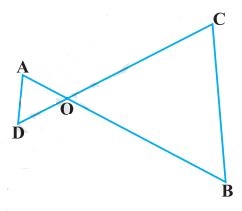
In the given figure, OA . OB = OC . OD. Show that \(\angle\)A = \(\angle\)C and \(\angle\)B = \(\angle\)D.
9.
A card is drawn at random from a well-shuffled deck of playing cards. Find the probability of drawing a (i) face card (ii) card which is neither a king nor a red card.
10.
Show that the points A(2,-2), B(14,10), C(11,13) abd D(-1,1) are the vertices of a rectangle
11.
Find the values of k for which the quadratic equation (k+4)x2+(k+1)x+1=0 has equal roots.
12.
The 6th term of an Arithmetic Progression (AP) is -10 and its 10th term is -26. Determine the 15th term of the AP.
13.
The denominator of a fraction is one more than twice the numerator. If the sum of the fraction and its reciprocal is 2\(\frac{16}{21}\), then find the fraction.
14.
Sides AB and AC and median AD of △ABC are respectively proportional to sides PQ and PR and median PM of another △PQR. Show that \(\triangle\)ABC ~ \(\triangle\)PQR.
15.
The mean of the following frequency distribution is 50, but the frequencies f1 and f2 in classes 20-40 and 60-80 respectively are missing. Find the missing frequencies.
| Class interval | 0-20 | 20-40 | 40-60 | 60-80 | 80-100 | Total |
|---|---|---|---|---|---|---|
| Frequency | 17 | f1 | 32 | f2 | 19 | 120 |
16.
Show that \(\frac { \sin { \theta } }{ 1+\cos { \theta } } +\frac { 1+\cos { \theta } }{ \sin { \theta } } =2cosec\theta \)
17.
Solve the following quadratic equation for x :
\(4x^{2} - 2(a^{2} + b^{2})x + a^{2}b^{2} = 0\)
18.
If for a distribution \(\sum_1^n f_i x_i=132+5 p, \sum_1^n f_i=20\) and mean of the distribution is 8.1, then the value of p is
3
6
4
5
19.
Value(s) of k for which the quadratic equation 2x2 - kx + k = 0 has equal roots is/are
0
4
8
0,8
20.
What is the common difference of the A.P. in which a18 – a14 = 32?
8
-4
-8
4
21.
The nth term of the AP 9, 13, 17, 21, 25, ………….. is:
3n+2
4n+5
5n+3
4n-5
22.
If the equation px2 – 6x – 2 = 0 has real roots then, ________
p ≥ -9/2
p > -9/2
p < -9/2
p ≤ -9/2
23.
What is the empirical relationship between the three measures of central tendency?
3 Mean = Mode + 2 Median
3 Median = Mode + 2 Mean
3 Median = 2Mode + Mean
3 Mean = 2Mode + Median
24.
The express sin A in terms of cot A is
\(\frac { \sqrt { 1+{ cot }^{ 2 }\quad A } }{ cot\quad A } \)
\(\frac { \sqrt { 1-{ cot }^{ 2 }\quad A } }{ cot\quad A } \)
\(\sqrt { \frac { 1-{ cot }^{ 2 }\quad A }{ cot\quad A\quad } } \)
\(\frac { 1 }{ \sqrt { 1+{ cot }^{ 2 }\quad A } } \)
25.
If tan\(\theta =\frac { 12 }{ 5 } \) then\(\frac { 1+sin\theta }{ 1-sin\theta } \) is equal to
9
12/13
24
25
26.
The value of cosec2 30° sin2 45° – sec2 60° is
2
1
-2
0
27.
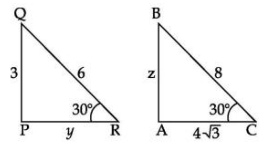
In figure, ΔABC ~ ΔPQR
2 + √3
4 + √3
3 + 4√3
4 + 3√3
28.
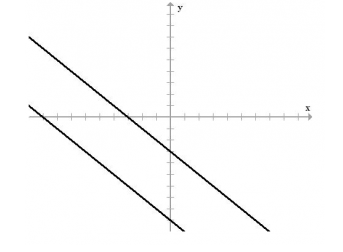
The number of solutions of equations represented by this graph is
Infinite
1
2
No solution
29.
If the pair of equation has no solution, then the pair of equation is
inconsistent
none of these
coincident
consistent
30.
If sum of the zeroes of the polynomial is 4 and their product is 4, then the quadratic polynomial is
x2 + 2x + 2
x2 + 4x + 4
x2 – 4x + 4
x2 – 2x + 2
31.
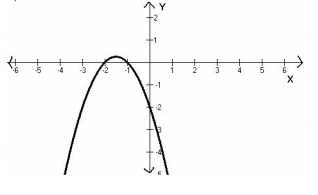
Polynomial will have zeroes
-1
2 and -1
-2 and -1
-5
32.
The HCF of 135 and 165 is …
25
5
15
35
33.
For some integer ‘m’ every odd integer is of form
2m + 1
m + 1
2 m
m
34.
The graph of the equation x = 3 is
a point
straight line parallel to y axis
straight line passing through the origin
straight line parallel to x axis
35.
Find the distance of the point (–6, 8) from the origin
8
11
10
9
36.
In a throw of a die, the probability of getting a prime number is
6
1/2
3/2
3/4
37.
The probability of a leap year selected at random contain 53 Sunday is
53/ 366
1/7
2/7
53/365
38.
Your elder brother wants to buy a car and plans to take loan from a bank for his car. He repays his total loan of Rs 118000 by paying every month starting with the first instalment of Rs 1000. If he increases the instalment by Rs 100 every month, answer the following:


(i) The amount paid by him in 30th instalmnent is
(a) 3900 (b) 3500 (c) 3700 (d) 3600
(ii) The amount paid by him in the 30 instalments is
(a) 37000 (b) 73500 (c) 75300 (d) 75000
(iii) What amount does he still have to pay after 30th instalment?
(a) 45500 (b) 49000 (c) 44500 (d) 54000
(iv) If total instalments are 40, then amount paid in the last instalment?
(a) 4900 (b) 3900 (c) 5900 (d) 9400
(v) The ratio of the 1st instalment to the last instalment is
(a) 1 : 49 (b) 10 : 49 (c) 10 : 39 (d) 39 : 10
39.
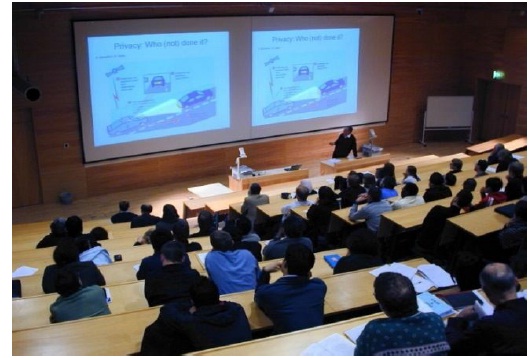
The department of Computer Science and Technology is conducting an International Seminar. In the seminar, the number of participants in Mathematics, Science and Computer Science are 60, 84 and 108 respectively. The coordinator has made the arrangement such that in each room, the same number of participants are to be seated and all of them being in the same subject. Also, they allotted the separate room for all the official other than participants.
(i) Find the total number of participants.
| (a) 60 | (b) 84 | (c) 108 | (d) none of these |
(ii) Find the LCM of 60, 84 and 108.
| (a) 12 | (b) 504 | (c) 544320 | (d) 3780 |
(iii) Find the HCF of 60, 84 and 108.
| (a) 12 | (b) 60 | (c) 84 | (d) 108 |
(iv) Find the minimum number of rooms required, if in each room, the same number of participants are to be seated and all of them being in the same subject.
| (a) 12 | (b) 20 | (c) 21 | (d) none of these |
(v) Based on the above (iv) conditions, find the minimum number of rooms required for all the participants and officials.
| (a) 12 | (b) 20 | (c) 21 | (d) none of these |
40.
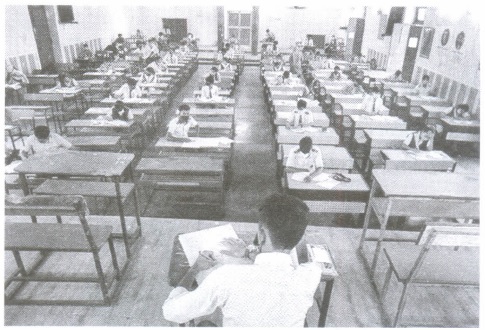
In an examination hall, students are seated at a distance of 2 m from each other, to maintain the social distance due to CORONA virus pandemic. Let three students sit at points A, Band C whose coordinates are (4, -3), (7,3) and (8, 5) respectively.
Based on the above information, answer the following questions.
(i) The distance between A and C is
| (a) \(\sqrt{5}\) units | (b) \(4\sqrt{5}\) units | (c) \(3\sqrt{5}\) units | (d) none of these |
(ii) If an invigilator at the point I, lying on the straight line joining Band C such that it divides the distance between them in the ratio of 1 : 2. Then coordinates of I are
| \((a) \left(\frac{22}{3}, \frac{11}{3}\right)\) | \((b) \left(\frac{23}{3}, \frac{13}{3}\right)\) | (c) (6,1) | (d) (9,1) |
(iii) The mid-point of the line segment joining A and C is
| (a) (1.6) | (b) (6.1) | \(\text { (c) }\left(\frac{11}{2}, 0\right)\) | (d) none of these |
(iv) The ratio in which B divides the line segment joining A and C is
| (a) 2:1 | (b) 3:1 | (c) 1:2 | (d) none of these |
(v) The points A, Band C lie on
| (a) a straight line | (b) an equilateral triangle |
| (c) a scalene triangle | (d) an isosceles triangle |
1.
= \(\frac{14}{21},-\frac{1}{7}\)
2.
For x + 2y = 3
a1 = 1, b1 = 2 ,c1 = - 3
For (k-1)x + (k +1)y= (k + 2)
a2 = (k - 1), b2= (k + 1), c2 = - (k + 2)
For no solution, \(\frac { { a }_{ 1 } }{ { a }_{ 2 } } =\frac { { b }_{ 1 } }{ { b }_{ 2 } } \neq \frac { c_{ 1 } }{ { c }_{ 2 } } \)
\(\Rightarrow \quad \frac { 1 }{ k-1 } =\frac { 2 }{ k+1 } \neq \frac { 3 }{ k+2 } \)
I II III
From I and II, \(\frac { 1 }{ k-1 } =\frac { 2 }{ k+1 } \)
\(\Rightarrow\) k + 1 = 2k - 2
\(\therefore\) k = 3
From II and III, \(\frac { 2 }{ k+1 } \neq \frac { 3 }{ k+2 } \)
\(\Rightarrow\) 2(k + 2) \(\neq\) 3(k + 1)
\(\Rightarrow\) 2k+4\(\neq\)3k+3
\(\therefore\) k \(\neq\) 1
From I and III, \(\frac { 1 }{ k-1 } \neq \frac { 3 }{ k+2 } \)
\(\Rightarrow \quad k+2\neq 3k-3\)
\(\therefore \quad k\neq -\frac { 5 }{ 2 } \)
Hence, k = 3 but k \(\neq\)1 and \(\\ \\ k\neq -\frac { 5 }{ 2 } \)
3.
Since we will apply the identity involving sec \(\theta\) and tan \(\theta\), let us first convert the LHS (of the identity we need to prove) in terms of sec \(\theta\) and tan \(\theta\) by dividing numerator and denominator by cos \(\theta\).
\(\begin{aligned} \text { LHS } & =\frac{\sin \theta-\cos \theta+1}{\sin \theta+\cos \theta-1}=\frac{\tan \theta-1+\sec \theta}{\tan \theta+1-\sec \theta} \\ \end{aligned}\)
\(\begin{aligned} & =\frac{(\tan \theta+\sec \theta)-1}{(\tan \theta-\sec \theta)+1}=\frac{\{(\tan \theta+\sec \theta)-1\}(\tan \theta-\sec \theta)}{\{(\tan \theta-\sec \theta)+1\}(\tan \theta-\sec \theta)} \\ \end{aligned}\)
\(\begin{aligned} & =\frac{\left(\tan ^2 \theta-\sec ^2 \theta\right)-(\tan \theta-\sec \theta)}{\{\tan \theta-\sec \theta+1\}(\tan \theta-\sec \theta)} \\ \end{aligned}\)
\(\begin{aligned} & =\frac{-1-\tan \theta+\sec \theta}{(\tan \theta-\sec \theta+1)(\tan \theta-\sec \theta)} \end{aligned}\)
\(=\frac{-1}{\tan \theta-\sec \theta}=\frac{1}{\sec \theta-\tan \theta}\)
which is the RHS of the identity, we are required to prove.
4.
(i)Total number of cards=52
Number of red coloured kings=2
p(a king of red colour)=\({2\over52}={1\over26}\)
(ii)Number of face cards=12
p(a face card)\(={12\over52}={3\over13}\)
(iii)Number of queen of diamonds=1
p(the queen of diamonds)\(={1\over52}\)
5.
AB = \(\sqrt { { (5-1 })^{ 2 }+{ (3-0) }^{ 2 } } =\sqrt { 16+9 } =5\)
DC = \(\sqrt { { (2+2 })^{ 2 }+{ (7-4) }^{ 2 } } =\sqrt { 16+9 } =5\)
BC = \(\sqrt { { (5-2 })^{ 2 }+{ (3-7) }^{ 2 } } =\sqrt { 9+16 } =5\)
AD = \(\sqrt { { (1+2 })^{ 2 }+{ (0-4) }^{ 2 } } =\sqrt { 9+16 } =5\)
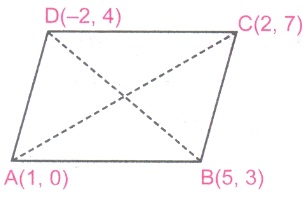
Mid-point of AC = \((\frac{1+2}{2}, \frac{0+7}{2}) = (\frac{3}{2},\frac{7}{2})\)
Mid-point of BD = \((\frac{5-2}{2},\frac{3+4}{2}) = (\frac{3}{2},\frac{7}{2})\)
Since AB = DC and BC = AD.
Opposite sides are parallel and diagonals bisect each other.
∴ The given points are the vertices ofa parallelograin.
6.
Here, a = -6, d = - 2 + 6 and an = 58
an = 58
\(\Rightarrow\) a + ( n - 1 )d = 58 \(\Rightarrow\) - 6 + ( n - 1 )4 = 58
\(\Rightarrow\) ( n - 1 )4 = 64 \(\Rightarrow\) n - 1 = 16 \(\Rightarrow\) n = 17 (odd)
\(\therefore\) Middle term = \(\frac{17+1}{2}=\frac{18}{2}\) = 9th term
\(\therefore\) 9th term is the middle term.
Now, a9 = a + 8d = - 6 + 8 X 4 = - 6 + 32 = 26
7.
Let usual speed of the train be x km/h Distance = 300 km : Time taken = \(\frac { 300 }{ x } \) hours
Increase speed = (x+5) km/h
Then Time taken = \(\left( \frac { 300 }{ x+5 } \right) \) hours
ATQ \(\frac { 300 }{ x } =\frac { 300 }{ x+5 } =2\) \(\Rightarrow \frac { 300(x+5)-300x }{ x(x+5) } =2\)
\(\Rightarrow 300x+1500-300x=2(x^{ 2 }+5x)\Rightarrow 2x^{ 2 }+10x-1500=0\)
\(\Rightarrow x^{ 2 }+5x-750=0\quad \Rightarrow (x+30)(x-25)=0\)
\(\Rightarrow x=-30\) rejected or x= 25
Usual speed = 25 km/h
8.
OA. OB = OC . OD (Given)
So, \(\frac{\mathrm{OA}}{\mathrm{OC}}=\frac{\mathrm{OD}}{\mathrm{OB}}\) (1)
Also, we have \(\angle\)AOD = \(\angle\)COB (Vertically opposite angles) (2)
Therefore, from (1) and (2), \(\Delta\)AOD \(\sim\) \(\Delta\)COB (SAS similarity criterion)
So, \(\angle\)A = \(\angle\)C and \(\angle\)D = \(\angle\)B
(Corresponding angles of similar triangles)
9.
Total number of outcomes = 52
(i) Number of face cards = 12
\(\therefore\) Probability of drawing a face card = \(\frac{12}{52}=\frac{3}{13}\)
(ii) Number of cards which are neither king nor red = 24
\(\therefore\) Probability of drawing a card which is neither a king nor a red card = \(\frac{24}{52}=\frac{6}{13}\)
10.
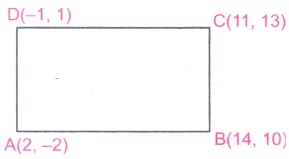
\(AB=\sqrt { (14-{ 2) }^{ 2 }+(10+2)^{ 2 } } =12\sqrt { 2 } units\)
\(BC=\sqrt { (11-{ 14) }^{ 2 }+(13-10)^{ 2 } } =3\sqrt { 2 } units\)
\(CD=\sqrt { (-1-{ 11) }^{ 2 }+(1-13)^{ 2 } } =12\sqrt { 2 } units\)
\(AD=\sqrt { (-1-{ 2) }^{ 2 }+(1+2)^{ 2 } } =3\sqrt { 2 } units\)
⇒ AB=CD and BC = AD
∴ ABCD is a || gm
Now, \(AC=\sqrt { (11-2)^{ 2 }+({ 13+2) }^{ 2 } } =\sqrt { 306 } \)
⇒ AC2=306 units, AB2 = 288 units, BC2 =18 units
AB2+BC2=306 units
⇒ AC2=AB2+BC2⇒∠ABC = 900
⇒ ABCD is a rectangle.
11.
(k+4)x2+(k+1) x+1=0
a=k+4,b=k+1,c=1
D=b2-4ac
D=(k+1)2-4(k+4)X1
= k2+2k+1-4k-16
=k2-2k-15
For equal roots D=0
\(\Rightarrow \) k2+2k-15=0
\(\Rightarrow \) (k-5)(k+3)=0
k=5,k=-3
12.
Let Ist term of AP = a and common difference = d.
Now, a6 = -10 \(\Rightarrow\) a + 5d = -10 ..(i)
Also, a10 = -26 \(\Rightarrow\) a + 9d = -26 ...(ii)
Subtract (i) from (ii),
a + 9d = - 26
a + 5d = -10
- - +
4d = -16 \(\Rightarrow\) d = - 4
Substituting in (i), we get
a + 5 x ( -4 ) = - 10 \(\Rightarrow\) a = 10
Now, a15 = a + 14d = 10 + 14 X - 4 = - 46
13.
Let the fraction be \(\frac{x}{y}\), where x is the numerator and y is the denominator.
According to the given condition,
y = 2x + 1
So,the fraction = \(\frac{x}{2 x+1}\)
Reciprocal of the fraction \(=\frac{2 x+1}{x}\)
It is given that the sum of the fraction and its reciprocal is 2\(\frac{16}{21}\).
\(\begin{array}{ll} \therefore & \frac{x}{2 x+1}+\frac{2 x+1}{x}=2 \frac{16}{21} \end{array}\)
\(\begin{array}{ll} \Rightarrow & \frac{x^2+(2 x+1)^2}{x(2 x+1)}=\frac{58}{21} \\ \end{array}\)
\(\begin{array}{ll} \Rightarrow & \frac{x^2+4 x^2+1+4 x}{2 x^2+x}=\frac{58}{21} \\ \end{array}\)
\(\begin{array}{ll} \Rightarrow & \frac{x^2+4 x^2+1+4 x}{2 x^2+x}=\frac{58}{21} \\ \end{array}\)
\(\begin{array}{ll} & \frac{5 x^2+4 x+1}{2 x^2+x}=\frac{58}{21} \end{array}\)
\(\Rightarrow\) 21(5x2 + 4x + 1) = 58(2x2 + x)
\(\Rightarrow\) 105x2 + 84x + 21 = 116x2 + 58x
\(\Rightarrow\) -11x2 + 26x + 21 = 0
\(\Rightarrow\) 11x2 - 26x - 21 = 0
\(\Rightarrow\) 11x2 - 33x + 7x - 21 = 0
\(\Rightarrow\) 11x(x-3) + 7(x - 3) = 0
\(\Rightarrow\) (x - 3)(11x + 7) = 0
\(\Rightarrow \quad x=3, x \neq-\frac{7}{11}\)
[x cannot be negative]
\(\Rightarrow\) x = 3
\(\therefore\) y = 2(3) + 1 = 6 + 1 = 7
Hence, the required fraction = \(\frac{3}{7}\)
14.
Given, in △ABC and △PQR, AD and PM are their medians, respectively.
\(\therefore \quad \frac{A B}{P Q}=\frac{A C}{P R}=\frac{A D}{P M}\) ...(i)
To prove △ABC ~ △PQR
Construction Produce AD to E such that AD = DE and produce PM to N such that PM = MN.
Join BE, CE, QN and RN.
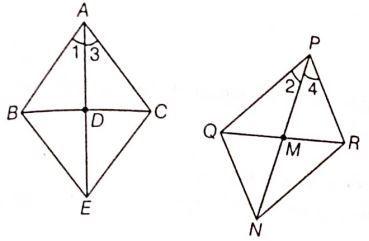
In above figures, quadrilaterals ABEC and PQNR are parallelograms because their diagonals bisect each other at D and M, respectively.
\(\therefore\) BE = AC and QN = PR
\(\begin{array}{ll} \Rightarrow & \frac{B E}{A C}=1 \quad \text { and } \frac{Q N}{P R}=1 \\ \end{array}\)
\(\begin{array}{ll} \Rightarrow & \frac{B E}{A C}=\frac{Q N}{P R} \text { or } \frac{B E}{Q N}=\frac{A C}{P R} \\ \end{array}\)
\(\begin{array}{ll} \Rightarrow & \frac{B E}{Q N}=\frac{A B}{P Q} \\ \end{array}\) [from Eq. (i)]
\(\begin{array}{ll} \text { or } & \frac{A B}{P Q}=\frac{B E}{Q N} \end{array}\) ....(ii)
From Eq. (i), we get
\(\frac{A B}{P Q}=\frac{A D}{P M}=\frac{2 A D}{2 P M}=\frac{A E}{P N}\) [since, diagonals bisect each other]
\(\Rightarrow \quad \frac{A B}{P Q}=\frac{A E}{P N}\) ...(iii)
From Eqs. (ii) and (iii),
\(\frac{A B}{P Q}=\frac{B E}{Q N}=\frac{A E}{P N}\)
\(\Rightarrow \quad \triangle A B E \sim \triangle P Q N \Rightarrow \angle 1=\angle 2\) ...(iv)
[since, corresponding angles of two similar triangles are equal]
Similarly, we can prove that
\(\begin{aligned} & \triangle A C E \sim \triangle P R N \\ \end{aligned}\)
\(\begin{aligned} \Rightarrow \quad \angle 3=\angle 4 \end{aligned}\) ....(v)
On adding Egs. (iv) and (v), we get
\(\begin{array}{rlrl} \angle 1+\angle 3 & =\angle 2+\angle 4 \\ \end{array}\)
\(\begin{array}{rlrl} \Rightarrow \angle B A C =\angle Q P R \\ \end{array}\)
and \(\begin{array}{rlrl} \frac{A B}{P Q} & =\frac{A C}{P R} \end{array}\) [from Eq. (i)]
\(\therefore\) \(\triangle ABC \sim \triangle PQR\) [by SAS similarity criterion]
Hence proved.
15.
f1=28, f2=24
16.
LHS = \(\frac { \sin ^{ 2 }{ \theta } +\cos ^{ 2 }{ \theta } ++1 }{ (1+\cos { \theta } )\sin { \theta } } \)
\(=\frac { 1+2\cos { \theta } +1 }{ (1+\cos { \theta } )\sin { \theta } } =\frac { 2(\cos { \theta } +1) }{ (1+\cos { \theta } )\sin { \theta } } =2cosec\theta \)
17.
\(x = {a^{2}\over 2}\) or \(x = {b^{2}\over 2}\)
18.
(b)
6
19.
(d)
0,8
20.
(a)
8
21.
(b)
4n+5
22.
(a)
p ≥ -9/2
23.
(b)
3 Median = Mode + 2 Mean
24.
(d)
\(\frac { 1 }{ \sqrt { 1+{ cot }^{ 2 }\quad A } } \)
25.
(d)
25
26.
(c)
-2
27.
(d)
4 + 3√3
28.
(d)
No solution
29.
(a)
inconsistent
30.
(c)
x2 – 4x + 4
31.
(c)
-2 and -1
32.
(c)
15
33.
(a)
2m + 1
34.
(b)
straight line parallel to y axis
35.
(c)
10
36.
(b)
1/2
37.
(a)
53/ 366
38.
(a) Since, he pays first instalment of? 1000 and next consecutive months he pay the instalment are 1100, 1200, ..... .
Thus, we get the AP sequence,
1000, 1100, 1200, ...
Here, a = 1000, d = 1100 - 1000 = 100
Now, T30 = a + (30 - 1) d
= 1000 + 29 \(\times\) 100
= 1000 + 2900 = 3900
Hence, the amount paid by him in 30th instalment is Rs 3900.
(ii) (b) Now, \(S_{30}=\frac{30}{2}[2 a+(30-1) d]\)
= 15 (2 \(\times\) 1000 + 29 \(\times\)100)
= 15 (2000 + 2900)
= 15 \(\times\) 4900 = Rs 73500
(iii) (c) After 30th instalment, he still have to pay = 118000 - 73500= 44500
(iv) (a) The amount in last 40th instalment is
T40 = a + (40 - 1)d
= 1000 + 39 \(\times\) 100
= 1000 + 3900 = Rs 4900
(v) (b) The ratio of Ist instalment to the last instalment is \(\frac{1000}{4900} \text { i.e. } \frac{10}{49}\)
39.
(i) (d):
Total number of participants = 60 + 84 + 108
= 252
(ii) (d):
60 = 22 x 3 x 5
84 = 22 x 3 x 7
108 = 22 x 33
LCM(60, 84, 108) = 22 x 33 x 5 x 7
= 3780
(iii) (a):
60 = 22 x 3 x 5
84 = 22 x 3 x 7
108 = 22 x 33
HCF(60, 84, 108) = 22 x 3
= 12
(iv) (c):
Minimum number of rooms required for all the participants = 252/12
= 21
(v) (d):
Minimum number of rooms required for all = 21 + 1 = 22
40.
(i) (b): The distance between A and C
\(=\sqrt{(8-4)^{2}+(5+3)^{2}}=\sqrt{4^{2}+8^{2}} \)
\(=\sqrt{16+64}=\sqrt{80}=4 \sqrt{5} \text { units }\)
(ii) (a): Let the coordinates of I be (x, y).
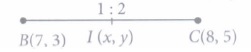
Then, by section formula
\(x =\frac{1 \times 8+2 \times 7}{1+2}=\frac{8+14}{3}=\frac{22}{3}\)
\(\text { and } y =\frac{1 \times 5+2 \times 3}{1+2}=\frac{5+6}{3}=\frac{11}{3}\)
Thus, the coordinates of I is \(\left(\frac{22}{3}, \frac{11}{3}\right)\)
(iii) (b): The mid -point of A and C
\(=\left(\frac{8+4}{2}, \frac{5-3}{2}\right)=(6,1)\)
(iv) (b): Let B divides the line segment joining A and C in the ratio k : 1. Then, the coordinates of B will be
\(\left(\frac{8 k+4}{k+1}, \frac{5 k-3}{k+1}\right)\)
\(\text { Thus, we have }\left(\frac{8 k+4}{k+1}, \frac{5 k-3}{k+1}\right)=(7,3)\)
\(\Rightarrow \frac{8 k+4}{k+1}=7 \text { and } \frac{5 k-3}{k+1}=3
\)
\(\text { Consider, } \frac{8 k+4}{k+1}=7 \Rightarrow 8 k+4=7 k+7 \Rightarrow k=3\)
Hence, the required ratio is 3 : 1
(v) (a):\(\because\) B divides AC in the ratio 3 : 4.
\(\therefore\) A, B, C lie on a straight line.

10th Standard CBSE Syllabus & Materials
10th Standard CBSE
CBSE 10th Social Science PS - Federalism - New Model Questions Papers Study Material - QB365 Set A
NEW10th Standard CBSE
CBSE 10th Social Science PS - Power Sharing - New Model Questions Papers Study Material - QB365 Set A
NEW10th Standard CBSE
CBSE 10th Social Science GEO - Manufacturing Industries - New Model Questions Papers Study Material - QB365 Set A
NEW10th Standard CBSE
CBSE 10th Social Science GEO - Minerals and Energy Resources - New Model Questions Papers Study Material - QB365 Set A



NCERT Books

Syllabus

Exam Pattern

Sample Question Papers

Previous year Question Papers

Important Notes

MCQ Practice test

NCERT Exemplers

Case study Questions

Image Based Questions

Passage based Questions

HOT Questions

Value Based Questions

Model Questions Papers
NCERT ( Book Back ) Questions

Assertion and Reason
Important Questions And Answers

CBSE 10th Standard CBSE Subjects
CBSE Standards



