
 100% FREE ACCESS
10th Standard CBSE Syllabus & Materials
10th Standard CBSE
CBSE 10th Social Science ECO - Globalisation and the Indian Economy - New Model Questions Papers Study Material - QB365 Set A
NEW10th Standard CBSE
CBSE 10th Social Science ECO - Money and Credit - New Model Questions Papers Study Material - QB365 Set A
NEW10th Standard CBSE
CBSE 10th Social Science ECO - Sectors of the Indian Economy - New Model Questions Papers Study Material - QB365 Set A
NEW10th Standard CBSE
CBSE 10th Social Science ECO - Development - New Model Questions Papers Study Material - QB365 Set A
NEW10th Standard CBSE
CBSE 10th Social Science PS - Outcomes of Democracy - New Model Questions Papers Study Material - QB365 Set A
NEW10th Standard CBSE
CBSE 10th Social Science PS - Gender, Religion and Caste - New Model Questions Papers Study Material - QB365 Set A

Published on: 30/07/2018
The chapter Some Applications of Trigonometry contains the important question in CBSE 10th Standard Mathematics. It covers one mark, two, three and five marks questions from the book back and PTA question.
Download CBSE Class 10th Standard CBSE Maths question papers, sample papers, important questions, and previous year solved papers in PDF format. Get free study materials, NCERT solutions, and exam preparation resources for Class 10th Standard CBSE Maths
Questions + Answers key
Take MCQ Maths Test
1.
A straight tree is broken due to thunderstorm. The broken part is bent in such a way that the peak of the tree touches the ground at an angle of 60\(°\)at a distance of \(2\sqrt { 3 } m\) Find the whole height of the tree.
2.
As observed from the top of a light - house, 100 m high above sea level, the angle of depression of a ship, sailing directly towards it, changes from 30o to 60o . Determine the distance travelled by the ship during the period of observation. \((Use\sqrt { 3 } =1.732)\)
3.
The angle of elevation of a cloud from a point 60 m above a lake is 30o and the angle of depression of the reflection of the cloud in the lake is 60o . Find the height of the cloud from the surface of the lake.
4.
A man on the top of a vertical tower observes a car moving at a uniform speed coming directly towards it. If it takes 12 minutes for the angle of depression to change from 30o to 45o how soon after this, will the car reach the tower?
5.
The angles of elevation of the top of a tower from two points at a distance of 4 m and 9 m from the base of the tower and in the same straight line with it are complementary. Prove that the height of the tower is 6 m.
6.
From the top of a tower 50 m high the angles of depression of the top and bottom of a pole are observed to be 45o and 60o respectively. Find the height of the pole.
7.
A man on the deck of a ship, 12 m above water level, observes that the angle of elevation of the top of a cliff is 60o and the angle of depression of the base of the cliff is 30o. Find the distance of the cliff from the ship and the height of the cliff. \((Use\sqrt { 3 } =1.732)\)
8.
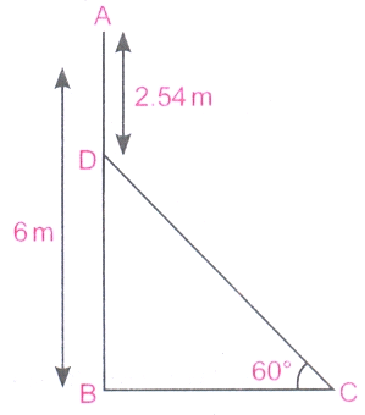
In Figure AB is a 6 m high pole and CD is a ladder inclined at an angle of 60o to the horizontal and reches up to a point D of pole. If AD = 2.54 m, find the length of the ladder. \((use\sqrt { 3 } =1.73)\)
9.
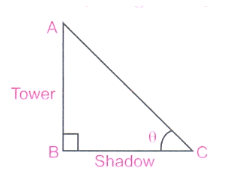
At some time of the day the length of the shadow of a tower is equal to its height. Find the sun's altitude at that time.
10.
If the elevation of the sun at a given time is 30o , then find the length of the shadow cast by a tower of 150 feet height at that time.
11.
Find the angle of elevation of the top of 15 m high tower at a point 15 m away from the base of the tower.
12.
If two towers of height h1 and h2 subtends angles of 60o and 30o respectively at the mid points of line joining their feet, find h1 : h 2
13.
The angle of elevation of the top of a tower from a point 20 meters away from the base is 45o . Find the height of the tower.
14.
A highway leads to the foot of 300 m high tower. An observatory is set at the top of the tower. It sees a car moving towards it with an angle of depression becomes 60°.
(i) Find the distance travelled by the car during this time.
(ii) How this observatory is helpful to regulate the traffic on the highway?
15.
The angle of elevation of an aeroplane from a point on the level ground is 60°. After 10 s of flight, the angle of elevation changes to 30°. If the aeroplane is flying horizontally at a height of 3000 m, then find the speed of the plane.
16.
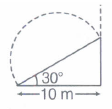
The top of a broken tree has its top touching the ground (shown in the following figure) at a distance of 10 m from the bottom. If the angle made by the broken part with ground is 30°, then find the length of the broken part.
17.
A statue 1.46 m tall stand on the top of a pedestal. From a point on the ground, the angle of elevation of the top of the statue is 60o and from the same point, the angle of elevation of the top of the pedestal is 45o . Find the height of the pedestal. \((\sqrt { 3 } =1.73)\) .
18.
If the ratio of the length of a pole and its shadow is 1 : 1, then angle of elevation of the sun is.......... .
19.
A 6m tall tree casts a shadow of length 4m.If at the same time a flagpole casts a shadow 50m in length, then the length of the flagpole is...........
20.
The height of a tower is 10m.The height of its shadow when sun's altitude is 450 , is ...........
21.
If the height of a tower and the distance of the point of observation from its foot, both are increased by 10% then the angle of elevation of its top remains.........
22.
The length of the shadow of a tree 8m high, when the sun's elevation is 450 , is .......
23.
If the ratio of the height of a tower and the length of its shadow \(\sqrt{3}:1\), then the elevation of the sun is 300
24.
The angle of elevation of the top of a tower is 600.If the height of the tower is doubled, then the angle of elevation of its top will also doubled.
25.
Trigonometric ratios are same for the same angles.
26.
The height of an object or distance between two distinct objects can be determined with help of trigonometric ratios.
27.
The line of sight is the line from the eye of an observer to the point in the viewed by the observer.
1.
Let AB be the tree whose part AC breaks and touches the ground at D
Then, BD = \(2\sqrt { 3 } m\)
and AC = CD
In right angled \(\Delta \)CBD,
\(cos 60°=\frac { B }{ H } =\frac { BD }{ CD } \)
\(\Rightarrow \frac { 1 }{ 2 } =\frac { 2\sqrt { 3 } }{ CD } \)
\(\left[ \because cos 60°=\frac { 1 }{ 2 } and BD=2\sqrt { 3 } m \right] \)
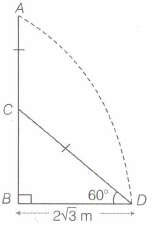
\(\Rightarrow\) \(CD=2\times 2\sqrt { 3 } =4\sqrt { 3 } \)
\(=4\times 1.732=6.928\ m [\because \sqrt { 3 } =1.732]\)
\(\therefore\) AC = CD = 6.928 m
Again, in right angled \(\Delta \)CBD,
\(tan\quad 60°=\frac { P }{ B } =\frac { BC }{ BD } \)
\(\Rightarrow \sqrt { 3 } =\frac { BC }{ 2\sqrt { 3 } } [\because tan60°=\sqrt { 3 } and BD=2\sqrt { 3 } m]\)
\(\Rightarrow BC=\sqrt { 3 } \times 2\sqrt { 3 } =6 m\)
Now, AB = AC + BC
= 6.928 + 6 = 12.928 m (approx)
Hence, the height of the tree is 12.928 m.
2.
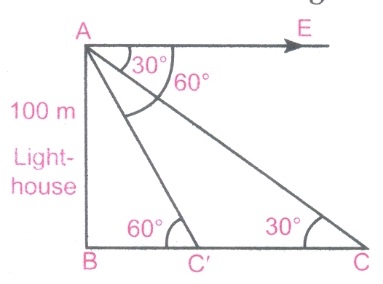
Given: AB the lighthouse 100 m above sea level and C is a ship sailing towards AB.
⇒ ㄥEAC = 30\(\unicode{xb0} \)
After travelling from C to C' angle of depression changes from ㄥEAC = 30\(\unicode{xb0} \) to ㄥEAC' = 60\(\unicode{xb0} \)
To Find: CC'
Solution: AE||BC
[Line of sight and line of horizontal]
⇒ ㄥACC' = ㄥEAC = 30\(\unicode{xb0} \) [Alternate angles]
ㄥAC'B = ㄥEAC' = 60\(\unicode{xb0} \) [Alternate angles]
In right ΔABC', \(\frac { AB }{ BC } \) = tan30o
\(\frac { 100 }{ BC } =\frac { 1 }{ \sqrt { 3 } } \Rightarrow BC=100\sqrt { 3 } \)
CC' = BC - BC'
=\(\left( 100\sqrt { 3 } -\frac { 100 }{ \sqrt { 3 } } \right) \)m
=\(\frac { 100\times 3-100 }{ \sqrt { 3 } } \)
=\(\frac { 200 }{ \sqrt { 3 } } m=\frac { 200\sqrt { 3 } }{ 3 } m\) = 115.466 m
3.
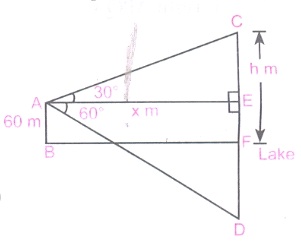
Let height of the cloud C from lake be h m . A is position of the point 60 m above the lake. D is the reflection of the cloud in lake .
Let AE=x m, CF=h m, CE=(h-60)m
DE=(60+h)m.
In right angled triangle AEC
\(\frac { AE }{ EC } \)=cot 300
AE=(h-60)\(\sqrt { 3 } \) .........(i)
In right angled triangle AED,
\(\frac { AE }{ ED } =cot60^{ 0 }\quad \Rightarrow \quad AE=\frac { h+60 }{ \sqrt { 3 } } \) .............(ii)
From (i) and (ii), we get
\((h-60)\sqrt { 3 } =\frac { h+60 }{ \sqrt { 3 } } \)
⇒ 3h-180=h+60 ⇒ 2h=240 ⇒ h=120 m.
∴ Height of the cloud above the lake is 120 m.
4.
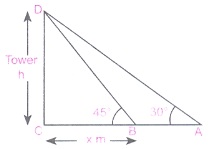
Given: A tower CD,
Car's original position is at A and is making a 300 angle of elevation with the point D.
After 12 minutes the position of car be at the point B. Making an angle of elevation of 45o.
To find: The time takem by car to reach the tower.
Solution: Let height of the tower be h m, BC=x m and AC=y m
AC=y m
In ΔDCA, ㄥDAC=30o
⇒ h/y=tan30o
⇒ h=\(\frac { 1 }{ \sqrt { 3 } } y \Rightarrow y=\sqrt { 3 } h\) ........(i)
In ΔDCB, \(\frac { h }{ x } \)=tan45o
⇒ h=x
Time taken to cover the distance AB=120minutes ......(ii)
speed=\(\frac { d }{ l } =\frac { y-x }{ 12 } \) m/minute
Time taken to cover x m=\(\frac { x\times 12 }{ y-x } =\frac { 12x }{ \sqrt { 3 } h-x } =\frac { 12x }{ \sqrt { 3 } x-x } \) [From (i)]
=\(\frac { 12x }{ (\sqrt { 3 } -1)x } =\frac { 12(\sqrt { 3 } +1) }{ (\sqrt { 3 } -1)(\sqrt { 3 } -1) } =\frac { 12(1.732+1) }{ 3-1 } \)
=6 x 2.732=16.39 min=16 min 39 sec
5.
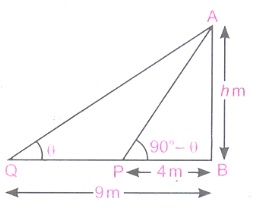
Let the height of the tower AB = h m,
We have PB = 4 m, QB = 9 m
Let ㄥAQB = θ [Both are complementary angles]
Then ㄥAPB = 90\(\unicode{xb0} \) - θ
In ΔABP, \(\frac { AB }{ PB } \) = tan (90\(\unicode{xb0} \)- θ)
⇒ h/4 = cotθ ....(i)
In ΔABQ, \(\frac { AB }{ QB } \) = tanፀ
h/9 = tanθ
h = 9tanθ ....(ii)
From equation (i) and (ii) we get
h x h = 4 cotθ x 9 tanθ
⇒ h2 = 36 cotθ x tanθ = 36 1/tanθ x tanθ
⇒ h2 = 36 ⇒ h = 6m
Hence, the height of the tower is 6 m.
6.
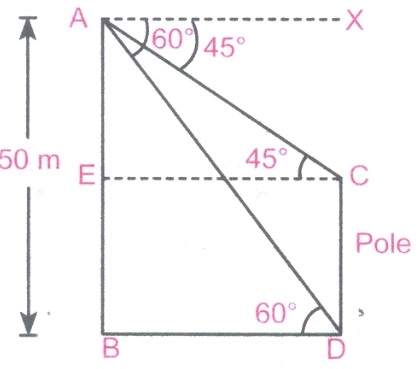
In ΔABD, \(\frac { BD }{ AB } \)=cot 60o
⇒ \(\frac { BD }{ 50 } =\frac { 1 }{ \sqrt { 3 } } \Rightarrow BD\frac { 50 }{ \sqrt { 3 } } \)
BD=EC⇒ EC=\(\frac { 50 }{ \sqrt { 3 } } \)
In ΔAEC, \(\frac { AE }{ EC } \)=tan 45o
⇒ ΔAEC, \(\frac { AE }{ EC } \)=tan 45o
⇒ AE=EC⇒ AE=\(\frac { 50 }{ \sqrt { 3 } } \)m
Now BE=AB-AE=50-\(\frac { 50 }{ \sqrt { 3 } } \)
=\(\frac { 50\sqrt { 3 } -50 }{ \sqrt { 3 } } \)
=\(\frac { 50(\sqrt { 3 } -1) }{ \sqrt { 3 } } \)
DC=BE=\(\frac { 50(\sqrt { 3 } -1) }{ \sqrt { 3 } } \)m
7.
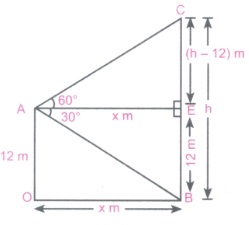
A is the position of the man, OA = 12m, BC is cliff.
Let height of the cliff
BC = h m and CE = (h - 12)m
Let AE = OB = x m
In right angled triangle AEB,
\(\frac { AE }{ BE } \) = cot30o ⇒ AE = 12 x \(\sqrt { 3 } \)
=12 x 1.732 m = 20.78 m
∴ Distance of ship from cliff = 20.78 m
In right angled triangle AEC,
\(\frac { CE }{ AE } =tan{ 60 }^{ 0 }\Rightarrow \frac { h-12 }{ 12\sqrt { 3 } } \) = \(\sqrt { 3 } \)
h - 12 = 36 ⇒ h = 48 m
∴. Height of the cliff = 48 m
8.
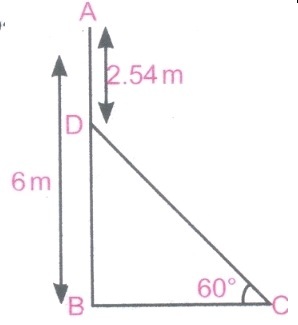
BD = AB - AD = 6 - 2.54
= 3.46
In right ΔDBC
\(\frac { BD }{ CD } \) = sin 60o
⇒ \(\frac { 3.46 }{ CD } =\frac { \sqrt { 3 } }{ 2 } \)
⇨ \(\frac { 3.46\times 2 }{ \sqrt { 3 } } \) = CD
⇒ \(\frac { 3.46\times 2 }{ 1.73 } \) = CD ⇒ CD = 4 m
9.
In right \(\Delta ABC\)
\(tan\theta =\frac { AB }{ BC } \)
\(\Rightarrow tan\theta =1 \left( \because AB=BC \right) \)
\(\Rightarrow \theta ={ 45 }^{ o }\)
10.
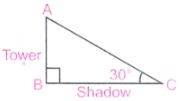
In right \(\Delta\)ABC
\(\frac { AB }{ BC } =\tan { { 30 }^{ o } } \)
\(\Rightarrow\) \(\frac { 150 }{ BC } =\frac { 1 }{ \sqrt { 3 } } \)
\(\Rightarrow\) BC = 150\(\sqrt { 3 } \) feet
11.
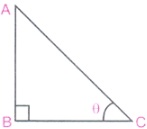
Let AB is the tower, AB = 15 m, BC = 15 m
In right \(\Delta\)ABC, \(\tan { \theta =\frac { AB }{ BC } } \Rightarrow \tan { \theta } =\frac { 15 }{ 15 } \)
\(\Rightarrow\) \(\tan { \theta } =1 \Rightarrow \theta ={ 45 }^{ o }\)
12.
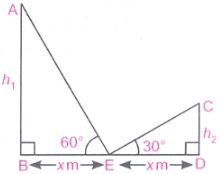
Let AB and CD are towers of height h1 and h2 respectively
If F. is the midpoint of BD then BE = DE = x
In right \(\Delta\)ABE
\(\frac { { h }_{ 1 } }{ x } =\tan { { 60 }^{ o } } \)
\(\Rightarrow\) \({ h }_{ 1 }=\sqrt { 3 } x\) ...(i)
In right \(\Delta\)CDE
\(\frac { { h }_{ 2 } }{ x } =\tan { { 30 }^{ o } } \Rightarrow { h }_{ 2 }=\frac { x }{ \sqrt { 3 } } \)
Now \(\frac { { h }_{ 1 } }{ { h }_{ 2 } } =\frac { \sqrt { 3 } x }{ \frac { x }{ \sqrt { 3 } } } =\frac { 3 }{ 1 } \) \(\Rightarrow\) h1 : h2 = 3 : 1
13.
Let AB is the tower and C is the point 20 m away from the base of the tower
∴ BC = 20m, ∠ACB = 45o
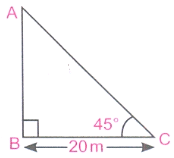
In right ΔABC, tan 45o = \(\frac{AB}{BC}\)
⇒ I = \(\frac{AB}{20}\) ∴ AB = 20 m
14.
(i) 14.66 km
(ii) Presence of mind, ability to take promote decisions.
15.
346.4 m/s
16.
\(\frac { 20 }{ \sqrt { 3 } } \)
17.
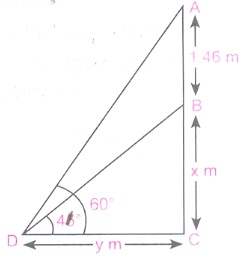
Let AB is statue, BC is pedestal and BC=x m, CD=y m.
In right ΔBCD, ΔBCD, \(\frac { BC }{ CD } \)=tan 45o
⇒, \(\frac { x }{ y } \)=1 ⇒ x=y .....(i)
In right ΔACD, \(\frac { AC }{ CD } \)=tan 600
⇒ \(\frac { x+1.46 }{ y } =\sqrt { 3 } \)
⇒ \(\frac { x+1.46 }{ x } \)=1.73 [Using (i)]
⇒ x+1.46=1.73x ⇒ 0.73x=1.46 ⇒ x=2
18.
()
450
19.
()
75m
20.
()
10m
21.
()
unchanged
22.
()
8m
23.
(b)
24.
(b)
25.
(a)
26.
(a)
27.
(a)

10th Standard CBSE Syllabus & Materials
10th Standard CBSE
CBSE 10th Social Science PS - Federalism - New Model Questions Papers Study Material - QB365 Set A
NEW10th Standard CBSE
CBSE 10th Social Science PS - Power Sharing - New Model Questions Papers Study Material - QB365 Set A
NEW10th Standard CBSE
CBSE 10th Social Science GEO - Manufacturing Industries - New Model Questions Papers Study Material - QB365 Set A
NEW10th Standard CBSE
CBSE 10th Social Science GEO - Minerals and Energy Resources - New Model Questions Papers Study Material - QB365 Set A



CBSE 10th Standard CBSE Subjects
CBSE Standards





