
 100% FREE ACCESS
10th Standard CBSE Syllabus & Materials
10th Standard CBSE
CBSE 10th Social Science ECO - Globalisation and the Indian Economy - New Model Questions Papers Study Material - QB365 Set A
NEW10th Standard CBSE
CBSE 10th Social Science ECO - Money and Credit - New Model Questions Papers Study Material - QB365 Set A
NEW10th Standard CBSE
CBSE 10th Social Science ECO - Sectors of the Indian Economy - New Model Questions Papers Study Material - QB365 Set A
NEW10th Standard CBSE
CBSE 10th Social Science ECO - Development - New Model Questions Papers Study Material - QB365 Set A
NEW10th Standard CBSE
CBSE 10th Social Science PS - Outcomes of Democracy - New Model Questions Papers Study Material - QB365 Set A
NEW10th Standard CBSE
CBSE 10th Social Science PS - Gender, Religion and Caste - New Model Questions Papers Study Material - QB365 Set A

Published on: 30/07/2018
From the chapter Circles, some of the important questions are covered in this question paper.
Students, subscribe and get plenty of question paper with answer key. For subscription please click here.
Download CBSE Class 10th Standard CBSE Maths question papers, sample papers, important questions, and previous year solved papers in PDF format. Get free study materials, NCERT solutions, and exam preparation resources for Class 10th Standard CBSE Maths
Questions + Answers key
Take MCQ Maths Test
1.
With the vertices of a triangle ABC as centres, three circles are described each touching the other two externally. If the sides of the triangle are 4 cm, 6 cm, and 8 cm, find the radii of the circles.
2.
In figure, the sides AB, BC and CA of triangle ABC touch a circle with centre O and radius r at P, Q and R respectively.Prove that
(i) AB + CQ = AC + BQ
(ii)area (\(\Delta\)ABC) = \(1\over2\) (perimeter of \(\Delta\)ABC) x r
-S.jpg)
3.
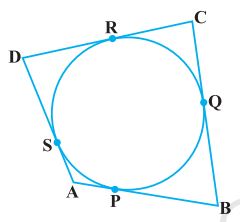
A quadrilateral ABCD is drawn to circumscribe a circle (see figure). Prove that AB+CD=AD+BC.
4.
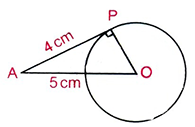
The length of a tangent from a point A at distance 5cm from the centre of the circle is 4cm.Find the radius of the circle.
5.
A line touches a circle of radius 4cm.Another line is drawn which is tangent to the circle.If the two lines are parallel find the distance between them.
6.
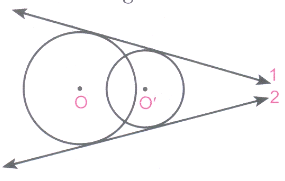
How many common tangents can be drawn to two circles intersecting in two distinct points?
7.
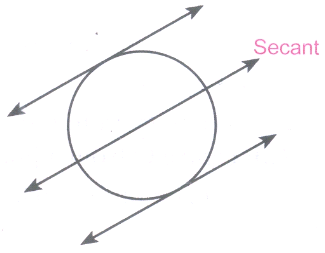
How many tangents parallel to a secant can a circle have?
8.
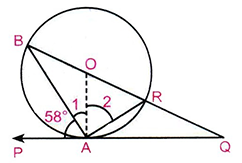
In figure, O is the centre of the circle, PQ is a tangent to the circle at A.If \(\angle PAB=50^0\ find\ \angle ABQ\ and \ \angle AQB.\)
-S.jpg)
9.
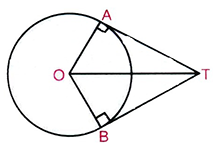
In figure if \(\angle ATO=40^0, find\ \angle AOB.\)
10.
What is the distance between two parallel tangents of a circle of radius 7cm?
11.
Find the length of the tangent drawn from a point whose distance from the centre of a circle is 35 cm.Given that radius of the circle is 7cm.
12.
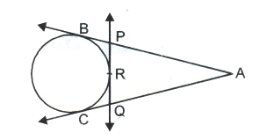
Two tangents are drawn to a circle from an exterior point A, touching the circle at B and C. From another point R, on circle a third tangent is drawn to the circle intersecting AB in P and AC in Q and touching the circle at R. If AB = 20 units, find the perimeter of \(\triangle APQ\).
13.
From an external point P, two tangents, PA and PB are drawn to a circle with centre O.At one point E on the circle tangent is drawn which intersect PA and PB at C and D, respectively.If PA = 10cm, find the perimeter of the triangle PCD.
14.
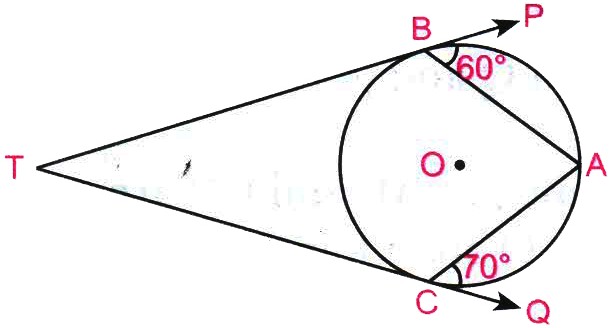
In the given figure, TBP and TCQ are tangents to the circle whose centre isO.Also \(\angle PBA=60^0\ and \ \angle ACQ=70^0.\)Determine \(\angle BAC\ and \ \angle BTC.\)
15.
Prove that the intercept of a tangent between two parallel tangents to a circle subtends a right angle at the centre.
16.
In the figure, a circle is inscribed in a quadrilateral ABCD in which\(\angle 90^0\).If AD = 23 cm, AB = 29 cm and DS = 5 cm, find the radius(r) of the circle.
17.
A circle can have _____________ parallel tangents at the most.
18.
A tangent to a circle intersects it in __________ point(s).
19.
At the point of contact, angle between the tangent and the radius is is ___________
20.
If a line and a circle have no point common, then the line lies ______________
21.
The length of the tangents drawn from an external point to a circle are _____________
22.
The common point of a tangent and a circle is called point of contact.
23.
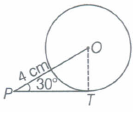
In the figure, PT is a tangent to the circle with centre O such hat OP is 4 cm and \(\angle OPT={ 30 }^{ \circ }\) , then length of tangent is 5 cm.
24.
The common point of a tangent to a circle with circle is called point of contact.
25.
A circle can have maximum two tangents.
26.
The length of tangents drawn from an external point to a circle are equal.
1.
1 cm, 3 cm and 5 cm
2.
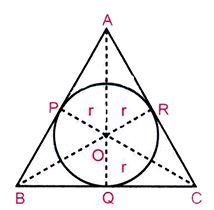
(i) AP = AR [Tangents from A] ...(i)
Similarly, BP = BQ ...(ii)
CR = CQ ...(iii)
Now, ∵ AP = AR
⇒ (AB - BP) = (AC-CR)
⇒ AB + CR = AC+ BP
⇒ AB + CQ = AC + BQ
(ii) Let AB = x, BC =y, AC = z
ஃ Perimeter of \(\triangle\)ABC = x + y + z
Area of \(\triangle\)ABC = [area of AOB + area of BOC + area AOC]
⇒ Area of ABC = AB x OP + x BC x OQ + x AC x OR
Area of ABC = \(1\over2\)X x r + \(1\over2\)y x r + \(1\over2\)z x
\(\Rightarrow\) Area of \(\Delta\)ABC=\(1\over2\)(x+y+z) x r
\(\Rightarrow\) Area of \(\Delta\)ABC=\(1\over2\)(Perimeter of \(\Delta\)ABC) x r
3.
Given A quadrilateral ABCD, circumscribing a circde.
To prove AB + CD = AD + BC
Proof We know that the lengths of tangents drawn from an external point to a circde are equal.
\(\therefore\) AP = AS ...(i)
[\(\because\) both are tangents to a circle from point A]
Similarly, BP = BQ, ...(ii)
CR = CQ ....(iii)
and DR = DS .....(iv)
On adding Eqs. (i), (ii), (ii) and (iv), we get
(AP + BP) + (CR + DR) = (AS + BQ) + (CQ + DS)
\(\Rightarrow\) AB + CD = (AS + DS) + (BQ + CQ)
\(\Rightarrow\) AB + CD = AD + BC
Hence Proved.
4.
OP = Radius of the circle OA = 5 cm; AP = 4 cm
OA2 = AP2 + OP2 [By pythagoras theorem]
52 = 42 + OP2
⇒ 25 = 16 + OP2 ⇒ 25 - 16 = OP2 ⇒ 9 = OP2 ⇒ OP = \(\sqrt9\) = 3
Radius = 3 cm
5.
Distance between two parallel tangents
= Diameter of the circle
= 2 x 4 = 8 cm.
6.
2 common tangents can be drawn as shown in the figure.
7.
2 tangents
8.
Join OA,
OA ⊥ PAQ
ஃ \(\angle \)OAP = 90o
⇒ \(\angle \)1 + 58o = 90o
⇒ \(\angle \)1 = 90o - 58o = 32o
In BOA, OA = OB
Now \(\angle \)1 = \(\angle \)ABQ
⇒ \(\angle \)ABQ = 32o
\(\angle \)PAB + \(\angle \)BAQ = 180o ⇒ \(\angle \)BAQ = 180o - 58o = 122o
In \(\triangle\)ABQ
\(\angle \)ABQ + \(\angle \)BAQ +\(\angle \)AQB = 180o ⇒ \(\angle \)AOB = 180o - 122o - 32o = 26o
9.
In OAT \(\angle \)ATO = 40o, \(\angle \)OAT = 90o
∴ \(\angle \)AOT = 50o [Angle sum property]
Now \(\angle \)BTO = 40o as OT bisects
ஃ \(\angle \)AOB = \(\angle \)AOT + \(\angle \)BOT = 50o + 50o = 100o
10.
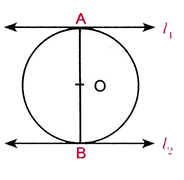
parallel tangents of a circle can be drawn only at the end points of the diameter
⇒ I1 || I2
⇒ Distance between I1 and I2 = AB = Diameter of the circle
= 2 x r = 2 x 7 cm = 14 cm
11.
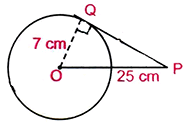
Let O is the centre of the circle and P is a point such that OP = 25 cm and PQ is the tangent to the circle.
OQ = radius = 7 cm
In \(\triangle\)OQP, we have \(\angle \)Q = 90°
OP2 = OQ2 + PQ2
⇒ (25)2 = 72 + PQ2 ⇒ PQ2 = 625 - 49 = 576
⇒ PQ = 24 cm
12.
40 units
13.
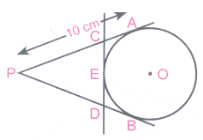
PA= 10 cm.
PA = PB [If P is external point] .....(i)
[ ∵ From an external point tangents drawn to a circle are equal in length]
If C is external point, then CA = CE
If D is external point, then
DB = DE ......(ii)
Perimeter of triangle \(\triangle\)PCD
= PC + CD + PD
= PC + CE + ED + PD
= pc + CA + DB + PD
= PA + PB
-PA + PA = 2 PA
= 2 x 10 = 20 cm.[From (ii)]
14.
Given: T BP and TCQ are tangents to the circle whose centre is O.
Also, \(\angle \)PBA = 60°
\(\angle \)ACQ = 70°
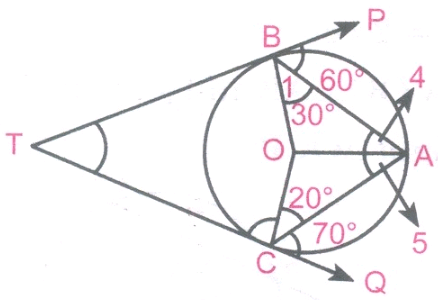
To determine: \(\angle \)BAC and \(\angle \)BTC
Sol. Join OB and OC
\(\angle \)OBP = 90°
[Tangent makes 90° angle with the radius at the point of contact]
⇒ \(\angle \)OBA + \(\angle \)ABP = 90°
⇒ \(\angle \)1 + 60° = 90° [Given ABP = 60°]
⇒ \(\angle \)1 = 30° ......(i)
Also \(\angle \)OCQ = 90°
⇒ OCA + 70° = 90° ......(i)
⇒ \(\angle \)OCA = 20° .....(ii)
In OBA , OB = OA = radii
⇒ \(\angle \)1 = \(\angle \)4 = \(\angle \)30° .....(iii)
[ Angles opposite to equal sides of a triangle are equal]
Similarly, In \(\triangle\)OCA
OC = OA
\(\angle \) 5 = 20° .....(iv)
From (iii) and (iv)
\(\angle \)BAC = 20° + 30° = 50°
⇒ \(\angle \)BOC = 2x50° = 100°
\(\angle \)BOC + BTC = 180°
100° + \(\angle \)BTC = 180°
⇒ \(\angle \)BTC = 80°
15.
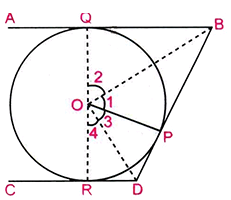
Given. AB and CD are two tangents to a circle and AB || CD.
Tangent BD intercepts an angle BOD at the centre.
To prove. \(\angle \)BOD = 90°
Construction. Join OQ, OB and OR.
Proof. OP ⊥ BD.
[A tangent at any point of a circle is perpendicular to the radius through the point of contact.]
In right angled \(\triangle\) s OQB and OPB
\(\angle \)1 = \(\angle \)2,
Similarly in right angled \(\triangle\)s OPD and ORD
\(\angle \)3 = \(\angle \)4
ஃ \(\angle \)BOD = \(\angle \)1 + \(\angle \)3 = \(1\over2\)[2\(\angle \)1 + 2\(\angle \)3] =\(1\over2\)(\(\angle \)1 + \(\angle \)1 + \(\angle \)3 + \(\angle \)3)
= \(1\over2\)(\(\angle \)1 + \(\angle \)2 + \(\angle \)3 + \(\angle \)4 ) = \(1\over2\)(180°) = 90°
16.
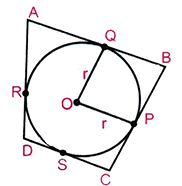
OQ 1 AB l [Radius is perpendicular to the tangent) OP 1 BC 1
ஃ OPBQ is a square.
⇒ BQ = BP = OP = r.
Now RD = DS ⇒ RD = 5 cm
ஃ AR = AD - RD = 23 - 5 = 18 cm
Also, AR = AQ ⇒ AQ = 18 cm
Now, AB = AQ + BQ ⇒ 29 = 18 + r ⇒ r = 11 cm.
17.
()
two
18.
()
one
19.
()
A right angle \(\left( { 90 }^{ \circ } \right) \).
20.
()
outside the circle.
21.
()
equal
22.
(a)
23.
(b)
24.
(a)
25.
(b)
26.
(a)

10th Standard CBSE Syllabus & Materials
10th Standard CBSE
CBSE 10th Social Science PS - Federalism - New Model Questions Papers Study Material - QB365 Set A
NEW10th Standard CBSE
CBSE 10th Social Science PS - Power Sharing - New Model Questions Papers Study Material - QB365 Set A
NEW10th Standard CBSE
CBSE 10th Social Science GEO - Manufacturing Industries - New Model Questions Papers Study Material - QB365 Set A
NEW10th Standard CBSE
CBSE 10th Social Science GEO - Minerals and Energy Resources - New Model Questions Papers Study Material - QB365 Set A



CBSE 10th Standard CBSE Subjects
CBSE Standards





