
 100% FREE ACCESS
10th Standard CBSE Syllabus & Materials
10th Standard CBSE
CBSE 10th Social Science ECO - Globalisation and the Indian Economy - New Model Questions Papers Study Material - QB365 Set A
NEW10th Standard CBSE
CBSE 10th Social Science ECO - Money and Credit - New Model Questions Papers Study Material - QB365 Set A
NEW10th Standard CBSE
CBSE 10th Social Science ECO - Sectors of the Indian Economy - New Model Questions Papers Study Material - QB365 Set A
NEW10th Standard CBSE
CBSE 10th Social Science ECO - Development - New Model Questions Papers Study Material - QB365 Set A
NEW10th Standard CBSE
CBSE 10th Social Science PS - Outcomes of Democracy - New Model Questions Papers Study Material - QB365 Set A
NEW10th Standard CBSE
CBSE 10th Social Science PS - Gender, Religion and Caste - New Model Questions Papers Study Material - QB365 Set A

Published on: 30/07/2018
Some of the important questions are covered in this question paper from the chapter Constructions.
Teachers can prepared question paper with answer key within five minutes. Please Click Here for subscribe.
Download CBSE Class 10th Standard CBSE Maths question papers, sample papers, important questions, and previous year solved papers in PDF format. Get free study materials, NCERT solutions, and exam preparation resources for Class 10th Standard CBSE Maths
Questions + Answers key
Take MCQ Maths Test
1.
Draw a line segment of length 7 cm. Find a point P on it which divides it in the ratio 3 : 5.
2.
Draw a circle of radius 3.2 cm. Draw any diameter of the circle. At the end points of the diameter of the circle, draw tangents. Are they parallel?
3.
Is it possible to construct a triangle whose sides measure 3 cm, 6 cm, 7 cm?
4.
Draw two tangents from the end points of the diameter of a circle of radius 3.5 cm. After these tangents parallel?
5.
Draw a pair of tangents to a circle of radius 5 cm which are inclined to each other at an angle of \(60^o\).
6.
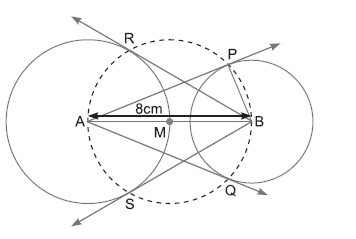
Draw a line segment AB of length 8 cm. Taking A as centre, draw a circle of radius 4 cm and taking B as centre, draw another circle of radius 3 cm . Construct tangents to each circle from the centre of the other circle
7.
Draw a right angled \(\Delta ABC\) , in which BC = 12 cm, AB = 5 cm and \(\angle B=90°\). Then, construct a triangle similar to it and of scale factor \(\frac { 2 }{ 3 } \). Is the new triangle also a right angled triangle?
8.
Draw two tangents to a circle of radius 3.5 cm from a point P at a distance of 6.2 cm from its centre.
9.
Let PQR be a right triangle in which PQ = 3cm, QR = 4cm and \(< Q=90^o\). QS is the perpendicular from Q on PR. The circle through Q, R, S is drawn. Construct the tangents from P to this circle.
10.
Construct a \(\Delta ABC\) with sides AB = 4 cm, BC = 5 cm and CA = 7cm. Then, construct a triangle to it whose sides are \(\frac { 5 }{ 7 } \) times of the corresponding sides of the given triangle. First, we draw a ray BX such that \(\angle CBX\) is an acute angle and X lies on the opposite side of A with respect to Be. Then, locate points B2 , B2 , B 3, ... on BX at equal distances. What is the next step to join?
11.
Find the ratio in which E divides the line segment PQ.
12.
To divide a line segment LM in the ratio 4 : 3, a ray LX is drawn first such that angle \(\angle\)MLX is an acute angle and then points L1, L2, L3,... are located at equal distances on the ray LX, then point M is joined to which point?
13.
To construct a triangle similar to a given \(\Delta ABC\) with its sides \(\frac{3}{7}\) of the corresponding sides of \(\Delta ABC\), first draw a ray BX such that \(\angle CBX\) is an acute angle and X lies on the opposite side of A with respect to BC. Then locate points B1, B2, B3,......... on BX at equal distance and then which points are joined in the next step.
14.
To divide a line segment AB in the ratio 5 : 7, first a ray AX is drawn so that \(\angle BAX\) is an acute angle then find the minimum number of such points marked at equal distances on the ray AX.
15.
If a line and a circle have two points common then the line is called ___________
16.
In reduced scale-factor, the geometric figure to be constructed is .______________in size.
17.
The sum of any two sides of a triangle is always _____________ than the third side.
18.
The sum of all the angles of a triangle is________________
19.
The tangent line is ___________ to the radius through the point of contact.
20.
In a \(\Delta ABC\) , we draw \(\Delta AB'C'\sim \Delta ABC\) with scale factor \(\frac { 13 }{ 15 } \) . Then, perimeter of \(\Delta ABC\) > perimeter of \(\Delta AB'C'\)
21.
A triangle similar to \(\Delta ABC\) is to be drawn. If scale factor is greater than 1, then we get enlarged figure.
22.
In enlarged scale-factor, the geometric figure to be constructed is larger in size.
23.
In all geometrical constructions only two geometrical instruments viz. graduated ruler and compasses are required.
24.
At least three parts are sufficient for construction of a triangle.
25.
Construct a triangle ABC with BC = 7 cm, B = 60° and AB = 6 cm. Construct another triangle whose sides are 3/4 times the corresponding sides ABC
26.
To a circle of radius 4 cm, draw two tangents which are inclined to each other at an angle of 60°.
27.
Draw a circle of radius 3.5 cm. Take a point T out side the circle at a distance of 7 cm from the centre and construct a pair of tangents from this point T to the circle and justify your construction.
1.
Steps of construction:
1. Draw a line segment AB = 7
1. Draw a line segment AB = 7 cm.
2. Draw any ray AX making an acute angle with AB.
3. Draw the point A ll such that
\(A_{ 1 }A_{ 2 },A_{ 3 }.....A_{ 6 }\)
4.Join BAg
5.Through the point A31 draw a line parallel to BAs.
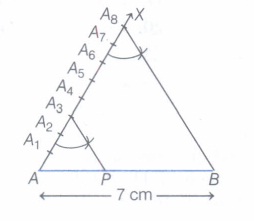
Then AP : PB = 3 : 5
2.
Yes
3.
Yes , because sum of any two sides is greater than third side i.e., 3 + 6 > 7, 6 + 7 > 3 and 3 + 7 >6.
4.
Steps of Construction :
1. Draw a circle with centre O and radius 3.5 cm.
2. Draw the diameter POQ.
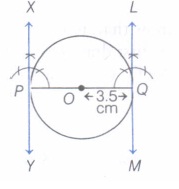
3. Construct angle of 90o at the end points P and Q.
4. XPY and LQM are the two tangents at P and Q to the circle with centre O.
XPY || LQM, because ㄥP + ㄥQ = 180o.
5.
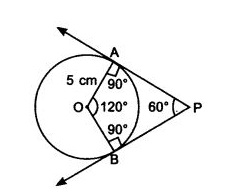
Steps of Construction:
1. Draw a circle of radius 5 cm.
2. As tangents are inclined to each other at an angle of 60o.
∴ Angle between the radii of circle is 120o. (Use quadrilateral property)
3. Draw radii OA and OB inclined to each other at an angle 120o.
4. At points A and B, draw 90o angles. The arms of these angles intersect at point P.
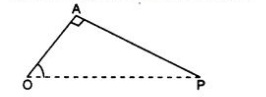
5. PA and PB are the required tangents.
Justification:
In quadrilateral AOBP
AP and BP are the tangents to the circle.
Join OP.
In right angled ΔOAP
OA 丄 PA
OAPB forms a quadrilateral
∴ ㄥAOB =120o
ㄥAOP = 60o
OA = 5cm
∴ \({ tan\quad 60 }^{ o }=\frac { AP }{ OA } =\frac { AP }{ 5 } \Rightarrow \sqrt { 3 } =\frac { AP }{ 5 } \Rightarrow AP=5\sqrt { 3 } cm.\)
Similarly BP = \(5\sqrt { 3 } cm\)
A pair of tangents can be drawn to a circle from an external point outside the circle. These two tangents are equal in lengths.
∴ PA = PB.
6.
Following steps will be followed for constructing the tangents on the given circles:
1. Draw a line segment AB of 8 cm. Taking A and B as centre draw two circles of 4 cm and 3 cm radius.
2. Bisect the line AB. Let mid-point of AB is C. Taking C as centre draw a circle of radius AC which will intersect the circles at point P, Q, R and S. Join BP, BQ, AS and AR. These are required tangents.
7.
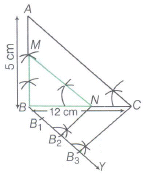
Given, scale factor = \(\frac { 2 }{ 3 } <1\)
Steps of Construction:
1. Draw a line segment Be = 12 cm.
2. From B, draw a line AB = 5 cm, which makes right angle at B.
3. Join AC. Thus, \(\Delta ABC\) is the required right angled triangle.
4. From B, draw an acute \(\angle CBY\) downwards.
5. On ray BY, mark three points B1 , B2 and B3 such that BB1 = B1B2 = B2B3
6. Join B3C,
7. From point B2, draw B2N || B3C intersecting BC at N.
8. From point N, draw NM II CA intersecting BA at M.Thus \(\Delta MBN\) is the required triangle.
Hence, \(\Delta MBN\) is also a right angled triangle, right-angled at B.
8.
Given: A circle of radius 3.5 cm and a point P, 6.2 cm away from its centre.
Required: A pair of tangents.
Steps of Construction :
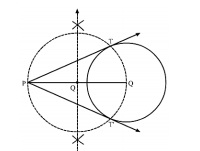
1. Draw a circle C (O, r) with centre O and radius 3.5 cm.
2. TakeapointP, such that OP = 6.2 cm.
3. Draw AB, the perpendicular bisector of OP and let it intersect OP in M.
4. With M as centre and PM or OM as radius, draw another circle intersecting the given circle in T and T'.
5. Join PT and PT'.
6. Thus, PT and PT' are the required tangents from point P to the circle C (O, r).
9.
Steps of Construction:
(i) Draw perpendicular bisector of QR intersecting at O.
(ii) Draw a circle with O as centre and OR as radius.
(iii) Join OP.
(iv) Draw a circle with OP as diameter intersecting the given circle at Q and T. Join PT.
∴ PQ and PT are required tangents.
10.
()
Here, scale factor =\(\frac { 5 }{ 7 } \).So, we locate points B1 , B2 , B3 , B4 , B5 , B6 and B7 on BX at equal distances and in next step, join the last p .nt B7 to C.
11.
()
3 : 2
12.
()
L7
13.
()
B7 to C
14.
()
Minimum number of points = 5 + 7 = 12
15.
()
secant line
16.
()
smaller
17.
()
greater
18.
()
180o
19.
()
Perpendicular.
20.
(a)
21.
(a)
22.
(a)
23.
(a)
24.
(a)
25.
Steps of construction:
Draw a line segment BC = 7 cm.
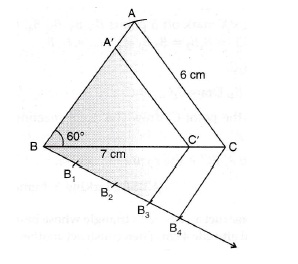
1. Draw a line segment BC of length 5 cm.
2. At B, draw LMBC = 60° and produced line BM.
3. From point C draw a line making an angle of 30°.
4. Both the lines intersect at A.
5.MBC is the given triangle.
6. Draw a ray BXmaking an acute angle.
7. Locate three points B1, Bz, and B3on line segment BX.
8. Join BC
9. Draw a parallel line through B3to B3C intersecting extended line BCat C.
10. Through C' draw a line parallel to AC intersecting extended line segment BA at A'. A'BC is the required triangle.
26.
Steps of construction:
1. Draw a circle of radius 4 cm with 0 as centre.
2. Take a point A on the circumference of the circle and join OA. Draw perpendicular to OA at point A.
3. Draw a radius OB, making an angle of 1200 with OA.
4. Draw the perpendicular to OB at point B. Let both the perpendiculars intersect at point P.
5. Join OP. PA and PB are required tangents, which make an angle of 600 to each other.
27.
\(2\sqrt { 15 } cm\)

10th Standard CBSE Syllabus & Materials
10th Standard CBSE
CBSE 10th Social Science PS - Federalism - New Model Questions Papers Study Material - QB365 Set A
NEW10th Standard CBSE
CBSE 10th Social Science PS - Power Sharing - New Model Questions Papers Study Material - QB365 Set A
NEW10th Standard CBSE
CBSE 10th Social Science GEO - Manufacturing Industries - New Model Questions Papers Study Material - QB365 Set A
NEW10th Standard CBSE
CBSE 10th Social Science GEO - Minerals and Energy Resources - New Model Questions Papers Study Material - QB365 Set A



CBSE 10th Standard CBSE Subjects
CBSE Standards





