
 100% FREE ACCESS
10th Standard Syllabus & Materials
10th Standard
TN 10th English Prose - 4 - The Attic Important Questions And Answers Study Material - QB365 Set A
NEW10th Standard
TN 10th English Supplementary - 3 - The Story of Mulan Important Questions And Answers Study Material - QB365 Set A
NEW10th Standard
TN 10th English Poem - 3 - I am Every Woman Important Questions And Answers Study Material - QB365 Set A
NEW10th Standard
TN 10th English Prose - 3 - Empowered Women Navigating The World Important Questions And Answers Study Material - QB365 Set A
NEW10th Standard
TN 10th English Supplementary - 2 - Zigzag Important Questions And Answers Study Material - QB365 Set A
NEW10th Standard
TN 10th English Poem - 2 - The Grumble Family Important Questions And Answers Study Material - QB365 Set A

Published on: 21/09/2019
Statistics and Probability
Download Tamil Nadu 10th Standard Maths question papers, model tests, one-mark questions, important questions, and public exam papers in PDF format. Free study materials and answer keys for TN State Board students.
Questions + Answers key
Take MCQ Maths Test1.
Marks of the students in a particular subject of a class are given below:
| Marks | 0-10 | 10-20 | 20-30 | 30-40 | 40-50 | 50-60 | 60-70 |
| Number of students | 8 | 12 | 17 | 14 | 9 | 7 | 4 |
Find its standard deviation.
2.
48 students were asked to write the total number of hours per week they spent on watching television. With this information find the standard deviation of hours spent for watching television.
| x | 6 | 7 | 8 | 9 | 10 | 11 | 12 |
| f | 3 | 6 | 9 | 13 | 8 | 5 | 4 |
3.
Find the mean and variance of the first n natural numbers.
4.
The number of televisions sold in each day of a week are 13, 8, 4, 9, 7, 12, 10. Find its standard deviation.
5.
The marks scored by 5 students in a test for 50 marks are 20, 25, 30, 35, 40. Find the S.D for the marks. If the marks are converted for 100 marks, find the S.D. for newly obtained marks.
6.
Find the standard deviation for the following data. 5, 10, 15, 20, 25. And also find the new S.D. if three is added to each value.
7.
Find the standard deviation of 30, 80, 60, 70, 20, 40, 50 using the direct method.
8.
A die is rolled and a coin is tossed simultaneously. Find the probability that the die shows an odd number and the coin shows a head.
9.
What is the probability that a leap year selected at random will contain 53 saturdays. (Hint: 366 = 52 x 7 + 2)
10.
Two coins are tossed together. What is the probability of getting different faces on the coins?
1.
Let the assumed mean, A = 35, c = 10
| Marks | Mid value (xi) |
fi | di = xi-A | di = \(\frac { x_{ i }-A }{ c } \) | fidi | fidi2 |
| 0-10 | 5 | 8 | -30 | -3 | -24 | 72 |
| 10-20 | 15 | 12 | -20 | -2 | -24 | 48 |
| 20-30 | 25 | 17 | -10 | -1 | -17 | 17 |
| 30-40 | 35 | 14 | 0 | 0 | 0 | 0 |
| 40-50 | 45 | 9 | 10 | 1 | 9 | 9 |
| 50-60 | 55 | 7 | 20 | 2 | 14 | 28 |
| 60-70 | 65 | 4 | 30 | 3 | 12 | 36 |
| N = 71 | Σfidi = -30 | Σfidi2 = 210 |
Standard deviation σ = \(c\times \sqrt { \frac { \Sigma { f }_{ i }{ d }_{ i }^{ 2 } }{ N } -\left( \frac { \Sigma { f }_{ i }{ d }_{ i } }{ N } \right) ^{ 2 } } \)
σ = \(10\times \sqrt { \frac { 210 }{ 71 } -\left( \frac { 30 }{ 71 } \right) ^{ 2 } } =10\times \sqrt { \frac { 210 }{ 71 } -\frac { 900 }{ 5041 } } \)
= 10 x \(\sqrt { 2.779 } \); σ ≃ 16.67
2.
| xi | fi | xifi | di = xi - \(\bar { x } \) | di2 | fidi2 |
| 6 | 3 | 18 | -3 | 9 | 27 |
| 7 | 6 | 42 | -2 | 4 | 24 |
| 8 | 9 | 72 | -1 | 1 | 9 |
| 9 | 13 | 117 | 0 | 0 | 0 |
| 10 | 8 | 80 | 1 | 1 | 8 |
| 11 | 5 | 55 | 2 | 4 | 20 |
| 12 | 4 | 48 | 3 | 9 | 36 |
| N = 48 | Σxifi = 432 | Σdi = 0 | Σfidi2 = 124 |
Mean
\(\bar { x } =\frac { \Sigma { x }_{ i }{ f }_{ i } }{ N } =\frac { 432 }{ 48 } \) = 9 (Since N = Σfi)
Standard deviation
σ =\(\sqrt { \frac { \Sigma { f }_{ i }{ d }_{ i }^{ 2 } }{ N } } =\sqrt { \frac { 124 }{ 48 } } =\sqrt { 2.58 } \)
σ ≃ 1.6
Assumed Mean method:
Let x1, x2, x3, ......x4 be the given data with frequencies f1, f2, f3, ... fn respectively.
Let \(\bar { x } \) be their mean and A be the assumed mean
di = xi - A
Standard deviation σ = \(\sqrt { \frac { \Sigma { f }_{ i }{ d }_{ i }^{ 2 } }{ N } -\left( \frac { \Sigma { f }_{ i }{ d }_{ i } }{ N } \right) ^{ 2 } } \).
3.
Mean \(\bar { x } \) = \(\frac { Sum\ of\ all\ observations }{ Number\ of\ observation } \)
= \(\frac { \Sigma x_{ i } }{ n } =\frac { 1+2+3+...+n }{ n } =\frac { n(n+1) }{ 2\times n } \)
Mean \(\bar { x } \) = \(\frac { n+1 }{ 2 } \)
Variance σ2 = \(\frac { \Sigma x_{ i }^{ 2 } }{ n } -\left( \frac { \Sigma x_{ i } }{ n } \right) ^{ 2 }\left[ \begin{matrix} \Sigma x_{ i }^{ 2 }={ 1 }^{ 2 }+{ 2 }^{ 2 }+{ 3 }^{ 2 }+...+{ n }^{ 2 } \\ (\Sigma x_{ i })^{ 2 }=(1+2+3+...+n)2 \end{matrix} \right] \)
= \(\frac { n(n+1)(2n+1) }{ 6\times n } -\left[ \frac { n(n+1) }{ 2\times n } \right] ^{ 2 }\)
= \(\frac { 2n^{ 2 }+3n+1 }{ 6 } -\frac { { n }^{ 2 }+2n+1 }{ 4 } \)
Variance σ2 = \(\frac { 4n^{ 2 }+6n+2-3n^{ 2 }-6n-3 }{ 12 } =\frac { { n }^{ 2 }-1 }{ 12 } \).
4.
| xi | xi2 |
| 13 | 169 |
| 8 | 64 |
| 4 | 16 |
| 9 | 81 |
| 7 | 49 |
| 12 | 144 |
| 10 | 100 |
| \({ \Sigma x }_{ i }\) = 63 | \({ \Sigma x }_{ i }^{ 2 }\) = 623 |
Standard deviation
σ =\(\sqrt { \frac { \Sigma x_{ i }^{ 2 } }{ n } -\left( \frac { { \Sigma x }_{ i } }{ n } \right) ^{ 2 } } \)
=\(\sqrt { \frac { 623 }{ 7 } -\left( \frac { 63 }{ 7 } \right) ^{ 2 } } \)
=\(\\ \sqrt { 89-81 } =\sqrt { 8 } \)
Hence, σ ≃ 2.83
(ii) Mean method:
Another convenient way of finding standard deviation is to use the following formula.
Standard deviation (by mean method) σ = \(\sqrt { \frac { \Sigma ({ x }_{ i }-\bar { x } )^{ 2 } }{ n } } \)
If di = xi - \(\bar { x } \) are the deviations, then σ = \(\sqrt { \frac { { \Sigma d }_{ i }^{ 2 } }{ n } } \).
5.
Let assumed mean A = 30
C = 5
| x | d' = \(\frac { x-30 }{ 5 } \) | d'2 |
| 20 | -2 | 4 |
| 25 | -1 | 1 |
| 30 | 0 | 0 |
| 35 | 1 | 1 |
| 40 | 2 | 4 |
| Σd' = 0 | Σd'2 = 10 |
σ =\(\sqrt { \left( \frac { \Sigma d'^{ 2 } }{ n } \right) -\left( \frac { \Sigma d' }{ n } \right) ^{ 2 } } \) x c
=\(\sqrt { \frac { 10 }{ 5 } -0 } \) x 5
=\(\sqrt { 2 } \) x 5
= 5\(\sqrt { 2 } \)
To convert the values for 100, all the values will be multiplied by 2. Therefore the new values are 40, 50, 60, 70, 80.
Let A = 60, C = 10
| x | d' = \(\frac { x-60 }{ 10 } \) | d'2 |
| 40 | -2 | 4 |
| 50 | -1 | 1 |
| 60 | 0 | 0 |
| 70 | 1 | 1 |
| 80 | 2 | 4 |
σ =\(\sqrt { \left( \frac { \Sigma d'^{ 2 } }{ n } \right) -\left( \frac { \Sigma d' }{ n } \right) ^{ 2 } } \) x c
=\(\sqrt { \frac { 10 }{ 5 } -0 } \) x 10
=\(\sqrt { 2 } \) x 10
= 10\(\sqrt { 2 } \)
S.D. also be multiplied by 2. It is also true for the division also.
6.
| x | d' = \(\frac { x-15 }{ 5 } \) | d'2 |
| 5 | -2 | 4 |
| 10 | -1 | 1 |
| 15 | 0 | 0 |
| 20 | 1 | 1 |
| 25 | 2 | 4 |
| Σd = 0 | Σd'2 = 10 |
\(\bar { x } =\frac { \Sigma x }{ n } =\frac { 75 }{ 5 } \)=15
d'=\(\frac { x-\bar { x } }{ c } =\frac { x-A }{ c } \)
A is assumed mean c is common factor.
Here A= 15, C = 5
σ =\(\sqrt { \left( \frac { \Sigma d'^{ 2 } }{ n } \right) -\left( \frac { \Sigma d' }{ n } \right) ^{ 2 } } \) x c
=\(\sqrt { \frac { 10 }{ 5 } -0 } \) x c
=\(\sqrt { 2 } \) x 5
= 5\(\sqrt { 2 } \)
If 3 is added to each value, we get 8, 13, 18,23, 28 as new values.
| x | d' = \(\frac { x-18 }{ 5 } \) | d'2 |
| 8 | -2 | 4 |
| 13 | -1 | 1 |
| 18 | 0 | 0 |
| 23 | 1 | 1 |
| 28 | 2 | 4 |
| Σd' = 10 | Σd'2 = 10 |
∴ σ =\(\sqrt { \left( \frac { \Sigma d'^{ 2 } }{ n } \right) -\left( \frac { \Sigma d' }{ n } \right) ^{ 2 } } \) x c
=\(\sqrt { \frac { 10 }{ 5 } -0 } \) x 5
=\(\sqrt { 2 } \) x 5
= 5\(\sqrt { 2 } \)
S.D. doesn't change when a number is added or subtracted to the values.
7.
| x | x2 |
| 30 | 900 |
| 80 | 6400 |
| 60 | 3600 |
| 70 | 4900 |
| 20 | 400 |
| 40 | 1600 |
| 50 | 2500 |
| Σx = 350 | Σx2 = 20300 |
σ =\(\sqrt { \frac { \Sigma x^{ 2 } }{ n } -\left( \frac { \Sigma x }{ n } \right) ^{ 2 } } \)
=\(\\ \sqrt { \frac { 20300 }{ 7 } -\left( \frac { 350 }{ 7 } \right) ^{ 2 } } \)
=\(\sqrt { 400 } \) = 20
8.
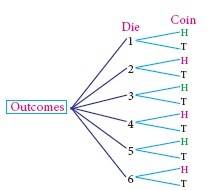
Sample space
S = {1H,1T,2H,2T,3H,3T,4H,4T,5H,5T,6H,6T};
n(S) = 12
Let A be the event of getting an odd number and a head.
A = {1H, 3H, 5H}; n(A) = 3
P(A) = \(\frac { n(A) }{ n(S) } =\frac { 3 }{ 12 } =\frac { 1 }{ 4 } \)
9.
leap year has 366 days. So it has 52 full weeks and 2 days. 52 Saturdays must be in 52 full weeks.
The possible chances for the remaining two days will be the sample space.
S = {(Sun-Mon, Mon-Tue, Tue-Wed, Wed-Thu, Thu-Fri, Fri-Sat, Sat-Sun)}
n(S) = 7
Let A be the event of getting 53rd Saturday.
Then A = {Fri-Sat, Sat-Sun}; n(A) = 2
Probability of getting 53 Saturdays in a leap year is P(A0 = \(\frac { n(A) }{ n(S) } =\frac { 2 }{ 7 } \).
10.
When two coins are tossed together, the sample space is
S = {HH, HT, TH, TT} n(S) = 4
Let A be the event of getting different faces on the coins.
A = {HT, TH}; n(A) = 2
Probability of getting different faces on the coins is P(A) = \(\frac { n(A) }{ n(S) } =\frac { 2 }{ 4 } =\frac { 1 }{ 2 } \).

10th Standard Syllabus & Materials
10th Standard
TN 10th English Prose - 2 - The Night the Ghost Got in Important Questions And Answers Study Material - QB365 Set A
NEW10th Standard
TN 10th English Supplementary - 1 - The Tempest Important Questions And Answers Study Material - QB365 Set A
NEW10th Standard
TN 10th English Poem - 1 - Life Important Questions And Answers Study Material - QB365 Set A
NEW10th Standard
TN 10th English Prose - 1 - His First Flight Important Questions And Answers Study Material - QB365 Set A



Tamilnadu Stateboard 10th Standard Subjects
Tamilnadu Stateboard Standards





