
 100% FREE ACCESS
10th Standard CBSE Syllabus & Materials
10th Standard CBSE
CBSE 10th Social Science ECO - Globalisation and the Indian Economy - New Model Questions Papers Study Material - QB365 Set A
NEW10th Standard CBSE
CBSE 10th Social Science ECO - Money and Credit - New Model Questions Papers Study Material - QB365 Set A
NEW10th Standard CBSE
CBSE 10th Social Science ECO - Sectors of the Indian Economy - New Model Questions Papers Study Material - QB365 Set A
NEW10th Standard CBSE
CBSE 10th Social Science ECO - Development - New Model Questions Papers Study Material - QB365 Set A
NEW10th Standard CBSE
CBSE 10th Social Science PS - Outcomes of Democracy - New Model Questions Papers Study Material - QB365 Set A
NEW10th Standard CBSE
CBSE 10th Social Science PS - Gender, Religion and Caste - New Model Questions Papers Study Material - QB365 Set A

Published on: 01/08/2018
From the chapter Surface Areas and Volumes, some of the important questions are covered in this question paper. The questions are covers from the book back and creative question.
Download CBSE Class 10th Standard CBSE Maths question papers, sample papers, important questions, and previous year solved papers in PDF format. Get free study materials, NCERT solutions, and exam preparation resources for Class 10th Standard CBSE Maths
Questions + Answers key
Take MCQ Maths Test
1.
The slant height of a bucket is 26 cm. The diameter of upper and lower circular ends are 36 cm and 16 cm. Find the height of the bucket.
2.
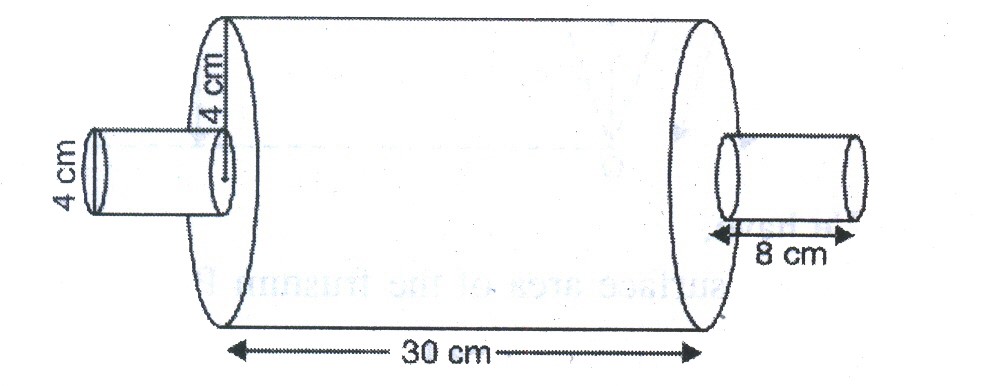
A rolling pin is made by joining three cylindrical pieces of wood as shown in the figure. Find the mass of the rolling pin with given measurements, if 1 cm3 of wood has approximately \(\frac { 1 }{ 2 } \)g mass. \(\left[ Use\ \pi =3.14 \right] \)
3.
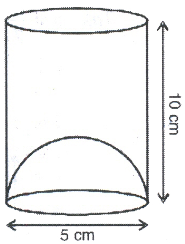
A milkman while supplying milk to their customer measures milk with a measuring cane which is cylindrical in shape with hemispherical raised bottom. The diameter of the measuring cylinder is 5 cm and height of the cylinder is 10 cm.
(i) Find the volume of measuring cane.
(ii) Which mathematical concept is used in given problem?
4.
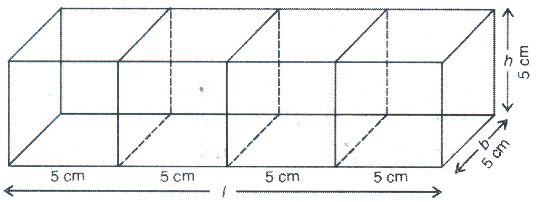
Four cubes of volume 125 cm3 each are joined end to end, in a row. Find the surface area and volume of the resulting cuboid (see Fig.).
5.
500 persons are taking a dip into a cuboidal pond which is 80 m long and 50 m broad. What is the rise of water level in the pond, if the average displacement of the water by a person is 0.04 m3 ?
6.
The dimensions of a metallic cuboid are 100cm x 80cm x 64cm.It is melted and recast into a cube.Find the surface area of the cube.
7.
Water is flowing at the rate of 2.52 km/h through a cylindrical pipe into a cylindrical tank, the radius of whose base is 40 cm, if the Increase in the level of water in the tank, in half an hour is 3.15 m, find the internal diameter of the pipe.
8.
A hemispherical bowl of internal diameter 36 cm contains liquid. This liquid is filled into 72 cylindrical bottles of diameter 6 cm, Find. the height of the each bottle, if 10% liquid is wasted in this transfer.
9.
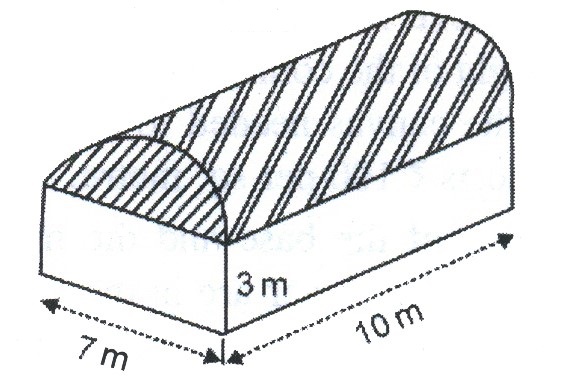
A godown building is in the form as shown in figure. The vertical cross-section parallel to the width side of the building is a rectangle of size 7 m x 3 m mounted by a semicircle of radius 3.5 m. The inner measurements of the cuboid are 10 m x 7 m x 3 m. Find the total internal surface area excluding the floor.
10.
A spherical shell of lead, whose external diameter is 18 cm, is melted and recast into a right circular cylinder, whose height is 8 cm and diameter 12 cm. Determine the internal diameter of the shell.
11.
A bucket open at the top is in the form of a frustum of a cone with a capacity of 12308.8 cm3 . The radii of the top and bottom circular ends are 20 cm and 12 cm respectively. Find the height of the bucket and the area of metal sheet used in making the bucket. \(\left[ Use\ \pi =3.14 \right] \)
12.
Volume of the frustum of a cone is .............
13.
The shape of a gilli in the gilli danda game is a combination of ..............
14.
If the ratio between the volume of two spheres is 27 : 8, then ratio between their surface areas is ..............
15.
If the surface area of a sphere is 6161 cm2, then its radius is equal to ...............
16.
Volume of a spherical shell = ...........
17.
Toy (Latto) is a solid which is a combination of ............. and .............
18.
The slant height of the frustum of cone (l) = ................
19.
Frustum is a latin word, meaning ............
20.
Total surface area of a cone= .........
21.
A solid cylinder of radius 'r' and height 'h' is placed over other cylinder of same height and radius. The total surface area of the shape so formed is \(4\pi rh+2\pi { r }^{ 2 }\)
22.
Conical flask is a combination of cylinder and the frustum of a cone.
23.
Two cubes each of edge 10 cm, are joined end to end. The surface area of the resulting cuboid is 900 cm2.
24.
If we double the radius of a hemisphere, its urface area will also be doubled.
25.
Volume of the frustum of the cone is \(\frac { 1 }{ 3 } \pi \left( { R }^{ 2 }+{ r }^{ 2 }+Rr \right) \times h.\)
26.
150 spherical marbles, each of diameter 1.4 cm, are dropped in a cylindrical vessel of diameter 7 cm containing some water, which are completely immersed in water. Find the rise in the level of water in the vessel.
27.
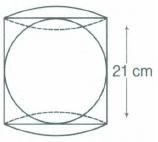
Ashwani, a factory owner wants to thank all his workers by gifting a decorated spherical ball. The diameter of the sphere is (2a+5) cm. Each ball is to be packed in a right circular cylindrical box which just encloses a sphere as shown in the figure.
If the height of the cylinder is 21 cm, then
(i) what is the value of a?
(ii) what is the curved surface area of a sphere?
(iii) which value are shown by Ashwani?
1.
Here, l = 26 cm, upper radius = 18 cm,
lower radius = 8 cm
d = difference in radius = 18- 8 = 10cm.
Let h be the height of bucket
\(\begin{aligned}
& \therefore \quad h=\sqrt{l^2-d^2} \\
\end{aligned}\)
\(\begin{aligned}
& =\sqrt{(26)^2-(10)^2} \\
\end{aligned}\)
\(\begin{aligned}
& =\sqrt{676-100} \\
\end{aligned}\)
\(\begin{aligned}
& =\sqrt{576}=24 \mathrm{~cm}
\end{aligned}\)
2.
Let radius of bigger cylinder be R = 4 cm and length = 30 cm
Let radius of smaller cylinders be r = 2 cm and length = 8 cm
Now, volume of wood used to make rolling pin = volume of bigger cylinder + 2 x volume of smaller cylinder
= 3.14 x 4 x 4 x 30 + 2 x 3.14 x 2 x 2 x 8
= 1507.2 + 200.96
= 1708.16 cm3
Since mass of 1 cm3 wood = \({{1}\over{2}}\) g
= \({\pi}{r}^{2}h+2\times{{2}\over{3}}{\pi}{r}^{3}\)
= \({\pi}({1.4})^{2}\times2.2+2\times{{2}\over{3}}{\pi}({1.4})^{3}\)
\(={{22}\over{7}}\times(1.4)^{2}\left[2.2+{{4}\over{3}}\times1.4 \right]\)
= \({{22}\over{7}}\times1.96\times{{12.2}\over{3}}={{75.152}\over{3}}\) cm2
3.
Radius of cylinder and hemisphere (r)=\(\frac{5}{2}\)cm
Height of cylinder (h)=10 cm
(i) Volume of the measuring cane=πr2h-\(\frac{2}{3}\)πr3
=\(\frac{22}{7}\times{\frac{5}{2}}\times{\frac{5}{2}}\times{10}-\frac{2}{3}\times{\frac{22}{7}}\times{\frac{5}{2}}\times{\frac{5}{2}}\times{\frac{5}{2}}\)
=196.43-32.74=163.69 cm3
(ii) Volumes of solid figures (mensuration)
4.
Volume of one cube=125 cm3
(edge)3=125
edge=\(\sqrt [ 3 ]{ 125 } \)=5 cm
Length of the cuboid = 20 cm and
height = 5 cm
Surface area of cuboid =2(lb+bh+lh)
=2[20x5+5x5+5x20]
= 2 x 225 = 450 cm2
Volume of the cuboid =lxbxh
= 20 x 5 x 5
= 500 cm3
5.
Water displaced by a person = 0.04 m3
Water displaced by 500 persons = 500 x 0.04 = 20 m3
Volume of cuboid = Volume of water displaced
Ibh=20
80 x 50 x h=20
h=\(\frac{20}{80\times{50}}\)=\(\frac{1}{200}\)m
⇒ h=0.5 cm
6.
Dimensions of the metallic cuboid are 100cm x 80cm x 64cm
100 x 80 x 64=a3(where a=side of cube)
\(\Rightarrow\)10 x 2 x 4=a \(\Rightarrow\) 80
cmSurface area of the cube=6a2
=6(80)2=6 x 80 x 80=38400 cm2
7.
Let the internal diameter of the pipe be r m.
Water flows in 1 hour = 2.52 km.
Water flows in \(\frac {1}{2}\) hour = 2.52 = 1.26 km
= 1260m
Volume of water flows in \(\frac {1}{2}\) hour = \(\pi\)r2h.
=\(\pi\)r2 x 1260
Volume of the water in cylindrical tank
\(=\pi \times { \left( \frac { 40 }{ 100 } \right) }^{ 2 }\times 3.15\)
Volume of water flow = Volume of increased water
\(\pi { r }^{ 2 }\times 1260=\pi { \left( \frac { 2 }{ 5 } \right) }^{ 2 }\times 3.15\)
\(\Rightarrow \quad 1260{ r }^{ 2 }=\frac { 2 }{ 5 } \times 3.15\)
\(\Rightarrow \quad { r }^{ 2 }=\frac { 4 }{ 25 } \times \frac { 315 }{ 100 } \times \frac { 1 }{ 1260 } =\frac { 1 }{ 1260 } \)
\(\Rightarrow \quad r=\frac { 1 }{ 50 } m=2cm\)
Internal diameter of pipe = 4 cm.
8.
Volume of bowl =\(=\frac { 2 }{ 3 } \pi { r }^{ 3 }\)
Volume of liquid in bowl
\(=\frac { 2 }{ 3 } \pi \times { (18) }^{ 3 }{ cm }^{ 3 }\)
Volume of liquid after wastage
\(=\frac { 2 }{ 3 } \pi \times { (18) }^{ 3 }\times \frac { 90 }{ 100 } { cm }^{ 3 }\)
Volume of bottle = \(\pi\)r2h
Volume of liquid in 72 bottles = \(\pi\) x (3)2X h x 72 cm2
Volume of liquid in bottles = volume after wastage
\(\pi \times { (3) }^{ 2 }\times h\times 72=\frac { 2 }{ 3 } \pi \times { (18) }^{ 3 }\times \frac { 90 }{ 100 } \)
\(\Rightarrow \quad h=\frac { \frac { 2 }{ 3 } \pi \times { (18) }^{ 3 }\times \frac { 90 }{ 100 } }{ \pi \times { (3) }^{ 2 }\times 72 } \)
= 5.4 cm.
9.
250.5 m2
10.
\(6{ \left( 19 \right) }^{ 1/3 }cm\)
11.
Volume of the bucket = 12308.8 cm3
r1 = 20 cm and r2 = 12 cm, h = ?
We have volume of bucket \(=\frac{\pi h}{3}\left(r_{1}^{2_{2}}+r_{2}^{2}+r_{1} r_{2}\right)\)
\(\begin{array}{l} \Rightarrow 12308.8=3.14 \times \frac{h}{3}\left(20^{2}+12^{2}+20 \times 12\right) \\ \Rightarrow \quad h=12308.8 \times \frac{3}{3.14 \times 784}=15 \mathrm{~cm} \end{array}\)
\(\therefore\)Height of the bucket, h = 15 cm
Surface area of the metal sheet used \(=\pi r_{2}^{2}+\pi\left(r_{1}+r_{2}\right) l\)
\(\because \quad l =\sqrt{h^{2}+\left(r_{1}-r_{2}\right)^{2}}=\sqrt{15^{2}+8^{2}}\)
\(=\sqrt{225+64}=17 \mathrm{~cm}\)
\(\therefore\) Surface area of the metal sheet used
\(\begin{array}{l} =\pi r_{2}^{2}+\pi\left(r_{1}+r_{2}\right) l \\ =3.14+12^{2}+\frac{22}{7} \times 32 \times 17 \\ =3.14(144+544)=216032 \mathrm{sq} \mathrm{cm} \end{array}\)
Hence, height of the bucket = 15 cm, area of metal, speed used = 216032 sq cm
12.
()
\(\frac { 1 }{ 3 } \pi h\left( { R }^{ 2 }+{ r }^{ 2 }+Rr \right) \)
13.
()
2 cone sand cylinder
14.
()
9 : 4
15.
()
7 cm
16.
()
\(\frac { 4 }{ 3 } \pi \left( { R }^{ 3 }-{ r }^{ 3 } \right) cubic\quad units.\)
17.
()
Cone and hemisphere.
18.
()
\(Slant\ height\ (l)=\sqrt { { h }^{ 2 }+{ \left( R-r \right) }^{ 2 } } \)
19.
()
piece cut off
20.
()
\(\pi rl+\pi { r }^{ 2 }\quad or\quad \pi r(l+r)\)
21.
(a)
22.
(a)
23.
(b)
24.
(b)
25.
(a)
26.
Diameter of spherical marble = 14 cm
Radius rl = 1.4/2 = 0.7 = 7/10 cm
Diameter of cylindrical vessel = 7 cm
Radius R = 7/2 cm
Let h be the rise in water level then
Volume of 150 spherical marbles =volume of water rises
\(\Rightarrow \quad 100\times \frac { 4 }{ 3 } \times \pi \times \frac { 7 }{ 10 } \times \frac { 7 }{ 10 } \times \frac { 7 }{ 10 } =\pi \times \frac { 7 }{ 2 } \times \frac { 7 }{ 2 } \times \frac { 7 }{ 2 } \times h\)
\(\Rightarrow \quad h=\frac { 4\times 7 }{ 5 } \)
\(\Rightarrow \quad \frac { 28 }{ 5 } =h\)
\(\Rightarrow\) h = 5.6 cm
The rise is the level of water, h = - 5.6 cm.
27.
(i) 8 cm
(ii) 1386 cm2
(iii) Social justice, caring

10th Standard CBSE Syllabus & Materials
10th Standard CBSE
CBSE 10th Social Science PS - Federalism - New Model Questions Papers Study Material - QB365 Set A
NEW10th Standard CBSE
CBSE 10th Social Science PS - Power Sharing - New Model Questions Papers Study Material - QB365 Set A
NEW10th Standard CBSE
CBSE 10th Social Science GEO - Manufacturing Industries - New Model Questions Papers Study Material - QB365 Set A
NEW10th Standard CBSE
CBSE 10th Social Science GEO - Minerals and Energy Resources - New Model Questions Papers Study Material - QB365 Set A



CBSE 10th Standard CBSE Subjects
CBSE Standards





