
 100% FREE ACCESS
10th Standard CBSE Syllabus & Materials
10th Standard CBSE
CBSE 10th Social Science ECO - Globalisation and the Indian Economy - New Model Questions Papers Study Material - QB365 Set A
NEW10th Standard CBSE
CBSE 10th Social Science ECO - Money and Credit - New Model Questions Papers Study Material - QB365 Set A
NEW10th Standard CBSE
CBSE 10th Social Science ECO - Sectors of the Indian Economy - New Model Questions Papers Study Material - QB365 Set A
NEW10th Standard CBSE
CBSE 10th Social Science ECO - Development - New Model Questions Papers Study Material - QB365 Set A
NEW10th Standard CBSE
CBSE 10th Social Science PS - Outcomes of Democracy - New Model Questions Papers Study Material - QB365 Set A
NEW10th Standard CBSE
CBSE 10th Social Science PS - Gender, Religion and Caste - New Model Questions Papers Study Material - QB365 Set A

Published on: 20/10/2025
Download CBSE Class 10th Standard CBSE Science question papers, sample papers, important questions, and previous year solved papers in PDF format. Get free study materials, NCERT solutions, and exam preparation resources for Class 10th Standard CBSE Science
Questions + Answers key
Take MCQ Science Test
1.
Resistance of a metal wire of length 1 m is 26 Ω at 20°C. If the diameter of the wire is 0.3 mm, what will be the resistivity of the metal at that temperature? Using Table, predict the material of the wire.
| Material | Resistivity (\(\Omega\) m) | |
| Conductors | Silver | 1.60 × 10⁻⁸ |
| Copper | 1.62 × 10⁻⁸ | |
| Aluminium | 2.63 × 10⁻⁸ | |
| Tungsten | 5.20 × 10⁻⁸ | |
| Nickel | 6.84 × 10⁻⁸ | |
| Iron | 10.0 × 10⁻⁸ | |
| Chromium | 12.9 × 10⁻⁸ | |
| Mercury | 94.0 × 10⁻⁸ | |
| Manganese | 1.84 × 10⁻⁶ | |
| Alloys | Constantan (alloy of Cu and Ni) |
49 × 10–6 |
| Manganin (alloy of Cu, Mn and Ni) |
44 × 10–6 | |
| Nichrome | 100 × 10–6 | |
| (alloy of Ni, Cr, Mn and Fe) | ||
| Insulators | Glass | 1010 – 1014 |
| Hard rubber | 1013 – 1016 | |
| Ebonite | 1015 – 1017 | |
| Diamond | 1012 - 1013 | |
| Paper (dry) | 1012 |
2.
The potential difference between the terminals of an electric heater is 60 V when it draws a current of 4 A from the source. What current will the heater draw if the potential difference is increased to 120 V?
3.
"It is a matter of chance whether a couple will have a male or a female child." Justify this statement by drawing a flow chart.
4.
List any four methods of contraceptions used by humans. How does their use have a direct effect on the health and prosperity of a family?
5.
What are fossils? What do they tell about the process of evolution?
6.
How does binary fission differ from multiple fission?
7.
Why is variation beneficial to the species, but not necessary for the individual?
8.
Give reasons for the following:
(a) Metals can be given different shapes according to our needs.
(B) Hydrogen is not evolved when a metal reacts with nitric acid.
9.
(a) Name the chief ore of iron. Write its formula.
(b) How is an iron ore concentrated? Describe it briefly.
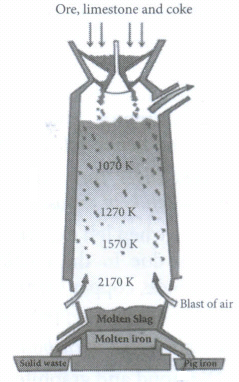
(c) Draw a labelled diagram of the blast furnace used in the extraction of iron from its concentrated ore.
10.
(a) What is meant by 'Electric Resistance' of a conductor?
(b) A wire of length 'L' and resistance 'R' is stretched so that its length is doubled and the area of cross-section is halved. How will its:
(i) resistance change
(ii) resistivity change
11.
(a) Distinguish between the terms "overloading and short circuiting" as used in domestic circuits.
(b) Why are the coils of electric toasters made of an alloy rather than a pure metal?
12.
What are the uses of washing soda?
13.
What is 'Plaster of Paris' chemically? How is it obtained from gypsum? Write the condition and chemical equation involved in its manufacture.
14.
Why does distilled water not conduct electricity, whereas rain water does?
15.
Metal compound A reacts with dilute hydrochloric acid to produce effervescence. The gas evolved extinguishes a burning candle, Write a balanced chemical equation for the reaction if one of the compounds formed is calcium chloride.
16.
Which of the following terms does not represent electrical power in a circuit?
I2R
IR2
VI
V2/R
17.
The change in focal length of eye lens is caused by action of
Pupil
Retina
Ciliary muscles
Iris
18.
The human eye forms the image of an object at its
Cornea
Iris
Pupil
Retina
19.
The anther contains
sepals
ovules
carpel
pollen grains
20.
Which of the following is not a part of the female reproductive system in human beings?
Ovary
Uterus
Vas deferens
Fallopian
21.
A mendelian experiment consisted of breeding tall pea plants bearing violet flowers with short pea plants bearing white flowers. The progeny all bore violet flowers, but almost half of them were short. This suggests that the genetic make-up of the tall parent can be depicted as
TTWW
TTww
TtWW
TtWw
22.
Which of the following methods is suitable for preventing an iron frying pan from rusting?
Applying grease
Applying paint
Applying a coating of zinc
All of the above
23.
Which of the following pairs will give displacement reactions?
NaCl solution and copper metal
MgCl2 solution and aluminium metal
FeSO4 solution and silver metal
AgNO3 solution and copper metal
24.
A solution reacts with crushed egg-shells to give a gas that turns lime-water milky. The solution contains.
NaCl
HCl
LiCl
KCl
25.
A solution turns red litmus blue; its pH is likely to be?
1
4
5
10
26.
(i) Name any two sexually transmitted diseases.
(ii) Prenatal sex-determination is prohibited by law. Why?
(iii) Name any three methods of contraception stating one side effect of each.
27.
(i) A person suffering from myopia (nearsightedness) was advised to wear corrective lens of power-25D. A spherical lens of same focal length was taken in the laboratory. At what distance should a student place an object from this lens, so that it forms an image at a distance of 10 cm from the lens?
(ii) Draw a ray diagram to shown the position and nature of the image formed in the above case.
28.
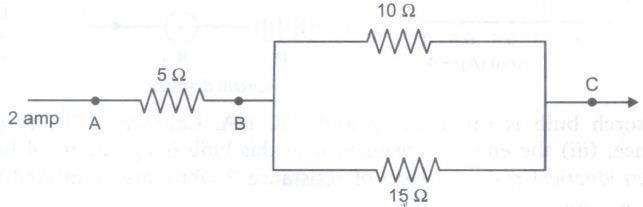
(i) Three resistors are connected as shown in the circuit diagram. Through the resistor 5 ohm, a current of 2 ampere is flowing.
(a) What is the current through the other two resistors?
(b) What is the p.d. across AB?
(c) What is the total resistance?
(ii) Can you change the set up and arrange the resistance in a manner to get the least resistance?
29.
Explain vegetative propagation with the help of two examples. List two advantages of vegetative propagation.
1.
We are given the resistance R of the wire = 26 Ω, the diameter d = 0.3 mm = 3 × 10⁻⁴ m, and the length l of the wire = 1 m.
Therefore, from Eq, the resistivity of the given metallic wire is
ρ = (RA/l) = (Rπd2/4l )
Substitution of values in this gives ρ = 1.84 × 10⁻⁶ Ω m
The resistivity of the metal at 20°C is 1.84 × 10⁻⁶ Ω m.
From Table, we see that this is the resistivity of manganese
2.
We are given, potential difference V = 60 V, current I = 4 A.
According to Ohm's law, \(R=\frac{V}{I}=\frac{60 \mathrm{~V}}{4 \mathrm{~A}}=15 \Omega\).
When the potential difference is increased to 120 V the current is given by current \(=\frac{V}{R}=\frac{120 \mathrm{~V}}{15 \Omega}=8 \mathrm{~A}\)
The current through the heater becomes 8 A .
3.
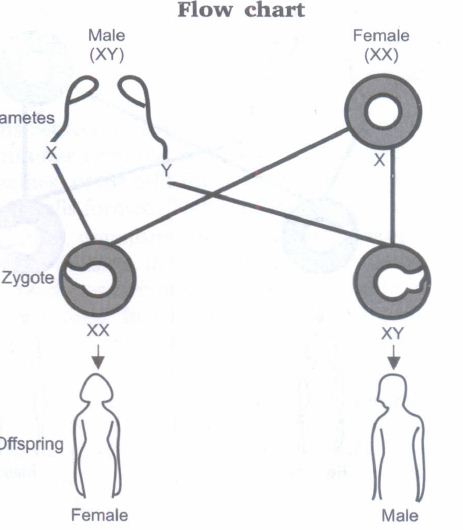
Justification: Women produce only one type of ovum (carrying X chromosome) and males produce two types of sperms (carrying either X or Y chromosome) in equal proportions. So the sex of a child is a matter of chance depending upon the type of sperm fertilizing the ovum.
4.
Four methods: (i) Mechanical or barrier method OR Male or female condoms.
(ii) Use of hormonal preparations OR Oral Pills/i-pill/Saheli.
(iii) Use of loop or copper T OR IUCD.
(iv) Surgical method OR tubectomy/vasectomy.
Effect on health and prosperity:
(i) Health of women is maintained.
(ii) Parents can give more attention to children.
(iii) More resources can be made available.
5.
The remains (or impressions) of dead animals or plants, that lived in the remote past, are known as fossils.
(a) Fossils provide evidence for evolution, e.g.r a fossil called Archaeopteryx had feathered wings like birds but teeth and tail like reptiles hence suggesting that birds and reptiles had a common ancestor.
(b) Fossils provide direct evidence of past life and thus provide convincing proof of organic evolution.
6.
Differences between binary fission and multiple fission are given below
| Binary Fission | Multiple Fission |
| The parent organism splits to form two new organisms. | The parent organism splits to form many new organisms at the same time. |
| It takes place during favourable environmental conditions. | It takes place during unfavourable environmental Conditions |
| It takes place in organisms like Amoeba, Leishmania, etc. | It takes place in organisms like Plasmodium. |
7.
Variations allow organisms to exist in diverse habitats or niches. In its absence, a species may remain restricted to a particular area. If this area gets drastically altered due to various natural or man-made causes, the species may be wiped out. However, if some variations are present in few individuals, it would help them to colonise other habitats and survive. But, if variations are present in a single organism, there would be a very little chance for it to survive and species is lost forever.
8.
(a) Metals are malleable and ductile i.e. it can be drawn into sheets and wires, it does not break due to high tensile strength and therefore it can be used for our needs.
(b) Nitric acid is strong oxidising agent, when metals react with nitric acid it does not release H2 gas as oxidise it to form H2 O.
9.
Haematite (Fe2O3) is an important ore of iron.
In the upper part of the blast furnace, carbon monoxide reduces iron (III) oxide to iron metal.
\(\underset { Iron(III)oxide }{ { Fe }_{ 2 }{ O }_{ 3 } } +\underset { Carbonmonoxide }{ 3CO(g) } \rightarrow \underset { Ironmetal }{ 2Fe(I) } +\underset { Carbondioxide }{ { 3CO }_{ 2 }(g) } \)
Following reactions are involved in the blast furnace:
(i) Formation of carbon monoxide
\(\underset { Carbon }{ C(s) } +\underset { Oxygen }{ { O }_{ 2 }(g) } \rightarrow \underset { Carbondioxide }{ { CO }_{ 2 }(g) } +Heat\\ \underset { Carbondioxide }{ { CO }_{ 2 }(g) } +\underset { Coke }{ C(s) } \rightarrow \underset { Carbonmonoxide }{ 2CO(g) } \)
(ii) Reduction of iron (III) oxide or haematite to iron
\(\underset { Iron(III)oxide }{ { Fe }_{ 2 }{ O }_{ 3 } } +\underset { Carbonmonoxide }{ 3CO(g) } \rightarrow \underset { Ironmetal }{ 2Fe(I) } +\underset { Carbondioxide }{ { 3CO }_{ 2 }(g) } \)
10.
(a) Resistance is defined as the property of a conductor due to which it opposes the flow of current through it. The S.I. unit of resistance is Ohm \(\left( \Omega \right) \).
(b) (i) The resistance (R) of a conductor is related to its length (l) and area of cross section (A) as
\(R=\frac { p\times l }{ A } \) Where \(\rho \) is the resistivity of the conducting material.
Let R1= Resistance of the original wire
R2= Resistance of the wire when its length is doubled
I1= Length of original wire
l2= Length of original wire when doubled
A1= Area of the original wire
A2= Area when it is halved
Therefore,
\({ R }_{ 1 }=\frac { P\times { l }_{ 1 } }{ { A }_{ 1 } } \quad \quad ---\quad (1)\\ { R }_{ 2 }=\frac { P\times { l }_{ 2 } }{ { A }_{ 2 } } \quad \quad ---\quad (2)\)
Dividing equation (1) and (2) by equation (1), we obtain
\(\frac { { R }_{ 1 } }{ { R }_{ 2 } } =\frac { { l }_{ 1 } }{ { l }_{ 2 } } \times \frac { { A }_{ 1 } }{ { A }_{ 2 } } \quad ---\quad (3)\)
It is given that:
\({ l }_{ 1 }=2l_{ 1 }\quad and\quad { A }_{ 2 }=\frac { 1 }{ 2 } { A }_{ 1 }\\ \)
Putting these values in equation (3), we obtain
R2=4R1
Hence, the resistance of the wire will be 4 times of the original value.
(ii) The resistivity will not change on stretching the wire. Resistivity is the property of the conducting material. It does not depend on the dimension of the wire. As materials of both the wires are the same, the resistivity will not change.
11.
(a) Short circuiting is the term used for defining the situation in which the neutral and live wires of an electric circuit come in direct contact. When too many electrical appliances are connected to a single socket, the appliances drawn much more current or power that the permissible limit from the main supply. This situation is termed as overloading.
(b) Resistivity of an alloy is much higher than its constituent metals Moreover, alloys do not oxidise as easily as the constituent metals at high temperature. Because of these reasons, coils of electric testers are made of an alloy rather than a pure meta.
12.
(i) Sodium carbonate (washing soda) is used in glass, soap and paper industries.
(ii) It is used in the manufacture of sodium compounds such as borax.
(iii) Sodium carbonate can be used as a cleaning agent for domestic purposes.
(iv) It is used for removing permanent hardness of water.
13.
Plaster of Paris is calcium sulphate hemihydrate \((CaSO_4.{1\over2}H_2O).\)
Gypsum, when heated at a temperature of about 380 K in a kiln. loses its three-fourth water of crystallisation and changes to plaster of Paris.
Following is the reaction involved:
\(\underset{Gypsum}{CaSO_4.2H_2O}\xrightarrow {Heat} \underset{Plaster\ of\ Paris}{CaSO_4.{1\over2}H_2O}+\underset{Water}{1{1\over2}H_2O}\)
14.
Distilled water does not contain any ions and have no electrolytes. Hence, it does not conduct electricity. But in rain water, a small amount of electrolyte is present in the form of acids. These acids are produced due to dissolution of acidic oxides (e.g. SO2, NO2) in rain water and make it a better conductor of electricity.
15.
CO2 is the gas that extinguishes a burning candle.
CO2 is produced when metal carbonate reacts with acid. Since, one of the products is calcium chloride.
Thus, the compound A should be calcium carbonate, The balanced chemical equation is
CaCO3 (s) + 2HCl(aq) \(\rightarrow\) CaCl2(aq) + CO2(g) + H2O(l)
16.
(b)
IR2
17.
(c)
Ciliary muscles
18.
(d)
Retina
19.
(d)
pollen grains
20.
(c)
Vas deferens
21.
(c)
TtWW
22.
(c)
Applying a coating of zinc
23.
(d)
AgNO3 solution and copper metal
24.
(b)
HCl
25.
(d)
10
26.
(i) Gonorrhoea and syphilis are two common STD'S.
(ii) Prenatal sex-determination is prohibited by law. This is because of practice of female foeticide due to the desire of male child.
27.
(i) Focal length, \(f(\mathrm{~m})=\frac{1}{P(D)}\)
\(f =\frac{1}{-2.5 D}=\frac{-10}{25} =-04 \mathrm{~m}=40 \mathrm{~cm} \)
\(f =-40 \mathrm{~cm}, v=-10 \mathrm{~cm}, u=\text { ? (to find) }\)
Using lens formula, \(\frac{1}{v}-\frac{1}{u}=\frac{1}{f}\)
\(\frac{-1}{u} =\frac{1}{40}+\frac{1}{-10}-\frac{1}{u}=\frac{1}{-40} =\frac{-1+4}{40}=\frac{3}{40}\)
\(\therefore \quad u =\frac{-40}{3}=-13.3 \mathrm{~cm}\)
(ii) The lens is concave as the power is -ve.
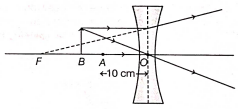
OA = v=-10 cm, OB=-13.3 cm, OF = f=-40cm
28.
(i) (a) In Parallel \(I=\overset { V }{ \underset { R }{ \_ \_ } } \) or 2 x 5 = V = 10 V
For I0 \(\Omega \) resistance I = \(\overset { V }{ \underset { R }{ \_ \_ } } =\overset { 10 }{ \underset { 10 }{ \_ \_ } } \) =1A
For 15 \(\Omega \) resistance I = \(\overset { V }{ \underset { R }{ \_ \_ } } =\overset { 10 }{ \underset { 10 }{ \_ \_ } } \) = 0.7A
(b) \(I=\overset { V }{ \underset { R }{ \_ \_ } } \)
or, 2 =\(\overset { V }{ \underset { 5 }{ \_ \_ } } \)
or V=10 V
(c) Resistance in Parallel
\(\overset { 1 }{ \underset { R }{ \_ \_ } } =\overset { 1 }{ \underset { 10 }{ \_ \_ } } +\overset { 1 }{ \underset { 15 }{ \_ \_ } } =\overset { 1 }{ \underset { 30 }{ \_ \_ } } =\overset { 1 }{ \underset { 6 }{ \_ \_ } } \)
So, R= 6 \(\Omega \)
So, Total resistance across AC
= 5 + 6 = 11\(\Omega \)
(ii)
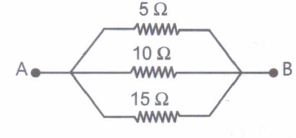
If we connect all the resistance in parallel we will get the least total resistance.
29.
In vegetative propagation, new plants are obtained from the parts of old plants like stems, roots and leaves, without the help of any reproductive organ.
There are two ways of vegetative propagation:
(a) Natural Vegetative Propagation, and
(b) Artificial Vegetative Propagation.
Natural vegetative propagation by leaves: The fleshy leaves of Bryophyllum bear adventitious buds in the notches along the leaf margin.
Grafting: In this method of reproduction, two plants of closely related varieties are joined together so that they live as one plant:
(a) The portion of a plant that is grafted on the other plant is called scion, and the plant in which grafting is performed is called the stock. .
(b) This method is applied to improve variety of fruits like mango, apple, peas, citrus and guava.
Advantages of vegetative propagation:
(i) Vegetative propagation is a cheaper, easier and more rapid method of propagation in plants than growing plants from their seeds.
(ii) Better quality of the plants can be maintained by this method.

10th Standard CBSE Syllabus & Materials
10th Standard CBSE
CBSE 10th Social Science PS - Federalism - New Model Questions Papers Study Material - QB365 Set A
NEW10th Standard CBSE
CBSE 10th Social Science PS - Power Sharing - New Model Questions Papers Study Material - QB365 Set A
NEW10th Standard CBSE
CBSE 10th Social Science GEO - Manufacturing Industries - New Model Questions Papers Study Material - QB365 Set A
NEW10th Standard CBSE
CBSE 10th Social Science GEO - Minerals and Energy Resources - New Model Questions Papers Study Material - QB365 Set A



NCERT Books

Syllabus

Exam Pattern

Sample Question Papers

Previous year Question Papers

Important Notes

MCQ Practice test

NCERT Exemplers

Case study Questions

Image Based Questions

Passage based Questions

HOT Questions

Value Based Questions

Model Questions Papers
NCERT ( Book Back ) Questions

Assertion and Reason
Important Questions And Answers

CBSE 10th Standard CBSE Subjects
CBSE Standards



