
 100% FREE ACCESS
10th Standard CBSE Syllabus & Materials
10th Standard CBSE
CBSE 10th Social Science ECO - Globalisation and the Indian Economy - New Model Questions Papers Study Material - QB365 Set A
NEW10th Standard CBSE
CBSE 10th Social Science ECO - Money and Credit - New Model Questions Papers Study Material - QB365 Set A
NEW10th Standard CBSE
CBSE 10th Social Science ECO - Sectors of the Indian Economy - New Model Questions Papers Study Material - QB365 Set A
NEW10th Standard CBSE
CBSE 10th Social Science ECO - Development - New Model Questions Papers Study Material - QB365 Set A
NEW10th Standard CBSE
CBSE 10th Social Science PS - Outcomes of Democracy - New Model Questions Papers Study Material - QB365 Set A
NEW10th Standard CBSE
CBSE 10th Social Science PS - Gender, Religion and Caste - New Model Questions Papers Study Material - QB365 Set A

Published on: 22/10/2025
Download CBSE Class 10th Standard CBSE Science question papers, sample papers, important questions, and previous year solved papers in PDF format. Get free study materials, NCERT solutions, and exam preparation resources for Class 10th Standard CBSE Science
Questions + Answers key
Take MCQ Science Test
1.
Two resistors with resistance 5 \(\Omega \) and 10 \(\Omega \) respectively are to be connected to a battery of emf 6 V so as to obtain:
(i) minimum current flowing, (ii) maximum current flowing:
(a) How will you connect the resistance in each case?
(b) Calculate the strength of the total current in the circuit in the two cases
2.
You are given kerosene, turpentine and water. In which of these does light travel fastest?
3.
Illustrate the following with the help of a suitable diagrams:
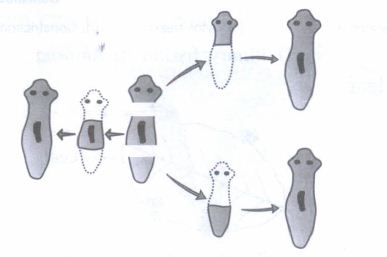
(i) Regeneration in Planaria
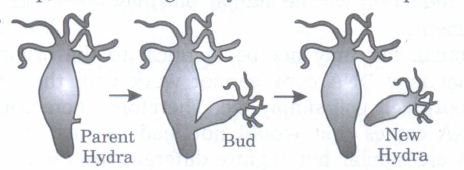
(ii) Budding in Hydra
4.
Draw a labelled diagram of the longitudinal section of a flower.
5.
(a) Why is sulphuric acid called 'King of Chemicals'?
(b) Describe the three chemical reactions that take place during the conversion of sulphur dioxide to sulphuric acid in the 'Contact Process'.
(c) Why should water be never added drop wise to concentrated sulphuric acid?
6.
Which gas is usually liberated when an acid reacts with a metal? Illustrate with an example, How will you test for the presence of the gas?
7.
A current of 2 A passes through a conductor and produces 80 joules of heat in 10 seconds. The resistance of the conductor is
0.5 \(\Omega \)
2\(\Omega \)
4\(\Omega \)
20\(\Omega \)
8.
It the resistance of wire A is four times resistance of wire B then ratio of radii of two wires is
1: 2
1:4
1:6
1:8
9.
An incident ray makes 60° angle with the surface of the plane mirror, the angle of its reflection is
60°
90°
30°
0°
10.
Unicellular organisms reproduce by
Mitotic cell division
Meiotic cell division
Both (a) and (b)
None of the above
11.
The aqueous solution of which of the following salt will have higher OH- ions?
NaCI
Na2SO4
CH3COONa
None of these
12.
Two conducting wires of the same material and of equal lengths and equal diameters are first connected in series and then parallel in a circuit across the same potential difference. The ratio of heat produced in series and parallel combination would be
1:2
2:1
1:4
4:1
13.
A child is standing in front of a magic mirror. She finds the image of her head bigger, the middle portion of her body of the same size and that of the legs smaller. The following is the order of combinations for the magic mirror from the top.
Plane, convex and concave
Convex, concave and plane
Concave, plane and concave
Convex, plane and concave
14.
A 10 mm long awl pin is placed vertically in front of a concave mirror. A 5 mm long image of the awl pin is formed at 30 cm in front of the mirror. The focal length of this mirror is.
- 30 cm
- 20 cm
- 40 cm
- 60 cm
15.
A spherical mirror and a thin spherical lens have each a focal length of - 15 cm. The mirror and the lens are likely to be
both concave
both convex
the mirror is concave and the lens is convex.
the mirror is convex, but the lens is concave.
16.
Vegetative propagation refers to formation of new plants from
stem, roots and flowers
stem, roots, and flower
stem, flowers and fruits
stem, leaves and flowers
17.
The correct sequence of reproductive stages seen in flowering plants is
gametes, zygote, embryo, seedling
zygote, gametes, embryo, seedling
seedling, embryo, zygote, gametes
gametes, embryo, zygote, seedling
18.
In a flower, the parts that produce male and female gametes (germ cells) are
stamen and anther
filament
anther and ovary
stamen and style
19.
Which of the following is not a part of the female reproductive system in human beings?
Ovary
Uterus
Vas deferens
Fallopian
20.
Electrical resistivity of a given metallic wire depends upon
its length
its thickness
its shape
nature of the material
21.
Electric potential is
Neither scalar nor vector
Scalar quantity
Vector quantity
Sometimes scalar sometimes vector
22.
Which of the following are present in a dilute aqueous solution of hydrochloric acid?
\(H_3O^++CH^-\)
\(H_3O^++OH^-\)
\(Cl^-+OH^-\)
unionised HCl
23.
Sodium carbonate is a basic salt because it is a salt of
Strong acid and strong base
weak acid and weak base
strong acid and weak base
weak acid and strong base
24.
10 ml of a solution of NaOH is found to be completely neutralised by 8 ml of a given solution of HCl. If we take 20 ml of the same solution of NaOH, the amount of HCl solution required to neutralise it will be
4 ml
8 ml
12 ml
16 ml
25.
An electric bulb is rated at 60 W, 240 V. Calculate its resistance. If the voltage drops to 192 V, calculate the power consumed and the current drawn by the bulb. (Assume that the resistance of the bulb remain unchanged.)
26.
Draw a ray diagram to show the path of light when it travels through glass slab.
27.
If the image formed by a lens for all positions of the object placed in front of it is always virtual, erect and diminished, state the type of the lens. Draw a ray diagram in support of your answer. If the numerical value of focal length of such a lens is 20 cm, find its power in new cartesian sign conventions.
28.
(a) List two reasons for the appearance of variations among the progeny formed by sexual reproduction.
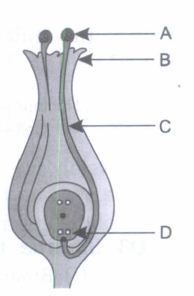
(b) (i) Name the part marked 'A ' in the diagram.
(ii) How does 'N. reaches part 'B'?
(iii) State the importance of the part 'C'.
(iv) What happens to the part marked 'D' after fertilisation is over?
29.
Write the chemical formula of bleaching powder. Write balanced chemical equation involved in the preparation of bleaching powder and write its three uses.
30.
How does binary fission differ from multiple fission?
31.
If a 12 V battery is connected to the arrangement of resistances given below, calculate
(i) the total effective resistance of the arrangement and
(ii) the total current flowing in the circuit
32.
(a) State the relation between hydrogen ion concentration of an aqueous solution and its pH.
(b) The pH of an aqueous solution decreases from 3 to 2. Calculate how many times the hydrogen ion concentration of the solution will change.
33.
Why does distilled water not conduct electricity, whereas rain water does?
34.
When we add NaOH in water to make a dilute solution, will it contain H+ ions in it or not?
35.
The refractive indices of glass and water with respect to air are 3/2 and 4/3 respectively. If speed of light in glass is \({ 2\times 10 }^{ 8 }\) m/s, find the speed of light in water.
36.
How is the refractive index of a medium related to the speed of light? Obtain an expression for refractive index of a medium with respect to another in terms of speed of light in these two media?
37.
Name an organism which reproduce by spore formation. List the conditions favourable for spore to germinate and grow.
38.
How is the process of pollination different from fertilisation?
39.
Calculate the electric energy consumed by 120 W toaster in 20 minutes.
40.
Name a device that helps to maintain a potential difference across a conductor.
41.
Fresh milk has a pH of 6. How do you think the pH will change as it turns into curd? Explain.
42.
The obstruction offered by a conductor in the path of flow of current is called resistance. The SI unit of resistance is ohm (\(\begin{equation}
\Omega
\end{equation}\)). It has been found that the resistance of a conductor depends on the temperature of the conductor. As the temperature increases the resistance also increases. But the resistance of alloys like mangnin, constantan and nichrome is almost unaffected by temperature. The resistance of a conductor also depends on the length of conductor and the area of cross-section of the conductor. More be the length, more will be the resistance, more be the area of cross-section, lesser will be the resistance.
(i) Which of the following is not will desired in material being used for making electrical wires?
| (a) High melting point | (b) High resistance |
| (c) High conductivity | (d) None of these |
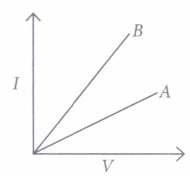
(ii) The V - I graph for two metallic wires A and B is given. What is the correct relationship between their temperatures?
| (a) TA < TB | (b) TA > TB |
| (c) TA = TB | (d) none of these |
(iii) Two wires of same material one of length L and area of cross-section A, other is of length 2L and area A/2 . Which of the following is correct?
| (a) R1 = R2 | (b) R1 = 4R2 |
| (c) R2 = 4R1 | (d) R1 = 2R2 |
(iv) For the same conducting wire
(a) resistance is higher in summer
(b) resistance is higher in winter
(c) resistance is same is summer or in winter
(d) none of these
(v) A wire of resistance 20 \(\begin{equation}
\Omega
\end{equation}\) is cut into 5 equal pieces. The resistance of each part is
| (a) 4 \(\begin{equation} \Omega \end{equation}\) | (b) 10 \(\begin{equation} \Omega \end{equation}\) |
| (c) 100 \(\begin{equation} \Omega \end{equation}\) | (d) 80 \(\begin{equation} \Omega \end{equation}\) |
43.
Ruchika planted three plants X, Y and Z of different species of flowering plant in her garden. After sometime she observed that fruit development occurred in plant X and Z but not in plant Y. She also observed that plant Z has two slightly different types of flowers.
(i) Why do you think fruit formation did not take place in plant Y?
(a) Plant Y is a cross pollinated plant having only female flowers
(b) Plant Y is a cross pollinated plant having only male flowers
(c) Plant Y is a monoecious plant having male and female organs in separate structure
(d) Plant Y is a self pollinated plant having anther and stigma is in the same flower.
(ii) Which of the following correctly identifies plant X, Y and Z?
| X | Y | Z |
| (a) Date palm | Maize | Watermelon |
| (b) Papaya | Maize | Mulberry |
| (c) Hibiscus | Date palm | Papaya |
| (d) Asparagus | Ocimum | Cucurbit |
(iii) Select the correct statement.
(a) Plant X could be self pollinated or cross pollinated
(b) Plant Y must be self pollinated whereas plant Z is cross pollinated
(c) Plant Y is cross pollinated and plant Z is either self pollinated or cross pollinated
(d) Both (a) and (c).
(iv) Which of the following holds false for plants X, Y and Z?
(a) If Ruchika covers all the male flowers of plant Z then only cross pollination is possible in plant Z
(b) Flowers of plant X are always bisexual and incomplete
(c) Plant Z is self pollinated if it is cucurbit but it is cross pollinated if it is pumpkin
(d) Plant Y lacks pistils or female reproductive part of plant and produces pollens in large numbers.
(v) Select the correct statement.
(a) Plant Y always requires another plant of same species but of opposite sex for pollination
(b) Plant Y always needs a pollinating agent
(c) The process offertilisation never takes place in plant Y
(d) All of these.
44.
A compound, X of sodium forms a white powder. It is a constituent of baking powder and is used in some antacids. When heated it gives a compound, Y which is anhydrous and absorbs water to become a hydrated salt. When this salt is kept in open air, it loses water molecules in a process called efflorescence. When dissolved in water it forms a strong base and a weak acid, Z.
(i) What is the compound, X?
| (a) NaHCO3 | (b) Na2CO3 | (c) NaOH | (d) NaCl |
(ii) The compound, Y is
| (a) NaHCO3 | (b) Na2CO3 | (c) Na2CO3 10H2O | (d) NaCI |
(iii) What is the nature of the solution formed by dissolving Y in water?
| (a) Alkaline | (b) Acidic | (c) Neutral | (d) It remains insoluble |
(iv) Identify the compound, Z.
| (a) CO2 | (b) H2CO3 | (c) NaOH | (d) H2O |
(v) Sodium carbonate is a basic compound because it is a salt of a
| (a) strong acid and strong base | (b) weak acid and weak base |
| (c) strong acid and weak base | (d) weak acid and strong base |
45.
Assertion: The size of the mirror affect the nature of the image.
Reason: Small mirrors always form virtual images.
Codes
(a) Both A and R are true, and R is correct explanation of the assertion.
(b) Both A and R are true, but R is not the correct explanation of the assertion.
(c) A is true, but R is false.
(d) A is false, but R is true.
46.
Assertion: Phosphoric acid is a weak acid.
Reason: Phosphoric acid when dissolved in water dissociates partially and produces very little H+ ions.
Codes
(a) Both A and R are true, and R is correct explanation of the assertion.
(b) Both A and R are true, but R is not the correct explanation of the assertion.
(c) A is true, but R is false.
(d) A is false, but R is true.
1.
(a) (i) To get minimum current-Resistance will be connected in series
(ii) To get maximum current the resistance should be connected in parallel.
(b) Strength of current in series
R = R1 + R2 = 5 + 10 = 15 \(\Omega \)
V=6V \(\therefore\) I =\(\overset { V }{ \underset { R }{ \_ \_ } } \quad \overset { 6 }{ \underset { 15 }{ \_ \_ } } =0.4A\)
:Strength of current in parallel
\(\overset { { 1 } }{ \underset { { R }_{ P } }{ \_ \_ } } =\overset { 1 }{ \underset { { R }_{ 1 } }{ \_ \_ } } +\overset { 1 }{ \underset { { R }_{ 2 } }{ \_ \_ } } =\overset { 1 }{ \underset { 5 }{ \_ \_ } } +\overset { 1 }{ \underset { 10 }{ \_ \_ } } =\overset { 2+1 }{ \underset { 10 }{ \_ \_ } } =\overset { 3 }{ \underset { 10 }{ \_ \_ } } \)
\(\therefore { R }_{ P }=\overset { 10 }{ \underset { 3 }{ \_ \_ } } \) V = 6V
\(\therefore\)\(I = \overset { V }{ \underset { R }{ \_ \_ } } =\overset { 6 }{ \underset { 10/3 }{ \_ \_ } } =\overset { 18 }{ \underset { 10 }{ \_ \_ } } =1.8 \ A\)
2.
Given, \(\mu\)kerosene = 1.44, \(\mu\)turpentine=1.47, \(\mu\)water = 1.33
Light travels the fastest in a medium having minimum optical density or lowest refractive index.
Since, \(\mu\)water(=1.33) is the lowest, speed of light is maximum in water.
3.
(i) Regeneration in Planaria
Planaria: If it is divided into 3 parts a, b and c, each part grows as a new individual
(ii) Budding in Hydra
4.
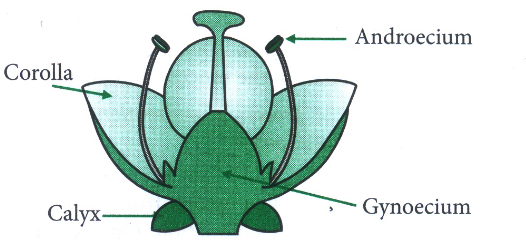
5.
(a) Concentrated sulphuric acid is called the king of chemicals as it is a very strong acid and is highly corrosive.
(b) The three chemical reactions that take place during the conversion of sulfur dioxide to sulphuric acid in the 'Contact Process' are given below.
Step I: Sulphur dioxide is mixed with air and passed over vanadiumpent (V) oxide catalyst heated to \(450^oC\) to form sulphur trioxide.
\(\underset{Sulphur\ dioxide}{2SO_{2(g)}}+\underset{Oxygen}{O_{2(g)}}\underset{\rightleftharpoons }{V_2O_5}\underset{Sulphur\ trioxide}{2SO_{3(g)}}+Heat\)
Step II : Sulphur trioxide is dissolved in concentrated sulphuric acid to form a thick fuming liquid called oleum.
\(\underset{Sulphuric\ acid}{H_2SO_4(l)}+\underset{Sulphur\ trioxide}{SO_{3(g)}}\begin{matrix} V_2O_5 \\ \rightleftharpoons \\ \end{matrix}\underset{Oleum}{H_2S_2O_{7(l)}}\)
Step III: Oleum is diluted with a calculated quantity of water to obtain sulphuric acid.
\(H_2S_2O_{7(l)}+\underset{Water}{H_2O_{(l)}}\rightarrow\underset{Sulphuric\ acid}{2H_2SO_{4(aq)}}\)
(c) If water is added to sulphuric acid then a large amount of heat is evolved. This changes water to steam, which can splash the acid. Hence, it is dangerous.
6.
Hydrogen gas is usually liberated when an acid reacts with metal.
e.g. Zn(s) + H2SO4 (aq) \(\rightarrow\) ZnSO4(aq) + H2 \(\uparrow\)
Test for H2 gas Testing of H2 gas presence can be done by passing the gas through soap solution and then bringing a burning splinter near the soap bubble filled with the gas. If the gas burns with a pop sound, it confirms hydrogen.
7.
(c)
4\(\Omega \)
8.
(a)
1: 2
9.
(c)
30°
10.
(a)
Mitotic cell division
11.
(c)
CH3COONa
12.
(c)
1:4
13.
(c)
Concave, plane and concave
14.
(b)
- 20 cm
15.
(a)
both concave
16.
(b)
stem, roots, and flower
17.
(a)
gametes, zygote, embryo, seedling
18.
(c)
anther and ovary
19.
(c)
Vas deferens
20.
(d)
nature of the material
21.
(b)
Scalar quantity
22.
(a)
\(H_3O^++CH^-\)
23.
(d)
weak acid and strong base
24.
(d)
16 ml
25.
Given: Pl = 60 W, Vl = 240 V, R = ?, P2 = ?, V2 = 192 V, I1 = ?
Using, \({ P }=\overset { { V }^{ 2 } }{ \underset { R }{ \_ \_ } } \)
We get \(R=\overset { { V }_{ 1 }^{ 2 } }{ \underset { { P }_{ 2 } }{ \_ \_ } } =\overset { (240)^{ 2 } }{ \underset { 60 }{ \_ \_ \_ } } =960\Omega \)
Again \({ P }_{ 2 }=\overset { { V }_{ 2 }^{ 2 } }{ \underset { R }{ \_ \_ } } =\overset { 192*192 }{ \underset { 960 }{ \_ \_ \_ } } =38.4W\)
Current drawn by bulb at 192 V is
I = \(\overset { V }{ \underset { R }{ \_ \_ } } =\overset { 192 }{ \underset { 960 }{ \_ \_ \_ } } \) = 0.2A
26.
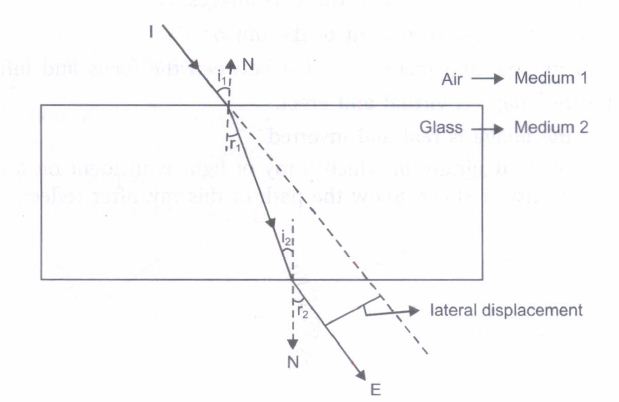
Incident ray I enters the glass slab forms an angle of incidence 'i'. Its bends towards the normal and forms an angle of refraction 'r'. The emergent ray is parallel to the incident ray.
27.
Diverging lens / concave lens
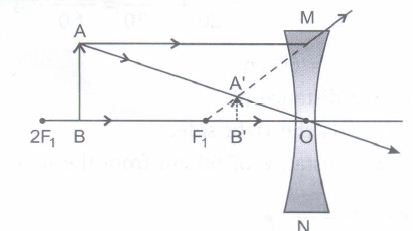
Focal length = -20 cm (lens is concave, hence f is -ve)
Power = P = 1/f = 100/ -20 cm = -5D.
28.
(a) (i) Involvement of two different individuals
(ii) Creation of new combination of variants
(b) (i) Pollen/pollen grain
(ii) By pollination/agents of pollination
(iii) It (pollen tube) helps male gamete to reach egg (ovule)
(iv) Converts into embryo.
29.
Chemical formula - CaOCI2
Chemical equation - Ca(OH)2 + CI2 ⟶ CaOCI2 + H2O
Uses:
(i) For bleaching cotton and linen in textile industry
(ii) As an oxidising agent in a chemical industry. Y,
(iii) For disinfecting water.
30.
Differences between binary fission and multiple fission are given below
| Binary Fission | Multiple Fission |
| The parent organism splits to form two new organisms. | The parent organism splits to form many new organisms at the same time. |
| It takes place during favourable environmental conditions. | It takes place during unfavourable environmental Conditions |
| It takes place in organisms like Amoeba, Leishmania, etc. | It takes place in organisms like Plasmodium. |
31.
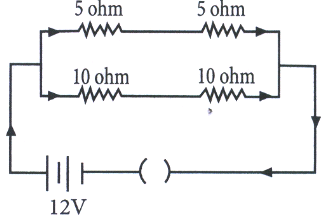
(i) The 5 Ω resistors are connected in series. Therefore, their effective resistance = (5 + 5) = 10 Ω
The 10 Ω resistors are connected in series. Therefore, their effective resistance = (10 + 10) = 20 Ω
Now these 10 Ω equivalent and 20 Ω equivalent are connected in parallel. Therefore, the equivalent resistance (Req) will be:
\(\frac { 1 }{ { R }_{ eq } } =\frac { 1 }{ { R }_{ 1 } } +\frac { 1 }{ { R }_{ 2 } } \)
\(\frac { 1 }{ { R }_{ eq } } =\frac { 1 }{ 10 } +\frac { 1 }{ 20 } \)
\(\frac { 1 }{ { R }_{ eq } } =\frac { 2+1 }{ 20 }
\)
\(\frac { 1 }{ { R }_{ eq } } =\frac { 20 }{ 3 } =6.76\Omega \)
(ii) Total Current = Total voltage / Total equivalent resistor
=12 / 6.67
= 1.8 A.
32.
(a) Following is the relation between hydrogen ion concentration of an aqueous solution and its pH.
(b) If the pH of the solution decreases from 3 to 2, then
\({pH_1\over pH_2}={-log[H^+]\over -log[H^+]_2}\)
\(\therefore {-log[H^+]_1\over -log [H^+]_2}={3\over 2}\)
\(\therefore {[H^+]_1\over [H^+]_2}={10^{-3}\over 10^{-2}}\)
or, \([H^+]_2=10[H^+]_1\)
Hence, hydrogen ion concentration will increase 10 times.
33.
Distilled water does not contain any ions and have no electrolytes. Hence, it does not conduct electricity. But in rain water, a small amount of electrolyte is present in the form of acids. These acids are produced due to dissolution of acidic oxides (e.g. SO2, NO2) in rain water and make it a better conductor of electricity.
34.
NaOH dissociates into sodium and hydroxyl ions while water dissociates into H+ and OH- ions. Hence, the solution does contain H+ ions. H+ ions are less than OH- ions.
35.
Given
\(n_g={3\over 2},\ \ \ \ n_w={4\over 3}\)
Speed of light in glass=2 x 10⁸ m/s
Speed of light water = v = ?
\(n_g={Speed\ of\ light\ in\ air\over Speed\ of\ light\ in\ glass}\)
\(\Rightarrow\ \ {3\over2}={Speed\ of\ light\ in\ air\over 2\times10^8\ m/s}\)
Speed of light in air=\({3\over 2}\times2\times10^8=3\times10^8\ m/s\)
\(n_w={Speed\ of\ light\ in\ air\over Speed\ of\ light\ in\ water}\)
\(\Rightarrow\ \ {4\over 3}={3\times10^8\ m/s\over V}\)
\(3\times10^8\times{3\over4}=v\)
⇒ v=2.25 x 10⁸ m/s
36.
We know that \(n=\frac { c }{ v } \), where 'c' is velocity of light in vaccum and 'v' is the velocity of the light in the medium. If v1 is velocity of light in a medium of refractive index n1 and v2 is velocity of light in another medium of refractive index n2, then
\({ n }_{ 1 }=\frac { c }{ { v }_{ 1 } } \quad and\quad { n }_{ 2 }=\frac { c }{ { v }_{ 2 } } \\ ^{ 1 }{ n }_{ 2 }=\frac { { n }_{ 2 } }{ { n }_{ 1 } } =\frac { { c/v }_{ 2 } }{ { c/v }_{ 1 } } =\frac { { v }_{ 1 } }{ { v }_{ 2 } } \)
37.
Rhizopus reproduces b spore formation. Conditions favourable for spore formation are:
(i) Cool place,
(ii) Moist place and
(iii) Dark place.
38.
Differences between pollination and fertilisation are
| Pollination | Fertilisation |
| The transfer of pollen grains from anther to the stigma of a flower is called pollination. | The fusion of male and female gamete to form zygote is called fertilisaton. |
| It involves only the male gamete (pollen grain). | It involves both male and female gamete. |
39.
P = 120 W
t = 20 minutes E = P\(\times\)t
E = ? = 120 \(\times\) 20 \(\times\) 60 = 120 \(\times\) 1200
E = 144 \(\times\) 103 J
40.
Electric cell or battery is a device that helps to maintain a potential difference across a conductor.
41.
pH will decrease from 6 because during curd formation, lactic acid is produced which makes it acidic. When milk changes into curd, its pH changes and becomes less than 6.
42.
(i) (b): The electrical wire should have low resistance.
(ii) (b): More is the temperature, more will be the resistance. The resistance of A is more, so temperature of A is more.
(iii) (c): \(\begin{equation}
R_{1}=\rho \frac{L}{A}, R_{2}=\rho \frac{2 L}{A / 2}
\end{equation}\)
(iv) (a): In summers, temperature is more, so resistance is more.
(v) (a): \(\begin{equation}
R^{\prime}=\frac{R}{5}=\frac{20}{5}=4 \Omega
\end{equation}\)
43.
(i) (b): Plant Y is a dioecious plant with only male flowers. As such flowers lack carpel, fruit formation cannot take place in them.
(ii) (c): X could be any monoecious bisexual plant,Y could be a dioecious male plant and Z could be a monoecious plant with separate male and female flowers.
(iii) (d): Plants X and Z have both types of sex organs present in same flower and different flowers on the same plant respectively. Plant X can be self or cross pollinated. Plant Z could undergo geitonogamy (a type of self pollination) or cross pollination.
(iv) (b): When all the four whorls of a flower are present, it is called complete flower. A bisexual flower is generally complete as it has sepals, petals, stamen and pistil.
(v) (d): Fertilisation takes place inside ovary i.e., female reproductive organ which is present inside female flowers present in female plant.
44.
(i) (a): The compound of sodium that is a constituent of baking powder and is used in antacids, is sodium hydrogen carbonate (NaHC03).
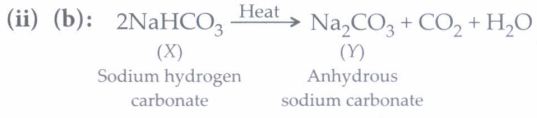
\(\text { (iii) }(\mathrm{a}): \mathrm{Na}_{2} \mathrm{CO}_{3}+2 \mathrm{H}_{2} \mathrm{O} \ \ \longrightarrow 2 \mathrm{NaOH}+ \mathrm{H}_{2} \mathrm{CO}_{3}\)
Strong base (Z)Weak acid
NaOH ionises completely to give a large amount of OH- ions whereas H2CO3 ionises partially to give a small amount ofH+ ions. Hence, the solution is overall alkaline.
(iv) (b): Z is carbonic acid, a weak acid formed when Na2CO3 is dissolved in water.
(v) (d)
45.
(d): The size of the image does not affect the nature of the image except that a bigger image as it gathers more light rays due to wider aperture.
46.
(a) Both A and R are true, and R is correct explanation of the assertion.

10th Standard CBSE Syllabus & Materials
10th Standard CBSE
CBSE 10th Social Science PS - Federalism - New Model Questions Papers Study Material - QB365 Set A
NEW10th Standard CBSE
CBSE 10th Social Science PS - Power Sharing - New Model Questions Papers Study Material - QB365 Set A
NEW10th Standard CBSE
CBSE 10th Social Science GEO - Manufacturing Industries - New Model Questions Papers Study Material - QB365 Set A
NEW10th Standard CBSE
CBSE 10th Social Science GEO - Minerals and Energy Resources - New Model Questions Papers Study Material - QB365 Set A



NCERT Books

Syllabus

Exam Pattern

Sample Question Papers

Previous year Question Papers

Important Notes

MCQ Practice test

NCERT Exemplers

Case study Questions

Image Based Questions

Passage based Questions

HOT Questions

Value Based Questions

Model Questions Papers
NCERT ( Book Back ) Questions

Assertion and Reason
Important Questions And Answers

CBSE 10th Standard CBSE Subjects
CBSE Standards



