
 100% FREE ACCESS
10th Standard CBSE Syllabus & Materials
10th Standard CBSE
CBSE 10th Social Science ECO - Globalisation and the Indian Economy - New Model Questions Papers Study Material - QB365 Set A
NEW10th Standard CBSE
CBSE 10th Social Science ECO - Money and Credit - New Model Questions Papers Study Material - QB365 Set A
NEW10th Standard CBSE
CBSE 10th Social Science ECO - Sectors of the Indian Economy - New Model Questions Papers Study Material - QB365 Set A
NEW10th Standard CBSE
CBSE 10th Social Science ECO - Development - New Model Questions Papers Study Material - QB365 Set A
NEW10th Standard CBSE
CBSE 10th Social Science PS - Outcomes of Democracy - New Model Questions Papers Study Material - QB365 Set A
NEW10th Standard CBSE
CBSE 10th Social Science PS - Gender, Religion and Caste - New Model Questions Papers Study Material - QB365 Set A

Published on: 26/10/2025
Download CBSE Class 10th Standard CBSE Science question papers, sample papers, important questions, and previous year solved papers in PDF format. Get free study materials, NCERT solutions, and exam preparation resources for Class 10th Standard CBSE Science
Questions + Answers key
Take MCQ Science Test
1.
Refer to the given figure and answer the following questions.
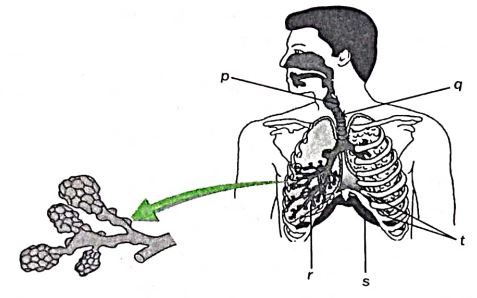
Which of these parts
I. are the actual sites of gaseous exchange?
II. Is the common passage for both air and food?
III. Is provided with incomplete cartilaginous rings?
IV. relaxes and gets back to its original shape during expiration?
V. moves upwards and outwards during inspiration?
| I | II | III | IV | V |
| s | p | q | r | t |
| I | II | III | IV | V |
| r | p | q | s | t |
| I | II | III | IV | V |
| t | q | r | s | p |
| I | II | III | IV | V |
| p | q | r | s | t |
2.
Two thin lenses of power 3D and -2D are placed in contact, then power and focal length of the lens combination is
+2D, +100 cm
+1D, +100 cm
+5D, +20 cm
+1D, -100 cm
3.
An element 'X' reacts with O2 to give a compound with a high melting point. This compound is also soluble in water. The element 'X' is likely to be
iron
calcium
carbon
silicon
4.
Given below is the balanced chemical equation for the thermal decomposition of lead nitrate.
\(2 \mathrm{~Pb}\left(\mathrm{NO}_3\right)_2 \longrightarrow 2 \mathrm{PbO}+4 \mathrm{NO}_2+\mathrm{O}_2\)
Which of the following information does the coefficients of PbO and NO2 in the equation (2 and 4 respectively) tell us?
The ratio of the number of molecules produced of the two substances.
The ratio of the number of atoms in the two substances.
The ratio of the mass produced of the two substances.
The ratio of the densities of the two substances.
5.
When aqueous solutions of potassium iodide and lead nitrate are mixed, an insoluble substance separates out. The chemical equation for the reaction involved is
KI + PbNO3 \(\rightarrow\) PbI + KNO3
2KI + Pb(NO3)2 \(\rightarrow\) PbI2 + 2KNO3
KI + Pb(NO3)2 \(\rightarrow\) PbI + KNO3
KI + PbNO3 \(\rightarrow\) PbI2 + KNO3
6.
Two metallic wires A and B are connected in parallel. Wire A has length 'l' and radius 'r' and wire B has a length '2l' and radius '2r'. Then the ratio of total resistance of parallel combination and the resistance of wire A is
1:2
1:3
1:4
1:5
7.
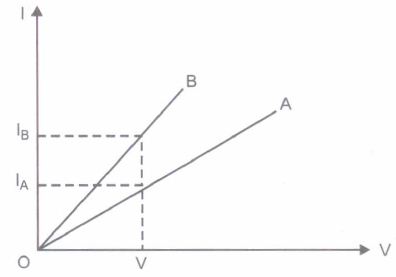
Graphs between electric current and potential difference across two conductors A and B are shown in the figure. Which of the following conductor has more resistance?
B
A
Both have equal resistance
None of these
8.
The radius of curvature and focal length of a concave mirror are
positive
negative
both
none of these
9.
Identify the type of cell division taking
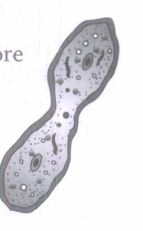
Longitudinal cell division taking place
Transversal cell division in Paramecium
Longitudinal cell division in Paramecium
Transversal cell division in Amoeba
10.
Auxin, in tendrils is synthesized at
Shoot tip
Leaves
Root tip
Stem
11.
Closing and opening of pores is a function of
Stomata
Chlorophyll
Chloroplast
Guard cells
12.
The bluish colour of water in deep sea is due to
the presence of algae and other plants found in water
reflection of sky in water
scattering of light
absorption of light by the sea
13.
An electrolytic cell consists of
(i) Positively charged cathode
(ii) Negatively charged anode
(iii) Positively charged anode
(iv) Negatively charged cathode
(i) and (ii)
(iii) and (iv)
(i) and (iii)
(ii) and (iv)
14.
To protect tooth decay we are advised to brush our tech regularly. The nature of the tooth paste commonly used is
acidic
neutral
basic
corrosive
15.
Draw a schematic diagram of an' electric circuit consisting of a battery of two cells each of 1.5 V, 5 \(\Omega \), 10 \(\Omega \) and 15 \(\Omega \) resistor and a plug key, all connected in series.
16.
How is power related to current and voltage?
17.
(i) How will you infer with the help of an experiment that the same current flows through every part of the circuit containing three resistors R1,R2 and R3 in series connected to a battery of V volts?
(ii) Study the following circuit and find out the (a) current in 12Ω resistor.
(b) difference in the reading of A1 and A2 if any
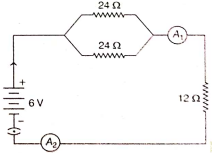 2019
2019
18.
Draw a neat labelled diagram of human eye and explain the working of each part of it.
19.
(a) What are plant hormones? Give one example each of a plant hormone that (i) promotes growth (ii) inhibits growth
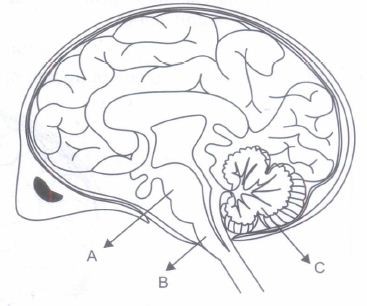
(b) Names the parts labelled A, Band C in the diagram given below. Write one function of each part.
20.
(a) Explain why copper is used to make taps, hot water tanks and not any other metal?
(b) What will happen if iron nails ate kept in a solution containing copper sulphate?
(c) Write the chemical equations for the following and balance it.
(i) Ca + H2O \(\longrightarrow \)
(ii) AI + HCl \(\longrightarrow \)
(iii) Fe + H2O \(\longrightarrow \)
21.
(a) Identify the acid and the base whose combination forms the common salt that you use in your food. Write its formula and chemical name of this salt. Name the source from where it is obtained.
(b) What is rock salt? Mention its colour and the reason due to which it has this colour.
(c) What happens when electricity is passed through brine? Write the chemical equation for it.
22.
A student focussed the image of a candle flame on a white screen using a convex lens. He noted down the position of the candle screen and the lens as under
Position of candle = 12.0 cm
Position of convex lens = 50.0 cm
Position of the screen = 88.0 cm
(a) What is the focal length of the convex lens?
(b) Where will the image be formed if he shifts the candle towards the lens at a position of 31.0 cm?
(c) What will be the nature of the image formed if he further shifts the candle towards the lens?
(d) Draw a ray diagram to show the formation of the image in case c) as said above.
23.
State the events occurring during the process of photosynthesis. ls it essential that these steps take place one after the other immediately?
24.
(i) List two constituents of Central Nervous System (CNS). How are these components protected from injuries?
(ii) Write two limitations of the use of electrical impulses.
25.
What happens to the Image distance in the normal human eye when we decrease the distance of an object, say 10 m to 1. m? Justify your answer.
26.
If the speed of light in water is 2.25 x 10⁸ m/s and the speed in vacuum is 3 x 10⁸m/s. Calculate the refractive index of water.
27.
(a) Draw a diagram showing longitudinal section of a flower and label on it:
stigma, ovary, anther, filament.
(b) How is the process of pollination different from fertilisation?
28.
(a) Show on a diagram the transfer of electrons between the atoms in the formation of MgO.
(b) Name the solvent in which ionic compounds are generally soluble.
(c) Why are aqueous solutions of ionic compounds able to conduct electricity?
29.
Write the chemical equation of the reaction with an example each in which the following change has taken place:
(i) Change in colour
(ii)Change in temperature
(iii) Formation of precipitate.
30.
A liquid has a pH less than 7 which represent all acidic solution:
(i) State the nature of the solution, if its pH increases from 7 to 14.
(ii) Mention the ion whose concentration increases with the increase in pH value.
(iii) Suggest a method that is generally used for measuring the pH value.
31.
Assertion: Plants show two different types of movement - one dependent on growth and the other independent of growth.
Reason: The first one is directional movement and the other one is non directional movement.
Codes
(a) If both assertion and reason are true and the reason is correct explanation of assertion.
(b) If both assertion and reason are true but reason is not a correct explanation of assertion.
(c) If assertion is true and reason is false.
(d) If both assertion and reason are false.
32.
Assertion: The colour of litmus solution is purple.
Reason: The litmus solution is neutral.
Codes
(a) If both assertion and reason are true and the reason is correct explanation of assertion.
(b) If both assertion and reason are true but reason is not a correct explanation of assertion.
(c) If assertion is true and reason is false.
(d) If both assertion and reason are false
33.
On a sunny day, Krish looked at the sky through a water fountain and he was surprised to see a rainbow In the sky
(i) The location of the sun when Krish observed a rainbow was
(a) behind him
(b) in front of him
(c) overhead
(d) on his left side
(ii) The phenomena of light involved in the formation of a rainbow are
(a) reflection, refraction and dispersion
(b) refraction, dispersion and total internal reflection
(c) refraction, dispersion and scattering
(d) dispersion, scattering and total internal reflection
(iii) In the formation of a rainbow, the role of water droplets present in the water fountain is to act as a
(a) glass slab
(b) convex lens
(c) concave lens
(d) prism
(iv) While entering a water droplet, the sunlight gets
(a) refracted only
(b) reflected internally
(c) refracted and dispersed
(d) first refracted and then dispersed while coming out of the water droplet
34.
Redox reactions are those reactions in which oxidation and reduction occur Simultaneously. A redox reaction is made up of two half reactions. In the first half reaction, oxidation takes place and in second half reaction, reduction occurs. Oxidation is a process in which a substance loses electrons and in reduction, a substance gains electrons. The substance which gains electrons is reduced and acts as an oxidising agent. On the other hand, a substance which loses electrons is oxidised and acts as a reducing agent.
(i) Which of the following is a redox reaction?
| \({ (a) \ } \mathrm{CaCO}_{3} \rightarrow \mathrm{CaO}+\mathrm{CO}_{2}\) | \(\text { (b) } \mathrm{H}_{2}+\mathrm{Cl}_{2} \rightarrow 2 \mathrm{HCl}\) |
| \({ (c) \ } \mathrm{CaO}+2 \mathrm{HCl} \rightarrow \mathrm{CaCl}_{2}+\mathrm{H}_{2} \mathrm{O}\) | \(\text { (d) } \mathrm{NaOH}+\mathrm{HCl} \rightarrow \mathrm{NaCl}+\mathrm{H}_{2} \mathrm{O}\) |
(ii) Identify the reaction in which H2 02 is acting as a reducing agent.
| \(\text { (a) } \mathrm{H}_{2} \mathrm{SO}_{3}+\mathrm{H}_{2} \mathrm{O}_{2} \longrightarrow \mathrm{H}_{2} \mathrm{SO}_{4}+\mathrm{H}_{2} \mathrm{O}\) | \(\text { (b) } 2 \mathrm{Hl}+\mathrm{H}_{2} \mathrm{O}_{2} \longrightarrow 2 \mathrm{H}_{2} \mathrm{O}+\mathrm{I}_{2}\) |
| \(\text { (c) } \mathrm{Cl}_{2}+\mathrm{H}_{2} \mathrm{O}_{2} \longrightarrow 2 \mathrm{HCl}+\mathrm{O}_{2}\) | \(\text { (d) } 2 \mathrm{FeCl}_{2}+2 \mathrm{HCl}+\mathrm{H}_{2} \mathrm{O}_{2} \longrightarrow 2 \mathrm{FeCl}_{3}+2 \mathrm{H}_{2} \mathrm{O}\) |
(iii) For the following reactions, identify the one in which H2S acts as a reducing agent.
| \(\text { (a) } \mathrm{CuSO}_{4}+\mathrm{H}_{2} \mathrm{~S} \longrightarrow \mathrm{CuS}+\mathrm{H}_{2} \mathrm{SO}_{4}\) | \(\text { (b) } \mathrm{Cd}\left(\mathrm{NO}_{3}\right)_{2}+\mathrm{H}_{2} \mathrm{~S} \longrightarrow \mathrm{CdS}+2 \mathrm{HNO}_{3}\) |
| \(\text { (c) } 2 \mathrm{FeCl}_{3}+\mathrm{H}_{2} \mathrm{~S} \longrightarrow 2 \mathrm{FeCl}_{2}+2 \mathrm{HCl}+\mathrm{S}\) | (d) None of these |
(iv) For the following reaction, identify the correct statement.
\(\mathrm{ZnO}+\mathrm{CO} \longrightarrow \mathrm{Zn}+\mathrm{CO}_{2}\)
| (a) ZnO is being reduced. | (b) CO2 is being oxidised |
| (c) CO is being reduced. | (d) ZnO is being oxidised. |
(v) In the following reaction, which substance is reduced?
\(\mathrm{PbS}+4 \mathrm{H}_{2} \mathrm{O}_{2} \longrightarrow \mathrm{PbSO}_{4}+4 \mathrm{H}_{2} \mathrm{O}\)
| (a) H2O | (b) H2 O2 | (c) PbS | d) PbSO4 |
1.
(b)
| I | II | III | IV | V |
| r | p | q | s | t |
2.
(b)
+1D, +100 cm
3.
(b)
calcium
4.
(a)
The ratio of the number of molecules produced of the two substances.
5.
(b)
2KI + Pb(NO3)2 \(\rightarrow\) PbI2 + 2KNO3
6.
(a)
1:2
7.
(b)
A
8.
(b)
negative
9.
(b)
Transversal cell division in Paramecium
10.
(a)
Shoot tip
11.
(d)
Guard cells
12.
(c)
scattering of light
13.
(b)
(iii) and (iv)
14.
(c)
basic
15.
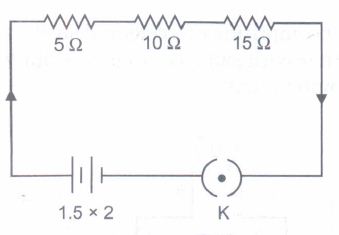
16.
Power (P) = Potential difference (V) \(\times\) Current (I)
17.
(i) The experimental set up comprise three resistors R1,R2 and R3 of three different values such as 1 Ω, 2 Ω and 3 Ω which are connected in series.
Connect them with a battery of 6 V , an ammeter and plug key, as shown in figure
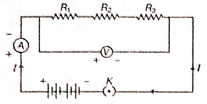
The key K is closed and the ammeter reading is recorded. Now, the position of ammeter is changed to anywhere in between the resistors again, the ammeter reading is recorded each time. It's observed that there was identical reading each time, which shows that same current flows through every part of the circuit containing three resistances in series connected to a battery.
(ii) (a) Equivalent resistance of given circuit is R, then
\(R =(24 \| 24)+12=\frac{24 \times 24}{24+24}+12\) =12+12=24 Ω
Therefore Current through $12 Ω resistor,
\(I=\frac{V}{R}=\frac{6}{24}=0.25 \mathrm{~A}\)
(b) Difference in reading of A1 and A2 = \((0.25-0.25) \mathrm{A}=0 \mathrm{~A} \)
18.
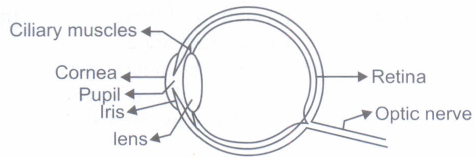
Working of Human eye
Human eye consists of various parts which helps us in seeing the objects, the function of various parts are:
(a) Cornea: It is the transparent membrane which refracts the light entering our eye.
(b) Iris: Iris controls the size of pupil.
(c) Pupil: It allows the light entering our eye to pass through it.
(d) Lens: Refracts the light of the objects at different places on retina.
(e) Ciliary muscles: Helps in changing the focal length of the lens.
(f) Retina: It is the screen of the eye on which image is formed. It consists of rods and cones .
(g) Optic nerve: It carries the electrical signals from retina to brain.
19.
(a) The chemical substances produced by plants for the coordination of plant body is called plant hormone.
(i) Promotes growth-Auxin
(ii) Inhibits growth-Abscisic acid
(b) A-Pons-It regulates respiration B-Medulla-It controls involuntary action. C-Cerebellum-It controls posture and balance of the body.
20.
(a) Copper does not react with any form of water, not even with steam. It is cheap, easily available, hence it is used to make taps and hot water tanks.
(b) On keeping iron nails in a copper sulphate solution, the blue colour of the copper sulphate fades due to displacement of copper by iron. Few deposits of red-brown metal i.e. copper is collected near the surface of iron metal.
(i) Ca + 2H2O \(\longrightarrow \) Ca(OH)2 + H2(g)
(ii) 2AI + 6HCl \(\longrightarrow \) 2AICl3 + 3H2(g)
(iii) 3Fe + 4H2O \(\longrightarrow \) Fe3O4 + 4H2(g)
21.
(a) HCl is acid and. NaOH is base whose combination forms the common salt. Its formula is NaCl (Sodium chloride). It is obtained from sea water.
(b) Rock salt is the common name for the mineral "halite". Its chemical formula is NaCl. It may be white or light blue or yellow depending upon impurities present in it .
(c) Brine is the aqueous solution of NaCl which undergoes electrolysis on passing current and forms H2 and Cl2 gases with NaOH as aqueous solution
2NaCl + 2H2O \(\overset { electrolysis }{ \longrightarrow } \) 2NaOH + H2 + Cl2
22.
Given
(a) Position of candle = 12.0 cm
Position of convex lens = 50.0 cm
Position of the screen = 88.0 cm
Therefore u = 50.0 - 12.0 = 38.0 cm
v = 88.0-50.0 = 38.0 cm
Therefore u = v
Hence both lie at 2F,
therefore F = 38/2 = 19 cm.
(b) u = 50.0-31.0 = -19 cm
f = +19 cm, v = ?
Using \(\frac { 1 }{ f } =\frac { 1 }{ u } +\frac { 1 }{ v } \)
We have \(\frac { 1 }{ 19 } =\frac { -1 }{ 19 } +\frac { 1 }{ v } \)
or v=infinity.
(c) If he further shifts the candle towards the lens the image will become virtual and erect.
(d) The ray diagram is as shown
-S.png)
23.
Photosynthesis is a process by which green plants, having chlorophyll, synthesise the simple sugar (glucose) from the simple raw materials, water and carbon dioxide using the energy of sunlight. Oxygen is released in this process.
\(\underset{\begin{array}{c} \text { Carbon } \\ \text { dioxide } \end{array}}{6 \mathrm{CO}_2}+\underset{\text { Water }}{12 \mathrm{H}_2 \mathrm{O}} \xrightarrow[\text { Chlorophyll }]{\text { Sunlight }} \underset{\text { Glucose }}{\mathrm{C}_6 \mathrm{H}_{12} \mathrm{O}_6}+6 \mathrm{H}_2 \mathrm{O}+\underset{\text { Oxygen }}{6 \mathrm{O}_2} \uparrow\)
The photosynthesis takes place in the following three steps
(i) Absorption of light energy by chlorophyll.
(ii) Conversion of light energy into chemical energy and splitting of water molecules into hydrogen and oxygen.
(iii) Reduction of carbon dioxide by hydrogen to form carbohydrate like glucose by utilising the chemical energy.
The steps do not need to take place one after the other immediately. For example, desert plants take up carbon dioxide at night and prepare intermediate which is acted upon by the energy absorbed by the chlorophyll during the day.
24.
(i) The two important constituents of Central Nervous system (CNS) are
(a) Brain
(b) Spinal cord
For protection of both these components.
(ii) Two limitation of the use of electrical impulses.
25.
When we decrease the distance of an object from 10m to 1m, normal human eye changes its focal length so as to form image on retina itself. As we know that, normal human eye has the ability to adjust focal length of its lens, called accommodation. So, image distance remains the same due to the ability of accommodation.
26.
Refractive index of water = \(\frac{Speed \ of \ light in \ 1 \ medium \ (air)}{Speed \ of \ light \ in \ 2 \ medium \ (water)}\)
nw= \(\frac{c}{v}\)
nw= \(\frac{3 \times 10^8}{2.25 \times 10^8}\)
nw= 1.33
ஃ The refractive index of water = 1.33.
27.
| pollination | fertilisation |
| 1. Transfer of pollen grain from anther to stigma of a flower. 2. It is a physical process, substance is formed. 3. Its types are self pollination and or cross pollination. |
Fusion of pollen nucleus and ovule in the |
28.

(b) Ionic compounds are soluble in water.
(c) The aqueous solutions of ionic compounds consists of ions which can move freely and conduct electricity.
29.
(i) Change in colour: Reaction between lead nitrate solution and potassium iodide solution.
Pb(NO3)2(aq) + 2KI \(\longrightarrow \) PbI2(s) + 2KNO3(aq)
In this reaction, colour changes from colourless to yellow.
(ii) Change in temperature: Action of dilute sulphuric acid on zinc.
Zn(s) + H2SO4(aq) \(\longrightarrow \) ZnSO4(aq) + H2
In this reaction, heat is evolved
(iii) Formation of precipitate : Action of barium chloride on sodium sulphate.
BaCl2(aq)+ Na2SO4(aq) \(\longrightarrow \) BaSO4(s) + 2NaCl(aq)
30.
(i) Increase in the strength of alkali. So the nature of solution will be basic.
(ii) Hydroxide ion or hydroxyl ion or OH- ion.
(iii) A paper impregnated with the universal indicator is generally used to measure the pH of a solution.
31.
(c) If assertion is true and reason is false.
32.
(a) If both assertion and reason are true and the reason is correct explanation of assertion.
33.
(i) (a) The rainbow appears opposite side of the Sun in sky.
(ii) (b) Refraction, dispersion and total internal reflection are the phenomenon involved in the formation of rainbow.
(iii) (a) Tiny water droplets act as prism in formation of rainbow.
(iv) (a) The water droplets are denser than air, therefore sunlight gets refracted and then dispersed, while coming out of the water droplet.
34.
(I) (b) : H2 is oxidised to HCI while Cl2 is reduced to HCl.
(ii) (c)
\((iii) (c): 2 \mathrm{Fe} \mathrm{Cl}_{3}+\mathrm{H}_{2} \mathrm{~S} \longrightarrow 2 \mathrm{FeCl}_{2}+2 \mathrm{HCl}+\mathrm{s}\)
H2 Sitself gets oxidised to Sand reduces FeCl3 to FeCI2
(iv) (a): ZnO is reduced to Zn and CO is oxidised to CO2
(v) (b): H2O2 is reduced to water by removal of oxygen.

10th Standard CBSE Syllabus & Materials
10th Standard CBSE
CBSE 10th Social Science PS - Federalism - New Model Questions Papers Study Material - QB365 Set A
NEW10th Standard CBSE
CBSE 10th Social Science PS - Power Sharing - New Model Questions Papers Study Material - QB365 Set A
NEW10th Standard CBSE
CBSE 10th Social Science GEO - Manufacturing Industries - New Model Questions Papers Study Material - QB365 Set A
NEW10th Standard CBSE
CBSE 10th Social Science GEO - Minerals and Energy Resources - New Model Questions Papers Study Material - QB365 Set A



NCERT Books

Syllabus

Exam Pattern

Sample Question Papers

Previous year Question Papers

Important Notes

MCQ Practice test

NCERT Exemplers

Case study Questions

Image Based Questions

Passage based Questions

HOT Questions

Value Based Questions

Model Questions Papers
NCERT ( Book Back ) Questions

Assertion and Reason
Important Questions And Answers

CBSE 10th Standard CBSE Subjects
CBSE Standards



