
 100% FREE ACCESS
10th Standard CBSE Syllabus & Materials
10th Standard CBSE
CBSE 10th Social Science ECO - Globalisation and the Indian Economy - New Model Questions Papers Study Material - QB365 Set A
NEW10th Standard CBSE
CBSE 10th Social Science ECO - Money and Credit - New Model Questions Papers Study Material - QB365 Set A
NEW10th Standard CBSE
CBSE 10th Social Science ECO - Sectors of the Indian Economy - New Model Questions Papers Study Material - QB365 Set A
NEW10th Standard CBSE
CBSE 10th Social Science ECO - Development - New Model Questions Papers Study Material - QB365 Set A
NEW10th Standard CBSE
CBSE 10th Social Science PS - Outcomes of Democracy - New Model Questions Papers Study Material - QB365 Set A
NEW10th Standard CBSE
CBSE 10th Social Science PS - Gender, Religion and Caste - New Model Questions Papers Study Material - QB365 Set A

Published on: 20/10/2025
Download CBSE Class 10th Standard CBSE Science question papers, sample papers, important questions, and previous year solved papers in PDF format. Get free study materials, NCERT solutions, and exam preparation resources for Class 10th Standard CBSE Science
Questions + Answers key
Take MCQ Science Test
1.
(i) Define isomerism. Draw all possible isomers of butane.
(ii) "A compound 'X' on combustion gives a yellow flame with lots of smoke." What inference would you draw from this statement?
(iii) State the role of alkaline KMnO4 in the reaction involving conversion of an alcohol to corresponding carboxylic acid.
2.
The table shows the electronic structures of four elements.
| Element | Electronic stucture |
| P | 2, 6 |
| Q | 2, 8, 1 |
| R | 2, 8, 7 |
| S | 2, 8, 8 |
(i) ldentify which element(s) will form covalent bonds with carbon.
(ii) "Carbon reacts with an element in the above table to form several compounds." Give suitable reason.
3.
How will an organism be benefited if it reproduces through spores?
4.
How does binary fission differ from multiple fission?
5.
What are oxidising agents?
6.
How can esters be converted into soap?
7.
What are isomers? Draw the structures of two isomers of butane, C4H10. Why can't we have isomers of first three members of alkane series?
8.
What are the functions performed by the testis in human beings?
9.
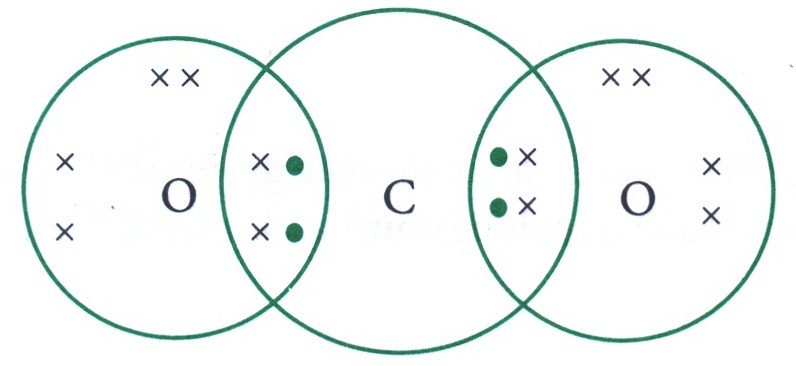
What would be the electron dot structure of carbon dioxide which has the formula CO2 ?
10.
A carbon compound 'P' on heating with excess cone. H2SO4 forms another carbon compound 'Q' which on addition of hydrogen in the presence of nickel catalyst forms a saturated carbon compound 'R'. One molecule of 'R' on combustion forms two molecules of carbon dioxide and three molecules of water. Identify P, Q and Rand write chemical equations for the reactions involved.
11.
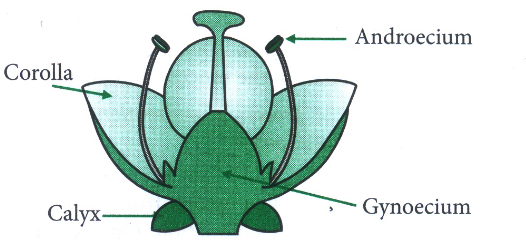
Draw a labelled diagram of the longitudinal section of a flower.
12.
An organic compound A on heating with concentrated H2SO4 forms a compound B which on addition of one mole of hydrogen in presence of Ni forms a compound C. One mole of compound C on combustion forms two moles of CO2 and 3 moles of H2O. Identify the compounds A, B and C and write the chemical equations of the reactions involved.
13.
Draw the structures for the following compounds.
(i) Ethanoic acid
(ii) Bromopentane*
(iii) Butanone
(iv) Hexanal
Are structural isomers possible for bromopentane?
14.
ldentify a group of the unsaturated hydrocarbons from the following
Propane, ethene, butyne
Ethene, propane, hexane
Cyclohexane, methane, ethane
Butyne, ethene, propyne
15.
According to IUPAC system, the correct name of the organic compound is
\(CH3-\overset { \overset {Br}{ | } }{ CH } -CH2-\overset { \overset { O }{ \parallel } }{ C } -OH\)
2-bromobutanoic acid
2-bromobutysis acid
3-bromobutanoic acid
3-bromo-2-hydroxybutan-2-one
16.
The upper and lower homologue of C2H5OH are respectively
methyl alcohol and butyl alcohol
ethyl alcohol and propyl alcohol
butyl alcohol and propyl alcohol
propyl alcohol and methyl alcohol
17.
The anther contains
sepals
ovules
carpel
pollen grains
18.
Asexual reproduction takes place through budding in
amoeba
yeast
plasmodium
leishmania
19.
Butanone is a four-carbon compound with the functional group
carboxylic acid
aldehyde
ketone
alcohol
20.
1. Wet a slice of bread, and keep it in a cool, moist and dark place.
2. Observe the surface of the slice with a magnifying glass.
3. Record your observations for a week.
21.
1) Take two test tubes with about 10 ML of hard water in each.
2) Add five drops of soap solution to one and five drops of detergent solution to the other.
3) Shake both test tubes for the same period.
4) Do both test tubes have the same amount of foam?
5) In which test tube is a curdy solid formed?
22.
1. Make a list of ten things you have used or consumed since the morning.
2. Compile this list with the lists made by your classmates and then sort the items into the adjacent Table.
3. If there are items which are made up of more than one material, put them into both the relevant columns of the table.
| Things made of metal | Things made of glass/clay | Others |
23.
As neutral atom carbon has electronic configuration K L. To gain inert gas configuration carbon can either 2, 4 donate 4 valence electrons (helium gas configuration) or gain 4 electrons (neon gas configuration), but it cannot do so. To acquire inert gas configuration carbon can only share its 4 valence electrons with other atoms forming covalent bonds. A covalent bond can be defined as a chemical bond formed between two atoms by mutual sharing of valence electrons so that each atom acquires the stable electronic configuration of the nearest noble gas. The concept of covalent bonds was given by Langmuir and Lewis to explain bonding in non-ionic compounds. The covalent bonds are of three types. If each atom contributes one electron, the covalent bond formed is called a single covalent bond and is represented by a single line (-) and if each atom contributes two electrons, the covalent bond formed is called a double bond and is represented by a double line (=) and if each atom contributes three electrons, the covalent bond formed is called a triple bond and is represented by a triple line (=).
(i) Which of the following do not contain a double bond?
I. S02
II. NH3
III. HCl
IV. 02
| (a) I and II only | (b) II and III only | (c) III and IV only | (d) I and IV only |
(ii) Which of the following contains a triple bond?
| (a) N2 | (b) O2 | (c) CO2 | (d) H2 |
(iii) The shared pair of electrons is said to constitute a _______________ bond between two hydrogen atoms.
| (a) single | (b) double | (c) triple | (d) ionic |
(iv) Which of the following molecules has all its atoms joined together by double covalent bonds?
| (a) Methane | (b) Water | (c) Carbon dioxide | (d) Nitrogen trichloride |
(v) Chlorine forms a diatomic molecule, Cl2 . The electron dot structure for this molecule is
 a.JPG) |
 b.JPG) |
 c JPG.JPG) |
 d.JPG) |
24.
Assertion: Graphite is a good conductor of electricity.
Reason: It has one free valence electron.
Codes
(a) Both A and R are true, and R is correct explanation of the assertion.
(b) Both A and R are true, but R is not the correct explanation of the assertion.
(c) A is true, but R is false.
(d) A is false, but R is true.
1.
(ii) A compound 'X' is an unsaturated compound, because they do not undergo complete combustion. Therefore, these produces yellow flame with lots of black smoke.
(iii) Alkaline KMnO4 acts as an oxidising agent in the conversion of an alcohol to corresponding carboxylic acid.
e.g. \(\underset{\text { Alcohol }}{\mathrm{CH}_3 \mathrm{CH}_2 \mathrm{OH}}\) \(\xrightarrow[\text { Alkaline } \mathrm{KMnO}_4]{[\mathrm{O}]}\) \(\underset{\text { Carboxylic acid }}{\mathrm{CH}_3 \mathrm{COOH}}\)
2.
(i) The elements P and R will form covalent bond with carbon because both the elements accept electrons to form ionic as well as covalent bonds.
While element Q (2, 8, 1) donates one electron to form ionic compounds and element 'S' (2, 8, 8) is stable due to complete octet in valence shell. Hence, they do not form covalent bond with carbon.
(ii) Carbon reacts with an element in table to form several compounds because of
(a) Tetravalency of carbon Carbon has electronic structure of (2, 4). Thus, it has four electrons in outermost shell. It is capable of bond formation with four other elements.
(b) Catenation Due to small size, C-C bond is strong. This allow carbon to form long chain compound of different size.
3.
Spores are tiny, spherical, asexual reproductive bodies. They are covered with a hard protective wall. This enables them to survive in unfavourable conditions. They can only germinate and produce new plant under favourable conditions thereby benefitting the organism from dying out.
4.
Differences between binary fission and multiple fission are given below
| Binary Fission | Multiple Fission |
| The parent organism splits to form two new organisms. | The parent organism splits to form many new organisms at the same time. |
| It takes place during favourable environmental conditions. | It takes place during unfavourable environmental Conditions |
| It takes place in organisms like Amoeba, Leishmania, etc. | It takes place in organisms like Plasmodium. |
5.
Substances that are capable of providing oxygen to other substances are called oxidising agents. Alkaline potassium permanganate (KMnO4) or acidified potassium dichromate (K2Cr2O7) act as an oxidising agent in oxidising alcohols into acids.
6.
By saponification reaction, by adding/reacting ester with NaOH
7.
Those compounds, which have same molecular formula but different structural formulae are called isomers.
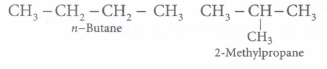
In first three members of alkane series, branching is not possible. Therefore, we cannot have isomers.
8.
Functions of testes in human beings include:
(i) production of male sex cells-sperms.
(ii) production of male sex hormone-testosterone.
9.
10.
P = Ethanol / C2H5OH
Q = Ethene / CH2= CH2
R = Ethane / C2H6
C2H5OH \(\overset { conc.H_2SO_4 }{ \underset { 443K }{ \longrightarrow } } \) CH2=CH2 + H2O
Ethanol
CH2=CH2\(\overset { nickel \ catalyst }{ \underset { H }{ \longrightarrow } } \) CH3-CH3
2CH3-CH3+7O2\(\longrightarrow \)4CO2+6H2O
11.
12.
i) Since compound C on combustion forms two moles of CO2 and 3 moles of H2 O, therefore compound C must contain two carbon atoms and six hydrogen atmos. Thus compound C must be C2H6 (ethane)
\(\underset{Ethene(C)}{2C_2H_6}+\underset{Oxygen}{7O_2}\xrightarrow{Heat}\underset{Carbon\ dioxide}{4CO_2}+\underset{Water}{6H_2O}\)
ii) Since compound (C) is obtained by addition of 1 mole of H2 in presence of Ni to compound (B), therefore (B) must be ethane.
\(\underset{Ethene(B)}{CH2}=CH_2+H_2\xrightarrow{Ni/Heat}\underset{Ethene(C)}{CH_3-CH_3}\)
iii) Since compound (B) is formed by heating compound (A) with cone. H2SO4 therefore compound (A) must be ethanol.
\(\underset{Ethanol(A)}{CH_3CH_2OH}\xrightarrow{Conc. H_2SO_4,443K}CH_2=CH_2+\underset{Ethene(B)}{H_2O}\)
13.
-s.jpg)
-s.png)
There are many structural isomers possible for bromopentane. Among them, the structures of three isomers are given.
-s.jpg)
-s.jpg)
14.
(d)
Butyne, ethene, propyne
15.
(c)
3-bromobutanoic acid
16.
(d)
propyl alcohol and methyl alcohol
17.
(d)
pollen grains
18.
(b)
yeast
19.
(c)
ketone
20.
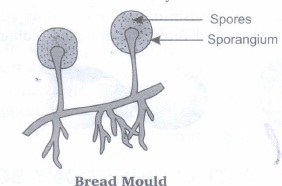
Wet a slice of bread, and keep it in a cool; moist and dark place. Observe the surface of the slice with a magnifying glass. Record your observations for a week.
Observation: On bread grows fungi called bread mould, initially it is white in colour then it becomes brown to black on maturity.
21.
Take two test tubes with 10 ML of hard water in each. Add five drops of soap solution to one and five drops of detergent solution to the other. Shake both the test tubes for the same period.
(i) Solution of hard water and soap forms curdy white precipitate.
(ii) The hard water and detergent forms foam
22.
| Things | Metals | Glass/Clay | Other materials |
| Fan | Aluminium/Iron | _ | _ |
| Bed | _ | _ | Wood (C) |
| Toothbrush | Plastic, nylon (C) | ||
| Spoon | Stainless steel | ||
| Tumbler | Glass | ||
| Clothes | Cotton (C) | ||
| Pencil | Graphite, Wood (C) | ||
| Pen | Steel | Plastic (C) | |
| Books | Paper-obtained from wood (C) | ||
| Bread | Wheat (C) |
(C) ⟶ indicates carbon
Most substances contain carbon in it
| a)\(\left.\begin{array}{ll} & \mathrm{CH}_{3} \mathrm{OH} \\ & \mathrm{C}_{2} \mathrm{H}_{5} \mathrm{OH} \end{array}\right\} \text { differ by } \mathrm{CH}_{2}\) | |
| Mass of CH3OH 12 + (1 x 3) + 16 + 1 = 32 u |
Mass of C2H5OH (12 x 2) + (1 x 5) + 16 + 1 = 46 u Difference ⟶ 46 - 32 = 14 u |
| b) \(\begin{aligned} &\left.\begin{array}{l} \mathrm{C}_{2} \mathrm{H}_{5} \mathrm{OH} \\ \mathrm{C}_{3} \mathrm{H}_{7} \mathrm{OH} \end{array}\right\} &\text { differ by } \mathrm{CH}_{2} \end{aligned}\) | |
| Mass of C2H5OH (12 x 2 ) + (1 x 5) + 16 + 1 = 46 u |
Mass of C3H7OH (12 x 3) + (1 x 7) + 16 + 1 = 60 u Difference ⟶ 60 - 46 = 14 u |
| c) \(\left.\begin{array}{l} \mathrm{C}_{3} \mathrm{H}_{7} \mathrm{OH} \\ \mathrm{C}_{4} \mathrm{H}_{9} \mathrm{OH} \end{array}\right\} \quad \text { differ by } \mathrm{CH}_{2}\) | |
| Mass of C3H7OH (12 x 3) + (1 x 7) + 16 + 1 = 60 u |
Mass of C4H9OH (12 x 4) + (1 x 9) + 16 + 1 = 74 u Difference ⟶774 - 60 = 14 u |
All 3 groups given above show a similarity⟶Two consecutive members of homologous series differ by CH2 group and mass 14 u.
CH3OH, C2HsOH, C3H7OH, C4H9OH form a homologous series.
| Chloro alkane | Alcohol | Aldehyde | Ketone | Carboxylic acid |
| CH3Cl | CH3-OH | HCHO |
23.
(i) (b): Both NH3 and HCI have single bonds.
(ii) (a): N=N
(iii) (a)
(iv) (c): O=C=O
(v) (c): In chlorine molecule, both chlorine atoms contribute one electron and thus share single electron pair to form single covalent bond. As shared pair is shared by both atoms, they acquire inert gas configuration of argon atom in valence shell.

24.
(a) Both A and R are true, and R is correct explanation of the assertion.

10th Standard CBSE Syllabus & Materials
10th Standard CBSE
CBSE 10th Social Science PS - Federalism - New Model Questions Papers Study Material - QB365 Set A
NEW10th Standard CBSE
CBSE 10th Social Science PS - Power Sharing - New Model Questions Papers Study Material - QB365 Set A
NEW10th Standard CBSE
CBSE 10th Social Science GEO - Manufacturing Industries - New Model Questions Papers Study Material - QB365 Set A
NEW10th Standard CBSE
CBSE 10th Social Science GEO - Minerals and Energy Resources - New Model Questions Papers Study Material - QB365 Set A



NCERT Books

Syllabus

Exam Pattern

Sample Question Papers

Previous year Question Papers

Important Notes

MCQ Practice test

NCERT Exemplers

Case study Questions

Image Based Questions

Passage based Questions

HOT Questions

Value Based Questions

Model Questions Papers
NCERT ( Book Back ) Questions

Assertion and Reason
Important Questions And Answers

CBSE 10th Standard CBSE Subjects
CBSE Standards



