
 100% FREE ACCESS
10th Standard CBSE Syllabus & Materials
10th Standard CBSE
CBSE 10th Social Science ECO - Globalisation and the Indian Economy - New Model Questions Papers Study Material - QB365 Set A
NEW10th Standard CBSE
CBSE 10th Social Science ECO - Money and Credit - New Model Questions Papers Study Material - QB365 Set A
NEW10th Standard CBSE
CBSE 10th Social Science ECO - Sectors of the Indian Economy - New Model Questions Papers Study Material - QB365 Set A
NEW10th Standard CBSE
CBSE 10th Social Science ECO - Development - New Model Questions Papers Study Material - QB365 Set A
NEW10th Standard CBSE
CBSE 10th Social Science PS - Outcomes of Democracy - New Model Questions Papers Study Material - QB365 Set A
NEW10th Standard CBSE
CBSE 10th Social Science PS - Gender, Religion and Caste - New Model Questions Papers Study Material - QB365 Set A

Published on: 22/10/2025
Download CBSE Class 10th Standard CBSE Science question papers, sample papers, important questions, and previous year solved papers in PDF format. Get free study materials, NCERT solutions, and exam preparation resources for Class 10th Standard CBSE Science
Questions + Answers key
Take MCQ Science Test
1.
(i) Define a double displacement reaction.
(ii) Write the chemical equation of a double displacement reaction which is also a
(a) Neutralisation reaction
(b) Precipitation reaction. Give justification of your answer.
2.
Equal length of magnesium ribbon are taken in two test tubes W. and 'B', H2SO4 is added to test tube 'A '. and H2CO3 in the test tube 'B' in equal amounts:
(a) Identify the test tube showing vigorous reaction.
(b) Give reason to support your answer.
(c) Name the gas liberated in both the tubes. How will you prove its liberation?
(d) Write chemical 'equations for both reactions.
(e) Out of the two acids taken above
(i) which one will have lower pH value.
(ii) lower H+ concentration respectively.
3.
What happens when:
(i) Dilute hydrochloric acid is added to solid sodium carbonate.
(ii) Quicklime is treated with water.
(iii) Sodium chloride solution is added to lead nitrate solution.
Also write the chemical equation in each case.
4.
Name the three products of 'chlor-alkali' process. Write one commercially or industrially important material each that can be prepared from each of these products
5.
(i) Write the chemical formula of each of the following:
(a) Plaster of Paris
(b) Gypsum.
(ii) How can plaster of paris be converted into gypsum?
(iii) List anyone use of plaster of paris.
6.
In the following schematic diagram for the preparation of hydrogen gas as shown in the figure, what would happen if following changes are made?
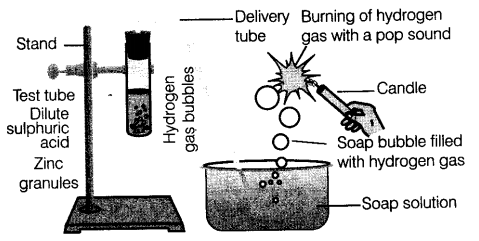
(i) In place of zinc granules, the same amount of zinc dust is taken in the test-tube.
(ii) Instead of dilute sulphuric acid, dilute hydrochloric acid is taken.
(iii) Sodium hydroxide is taken in place of dilute sulphuric acid and the test-tube is heated.
7.
Explain the action of dilute hydrochloric acid on the following with chemical equation:
(i) magnesium ribbon
(ii) sodium hydroxide
(iii) crushed egg shells
8.
(i) A white powder is an active ingredient of antacids and is used in preparation of baking powder. Name the compound and explain that how it is manufactured. Give chemical equation.
(ii) Write a chemical equation to show the effect of heat on this compound.
9.
A sanitary worker uses a white chemical having strong smell of chlorine gas to disinfect the water tank.
(i) Identify the chemical compound, write its chemical formula.
(ii) Give chemical equation for its preparation.
(iii) Write its two uses other than disinfection.
10.
A liquid has a pH less than 7 which represent all acidic solution:
(i) State the nature of the solution, if its pH increases from 7 to 14.
(ii) Mention the ion whose concentration increases with the increase in pH value.
(iii) Suggest a method that is generally used for measuring the pH value.
1.
(i) Double displacement is a chemical reaction in which the elements are exchanged between the two compounds. Basically, in this reaction the cations and anions of the two compounds will switch the two places
(ii) (a)
| NaOH(aq) + HCl(aq) \(\rightarrow\) NaCl (aq) + H2O (l) | |||
| Sodium hydroxide |
Hydrochloric acid |
Sodium Chloride |
Water |
A neutralisation reaction is a chemical reaction which is between the acid and base for the production of salt and water. It is a type of double displacement reaction.
(b)
| AgNO3 (aq) + NaCl (aq) \(\rightarrow\) AgCl (s) + NaNO3 (aq) | |||
| Silver nitrate | Sodium chloride | Silver Chloride | Sodium nitrate |
In this precipitation reaction, silver chloride is formed as a precipitate. It is also a double displacement reaction as both compounds exchanges their elements with each other to form two new products.
2.
(a) A will show vigorous reaction.
(b) It is because H2SO4 is strong acid.
(c) Hydrogen gas will be formed. Bring a burning splinter near the gas. It will burn with 'pop' sound. It shows gas liberated is hydrogen
(d) Mg + H2SO4 \(\longrightarrow \) MgSO4 + H2
Mg + H2CO3 \(\longrightarrow \) MgCO3 + H2
(e) 'A '(H2SO4) will have lower pH.
'B' (H2CO3) will have lower concentration of H+
3.
(i) Na2CO3(s) + 2HCl(aq) \(\longrightarrow \) 2NaCI(aq) + H2O(I) + CO2(g)
(ii) CaO(s) + H2O(I) \(\longrightarrow \)Ca(OH)2(aq) + Heat
(iii) Pb(NO3)2(aq) + NaCl(aq) \(\longrightarrow \) PbCI2(s) + 2NaNO3(aq)
4.
The three products are:
Sodium hydroxide (NaOH), Chlorine (CI2) and Hydrogen (H2).
NaOH - for soaps and detergents and paper making or artificial fibers.
Cl2- PVC, pesticides, CFCs.
H2- fuels, margarine, NH3 for fertilizers.
5.
(i) (a) CaSO4·\(1\over 2\) H2O
(b) CaSO4·2H2O
(ii) By mixing with water
\(CaSO_4.{1\over 2}H_2O+1{1\over 2}{H_2O}\longrightarrow CaSO_4.2H_20\)
(ill) For making toys, for supporting fractured bones.
6.
(i) Hydrogen gas will evolve with greater speed.
(ii) The almost same amount of gas is evolved.
(iii) If sodium hydroxide is taken, hydrogen gas will be evolved only on heating.
Zn + 2NaOH\(\rightarrow\)Na2ZnO2+H2
7.
(i) Mg + 2HCl\(\rightarrow\)MgCl2+H2
Hydrogen gas is produced
(ii) HCl + NaOH\(\rightarrow\) NaCl+H2O
Neutralisation reaction
(iii) 2HCI(aq)+ CaCO3(aq)\(\rightarrow\)CaCl2(aq)+H2O+CO2
Calcium chloride is formed.
8.
(i) Compound is NaHCOjbaking soda/sodium hydrogen carbonate
Manufacture - NH3 + NaCI + H20 + CO2 \(\longrightarrow\) NH4C1 + NaHCO3
\((ii) 2 NaHCO_3 \xrightarrow{Heat} Na_2CO_3 + H_2 O+ CO_2\)
9.
(i) Bleaching powder - CaOCI2
(ii) C(OH)2 + Cl2➝ CaOCI2 + H2O
(iii) Two uses other than disinfection are:
(a) Paper industries (b) Chemical Industries
10.
(i) Increase in the strength of alkali. So the nature of solution will be basic.
(ii) Hydroxide ion or hydroxyl ion or OH- ion.
(iii) A paper impregnated with the universal indicator is generally used to measure the pH of a solution.

10th Standard CBSE Syllabus & Materials
10th Standard CBSE
CBSE 10th Social Science PS - Federalism - New Model Questions Papers Study Material - QB365 Set A
NEW10th Standard CBSE
CBSE 10th Social Science PS - Power Sharing - New Model Questions Papers Study Material - QB365 Set A
NEW10th Standard CBSE
CBSE 10th Social Science GEO - Manufacturing Industries - New Model Questions Papers Study Material - QB365 Set A
NEW10th Standard CBSE
CBSE 10th Social Science GEO - Minerals and Energy Resources - New Model Questions Papers Study Material - QB365 Set A



NCERT Books

Syllabus

Exam Pattern

Sample Question Papers

Previous year Question Papers

Important Notes

MCQ Practice test

NCERT Exemplers

Case study Questions

Image Based Questions

Passage based Questions

HOT Questions

Value Based Questions

Model Questions Papers
NCERT ( Book Back ) Questions

Assertion and Reason
Important Questions And Answers

CBSE 10th Standard CBSE Subjects
CBSE Standards



