
 100% FREE ACCESS
10th Standard CBSE Syllabus & Materials
10th Standard CBSE
CBSE 10th Social Science ECO - Globalisation and the Indian Economy - New Model Questions Papers Study Material - QB365 Set A
NEW10th Standard CBSE
CBSE 10th Social Science ECO - Money and Credit - New Model Questions Papers Study Material - QB365 Set A
NEW10th Standard CBSE
CBSE 10th Social Science ECO - Sectors of the Indian Economy - New Model Questions Papers Study Material - QB365 Set A
NEW10th Standard CBSE
CBSE 10th Social Science ECO - Development - New Model Questions Papers Study Material - QB365 Set A
NEW10th Standard CBSE
CBSE 10th Social Science PS - Outcomes of Democracy - New Model Questions Papers Study Material - QB365 Set A
NEW10th Standard CBSE
CBSE 10th Social Science PS - Gender, Religion and Caste - New Model Questions Papers Study Material - QB365 Set A

Published on: 22/10/2025
Download CBSE Class 10th Standard CBSE Science question papers, sample papers, important questions, and previous year solved papers in PDF format. Get free study materials, NCERT solutions, and exam preparation resources for Class 10th Standard CBSE Science
Questions + Answers key
Take MCQ Science Test
1.
Why are certain reagents like silver bromide stored in dark bottles in the labs?
2.
Write the balanced equation for the following reaction and identify the type of reaction in each case.
(i) Potassium bromide + Barium iodide \(\longrightarrow\) Potassium iodide + Barium bromide.
(ii) Hydrogen(g) + Chlorine(g) \(\longrightarrow\) Hydrogen chloride(g)
3.
In electrolysis of water, why is volume of gas collected over one electrode double that of gas collected over the other electrode?
4.
What do you mean by a precipitation reaction? Explain by giving examples.
5.
What is the difference between displacement and double displacement reactions? Write equations for these reactions.
6.
The decomposition of vegetable matter in to compost is an example of what type of reaction?
7.
Write the chemical equation for reactions that takes place when lead nitrate and potassium iodide solutions are mixed.
8.
What happens when quick lime is added to water?
9.
Name and state the law which is kept in mind while we balance a chemical equation.
10.
Name the type of reaction in which two or more than two reactants form a single compound.
11.
Name the gas which burns with pop sound.
12.
Give the formula for quicklime.
13.
Name the gases evolved when lead nitrate is heated.
14.
Name the chemical used in black and white photography.
15.
Name the gas evolved when zinc reacts with dil.HCl.
16.
Identify the substances that are oxidised and the substances that are reduced in the following reactions.
(i) 4Na(s) + O2(g) \(\rightarrow\) 2Na2O(s)
(ii) CuO(s) + H2(g) \(\rightarrow\) Cu(s) + H2O(l)
17.
Give an example of a double displacement reaction other than the reaction of barium chloride with sodium sulphate.
18.
Why does the colour of copper sulphate solution change when an iron nail is dipped in it?
19.
FeSO4.7H2O, green colour crystals on heating, changes colour. Why?
20.
The following diagram displays a chemical reaction.
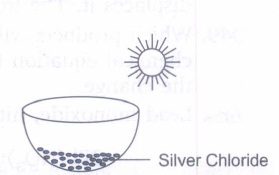
Observe carefully and answer the following questions
(a) Identify the type of chemical reaction that will take place and define it. How will the colour of the salt change?
(b) Write the chemical equation of the reaction that takes place.
(c) Mention one commercial use of this salt.
21.
2g ferrous sulphate crystals are heated in a dry boiling tube.
(i) List any two observations.
(ii) Name the type of chemical reaction taking place.
(iii) Write the chemical equation of the reaction.
22.
When a copper wire was left in silver nitrate solution for sometime, it was observed that the solution turned bluish green.
(i) Explain the observation.
(ii) Write the balanced chemical equation to represent the change taking place.
23.
Why is respiration considered an exothermic reaction? Explain
1.
Reagents/chemicals like silver bromide decompose when exposed to light. Hence, they are kept in dark bottles in labs, to prevent exposure to light and their decomposition.
2.
(i) 2KBr(aq) + BaI2(aq) ) \(\longrightarrow\)2KI(aq) + BaBr2(aq)
It is a double displacement reaction.
(ii) H2(g) + CI2(g) \(\longrightarrow\) 2HCl(g)
3.
The volume of gas collected over one electrode is double than that of the gas collected over the other electrode as the ratio of H : O in water is 2:1.
4.
The reaction which is accompanied by the formation of an insoluble solid mass (called precipitate) is known as precipitation reaction, e.g.
(i) When barium chloride solution is added to an aqueous solution of sodium sulphate, a white precipitate of barium sulphate is obtained.
BaCl2(aq) + Na2SO4(aq) \(\rightarrow\) BaSO4(s) \(\downarrow\) + 2NaCl (aq)
(White ppt.)
(ii) When silver nirate is added to an aqueous solution of sodium chloride, a white precipitate of silver chloride (AgCl), which is soluble in NH4OH is obtained.
AgNO3(aq) + NaCl(aq) \(\rightarrow\) AgCl(s) \(\downarrow\) + NaNO3(aq)
(White ppt.)
5.
In a displacement reaction, a more reactive element displaces a less reactive element from its salt solution. But in a double displacement reaction, two atoms or groups from different compounds displace each other. Chemical equation for single displacement,
Zn(s) + CuSO4(aq) \( \longrightarrow \) ZnSO4(aq) + Cu(s)
Here, Zn displaces Cu from its salt solution (CuSO4).
Chemical equation for double displacement,
BaCl2(aq) + K2SO4(aq) \( \longrightarrow \) BaSO4 (s) + 2KCl(aq)
Here, Ba and K displace each other.
6.
Exothermic reaction.
7.
\(\underset { (Lead\quad nitrate) }{ Pb({ { NO }_{ 3 } })_{ 2 } } +\underset { )Potassium\quad iodide) }{ 2KI } \longrightarrow \quad \underset { (Pottassime\quad nitrate) }{ 2KN{ O }_{ 3 } } +\underset { (Lead\quad iodide) }{ Pb{ I }_{ 2 } } \)
8.
Quick lime reacts with water vigorously to produce slaked lime and a large amount of heat.
\(\underset { (Quick\quad lime) }{ CaO(s) } +{ H }_{ 2 }O\rightarrow \underset { (Slaked\quad lime) }{ Ca(O{ H) }_{ 2 } } +Heat\)
9.
Law of conservation of mass.
Mass can neither be created nor destroyed during a chemical reaction.
10.
Combination reaction.
11.
Hydrogen gas.
12.
Calcium oxide (CaO), commonly known as quicklime
13.
Nitrogen dioxide gas (reddish brown in colour) and Oxygen gas (colourless).
14.
Silver bromide.
15.
Hydrogen gas is evolved.
16.
(i) 4Na (s) + O2 (g) \(\rightarrow\) 2Na2O (s)
Na has gained oxygen and forms Na2O.
So, Na is oxidised and O2 is reduced
(ii) CuO(s) + H2 (g) \(\rightarrow\) Cu(s) + H2 O (l)
CuO has lost oxygen and forms Cu.
So, Cu is reduced while H2 has gained oxygen, hence, it is oxidised.
17.
The following reaction is an example of a double displacement reaction:
2NaOH (aq) + H2SO4 (aq) \(\rightarrow\) Na2SO4(aq) + 2H2O (l)
Sodium hydroxide Sulphuric acid Sodium sulphate Water
18.
The colour of copper sulphate solution changes when an iron nail is dipped in it because iron being more reactive than copper, displaces copper metal from aqueous copper sulphate solution. Thus, blue colour of copper sulphate fades away to give green colour solution of ferrous sulphate.
Fe (s) + CuSO4(aq) \(\rightarrow\) FeSO4(aq) + Cu(s)
Grey Blue Green Brown
19.
The green colour of ferrous sulphate crystals is due to the presence of 7 water molecules (water of crystallization). :It loses the water of crystallization on heating, thus leading to change in colour.
20.
(a) Photochemical decomposition reaction: Those reactions in which a compound breaks down into simple substances in presence of light are called photochemical decomposition reaction. The colour of salt will change from white to grey.
(b) \( 2 \mathrm{AgCl}(\mathrm{s}) \stackrel{\text { Sunlight }}{\longrightarrow} 2 \mathrm{Ag}(\mathrm{s})+\mathrm{Cl}_{2}(\mathrm{~g}) \)
(c) Silver chloride is used in photography.
21.
(i) Before heating, it is pale green.
After heating, it is brown or reddish brown.
Two observations are:
(a) Change in state and colour
(b) Evolution of gas
(ii) Decomposition reaction
2FeSO4(s) \(\overset { Heat }{ \rightarrow } \) Fe2O3(s) + S02(g) + SO3(g)
22.
(i) Copper is more reactive than silver. Hence, when copper wire is dipped in silver nitrate solution, it displaces silver from AgNO3 solution forming copper nitrate which is bluish green in colour.
\((ii)\quad Cu+2AgN{ O }_{ 3 }\longrightarrow \underset { Copperr\quad (II)\quad nitrate\\ bluish\quad green }{ Cu{ (N{ O }_{ 3 }) }_{ 2 } } +\underset { Silver }{ 2Ag } \)
23.
The food taken by the living beings is ultimately broken down to glucose by the digestive system. The glucose so formed is slowly oxidised to carbon dioxide and water with the release of heat energy. Thus, respiration is an exothermic reaction.
C6H12O6(aq) + 6O2(g) \(\rightarrow\) 6CO2(g) + 6H2O(l) + energy
(Glucose)

10th Standard CBSE Syllabus & Materials
10th Standard CBSE
CBSE 10th Social Science PS - Federalism - New Model Questions Papers Study Material - QB365 Set A
NEW10th Standard CBSE
CBSE 10th Social Science PS - Power Sharing - New Model Questions Papers Study Material - QB365 Set A
NEW10th Standard CBSE
CBSE 10th Social Science GEO - Manufacturing Industries - New Model Questions Papers Study Material - QB365 Set A
NEW10th Standard CBSE
CBSE 10th Social Science GEO - Minerals and Energy Resources - New Model Questions Papers Study Material - QB365 Set A



NCERT Books

Syllabus

Exam Pattern

Sample Question Papers

Previous year Question Papers

Important Notes

MCQ Practice test

NCERT Exemplers

Case study Questions

Image Based Questions

Passage based Questions

HOT Questions

Value Based Questions

Model Questions Papers
NCERT ( Book Back ) Questions

Assertion and Reason
Important Questions And Answers

CBSE 10th Standard CBSE Subjects
CBSE Standards



