
 100% FREE ACCESS
10th Standard CBSE Syllabus & Materials
10th Standard CBSE
CBSE 10th Social Science ECO - Globalisation and the Indian Economy - New Model Questions Papers Study Material - QB365 Set A
NEW10th Standard CBSE
CBSE 10th Social Science ECO - Money and Credit - New Model Questions Papers Study Material - QB365 Set A
NEW10th Standard CBSE
CBSE 10th Social Science ECO - Sectors of the Indian Economy - New Model Questions Papers Study Material - QB365 Set A
NEW10th Standard CBSE
CBSE 10th Social Science ECO - Development - New Model Questions Papers Study Material - QB365 Set A
NEW10th Standard CBSE
CBSE 10th Social Science PS - Outcomes of Democracy - New Model Questions Papers Study Material - QB365 Set A
NEW10th Standard CBSE
CBSE 10th Social Science PS - Gender, Religion and Caste - New Model Questions Papers Study Material - QB365 Set A

Published on: 26/10/2025
Download CBSE Class 10th Standard CBSE Science question papers, sample papers, important questions, and previous year solved papers in PDF format. Get free study materials, NCERT solutions, and exam preparation resources for Class 10th Standard CBSE Science
Questions + Answers key
Take MCQ Science Test
1.
Explain why most of the metal articles become dull when kept exposed to air ?
2.
(i) Solution of a substance 'X' is used for testing carbon dioxide. Write the equation of the reaction of 'X' with carbon dioxide.
(ii) How is 'X' obtained? Write chemical equation.
3.
Identify the type of each of the following reactions. Also write balanced chemical equation for each.
(i) The reaction mixture becomes warm.
(ii) An insoluble substance is formed.
4.
Write the balanced chemical equation for the following and identify the type of reaction in each case.
(a) Potassium bromide(aq) + Barium Iodide(aq) \(\rightarrow\) Potassium iodide(aq) + Barium bromide(s)
(b) Zinc carbonate(s) → Zinc oxide(s) + Carbon dioxide(g)
(c) Hydrogen(g) + Chlorine(g) → Hydrogen chloride(g)
(d) Magnesium(s) + Hydrochloric acid(aq) → Magnesium chloride(aq) + Hydrogen(g)
5.
What is a balanced chemical equation? Why should chemical equations be balanced?
6.
Write the balanced equation for the following chemical reactions.
(i) Hydrogen + Chlorine \(\rightarrow\) Hydrogen chloride
(ii) Barium chloride + Aluminium sulphate \(\rightarrow\) Barium sulphate + Aluminium chloride
(iii) Sodium + Water \(\rightarrow\) Sodium hydroxide + Hydrogen
7.
When you heat few crystals of sugar in dry test tube, what do you obtain and why?
8.
Products formed when A and B react together are zinc chloride and hydrogen gas. Find reactants A and B.
9.
What is meant by a chemical reaction?
10.
Write one equation each for decomposition reactions where energy is supplied in the form of heat, light or electricity.
11.
Write the balanced chemical equations for the following reactions.
(a) Calcium hydroxide + Carbon dioxide \(\rightarrow\) Calcium carbonate + Water
(b) Zinc + silver nitrate \(\rightarrow\) Zinc nitrate + Silver
(c) Aluminium + Copper chloride \(\rightarrow\) Aluminium chloride + Copper
(d) Barium chloride + Potassium Sulphate \(\rightarrow\) Barium sulphate + Potassium chloride
12.
A solution of a substance 'X' is used for white washing.
(i) Name the substance 'X' and write its formula.
(ii) Write the reaction of the substance 'X' named in (i) above with water.
13.
Assertion: A lead nitrate on thermal decomposition gives lead oxide, brown coloured nitrogen dioxide and oxygen gas.
Reason: Lead nitrate reacts with potassium iodide to form yellow ppt of lead iodide and the reaction is double displacement as well as precipitation reaction.
Codes
(a) Both A and R are true, and R is correct explanation of the assertion.
(b) Both A and R are true, but R is not the correct explanation of the assertion.
(c) A is true, but R is false.
(d) A is false, but R is true.
14.
Assertion: Chips manufacturers usually flush bags of chips with gas such as nitrogen to prevent the chips from getting oxidised.
Reason: This increase the taste of the chips and helps in their digestion.
Codes
(a) Both A and R are true, and R is correct explanation of the assertion.
(b) Both A and R are true, but R is not the correct explanation of the assertion.
(c) A is true, but R is false.
(d) A is false, but R is true.
15.
Assertion: In a balanced chemical equation, total mass of the reactants is equal to the total mass of the products.
Reason: Mass can neither be created nor destroyed during a chemical change.
Codes
(a) Both A and R are true, and R is correct explanation of the assertion.
(b) Both A and R are true, but R is not the correct explanation of the assertion.
(c) A is true, but R is false.
(d) A is false, but R is true.
16.
Assertion: Food materials are often packed in air tight container.
Reason: Oxidation, resulting in rancidity, is prevented
Codes
(a) Both A and R are true, and R is correct explanation of the assertion.
(b) Both A and R are true, but R is not the correct explanation of the assertion.
(c) A is true, but R is false.
(d) A is false, but R is true.
17.
Assertion: CO + 2H2 \(\xrightarrow[{\triangle }]{340 \ atm}\) CH3OH(l)
Reason: It is a combination reaction because CO combines with H2 to form CH3OH i.e., two substances combine to form a single compound.
Codes
(a) If both assertion and reason are true and the reason is correct explanation of assertion.
(b) If both assertion and reason are true but reason is not a correct explanation of assertion.
(c) If assertion is true and reason is false.
(d) If both assertion and reason are false.
18.
Marble's popularity began in ancient Rome and Greece, where white and off-white marble were used to construct a variety of structures, from hand-held sculptures to massive pillars and buildings.
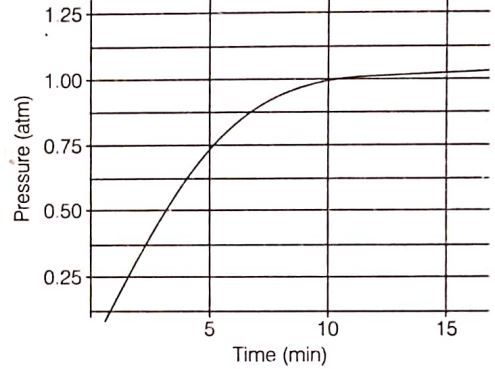
(i) A student added 10 g of calcium carbonate in a rigid container, secured it tightly and started to heat it. After some time, an increase in pressure was observed, the pressure reading was then noted at intervals of 5 min and plotted against time, in a graph as shown below. During which time interval did maximum decomposition took place?
(ii) Calcium oxide can be reduced to calcium, by heating with sodium metal. Which compound would act as an oxidising agent in the given process and why?
(iii) Gas obtained in (i) is a reactant for a very important biochemical process which occurs in the presence of sunlight. ldentify the name of the process.
(iii) Marble statues are corroded or stained when they repeatedly come in contact with polluted rain water. What could be the main reason? Write the chemical decomposition of calcium carbonate.
19.
Chemical reaction, a process in which one or more substances, the reactants, are converted to one or more different substances, the products. Substances are either chemical elements or compounds. A chemical reaction rearranges the constituent atoms of the reactants to create different substances as products. Study this table related to the different types of reactions / processes and answer the questions that follow.
| S.No. | Name of Process | Word Equation |
| i | Combustion | \(\text { Magnesium }+\text { Oxygen } \stackrel{\text { heat }}{\longrightarrow} \text { Magnesium dioxide }\) |
| ii | Photosynsthesis | \(\text { Carbon dioxide }+\text { Water } \frac{\text { sunlight }}{\text { chlorophyll }} \longrightarrow \text { Glucose }+\text { Oxygen }+\text { Water }\) |
| iii | Combination | \(\text { Iron }+\text { Sulphur } \stackrel{\text { heat }}{\rightarrow} \text { Iron sulphide }\) |
| iv. | Photodecomposition | \(\text { Silver bromide } \stackrel{\text { light }}{\longrightarrow} \text { Silver }+\text { Bromine }\) |
(i) The reaction in which two or more substances combine to form a single substance under suitable conditions is
(a) combination reaction (b) combustion
(c) decomposition reaction (d) photosynthesis
(ii) Which of the following is essential for photosynthesis?
(a) Sunlight (b) Chlorophyll (c) Glucose (d) Both 'a' and 'b’
Photosynthesis is the process by which green plants and some other organisms use sunlight to synthesis nutrients from carbon dioxide and water.
(iii) When a chemical compound decomposes on absorbing light and energy, then the reaction which takes place is known as
(a) photosynthesis (b) photodecomposition
(c) combination (d) thermal decomposition.
A photodecomposition is a chemical reaction in which an inorganic chemical (or an organic chemical) is broken down by photons and is the interaction of one or more photons with one target molecule.
(iv) Which of the following reactions is an example of combustion reaction ?
\((a) \mathrm{C}_{(s)}+\mathrm{O}_{2(g)} \longrightarrow \mathrm{CO}_{2(g)}\\
(b) \mathrm{Zn}_{(s)}+\mathrm{H}_{2} \mathrm{SO}_{4(a q)} \longrightarrow \mathrm{ZnSO}_{4(a q)}+\mathrm{H}_{2(g)}\\
(c) \mathrm{Zn}_{(s)}+2 \mathrm{HCl}_{(a q)} \longrightarrow \mathrm{ZnCl}_{2(a q)}+\mathrm{H}_{2(g)}\\
(d) 3 \mathrm{Mg}_{(s)}+\mathrm{N}_{2(g)} \longrightarrow \mathrm{Mg}_{3} \mathrm{~N}_{2(s)}\)
A combustion reaction is a reaction in which a substance reacts with oxygen gas, releasing energy in the form of light and heat.
(v) Which of the following is an example of combination reaction?
\((a) \mathrm{H}_{2(g)}+\mathrm{Cl}_{2(g)} \stackrel{\text { light }}{\longrightarrow} 2 \mathrm{HCl}_{(g)}\\
(b) \mathrm{Fe}_{(s)}+S_{(s)} \longrightarrow \mathrm{FeS}_{(g)}\\
(c) 2 \mathrm{H}_{2(g)}+\mathrm{O}_{2(g)} \longrightarrow 2 \mathrm{H}_{2} \mathrm{O}_{(l)}\\
(d) All \ of \ them\)
A combination reaction (also known as a synthesis reaction) is a reaction where two or more elements or compounds (reactants) combine to form a single compound (product).
1.
Metal articles react with the gases present in the air and their surface gets coated with the layer of compound it forms making them look dull and the lustre is lost. For example, aluminium metal reacts readily with oxygen to form aluminium oxide and its surface becomes dull.
2.
(i) Substance X-Calcium Hydroxide.
Ca(OH)2(aq) + CO2(g)\(\longrightarrow \) CaCO3(s) + H2Cl
(White ppt.)
(ii) Calcium hydroxide is obtained by reaction of calcium oxide and water.
CaO(s) + H2O(l) \(\longrightarrow \)Ca(OH)2(aq) + Heat
3.
(i) Exothermic Reaction
CaO + H2O \(\longrightarrow \)Ca(OH}2
(ii) Double displacement reaction.
BaCl2 + Na2SO4 \(\longrightarrow \) BaSO4 + 2NaCl
4.
(a) 2KBr(aq) + BaI2(aq) \(\rightarrow\) 2KI + (aq) + BaBr2(s)
Type: Double displacement reaction
(b) ZnCO3(s) \(\overset{\Delta }{\rightarrow}\) ZnO(s)+CO2(g)
Type: Thermal decomposition reaction
(c) H2(g)+Cl2(g)\(\rightarrow\) 2HCl(g)
Type: Combination reaction
(d) Mg(s)+2HCl(aq)\(\rightarrow\)MgCl2(aq)+H2(g)
Type: Displacement reaction
5.
A chemical change is represented by a chemical equation. When the number of atoms of different elements on reactant and product side are equal, then the chemical equation is called a balanced chemical equation.
It is important to balance a chemical equation because
(i) to validate the law of conservation of mass which states that the mass of reactants should be equal to the mass of the products. The total mass of a system is thus conserved.
This law holds true only if number of atoms of reactants reacting together is equal to number of product atoms formed.
(ii) a balanced chemical equation tells us about the physical state of the reactants and products whether they are solid (s), liquid (l) or gas (g) or aqueous(aq).
(iii) it tells us about heat changes that can take place in a chemical reaction. \(\Delta\) is the symbol of heat. Hence, it is endothermic or exothermic can be deduced from a balanced chemical equations.
6.
(i) H2 + Cl2 \(\rightarrow\) 2HCI
(ii) 3BaCl2 + Al2(SO4)3 \(\rightarrow\) 3BaSO4 \(\downarrow\)+ 2AlCl3
(iii) 2Na + 2H2O \(\rightarrow\) 2NaOH + H2
7.
Once we turned the sugar into from the flame of metal dish, the sugar would be blackish brown, solid and surrounded by black sooth because sugar is made from carbon, hydrogen and oxygen atom when it heated the element react with the fire to turn into liquid The heat cause the sugar's atom to combine with the oxygen in air forming new groups atom .Energy is released in the chemical reaction in the form of smoke and black soot
8.
The reactant A is zinc metal and the reactant B is hydrochloric acid.
Zn + 2HCl\(\longrightarrow \)ZnCl2 + H2
9.
A process in which two or more substances react to form some other new substances with new set of properties is called a chemical reaction.
10.
(i) Heat : CaCO3(s) \(\overset{Heat}{\rightarrow}\) CaO(s) + CO2(g)
(ii) Light : 2AgCl(s) \(\overset{Light}{\rightarrow}\) 2Ag(s) + Cl2(g)
(iii) Electricity: 2H2O (l) \(\overset{Electric \quad current}{\rightarrow}\) 2H2 (g) + O2(g)
(Acidulated)
11.
(a) Ca(OH)2 + CO2 \(\rightarrow\) CaCO3 + H2O
(b) Zn + 2AgNO3 \(\rightarrow\) Zn(NO3)2 + 2Ag
(c) 2Al + 3CuCl2 \(\rightarrow\) 2AlCl3 + 3Cu
(d) BaCl2 + K2SO4 \(\rightarrow\) BaSO4 + 2KCl
12.
(i) Substance X is calcium oxide or quicklime. Its formula is CaO
(ii) Quicklime reacts with water as:
CaO(s) + H2O(l) \(\rightarrow\)Ca(OH)2 (aq)
X Water Slaked lime (Calcium hydroxide)
13.
(b): Decomposition reaction is a reaction in which a compound breaks down into two or more simpler substances.
\(2 \mathrm{~Pb}\left(\mathrm{NO}_{3}\right)_{2} \longrightarrow 2 \mathrm{PbO}+4 \mathrm{NO}_{2}+\mathrm{O}_{2}\)
14.
(c): This is because nitrogen is an antioxidant. It prevents the chips from being oxidised.
15.
(a): This is according to the law of conservation of mass
16.
(a) Both A and R are true, and R is correct explanation of the assertion.
17.
(a) If both assertion and reason are true and the reason is correct explanation of assertion.
18.
(i) The pressure reading was noted at intervals of 5 min and plotted against time of the reaction which involved:
\(\mathrm{CaCO}_3 \xrightarrow{\Delta} \mathrm{CaO}+\mathrm{CO}_2 \uparrow\)
Formation of CO2 gas increases pressure and is maximum in (0-5) min graph as shown sharp curve in (0-5) min.
(ii) Calcium oxide can be reduced to calcium by heating with sodium metal and calcium oxide acts as an oxidising agent because it oxidises other substance, i.e. sodium and itself gets reduced.
(iii) CO2 gas is a reactant for a very important biochemical process which occurs in the presence of sunlight, the name of the process is photosynthesis.
The reactants for photosynthesis are light energy, water, carbon dioxide and chlorophyll, while the products are glucose, oxygen and water.
Or
Marble statues are corroded or stained when they repeatedly come in contact with polluted rain water. Polluted rain water is acidic in nature hence, it reacts with calcium carbonate.
CaCO3(s) + H2SO4(aq) \(\rightarrow\) CaSO4(s) + CO2(g) + H2O
The decomposition of calcium carbonate is as follows
\(\mathrm{CaCO}_3(\mathrm{~s}) \xrightarrow{\Delta} \mathrm{CaO}(\mathrm{s})+\mathrm{CO}_2(\mathrm{~g})\)
19.
(i) (a) combination reaction
(ii) (d) Both 'a' and 'b'
(iii) (b) photodecomposition
(iv) \((a) \ \mathrm{C}_{(s)}+\mathrm{O}_{2(g)} \longrightarrow \mathrm{CO}_{2(g)}\)
(v) (d) All of them

10th Standard CBSE Syllabus & Materials
10th Standard CBSE
CBSE 10th Social Science PS - Federalism - New Model Questions Papers Study Material - QB365 Set A
NEW10th Standard CBSE
CBSE 10th Social Science PS - Power Sharing - New Model Questions Papers Study Material - QB365 Set A
NEW10th Standard CBSE
CBSE 10th Social Science GEO - Manufacturing Industries - New Model Questions Papers Study Material - QB365 Set A
NEW10th Standard CBSE
CBSE 10th Social Science GEO - Minerals and Energy Resources - New Model Questions Papers Study Material - QB365 Set A



NCERT Books

Syllabus

Exam Pattern

Sample Question Papers

Previous year Question Papers

Important Notes

MCQ Practice test

NCERT Exemplers

Case study Questions

Image Based Questions

Passage based Questions

HOT Questions

Value Based Questions

Model Questions Papers
NCERT ( Book Back ) Questions

Assertion and Reason
Important Questions And Answers

CBSE 10th Standard CBSE Subjects
CBSE Standards



