
 100% FREE ACCESS
10th Standard CBSE Syllabus & Materials
10th Standard CBSE
CBSE 10th Social Science ECO - Globalisation and the Indian Economy - New Model Questions Papers Study Material - QB365 Set A
NEW10th Standard CBSE
CBSE 10th Social Science ECO - Money and Credit - New Model Questions Papers Study Material - QB365 Set A
NEW10th Standard CBSE
CBSE 10th Social Science ECO - Sectors of the Indian Economy - New Model Questions Papers Study Material - QB365 Set A
NEW10th Standard CBSE
CBSE 10th Social Science ECO - Development - New Model Questions Papers Study Material - QB365 Set A
NEW10th Standard CBSE
CBSE 10th Social Science PS - Outcomes of Democracy - New Model Questions Papers Study Material - QB365 Set A
NEW10th Standard CBSE
CBSE 10th Social Science PS - Gender, Religion and Caste - New Model Questions Papers Study Material - QB365 Set A

Published on: 26/10/2025
Download CBSE Class 10th Standard CBSE Science question papers, sample papers, important questions, and previous year solved papers in PDF format. Get free study materials, NCERT solutions, and exam preparation resources for Class 10th Standard CBSE Science
Questions + Answers key
Take MCQ Science Test
1.
A student focussed the image of a candle flame on a white screen using a convex lens. He noted down the position of the candle screen and the lens as under
Position of candle = 12.0 cm
Position of convex lens = 50.0 cm
Position of the screen = 88.0 cm
(a) What is the focal length of the convex lens?
(b) Where will the image be formed if he shifts the candle towards the lens at a position of 31.0 cm?
(c) What will be the nature of the image formed if he further shifts the candle towards the lens?
(d) Draw a ray diagram to show the formation of the image in case c) as said above.
2.
A convex lens forms a real and inverted image of a needle at a distance of 50cm from it.Where is the needle placed in front of the convex lens, if the image is equal to the size of object? Also, find the power of the lens.
3.
A salt X is formed and a gas is evolved when ethanoic acid reacts with sodium hydrogen carbonate. Name the salt X and the gas evolved. Describe an activity and draw the diagram of the apparatus to prove that the evolved gas is the one which you have named. Also, write chemical equation of the reaction involved.
4.
(a) What is meant by a magnetic field?
(b) How is the direction of magnetic field at a point determined?
(c) Describe an activity to demonstrate the direction of the magnetic field generated around a current carrying conductor.
(d) What is the direction of magnetic field at the centre of a current carrying circular loop?
5.
Of the three metals X, Y and Z, X reacts with cold water, Y with hot water and Z with steam only. Identify X, Y and Z and also arrange them in order of increasing reactivity.
6.
On adding a drop of barium chloride solution to an aqueous solution of sodium sulphite, white precipitate is obtained.
(a) Write a balanced chemical equation of the reaction involved.
(b) What other name can be given to this precipitation reaction?
(c) On adding dilute hydrochloric acid to the reaction mixture, white precipitate disappears. Why?
7.
A dry pellet of a common base B, when kept in open absorbs moisture and turns sticky. The compound is also a by-product of chlor-alkali process. Identify B. What type of reaction occurs when B is treated with an acidic oxide? Write a balanced chemical equation for one such solution.
8.
The decomposition of vegetable matter in to compost is an example of what type of reaction?
9.
When Hydrogen gas is passed over heated copper (II) oxide, copper and steam are formed. Write the balanced chemical equation with physical states for this reaction. State what kind of chemical reaction is this?
10.
Dry HCl gas does not change the colour of dry blue litmus paper. Give reasons
11.
Which gas is liberated when a metal reacts with an acid? How will you test the presence of this gas?
12.
Identify and name the functional groups present in the following compounds.
-q.jpg)
-q.jpg)
13.
Where is the image formed in a convex mirror, when the object is anywhere in front of it?
14.
Who was the first person to obtain the spectrum of sunlight?
15.
What is meant by a saturated hydrocarbon?
16.
Distinguish between DC and AC.
17.
A magnetic compass shows a deflection when placed near a current carrying wire. How will the deflection of the compass get affected if the current in the wire is increased? Support your answer with a reason.
18.
Hydrogen compounds are abundantly available on earth and it has high calorific values. But this is not used as a common fuel. Give any two reasons. What are being developed to use hydrogen as a common fuel?
19.
How is power related to current and voltage?
20.
Dry ammonia gas has no action on litmus paper, but a solution of a ammonia in water turns red litmus paper blue, why is it so?
21.
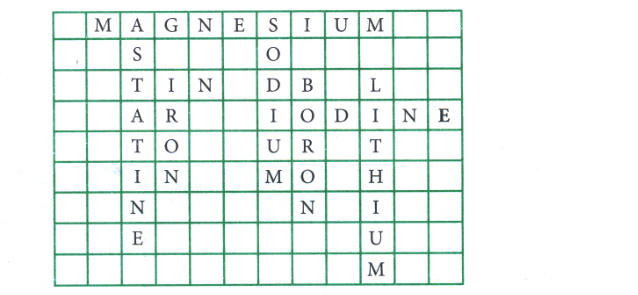
Complete the following cross word puzzle shown in the below Figure
Across:
(1) An element with atomic number 12.
(3) Metal used in making cans and member of Group 14.
(4) A lustrous non-metal which has 7 electrons in its outermost shell.
Down:
(2) Highly reactive and soft metal which imparts yellow colour when subjected to flame and is kept in kerosene.
(5) The first element of second Period.
(6) An element which is used in making fluorescent bulbs and is second member of Group 18 in the Modern Periodic Table.
(7) A radioactive element which is the last member of halogen family.
(8) Metal which is an important constituent of steel and forms' rust when exposed to moist air.
(9) The first metalloid in Modern Periodic Table whose fibres are used in making bullet-proof vests.
 image.png)
22.
The position of three elements A, B and C in the Periodic Table are shown below:
| Group 16 | Group 17 |
| - | - |
| - | A |
| - | - |
| B | C |
(a) State whether A is a metal or non-metal.
(b) State whether C is more reactive or less reactive than A.
(c) Will C be larger or smaller in size than B?
(d) Which type of ion, cation or anion, will be formed by element A?
23.
What are the environmental consequences of using fossil fuels? Suggest the steps to minimize the pollution caused by various source of energy including non-conventional sources of energy?
24.
Chlorine, bromine and iodine form a Dobereiner's triad. The atomic masses of chlorine and iodine are 35.5 and 126.9 respectively. Predict the atomic mass of bromine.
25.
What are fossil fuels?
1.
Given
(a) Position of candle = 12.0 cm
Position of convex lens = 50.0 cm
Position of the screen = 88.0 cm
Therefore u = 50.0 - 12.0 = 38.0 cm
v = 88.0-50.0 = 38.0 cm
Therefore u = v
Hence both lie at 2F,
therefore F = 38/2 = 19 cm.
(b) u = 50.0-31.0 = -19 cm
f = +19 cm, v = ?
Using \(\frac { 1 }{ f } =\frac { 1 }{ u } +\frac { 1 }{ v } \)
We have \(\frac { 1 }{ 19 } =\frac { -1 }{ 19 } +\frac { 1 }{ v } \)
or v=infinity.
(c) If he further shifts the candle towards the lens the image will become virtual and erect.
(d) The ray diagram is as shown
-S.png)
2.
Given, image distance, v = + 50 cm
Magnification, m = -1 [\(\because\)image is inverted]
\(m=\frac{v}{u}\Rightarrow u=\frac{v}{m}=\frac{50}{-1}=-50 \quad cm\)
So, needle is placed at 50 cm in front to the lens.
By lens formula, \(\frac{1}{f}=\frac{1}{v}-\frac{1}{u}\Rightarrow \frac{1}{f}=\frac{1}{50}-\frac{1}{(-50)}\)
\(\frac{1}{f}=\frac{1}{25}\Rightarrow f=25\quad cm = 0.25 \quad m\)
\(\therefore\) Power, \(P=\frac{1}{f}=\frac{1}{0.25}=4 D\)
3.
\(\underset{Ethanoic\ acid}{CH_3COOH} + \underset {Sodium\ hydrogen\\ Carbonate}{NaHCO_3} \rightarrow \underset{sodium\ ethanoate}{CH_3COONa}+ \underset{Cabon\ dioxide}{CO_2} + \underset{Water}{H_2O}\)
Activity to show that ethanoic acid reacts with metal hydrogen carbonate to liberate carbon dioxide.
Procedure:
i) Take two test tubes and label them as A and B.
ii) Now, take few grams of sodium carbonate in test tube A.
iii) Take few grams of sodium hydrogen carbonate in test tube B.
iv) Now, add ethanoic acid to both the test tubes.
v) Note your observation.
vi) Pass the gas liberated in test tube A and B through lime water or calcium hydroxide solution.
vii) Record your observation.
Observation
a) A brisk effervescence is formed.
b) The lime water turns milky in both the test tubes.
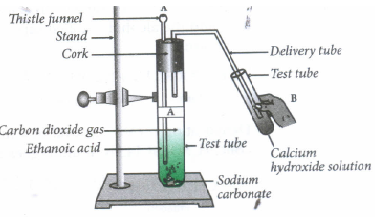
When carboxylic acids react with sodium carbonate or sodium bicarbonates, it liberates carbon dioxide gas which turns lime water milky.
\(\underset{Calcium\ hydroxide\\ (Lime\ wate)}{Ca(OH)_2(aq)}+\underset{Carbon\ dioxide}{CO_2(g)}\rightarrow \underset{Calcium\ carbonate\\ (White \ ppt)}{CaCO_3(s)\downarrow}+\underset{Water}{H_2O(l)}\)
4.
(a) Magnetic field is the region around a magnet in which a magnetic material experiences a force because of that magnet.
(b) The direction of magnetic field at a point is determined by using a magnetic compass. The direction along which the needle of a magnetic compass gets aligned indicates the direction of the magnetic field.
(c) A straight thick conducting wire is inserted normally through centre of a plane paper. Now, electric current is passed through the wire. When a small magnetic compass is placed on the paper, the magnetic needle of the compass gets aligned along a particular direction. The positions of the North Pole and South Pole are marked on the paper. Now, the magnetic needle is shifted to a new position such that its South Pole occupies the position previously occupied by its North Pole. Again, the positions of the North Pole and South Pole are marked. These steps are repeated over and over again and the marked points are joined to obtain the direction of the magnetic field generated by the current-carrying straight wire.
(d) The direction of magnetic field at the centre of a current of a current carrying loop is normal to the plane formed by the loop.
5.
Since the metal X react with cold water, it must be high in the reactivity series i.e., sodium or potassium.
X is alkali metal, Na or K.
Since the metal Y reacts with hot water, it must be middle in the reactivity series i.e., magnesium or calcium.
Y is alkaline earth metal, Mg or Ca.
Since the metal X reacts with steam only, it must be low in the reactivity series i.e., iron Z is Fe.
Increasing reactivity series : Na > Mg > Fe.
6.
(a) A white precipitate of barium sulphite is formed when barium chloride is added to the solution of sodium sulphite.
\(\underset{Barium\\ Chloide}{BaCl_2} +\underset{Sodium\\ sulphite}{ Na2S03} \rightarrow \underset{Baru\ sulphate\\ (white\ ppt)}{ BaS03\downarrow} +\underset{Sodium\\ chloride}{2NaCI}\)
(b) This precipitation reaction is also a double displacement reaction.
(c) Barium chloride, suphur dioxide and water are formed when dilute hydrochloric acid is added to this solution of barium sulphite. Since barium chloride is a soluble substance, thus white precipitate of barium sulphite disappears.
\(\underset { Barium\ sulphate\\ (white\ ppt) }{ BaCl_{ 2 } } +\underset { Hydrochloric\\ acid }{ 2HCl(aq) } \rightarrow \underset { Barium\\ chloride }{ BaC{ l }_{ 2 }(aq) } +\underset { Sulphur\\ dioxde }{ { SO }_{ 2 } } +\underset { Water }{ { H }_{ 2 }O } \)
7.
Sodium hydroxide (NaOH) is a commonly used base and is hygroscopic, that is, it absorbs moisture from the atmosphere and becomes sticky. The acidic oxides react with base to give salt and water. The reaction between NaOH and \(CO_2\) can be given as \(2NaOH+CO_2\rightarrow Na_2CO_3+H_2O\)
8.
Exothermic reaction.
9.
(I) CuO(s) + H2(g) \(\rightarrow \) Cu(s) + H2O(g)
(ii) Redox reaction.
10.
In the dry state, HCI gas does not give any H + ions. It does not behave as an acid. That is why the colour of litmus paper does not change.
11.
Hydrogen gas is formed. Bring a burning matchstick near to it, H2 will burn explosively with 'pop' sound.
12.
-s.jpg)
-s.jpg)
13.
Between pole and focus, behind the convex mirror.
14.
Sir Issac Newton
15.
Those hydrocarbons in which valency of carbon is satisfied by single bonds only are called saturated hydrocarbons.
16.
| DC | AC |
| 1. Unidirectional flow of current. | Current changes its direction in a cycle. |
| 2. Cells and batteries produce DC. | Dynamo produces AC. |
17.
The strength of magnetic field varies directly as the magnitude of the electric current. So, in case of an increase in current the magnetic field would increase.
18.
a)Hydrogen is not used as a common fuel because when it is lighted, it burns with an explosion and it is very difficult to store and transport hydrogen.
b) Fuel cells are being developed that can store energy produced by burning hydrogen. Development of materials that can absorb hydrogen and then release it at a steady rate.
19.
Power (P) = Potential difference (V) \(\times\) Current (I)
20.
A solution of ammonia in water results in the formation of ammonium hydroxide (NH4OH). Ammonium hydroxide is basic in nature and turns red litmus blue.
21.
22.
(a) Group 17 belongs to halogen family and thus, A is non-metal.
(b) C is less reactive than A because the reactivity of non-metal decreases from top to bottom.
(c) Since the size decreaes across a period on moving from left to right, the size of C is smaller than B because B and C belong to the same period.
(d) A forms anion because C is non-metals for anion (negative ion).
23.
Environmental consequences of using fossil are air pollution, greenhouse effect, acid rain, global warming. To minimize the pollution caused by various source of energy.
1. We should use smokeless appliances
2. Technology should be constantly upgraded
3. Use of energy should be judicious
4. Proper and safe disposal of nuclear waste.
24.
()
Atomic mass of Br = 35.5 + 126.9 / 2
= 162.4 / 2 = 81.2
25.
()
Fuels which are formed from the fossil remains of plants and animals and are obtained from under the earth's crust are called fossil fuels. Example coal, petroleum and natural gas.

10th Standard CBSE Syllabus & Materials
10th Standard CBSE
CBSE 10th Social Science PS - Federalism - New Model Questions Papers Study Material - QB365 Set A
NEW10th Standard CBSE
CBSE 10th Social Science PS - Power Sharing - New Model Questions Papers Study Material - QB365 Set A
NEW10th Standard CBSE
CBSE 10th Social Science GEO - Manufacturing Industries - New Model Questions Papers Study Material - QB365 Set A
NEW10th Standard CBSE
CBSE 10th Social Science GEO - Minerals and Energy Resources - New Model Questions Papers Study Material - QB365 Set A



NCERT Books

Syllabus

Exam Pattern

Sample Question Papers

Previous year Question Papers

Important Notes

MCQ Practice test

NCERT Exemplers

Case study Questions

Image Based Questions

Passage based Questions

HOT Questions

Value Based Questions

Model Questions Papers
NCERT ( Book Back ) Questions

Assertion and Reason
Important Questions And Answers

CBSE 10th Standard CBSE Subjects
CBSE Standards



