
 100% FREE ACCESS
10th Standard CBSE Syllabus & Materials
10th Standard CBSE
CBSE 10th Social Science ECO - Globalisation and the Indian Economy - New Model Questions Papers Study Material - QB365 Set A
NEW10th Standard CBSE
CBSE 10th Social Science ECO - Money and Credit - New Model Questions Papers Study Material - QB365 Set A
NEW10th Standard CBSE
CBSE 10th Social Science ECO - Sectors of the Indian Economy - New Model Questions Papers Study Material - QB365 Set A
NEW10th Standard CBSE
CBSE 10th Social Science ECO - Development - New Model Questions Papers Study Material - QB365 Set A
NEW10th Standard CBSE
CBSE 10th Social Science PS - Outcomes of Democracy - New Model Questions Papers Study Material - QB365 Set A
NEW10th Standard CBSE
CBSE 10th Social Science PS - Gender, Religion and Caste - New Model Questions Papers Study Material - QB365 Set A

Published on: 20/10/2025
Download CBSE Class 10th Standard CBSE Science question papers, sample papers, important questions, and previous year solved papers in PDF format. Get free study materials, NCERT solutions, and exam preparation resources for Class 10th Standard CBSE Science
Questions + Answers key
Take MCQ Science Test
1.
A person is unable to see objects distinctly placed within 50 cm from his eyes.
(i) Name the defect of vision the person is suffering from and list its two possible causes.
(ii) Draw a ray diagram to show the defect in the above case.
(iii) Mention the type of lens used by him for the correction of the defect and calculate its power. Assume that the near point for the normal eye is 25 cm.
(iv) Draw a labelled diagram for the correction of the defect in the above case.
2.
State the function of each of the following parts of the human eye :
(i) Cornea
(ii) Iris
(iii) Pupil
(iv) Retina
(b) Millions of people of the developing countries are suffering from corneal blindness. This disease can be cured by replacing the defective cornea with the cornea of a donated eye. Your school has organised a campaign in the school and its neighbourhood in order to create awareness about this fact and motivate people to donate their eyes after death. How can you along with your classmates contribute in this noble cause? State the objectives of organising such campaigns.
3.
Name different types of chemical reactions. Give one example for each.
4.
Which gas is usually liberated when an acid reacts with a metal? Illustrate with an example, How will you test for the presence of the gas?
5.
Adding which of the following to a colourless solution would give an indication that the solution could possibly be hydrochloric acid?
Copper metal strips
Silver metal strips
Calcium carbonate
Sodium chloride
6.
The phenomenon of light responsible for the working of the human eye is
reflection
refraction
power of accommodation
persistence of vision.
7.
Identify the following type of reaction:
2KClO3 \(\quad \overset { heat }{ \underset { catalyst }{ \longrightarrow } } \) 2KCl(s) + 3O2(g)
It is a combination reaction.
It is a decomposition reaction and is accompanied by release of heat
It is a photochemical decomposition reaction and exothermic in nature.
It is a decomposition reaction and is endothermic in nature
8.
Which one of the following will turn blue litmus red?
Vinegar
Lime water
Baking soda solution
Washing soda solution
9.
In the decomposition of lead (II) nitrate to give lead (II) oxide, nitrogen dioxide and oxygen gas, the coefficient of nitrogen dioxide (in the balanced equation) is
1
2
3
4
10.
The danger signals installed at the top of tall buildings are red in colour. These can be easily seen from a distance because among all other colours, the red light
is scattered the most by smoke or fog
is scattered the least by smoke or fog
is absorbed the most by smoke or fog
moves faster in air
11.
The human eye can focus objects at different distances by adjusting the focal length of the eye lens. This is due to
Presbyopia
Accommodation
Near sightedness
Far sightedness
12.
Which one of the following types of medicines is used for treating indigestion?
Antibiotic
Analgesic
Antacid
Antiseptic
13.
What happens when dilute hydrochloric acid is added to iron fillings? Tick the correct answer
Hydrogen gas and Iron chloride are produced.
Chloride gas and Iron hydroxide are produced.
No reaction takes place
Iron salt and water are produced
14.
What is presbyopia?
15.
What is 'Baking Powder'? How does it make the cake soft and spongy?
16.
Make a diagram to show how hypermetropia is corrected. The near point of a hypermetropic eye is 1 m. What is the power of the lens required to correct this defect? Assume that near point of the normal eye is 25cm
17.
Write the balanced chemical equations for the following reactions.
(a) Calcium hydroxide + Carbon dioxide \(\rightarrow\) Calcium carbonate + Water
(b) Zinc + silver nitrate \(\rightarrow\) Zinc nitrate + Silver
(c) Aluminium + Copper chloride \(\rightarrow\) Aluminium chloride + Copper
(d) Barium chloride + Potassium Sulphate \(\rightarrow\) Barium sulphate + Potassium chloride
18.
Observe the following diagram showing an image formation in an eye
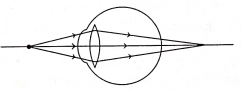
(i) ldentify the defect of vision shown in the figure.
(ii) List its two causes and suggest a suitable Corrective lens to overcome this defect.
19.
(i) How is a universal indicator better than litmus solution?
(ii) State two features of pH scale.
(iii) Why should we not add water to a concentrated acid?
20.
Why are decomposition reactions called the opposite of combination reactions? Write equations for these reactions.
21.
Draw a labelled diagram of rainbow formation. Also explain the phenomenon of rainbow formation
22.
Three test tubes are taken and labeled as A, B and C. In test tube A iron nail is dipped in water. In test tube B iron nail is dipped in mixture of water and oil and in o test tube C iron nail is added with dry calcium chloride. Name the test tube in which the iron nail will rust and why?
23.
What is 'Plaster of Paris' chemically? How is it obtained from gypsum? Write the condition and chemical equation involved in its manufacture.
24.
Assertion: Iron articles are painted so as to prevent them from rusting.
Reason: When the surface of iron is coated with paint, its surface does not come in contact with oxygen and moisture therefore rusting does not take place.
Codes
(a) Both A and R are true, and R is correct explanation of the assertion.
(b) Both A and R are true, but R is not the correct explanation of the assertion.
(c) A is true, but R is false.
(d) A is false, but R is true.
25.
Assertion: Planets are far and they do not twinkle
Reason: Stars are nearby and they twinkle
Codes
(a) If both assertion and reason are true and the reason is correct explanation of assertion.
(b) If both assertion and reason are true but reason is not a correct explanation of assertion.
(c) If assertion is true and reason is false.
(d) If both assertion and reason are false
26.
On a sunny day, Krish looked at the sky through a water fountain and he was surprised to see a rainbow In the sky
(i) The location of the sun when Krish observed a rainbow was
(a) behind him
(b) in front of him
(c) overhead
(d) on his left side
(ii) The phenomena of light involved in the formation of a rainbow are
(a) reflection, refraction and dispersion
(b) refraction, dispersion and total internal reflection
(c) refraction, dispersion and scattering
(d) dispersion, scattering and total internal reflection
(iii) In the formation of a rainbow, the role of water droplets present in the water fountain is to act as a
(a) glass slab
(b) convex lens
(c) concave lens
(d) prism
(iv) While entering a water droplet, the sunlight gets
(a) refracted only
(b) reflected internally
(c) refracted and dispersed
(d) first refracted and then dispersed while coming out of the water droplet
27.
Bleaching powder is also known as chloride of lime. It is a solid and yellowish white in colour. Bleaching powder can be easily identified by the strong smell of chlorine. When calcium hydroxide (slaked lime) reacts with chlorine, it gives calcium oxychloride (bleaching powder) and water is formed. Aqueous solution of bleaching powder is basic in nature. The material to be bleached is first passed through solution of NaOH to remove greasy matter. Then it is passed through aqueous solution of bleaching powder and very dil. HCI solution. HCI reacts with bleaching powder to liberate nascent oxygen which bleaches material.
(i) Bleaching powder is used as
| (a) bleaching agent in textile, paper and jute industry |
| (b) disinfectant for water to make water free of germs |
| (c) oxidising agent in many industries |
| (d) all of these |
(ii) Bleaching powder is also known as
| (a) calcium oxychloride | (b) calcium hypochlorite |
| (c) chloride of lime | (d) all of these. |
(iii) Bleaching powder gives smell of chlorine because it
| (a) is unstable | (b) gives chlorine on exposure to atmosphere |
| (c) is a mixture of chlorine and slaked lime | (d) contains excess of chlorine |
(iv) Select the correct statement(s) regarding bleaching powder.
| (a) It is pale yellow powder having smell of chlorine |
| (b) It is sparingly soluble in water and gives milky suspension when dissolved in water |
| (c) As bleaching powder gives nascent oxygen, it shows bleaching property |
| (d) All of these |
(v) Identify the product 'X' in the given reaction \(\mathrm{Ca}(\mathrm{OH})_{2}+\mathrm{Cl}_{2} \longrightarrow X+\mathrm{H}_{2} \mathrm{O}\)
| (a) CaOCl2 | (b) CaCl2 | (c) Ca(CIO3 )2 | (d) CaCO3 |
1.
(i) Hypermetropia is the defect of vision. It occurs due to
(a) the focal length of eye lens is too long.
(b) decrease in the size of the eyeball.
(ii) (a) The person is suffering from Hypermetropia i.e. Far-sightedness

Hypermetropia is caused due to:
(i)The focal length of the eye lens is too long
(ii) Decrease in the length of the eyeball
This defect can be corrected using convex lens of appropriate focal length

(iii) Convex lens can be used to correct this defect
\(P=\frac{1}{f}\)
\(u=-25 \mathrm{~cm}\)
\(v=-50 \mathrm{~cm}\)
Using lens formula,
\(\frac{1}{f} =\frac{1}{v}-\frac{1}{u}\)
\(=\frac{1}{-50}-\frac{1}{-25} =\frac{-1-(-2)}{50} \)
\(=\frac{1}{50}=50 \mathrm{~cm} \text { or } 0.5 \mathrm{~m}\)
\(P =\frac{1}{f}=\frac{1}{0.5} =\frac{10}{5}=2 \mathrm{D}\)
2.
(a) (i) Cornea - Refraction of the light rays falling on the eye.
(ii) Iris - To control the size of the pupil.
(iii) Pupil - To regulate and control the amount of light entering the eye.
(iv) Retina - To act as a screen to obtain the image of object and generate electrical signals which are sent to the brain via optic nerves.
(b) Ways of motivating people for the noble cause of eye donation are street play, banners, poster, door to door campaign, etc.
Objectives:
(i) To develop the habit of group work.
(ii) To work for a common cause.
(iii) To understand social issues and problems.
3.
Different types of chemical reactions are:
(a) Combination reactions: The reaction in which two or more than two substances combine together to form a single compound.
e.g., 2Mg + O2 \(\longrightarrow \) 2 MgO
(b) Decomposition reaction: The reaction in which a compound decomposes to form two or more substances is called decomposition reaction.
e.g., CaCO3 heat\(\overset { heat }{ \longrightarrow } \) CaO + CO2
(c) Displacement reaction: The reaction in which more reactive metal displaces the less reactive metal is called displacement reaction.
e.g., Fe + CuSO4 \(\longrightarrow \) FeSO4 + Cu
(d) Double displacement reaction: The reaction in which two different atoms or groups of atoms exchange for each other is called double displacement reaction.
e.g., Na2SO4(aq) + BaCI2(aq) \(\longrightarrow \) BaSO4(s) + 2NaCI(aq)
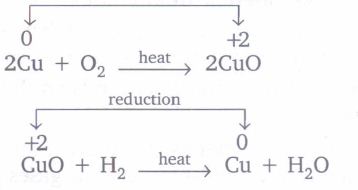
(e) Oxidation-reduction reaction: The reaction in which oxygen is added/hydrogen is removed is called oxidation reaction.
The reaction in which hydrogen is added/oxygen is removed is called reduction
e.g., Oxidation,
4.
Hydrogen gas is usually liberated when an acid reacts with metal.
e.g. Zn(s) + H2SO4 (aq) \(\rightarrow\) ZnSO4(aq) + H2 \(\uparrow\)
Test for H2 gas Testing of H2 gas presence can be done by passing the gas through soap solution and then bringing a burning splinter near the soap bubble filled with the gas. If the gas burns with a pop sound, it confirms hydrogen.
5.
(c)
Calcium carbonate
6.
(b)
refraction
7.
(d)
It is a decomposition reaction and is endothermic in nature
8.
(a)
Vinegar
9.
(d)
4
10.
(b)
is scattered the least by smoke or fog
11.
(b)
Accommodation
12.
(c)
Antacid
13.
(a)
Hydrogen gas and Iron chloride are produced.
14.
It is the defect of eye in which one cannot see nearby as well as far objects clearly.
15.
Baking powder is the mixture of baking soda and tartaric acid. When baking powder is heated it releases CO2 gas due to which the cake rises and becomes soft and spongy.
16.
Hypermetropia is corrected by convex lens.
The ray diagram is as follows:
Now, according to the question,
Given values are,
Image distance, v = -1 m = -100 cm
Object distance, u = -25 cm
[For correction, image should be at 1m]
From lens formula,
\(\frac{1}{v}-\frac{1}{u}=\frac{1}{f}\)
\(\Rightarrow \frac{1}{f}=\frac{u-v}{uv}\)
\(\Rightarrow f=\frac{uv}{u-v}\)
\(=\frac{-25\times (-100)}{-25+100}\)
\(=\frac{100\times 25}{75}\)
So, \(f=\frac{100}{3}cm=\frac{1}{3}m\)
Power of the lens, \(p=\frac{1}{f(in \quad metre)}=3D\)
17.
(a) Ca(OH)2 + CO2 \(\rightarrow\) CaCO3 + H2O
(b) Zn + 2AgNO3 \(\rightarrow\) Zn(NO3)2 + 2Ag
(c) 2Al + 3CuCl2 \(\rightarrow\) 2AlCl3 + 3Cu
(d) BaCl2 + K2SO4 \(\rightarrow\) BaSO4 + 2KCl
18.
(1) Since the light rays from a nearby object are focused at a point behind the retina, the defect shown in the ray diagram is hypermetropia.
(2) This defect arises either because the focal length of the eye lens is too long or the eyeball has become too small.
(3) To correct this defect of vision, a convex lens is used, which has the ability to converge incoming rays for forming the image on the retina.
(4) Since a convex lens has the ability to converge incoming rays, it can be used to correct this defect of vision. The ray diagram for the corrective measure for a hypermetropic eye is shown in the given figure:

19.
20.
In a decomposition reaction, single reactant breaks down to produce two or more products, whereas in a combination reaction, two or more reactants combine to give a single product. Thus, these reactions are supposed to be opposite of each other, e.g.
(i) 2H2 + O2 \(\xrightarrow[(Combination)]{}\) 2H2O
or Electroytic
2H2O \(\xrightarrow[(Decomposition)]{(Electric \quad current \quad or \quad electrolyte)}\) 2H2 + O2
(ii) CaCO3 + H2O + CO2 \(\xrightarrow[(Combination)]{}\) Ca (HCO3)2
Ca(HCO3)2 \(\xrightarrow[(Decomposition)]{\Delta}\) CaCO3 + H2O + CO2
21.
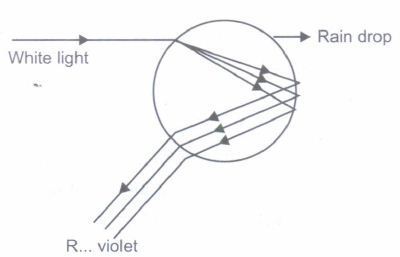
Water droplets acts as tiny prism in the sky. The sunlight when enters these tiny droplets undergo internal reflection and also refract these rays which are dispersed causing a band of seven colours called rainbow. Rainbow is always formed in the direction opposite to the sun.
22.
The iron nail will rust in test tube A because it provides the condition required for rusting, both moisture as well as air is present in it
23.
Plaster of Paris is calcium sulphate hemihydrate \((CaSO_4.{1\over2}H_2O).\)
Gypsum, when heated at a temperature of about 380 K in a kiln. loses its three-fourth water of crystallisation and changes to plaster of Paris.
Following is the reaction involved:
\(\underset{Gypsum}{CaSO_4.2H_2O}\xrightarrow {Heat} \underset{Plaster\ of\ Paris}{CaSO_4.{1\over2}H_2O}+\underset{Water}{1{1\over2}H_2O}\)
24.
(a) Both A and R are true, and R is correct explanation of the assertion.
25.
(d) If both assertion and reason are false
26.
(i) (a) The rainbow appears opposite side of the Sun in sky.
(ii) (b) Refraction, dispersion and total internal reflection are the phenomenon involved in the formation of rainbow.
(iii) (a) Tiny water droplets act as prism in formation of rainbow.
(iv) (a) The water droplets are denser than air, therefore sunlight gets refracted and then dispersed, while coming out of the water droplet.
27.
(i) (d)
(ii) (d)
(iii) (b): Bleaching powder gives chlorine on exposure to air by reacting with CO2 . \(\mathrm{CaOCl}_{2}+\mathrm{CO}_{2} \longrightarrow \mathrm{CaCO}_{3}+\mathrm{Cl}_{2}\)
(iv) (d)
\({ (v) }(\mathrm{a}): \mathrm{Ca}(\mathrm{OH})_{2}+\mathrm{Cl}_{2} \longrightarrow \mathrm{CaOCl}_{2}+\mathrm{H}_{2} \mathrm{O}\)

10th Standard CBSE Syllabus & Materials
10th Standard CBSE
CBSE 10th Social Science PS - Federalism - New Model Questions Papers Study Material - QB365 Set A
NEW10th Standard CBSE
CBSE 10th Social Science PS - Power Sharing - New Model Questions Papers Study Material - QB365 Set A
NEW10th Standard CBSE
CBSE 10th Social Science GEO - Manufacturing Industries - New Model Questions Papers Study Material - QB365 Set A
NEW10th Standard CBSE
CBSE 10th Social Science GEO - Minerals and Energy Resources - New Model Questions Papers Study Material - QB365 Set A



NCERT Books

Syllabus

Exam Pattern

Sample Question Papers

Previous year Question Papers

Important Notes

MCQ Practice test

NCERT Exemplers

Case study Questions

Image Based Questions

Passage based Questions

HOT Questions

Value Based Questions

Model Questions Papers
NCERT ( Book Back ) Questions

Assertion and Reason
Important Questions And Answers

CBSE 10th Standard CBSE Subjects
CBSE Standards



