
 100% FREE ACCESS
10th Standard CBSE Syllabus & Materials
10th Standard CBSE
CBSE 10th Social Science ECO - Globalisation and the Indian Economy - New Model Questions Papers Study Material - QB365 Set A
NEW10th Standard CBSE
CBSE 10th Social Science ECO - Money and Credit - New Model Questions Papers Study Material - QB365 Set A
NEW10th Standard CBSE
CBSE 10th Social Science ECO - Sectors of the Indian Economy - New Model Questions Papers Study Material - QB365 Set A
NEW10th Standard CBSE
CBSE 10th Social Science ECO - Development - New Model Questions Papers Study Material - QB365 Set A
NEW10th Standard CBSE
CBSE 10th Social Science PS - Outcomes of Democracy - New Model Questions Papers Study Material - QB365 Set A
NEW10th Standard CBSE
CBSE 10th Social Science PS - Gender, Religion and Caste - New Model Questions Papers Study Material - QB365 Set A

Published on: 20/10/2025
Download CBSE Class 10th Standard CBSE Science question papers, sample papers, important questions, and previous year solved papers in PDF format. Get free study materials, NCERT solutions, and exam preparation resources for Class 10th Standard CBSE Science
Questions + Answers key
Take MCQ Science Test
1.
Pancreas secretes lipase enzyme. Mr. Ayub is suffering from malfunctioning of the pancreas. Which of the following will be adversely affected in Mr. Ayub's body?
Digestion of carbohydrates
Digestion of proteins
Digestion of fats
Digestion of vitamins
2.
The correct sequence of organs in the male reproductive system for transport of sperms is
Testis \(\rightarrow\) Vas deferens \(\rightarrow\) Urethra
Testis \(\rightarrow\) Ureter \(\rightarrow\) Urethra
Testis \(\rightarrow\) Urethra \(\rightarrow\) Ureter
Testis \(\rightarrow\) Vas deferens \(\rightarrow\) Ureter
3.
Which of the following mirror is used by a dentist to examine a small cavity In a patient's teeth?
Convex mirror
Plane mirror
Concave mirror
Any spherical mirror
4.
A piece of zinc (Zn)-a reactive metal-was dropped into a test tube containing a substance. A zinc salt was formed and hydrogen gas was liberated. This is shown in the equation below.
Zn+ \(\rightarrow\) Zinc salt + H2 gas
Which of the following can be the substance that zinc was dropped into?
P. water
Q. hydrochloric acid
R. a solution of a zinc salt
Only P
Only Q
Only R
Either P or R
5.
The expressions that relate (i) Q, l and t and (ii) Q,V and W respectively are (Here, the symbols have their usual meanings)
| (i) I = Q/t | (ii) W = V/Q |
| (i) Q = I x t | (ii) W = V x Q |
| (i) Q = I/t | (ii) V = W/Q |
| (i) I = Q/t | (ii) Q = V/W |
6.
Which of these devices works due to the magnetic effect of electric current?
LED bulb
Electric bell
Electric heater
Mobile charger
7.
Which of the following in not an effect of ultraviolet radiations?
Causes skin cancer
Causes sun bum
Causes eye disease
Causes typhoid
8.
The amount of light entering the human eye is controlled by
Ciliary muscles
Pupil
Cornea
Iris
9.
The correct structural formula of butanoic acid is
-q.jpg)
-q.jpg)
-q.jpg)
-q.jpg)
10.
A 10 mm long awl pin is placed vertically in front of a concave mirror. A 5 mm long image of the awl pin is formed at 30 cm in front of the mirror. The focal length of this mirror is.
- 30 cm
- 20 cm
- 40 cm
- 60 cm
11.
In the given food chain, suppose the amount of energy at fourth trophic level is 5 kJ, what will be the energy available at the producer level?
Grass\(\longrightarrow\)Grasshopper\(\longrightarrow\)Frog\(\longrightarrow\)Snake\(\longrightarrow\)Hawk
5 kJ
50 kJ
500 kJ
5000 kJ
12.
The maleness of a child is determined by
the X chromosome in the zygote
the Y chromosome in zygote
the cytoplasm of germ cell which determines the sex.
sex is determined by chance
13.
The substance that triggers the fall of mature leaves and fruits from plants is due to
Auxin
Gibberellin
Abscissic acid
Cytokinin
14.
Equal volumes of hydrochloric acid and sodium hydroxide solutions of same concentration are mixed and the pH of the resulting solution is checked with a pH paper. What would be the colour obtained?
Red
Yellow
Yellowish green
Blue
15.
In the double displacement reaction between aqueous potassium iodide and aqueous lead nitrate, a yellow precipitate of lead iodide is formed. While performing the activity if lead nitrate is not available, which of the following can be used in place of lead nitrate?
Lead sulphate (insoluble)
Ammonium nitrate
Lead acetate
Potassium sulphate
16.
Which of the statements about the reaction below are incorrect?
2PbO(s) + C(s) \(\rightarrow\) 2Pb(s) + CO2(g)
(a) Lead is getting reduced
(b) Carbon dioxide is getting oxidized
(c) Carbon is getting oxidized
(d) Lead oxide is getting reduced.
(a) and (b)
(a) and (c)
(a), (b) and (c)
All of these
17.
A wire of given material having length l and area of cross-section A has a resistance of 4 Ω. What would be the resistance of another wire of the same material having length l/2 and area of cross-section 2A?
18.
What are the differences between the transport of materials in xylem and phloem?
19.
Draw ray diagrams to represent the nature, position and relative size of the image formed by a convex lens for the object placed:
(a) At 2F
(b) Between F1 and the optical centre O of lens
20.
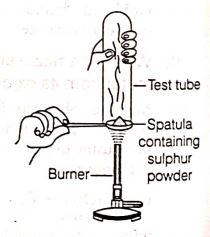
Pratyush took sulphur powder on a spatula and heated it. He collected the gas evolved by inverting a test tube over it as shown in the figure below
(a) What will be the action of gas on
(i) Dry litmus paper?
(ii) Moist litmus paper?
(b) Write a balanced chemical equation for the reaction taking place.
21.
The magnification produced by a plane mirror is +1. What does it mean?
22.
How can ethanol and ethanoic acid can be differentiated on the basis of their physical and chemical properties?
23.
Five solutions A, B, C, D and E when tested with universal indicator showed pH as 4, 1, 11, 7 and 9 respectively. Which solution is ?
(i) neutral
(ii) strongly alkaline
(iii) strongly acidic
(iv) weakly acidic
(v) weakly alkaline
Arrange the pH in increasing order of H+ion concentration.
24.
Write the balanced chemical equation for the following and identify the type of reaction in each case.
(a) Potassium bromide(aq) + Barium Iodide(aq) \(\rightarrow\) Potassium iodide(aq) + Barium bromide(s)
(b) Zinc carbonate(s) → Zinc oxide(s) + Carbon dioxide(g)
(c) Hydrogen(g) + Chlorine(g) → Hydrogen chloride(g)
(d) Magnesium(s) + Hydrochloric acid(aq) → Magnesium chloride(aq) + Hydrogen(g)
25.
What is an electric fuse? What material is selected for fuse wire?
26.
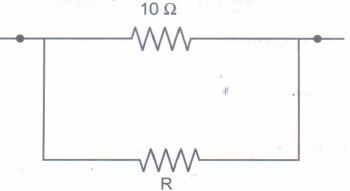
The combined resistance in the given circuit is 5\(\Omega \) . What is the value of R?
27.
State the functions of plant hormones. Name four different types of plant hormones.
28.
DDT has entered food chain. Which food habit is safer - vegetarian or non - vegetarian?
29.
List any two differences between pollination and fertilisation.
30.
List two vital functions of the human kidney.Name the procedure used in the working of artificial kidney.
31.
Balance the following chemical equation:
Fe(s) + H2O(g) \(\rightarrow\) Fe3O4(s) + H2(g)
32.
Give reasons
(i) Ventricles have thicker muscular walls than atria.
(ii) Transport system in plants is slow.
(iii) Circulation of blood in aquatic vertebrates differs from that in terrestrial vertebrates.
(iv) During the daytime, water and minerals travel faster through xylem as compared to the night.
(v) Veins have valves whereas arteries do not.
33.
(i) It would cost a man ₹ 3.50$ to buy 1.0 kWh of electrical energy from the main electricity board. His generator has a maximum power of 2.0 kW . The generator produces energy at this maximum power for 3 h . Calculate how much it would cost to buy the same amount of energy from the main electricity board.
(ii) A student boils water in an electric kettle for 20 min . Using the same mains supply, he wants to reduce the boiling time of water. To do so should he increase or decrease the length of the heating element? Justify your answer.
34.
(i) A student mixes sodium sulphate powder in barium chloride. What change would the student observe on mixing the two powder. Justify your answer and explain how he can obtained the desired change?
(ii) (a) Arrange the following metals in the increasing order reactivities.
Copper, zinc, aluminiumn and iron.
(b) List two observations you would record in your 30 minutes after adding iron filings to copper sulphate solution.
35.
(a) Why does carbon form compounds mainly by covalent bonding?
(b) List any two reasons for carbon forming a very large number of compounds.
(c) An organic acid 'X' is a liquid which often freezes during winter time in cold countries, has the molecular formula, C2H4O2. On warming it with ethanol in the presence of a few drops of concentrated sulphuric acid, a compound 'Y with a sweet smell is formed.
(i) Identify 'X' and 'Y.
(ii) Write a chemical equation for the reaction involved.
36.
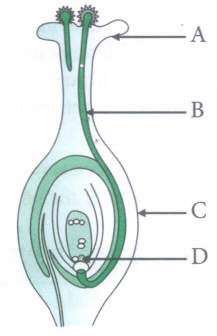
(a) Name the parts labelled as A,B,C and D in the diagram given below:
(b) What is pollination? State its significance.
(c) How does fertilisation occur in flowers? Name the parts of the floower that develop into
(i) seed, and (ii) fruit after fertilisation.
37.
(i) State Snell's law of refraction of light. Write an expression to relate refractive index of a medium with speed of light in vacuum.
(ii) The refractive index of a medium 'a' with respect to medium 'b' is 2/3 and the refractive index of medium 'b' with respect to medium 'c' is 4/3. Find the refractive index of medium 'c' with respect to medium 'a'.
38.
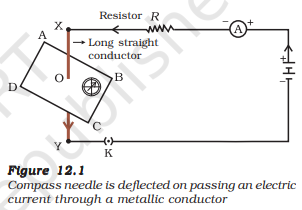
1. Take a straight thick copper wire and place it between the points X and Y in an electric circuit as shown on next page. The wire XY is kept perpendicular to the plane of paper.
2. Horizontally place a small compass near to this copper wire. See the position of its needle.
3. Pass the current through the circuit by inserting the key into the plug.
4. Observe the change in the position of the compass needle.
39.
1. Take two healthy potted plants which are nearly the same size.
2. Keep them in a dark room for three days.
3. Now place each plant on separate glass plates. Place a watch-glass containing potassium hydroxide by the side of one of the plants. The potassium hydroxide is used to absorb carbon dioxide.
4. Cover both plants with separate bell-jars as shown in Fig.
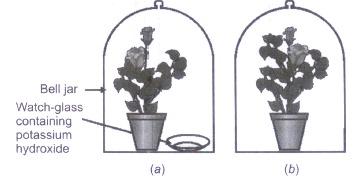
5. Use vaseline to seal the bottom of the jars to the glass plates so that the set-up is air-tight.
6. Keep the plants in sunlight for about two hours.
7 Pluck a leaf from each plant and check for the presence of starch as in the above activity.
8. Do both the leaves show the presence of the same amount of starch?
9. What can you conclude from this activity?
40.
1.Set up the apparatus as
(i) Take two test tubes, label them as A and B.
(ii) Take about 0.5 g of sodium carbonate (Na2CO3) in test tube A and about 0.5 g of sodium hydrogen carbonate (NaHCO3) in test tube B.
(iii) Add about 2 mL of dilute HCl to both the test tubes. What do you observe?
(iv) Pass the gas produced in each case through lime water (calcium hydroxide solution) as shown in Fig and record your observations.
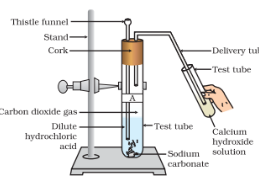
2.Take a spatula full of sodium carbonate in a test tube and add 2 mL of dilute ethanoic acid.
3.What do you observe?
4.Pass the gas produced through freshly prepared lime-water. What do you observe?
5.Can the gas produced by the reaction between ethanoic acid and sodium carbonate be identified by this test?
6.Repeat this Activity with sodium hydrogen carbonate instead of sodium carbonate.
41.
Assertion: The 200 W bulbs glows with more brightness than 100W bulbs.
Reason: A 100 watt bulb has more resistance than a 200W bulb.
Codes
(a) Both A and R are true, and R is correct explanation of the assertion.
(b) Both A and R are true, but R is not the correct explanation of the assertion.
(c) A is true, but R is false.
(d) A is false, but R is true.
42.
Assertion: In the reaction,\(\mathrm{Zn}_{(s)}+2 \mathrm{H}_{(a q)}^{+} \rightarrow \mathrm{Zn}_{(a q)}^{2+}+\mathrm{H}_{2(g)}\) ' zinc acts as an oxidising agent and H+ acts as a reducing agent.
Reason: An oxidising agent accepts electrons while a reducing agent loses electrons.
Codes
(a) Both A and R are true, and R is correct explanation of the assertion.
(b) Both A and R are true, but R is not the correct explanation of the assertion.
(c) A is true, but R is false.
(d) A is false, but R is true.
43.
Assertion:Parasitic nutritive strategy is used by a wide variety of organisms.
Reason: It means they derive nutrition from plants or animals without killing them.
Codes
(a) If both assertion and reason are true and the reason is correct explanation of assertion.
(b) If both assertion and reason are true but reason is not a correct explanation of assertion.
(c) If assertion is true and reason is false.
(d) If both assertion and reason are false.
44.
Assertion: Ethanoic acid often freezes during winter in cold climates
Reason: The melting point of pure ethanoic acid is 290 K
Codes
(a) If both assertion and reason are true and the reason is correct explanation of assertion.
(b) If both assertion and reason are true but reason is not a correct explanation of assertion.
(c) If assertion is true and reason is false.
(d) If both assertion and reason are false.
1.
(c)
Digestion of fats
2.
(a)
Testis \(\rightarrow\) Vas deferens \(\rightarrow\) Urethra
3.
(c)
Concave mirror
4.
(b)
Only Q
5.
(b)
| (i) Q = I x t | (ii) W = V x Q |
6.
(b)
Electric bell
7.
(d)
Causes typhoid
8.
(b)
Pupil
9.
(d)
10.
(b)
- 20 cm
11.
(d)
5000 kJ
12.
(b)
the Y chromosome in zygote
13.
(c)
Abscissic acid
14.
(c)
Yellowish green
15.
(b)
Ammonium nitrate
16.
(a)
(a) and (b)
17.
For first wire R1 = ρ l/A = 4Ω
Now for second wire
R2 = ρ\(\frac { l/2}{2A}\) = 1/4 ρ l/A
R2 = 1/4 R1
R2 = 1Ω
The resistance of the new wire is 1Ω.
18.
The differences between transport of materials in xylem and phloem are as follows:
| Transport in Xylem | Transport In Phloem |
| Xylem transports water and minerals in plants | Phloem transports the products of photosynthesis, amino acids and other organic substances in plants. |
| The movement of water is unidirectional in xylem. | The movement of substances can be multidirectional. |
| Major operating forces are diffusion and transpirational pull. | Energy (ATP) is required for translocation. |
| It is not influenced by metabolic inhibitors. | Phloem transport is inhibited by metabolic inhibitors. |
| It is carried out by xylem vessels and tracheids. | It is carried out by sieve tubes with the help of adjacent Companion cells. |
19.
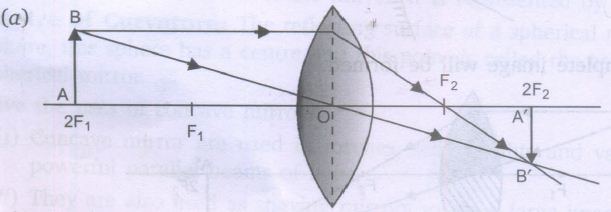
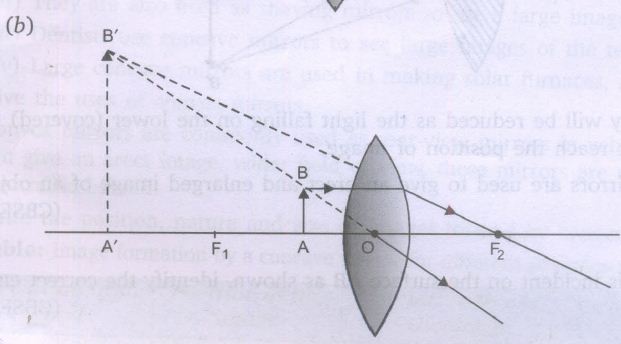
20.
(i) (a) No change in colour will take place in case of dry blue litmus.
(b) The moist blue litmus paper will change its colour to red because sulphur is non-metal and non-metal oxides are acidic in nature.
(ii) S(s) + O2(g) \(\rightarrow\) SO2(g)
SO2(g) + H2O(l) \(\rightarrow\) H2SO3 (aq)
Sulphurous acid
21.
If magnification is 1, the image size is same as that of object size.
Since, magnification is positive, the image is erect and virtual.
22.
(i) Distinction based on physical properties:
(a) Smell Ethanoic acid has a pungent smell.
Ethanol has a pleasant smell.
(b) Melting point Ethanol has lower melting point (156 K) than ethanoic acid (290 K).
(c) Physical state Ethanoic acid is solid (glacial acetic acid) in winters but ethanol is always a liquid.
(ii) Distinctions based on chemical properties:
(a) Reaction with sodium hydrogen carbonate On adding a small amount of sodium hydrogen carbonate to ethanoic acid, carbon dioxide gas is evolved with brisk effervescence. However, no such reaction noticed in case of ethanol.
CH3COOH + NaHCO3 \(\rightarrow\) CH3CO\(\bar{O}\)\(\overset{+}{N}\)a + CO2\(\uparrow\) H2O
Ethanoic acid
C2H5OH + NaHCO3 \(\rightarrow\) No reaction
Ethanol
(b) Reaction with caustic alkalies Ethanoic acid reacts with both sodium hydroxide (NaOH) and potassium hydroxide (KOH) to form corresponding salt and water. Ethanol fails to react with either of these.
CH3COOH + NaOH \(\rightarrow\) CH3CO\(\bar{O}\)\(\overset{+}{N}\)a + H2O
CH3COOH + KOH \(\rightarrow\) CH3CO\(\bar{O}\)\(\overset{+}{K}\) + H2O
23.
| Solution | A | B | C | D | E |
| pH Value | 4 | 1 | 11 | 7 | 9 |
| (i) D | (ii) C | (iii) B | (iv) A | (v) E |
pH in increasing order of H+ion concentration is C < E < D < A < B
24.
(a) 2KBr(aq) + BaI2(aq) \(\rightarrow\) 2KI + (aq) + BaBr2(s)
Type: Double displacement reaction
(b) ZnCO3(s) \(\overset{\Delta }{\rightarrow}\) ZnO(s)+CO2(g)
Type: Thermal decomposition reaction
(c) H2(g)+Cl2(g)\(\rightarrow\) 2HCl(g)
Type: Combination reaction
(d) Mg(s)+2HCl(aq)\(\rightarrow\)MgCl2(aq)+H2(g)
Type: Displacement reaction
25.
An electric fuse is a device which is used and connected in series of an electric circuit as a safety device to prevent the damage caused by short circuiting or overloading of the circuit.
Fuse wire is made up of small thin wire whose melting point is low. So that it can control the amount of current flowing through it, if an extra current passes through it then the fuse wire melts and breaks the circuit thereby preventing the damage of electric appliances. An alloy of Pb + Sn is used for the same.
26.
In parallel
\(\overset { 1 }{ \underset { { R }_{ 1 } }{ \_ \_ } } =\overset { 1 }{ \underset { { R }_{ 1 } }{ \_ \_ } } +\overset { 1 }{ \underset { { R }_{ 2 } }{ \_ \_ } } \)
hence
\(\overset { 1 }{ \underset { 5 }{ \_ \_ } } =\overset { 1 }{ \underset { 10 }{ \_ \_ } } +\overset { 1 }{ \underset { { R }_{ 2 } }{ \_ \_ } } \)
\(\overset { 1 }{ \underset { { R }_{ 2 } }{ \_ \_ } } =\overset { 1 }{ \underset { 5 }{ \_ \_ } } -\overset { 1 }{ \underset { 10 }{ \_ \_ } } \)
\(\therefore { R }_{ 2 \ = \ 10 \ \Omega }\)
27.
Phytohorrnones help in control and coordiantion in plants. The plant hormones also help in growth, vegetative growth, ripening of fruit and promotes to the stem cell divistion.
28.
Vegetarian habit is safer. Being closer to producers, less DDT will accumulate in our body. Bio magnification leads to higher level of DDT in higher trophic levels.
29.
| Pollination | Fertilisation |
| 1. It is the transfer of pollen grains from another to the stigma of a flower | 1. It is the fusion of male and female gametes. |
| 2. Pollination precedes fertilisation. | 2. Fertilisation occurs only after pollination when the pollen grains has germinated and sent the male gametes to ovule. |
| 3. Pollination carries the male gamete producing pollen grains to the female sex organ. | 3. Fertilisation brings about fusion of gametes. |
30.
(i)Removal of waste products from the blood
(ii)Maintenance of the water balance of the body
The procedure used in the working of artificial kidney is haemodialysis.
31.
3Fe(s) + 4H2O(g) →→ Fe3O4(s) + 4H2(g)
32.
(i) Ventricles have to pump blood out of the heart into various organs of the body, therefore they have thicker muscular walls than atria.
(ii) Plants do not move and have a large proportion of dead cells in many tissues. As a result, plants have low energy needs and therefore transport system in plants is slow.
(iii) Circulation of blood in aquatic vertebrates such as fishes differs from that in terrestrial vertebrates as fishes have two-chambered heart. The blood is pumped to the gills for oxygenation and is then transported to the rest of the body.
On the other hand, most terrestrial vertebrates have lungs for oxygenation of blood. The deoxygenated blood is transported to heart from where it is transported to lungs for oxygenation and is then distributed to all body parts.
(iv) During daytime, due to transpiration pull, more water is absorbed by roots that is why absorption is faster in daytime.
(v) Veins have valves whereas arteries do not because valves have to prevents the back flow of blood as blood flows in them at low pressure.
33.
(i) Given, power of generator, \(P \approx 2 \mathrm{~kW}\)
Time, t=3h
therefore Energy consumed, \(E=P \times t=2 \times 3=6 \mathrm{kWh}\)
Since, cost of 1 kWh of electrical energy is ₹ 3.50.
Therefore Cost of 6 kWh of electrical energy =6 x 350 =₹ 21.0
(ii) As we know that, Heat, \(H=t^2 R t\)
Here, I is constant, so to reduce the boiling time ( f ), R should be increased.
Since, \(R=\rho \frac{l}{A}\) or \(R \propto l\)
So, the length of the heating element should be increased.
34.
(i) When the student mixed sodium sulphate powder in barium chloride in a dry state, no change would be observed. But when he dissolved them in water, barium sulphate precipitates out and sodium chloride remains in solution. This is called a double displacement reaction.
(ii) (a) Copper < iron < zinc < aluminium
35.
(a) Carbon forms compounds mainly by covalent bonding because carbon has small size, so neither it can lose four electrons easily, because very high amount of energy will be required, nor it can gain four electrons as 6 parotons cannot hold 10 electrons. Hence, it shares four electrons forming covalent bonds.
(b) (i) Due to catenation - Self linking property
(ii) Tetravalency of carbon - Forms compounds with other elements.
(c)(i) 'X' is CH3COOH, it freezes during winter in cold countries.
'Y' is ester CH3COOC2H5
(ii) CH3COOH+ C2H5OH \(\overset { Cone.H_2SO_4 }{ \leftrightarrows } \)CH3COOC2H5 + H2O
36.
(a) A - Stigma B - Pollen tube C - Ovary D - Ovule (ovum)
(b) The transfer of pollen grains from anther (male sexual part) of a flower to the stigma part of the pistil (female sexual part) is known as pollination. Signification of pollination. It may be the cause of variation in a species of a plant.
(c) Fertilisation in flower. A pollen grain contains two male gametes. When a pollen grain falls on the stigma of the carpel, it grows a pollen tube downwards into the
style. One of the male gametes reaches the ovary through pollen tube and fuses with female gamete present in the ovule. This fertilisation of the two germ cells forms a zygote. The zygote is capable of growing into a new plant. The other male gamete fuses with two polar nuclei to form endosperm nucleus. This fusion is called triple fusion. The zygote grows into an embryo and an endosperm nucleus grows into endosperm (the food storage tissue of seed).
(i) All the eggs in the ovule present in the ovary of a flower gets fertilised by male gametes from pollen grains and grow to become seeds.
(ii) The ovary of flower develops and becomes fruit.
37.
(i) Snell's law states that, "the ratio of sine of angle of incidence to the sine of angle of refraction is constant for a given pair of media."
\(\frac { sin\quad i }{ sin\quad r } \)=Constant
The value of constant for a ray of light passing from air into a particular medium is called the refractive index of the medium.
Refractive index (of a medium) = \(\frac { Speed\quad of\quad light\quad in\quad vacuum }{ Speed\quad of\quad light\quad in\quad medium } \)
(ii) Refractive index of medium 'a' with respect to 'b'=\(_{ b }{ { n }_{ a } }=\frac { 2 }{ 3 } \)
\(_{ b }{ { n }_{ a } }=\frac { Speed\quad of\quad light\quad in\quad medium\quad 'b' }{ Speed\quad of\quad light\quad in\quad medium\quad 'a' } \)
\(=\frac { { v }_{ b } }{ { v }_{ a } } =\frac { 2 }{ 3 } \)
Refractive index of medium 'b' with respect to 'c' =\(_{ c }{ { n }_{ b } }=\frac { 4 }{ 3 } \)
\(_{ c }{ { n }_{ b } }=\frac { Speed\quad of\quad light\quad in\quad medium\quad 'c' }{ Speed\quad of\quad light\quad in\quad medium\quad 'b' } \)
\(=\frac { { v }_{ c } }{ { v }_{ b } } =\frac { 4 }{ 3 } \)
Refractive index of medium 'c' with respect to 'a' =\(_{ a }{ { n }_{ c } }=?\)
\(_{ a }{ { n }_{ c } }=\frac { Speed\quad of\quad light\quad in\quad medium\quad 'a' }{ Speed\quad of\quad light\quad in\quad medium\quad 'c' } \)
\(=\frac { { v }_{ a } }{ { v }_{ c } } =?\)
\(\because \quad \frac { { v }_{ b } }{ { v }_{ a } } =\frac { 2 }{ 3 } \Rightarrow { v }_{ a }=\frac { 3 }{ 2 } { v }_{ b }\)
\(\because \quad \frac { { v }_{ c } }{ { v }_{ b } } =\frac { 4 }{ 3 } \Rightarrow { v }_{ c }=\frac { 4 }{ 3 } { v }_{ b }\)
-S.png)
38.
Observation: As shown in the figure-the current flows from +ve to -ve and the current flows from X to Y. The needle deflects to right.
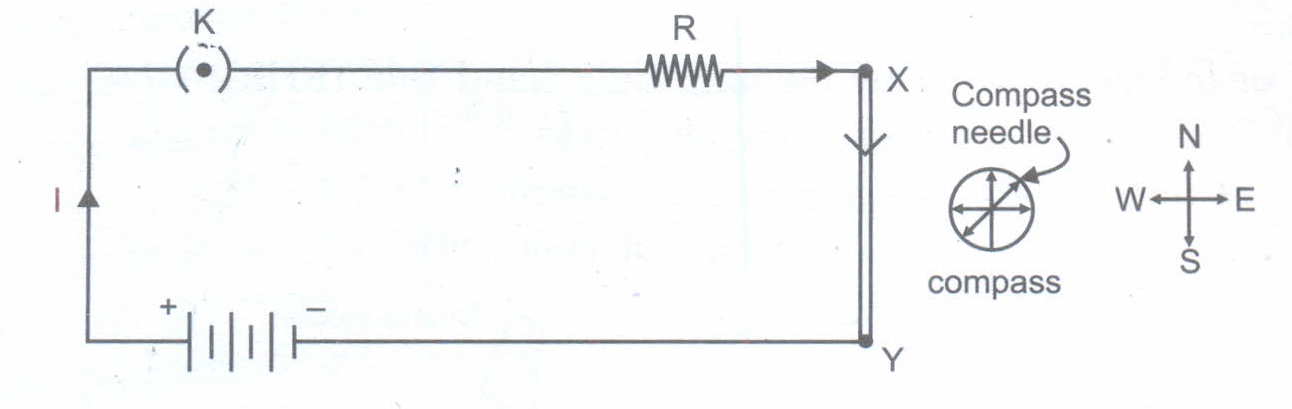
Compass needle deflects as current passes through a metallic conductor. It means that the electric current through the wire has produced a magnetic effect.
39.
Aim: To show that carbon dioxide is necessary for the starch formation.
Procedure: Take two healthy potted plants which are nearly the same size. Keep them in a dark room for three days. Now place each plant on separate glass plates. Place a watch-glass containing potassium hydroxide by the side of one of the plants. The potassium hydroxide is used to absorb carbon dioxide.
Material Required: Two potted plants, two bell shaped glass jars, watch glass, KOH, vaseline and glass plates.
Cover both plants with separate bell-jars as shown in figure below.
Use vaseline to seal the bottom of the jars to the glass plates so that the set up is air tight. Keep the plants in sunlight for about two hours. Pluck a leaf from each plant and check for the presence of starch.
Observation: The leaf of the pot with KOH will not turn blue-black because KOH absorbs carbon dioxide required for photosynthesis. The leaf of pot without KOH will show blue-black colour due to presence of CO2 which is essential for starch formation in plants.
Conclusion: Carbon dioxide is essential for starch formation.
Experimental set-up (a) with potassium hydroxide, (b) without potassium hydroxide
40.
Take a spatula full of sodium carbonate in a test tube and add 2 mL of dilute ethanoic acid. Pass the gas produced through freshly prepared lime water. Repeat the above procedure with sodium hydrogen carbonate
Following reactions take place
2CH3COOH + Na2CO3 \(\to \) 2CH3COONa + H2O+ CO2
CH3COOH + NaHCO3 \(\to \) CH3COONa + H2O + CO2
The brisk effervescence of CO2 gas is obtained which when passed through lime water turns it milky
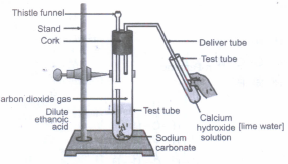
41.
(b): The resistance, \(\begin{equation} R=\frac{V^{2}}{P}, \text { i.e., } R \propto 1 / P \end{equation}\) i.e., higher is the wattage of a bulb, lesser is the resistance and so it will glow bright.
42.
\({ (d) }: \mathrm{Zn}_{(s)}+2 \mathrm{H}_{(a q)}^{+} \rightarrow \mathrm{Zn}_{(a q)}^{2+}+\mathrm{H}_{2(g)}\)
In this reaction, zinc loses electrons and so it is a reducing agent, while H+ gains electrons and so it is an oxidising agent.
43.
(a) If both assertion and reason are true and the reason is correct explanation of assertion.
44.
(a) If both assertion and reason are true and the reason is correct explanation of assertion.

10th Standard CBSE Syllabus & Materials
10th Standard CBSE
CBSE 10th Social Science PS - Federalism - New Model Questions Papers Study Material - QB365 Set A
NEW10th Standard CBSE
CBSE 10th Social Science PS - Power Sharing - New Model Questions Papers Study Material - QB365 Set A
NEW10th Standard CBSE
CBSE 10th Social Science GEO - Manufacturing Industries - New Model Questions Papers Study Material - QB365 Set A
NEW10th Standard CBSE
CBSE 10th Social Science GEO - Minerals and Energy Resources - New Model Questions Papers Study Material - QB365 Set A



NCERT Books

Syllabus

Exam Pattern

Sample Question Papers

Previous year Question Papers

Important Notes

MCQ Practice test

NCERT Exemplers

Case study Questions

Image Based Questions

Passage based Questions

HOT Questions

Value Based Questions

Model Questions Papers
NCERT ( Book Back ) Questions

Assertion and Reason
Important Questions And Answers

CBSE 10th Standard CBSE Subjects
CBSE Standards



