
 100% FREE ACCESS
10th Standard CBSE Syllabus & Materials
10th Standard CBSE
CBSE 10th Social Science ECO - Globalisation and the Indian Economy - New Model Questions Papers Study Material - QB365 Set A
NEW10th Standard CBSE
CBSE 10th Social Science ECO - Money and Credit - New Model Questions Papers Study Material - QB365 Set A
NEW10th Standard CBSE
CBSE 10th Social Science ECO - Sectors of the Indian Economy - New Model Questions Papers Study Material - QB365 Set A
NEW10th Standard CBSE
CBSE 10th Social Science ECO - Development - New Model Questions Papers Study Material - QB365 Set A
NEW10th Standard CBSE
CBSE 10th Social Science PS - Outcomes of Democracy - New Model Questions Papers Study Material - QB365 Set A
NEW10th Standard CBSE
CBSE 10th Social Science PS - Gender, Religion and Caste - New Model Questions Papers Study Material - QB365 Set A

Published on: 26/10/2025
Download CBSE Class 10th Standard CBSE Science question papers, sample papers, important questions, and previous year solved papers in PDF format. Get free study materials, NCERT solutions, and exam preparation resources for Class 10th Standard CBSE Science
Questions + Answers key
Take MCQ Science Test
1.
(i) List two constituents of Central Nervous System (CNS). How are these components protected from injuries?
(ii) Write two limitations of the use of electrical impulses.
2.
Classify the following into reflex action and involuntary actions of brain.
(i) Beating of heart.
(ii) Withdrawing your hand immediately on touching a hot object.
(iii) Change in size of pupil in response to intensity of light.
(iv) Riding a bicycle.
(v) Sneezing.
(vi) Pulling up the leg immediately when foot falls on some sharp object.
3.
Plants show tropic movement for their survival. Describe and discuss these movements in plants.
4.
Discuss the functioning of muscles under the nervous control
5.
Distinguish between voluntary and involuntary actions of our body.
6.
Write down three main differences between auxin and cytokinin.
7.
Give difference between nervous system and endocrine system.
8.
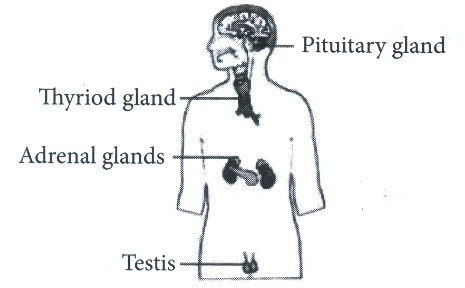
Draw a diagram showing endocrine glands in a male body. Label the following glands on it:
(i) Pituitary
(ii) Thyroid
(iii) Adrenal
(iv) Testes
9.
Describe the central nervous system in human being under the following heads:
(i) Regions included
(ii) Three functions of any one region
10.
How does chemical coordination take place in animals?
11.
How does chemical coordination occur in plants?
12.
Which signals will get disrupted in case of a spinal cord injury?
13.
What is the function of receptors in our body? Think of situations where receptors do not work properly. What problems are likely to arise?
14.
Design an experiment to demonstrate hydrotropism.
15.
How is the movement of leaves of the sensitive plant different from the movement of a shoot towards light?
16.
What are plant hormones?
17.
(i) Name the hormones that are released in human males and females when they reach puberty.
(ii) Name a gland associated with brain. Which problem is caused due to the
deficiency of the hormone released by this gland?
18.
(a) Explain any three directional movements in plants.
(b) How brain and spinal cord are protected in human?
(c) Name the master gland present in the brain
19.
Name three different types of neurons and state the function of each.
20.
Define chemotropism
21.
What are nastic and curvature movement? Give one example of each
22.
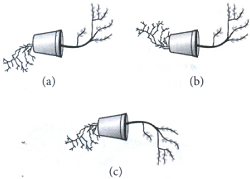
In the given figures, (a), (b) and (c), which appears more accurate and why?
23.
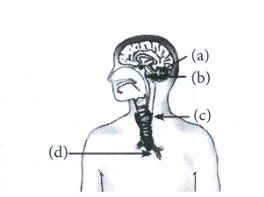
Label the endocrine glands in the given figure.
24.
Answer the following:
(a) Name the endocrine gland associated with brain?
(b) Which gland secretes digestive enzymes as well as hormones?
(c) Name the endocrine gland associated with kidneys?
(d) Which endocrine gland is present in males but not in females?
25.
Answer the following:
(a) Which hormone is responsible for the changes noticed in females at puberty?
(b) Dwarfism results due to deficiency of which hormone?
(c) Blood sugar level rises due to deficiency of which hormone?
(d) Iodine is necessary for the synthesis of which hormone?
26.
Name the plant hormones responsibility for the following:
(a) Elongation of cells
(b) Growth of stem
(c) Promotion of cell division
(d) Falling of senescent leaves.
27.
(a) Name the two hormones secreted from the follicles of thyroids.
(b) Mention one symptom of hypothyroidism and name the disorder.
1.
(i) The two important constituents of Central Nervous system (CNS) are
(a) Brain
(b) Spinal cord
For protection of both these components.
(ii) Two limitation of the use of electrical impulses.
2.
Reflex actions
(ii) Withdrawing your hand immediately on touching a hot object.
(iii) Change in size of pupil in response to intensity of light.
(v) Sneezing.
(vi) Pulling up the leg immediately when foot falls on some sharp object.
Involuntary actions
(i) Beating of heart.
(iv) Riding a bicycle is neither a reflex action nor an involuntary action. This is a voluntary action controlled by a part of the hindbrain called cerebellum.
3.
The following tropic movements are seen in plants:
(a) Geotropic Movement: The growth in a plant part in response to the gravity is called geotropic movement. Roots usually show positive geotropic movement, i.e. they grow in the direction of the gravity. Stems usually show negative geotropic movement.
(b) Phototropic Movement: The growth in a plant part in response to light is called phototropic movement. Stems usually show positive phototropic movement, while roots usually show negative phototropic movement. If a plant is kept in a container in which no sunlight reaches and a hole in the container allows some sunlight; the stem finally grows in the direction of the sunlight moving out through the hole. This happens because of a higher rate of cell division in the part of stem which is away from the sunlight. As a result, the stem bends towards the light. The increased rate of cell division is attained by increased secretion of the plant hormone auxin in the part which is away from sunlight. or
(c) Hydrotropic Movement: When roots grow in the soil, they usually grow towards the nearest source of water. This shows a positive hydrotropic movement.
(d) Thigmotropic Movement: The growth in a plant part in response to touch is called thigmotropic movement. Such movements are seen in tendrils of climbers. The tendril grows in a way so as it can coil around a support. The differential rate of cell division in different parts of the tendril happens due to action of auxin.
4.
Muscle tissues have special filaments called actin and myosin. When a muscle receives "a nerve signal a series of events is triggered in the muscle. Calcium ions enter the muscle cells. It results in actin and myosin filaments sliding towards each other and that is how a muscle contracts. Contraction in a muscle brings movement in the related organ.
5.
Voluntary actions are under the control of our will, it needs thinking. e.g. talking, walking. Involuntary actions are not under the control of our will, they are automatic. eg. salivation, heart beat.
6.
| Auxin | Cytokinin |
| 1. It promotes cell elongation. | It promotes cell division. |
| 2. It promotes the growth of stem and roots. | It promotes the growth of lateral buds. |
| 3. It can cause formation of seedless fruits. | It can retard ageing of plants. |
7.
| Endocrine System | Nervous System |
| 1. This system does not have direct connection with the organs or tissues controlled by it. |
This system has direct connection and control over the tissues or organs. |
| 2. The information of coordination is transmitted slowly. | The information is transmitted very fast. |
| 3. The effect is long lasting. | The effect is short lived. |
8.
9.
(i) Regions included in central nervous system are the brain and the spinal cord. The brain and the spinal cord. The brain is further divided into three parts - forebrain, midbrain, and hindbrain.
(ii) Three of the functions of the brain are:
Forebrain controls intelligence, learning, memory, thinking, speech, etc.
Midbrain is associated with the sense of sight and hearing.
Hindbrain controls all involuntary actions such as breathing, peristalsis, etc.
10.
Chemical coordination is performed by hormones, which are chemical messengers secreted by endocrine glands.
These hormones coordinate the activities of living organisms and also their growth.
The timing and the amount of hormones released are regulated by the feedback mechanism.
11.
Chemical coordination in plants is achieved by the plant hormones. These are the chemical compounds, which help the plant to coordinate the growth , development and responses to the environment. Plant contains the following plant hormones :
(i) Auxins helps in cell elongation.
(ii) Gibberellins helps in the growth of the stem.
(iii) Cytokinins promotes cell division.
(iv) Abscisic acid inhibits plant growth.
12.
In case of a spinal cord injury, signals for reflex actions and involuntary actions will get disrupted.
13.
The function of receptors in our body is very important as they collect informations about changes in the environment around us. Receptors then pass the same information in the form of nerve impulse to the central nervous system, where the information is processed and the ultimate response is given. Now, for example, if the gustatory receptors of our tongue do not work properly, we will not be able to know the taste of different types of foods (whether it is sweet, salty, sour or bitter, etc.)
14.
The growth of plant parts towards or away from water is called hydrotropism. It is shown in the diagram given below:
To perform the experiment,take a plant (pea seedling) in a jar filled with sand. Place a porous pot filled with warer in the wide jar. Roots of the plant will grow towards water and bend towards the water source showing positive hydrotropism.
15.
Differences between movement of leaves and movement of shoot towards light are as follows:
| Movement of Leaves(Sensitive Plant) | Movement of Shoot |
| This movement is independent of growth | This movement is dependent on growth. |
| Stimulus is touch. | Stimulus is light. |
| Movement is not directional. | Movement is directional. |
| Movement is neither away nor towards the stimulus. | Movement is towards the stimulus. |
16.
Plant hormones are organic substances produced naturally in higher plants. They control growth and other physiological functions of the plants. These are required in very small amounts.
17.
(i) Testes in males produces hormone testosterone. Ovaries in females produces hormone oestrogen
(ii) Pituitary gland present in the brain is responsible for body growth, development of bones and muscles. If the release is in excess it causes gigantism and if it is produced less then it causes dwarfism.
18.
(a) Geotropism: Movement of roots towards the earth.
Hydrotropism: Movement of roots towards water.
Phototropism: Movement of plant parts towards light
(b) Brain is protected by skull made up of bone and the spinal cord is protected by the bony vertebrae. They are further protected by the cushion layers inside and a fluid which absorbs shocks.
(c) The master gland in the brain is called pituitary gland.
19.
(a) Sensory neuron: These neurons receive signals from a sense organ.
(b) Motor neuron: These neurons send signals to a muscle or a gland.
(c) Association neuron: These neurons relay the signals between sensory neuron and motor neuron and motor neuron .
20.
When the stimulus is some chemical then movement due to response is called chemotropism.
21.
Nastic movement: It is a non-directional movement, e.g. touch me not plant drops it leaves on touching.
Curvature movement: It is a change in orientation of different parts of plant like bending, frosting, curling, e.g. curling of stem tendril
22.
Figure (a) appears more accurate because it is showing positive geotropic movement in roots and negative geotropic movement in stem.
23.
(a) Pineal gland
(b) Pituitary gland
(c) Thyroid gland
(d) Thymus
24.
(a) Pineal Gland
(b) Pancreas
(c) Adrenal gland
(d) Testis
25.
(a) Oestrogen
(b) Growth hormone
(c) Insulin
(d) Thyroxine
26.
(a) Auxin
(b) Giberellin
(c) Cytokinin
(d) Abscissic acid
27.
(a) The two hormones secreted from the follicles of thyroids are:
(i) Thyroxine
(ii) Calcitonin
(b) Symptoms of hypothyroidism are slow heart beat and low blood pressure. This disorder is called cretinism in infants or enlargement of thyroid gland causing a swelling in the neck region. This disorder is called goitre.

10th Standard CBSE Syllabus & Materials
10th Standard CBSE
CBSE 10th Social Science PS - Federalism - New Model Questions Papers Study Material - QB365 Set A
NEW10th Standard CBSE
CBSE 10th Social Science PS - Power Sharing - New Model Questions Papers Study Material - QB365 Set A
NEW10th Standard CBSE
CBSE 10th Social Science GEO - Manufacturing Industries - New Model Questions Papers Study Material - QB365 Set A
NEW10th Standard CBSE
CBSE 10th Social Science GEO - Minerals and Energy Resources - New Model Questions Papers Study Material - QB365 Set A



NCERT Books

Syllabus

Exam Pattern

Sample Question Papers

Previous year Question Papers

Important Notes

MCQ Practice test

NCERT Exemplers

Case study Questions

Image Based Questions

Passage based Questions

HOT Questions

Value Based Questions

Model Questions Papers
NCERT ( Book Back ) Questions

Assertion and Reason
Important Questions And Answers

CBSE 10th Standard CBSE Subjects
CBSE Standards



