
 100% FREE ACCESS
10th Standard CBSE Syllabus & Materials
10th Standard CBSE
CBSE 10th Social Science ECO - Globalisation and the Indian Economy - New Model Questions Papers Study Material - QB365 Set A
NEW10th Standard CBSE
CBSE 10th Social Science ECO - Money and Credit - New Model Questions Papers Study Material - QB365 Set A
NEW10th Standard CBSE
CBSE 10th Social Science ECO - Sectors of the Indian Economy - New Model Questions Papers Study Material - QB365 Set A
NEW10th Standard CBSE
CBSE 10th Social Science ECO - Development - New Model Questions Papers Study Material - QB365 Set A
NEW10th Standard CBSE
CBSE 10th Social Science PS - Outcomes of Democracy - New Model Questions Papers Study Material - QB365 Set A
NEW10th Standard CBSE
CBSE 10th Social Science PS - Gender, Religion and Caste - New Model Questions Papers Study Material - QB365 Set A

Published on: 26/10/2025
Download CBSE Class 10th Standard CBSE Science question papers, sample papers, important questions, and previous year solved papers in PDF format. Get free study materials, NCERT solutions, and exam preparation resources for Class 10th Standard CBSE Science
Questions + Answers key
Take MCQ Science Test
1.
Compare and contrast nervous and hormonal mechanisms for control and coordination in animals.
2.
How does our body respond when adrenaline is secreted into the blood?
3.
How do auxins promote the growth of a tendril around a support?
4.
Give an example of a plant hormone that promotes growth.
5.
What is the role of the brain in reflex action?
6.
How do we detect the smell of an agarbatti (incense stick)?
7.
Which part of the brain maintains posture and equilibrium of the body?
8.
What is the difference between a reflex action and walking?
9.
Select the mis-matched pair.
Adrenaline : Pituitary gland
Testosterone : Testes
Estrogen : Ovary
Thyroxin : Thyroid gland
10.
Choose the incorrect statement about insulin.
It is produced from pancreas
It regulates growth and development of the body
It regulates blood sugar level
Insufficient secretion of insulin will cause diabetes
11.
Iodine is necessary for the synthesis of which hormone?
Adrenaline
Thyroxin
Auxin
Insulin
12.
Which of the following is not associated with growth of plant?
Auxin
Gibberellins
Cytokinins
Abscissic acid
13.
The main function of abscisic acid in plants is to
Increase the length of cells
Promote cell division
Inhibit growth
Promote growth of stem
14.
The movement of shoot towards light is
Geotropism
Hydrotropism
Chemotropism
Phototropism
15.
Posture and balance of the body is controlled by
Cerebrum
Cerebellum
Medulla
Pons
16.
Which of the following statements are true about the brain?
(i) The main thinking part of brain is hind brain
(ii) Centres of hearing, smell, memory, sight, etc. are located in forebrain.
(iii) Involuntary actions like salivation, vomiting, blood pressure are controlled by the medulla in the hind brain
(iv) Cerebellum does not control posture and balance of the body
(i) and (ii)
(i), (ii) and (iii)
(ii) and (iii)
(iii) and (iv)
17.
Which of the following statements are true?
(i) Sudden action in response to something in the environment is called reflex action
(ii) Sensory neurons carry signals from spinal cord to muscles
(iii) Motor neurons carry signals from receptors to spinal cord
(iv) Impulse from a receptor to a muscle or a gland is called reflex arc
(i) and (ii)
(i) and (iii)
(i) and (iv)
(i), (ii) and (iii)
18.
Which is the correct sequence of the components of a reflex arc?
Receptors \(\rightarrow\) Muscles \(\rightarrow\) Sensory neuron \(\rightarrow\) Motor neuron \(\rightarrow\) Spinal cord
Receptors \(\rightarrow\) Motor neuron \(\rightarrow\) Spinal cord \(\rightarrow\) Sensory neuron \(\rightarrow\)Muscle
Receptors \(\rightarrow\) Spinal cord \(\rightarrow\) Sensory neuron \(\rightarrow\) Motor neuron \(\rightarrow\) Muscle
Receptors \(\rightarrow\) Sensory neuron \(\rightarrow\) Spinal cord \(\rightarrow\) Motor neuron \(\rightarrow\) Muscle
19.
In a neuron, conversion of electrical signal to a chemical signal occurs at/in
Cell body
Axonal end
Dendritic end
Axon
20.
In a synapse, chemical signal is transmitted from
Dendritic end of one neuron to axonal end of another neuron
Axon to cell body of the same neuron
Cell body to axonal end of the same neuron
Axonal end of one neuron to dendritic end of another neuron
21.
Electrical impulse travels in a neuron from
Dendrite \(\rightarrow\) axon \(\rightarrow\) axonal end \(\rightarrow\) cell body
Cell body \(\rightarrow\) dendrite \(\rightarrow\) axon \(\rightarrow\) axonal end
Dendrite \(\rightarrow\) cell body \(\rightarrow\) axon \(\rightarrow\) axonal end
Axonal end \(\rightarrow\) axon \(\rightarrow\) cell body \(\rightarrow\) dendrite
22.
The brain is responsible for
Thinking
balancing the body
regulating
All of the above
23.
The gap between two neurons is called as
Dendrite
Synapse
Axon
Impulse
24.
Which of the following is a plant hormone?
Insulin
Thyroxin
Oestrogen
Cytokinin
25.
Distinguish between voluntary and involuntary actions of our body.
26.
Write down three main differences between auxin and cytokinin.
27.
Give difference between nervous system and endocrine system.
28.
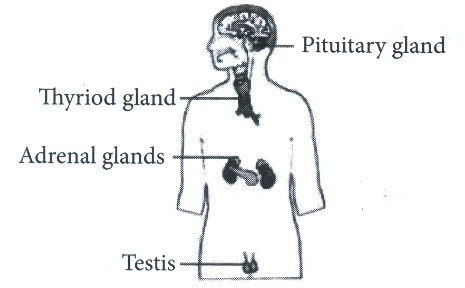
Draw a diagram showing endocrine glands in a male body. Label the following glands on it:
(i) Pituitary
(ii) Thyroid
(iii) Adrenal
(iv) Testes
29.
How do neurons transmit information?
30.
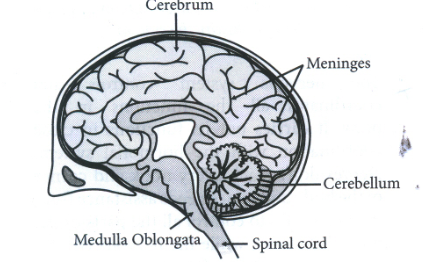
Draw a diagram of human brain and label on it the following of its parts:
(i) Cerebrum
(ii) Meninges
(iii) Medulla Oblongata
(iv) Cerebellum
31.
Describe the central nervous system in human being under the following heads:
(i) Regions included
(ii) Three functions of any one region
32.
What are tropic movements?
33.
Why is the flow of signals in a synapse from axonal end of one neuron to dendritic end of another neuron but not the reverse?
34.
Nervous and hormonal system together perform the function of control and coordination in human beings. Justify the statement with the help of an example.
35.
What are reflex actions? Give two examples. Explain a reflex arc.
36.
Name various plant hormones. Also give their physiological effects on plant growth and development.
37.
Mention one function for each of these hormones:
(a) Thyroxin
(b) Insulin
(c) Adrenaline
(d) Growth hormone
(e) Testosterone
38.
What constitutes the central and peripheral nervous systems? How are the components of central nervous system protected?
39.
Assertion: Biceps and triceps in arms helps in lifting the weight.
Reason: These muscles are involuntary
Codes
(a) If both assertion and reason are true and the reason is correct explanation of assertion.
(b) If both assertion and reason are true but reason is not a correct explanation of assertion.
(c) If assertion is true and reason is false.
(d) If both assertion and reason are false.
40.
Assertion: The motor areas control the movement of voluntary muscles.
Reason: Our hands and leg muscles are the examples of voluntary muscles.
Codes
(a) If both assertion and reason are true and the reason is correct explanation of assertion.
(b) If both assertion and reason are true but reason is not a correct explanation of assertion.
(c) If assertion is true and reason is false.
(d) If both assertion and reason are false.
41.
Assertion: The brain and spinal cord constitute the central nervous system.
Reason: As it receives the information from all other parts of the body.
Codes
(a) If both assertion and reason are true and the reason is correct explanation of assertion.
(b) If both assertion and reason are true but reason is not a correct explanation of assertion.
(c) If assertion is true and reason is false.
(d) If both assertion and reason are false.
42.
Assertion: Gustatory receptor detect taste while olfactory receptors detect smell.
Reason: Receptors helps in detecting the environment, they are present on the nerve cells.
Codes
(a) If both assertion and reason are true and the reason is correct explanation of assertion.
(b) If both assertion and reason are true but reason is not a correct explanation of assertion.
(c) If assertion is true and reason is false.
(d) If both assertion and reason are false.
43.
Answer the questions on the basis of your understanding of the following table and related studied concepts.
Study the table in which the levels of Thyroid Stimulating Hormone (TSH) in women are given and answer the questions that follow on the basis of understanding of the following paragraph and the related studied concepts.
| Age | Range Normal (mU/L) | Low (mU/L) |
| 18-29 years | 0.4-2.34 mU/L | <0.4 mU/L |
| 30-49 years | 0.4-4.0 mU/L | <0.4 mU/L |
| 50-79 years | 0.46-4.68 mU/L | <0.46 mU/L |
Women are at greater risk for developing abnormal TSH levels during menstruation, while giving birth and after going through menopause. Around 5% of women in the United States have some kinds of thyroid problem compared to 3% of men.
Despite claims that high TSH increases your risk for heart disease. A 2013 study found no link between high TSH and heart diseases. But a 2017 study showed that older women are especially at risk for developing thyroid cancer if they have high TSH levels along with thyroid nodules.
(i) A 35 year old woman has TSH level 6.03 mU/L. What change should she bring in her diet to control this level?
(ii) When do women face a greater risk of abnormal TSH level?
(iii) State the consequence of low TSH level.
(iv) Name the mineral that is responsible for synthesis of hormone secreted by thyroid gland.
44.
Study the figure given below and answer the questions that follows.
Figure given below shows that how the root and shoot of a seed develop in response to stimuli.
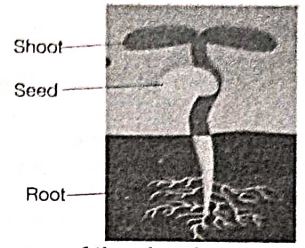
(i) State the name of the plant hormone that causes the root and shoot to develop in the way shown in the figure.
(ii) Explain how the plant hormone controls the growth response of the shoot?
(iii) ldentify the stimulus that causes the roots to grow in the direction shown in the figure and state the name of this response.
Or
(iii) ldentify the stimulus that cause the shoot to grow in the direction shown in the figure.
State the name of this response.
1.
Comparison between hormonal mechanisms are as follows :
| Basis | Hormonal Mechanism/Endocrine System | Nervous Mechanism |
| Passage of Information | It is through chemicals called hormones. | It is through electrical conduction. |
| Sensory receptors | Absent | Present |
| Rapidly | The system is comparatively slower. | The system is rapid |
| Connection | The system is not connected to target sites directly. | The systern is directly connected to every part under its control. |
| Response | The response is slow and produced by all the cells of target tissues. | The response is quick and limited to those cells that are innervated with nerves. |
| Role in growth and development | The system controls growth and development. | It has little role in growth and development. |
| Components | It consists of glands and their secretions. | It consists of neurons, nerves and nervous organs. |
| Effects | The effect of chemical message lasts for longer period. | The effect of nervous message is for short duration. |
| Action | It is Involuntary. | It can be voluntary or involuntary. |
2.
Adrenaline hormone is secreted from adrenal gland into the blood and carried to different parts of the body. At the time of emergency, danger or stress, it is released in large quantities. As a result, it causes fast beating of heart, resulting in more supply of oxygen to muscles.
The blood supply to the digestive system and skin is reduced due to contraction of muscles around small arteries in these organs. The breathing rate also increases because of the contraction of diaphragm and rib muscles. All these responses together help the animal to deal with the emergency situation.
3.
Auxins promote cell elongation and are present at the shoot tip. When tendril comes in contact with a support, auxin stimulates faster growth of the cells on the opposite sides. Thus, the tendril coils around the support.
4.
Auxin is a plant hormone, which promotes growth in plants.
5.
Brain has limited role to play in reflex action. It is an extremely quick action, which does not involve any thinking by the brain. In this type of action, the stimulus is received by the spinal cord that sends a response,e.g. coughing, The action is registered in cercbral brain just for memory.
6.
The smell reaches the neurons of olfactory receptor of nose. It causes the generation of nerve impulses that reach the olfactory lobes of the forebrain to produce the sensation of smell.
7.
Cerebellum is the part of hindbrain that maintains posture and equilibrium of the body.
8.
The differences between a reflex action and walking are as follows:
| Reflex Action | Walking |
| It is an spontaneous and involuntary response to a stimulus. | It is acquired through learning and is a voluntary response. |
| It is regulated by spinal cord. | It is coordinated by the brain (hindbrain). |
| Its intensity cannot be changed. | Its intensity can be changed. |
| It increases the survival and protective values of an organism. | It is concerned with the locomotion. |
9.
(a)
Adrenaline : Pituitary gland
10.
(b)
It regulates growth and development of the body
11.
(b)
Thyroxin
12.
(d)
Abscissic acid
13.
(c)
Inhibit growth
14.
(d)
Phototropism
15.
(b)
Cerebellum
16.
(c)
(ii) and (iii)
17.
(c)
(i) and (iv)
18.
(d)
Receptors \(\rightarrow\) Sensory neuron \(\rightarrow\) Spinal cord \(\rightarrow\) Motor neuron \(\rightarrow\) Muscle
19.
(b)
Axonal end
20.
(d)
Axonal end of one neuron to dendritic end of another neuron
21.
(c)
Dendrite \(\rightarrow\) cell body \(\rightarrow\) axon \(\rightarrow\) axonal end
22.
(d)
All of the above
23.
(b)
Synapse
24.
(d)
Cytokinin
25.
Voluntary actions are under the control of our will, it needs thinking. e.g. talking, walking. Involuntary actions are not under the control of our will, they are automatic. eg. salivation, heart beat.
26.
| Auxin | Cytokinin |
| 1. It promotes cell elongation. | It promotes cell division. |
| 2. It promotes the growth of stem and roots. | It promotes the growth of lateral buds. |
| 3. It can cause formation of seedless fruits. | It can retard ageing of plants. |
27.
| Endocrine System | Nervous System |
| 1. This system does not have direct connection with the organs or tissues controlled by it. |
This system has direct connection and control over the tissues or organs. |
| 2. The information of coordination is transmitted slowly. | The information is transmitted very fast. |
| 3. The effect is long lasting. | The effect is short lived. |
28.
29.
Information passes through neuron in the form of electro-chemical signals. These signals are called impulse.
When an impulse reaches the end of the axon it sets off the release of some chemicals. These chemicals cross the gap or the synapse and start a similar electrical impulse in a dendrite of the next neuron. A similar synapse allows the delivery of impulses from the neurons to other cells, like muscle cells or glands.
30.
31.
(i) Regions included in central nervous system are the brain and the spinal cord. The brain and the spinal cord. The brain is further divided into three parts - forebrain, midbrain, and hindbrain.
(ii) Three of the functions of the brain are:
Forebrain controls intelligence, learning, memory, thinking, speech, etc.
Midbrain is associated with the sense of sight and hearing.
Hindbrain controls all involuntary actions such as breathing, peristalsis, etc.
32.
Tropic movements are directional movements which are either towards the stimuli or away from it.
(i) Phototropism: Movement is in response to light: stem positive, root negative.
(ii) Geotropism: Movement is in response to gravity: stem negative, root positive.
(iii) Hydrotropism: Movement in response to water: stem negative, root positive.
(iv) Chemotropism: Growth of pollen tubes towards ovules.
For example, the shoot usually grows in the direction of sunlight. This is called positive phototropic movement.
33.
The flow of signals through neurons takes place in the form of specialized chemicals; called neurotransmitters. The neurotransmitters. The neurotransmitters can only enter a neuron through dedicated receptor channels. Such receptor channels a5re only present at the dendritic end but not at the axonal end. Hence, the flow of signals in a synapse happens from axonal end of one neuron to dendritic end of another neuron but not in the reverse direction.
34.
The endocrine and neural system both works together for the normal functioning of our body. The synthesis and release of certain hormones is regulated by the neural system. Also, the release of certain hormones influences the activity of nerves.
For example, hypothalamus receives neural signals from brain and releases hormones.
In case of deficiency of iodine, body produces less thyroxine hormone. Hypothalamus releases hormones to stimulate pituitary gland which further stimulates thyroid gland to secrete thyoxine.
35.
Reflex action is a special case of involuntary movement involuntary organs. When a voluntary organ is in the vicinity of a sudden danger, it is immediately pulled away from the danger to save itself. For example; when your hand touches a very hot electric iron, you move away your hand in a jerk. All of this happens in flash and your hand is saved from the imminent injury. This is an example of reflex action.
Reflex Arc: The path through which nerves signals; involved in a reflex action; travel is called the reflex arc. The following flow chart shows the flow of signal in a reflex arc. Receptor \(\rightarrow\) Sensory Neuron\(\rightarrow\) Relayneuron \(\rightarrow\) Motor neuron \(\rightarrow\) Effector (muscle) The receptor is the organ which comes in the danger zone. The sensory neurons pick signals from the receptor and send them to the relay neuron. The relay neuron is present in the spinal cord. The spinal cord sends signals to the effector via the motor neuron. The effector comes in action moves the receptor away from the danger.
36.
Various plant hormones and their effects are as follows:
(i) Auxin : Promotes cell elongation and thus promotes growth of a plant part.
(ii) Gibberellins : Promotes growth.
(iii) Cytokinin : Promotes cell division and thus promotes growth.
(iv) Abscissic acid : Inhibits growth and is responsible for shedding or older parts.
37.
(a) General metabolism.
(b) Controls blood sugar level.
(c) Prepare the body for 'fight or flight' response.
(d) Promotes growth and development.
(e) Triggers sperm production and is responsible for the development of secondary sexual characters in males.
38.
The central nervous is composed of the brain and the spinal cord. The peripheral nervous system is composed of cranial nerves, spinal nerves and the autonomous nervous system. Brain gets the maximum protection, as it is found inside the skull. Spinal cord gets protection by the vertebral column. Additionally, the brain and the spinal cord are surrounded by a system of three layers called meninges. The cerebrospinal fluid is filled between these membranes which provide a cushion against mechanical shocks.
39.
(c) If assertion is true and reason is false.
40.
(b) If both assertion and reason are true but reason is not a correct explanation of assertion.
41.
(a) If both assertion and reason are true and the reason is correct explanation of assertion.
42.
(a) If both assertion and reason are true and the reason is correct explanation of assertion.
43.
(i) The woman who has TSH 6.03 mU/L should take iodine rich diet and should use iodised salt.
(ii) Women are at a greater risk for developing abnormal TSH levels during menstruation, while giving birth and after going through menopause.
(iii) Low TSH level causes goitre disease.
(iv) Iodine is required for synthesis of thyroxine by thyroid gland.
44.
(i) Auxin causes the root and shoot to develop in the way shown in the above figure.
(ii) Auxin is synthesised at the shoot tip. When plant is exposed to unidirectional light auxin diffuses to shady side and causes all elongation. In this way, auxin controls the growth response of the shoot.
(iii) Gravity the response is called geotropism.
Or
(iii) Light the respones is called phototropism.

10th Standard CBSE Syllabus & Materials
10th Standard CBSE
CBSE 10th Social Science PS - Federalism - New Model Questions Papers Study Material - QB365 Set A
NEW10th Standard CBSE
CBSE 10th Social Science PS - Power Sharing - New Model Questions Papers Study Material - QB365 Set A
NEW10th Standard CBSE
CBSE 10th Social Science GEO - Manufacturing Industries - New Model Questions Papers Study Material - QB365 Set A
NEW10th Standard CBSE
CBSE 10th Social Science GEO - Minerals and Energy Resources - New Model Questions Papers Study Material - QB365 Set A



NCERT Books

Syllabus

Exam Pattern

Sample Question Papers

Previous year Question Papers

Important Notes

MCQ Practice test

NCERT Exemplers

Case study Questions

Image Based Questions

Passage based Questions

HOT Questions

Value Based Questions

Model Questions Papers
NCERT ( Book Back ) Questions

Assertion and Reason
Important Questions And Answers

CBSE 10th Standard CBSE Subjects
CBSE Standards



